Archive for Applied Mathematics

Leaving Certificate Results

Posted in Bad Statistics, Covid-19, Education, Maynooth with tags , , , , , , on August 23, 2024 by telescoper

Today’s the day that over 60,000 school students across Ireland are receiving their Leaving Certificate Results. As always there will be joy for some, and disappointment for others. The headline news relating to these results is that a majority (68%) of grades have been scaled up to that the distribution matches last year’s outcomes. This has meant an uplift of marks by about 7.5% on average, with the biggest changes happening at the lower levels of grade.

This artificial boost is a consequence of the generous adjustments made during the pandemic and apparent wish by the Education Minister, Norma Foley, to ensure that this year’s students are treated “fairly” compared to last year’s. Of course this argument could be made for continuing to inflate grades next year too, and the year after that. Perhaps the Minister’s plan seems to be to keep the grades high until after the next General Election, after which it will be someone else’s job to treat students “unfairly”. Anyway, you might say that marks have been scaled to maintain a Norma Distribution…

One can’t blame the students, of course, but one of the effects of this scaling is that students will be coming into third-level education with grades that imply a greater level of achievement than they actually have reached. This is a particular problem with a subject like physics where we really need students to be comfortable with certain aspects of mathematics before they start their course. It has been clear that even students with very good grades at Higher level have considerable gaps in their knowledge. This looks set to continue, and we will just have to deal with it. This issue was compounded for a while because Leaving Certificate grades were produced so late that first-year students had to start university a week late, giving less time for the remedial teaching that many of them needed. At least this year we won’t have that problem, so can plan some activities early on in the new Semester.

Anyway, out of interest – probably mine rather than yours – I delved into the statistics of Leaving Certificate results going back six years for Mathematics (at Higher A and Ordinary B) level, Physics and Applied Mathematics which I fished out of the general numbers given here.

Here are the results in a table, with the columns denoting the grade (1=high) and the numbers are percentages:

You can seen that the percentage of students getting H1 in Mathematics has increased a bit to 12.6% after falling considerably from 18.1% in 2022 to 11.2% last year (2023); note the huge increase in H1 from 2020 to 2021 (8.6% to 15.1%). Another thing worth noting is that both Physics and Applied Mathematics have declined significantly in popularity since 2019 from 7210.

Now that the results are out there will be a busy time until next Wednesday (28th) when the CAO first round offers go out. That is when those students wanting to go to university find out if they made the grades and university departments find out how many new students (if any) they will have to teach in September.

P.S. When I was a little kid we used to call a “Certificate” a “Stiff Ticket”. I just thought you would like to know that.

A Leaving Certificate Applied Maths Problem

Posted in Cute Problems, Education, mathematics with tags , on June 11, 2022 by telescoper

The 2022 cycle of Leaving Certificate examinations is under way and the first Mathematics (Ordinary and Higher) were yesterday there’s been the usual discussion about whether they are easier or harder than in the past. I won’t get involved in this except to point you to this interesting discussion based on an archive of mathematics questions, that this year the papers have more choice for students and that, apparently, the first Higher Mathematics paper had very little calculus on it.

Anyway, I was looking through some old Applied Mathematics Leaving Certificate papers, as these cover some similar ground to our first year Mathematical Physics at Maynooth, and my eye was drawn to this question from 2010 about two balls jammed in a cylinder…

I’d add another: does it matter whether or not the cylinder is smooth (as this is not specified in the question)?

Your answers are welcome through the comments box!

The Hardest Problem

Posted in Cute Problems, Education, mathematics with tags , , , on November 19, 2021 by telescoper

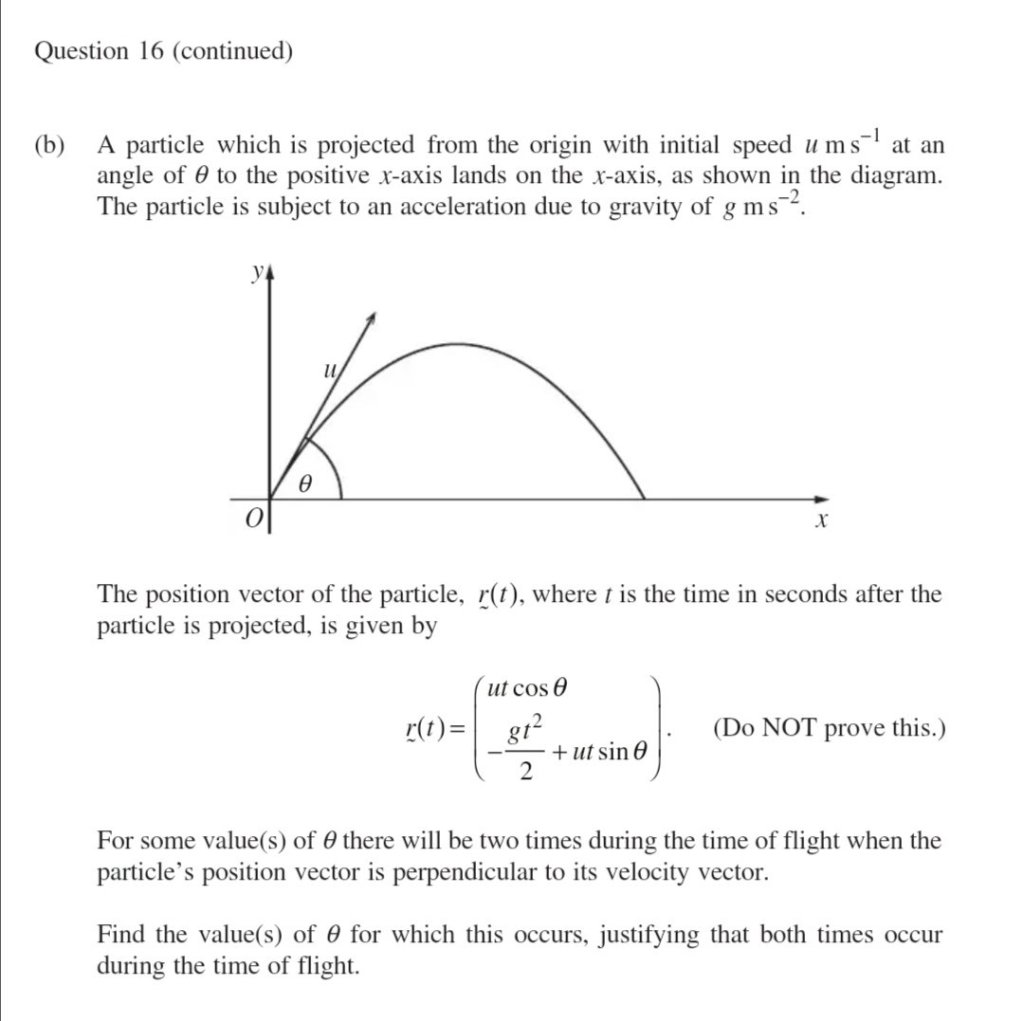
The following Question, 16(b), is deemed to have been the hardest problem on the Maths Extension 2 paper of this year’s HSC (Higher School Certificate), which I think is the Australian Equivalent of the Leaving Certificate. You might find a question like this in the Applied Mathematics paper in the Leaving Certificate actually. Since it covers topics I’ve been teaching here in Maynooth for first-year students I thought I’d share it here.

I don’t think it’s all that hard really, probably because it’s really a physics problem (which I am supposed to know how to solve), but it does cover topics that tend to be treated separately in school maths (vectors and mechanics) which may be the reason it was found to be difficult.

Anyway, answers through the comments box please. Your time starts now.

Trees, Graphs and the Leaving Certificate

Posted in Biographical, mathematics, Maynooth, The Universe and Stuff with tags , , , , , , on December 15, 2017 by telescoper

I’m starting to get the hang of some of the differences between things here in Ireland and the United Kingdom, both domestically and in the world of work.

One of the most important points of variation that concerns academic life is the school system students go through before going to University. In the system operating in England and Wales the standard qualification for entry is the GCE A-level. Most students take A-levels in three subjects, which gives them a relatively narrow focus although the range of subjects to choose from is rather large. In Ireland the standard qualification is the Leaving Certificate, which comprises a minimum of six subjects, giving students a broader range of knowledge at the sacrifice (perhaps) of a certain amount of depth; it has been decreed for entry into this system that an Irish Leaving Certificate counts as about 2/3 of an A-level for admissions purposes, so Irish students do the equivalent of at least four A-levels, and many do more than this.

There’s a lot to be said for the increased breadth of subjects undertaken for the leaving certificate, but I have no direct experience of teaching first-year university students here yet so I can’t comment on their level of preparedness.

Coincidentally, though, one of the first emails I received this week referred to a consultation about proposed changes to the Leaving Certificate in Applied Mathematics. Not knowing much about the old syllabus, I didn’t feel there was much I could add but I had a look at the new one and was surprised to see a whole `Strand’, on Mathematical Modelling with netwworks and graphs.

The introductory blurb reads:

In this strand students learn about networks or graphs as mathematical models which can be used to investigate a wide range of real-world problems. They learn about graphs and adjacency matrices and how useful these are in solving problems. They are given further opportunity to consolidate their understanding that mathematical ideas can be represented in multiple ways. They are introduced to dynamic programming as a quantitative analysis technique used to solve large, complex problems that involve the need to make a sequence of decisions. As they progress in their understanding they will explore and appreciate the use of algorithms in problem solving as well as considering some of the wider issues involved with the use of such techniques.


Among the specific topics listed you will find:

  • Minimal Spanning trees applied to problems involving optimising networks and algorithms associated with finding these (Kruskal, Prim);  
  • Bellman’s Optimality Principal to find the shortest paths in a weighted directed network, and to be able to formulate the process algebraically;
  •  Dijkstra’s algorithm to find shortest paths in a weighted directed network; etc.


For the record I should say that I’ve actually used Minimal Spanning Trees in a research context (see, e.g., this paper) and have read (and still have) a number of books on graph theory, which I find a truly fascinating subject. It seems to me that the topics all listed above  are all interesting and they’re all useful in a range of contexts, but they do seem rather advanced topics to me for a pre-university student and will be unfamiliar to a great many potential teachers of Applied Mathematics too. It may turn out, therefore, that the students will end up getting a very superficial knowledge of this very trendy subject, when they would actually be better off getting a more solid basis in more traditional mathematical methods  so I wonder what the reaction will be to this proposal!


Advanced Level Mathematics Examination, Vintage 1981

Posted in Education with tags , , , , , , on September 26, 2011 by telescoper

It’s been a while since I posted any of my old examination papers, but I wanted to put this one up before term starts in earnest. In the following you can find both papers (Paper I and Paper 2) of the Advanced Level Mathematics Examination that I sat in 1981.

Each paper is divided into two Sections: A covers pure mathematics while B encompasses applied mathematics (i.e. mechanics) and statistics. Students were generally taught only one of the two parts of Section B and in my case it was the mechanics bit that I answered in the examination. Paper I contains slightly shorter questions than Paper 2 and more of them..

Note that slide rules were allowed, but calculators had crept in by then. In fact I used my wonderful HP32-E, complete with Reverse Polish Notation. I loved it, not least because nobody ever asked to borrow it as they didn’t understand how it worked…

I also did Further Mathematics, and will post those papers in due course, but in the meantime I stress that this is just plain Mathematics.

If it looks a bit small you can use the viewer to zoom in.

I’ll be interested in comments from anyone who sat A-Level Mathematics more recently than 1981. Do you think these papers are harder than the ones you took? Is the subject matter significantly different?