Archive for astro-ph

Predicting the Future of Publishing from the Past

Posted in Open Access, The Universe and Stuff with tags , , , , on October 11, 2024 by telescoper

I was intrigued by an editorial piece from 20 years ago that was sent to me by Prof. Peter Schneider (who, among many other things, is Chair of the Euclid Consortium Editorial Board) who happens to be one of the authors. The article gives an interesting insight into the processes involved in being an Editor for the journal Astronomy and Astrophysics (A&A) at the time, and is worth reading all the way through, but I was particularly struck by Section 6.2, which makes some predictions about the future.

Here’s an excerpt:

We can even go a step further and ask the provocative question of whether we will need a peer-reviewed journal like A&A in the future. After all, in some communities, astro-ph has taken over the role of communicating new results. Is astro-ph not sufficient? A few aspects of a potentially very long answer to that question are as follows: many authors submit their manuscript to astro-ph, but only after it has been peer-reviewed, which shows that most researchers consider the peer-reviewing essential. People’s achievements are often judged by their refereed papers. Certainly at present, peer-reviewing is seen as a kind of quality stamp on manuscripts, and we are here to witness that papers are improved in the course of the refereeing process.


But what if astro-ph is supplemented by a refereeing process, essentially in the same way as the major journals do today, so that a manuscript gets a “green tick-mark” after successfully passing the reviewing stage and being “frozen”, i.e., cannot be replaced with an updated version anymore. We suspect that this is possible, although it would require a fairly large board of Editors to cope with the numbers of submissions to astro-ph, accompanied by costs that would have to be covered by someone. If this system were to replace the current journals, then one would end up with a single electronic-only astronomy journal and preprint service system. What if a paper is not passing through the refereeing stage? At present, a paper rejected by one journal can still be submitted to a second one, thus getting another chance to be published. We consider this second-chance opportunity a necessary feature for a fair peer-reviewed information flow. Hence, we would need more than one “astro-ph”-like system with different boards of editors, and this brings us back closely to a system of several electronic-only journals.

This is basically the idea behind the Open Journal of Astrophysics, which I didn’t really start thinking about until about 2010. In fact, when we were talking about setting up OJAp – about a decade after this paper was written – we did discuss the possibility of just having a “green tick-mark” on the arXiv entry. We rejected this idea in favour of the overlay concept primarily because of security concerns about who writes the tick mark into the arXiv field. I do agree with the point about having multiple platforms for such publications, however, and I have frequently argued that there should be alternatives to OJAp.

Here is another extract, from the very end of the paper:

We have taken here the role of devil’s advocate to demonstrate that issues in going electronic-only are far from being as simple and clear-cut as some open-access gurus would like us to believe. Obviously, electronic publishing is a timely and controversial issue that we will continue to consider in the coming years. The future of publication will be decided less by Boards of Directors and Editors, or by publishers, than by the community at large. With the availability of electronic-only journals, authors make their own decision on where to submit a manuscript. At present, this vote is clearly in favor of traditional journals, but as that may change we will remain open and ready to adapt.

I would hesitate to call myself a “guru” but I do think that the issues are clearer now than perhaps they were in 2004. Twenty years on, the balance is still in favour of traditional journals at least in terms of numbers of papers being published. Judging by the activity at OJAp, it may be that things may be changing…
Guest Post – by A.I. Addio

Posted in The Universe and Stuff with tags , , , , on December 6, 2022 by telescoper

Quite a few people have been playing around with a new-fangled AI tool called ChatGPT the developers of which say this:

We’ve trained a model called ChatGPT which interacts in a conversational way. The dialogue format makes it possible for ChatGPT to answer followup questions, admit its mistakes, challenge incorrect premises, and reject inappropriate requests. ChatGPT is a sibling model to InstructGPT, which is trained to follow an instruction in a prompt and provide a detailed response.

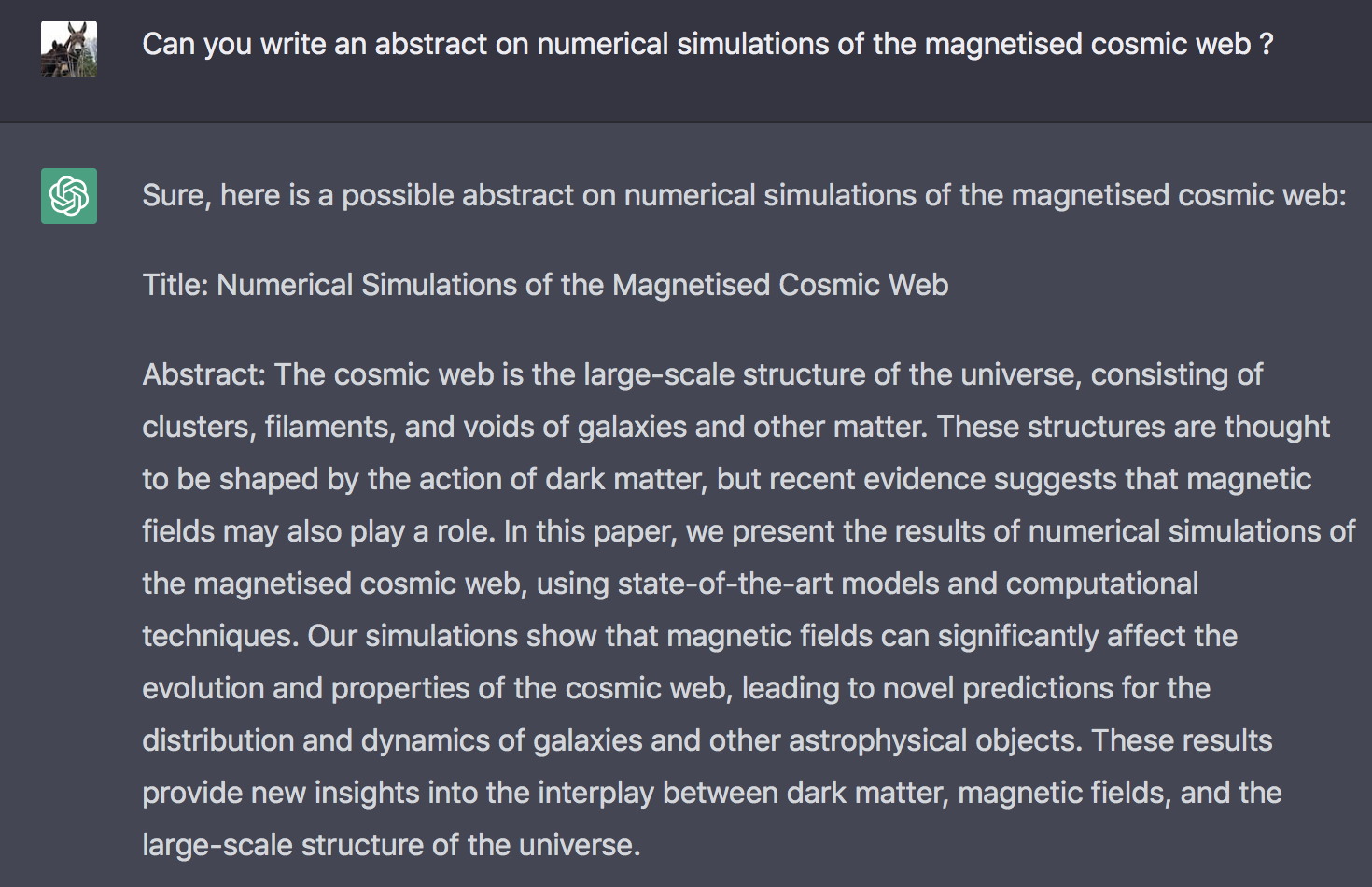
Here is an example (stolen from here) wherein this “model” creates the abstract of a scientific paper on a suggested topic:

This makes me wonder how many abstracts on astro-ph are actually written this way!

Please note that no papers of mine involved the use of any form of Artificial Insemination. I hope this clarifies the situation.

Another Day at the ArXiv..

Posted in Cosmic Anomalies, The Universe and Stuff with tags , , , , , , , on October 8, 2009 by telescoper

Every now and again I remember that this is supposed to be some sort of science blog. This happened again this morning after three hours of meetings with my undergraduate project students. Dealing with questions about simulating the cosmic microwave background, measuring the bending of light during an eclipse, and how to do QCD calculations on a lattice reminded me that I’m supposed to know something about stuff like that.

Anyway, looking for something to post about while I eat my lunchtime sandwich, I turned to the estimable arXiv and turned to the section marked astro-ph, and to the new submissions category, for inspiration.

I’m one of the old-fashioned types who still gets an email every day of the new submissions. In the old days there were only a few, but today’s new submissions were 77 in number, only about half-a-dozen of which seemed directly relevant to things I’m interested in. It’s always a bit of a struggle keeping up and I often miss important things. There’s no way I can read as widely around my own field as I would like to, or as I used to in the past, but that’s the information revolution for you…

Anyway, the thing that leapt out at me first was an interesting paper by Dikarev et al (accepted for publication in the Astrophysical Journal) that speculates about the possibility that dust grains in the solar system might be producing emission that messes up measurements of the cosmic microwave background, thus possibly causing the curious cosmic anomalies seen by WMAP I’ve blogged about on more than one previous occasion.

Their abstract reads:

Analyses of the cosmic microwave background (CMB) radiation maps made by the Wilkinson Microwave Anisotropy Probe (WMAP) have revealed anomalies not predicted by the standard inflationary cosmology. In particular, the power of the quadrupole moment of the CMB fluctuations is remarkably low, and the quadrupole and octopole moments are aligned mutually and with the geometry of the Solar system. It has been suggested in the literature that microwave sky pollution by an unidentified dust cloud in the vicinity of the Solar system may be the cause for these anomalies. In this paper, we simulate the thermal emission by clouds of spherical homogeneous particles of several materials. Spectral constraints from the WMAP multi-wavelength data and earlier infrared observations on the hypothetical dust cloud are used to determine the dust cloud’s physical characteristics. In order for its emissivity to demonstrate a flat, CMB-like wavelength dependence over the WMAP wavelengths (3 through 14 mm), and to be invisible in the infrared light, its particles must be macroscopic. Silicate spheres from several millimetres in size and carbonaceous particles an order of magnitude smaller will suffice. According to our estimates of the abundance of such particles in the Zodiacal cloud and trans-neptunian belt, yielding the optical depths of the order of 1E-7 for each cloud, the Solar-system dust can well contribute 10 microKelvin (within an order of magnitude) in the microwaves. This is not only intriguingly close to the magnitude of the anomalies (about 30 microKelvin), but also alarmingly above the presently believed magnitude of systematic biases of the WMAP results (below 5 microKelvin) and, to an even greater degree, of the future missions with higher sensitivities, e.g. PLANCK.

I haven’t read the paper in detail yet, but will definitely do so. In the meantime I’d be interested to hear the reaction to this claim from dusty experts!

Of course we know there is dust in the solar system, and were reminded of this in spectacular style earlier this week by the discovery (by the Spitzer telescope) of an enormous new ring around Saturn.

That tenuous link gives me an excuse to include a gratuitous pretty picture:

It may look impressive, but I hope things like that are not messing up the CMB. Has anyone got a vacuum cleaner?