Archive for astronomy

The Sketch Process

Posted in Art, Education, The Universe and Stuff with tags , , , , , , , , , on August 25, 2010 by telescoper

It’s pouring with rain so, rather than set off home and get drenched, I thought I’d spend a few minutes on the blog and hope that the deluge dies down before I leave. Knowing my luck it will probably get worse.

Anyway, I thought I’d put together a short item on the theme of sketching. This is quite a strange subject for me to pick because drawing is something I’m completely useless at, but I hope you’ll bear with me and hopefully it will make some sense in the end.

What  spurred me on to think about it was the exhibit I’ve been involved with for the forthcoming Architecture Biennale in Venice as part of a project called Beyond Entropy organized by the Architectural Association School of Architecture. Unfortunately, although I’d originally planned to attend I can’t be there for the opening Symposium, but I hope it turns out to be as successful event as it promises to be!

Anyway, in the course of this project I came across this image of the Moon as drawn by Galileo

This led to an interesting discussion about the role of drawings like this in science. Of course  the use of sketches for the scientific representation of images has been superseded by photographic techniques, initially using film and more recently by digital techniques. The advantage of these methods is that they are quicker and also more “objective”. However, there are still many amateur astronomers who make drawings of the Moon as well as objects such as Jupiter and Saturn (which Galileo also drew). Moreover there are other fields in which experienced practioners continue to use pencil drawings in preference to photographic techniques. Archaeology provides many good examples, e.g.

The reason sketching still has a role in such fields is not that it can compete with photography for accuracy or objectivity but that there’s something about the process of sketching that engages the sketcher’s brain in a  way that’s very different from taking a photograph. The connection between eye, brain and hand seems to involve a cognitive element that is extremely useful in interpreting notes at a later date. In fact it’s probably their very subjectivity that makes them useful.  A thicker stroke of the pencil, or deliberately enhanced shading, or leaving out seemingly irrelevant detail, can help pick out  features that seem to the observer to be of particular significance. Months later when you’re trying to write up what you saw from your notes, those deliberate interventions against objectivity will take you back to what you  saw with your mind, not just with your eyes.

It doesn’t even matter whether or not you can draw well. The point isn’t so much to explain to other people what you’ve seen, but to record your own interaction with the object you’ve sketched in a way that allows you to preserve something more than a surface recollection.

You might think this is an unscientific thing to do, but I don’t think it is. The scientific process involves an interplay between objective reality and theoretical interpretation and drawing can be a useful part of this discourse. It’s as if the pencil allows the observer to interact with what is observed, forming a closer bond and probably a deeper level of understanding patterns and textures. I’m not saying it replaces a purely passive recording method like photography, but it can definitely help it.

I have not a shred of psychological evidence to back this up, but I’d also assert that sketching is very good for the learning process too.  Nowadays we tend to give out handouts of diagrams involved in physics, whether they relate to the design of apparatus or the geometrical configuration of a physical system. There’s a reason for doing this – they take a long time to draw and there’s a likelihood students will make mistakes copying them down. However, I’ve always  found that the only way to really take in what a diagram is saying is to try to draw it again myself. Even if the level of draftsmanship is worse, the level of understanding is undoubtedly better.Merely looking at someone else’s representation of something won’t give your brain as a good a feeling for what it is trying to say  as you would get if you tried to draw it yourself.

Perhaps what happens is that simply looking at a diagram only involves the connection between eye and brain. Drawing a copy requires also the connection between brain and hand. Maybe  this additional connection brings in additional levels of brain functionality. Sketching iinvolves your brain in an interaction that is different from merely looking.

The problem with excessive use of handouts – and this applies not only to figures  but also to lecture notes – is that they turn teaching into a very passive process. Taking notes in your own hand, and supplementing them with your own sketches – however scribbly and incomprehensible they may appear to other people – is  a much more active way to learn than collecting a stack of printed notes and meticulously accurate diagrams. And if it was good enough for Galileo, it should good enough for most of us!

Now it’s stopped raining so I’m off home!


Share/Bookmark

Publish or be Damned

Posted in Science Politics, The Universe and Stuff with tags , , , , , , , , , on August 23, 2010 by telescoper

For tonight’s post I thought I’d compose a commentary on a couple of connected controversies suggested by an interestingly provocative piece by Nigel Hawkes in the Independent this weekend entitled Peer Review journals aren’t worth the paper they’re written on. Here is an excerpt:

The truth is that peer review is largely hokum. What happens if a peer-reviewed journal rejects a paper? It gets sent to another peer-reviewed journal a bit further down the pecking order, which is happy to publish it. Peer review seldom detects fraud, or even mistakes. It is biased against women and against less famous institutions. Its benefits are statistically insignificant and its risks – academic log-rolling, suppression of unfashionable ideas, and the irresistible opportunity to put a spoke in a rival’s wheel – are seldom examined.

In contrast to many of my academic colleagues I largely agree with Nigel Hawkes, but I urge you to read the piece yourself to see whether you are convinced by his argument.

I’m not actually convinced that peer review is as biased as Hawkes asserts. I rather think that the strongest argument against  the scientific journal establishment  is the ruthless racketeering of the academic publishers that profit from it.  Still, I do think he has a point. Scientists who garner esteem and influence in the public domain through their work should be required to defend it our in the open to both scientists and non-scientists alike. I’m not saying that’s easy to do in the face of ill-informed or even illiterate criticism, but it is in my view a necessary price to pay, especially when the research is funded by the taxpayer.

It’s not that I think many scientists are involved in sinister activities, manipulating their data and fiddling their results behind closed doors, but that as long as there is an aura of secrecy it will always fuel the conspiracy theories on which the enemies of reason thrive. We often hear the accusation that scientists behave as if they are priests. I don’t think they do, but there are certainly aspects of scientific practice that make it appear that way, and the closed world of academic publishing is one of the things that desperately needs to be opened up.

For a start, I think we scientists should forget academic journals and peer review, and publish our results directly in open access repositories. In the old days journals were necessary to communicate scientific work. Peer review guaranteed a certain level of quality. But nowadays it is unnecessary. Good work will achieve visibility through the attention others give it. Likewise open scrutiny will be a far more effective way of identifying errors than the existing referee process. Some steps will have to be taken to prevent abuse of the access to databases and even then I suspect a great deal of crank papers will make it through. But in the long run, I strongly believe this is the only way that science can develop in the age of digital democracy.

But scrapping the journals is only part of the story. I’d also argue that all scientists undertaking publically funded research should be required to put their raw data in the public domain too. I would allow a short proprietary period after the experiments, observations or whatever form of data collection is involved. I can also see that ethical issues may require certain data to be witheld, such as the names of subjects in medical trials. Issues will also arise when research is funded commercially rather than by the taxpaper. However, I still maintain that full disclosure of all raw data should be the rule rather than the exception. After all, if it’s research that’s funded by the public, it is really the public that owns the data anyway.

In astronomy this is pretty much the way things operate nowadays, in fact. Maybe stargazers have a more romantic way of thinking about scientific progress than their more earthly counterparts, but it is quite normal – even obligatory for certain publically funded projects – for surveys to release all their data. I used to think that it was enough just to publish the final results, but I’ve become so distrustful of the abuse of statistics throughout the field that I think it is necessary for independent scientists to check every step of the analysis of every major result. In the past it was simply too difficult to publish large catalogues in a form that anyone could use, but nowadays that is simply no longer the case. Astronomers have embraced this reality, and it is liberated them.

To give a good example of the benefits of this approach, take the Wilkinson Microwave Anisotropy Probe (WMAP) which released full data sets after one, three, five and seven years of operation. Scores of groups around the world have done their best to find glitches in the data and errors in the analysis without turning up anything particularly significant. The standing of the WMAP team is all the higher for having done this, although I don’t know whether they would have chosen to had they not been required to do so under the terms of their funding!

In the world of astronomy research it’s not at all unusual to find data for the object or set of objects you’re interested in from a public database, or by politely asking another team if they wouldn’t mind sharing their results. And if you happen to come across a puzzling result you suspect might be erroneous and want to check the calculations, you just ask the author for the numbers and, generally speaking, they send the numbers to you. A disagreement may ensue about who is right and who is wrong, but that’s the way science is supposed to work.  Everything must be open to question. It’s often a chaotic process, but it’s a process all the same, and it is one that has servedus incredibly well.

I was quite surprised recently to learn that this isn’t the way other scientific disciplines operate at all. When I challenged the statistical analysis in a paper on neuroscience recently, my request to have a look at the data myself was greeted with a frosty refusal. The authors seemed to take it as a personal affront that anyone might have the nerve to question their study. I had no alternative but to go public with my doubts, and my concerns have never been satisfactorily answered. How many other examples are there wherein application of the scientific method has come to a grinding halt because of compulsive secrecy? Nobody likes to have their failings exposed in public, and I’m sure no scientists likes see an error pointed out, but surely it’s better to be seen to have made an error than to maintain a front that perpetuates the suspicion of malpractice?

Another, more topical, example concerns the University of East Anglia’s Climatic Research Unit which was involved in the Climategate scandal and which has apparently now decided that it wants to share its data. Fine, but I find it absolutely amazing that such centres have been able to get away with being so secretive in the past. Their behaviour was guaranteed to lead to suspicions that they had something to hide. The public debate about climate change may be noisy and generally ill-informed but it’s a debate we must have out in the open.

I’m not going to get all sanctimonious about `pure’ science nor am I going to question the motives of  individuals working in disciplines I know very little about. I would, however, say that from the outside it certainly appears that there is often a lot more going on in the world of academic research than the simple quest for knowledge.

Of course there are risks in opening up the operation of science in the way I’m suggesting. Cranks will probably proliferate, but we’ll no doubt get used to them- I’m a cosmologist and I’m pretty much used to them already! Some good work may find it a bit harder to be recognized. Lack of peer review may mean more erroneous results see the light of day. Empire-builders won’t like it much either, as a truly open system of publication will be a great leveller of reputations. But in the final analysis, the risk of sticking to our arcane practices is far higher. Public distrust will grow and centuries of progress may be swept aside on a wave of irrationality. If the price for avoiding that is to change our attitude to who owns our data, then it’s a price well worth paying.


Share/Bookmark

The Next Decade of Astronomy?

Posted in Science Politics, The Universe and Stuff with tags , , , , , , , on August 14, 2010 by telescoper

I feel obliged to pass on the news that the results of the Decadal Review of US Astronomy were announced yesterday. There has already been a considerable amount of reaction to what the Review Panel (chaired by the esteemed Roger Blandford) came up with from people much more knowledgeable about observational astronomy and indeed US Science Politics, so I won’t try to do a comprehensive analysis here. I draw your attention instead to the report itself  (which you can download in PDF form for free)  and Julianne Dalcanton’s review of, and comments on, the Panel’s conclusions about the priorities for  space-based and ground-based astronomy for the next decade or so over on Cosmic Variance.  There’s also a piece by Andy Lawrence over on The e-Astronomer’s blog. I’ll just mention that Top of the Pops for space-based astronomy is the Wide-Field Infrared Survey Telescope (WFIRST) which you can read a bit more about here, and King of the Castle for the ground-based programme is the Large Synoptic Survey Telescope (LSST). Both of these hold great promise for the area I work in – cosmology and extragalactic astrophysics – so I’m pleased to see our American cousins placing such a high priority on them. The Laser Interferometer Space Antenna (LISA), which is designed to detect gravitational waves, also did very well, which is great news for Cardiff’s Gravitational Physics group.

It will be interesting to see what effect – if any – these priorities have on the ranking of corresponding projects this side of the Atlantic. Some of the space missions involved in the Decadal Review in fact depend on both NASA and ESA so there clearly will be a big effect on such cases. For example, the proposed International X-ray Observatory (IXO) did less well than many might have anticipated, with clear implications for  Europe (including the UK).  The current landscape  of X-ray astronomy is dominated by Chandra and XMM, both of which were launched in 1999 and which are both nearing the end of their operational lives. Since X-ray astronomy can only be done from space, abandoning IXO would basically mean the end of the subject  as we know it, but the question is how to bridge the  the gap between the end of these two missions and the start of IXO even if it does go ahead but not until long after 2020? Should we keep X-ray astronomers on the payroll twiddling their thumbs for the next decade when other fields are desperately short of manpower for science exploitation?

On a more general level, it’s not obvious how we should react when the US gives a high priority to a given mission anyway. Of course, it gives us confidence that we’re not being silly when very smart people across the Pond endorse missions and facilities similar to ones we are considering over here. However, generally speaking the Americans tend to be able to bring missions from the drawing board to completion much faster than we can in Europe. Just compare WMAP with Planck, for instance. Trying to compete with the US, rather than collaborate, seems likely to ensure only that we remain second best. There’s an argument, therefore, for Europe having a programme that is, in some respects at least, orthogonal to the United States; in matters where we don’t collaborate, we should go for facilities that complement rather than compete with those the Americans are building.

It’s all very well talking of priorities in the UK but we all know that the Grim Reaper is shortly going to be paying a visit to the budget of the  agency that administers funding for our astronomy, STFC. This organization went through a financial crisis all of its very own in 2007 from which it is still reeling. Now it has to face the prospect of further savage cuts. The level of “savings” being discussed  – at least 25%  -means that the STFC management must be pondering some pretty drastic measures, even pulling out of the European Southern Observatory (which we only joined in 2002). The trouble is that most of the other ground-based astronomical facilities used by UK astronomers have been earmarked for closure, or STFC has withdrawn from them. Britain’s long history of excellence in ground-based astronomy now hangs in the balance. It’s scary.

I hope the government can be persuaded that STFC should be spared another big cut and I’m sure that there’s extensive lobbying going on.  Indeed, STFC has already requested input to its plans for the ongoing Comprehensive Spending Review (CSR). With this in mind, the Royal Astronomical Society has produced a new booklet designed to point out the  relevance of astronomy to wider society. However I can’t rid from my mind the memory a certain meeting in London in 2007 at which the STFC Chief Executive revealed the true scale of STFC’s problems. He predicted that things would be much worse at the next CSR, i.e. this one. And that was before the Credit Crunch, and the consequent arrival of a new government swinging a very large axe. I wish I could be optimistic but, frankly, I’m not.

When the CSR is completed then STFC will have yet again to do another hasty re-prioritisation. Their Science Board has clearly been preparing:

… Science Board discussed a number of thought provoking scenarios designed to explore the sort of issues that the Executive may be confronted with if there were to be a significant funding reduction as a result of the 2010 comprehensive spending review settlement. As a result of these deliberations Science Board provided the Executive with guidance on how to take forward this strategic planning.

This illustrates a big difference in the way such prioritisation exercises are carried out in the UK versus the USA. The Decadal Review described above is a high-profile study, carried out by a panel of distinguished experts, which takes detailed input from a large number of scientists, and which delivers a coherent long-term vision for the future of the subject. I’m sure not everyone agrees with their conclusions, but the vast majority respect its impartiality and level-headedness and have confidence in the overall process. Here in the UK we have “consultation exercises” involving “advisory panels” who draw up detailed advice which then gets fed into STFC’s internal panels. That bit is much like the Decadal Review. However, at least in the case of the last prioritisation exercise, the community input doesn’t seem to bear any obvious relationship to what comes out the other end. I appreciate that there are probably more constraints on STFC’s Science Board than it has degrees of freedom, but there’s no getting away from the sense of alienation and cynicism this has generated across large sections of the UK astronomy community.

The problem with our is that we always seem to be reacting to financial pressure rather than taking the truly long-term “blue-skies” view that is clearly needed for big science projects of the type under discussion. The Decadal Review, for example, places great importance on striking a balance between large- and small-scale experiments. Here we tend slash the latter because they’re easier to kill than the former. If this policy goes on much longer, in the long run we’ll end up a with few enormous expensive facilities but none of the truly excellent science that can be done from using smaller kit.  A crucial aspect of this that that science seems to have been steadily relegated in importance in favour of technology ever since the creation of STFC.  This must be reversed. We need a proper strategic advisory panel with strong scientific credentials that stands outside the existing STFC structure but which has real influence on STFC planning, i.e. one which plays the same role in the UK as the Decadal Review does in the States.

Assuming, of course, that there’s any UK astronomy left in the next decade…

A Sonnet of Significance

Posted in Poetry, The Universe and Stuff with tags , , , on August 3, 2010 by telescoper

Inspired by Dennis Overbye’s nice article in the New York Times about the plethora of false detections in physics and astronomy, and another one in Physics World by Robert P Crease with a similar theme, I’ve decided to relaunch my campaign to become the next Poet Laureate with this Sonnet (in Petrarchean form) which I offer as an homage to John Keats. I’ve slavishly copied the rhyme scheme of one of Keats’ greatest poems, although I think I’ve made all the lines scan properly which he didn’t manage to do in the original.  Nevertheles, I’m sure that if he were alive today he’d be turning in his grave.

Much have I marvell’d at discov’ries bold
And many gushing press releases seen
But often what is “found” just hasn’t been
(Though only rather later are we told).
Be doubtful if you ever do behold
A scientific “certainty” between
The pages of a Sunday magazine;
The complex truth is rarely so extolled.
So if you are a watcher of the skies
Or particle detection is your yen,
Refrain from spreading rumour and surmise
Lest you look silly time and time again.
Two sigma peaks – so you should realise –
Are naught but noise, so hold your tongue. Amen.

Off the Main Sequence…

Posted in Biographical, The Universe and Stuff with tags , , , , , , , on July 22, 2010 by telescoper

When I was at School, one of my English teachers enjoyed setting creative writing challenges for homework. One of the things he liked to do was to give us two apparently separate topics and get us to write a short story that managed to tie them together. Although I seldom got good marks I now realise that this is quite a useful skill to develop.  Sometimes, when I’ve been at a loss for something  to blog about, I’ve taken two items from the news and tried to link them somehow. That’s also how a lot of satire works – many of the best Private Eye skits involve putting two pieces of news together in a way that’s deliberately back to front. In fact many writers have commented along similar lines,  the most famous being E. M. Forster, whose advice to a young writer was “Only Connect”.

Yesterday the news was full of stories emanating from the discovery of a very massive star, in fact the most massive one ever found.  This news also got the Jonathan Amos treatment on the  BBC science website too. I think it’s quite an interesting discovery but it  didn’t generate much enthusiasm from Lord Rees who wrote in a Guardian article

I don’t view this discovery as a big breakthrough. It’s a bit bigger than other stars of this kind that we’ve seen and it’s nice that it involves British scientists and the world’s biggest telescope. It’s a step forward, but it is not more than an incremental advance in our knowledge.

What’s interesting about this star is that it may shed some light – actually, rather a lot of light, because it’s 10,000,000 times brighter than the Sun – on the properties of very big stars as well as possibly how they form.

There was even an item on local radio last night, which reported

The biggest star ever discovered was recently found by astronomers in Sheffield.

You’d think if it was that bright and so nearby somebody in Sheffield would have noticed it long before now…

A star this big – about 300 times the mass of the Sun – operates on the same basic mechanism as the Sun but the quantitative details are very different. Its surface temperature is about 40,000 Kelvin compared to the Sun’s, which is only about 6000K, so the radiation field it generates is very much more powerful. It’s also very much larger, probably about 50 times the Sun’s radius, so there’s more surface area to radiate. It’s a very big and very bright beastie.

The name of this star is R136a1 but given its new status as media star, it really needs a better one. In fact, there’s a suggestions page here. Let me see. Overweight and prominent in the media? No Eamonn Holmes gags please.

A star is basically just a ball of hot gas which exerts pressure forces that balance the force of gravity, which tries to make it collapse, in a form of hydrostatic equilibrium. With so much mass to hold up the pressure in the centre of the star has to be very large, and it therefore has to be very hot. The energy needed to keep it hot comes from nuclear reactions that mainly burn hydrogen to make helium (as in the Sun), but the rate of these processes is sensitively dependent on the temperature and density in the star’s core. The Sun is a relatively sedate pressure-cooker that will  simmer away for billions of years. A monster like the one just found guzzles fuel at such a rate that its lifetime will only be a few million years. Like megastars in other fields, this one will live fast and die young.

Nobody really knows how big the biggest star should be. Very big stars are produce such intense radiation that radiation pressure is more important than gas pressure in supporting the star against collapse, but if the star is too big (and therefore too hot) then the radiation field will blow the star apart. This is when the so-called Eddington Limit is reached.  Where the line is drawn isn’t all that clear. The new star  suggests that it is a bit higher up the mass scale than previously thought. I think it’s interesting.

I’ve written about this star partly to make a point about how wonderful astronomy is for teaching physics. To understand how a star works you need to take into account thermal physics, gravity, nuclear physics, radiative transport and whole load of other things besides. Putting all that physics together to produce a stellar model is a great way to illustrate the much-neglected synthetic (rather than analytic) side of (astro)physical theory education. Stars are good.

Cue cheesy link to another item.

The single biggest step towards the understanding of stellar structure and evolution was the Hertzsprung-Russel diagram, or HR diagram for short, which shows that there is a Main Sequence of stars (to which the Sun belongs). Main sequence stars have luminosities and temperatures that are related to each other because they are both determined by the star’s mass. That’s because they’re all described by the same basic physics – hydrostatitic equilibrium, nuclear burning, etc – but just come in different masses. They adjust their temperature and luminosity in order to find an equilibrium configuration.

Not all stars are main sequence stars, however. There are classes of stars with different things going on and these lie in other regions of the HR diagram.

With this in mind, the Astronomy Blog has constructed an amusing career-related version of the HR diagram which I’ve reproduced here:

Instead of plotting temperature against luminosity (or, to be precise, colour against magnitude) as in the standard version this one plots academic publications against google hits, which purport to be a measure of “fame”. A traditional academic will presumably acquire fame through their publications only, thus defining a main sequence, whereas some lie off that sequence because of media work, blogging, or (perhaps) involvement in a juicy sex scandal. I don’t think fame and notoriety are distinguished in this calculation.

I know quite a few colleagues have been quietly calculating where they lie on the above diagram, as indeed have I. Vanity, you see, is very contagious. I’m not named on the version shown, but I can tell you that I’m much more famous than Andy Lawrence, who is. So there.

Space: The Final Frontier?

Posted in The Universe and Stuff with tags , , , , , , , on July 9, 2010 by telescoper

I found this on my laptop just now. Apparently I wrote it in 2003, but I can’t remember what it was for. Still, when you’ve got a hungry blog to feed, who cares about a little recycling?

It seems to be part of our nature for we humans to feel the urge  to understand our relationship to the Universe. In ancient times, attempts to cope with the vastness and complexity of the world were usually in terms of myth or legend, but even the most primitive civilizations knew the value of careful observation. Astronomy, the science of the heavens, began with attempts to understand the regular motions of the Sun, planets and stars across the sky. Astronomy also aided the first human explorations of own Earth, providing accurate clocks and navigation aids. But during this age the heavens remained remote and inaccessible, their nature far from understood, and the idea that they themselves could some day be explored was unthinkable. Difficult frontiers may have been crossed on Earth, but that of space seemed impassable.

The invention of the telescope ushered in a new era of cosmic discovery, during which we learned for the first time precisely how distant the heavenly bodies were and what they were made of.  Galileo saw that Jupiter had moons going around it, just like the Earth. Why, then, should the Earth be thought of as the centre of the Universe? The later discovery, made in the 19th Century using spectroscopy, that the Sun and planets were even made of the same type of material as commonly found on Earth made it entirely reasonable to speculate that there could be other worlds just like our own. Was there any theoretical reason why we might not be able to visit them?

No theoretical reason, perhaps, but certainly practical ones. For a start, there’s the small matter of getting “up there”. Powered flying machines came on the scene about one hundred years ago, but conventional aircraft simply can’t travel fast enough to escape the pull of Earth’s gravity. This problem was eventually solved by adapting technology developed during World War II to produce rockets of increasingly large size and thrusting power. Cold-war rivalry between the USA and the USSR led to the space race of the 1960s culminating in the Apollo missions to the Moon in the late 60s and early 70s. These missions were enormously expensive and have never been repeated, although both NASA and the European Space Agency are currently attempting to gather sufficient funds to (eventually) send manned missions to Mars.

But manned spaceflights have been responsible for only a small fraction of the scientific exploration of space. Robotic probes have been dispatched all over the Solar System. Some have failed, but at tiny fraction of the cost of manned missions. Landings have been made on the solid surfaces of Venus, Mars and Titan and probes have flown past the beautiful gas giants Jupiter, Saturn, Uranus and Neptune taking beautiful images of these bizarre frozen worlds.

Space is also a superb vantage point for astronomical observation. Above the Earth’s atmosphere there is no twinkling of star images, so even a relatively small telescope like the Hubble Space Telescope (HST) can resolve details that are blurred when seen from the ground. Telescopes in space can also view the entire sky, which is not possible from a point on the Earth’s surface. From space we can see different kinds of light that do not reach the ground: from gamma rays and X-rays produced by very energetic objects such as black holes, down to the microwave background which bathes the Universe in a faint afterglow of its creation in the Big Bang. Recently the Wilkinson Microwave Anisotropy Probe (WMAP) charted the properties of this cosmic radiation across the entire sky, yielding precise measurements of the size and age of the Universe. Planck and Herschel are pushing back the cosmic frontier as I write, and many more missions are planned for the future.

Over the last decade, the use of dedicated space observatories, such as HST and WMAP, in tandem with conventional terrestrial facilities, has led to a revolution in our understanding of how the Universe works. We are now convinced that the Universe began with a Big Bang, about 14 billion years ago. We know that our galaxy, the Milky Way, is just one of billions of similar objects that condensed out of the cosmic fireball as it expanded and cooled. We know that most galaxies have a black hole in their centre which gobbles up everything falling into it, even light. We know that the Universe contains a great deal of mysterious dark matter and that empty space is filled with a form of dark energy, known in the trade as the cosmological constant. We know that our own star the Sun is a few billion years old and that the planets formed from a disk of dusty debris that accompanied the infant star during its birth. We also know that planets are by no means rare: nearly two hundred exoplanets (that is, planets outside our Solar System) have so far been discovered. Most of these are giants, some even larger than Jupiter which is itself about 300 times more massive than Earth, but this may simply because big objects are easier to find than small ones.

But there is still a lot we still don’t know, especially about the details. The formation of stars and planets is a process so complicated that it makes weather forecasting look simple. We simply have no way of knowing what determines how many stars have solid planets, how many have gas giants, how many have both and how many have neither. In order to support life, a planet must be in an orbit which is neither too close to its parent star (where it would be too hot for life to exist) nor too far aware (where it would be too cold). We also know very little about how life evolves from simple molecules or how robust it is to the extreme environments that might be found elsewhere in our Universe. It is safe to say that we have no absolutely idea how common life is within our own Galaxy or the Universe at large.

Within the next century it seems likely that we will whether there is life elsewhere in our Solar System. We will probably also be able to figure out how many earth-like exoplanets there are “out there”. But the unimaginable distances between stars in our galaxy make it very unlikely that crude rocket technology will ever enable us to physically explore anything beyond our own backyard for the foreseeable future.

So will space forever remain the final frontier? Will we ever explore our Galaxy in person, rather than through remote observation? The answer to these questions is that we don’t know for sure, but the laws of nature may have legal loopholes (called “wormholes”) that just might allow us to travel faster than light if we ever figure out how to exploit them. If we can do it then we could travel across our Galaxy in hours rather than aeons. This will require a revolution in our understanding not just of space, but also of time. The scientific advances of the past few years would have been unimaginable only a century ago, so who is to say that it will never happen?

Ten Facts about Space Exploration

  1. The human exploration of space began on October 4th 1957 when the Soviet Union launched Sputnik the first man-made satellite. The first man in space was also a Russian, Yuri Gagarin, who completed one orbit of the Earth in the Vostok spacecraft in 1961. Apparently he was violently sick during the entire flight.
  2. The first man to set foot on the Moon was Neil Armstrong, on July 20th 1969. As he descended to the lunar surface, he said “That’s one small step for a man, one giant leap for mankind.”
  3. In all, six manned missions landed on the Moon (Apollo 11, 12, 14, 15, 16 and 17; Apollo 13 aborted its landing and returned to Earth after an explosion seriously damaged the spacecraft). Apollo 17 landed on December 14th 1972, since when no human has set foot on the lunar surface.
  4. The first reusable space vehicle was the Space Shuttle, four of which were originally built. Columbia was the first, launched in 1981, followed by Challenger in 1983, Discovery in 1984 and Atlantis in 1985.  Challenger was destroyed by an explosion shortly after takeoff in 1992, and was replaced by Endeavour. Columbia disintegrated over Texas while attempting to land in 2003.
  5. Viking 1 and Viking 2 missions landed on surface of Mars in 1976; they sent back detailed information about the Martian soil. Tests for the presence of life proved inconclusive, but there is strong evidence that Mars once had running water on its surface.
  6. The outer planets (Jupiter, Saturn, Uranus and Neptune) have been studied by numerous fly-by probes, starting with Pioneer 10 (1973) and Pioneer 11 (1974) . Voyager 1 and Voyager 2 flew past Jupiter in 1979;  Voyager 2 went on to visit Uranus (1986)  and Neptune (1989) after receiving a gravity assist from a close approach to Jupiter. These missions revealed, among other things, that all these planets have spectacular ring systems – not just Saturn. More recently, in 2004, the Cassini spacecraft launched the Huygens probe into the atmosphere of Titan. It survived the descent and sent back amazing images of the surface of Saturn’s largest moon.
  7. Sending a vehicle into deep space requires enough energy to escape the gravitational pull of the Earth. This means exceeding the escape velocity of our planet, which is about 11 kilometres per second (nearly 40,000 kilometres per hour). Even travelling at this speed, a spacecraft will take many months to reach Mars, and years to escape the Solar System.
  8. The nearest star to our Sun is Proxima Centauri, about 4.5 light years away. This means that, even travelling at the speed of light (300,000 kilometres per second) which is as fast as anything can do according to known physics, a spacecraft would take 4.5 years to get there. At the Earth’s escape velocity (11 kilometres per second), it would take over a hundred thousand years.
  9. Our Sun orbits within our own galaxy – the Milky Way – at a distance of about 30,000 light years from the centre at a speed of about 200 kilometres per second, taking about a billion years to go around. The Milky Way contains about a hundred billion stars.
  10. The observable Universe has a radius of about 14 billion light years, and it contains about as many galaxies as there are stars in the Milky Way. If every star in every galaxy has just one planet then there are approximately ten thousand million million million other places where life could exist.

The Planck Sky

Posted in The Universe and Stuff with tags , , , , , , , on July 5, 2010 by telescoper

Hot from the press today is a release of all-sky images from the European Space Agency’s Planck mission, including about a year’s worth of data. You can find a full set of high-resolution images here at the ESA website, along with a lot of explanatory text, and also here and here. Here’s a low-resolution image showing the galactic dust (blue) and radio (pink) emission concentrated in the plane of the Milky Way but extending above and below it. Only well away from the Galactic plane do you start to see an inkling of the pattern of fluctuations in the Cosmic Microwave Background that the survey is primarily intended to study.

It will take a lot of sustained effort and clever analysis to clean out the foreground contamination from the maps, so the cosmological interpretation will have to wait a while. In fact, the colour scale seems to have been chosen in such a way as to deter people from even trying to analyse the CMB component of the data contained in these images. I’m not sure that will work, however, and it’s probably just a matter of days before some ninny posts a half-baked paper on the arXiv claiming that the standard cosmological model is all wrong and that the Universe is actually the shape of a vuvuzela. (This would require only a small modification of an earlier suggestion.)

These images are of course primarily for PR purposes, but there’s nothing wrong with that. Apart from being beautiful in its own right, they demonstrate that Planck is actually working and that results it will eventually produce should be well worth waiting for!

Oh, nearly forgot to mention that the excellent Jonathan Amos has written a nice piece about this on the BBC Website too.

New light through a gravitational lens

Posted in The Universe and Stuff with tags , , , , on July 1, 2010 by telescoper

New data from the European Space Agency’s Herschel Space Observatory have just been released that shed new light on a well-known gravitational lens system involving the cluster Abell 2218. You can get more details and higher-resolution pictures from the STFC press release or from the dedicated Herschel Outreach Website, but I couldn’t resist putting this nice picture up.

Image Credit: ESA/SPIRE and HERMES Consortia

This triptych shows the region of sky around the massive galaxy cluster Abell 2218, as seen by the SPIRE instrument on Herschel and by the Hubble Space Telescope. On the far left, we have images at the three SPIRE wavelength bands (in the far-infrared part of the spectrum), while the centre image is a false-colour composite. The centre of the galaxy cluster is shown as a white cross-hair, while the large orange-yellow blob just below it is a much more distant galaxy.

On the far right you can see an optical image of the same cluster taken using the Hubble Space Telescope. Working at much shorter, optical wavelengths, the resolution here is much higher. This makes it possible to see the complicated pattern of  arcs caused by the distortion of light as it travels through the gravitational field of the cluster from background sources to the observer. The cluster acts as a gigantic optical system that produces magnified but warped images of very distant galaxies that lie behind it. It’s not designed to act as proper lens, of course, so the images it produces are deformed versions of the original, but they yield sufficient clues to work out the optical properties of the gravitational lens.

Clusters like this tend to contain lots of elliptical galaxies which are not bright in the SPIRE wavebands, so what we see with Herschel is very different from the Hubble view. What Herschel has  done in this particular case is  to reveal that this  gravitational lens produces at least one bright image in the far-infrared part of the spectrum. This is produced by a very distant galaxy which we probably would not have been able to see at all, even with Herschel, had it not been located fortuitously close to a perfect alignment with the optical axis of the Abell 2218 system. Although the image we see is distorted we can still learn a lot about the source that produced using the new data.

Science Examination Blues

Posted in Education, The Universe and Stuff with tags , , , , , on June 16, 2010 by telescoper

I woke up this morning …

.. to the 7am news on BBC Radio 3, including a story about how GCSE science examinations are not “sufficiently rigorous”. Then, on Twitter, I saw an example of an Edexcel GCSE (Multiple-choice) Physics paper.  It’s enough to make any practising physicist weep.

Most of the questions are very easy, but there’s just as many that are so sloppily put together that they  don’t make any sense at all. Take Question 1:

I suppose the answer is meant to be C, but since it doesn’t say that A is the orbit of a planet, as far as I’m concerned, it might just as well be D. Are we meant to eliminate D simply because it doesn’t have another orbit going through it?

On the other hand, the orbit of a moon around the Sun is in fact similar to the orbit of its planet around the Sun, since the orbital speed and radius of the moon around its planet are smaller than those of the planet around the Sun. At a push, therefore you could argue that A is the closest choice to a moon’s orbit around the Sun. The real thing would be something close to a circle with a 4-week wobble variation superposed.

You might say I’m being pedantic, but the whole point of exam questions is that they shouldn’t be open to ambiguities like this, at least if they’re science exams. I can imagine bright and knowledgeable students getting thoroughly confused by this question, and many of the others on the paper.

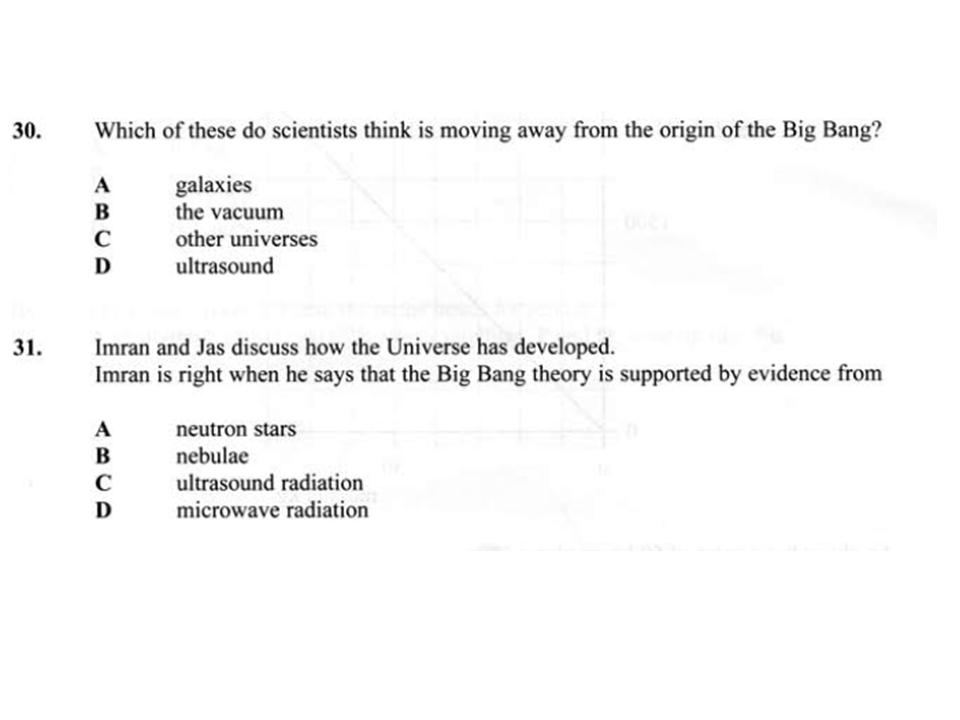
Here’s a couple more, from the “Advanced” section:

The answer to Q30 is, presumably, A. But do any scientists really think that galaxies are “moving away from the origin of the Big Bang”?  I’m worried that this implies that the Big Bang was located at a specific point. Is that what they’re teaching?

Bearing in mind that only one answer is supposed to be right, the answer to Q31 is presumably D. But is there really no evidence from “nebulae” that supports the Big Bang theory? The expansion of the Universe was discovered by observing things Hubble called “nebulae”..

I’m all in favour of school students being introduced to fundamental things such as cosmology and particle physics, but my deep worry is that this is being done at the expense of learning any real physics at all and is in any case done in a garbled and nonsensical way.

Lest I be accused of an astronomy-related bias, anyone care to try finding a correct answer to this question?

The more of this kind of stuff I see, the more admiration I have for the students coming to study physics and astronomy at University. How they managed to learn anything at all given the dire state of science education in the UK is really quite remarkable.

Alternative Galaxy Dynamics Examination

Posted in Education, The Universe and Stuff with tags , , , , on June 12, 2010 by telescoper

Time Allowed: ~1/H0

Study the following video and answer the questions below it. Or else.

1. Use the information provided about the Earth’s orbital speed to estimate the mass of the Sun. (Assume a circular orbit; 1 AU is 1.5 × 10¹¹ m.)

2. Use the information provided about the Sun’s motion around the Galactic Centre to estimate the total mass interior to the Sun’s orbit. (Assume a circular orbit and that the mass distribution is spherically symmetric; you may quote Newton’s shell theorem without proof.)

3. Use the answer to Q2, and other information provided in the video, to estimate the mean matter density in the Milky Way.

4. Use the information provided about the size, shape and stellar content of the Milky Way to estimate the mean number-density of stars interior to the Sun’s orbit.

5. Use the answers to Q3 & Q4 to estimate the mean mass-to-light ratio of the Galaxy.