Archive for astronomy

Audio Video Disco

Posted in Biographical, The Universe and Stuff with tags , , on August 26, 2009 by telescoper

2656852604_d321d54df1

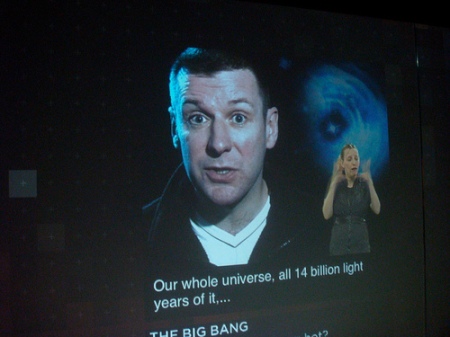
This scary picture is taken from an interactive exhibit in the Weller Galleries of the Royal Observatory at Greenwich, which opened in 2007. The exhibit, I mean, not the Royal Observatory. I remember going down there to record the video segments, but had forgotten all about it until somebody found this image on the net and drew my attention to it.

The exhibit consists of a series of display screens with various astronomical and cosmological concepts and questions on them, along with appropriate images. Visitors touch the screens to bring up the video segments in which distinguished astronomers (or me) attempt to provide explanations.

The lady to the bottom right is probably providing a sign language translation of my contribution. Or she could simply be screaming and waving her hands in terror. Wouldn’t you?

PS. If you want an explanation of the title of this blog post, I’ll translate Audio Video Disco from the latin for you. It means “I hear, I see, I learn”. Since they have to touch the screen, I might have added “I touch” which would be Tango….

Return of the Clerihews!

Posted in Poetry, The Universe and Stuff with tags , , on August 2, 2009 by telescoper

As a result of an after-dinner discussion at the meeting I attended last week, I’ve decided to put a revised cosmological clerihew collection back online. I’ve removed or edited those that caused the greatest offence, and added a few new ones.

Bernard Carr
Has gone a bit far:
His Anthropic Principle
Makes theories invincible

Sean Carroll
Has me over a barrel
Because the only plausible rhyme
Plugs his new book on Time

The mind of John Barrow
Is not very narrow:
He’s more open than me
To a variable c

Stephen Hawking
Lets a machine do the talking
But even  he can’t vocalize in-
side a black hole horizon.

Joe Silk
Is one of that ilk
Who writes far more articles
Than there are elementary particles

Matt Griffin
Has healthy salad for tiffin
But he’d probably expire
If something went wrong with SPIRE.

Peter Ade
Would never be afraid
To enter his name
In the citation game

Andy Lawrence
Would shed tears in torrents
If they finally got rid
Of the Astrogrid

Steve Maddox
Never eats haddocks
But he’s quite a dab hand
In the optical band

Ofer Lahav
Is awfully suave
But must be getting nervy
About the cancellation of funding for the Dark Energy Survey

Joao Magueijo
Was on the Today Show
Talking some shite
About travelling faster than light

Keith Mason
Said to Lord Drayson
“Can we have some more money?”
He replied “Don’t try to be funny…”

Andrei Linde
Felt rather windy
A peculiar sensation:
The result of internal inflation?

To rhyme Carlos Frenck
I’ve drawn a complete blenk
But I found in the lexicon
A good one for Mexican

When Andrew Jaffe
Plots a new graph he
Thinks fits his theory he’ll
Tell everyone at Imperial

Paul Steinhardt
Said “Lust not after beauty in thine heart”
But why he did so
I really don’t know

Feel free to offer your own through the comments box, after consulting the rules, although I remind you I don’t accept anonymous comments, even if they’re funny.

Astronomy or Astrophysics?

Posted in The Universe and Stuff with tags , , , , , on July 25, 2009 by telescoper

A chance encounter with the parent of a prospective student the other day led eventually to the question What’s the difference between Astronomy and Astrophysics? This is something I’m asked quite often so I thought I’d comment on here for those who might stumble across it. I teach a first-year course module entitled “Astrophysical Concepts”. One of the things I try to do in the first lecture is explain that difference. The Oxford English Dictionary gives the following primary definition for astronomy:

The science which treats of the constitution, relative positions, and motions of the heavenly bodies; that is, of all the bodies in the material universe outside of the earth, as well as of the earth itself in its relations to them.

Astrophysics, on the other hand, is described as

That branch of astronomy which treats of the physical or chemical properties of the celestial bodies.

So astrophysics is regarded as a subset of astronomy which is primarily concerned with understanding the properties of stars and galaxies, rather than just measuring their positions and motions. It is possible to assign a fairly precise date when astrophysics first came into use in English because, at least in the early years of the subject, it was almost exclusively associated with astronomical spectroscopy. Indeed the OED gives the following text as the first occurence of astrophysics, in 1869:

As a subject for the investigations of the astro-physicist, the examination of the luminous spectras of the heavenly bodies has proved a remarkably fruitful one

The scientific analysis of astronomical spectra began with a paper  William Hyde Wollaston in the Philosophical Transactions of the Royal Society Vol. 102, p. 378, 1802. He was the first person to notice the presence of dark bands in the optical spectrum of the Sun. These bands were subsequently analysed in great detail by Joseph von Fraunhofer in a paper published in 1814 and are now usually known as Fraunhofer lines.  Technical difficulties  made it impossible to obtain spectra of stars other than the Sun for a considerable time, but  William Huggins finally succeeded in 1864. A drawing of his pioneering spectroscope is shown below.

Meanwhile, fundamental work by Gustav Kirchoff and Robert Bunsen had been helping  to establish an understanding the spectra produced by hot gases.  The identification of features in the Sun’s spectrum  with similar lines produced in laboratory experiments led to a breakthrough in our understanding of the Universe whose importance shouldn’t be underestimated. The Sun and stars were inaccessible to direct experimental test during the 19th Century (as they are now). But spectroscopy now made it possible to gather evidence about their chemical composition as well as physical properties. Most importantly, spectroscopy provided definitive evidence that the Sun wasn’t made of some kind of exotic unknowable celestial material, but of the same kind of stuff (mainly Hydrogen) that could be studied on Earth.  This realization opened the possibility of applying the physical understanding gained from small-scale experiments to the largest scale phenomena that could be seen. The science of astrophysics was born. One of the leading journals in which professional astronomers and astrophysicists publish their research is called the Astrophysical Journal, which was founded in 1895 and is still going strong. The central importance of the (still) young field of spectroscopy can be appreciated from the subtitle given to the journal: Initially the branch of physics most important to astrophysics was atomic physics since the lines in optical spectra are produced by electrons jumping between different atomic energy levels. Spectroscopy of course remains a key weapon in the astrophysicist’s arsenal but nowadays the term is taken to mean any application of physical laws to astronomical objects. Over the years, astrophysics has gradually incorporated nuclear and particle physics as well as thermodynamics, relativity and just about every other branch of physics you can think of. I realise, however, that this  isn’t really the answer to the question that potential students want to ask. What they (probably) want to know is what is the difference between undergraduate courses called Astronomy and those called Astrophysics? The answer to this one depends very much on where you want to study. Generally speaking the differences are in fact quite minimal. You probably do a bit more theory in an Astrophysics course than an Astronomy course, for example. Your final-year project might have to be observational or instrumental if you do Astronomy, but might be theoretical in Astrophysics.  If you compare the complete list of modules to be taken, however, the difference will be very small.

Over the last twenty years or so, most Physics departments in the United Kingdom have acquired some form of research group in astronomy or astrophysics and have started to offer undergraduate degrees with some astronomical or astrophysical content. My only advice to prospective students wanting to find which course is for them is to look at the list of modules and projects likely to be offered. You’re unlikely to find the name of the course itself to be very helpful in making a choice. One of the things that drew me into astrophysics as a discipline (my current position is Professor of Theoretical Astrophysics) is that it involves such a wide range of techniques and applications, putting apparently esoteric things together in interesting ways to develop a theoretical understanding of a complicated phenomenon. I only had a very limited opportunity to study astrophysics during my first degree as I specialised in Theoretical Physics.  This wasn’t just a feature of Cambridge. The attitude in most Universities in those days was that you had to learn all the physics before applying it to astronomy. Over the years this has changed, and most departments offer some astronomy right from Year 1. I think this change has been for the better because I think the astronomical setting provides a very exciting context to learn physics. If you want to understand, say, the structure of the Sun you have to include atomic physics, nuclear physics, gravity, thermodynamics, radiative transfer and hydrostatics all at the same time. This sort of thing makes astrophysics a good subject for developing synthetic skills while more traditional physics teaching focusses almost exclusively on analytical skills. Indeed, my first-year Astrophysical Concepts course is really a course about modelling and problem-solving in physics.

Advanced Fellowships

Posted in Science Politics with tags , , , on July 11, 2009 by telescoper

This is just a quick Newsflash that UK Astronomers will be  interested in (and depressed by). My attention was drawn to it yesterday by Frazer Pearce of Nottingham.

The Science and Technology Facilities Council (STFC) has decided in its finite wisdom to cut in half the number of Advanced Fellowships (AFs) it awards each year, that is from 12 to 6, that number to cover all of Astronomy and Particle Physics.

These fellowships are awarded to researchers who do not have a permanent position but wish to pursue research, and are designed to further the careers of individuals with outstanding potential. They last 5 years – longer than the usual 2-3 year postdoctoral positions and have been for many a scientist an important stepping-stone to an academic career. A very large fraction of my colleagues who have permanent positions were awarded one of these fellowships when they were run by PPARC (including Frazer), as was I myself but, being an Oldie, mine was even pre-PPARC so was in fact given by SERC. Of course the fact that they gave me one doesn’t itself serve as much of a recommendation for continuing them, but it is worth drawing attention to the huge amount of  high quality research done in the UK by holders of these Fellowships.

A number of people have expressed to me their shock at this decision but it doesn’t surprise me at all. For one thing, it’s an open secret that STFC considers the academic community in these areas to be too large so the last thing it wants is more people getting permanent jobs through the AF route.  In any case, STFC’s prime concern is with facilities, not with scientific research.

Who needs half a dozen top class scientists when you can have Moonlite instead?

Good News, Bad News

Posted in Science Politics with tags , , on May 1, 2009 by telescoper

Further to my gloomy prognosis about the implications of the Budget for astronomy research, I’ve managed to glean the following interpretation of the outcome for the Science & Technology Facilities Council (STFC).

Just to remind you that the situation before the budget settlement was announced last week was truly dire, with  falling exchange rates leading to rises in the cost of subscriptions putting pressure on an already overstretched STFC budget. In fact, STFC actually underspent last year but was not allowed to carry the underspend forward into the tax year beginning this April so that has done nothing to help the imminent financial meltdown. The overall  shortfall for 2009-10 was estimated pre-budget to be about £80 million, meaning that £80 million of current commitments would have to be ditched if nothing was done.

First, the good news. After the budget it has emerged that the Department for Innovation, Universities and Skills (DIUS)  has taken steps to “lend” STFC money to plug the shortfall arising from exchange rate fluctuations. This means the actual shortfall is not going to be as large as the previous estimate.

Now the bad news. There is no new money for STFC,  and there is consequently still a serious gap in the finances. There will have to be about £20 million savings this financial year (against current commitment) and about £30 million next year. Not as bad as £80 million, but still very tough.

At this moment the powers that be are dusting off the Programmatic Review which involved the prioritisation of missions and facilities within the STFC remit. There is also yet another review of ground-based astronomy which is meant to be a long-term thing, but will presumably inform the decision-making process in the short term too.

A line had previously drawn as far down the  list of priorities as funding would permit. Now the available funds are less the line will have to rise and some astronomical projects that thought they were safe will have to be ditched after all. This also depends on whether STFC saves money in other ways,  such as from the grants line or by internal savings within its own administration.

It will be a nervous wait for many of us to see where and the axe will fall next…

Budget Boost?

Posted in Science Politics with tags , , , , on April 19, 2009 by telescoper

This Wednesday (22nd April 2009) the Chancellor of the Exchequer, Alistair Darling, will deliver the UK government’s budget for this year. The background is of course the economic recession and the consequent collapse of our public finances. The government will have to borrow an estimated £175 billion over the next year, and it likely that taxes will eventually have to rise considerably to balance the books in the longer term.

Rumours are abounding about what will be in the budget and what won’t. According to today’s Observer, the centrepiece is likely to be a £50 billion scheme to revitalize the housing market.  If this is the case then I think it’s a mistake. Our economy has been run for too long on the basis of money raised from inflated property valuations, and we need to take this opportunity to change to a more sustainable way of running the country. Other schemes that may emerge include a £2 billion scheme to help unemployed young people which is a better idea, but much of it would probably be wasted in bureaucracy rather than doing real good.

My own attention will be focussed on whether there is anything in Alistair Darling’s speech that indicates some help for science, particularly fundamental science like physics and astronomy. In yesterday’s Guardian the Astronomer Royal and President of the Royal Society, Lord Martin Rees argued  for an injection of cash to stimulate science and innovation. About a month ago the BBC reported on efforts by Ministers to convince the treasury of the benefit of a £1 billion stimulus package for science along these lines. However, even if the powers that be listen to this argument (which is, in my view, unlikely), any increase in science funding would not necessarily be directed towards fundamental physics. I think if there isn’t anything for those of us working in astronomy in this budget, then we’re completely screwed.

I believe the funding crisis at the Science & Technology Facilities Council (STFC) was precipitated by a conscious government decision to move funds away from blue skies research and into more applied, technology driven areas.  The 2007 Comprehensive Spending Review was extremely tough on STFC but quite generous to some other agencies.  Moreover, within STFC itself there seems to be a shift from science-driven to technology-driven projects,  signalled by the cancellation of projects such as Clover to save a couple of million, and the allocation of funds to projects such as Moonlite which is devoid of any scientific interest and which could end up costing as much as £150 million over the next five years or so.

The true depth of the ongoing STFC crisis is only gradually becoming apparent. It was bad enough to start with, but has been exacerbated by the fall in value of sterling against the euro since 2007 which has meant that the cost of subscriptions to CERN, ESA and ESO have risen dramatically (by about 40%). These form such a large part of STFC’s expenditure – the CERN subscription alone is £70m out of a total budget of around £800m – that it cannot absorb the increased cost and it is now looking to make swingeing cuts on top of the 25% cut in research grants already implemented.

News emerged last week that STFC has abandoned plans to fund any R&D grants for ESA’s Cosmic Vision programme, and there are dark rumours circulating that it is considering cancelling all astronomy grants this year as well as clawing back money already given to universities in previous rounds. I hope these are not true, but I fear the worst.

Cuts on this scale would be devastating, demoralising, and I honestly think would destroy the United Kingdom as a place to do astronomy. They would also signal a complete breakdown of trust between scientists and the research council that is supposed to support them, if that hadn’t happened already.

Incidentally it is noticeable that STFC hasn’t bothered to report any of these matters publically through its website. Instead, the lead story on the STFC news page is about a visit by Prince Andrew to the Rutherford Appleton Lab. No sign yet, then, of the promised improvement in communication between the STFC Executive and its community.

The way I see it, the urgent issue is not whether we get a stimulus package , but whether we even get the bit of sticking plaster that is needed to  saves physics and astronomy from utter ruin. The cost would be a small fraction of the billions lavished on profligate bankers, but I’m not at all sure that the government either appreciates or cares about the scale of the problem.

Anyway, coincidentally, next week sees the Royal Astronomical Society’s National Astronomy Meeting (NAM), which is this year held jointly with the European Astronomical Society’s JENAM at the University of Hertfordshire. I won’t be going because it has unfortunately been organized in term time apparently because European astronomers refuse to attend meetings in the vacations, at least if they’re in places like Hatfield.  STFC representatives  have been invited; it remains to be seen what, if anything, they will have to say.

Full Blast

Posted in Science Politics, The Universe and Stuff with tags , , , , , on April 9, 2009 by telescoper

Yesterday, Paolo Calisse and I were paid a visit by a reporter (Martin Shipton) and a photographer from Welsh newspaper The Western Mail who wanted to cover the sad story of Clover.

Paolo is heavily involved with Clover, but I was a bit hesitant about doing this because I’m not really part of the Clover team. Paolo suggested it might be an advantage that I wasn’t so directly involved as I might be able to give a more balanced view of the importance of the experiment than him. Anyway, the story came out today in the newspaper and is available online too.

DrThis is the picture they took of me and Paolo in the Clover lab, fiddling with the cryostat. I’ve already had my leg pulled enough about pretending to be an instrumentalist for the photograph so no jokes please…


In the same issue of the paper there is another feature about Cardiff’s astronomy research, concerning BLAST (Balloon-borne Large Aperture Submillimetre Telescope). This is a much happier story, as it marks the release of results from a highly successful science run from 2006. In the print version of the Western Mail the two stories were run on the same page, one above the other, making very effectively the point that cutting the funding of the Astronomy Instrumentation Group jeopardizes a great deal of world-leading research besides Clover itself. And when I say “world-leading” I mean it, whatever the RAE panel might have thought.

A deluge of articles about BLAST appeared on the arXiv today, one of which is now published in Nature. I thought I’d put up the abstracts here in order to draw attention to these results. The author lists contain many Cardiff authors and, as you’ll see, the results are both fascinating and wide-ranging. I’ve put links to the arXiv after each abstract:

Title: BLAST: Correlations in the Cosmic Far-Infrared Background at 250, 350, and 500 microns Reveal Clustering of Star-Forming Galaxies

Authors: Marco P. Viero, Peter A. R. Ade, James J. Bock, Edward L. Chapin, Mark J. Devlin, Matthew Griffin, Joshua O. Gundersen, Mark Halpern, Peter C. Hargrave, David H. Hughes, Jeff Klein, Carrie J. MacTavish, Gaelen Marsden, Peter G. Martin, Philip Mauskopf, Lorenzo Moncelsi, Mattia Negrello, Calvin B. Netterfield, Luca Olmi, Enzo Pascale, Guillaume Patanchon, Marie Rex, Douglas Scott, Christopher Semisch, Nicholas Thomas, Matthew D. P. Truch, Carole Tucker, Gregory S. Tucker, Donald V. Wiebe

We detect correlations in the cosmic far-infrared background due to the clustering of star-forming galaxies, in observations made with the Balloon-borne Large Aperture Submillimeter Telescope (BLAST), at 250, 350, and 500 microns. Since the star-forming galaxies which make up the far-infrared background are expected to trace the underlying dark matter in a biased way, measuring clustering in the far infrared background provides a way to relate star formation directly to structure formation. We test the plausibility of the result by fitting a simple halo model to the data. We derive an effective bias b_eff = 2.2 +/- 0.2, effective mass log(M_eff/M_sun) = 13.2 (+0.3/-0.8), and minimum mass log(M_min/M_sun) = 9.9 (+1.5/-1.7). This is the first robust clustering measurement at submillimeter wavelengths.

http://arxiv.org/abs/0904.1200

Title: Over half of the far-infrared background light comes from galaxies at z >= 1.2

Authors: Mark J. Devlin, Peter A. R. Ade, Itziar Aretxaga, James J. Bock, Edward L. Chapin, Matthew Griffin, Joshua O. Gundersen, Mark Halpern, Peter C. Hargrave, David H. Hughes, Jeff Klein, Gaelen Marsden, Peter G. Martin, Philip Mauskopf, Lorenzo Moncelsi, Calvin B. Netterfield, Henry Ngo, Luca Olmi, Enzo Pascale, Guillaume Patanchon, Marie Rex, Douglas Scott, Christopher Semisch, Nicholas Thomas, Matthew D. P. Truch, Carole Tucker, Gregory S. Tucker, Marco P. Viero, Donald V. Wiebe

Journal-ref: Nature, vol. 458, 737-739 (2009) DOI: 10.1038/nature07918

Submillimetre surveys during the past decade have discovered a population of luminous, high-redshift, dusty starburst galaxies. In the redshift range 1 <= z <= 4, these massive submillimetre galaxies go through a phase characterized by optically obscured star formation at rates several hundred times that in the local Universe. Half of the starlight from this highly energetic process is absorbed and thermally re-radiated by clouds of dust at temperatures near 30 K with spectral energy distributions peaking at 100 microns in the rest frame. At 1 <= z <= 4, the peak is redshifted to wavelengths between 200 and 500 microns. The cumulative effect of these galaxies is to yield extragalactic optical and far-infrared backgrounds with approximately equal energy densities. Since the initial detection of the far-infrared background (FIRB), higher-resolution experiments have sought to decompose this integrated radiation into the contributions from individual galaxies. Here we report the results of an extragalactic survey at 250, 350 and 500 microns. Combining our results at 500 microns with those at 24 microns, we determine that all of the FIRB comes from individual galaxies, with galaxies at z >= 1.2 accounting for 70 per cent of it. As expected, at the longest wavelengths the signal is dominated by ultraluminous galaxies at z > 1.

http://arxiv.org/abs/0904.1201

Title: The Balloon-borne Large Aperture Submillimeter Telescope (BLAST) 2006:
Calibration and Flight Performance

Authors: Matthew D. P. Truch, Peter A. R. Ade, James J. Bock, Edward L. Chapin, Mark J. Devlin, Simon R. Dicker, Matthew Griffin, Joshua O. Gundersen, Mark Halpern, Peter C. Hargrave, David H. Hughes, Jeff Klein, Gaelen Marsden, Peter G. Martin, Philip Mauskopf, Lorenzo Moncelsi, Calvin B. Netterfield, Luca Olmi, Enzo Pascale, Guillaume Patanchon, Marie Rex, Douglas Scott, Christopher Semisch, Nicholas E. Thomas, Carole Tucker, Gregory S. Tucker, Marco P. Viero, Donald V. Wiebe

The Balloon-borne Large Aperture Submillimeter Telescope (BLAST) operated successfully during a 250-hour flight over Antarctica in December 2006 (BLAST06). As part of the calibration and pointing procedures, the red hypergiant star VY CMa was observed and used as the primary calibrator. Details of the overall BLAST06 calibration procedure are discussed. The 1-sigma absolute calibration is accurate to 10, 12, and 13% at the 250, 350, and 500 micron bands, respectively. The errors are highly correlated between bands
resulting in much lower error for the derived shape of the 250-500 micron continuum. The overall pointing error is <5″ rms for the 36, 42, and 60″ beams. The performance of the optics and pointing systems is discussed.

http://arxiv.org/abs/0904.1202

Title: A Bright Submillimeter Source in the Bullet Cluster (1E0657–56) Field Detected with BLAST

Authors: Marie Rex, Peter A. R. Ade, Itziar Aretxaga, James J. Bock, Edward L. Chapin, Mark J. Devlin, Simon R. Dicker, Matthew Griffin, Joshua O. Gundersen, Mark Halpern, Peter C. Hargrave, David H. Hughes, Jeff Klein, Gaelen Marsden, Peter G. Martin, Philip Mauskopf, Calvin B. Netterfield, Luca Olmi, Enzo Pascale, Guillaume Patanchon, Douglas Scott, Christopher Semisch, Nicholas Thomas, Matthew D. P. Truch, Carole Tucker, Gregory S. Tucker, Marco P. Viero, Donald V. Wiebe

We present the 250, 350, and 500 micron detection of bright submillimeter emission in the direction of the Bullet Cluster measured by the Balloon-borne Large-Aperture Submillimeter Telescope (BLAST). The 500 micron centroid is coincident with an AzTEC 1.1 millimeter detection at a position close to the peak lensing magnification produced by the cluster. However, the 250 micron and 350 micron emission is resolved and elongated, with centroid positions shifted toward the south of the AzTEC source and a differential shift between bands that cannot be explained by pointing uncertainties. We therefore conclude that the BLAST detection is contaminated by emission from foreground galaxies associated with the Bullet Cluster. The submillimeter redshift estimate based on 250-1100 micron photometry at the position of the AzTEC source is z_phot = 2.9 (+0.6/-0.3), consistent with the infrared color redshift estimation of the most likely Spitzer IRAC counterpart. These flux densities indicate an apparent far-infrared luminosity of L_FIR = 2E13 L_sun. When the amplification due to the gravitational lensing of the cluster is removed, the intrinsic far-infrared luminosity of the source is found to be L_FIR <= 1E12 L_sun, consistent with typical luminous infrared galaxies.

http://arxiv.org/abs/0904.1203

Title: Radio and mid-infrared identification of BLAST source counterparts in the Chandra Deep Field South

Authors: Simon Dye, Peter A. R. Ade, James J. Bock, Edward L. Chapin, Mark J. Devlin, James S. Dunlop, Stephen A. Eales, Matthew Griffin, Joshua O. Gundersen, Mark Halpern, Peter C. Hargrave, David H. Hughes, Jeff Klein, Gaelen Marsden, Philip Mauskopf, Lorenzo Moncelsi, Calvin B. Netterfield, Luca Olmi, Enzo Pascale, Guillaume Patanchon, Marie Rex, Douglas Scott, Christopher Semisch, Nicholas Thomas, Matthew D. P. Truch, Carole Tucker, Gregory S. Tucker, Marco P. Viero, Donald V. Wiebe

We have identified radio and/or mid-infrared counterparts to 198 out of 351 sources detected at >= 5 sigma over ~ 9 sq. degrees centered on the Chandra Deep Field South (CDFS) by the Balloon-borne Large Aperture Submillimeter Telescope (BLAST) at 250, 350, and 500 microns. We have matched 92 of these counterparts to optical sources with previously derived photometric redshifts and fitted SEDs to the BLAST fluxes and fluxes at 70 and 160 microns acquired with the Spitzer Space Telescope. In this way, we have constrained dust temperatures, total far-infrared/submillimeter luminosities and star formation rates for each source. Our findings show that the BLAST sources lie at significantly lower redshifts and have significantly lower rest-frame dust temperatures compared to submm sources detected in surveys conducted at 850 microns. We demonstrate that an apparent increase in dust temperature with redshift in our sample arises as a result of selection effects. This paper
constitutes the public release of the multi-wavelength catalog of >= 5 sigma BLAST sources contained within the full ~ 9 sq. degree survey area.

http://arxiv.org/abs/0904.1204

Title: BLAST: Resolving the Cosmic Submillimeter Background

Authors: Gaelen Marsden, Peter A. R. Ade, James J. Bock, Edward L. Chapin, Mark J. Devlin, Simon R. Dicker, Matthew Griffin, Joshua O. Gundersen, Mark Halpern, Peter C. Hargrave, David H. Hughes, Jeff Klein, Philip Mauskopf, Benjamin Magnelli, Lorenzo Moncelsi, Calvin B. Netterfield, Henry Ngo, Luca Olmi, Enzo Pascale, Guillaume Patanchon, Marie Rex, Douglas Scott, Christopher Semisch, Nicholas Thomas, Matthew D. P. Truch, Carole Tucker, Gregory S. Tucker, Marco P. Viero, Donald V. Wiebe

The Balloon-borne Large Aperture Submillimeter Telescope (BLAST) has made one square-degree, deep, confusion-limited maps at three different bands, centered on the Great Observatories Origins Deep Survey South field. By calculating the covariance of these maps with catalogs of 24 micron sources from the Far-Infrared Deep Extragalactic Legacy Survey (FIDEL), we have determined that the total submillimeter intensities are 8.60 +/- 0.59, 4.93 +/- 0.34, and 2.27 +/- 0.20 nW m^-2 sr^-1 at 250, 350, and 500 microns, respectively. These numbers are more precise than previous estimates of the cosmic infrared background (CIB) and are consistent with 24 micron-selected galaxies generating the full intensity of the CIB. We find that more than half of the CIB originates from sources at z >= 1.2. At all BLAST wavelengths, the relative intensity of high-z sources is higher for 24 micron-faint sources than it is for 24 micron-bright sources. Galaxies identified very broadly as AGN by their Spitzer Infrared Array Camera (IRAC) colors contribute 32-48% of the CIB, although X-ray-selected AGN contribute only 7%. BzK-selected galaxies are found to be brighter than typical 24 micron-selected galaxies in the BLAST bands, and contribute 32-42% of the CIB. These data provide high-precision constraints for models of the evolution of the number density and intensity of star-forming galaxies at high redshift.

http://arxiv.org/abs/0904.1205

Title: BLAST: A Far-Infrared Measurement of the History of Star Formation

Authors: Enzo Pascale, Peter A. R. Ade, James J. Bock, Edward L. Chapin, Mark J. Devlin, Simon Dye, Steve A. Eales, Matthew Griffin, Joshua O. Gundersen, Mark Halpern, Peter C. Hargrave, David H. Hughes, Jeff Klein, Gaelen Marsden, Philip Mauskopf, Lorenzo Moncelsi, Calvin B. Netterfield, Luca Olmi, Guillaume Patanchon, Marie Rex, Douglas Scott, Christopher Semisch, Nicholas Thomas, Matthew D. P. Truch, Carole Tucker, Gregory S. Tucker, Marco P. Viero, Donald V. Wiebe

We use measurements from the Balloon-borne Large Aperture Sub-millimeter Telescope (BLAST) at wavelengths spanning 250 to 500 microns, combined with data from the Spitzer Infrared telescope and ground-based optical surveys in GOODS-S, to determine the average star formation rate of the galaxies that comprise the cosmic infrared background (CIB) radiation from 70 to 500 microns, at redshifts 0 < z < 3. We find that different redshifts are preferentially probed at different wavelengths within this range, with most of the 70 micron background generated at z < ~1 and the 500 micron background generated at z >~1. The spectral coverage of BLAST and Spitzer in the region of the peak of the background at ~200 microns allows us to directly estimate the mean physical properties (temperature, bolometric luminosity and mass) of the dust in the galaxies responsible for contributing more than 80% of the CIB. By utilizing available redshift information we directly measure the evolution of the far infrared luminosity density and therefore the optically obscured star formation history up to redshift z ~3.

http://arxiv.org/abs/0904.1206

Title: BLAST: The Mass Function, Lifetimes, and Properties of Intermediate Mass Cores from a 50 Square Degree Submillimeter Galactic Survey in Vela (l = ~265)

Authors: Calvin. B. Netterfield, Peter A. R. Ade, James J. Bock, Edward L. Chapin, Mark J. Devlin, Matthew Griffin, Joshua O. Gundersen, Mark Halpern, Peter C. Hargrave, David H. Hughes, Jeff Klein, Gaelen Marsden, Peter G. Martin, Phillip Mauskopf, Luca Olmi, Enzo Pascale, Guillaume Patanchon, Marie Rex, Arabindo Roy, Douglas Scott, Christopher Semisch, Nicholas Thomas, Matthew D. P. Truch, Carole Tucker, Gregory S. Tucker, Marco P. Viero, Donald V. Wiebe

We present first results from an unbiased, 50 square degree submillimeter Galactic survey at 250, 350, and 500 microns from the 2006 flight of the Balloon-borne Large Aperture Submillimeter Telescope (BLAST). The map has resolution ranging from 36″ to 60″ in the three submillimeter bands spanning the thermal emission peak of cold starless cores. We determine the temperature, luminosity, and mass of more than a thousand compact sources in a range of evolutionary stages and an unbiased statistical characterization of the population. From comparison with C^18 O data, we find the dust opacity per gas mass, kappa/R = 0.16 cm^2/g at 250 microns, for cold clumps. We find that 2% of the mass of the molecular gas over this diverse region is in cores colder than 14 K, and that the mass function for these cold cores is consistent with a power law with index alpha = -3.22 +/- 0.14 over the mass range 14 M_sun < M < 80 M_sun, steeper than the Salpeter alpha = -2.35 initial massfunction for stars. Additionally, we infer a mass dependent cold core lifetime of tau(M) = 4E6 (M/20 M_sun)^-0.9 years — longer than what has been found in previous surveys of either low or high mass cores, and significantly longer than free fall or turbulent decay time scales. This implies some form of non-thermal support for cold cores during this early stage of star formation.

http://arxiv.org/abs/0904.1207

You can find a lot more detailed information on the dedicated BLAST website.
Social Physics and Astronomy

Posted in The Universe and Stuff with tags , , , , , on March 23, 2009 by telescoper

When I give popular talks about Cosmology,  I sometimes look for appropriate analogies or metaphors in television programmes about forensic science, such as CSI: Crime Scene Investigation which I used to watch quite regularly (to the disdain of many of my colleagues and friends). Cosmology is methodologically similar to forensic science because it is generally necessary in both these fields to proceed by observation and inference, rather than experiment and deduction: cosmologists have only one Universe;  forensic scientists have only one scene of the crime. They can collect trace evidence, look for fingerprints, establish or falsify alibis, and so on. But they can’t do what a laboratory physicist or chemist would typically try to do: perform a series of similar experimental crimes under slightly different physical conditions. What we have to do in cosmology is the same as what detectives do when pursuing an investigation: make inferences and deductions within the framework of a hypothesis that we continually subject to empirical test. This process carries on until reasonable doubt is exhausted, if that ever happens.

Of course there is much more pressure on detectives to prove guilt than there is on cosmologists to establish the truth about our Cosmos. That’s just as well, because there is still a very great deal we do not know about how the Universe works.I have a feeling that I’ve stretched this analogy to breaking point but at least it provides some kind of excuse for writing about an interesting historical connection between astronomy and forensic science by way of the social sciences.

The gentleman shown in the picture on the left is Lambert Adolphe Jacques Quételet, a Belgian astronomer who lived from 1796 to 1874. His principal research interest was in the field of celestial mechanics. He was also an expert in statistics. In Quételet’s  time it was by no means unusual for astronomers to well-versed in statistics, but he  was exceptionally distinguished in that field. Indeed, Quételet has been called “the father of modern statistics”. and, amongst other things he was responsible for organizing the first ever international conference on statistics in Paris in 1853.


His fame as a statistician owed less to its applications to astronomy, however, than the fact that in 1835 he had written a very influential book which, in English, was titled A Treatise on Man but whose somewhat more verbose original French title included the phrase physique sociale (“social physics”).

Apparently the philosopher Auguste Comte was annoyed that Quételet appropriated the phrase “social physics” because he did not approve of the quantitative statistical-based  approach that it had come to represent. For that reason Comte  ditched the term from his own work and invented the subject of  sociology…

Quételet had been struck not only by the regular motions performed by the planets across the sky, but also by the existence of strong patterns in social phenomena, such as suicides and crime. If statistics was essential for understanding the former, should it not be deployed in the study of the latter? Quételet’s first book was an attempt to apply statistical methods to the development of man’s physical and intellectual faculties. His follow-up book Anthropometry, or the Measurement of Different Faculties in Man (1871) carried these ideas further, at the expense of a much clumsier title.

This foray into “social physics” was controversial at the time, for good reason. It also made Quételet extremely famous in his lifetime and his influence became widespread. For example, Francis Galton wrote about the deep impact Quételet had on a certain British lady:

Her statistics were more than a study, they were indeed her religion. For her Quételet was the hero as scientist, and the presentation copy of his “Social Physics” is annotated on every page. Florence Nightingale believed – and in all the actions of her life acted on that belief – that the administrator could only be successful if he were guided by statistical knowledge. The legislator – to say nothing of the politician – too often failed for want of this knowledge. Nay, she went further; she held that the universe – including human communities – was evolving in accordance with a divine plan; that it was man’s business to endeavour to understand this plan and guide his actions in sympathy with it. But to understand God’s thoughts, she held we must study statistics, for these are the measure of His purpose. Thus the study of statistics was for her a religious duty.

The name of the lady in question was Florence Nightingale. Not many people know that she was an adept statistician who was an early advocate of the use of pie charts to represent data graphically; she apparently found them useful when dealing with dim-witted army officers and dimmer-witted politicians.

The type of thinking described in the quote  also spawned a number of highly unsavoury developments in pseudoscience, such as the eugenics movement (in which Galton himself was involved), and some of the vile activities related to it that were carried out in Nazi Germany. But an idea is not responsible for the people who believe in it, and Quételet’s work did lead to many good things, such as the beginnings of forensic science.

A young medical student by the name of Louis-Adolphe Bertillon was excited by the whole idea of “social physics”, to the extent that he found himself imprisoned for his dangerous ideas during the revolution of 1848, along with one of his Professors, Achile Guillard, who later invented the subject of demography, the study of racial groups and regional populations. When they were both released, Bertillon became a close confidante of Guillard and eventually married his daughter Zoé. Their second son, Adolphe Bertillon, turned out to be a prodigy.

Young Adolphe was so inspired by Quételet’s work, which had no doubt been introduced to him by his father, that he hit upon a novel way to solve crimes. He would create a database of measured physical characteristics of convicted criminals. He chose 11 basic measurements, including length and width of head, right ear, forearm, middle and ring fingers, left foot, height, length of trunk, and so on. On their own none of these individual characteristics could be probative, but it ought to be possible to use a large number of different measurements to establish identity with a very high probability. Indeed, after two years’ study, Bertillon reckoned that the chances of two individuals having all 11 measurements in common were about four million to one. He further improved the system by adding photographs, in portrait and from the side, and a note of any special marks, like scars or moles.

Bertillonage, as this system became known, was rather cumbersome but proved highly successful in a number of high-profile criminal cases in Paris. By 1892, Bertillon was exceedingly famous but nowadays the word bertillonage only appears in places like the Observer’s Azed crossword.

The main reason why Bertillon’s fame subsided and his system fell into disuse was the development of an alternative and much simpler method of criminal identification: fingerprints. The first systematic use of fingerprints on a large scale was implemented in India in 1858 in an attempt to stamp out electoral fraud.

The name of the British civil servant who had the idea of using fingerprinting in this way was William Herschel, although I don’t think he was related to the astronomer of the same name.

That would be too much of a coincidence.

Factoid-based Learning

Posted in Books, Talks and Reviews, The Universe and Stuff with tags , on March 16, 2009 by telescoper

There’s a post over on cosmic variance that asks the question What is Scientific Literacy? Some of the comments reminded me of a book review I did for Nature a while ago, so I thought I’d put it on here.

My point is that teaching science isn’t about teaching facts, it’s about trying to develop critical thinking and problem-solving skills.
At least that’s what it should be, if only the dumbers-down would stop meddling.

BOOK REVIEWED Heavenly Errors: Misconceptions about the Real Nature of the Universe

by Neil F. Comins

Columbia University Press: 2001. 288 pp. $27.95, £18.95

Astronomy is a curious subject to teach. Even the most unpromising fledgling scientist has probably, at some stage, looked at the night sky and wondered about the meaning of it all. Students usually therefore enter the classroom with some preconceived notions about astronomical matters. These notions are often naïve, sometimes inaccurate, and occasionally downright bogus. The teaching of astronomy does not, therefore, begin with a blank piece of paper, as it does with other topics in physical science, but with the correction of misconceptions that may be deeply held.

In Heavenly Errors, Neil F. Comins illustrates the ambivalent consequences of astronomy’s peculiar allure with a series of commonly held misconceptions, misunderstandings and errors of logic. It is a promising idea for a book, particularly when the author has enlisted the willing help of thousands of undergraduate students to compile a list of frequently held wrong ideas about the Solar System and beyond. It is interesting to read of the origins of these misconceptions: Hollywood movies, astrology, the Internet and bad reporting of science all share some of the blame. But it’s even more interesting to look at the different kinds of misconception and what they tell us about the chasm that often lies between scientific thinking and the ‘common-sense’ reasoning they represent.

Ask why the weather is colder in the winter and you may well get the reply that, because its orbit is elliptical, the Earth is further from the Sun during winter than it is during summer and therefore receives less of the Sun’s power at that time of year. This explanation fails to explain why the Southern Hemisphere experiences summer at the same time as the Northern Hemisphere experiences winter, that is, at the same stage of the Earth’s orbit around the Sun. Talking through the logic of this example with students not only corrects the misconception, but also illustrates the scientific method by examining other necessary consequences of a given explanation before settling on the correct one. In this case, it is to do with the varying length of day and angle of the Sun in the sky.

Many of the examples presented by Comins are simple errors of fact. For example, “Polaris is the brightest star in the night sky”, comes in at number 8 in the top 50 Cosmic Clangers (it is Sirius). Many others do not justify being called misconceptions at all. Time travel, which Comins takes to be self-evidently impossible, is not, as he claims, excluded by the general theory of relativity. On the other hand, he states that black holes are definitely not black because they give off Hawking radiation — this despite the fact that Hawking radiation has not yet been observed in an astronomical object.

And what is a misconception anyway? Contrary to popular belief, planetary orbits are not circular, and yet circles provide a useful approximate description for many purposes. We are told that they are actually elliptical, but this is itself an approximation that ignores perturbations from other bodies and relativistic effects. Most scientific explanations are misconceptions if you view them like this.

Much of the early part of Heavenly Errors is excellent, particularly its explanations of the basic astronomical properties of the Sun, planets and comets. But further on, the book goes badly off the rails. Through its conflation of fact and theory, and its blurring of the distinction between truth and approximation, it turns into a misguided crusade that encourages the rote learning of factoids as a means to “acquire a sound scientific foundation for understanding nature”. I think this does more harm than good. T. H. Huxley, who knew a thing or two about science, put it best: “irrationally held truths may be more harmful than reasoned errors.”

The First Digit Phenomenon

Posted in Bad Statistics, The Universe and Stuff with tags , , on March 11, 2009 by telescoper

I thought it would be fun to put up this quirky example of how sometimes things that really ought to be random turn out not to be. It’s also an excuse to mention a strange connection between astronomy and statistics.

The astronomer Simon Newcomb (right) was born in 1835 in Nova Scotia picture2(Canada). He had no real formal education at all, but since there wasn’t much else to do in Nova Scotia, he taught himself mathematics and astronomy and became very adept at performing astronomical calculations with great diligence. He began work in a lowly position at the US Nautical Almanac Office in 1857, and by 1877 he was director. He became was professor of Mathematics and Astronomy and Johns Hopkins University from 1884 until 1893 and was made the first ever president of the American Astronomical Society in 1899; he died in 1909.
Newcomb was performing lengthy numerical calculations in an era long before the invention of the pocket calculator or desktop computer. In those days many such calculations, including virtually anything involving multiplication, had to be done using logarithms. The logarithm (to the base ten) of a number x is defined to be the number a such that x=10a. To multiply two numbers whose logarithms are a and b respectively involves simply adding the logarithms: 10a times 10b=10(a+b), which helps a lot because adding is a lot easier than multiplying if you have no calculator. The initial logarithms are simply looked up in a table; to find the answer you use different tables to find the “inverse” logarithm.

Newcomb was a heavy user of his book of mathematical tables for this type of calculation, and it became very grubby and worn. But he also noticed that the first pages of the logarithms seemed to have been used much more than the others. This puzzled him greatly. Logarithm tables are presented in order of the first digit of the number required: the first pages therefore contain logarithms for numbers beginning with the digit 1. Newcomb used the tables for a vast range of different calculations of different things. He expected the first digits of numbers that he had to look up to just be as likely to be anything. Shouldn’t they be randomly distributed? Shouldn’t all the pages be equally used?

Once raised, this puzzle faded away until it was re-discovered in 1938 and acquired the name of Benford’s law, or the first digit phenomenon. In virtually any list you can think of – street addresses, city populations, lengths of rivers, and so on – there are more entries beginning with the digit “1” than any other digit.

To give another example, although I admit this one is much harder to explain, in the American Physical Society’s list of fundamental constants, or at least the last version I happened to look at, no less than 40% begin with the digit 1. If you’ve been writing physics examination papers recently like I have, you will notice a similar behaviour. Out of the 16 physical constants listed in the rubric of a physics examination paper lying on my desk right now, 6 begin with the digit 1.

So what is going on?

There is a (relatively) simple answer, and a more complicated one. I’ll take the simple one first.

Consider street numbers in an address book as an example. Suppose Any street will be numbered from 1 to N. It doesn’t really matter what N is as long as it is finite (and nobody has ever built an infinitely long street). Now think about the first digits of the addresses. There are 9 possibilities, because we never start an address with 0. On the face of it, we might expect a fraction 1/9 (approximately 11%) of the addresses will start with 1. Suppose N is 200. What fraction actually starts with 1? The answer is more than 50%. Everything from 100 upwards, plus 1, and 11 to 19. Very few start with 9: only 9 itself, and 90-99 inclusive. If N is 300 then there are still more beginning with 1 than any other digit, and there are no more that start with 9. One only gets close to an equal fraction of each starting number if the value of N is an exact power of 10, e.g. 1000.

Now you can see why pulling numbers out of an address book leads to a distribution of first digits that is not at all uniform. As long as the numbers are being drawn from a collection of streets each of whom has a finite upper limit, then the result is bound to be biased towards low starting digits. Only if every street contained an exact power of ten addresses would the result be uniform. Every other possibility favours 1 at the start.

The more complicated version involves a scaling argument and is a more suitable explanation for the appearance of this phenomenon in measured physical quantities. Lengths, heights and weights of things are usually measured with respect to some reference quantity. In the absence of any other information, one might imagine that the distribution of whatever is being measured possesses some sort of invariance or symmetry with respect to the scale being chosen. In this case the prior distribution p(x) can be taken to have the so-called Jeffreys form, which is uniform in the logarithm, i.e. p(x) is proportional to 1/x. There obviously must be a cut-off at some point as this can’t be allowed to go on forever as it doesn’t converge for large x, but this doesn’t really matter for the sake of this argument. We can suppose anyway that there are many powers of ten involved before this upper limit is reached.

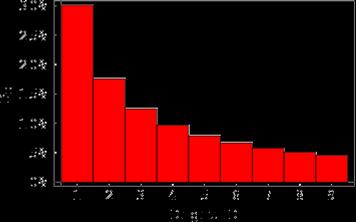
In this case the probability that the first digit is D is just given by the ratio of two terms: In the numerator we have the integral between D and D+1 of p(x) (that’s a measure of how much of the distribution represents numbers starting with the digit D) and on the denominator we have the integral between 1 and 10 of p(x) (the overall measure). The result, if we take p(x) to be proportional to 1/x, is just log (1+1/D).

picture1

The shape of this distribution is shown in the Figure. Note that about 30% of the first digits are expected to be 1. Of course I have made a number of simplifying assumptions that are unlikely to be exactly true, and the case of the physical constants is complicated by the fact that some are measured and some are defined, but I think this captures the essential reason for the curious behaviour of first digits.

If nothing else, it provides a valuable lesson that you should be careful in what variables you assume are uniformly distributed!