Archive for Beethoven Piano Concerto No. 4

Leonard Slatkin at 80

Posted in Biographical, Music with tags , , , , , , on September 28, 2024 by telescoper

Last night found me once again at the National Concert Hall in Dublin for a concert by the National Symphony Orchestra conducted this time by Leonard Slatkin, who has a long association with the NSO and who was 80 years old on 1st September. I must say he looked very sprightly for a man eighty years of age!

To start the programme we had the world premiere of a piece by Leonard Slatkin’s son, Daniel. Voyager 130 was inspired by the Voyager space mission, and especially by the Golden Records carried by the Voyager probes. Among the pieces of music included on those records is the exquisite Cavatina from Beethoven’s String Quartet No. 13 (Opus 130) from which the composer borrows thematic material for this piece. Daniel Slatkin was actually in the audience for this – in fact he was sitting just two rows in front of me – and went up on stage after the very enjoyable performance.

After that, and some rearranging on stage, we had a performance of Beethoven’s Piano Concerto No. 4 with Dublin-born soloist Hugh Tinney. Although for its time it was very unconventional in structure, this is now a very familiar piece in the concert hall. For the most part it was played very well but I did think the orchestra were a bit stiff and lacking in expression in places. The performance was warmly received by the NCH audience, and Hugh Tinney received a standing ovation at the end.

After the wine break we had another familiar work, the Symphony No. 3 by Johannes Brahms, which Leonard Slatkin conducted without a score. I’m persevering with Brahms. I still don’t find that he moves me as much as many other composers and so many people rave about him that I think I must be missing something. The 3rd Symphony is a very fine work, offering lots of variety across its four movements while maintaining a strong sense of coherence and remaining relatively concise – it lasts about 33 minutes in performance. I’m no expert on Brahms but it seems to me that the 3rd Symphony is where he really found his voice as a symphonic composer and stepped out from the shadow of Beethoven.

Apart from the first piece, it was a very conventional programme but I enjoyed it as did the audience. It’s a pity there weren’t more people there, though. I’d guess that the NCH was about 2/3 full at most.

P.S. Last night Leinster rugby were playing a match at Landsdowne Road (beating the Dragons 34-6) and Shelbourne were playing Sligo Rovers at home in the League of Ireland (a 0-0 draw) so the train home was a bit busier than last time but still uneventful. When I got home later I decided to listen to a recording of the Beethoven Strong Quartet No. 13 before bed…
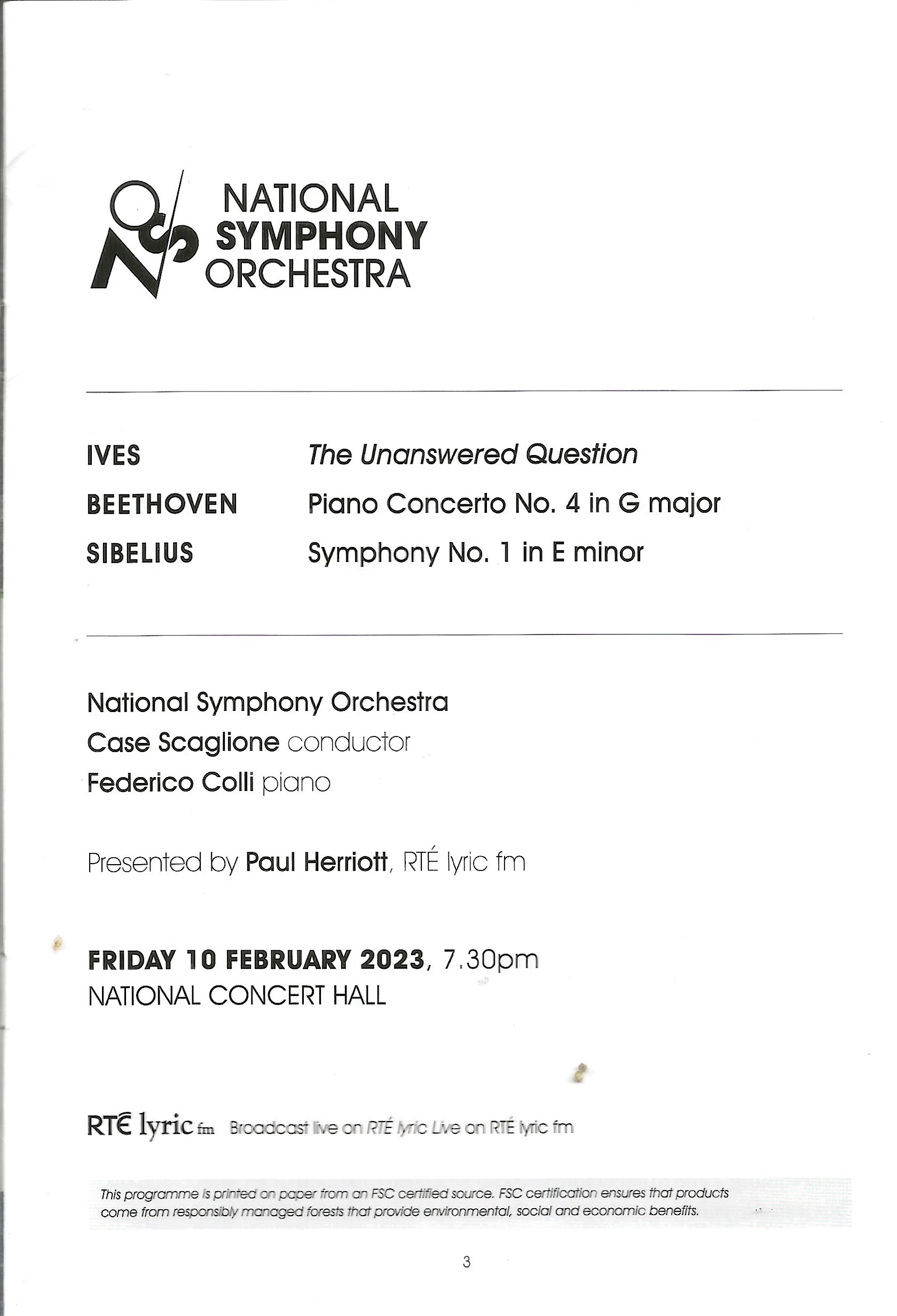
Ives, Beethoven and Sibelius at the National Concert Hall

Posted in Biographical, Music with tags , , , , , , , on February 11, 2023 by telescoper

Last night’s concert by the National Symphony Orchestra at the National Concert Hall in Dublin was one that I’d been looking forward to for a long time. It didn’t disappoint! Congratulations to the National Symphony for yet another excellent concert, this time under the direction of guest conductor Case Scaglione.

The first half of the programme consisted of The Unanswered Question by Charles Ives and Beethoven’s Piano Concerto No. 4 with soloist Federico Colli. That’s an interesting juxtaposition, made even more interesting by the Beethoven piece was played directly after the Ives without a break for applause. I wondered what was up when Case Scaglione walked on stage with Federico Colli who took his seat at the piano at the start of the concert. There is no piano part in The Unanswered Question, so Colli sat quietly until the end of that piece and then went straight into the opening piano statement of the Beethoven. I wasn’t expecting this before the performance but it worked very well. The only problem is that I didn’t get the chance to applaud at the end of The Unanswered Question.

The Unanswered Question is one of my favourite works by Charles Ives (along with Three Places in New England), a composer whom I admire greatly. I wrote a piece about him some years ago, actually.  The Unanswered Question, was completed in 1908 (although it was revised later) and is subtitled “A Cosmic Landscape”. It’s a sort of meditation on the philosophical problem of existence. It comprises three different voices: muted strings playing notes from a G-Major triad (a rather “churchy” key, giving the flavour of a simple hymn). Then, played (in this performance) from the balcony behind the conductor, a solo trumpet poses the Question: a five note figure that is repeated with almost imperceptible variations several times during the work. The reply to the Question comes from the woodwinds, whose dissonant response is at first plaintive but then increasingly agitated and frustrated. Then the Question comes again without an answer, but the strings carry on quietly in G Major until everything goes quiet.

The Piano Concerto No. 4 by Ludwig van Beethoven is in G Major, so there is a continuity between the two pieces in terms of tonality, although of course the musical language is very different. It was composed in 1805/6, a hundred years before the Ives. It’s an audacious piece right from the start as it opens with unaccompanied piano. The second movement is a kind of dialogue between the orchestra and the piano, which at times sounds more like an argument as the orchestra makes a series of rather harsh statements with somewhat conciliatory responses from the piano. The last movement is a more conventional and jovial Rondo, by which time the solo trumpeter from the Ives piece had found her way back to the stage from the balcony. I’ve heard this movement several times played on its own on the radio.

Federico Colli cut a dashing figure in a grey suit and waistcoat with a high collar and a voluminous white cravat. He was well up to the demands of the piece, playing very expressively, tenderly at times and with virtuosic brilliance when called for.

After the wine break we returned for the majestic Symphony No. 1 by Jean Sibelius. This is one of the great symphonies and another favourite of mine – I have several different recordings of it and have heard it on the radio many times – but I had never heard it performed live in person before last night. The First Movement (initially Andante) opens with a theme played by solo clarinet. It then moves into allegro energico which was played very briskly in this performance (in contrast to some famous recordings which slow it down). The motif played by the clarinet at the start permeates the whole work, returning in different guises and endowing the composition with a strong sense of unity. It’s all shot through with great romantic tunes and has wonderful dynamics. In short, it’s a masterpiece. Not bad for a First Symphony!