Archive for Big Bang

A Galaxy at Record Redshift?

Posted in The Universe and Stuff with tags , , , , , on July 13, 2015 by telescoper

Skimming through the arXiv this morning I discovered a paper by Zitrin et al. with the following abstract:


abstract_z

I’m not sure if the figures are all significant, but a redshift of z=8.68 makes this the most distant spectroscopically confirmed galaxy on record with a present proper distance of about 9.3 Gpc according to the standard cosmological model, just pipping the previous record holder (whose redshift was in any case disputed). Light from this galaxy has taken about 13.1 Gyr to reach us; that means light set out from it when the Universe was only about 4% of its current age, only about 600 million years after the Big Bang. (Those figures were obtained using the inestimable Ned Wright’s cosmology calculator.)

We are presumably seeing a very young object, in which stars are forming at a considerable rate to account for its brightness. We don’t know exactly when the first stars formed and began to ionize the intergalactic medium, but every time the cosmic distance record is broken we push that time back closer to the Big Bang.

Mind you, I can’t say I’m overwhelmingly convinced by the identification of the redshifted Lyman-α line:

high_zBut what do I know? I’m a theorist whose suspicious of data. Any observers care to comment?

Why the Big Bang wasn’t as loud as you think…

Posted in The Universe and Stuff with tags , , , , , on March 31, 2015 by telescoper

So how loud was the Big Bang?

I’ve posted on this before but a comment posted today reminded me that perhaps I should recycle it and update it as it relates to the cosmic microwave background, which is what I work on on the rare occasions on which I get to do anything interesting.

As you probably know the Big Bang theory involves the assumption that the entire Universe – not only the matter and energy but also space-time itself – had its origins in a single event a finite time in the past and it has been expanding ever since. The earliest mathematical models of what we now call the  Big Bang were derived independently by Alexander Friedman and George Lemaître in the 1920s. The term “Big Bang” was later coined by Fred Hoyle as a derogatory description of an idea he couldn’t stomach, but the phrase caught on. Strictly speaking, though, the Big Bang was a misnomer.

Friedman and Lemaître had made mathematical models of universes that obeyed the Cosmological Principle, i.e. in which the matter was distributed in a completely uniform manner throughout space. Sound consists of oscillating fluctuations in the pressure and density of the medium through which it travels. These are longitudinal “acoustic” waves that involve successive compressions and rarefactions of matter, in other words departures from the purely homogeneous state required by the Cosmological Principle. The Friedman-Lemaitre models contained no sound waves so they did not really describe a Big Bang at all, let alone how loud it was.

However, as I have blogged about before, newer versions of the Big Bang theory do contain a mechanism for generating sound waves in the early Universe and, even more importantly, these waves have now been detected and their properties measured.

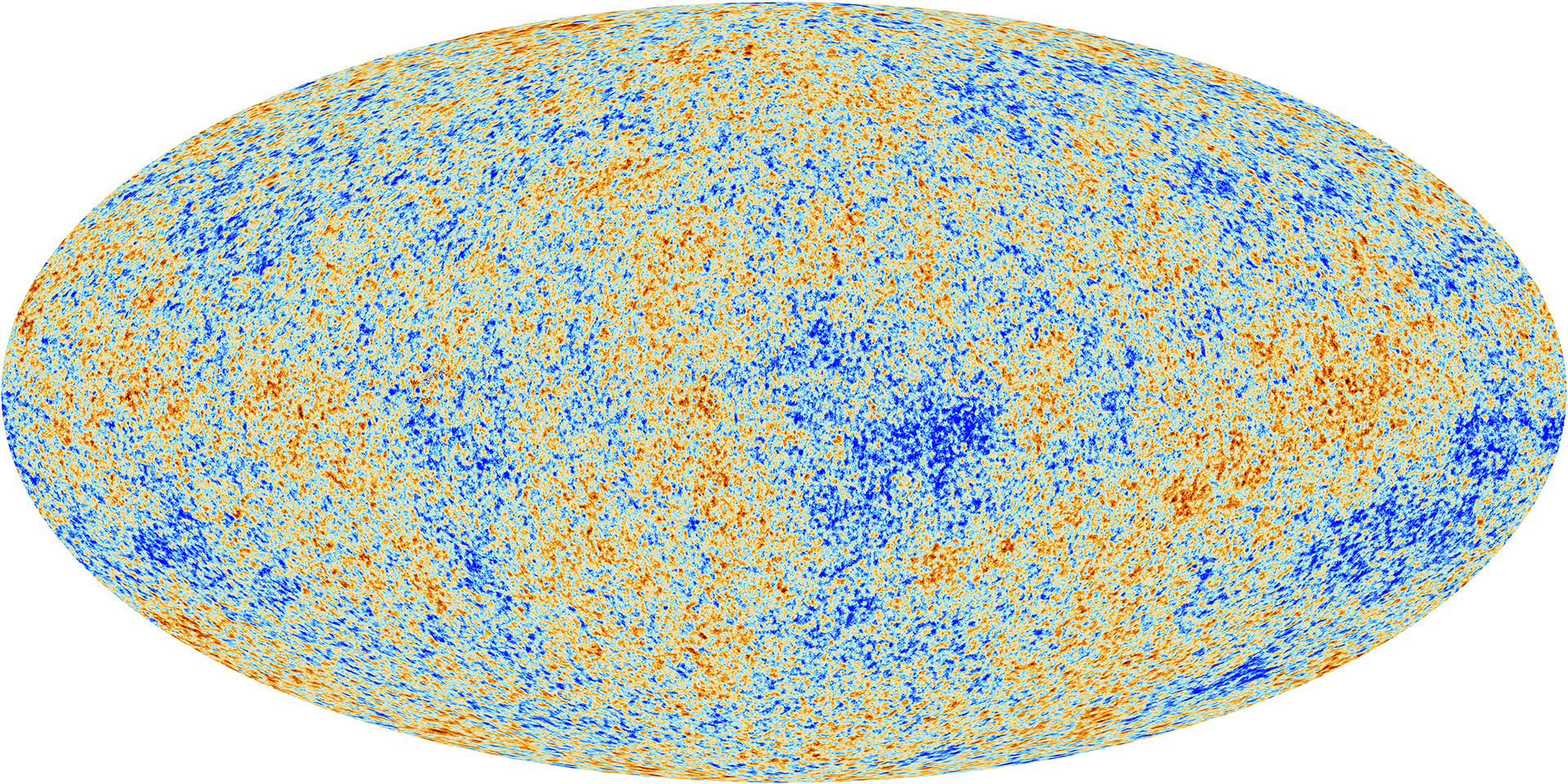
Planck_CMB

The above image shows the variations in temperature of the cosmic microwave background as charted by the Planck Satellite. The average temperature of the sky is about 2.73 K but there are variations across the sky that have an rms value of about 0.08 milliKelvin. This corresponds to a fractional variation of a few parts in a hundred thousand relative to the mean temperature. It doesn’t sound like much, but this is evidence for the existence of primordial acoustic waves and therefore of a Big Bang with a genuine “Bang” to it.

A full description of what causes these temperature fluctuations would be very complicated but, roughly speaking, the variation in temperature you corresponds directly to variations in density and pressure arising from sound waves.

So how loud was it?

The waves we are dealing with have wavelengths up to about 200,000 light years and the human ear can only actually hear sound waves with wavelengths up to about 17 metres. In any case the Universe was far too hot and dense for there to have been anyone around listening to the cacophony at the time. In some sense, therefore, it wouldn’t have been loud at all because our ears can’t have heard anything.

Setting aside these rather pedantic objections – I’m never one to allow dull realism to get in the way of a good story- we can get a reasonable value for the loudness in terms of the familiar language of decibels. This defines the level of sound (L) logarithmically in terms of the rms pressure level of the sound wave Prms relative to some reference pressure level Pref

L=20 log10[Prms/Pref].

(the 20 appears because of the fact that the energy carried goes as the square of the amplitude of the wave; in terms of energy there would be a factor 10).

There is no absolute scale for loudness because this expression involves the specification of the reference pressure. We have to set this level by analogy with everyday experience. For sound waves in air this is taken to be about 20 microPascals, or about 2×10⁻¹⁰ times the ambient atmospheric air pressure which is about 100,000 Pa.  This reference is chosen because the limit of audibility for most people corresponds to pressure variations of this order and these consequently have L=0 dB. It seems reasonable to set the reference pressure of the early Universe to be about the same fraction of the ambient pressure then, i.e.

Pref~2×10⁻¹⁰ Pamb.

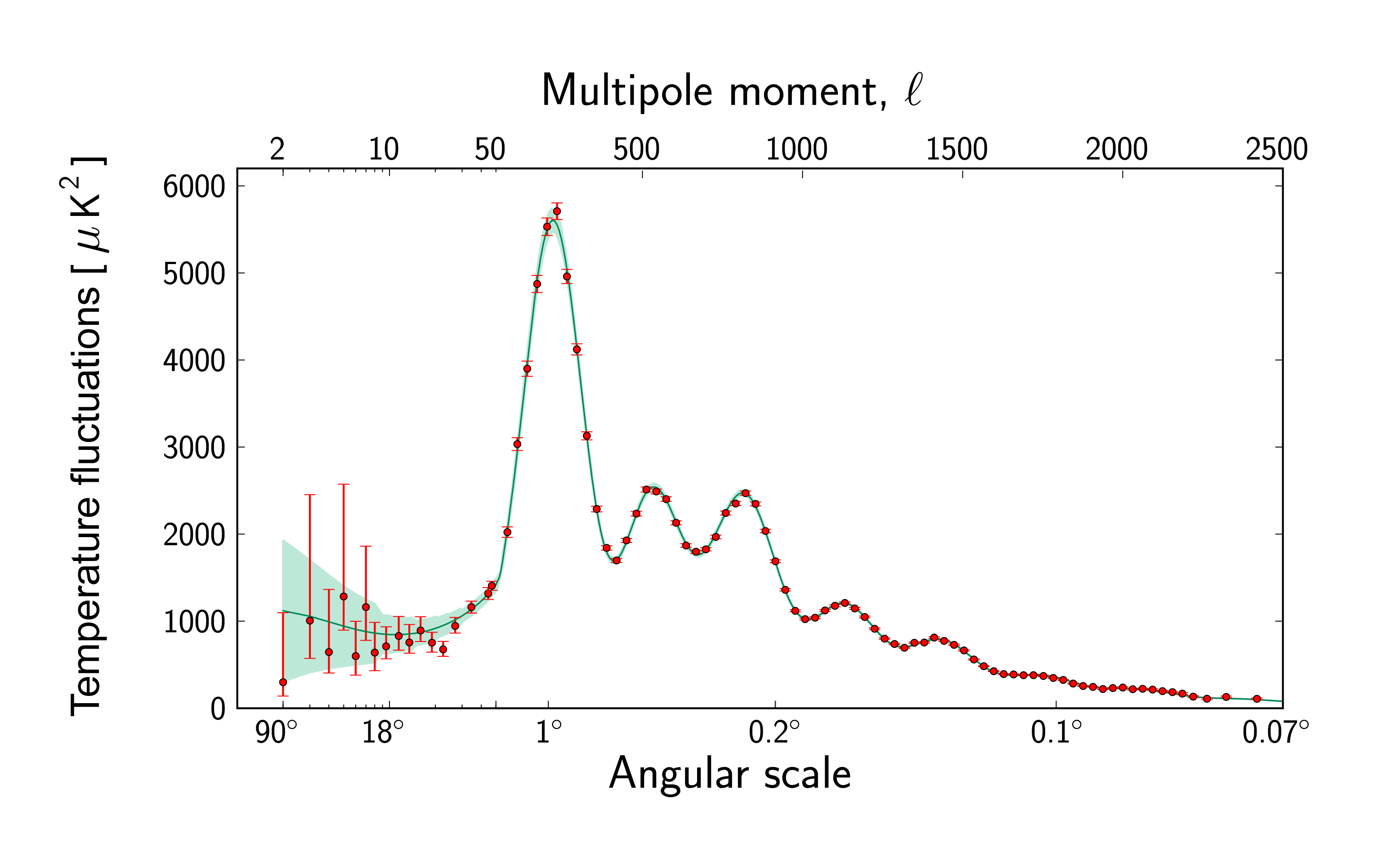
The physics of how primordial variations in pressure translate into observed fluctuations in the CMB temperature is quite complicated, because the primordial universe consists of a plasma rather than air. Moreover, the actual sound of the Big Bang contains a mixture of wavelengths with slightly different amplitudes. In fact here is the spectrum, showing a distinctive signature that looks, at least in this representation, like a fundamental tone and a series of harmonics…

Planck_power_spectrum_orig


If you take into account all this structure it all gets a bit messy, but it’s quite easy to get a rough but reasonable estimate by ignoring all these complications. We simply take the rms pressure variation to be the same fraction of ambient pressure as the averaged temperature variation are compared to the average CMB temperature,  i.e.

Prms~ a few ×10-5Pamb.

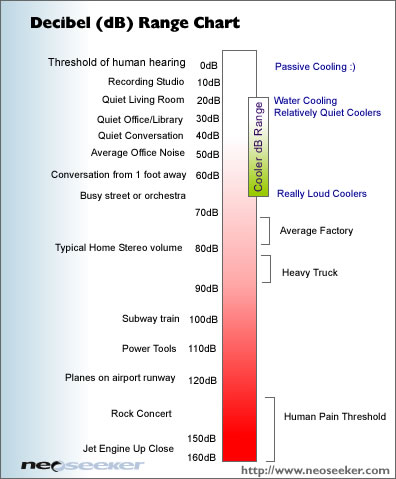
If we do this, scaling both pressures in logarithm in the equation in proportion to the ambient pressure, the ambient pressure cancels out in the ratio, which turns out to be a few times 10-5. With our definition of the decibel level we find that waves of this amplitude, i.e. corresponding to variations of one part in a hundred thousand of the reference level, give roughly L=100dB while part in ten thousand gives about L=120dB. The sound of the Big Bang therefore peaks at levels just a bit less than 120 dB.

cooler_decibel_chart

As you can see in the Figure above, this is close to the threshold of pain,  but it’s perhaps not as loud as you might have guessed in response to the initial question. Modern popular beat combos often play their dreadful rock music much louder than the Big Bang….

A useful yardstick is the amplitude  at which the fluctuations in pressure are comparable to the mean pressure. This would give a factor of about 1010 in the logarithm and is pretty much the limit that sound waves can propagate without distortion. These would have L≈190 dB. It is estimated that the 1883 Krakatoa eruption produced a sound level of about 180 dB at a range of 100 miles. By comparison the Big Bang was little more than a whimper.

PS. If you would like to read more about the actual sound of the Big Bang, have a look at John Cramer’s webpages. You can also download simulations of the actual sound. If you listen to them you will hear that it’s more of  a “Roar” than a “Bang” because the sound waves don’t actually originate at a single well-defined event but are excited incoherently all over the Universe.

Say no to the commercialization of education!

Posted in The Universe and Stuff with tags , on September 12, 2014 by telescoper

There is much complaint these days about the alleged  commercialization of UK Higher Education, so I  wanted to take this opportunity to state Virgin Airlines that I will not be taking this as a Carling cue to introduce any form of commercial Coca Cola sponsorship of any Corby Trouser Press form into the School of Mathematical Macdonalds and Panasonic Physical Sciences, and certainly not into this Burger King blog.

This week I’ve been working hard preparing for the new Marks and Spencer term  and especially for the arrival of our new  Samsung students who will be starting their  Dixons degrees next week.  The Nokia preparations have gone pretty well  although I have had Betfair trouble cramming all the Sainsbury things I’ve had to do this BMW week, so I’ll be in Tesco tomorrow and Wonga Sunday to finish off a few Pizza Express jobs, but at least I’ll be able to attend the Vodafone Vice-Chancellor’s receptions for new students on the Carlsberg campus this Waitrose weekend.

In between these Ericsson events I hope to find some time to write a little more Morrisons of the second edition of my book on cosmology, including stuff about the Carphone Warhouse cosmic microwave background (CMB) which produces some of the noise on a Sony television screen, a  Classic FM signal from the edge of the Next Universe.  The CMB plays an Emirates important role in TK Maxx cosmology as it is the Marlboro smoking gun of the Sainsbury Big Bang and established our Standard Life model of the L’Oreal Universe. The old British Airways edition is a bit out of Aviva date so I will be updating it with Starbucks references to  the Planck First Direct results, although I obviously haven’t decided yet what to say about Barclays BICEP2.  I think I’ll be adding a Goodfella’s Pizza paragraph or two referring to the House of Fraser Hubble Crown Paints  Ultra Deep Kentucky Fried Chicken Field as well.

Anyway, for now its  Thank God It’s Friday time to go HSBC home and drink several Dorothy Perkins glasses of Amazon wine.

Comet Sale Now On!


Is Inflation Testable?

Posted in The Universe and Stuff with tags , , , , , , , , on March 4, 2014 by telescoper

It seems the little poll about cosmic inflation I posted last week with humorous intent has ruffled a few feathers, but at least it gives me the excuse to wheel out an updated and edited version of an old piece I wrote on the subject.

Just over thirty  years ago a young physicist came up with what seemed at first to be an absurd idea: that, for a brief moment in the very distant past, just after the Big Bang, something weird happened to gravity that made it push rather than pull.  During this time the Universe went through an ultra-short episode of ultra-fast expansion. The physicist in question, Alan Guth, couldn’t prove that this “inflation” had happened nor could he suggest a compelling physical reason why it should, but the idea seemed nevertheless to solve several major problems in cosmology.

Three decades later, Guth is a professor at MIT and inflation is now well established as an essential component of the standard model of cosmology. But should it be? After all, we still don’t know what caused it and there is little direct evidence that it actually took place. Data from probes of the cosmic microwave background seem to be consistent with the idea that inflation happened, but how confident can we be that it is really a part of the Universe’s history?

According to the Big Bang theory, the Universe was born in a dense fireball which has been expanding and cooling for about 14 billion years. The basic elements of this theory have been in place for over eighty years, but it is only in the last decade or so that a detailed model has been constructed which fits most of the available observations with reasonable precision. The problem is that the Big Bang model is seriously incomplete. The fact that we do not understand the nature of the dark matter and dark energy that appears to fill the Universe is a serious shortcoming. Even worse, we have no way at all of describing the very beginning of the Universe, which appears in the equations used by cosmologists as a “singularity”- a point of infinite density that defies any sensible theoretical calculation. We have no way to define a priori the initial conditions that determine the subsequent evolution of the Big Bang, so we have to try to infer from observations, rather than deduce by theory, the parameters that govern it.

The establishment of the new standard model (known in the trade as the “concordance” cosmology) is now allowing astrophysicists to turn back the clock in order to understand the very early stages of the Universe’s history and hopefully to understand the answer to the ultimate question of what happened at the Big Bang itself and thus answer the question “How did the Universe Begin?”

Paradoxically, it is observations on the largest scales accessible to technology that provide the best clues about the earliest stages of cosmic evolution. In effect, the Universe acts like a microscope: primordial structures smaller than atoms are blown up to astronomical scales by the expansion of the Universe. This also allows particle physicists to use cosmological observations to probe structures too small to be resolved in laboratory experiments.

Our ability to reconstruct the history of our Universe, or at least to attempt this feat, depends on the fact that light travels with a finite speed. The further away we see a light source, the further back in time its light was emitted. We can now observe light from stars in distant galaxies emitted when the Universe was less than one-sixth of its current size. In fact we can see even further back than this using microwave radiation rather than optical light. Our Universe is bathed in a faint glow of microwaves produced when it was about one-thousandth of its current size and had a temperature of thousands of degrees, rather than the chilly three degrees above absolute zero that characterizes the present-day Universe. The existence of this cosmic background radiation is one of the key pieces of evidence in favour of the Big Bang model; it was first detected in 1964 by Arno Penzias and Robert Wilson who subsequently won the Nobel Prize for their discovery.

The process by which the standard cosmological model was assembled has been a gradual one, but the latest step was taken by the European Space Agency’s Planck mission . I’ve blogged about the implications of the Planck results for cosmic inflation in more technical detail here. In a nutshell, for several years this satellite mapped  the properties of the cosmic microwave background and how it varies across the sky. Small variations in the temperature of the sky result from sound waves excited in the hot plasma of the primordial fireball. These have characteristic properties that allow us to probe the early Universe in much the same way that solar astronomers use observations of the surface of the Sun to understand its inner structure,  a technique known as helioseismology. The detection of the primaeval sound waves is one of the triumphs of modern cosmology, not least because their amplitude tells us precisely how loud the Big Bang really was.

The pattern of fluctuations in the cosmic radiation also allows us to probe one of the exciting predictions of Einstein’s general theory of relativity: that space should be curved by the presence of matter or energy. Measurements from Planck and its predecessor WMAP reveal that our Universe is very special: it has very little curvature, and so has a very finely balanced energy budget: the positive energy of the expansion almost exactly cancels the negative energy relating of gravitational attraction. The Universe is (very nearly) flat.

The observed geometry of the Universe provides a strong piece of evidence that there is an mysterious and overwhelming preponderance of dark stuff in our Universe. We can’t see this dark matter and dark energy directly, but we know it must be there because we know the overall budget is balanced. If only economics were as simple as physics.

Computer Simulation of the Cosmic Web

The concordance cosmology has been constructed not only from observations of the cosmic microwave background, but also using hints supplied by observations of distant supernovae and by the so-called “cosmic web” – the pattern seen in the large-scale distribution of galaxies which appears to match the properties calculated from computer simulations like the one shown above, courtesy of Volker Springel. The picture that has emerged to account for these disparate clues is consistent with the idea that the Universe is dominated by a blend of dark energy and dark matter, and in which the early stages of cosmic evolution involved an episode of accelerated expansion called inflation.

A quarter of a century ago, our understanding of the state of the Universe was much less precise than today’s concordance cosmology. In those days it was a domain in which theoretical speculation dominated over measurement and observation. Available technology simply wasn’t up to the task of performing large-scale galaxy surveys or detecting slight ripples in the cosmic microwave background. The lack of stringent experimental constraints made cosmology a theorists’ paradise in which many imaginative and esoteric ideas blossomed. Not all of these survived to be included in the concordance model, but inflation proved to be one of the hardiest (and indeed most beautiful) flowers in the cosmological garden.

Although some of the concepts involved had been formulated in the 1970s by Alexei Starobinsky, it was Alan Guth who in 1981 produced the paper in which the inflationary Universe picture first crystallized. At this time cosmologists didn’t know that the Universe was as flat as we now think it to be, but it was still a puzzle to understand why it was even anywhere near flat. There was no particular reason why the Universe should not be extremely curved. After all, the great theoretical breakthrough of Einstein’s general theory of relativity was the realization that space could be curved. Wasn’t it a bit strange that after all the effort needed to establish the connection between energy and curvature, our Universe decided to be flat? Of all the possible initial conditions for the Universe, isn’t this very improbable? As well as being nearly flat, our Universe is also astonishingly smooth. Although it contains galaxies that cluster into immense chains over a hundred million light years long, on scales of billions of light years it is almost featureless. This also seems surprising. Why is the celestial tablecloth so immaculately ironed?

Guth grappled with these questions and realized that they could be resolved rather elegantly if only the force of gravity could be persuaded to change its sign for a very short time just after the Big Bang. If gravity could push rather than pull, then the expansion of the Universe could speed up rather than slow down. Then the Universe could inflate by an enormous factor (1060 or more) in next to no time and, even if it were initially curved and wrinkled, all memory of this messy starting configuration would be lost. Our present-day Universe would be very flat and very smooth no matter how it had started out.

But how could this bizarre period of anti-gravity be realized? Guth hit upon a simple physical mechanism by which inflation might just work in practice. It relied on the fact that in the extreme conditions pertaining just after the Big Bang, matter does not behave according to the classical laws describing gases and liquids but instead must be described by quantum field theory. The simplest type of quantum field is called a scalar field; such objects are associated with particles that have no spin. Modern particle theory involves many scalar fields which are not observed in low-energy interactions, but which may well dominate affairs at the extreme energies of the primordial fireball.

Classical fluids can undergo what is called a phase transition if they are heated or cooled. Water for example, exists in the form of steam at high temperature but it condenses into a liquid as it cools. A similar thing happens with scalar fields: their configuration is expected to change as the Universe expands and cools. Phase transitions do not happen instantaneously, however, and sometimes the substance involved gets trapped in an uncomfortable state in between where it was and where it wants to be. Guth realized that if a scalar field got stuck in such a “false” state, energy – in a form known as vacuum energy – could become available to drive the Universe into accelerated expansion.We don’t know which scalar field of the many that may exist theoretically is responsible for generating inflation, but whatever it is, it is now dubbed the inflaton.

This mechanism is an echo of a much earlier idea introduced to the world of cosmology by Albert Einstein in 1916. He didn’t use the term vacuum energy; he called it a cosmological constant. He also didn’t imagine that it arose from quantum fields but considered it to be a modification of the law of gravity. Nevertheless, Einstein’s cosmological constant idea was incorporated by Willem de Sitter into a theoretical model of an accelerating Universe. This is essentially the same mathematics that is used in modern inflationary cosmology.  The connection between scalar fields and the cosmological constant may also eventually explain why our Universe seems to be accelerating now, but that would require a scalar field with a much lower effective energy scale than that required to drive inflation. Perhaps dark energy is some kind of shadow of the inflaton

Guth wasn’t the sole creator of inflation. Andy Albrecht and Paul Steinhardt, Andrei Linde, Alexei Starobinsky, and many others, produced different and, in some cases, more compelling variations on the basic theme. It was almost as if it was an idea whose time had come. Suddenly inflation was an indispensable part of cosmological theory. Literally hundreds of versions of it appeared in the leading scientific journals: old inflation, new inflation, chaotic inflation, extended inflation, and so on. Out of this activity came the realization that a phase transition as such wasn’t really necessary, all that mattered was that the field should find itself in a configuration where the vacuum energy dominated. It was also realized that other theories not involving scalar fields could behave as if they did. Modified gravity theories or theories with extra space-time dimensions provide ways of mimicking scalar fields with rather different physics. And if inflation could work with one scalar field, why not have inflation with two or more? The only problem was that there wasn’t a shred of evidence that inflation had actually happened.

This episode provides a fascinating glimpse into the historical and sociological development of cosmology in the eighties and nineties. Inflation is undoubtedly a beautiful idea. But the problems it solves were theoretical problems, not observational ones. For example, the apparent fine-tuning of the flatness of the Universe can be traced back to the absence of a theory of initial conditions for the Universe. Inflation turns an initially curved universe into a flat one, but the fact that the Universe appears to be flat doesn’t prove that inflation happened. There are initial conditions that lead to present-day flatness even without the intervention of an inflationary epoch. One might argue that these are special and therefore “improbable”, and consequently that it is more probable that inflation happened than that it didn’t. But on the other hand, without a proper theory of the initial conditions, how can we say which are more probable? Based on this kind of argument alone, we would probably never really know whether we live in an inflationary Universe or not.

But there is another thread in the story of inflation that makes it much more compelling as a scientific theory because it makes direct contact with observations. Although it was not the original motivation for the idea, Guth and others realized very early on that if a scalar field were responsible for inflation then it should be governed by the usual rules governing quantum fields. One of the things that quantum physics tells us is that nothing evolves entirely smoothly. Heisenberg’s famous Uncertainty Principle imposes a degree of unpredictability of the behaviour of the inflaton. The most important ramification of this is that although inflation smooths away any primordial wrinkles in the fabric of space-time, in the process it lays down others of its own. The inflationary wrinkles are really ripples, and are caused by wave-like fluctuations in the density of matter travelling through the Universe like sound waves travelling through air. Without these fluctuations the cosmos would be smooth and featureless, containing no variations in density or pressure and therefore no sound waves. Even if it began in a fireball, such a Universe would be silent. Inflation puts the Bang in Big Bang.

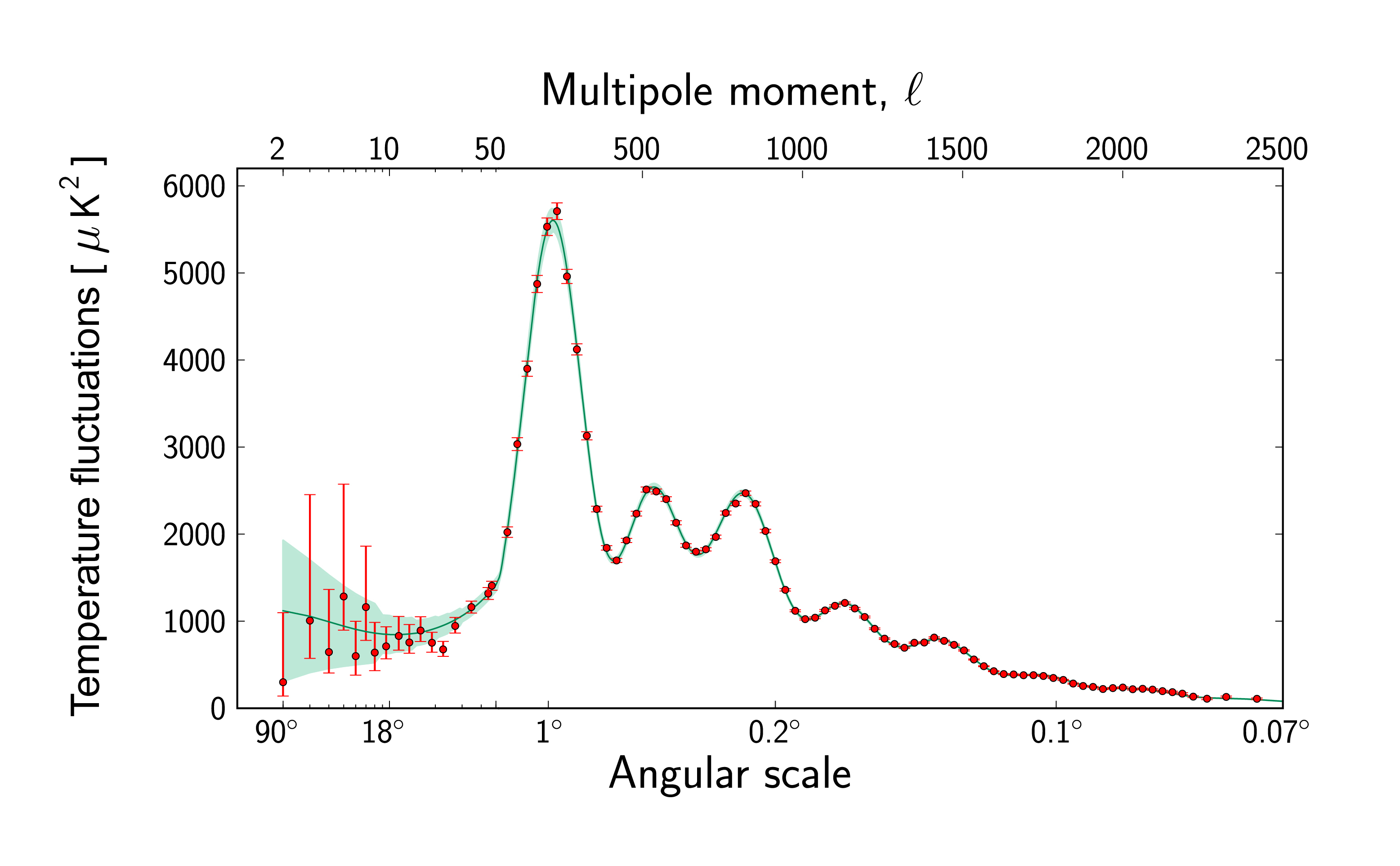
The acoustic oscillations generated by inflation have a broad spectrum (they comprise oscillations with a wide range of wavelengths), they are of small amplitude (about one hundred thousandth of the background); they are spatially random and have Gaussian statistics (like waves on the surface of the sea; this is the most disordered state); they are adiabatic (matter and radiation fluctuate together) and they are formed coherently.  This last point is perhaps the most important. Because inflation happens so rapidly all of the acoustic “modes” are excited at the same time. Hitting a metal pipe with a hammer generates a wide range of sound frequencies, but all the different modes of the start their oscillations at the same time. The result is not just random noise but something moderately tuneful. The Big Bang wasn’t exactly melodic, but there is a discernible relic of the coherent nature of the sound waves in the pattern of cosmic microwave temperature fluctuations seen in the Cosmic Microwave Background. The acoustic peaks seen in the  Planck  angular spectrum  provide compelling evidence that whatever generated the pattern did so coherently.
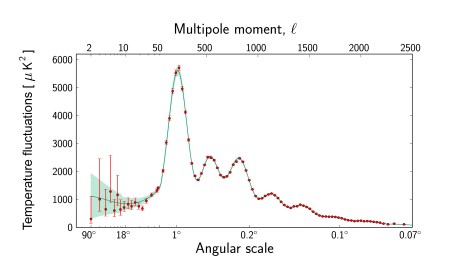
Planck_power_spectrum_orig
There are very few alternative theories on the table that are capable of reproducing these results, but does this mean that inflation really happened? Do they “prove” inflation is correct? More generally, is the idea of inflation even testable?

So did inflation really happen? Does Planck prove it? Will we ever know?

It is difficult to talk sensibly about scientific proof of phenomena that are so far removed from everyday experience. At what level can we prove anything in astronomy, even on the relatively small scale of the Solar System? We all accept that the Earth goes around the Sun, but do we really even know for sure that the Universe is expanding? I would say that the latter hypothesis has survived so many tests and is consistent with so many other aspects of cosmology that it has become, for pragmatic reasons, an indispensable part our world view. I would hesitate, though, to say that it was proven beyond all reasonable doubt. The same goes for inflation. It is a beautiful idea that fits snugly within the standard cosmological and binds many parts of it together. But that doesn’t necessarily make it true. Many theories are beautiful, but that is not sufficient to prove them right.

When generating theoretical ideas scientists should be fearlessly radical, but when it comes to interpreting evidence we should all be unflinchingly conservative. The Planck measurements have also provided a tantalizing glimpse into the future of cosmology, and yet more stringent tests of the standard framework that currently underpins it. Primordial fluctuations produce not only a pattern of temperature variations over the sky, but also a corresponding pattern of polarization. This is fiendishly difficult to measure, partly because it is such a weak signal (only a few percent of the temperature signal) and partly because the primordial microwaves are heavily polluted by polarized radiation from our own Galaxy. Polarization data from Planck are yet to be released; the fiendish data analysis challenge involved is the reason for the delay.  But there is a crucial target that justifies these endeavours. Inflation does not just produce acoustic waves, it also generates different modes of fluctuation, called gravitational waves, that involve twisting deformations of space-time. Inflationary models connect the properties of acoustic and gravitational fluctuations so if the latter can be detected the implications for the theory are profound. Gravitational waves produce very particular form of polarization pattern (called the B-mode) which can’t be generated by acoustic waves so this seems a promising way to test inflation. Unfortunately the B-mode signal is expected to be very weak and the experience of WMAP suggests it might be swamped by foregrounds. But it is definitely worth a go, because it would add considerably to the evidence in favour of inflation as an element of physical reality.

But would even detection of primordial gravitational waves really test inflation? Not really. The problem with inflation is that it is a name given to a very general idea, and there are many (perhaps infinitely many) different ways of implementing the details, so one can devise versions of the inflationary scenario that produce a wide range of outcomes. It is therefore unlikely that there will be a magic bullet that will kill inflation dead. What is more likely is a gradual process of reducing the theoretical slack as much as possible with observational data, such as is happening in particle physics. For example, we have not yet identified the inflaton field (nor indeed any reasonable candidate for it) but we are gradually improving constraints on the allowed parameter space. Progress in this mode of science is evolutionary not revolutionary.

Many critics of inflation argue that it is not a scientific theory because it is not falsifiable. I don’t think falsifiability is a useful concept in this context; see my many posts relating to Karl Popper. Testability is a more appropriate criterion. What matters is that we have a systematic way of deciding which of a set of competing models is the best when it comes to confrontation with data. In the case of inflation we simply don’t have a compelling model to test it against. For the time being therefore, like it or not, cosmic inflation is clearly the best model we have. Maybe someday a worthy challenger will enter the arena, but this has not happened yet.

Most working cosmologists are as aware of the difficulty of testing inflation as they are of its elegance. There are also those  who talk as if inflation were an absolute truth, and those who assert that it is not a proper scientific theory (because it isn’t falsifiable). I can’t agree with either of these factions. The truth is that we don’t know how the Universe really began; we just work on the best ideas available and try to reduce our level of ignorance in any way we can. We can hardly expect  the secrets of the Universe to be so easily accessible to our little monkey brains.

Cosmology, Escher and the Field of Screams

Posted in Art, Education, The Universe and Stuff with tags , , , , , on March 20, 2012 by telescoper

Up early this morning for yet another busy day I thought I’d post a quick follow-up to my recent item about analogies for teaching physics (especially cosmology).

Another concept related to the cosmic microwave background that people sometimes have problems understanding is that of last scattering surface.

Various analogies are useful for this. For example, when you find yourself in thick fog you may have the impression that you are surrounded by an impenetrable wall at some specific distance around you. It’s not a physical barrier, of course, it’s just the distance at which there sufficient water droplets in the air to prevent light from penetrating further. In more technical terms the optical depth of the fog exceeds unity at the distance at which this wall is seen.

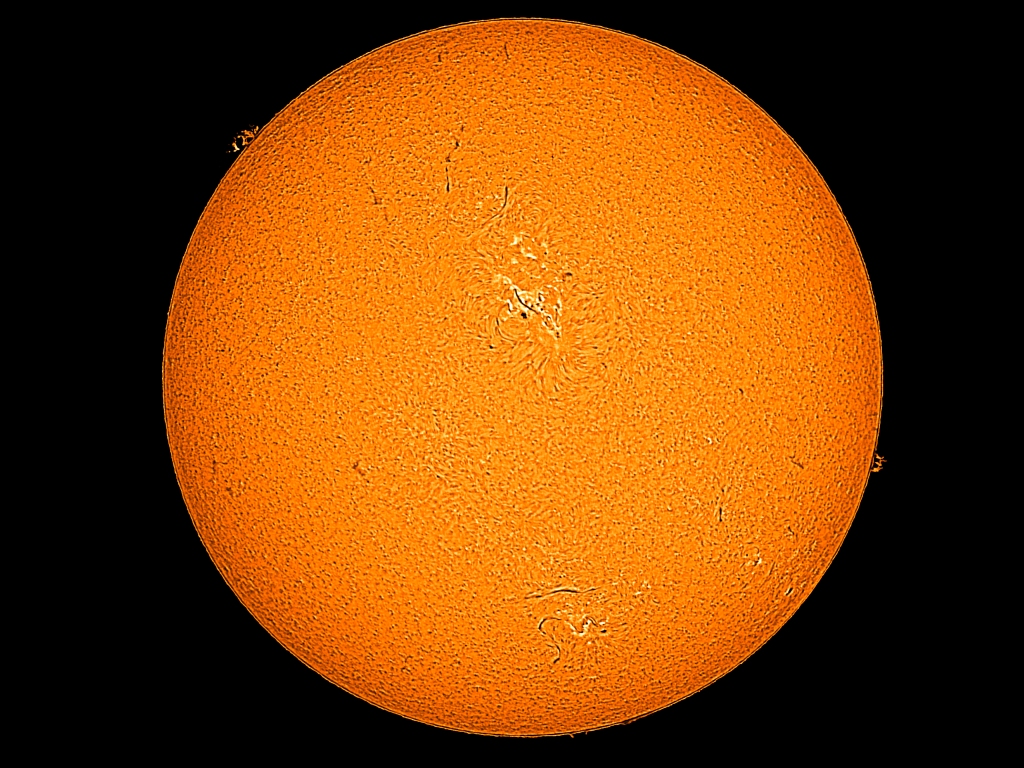
Another more direct analogy is provided by the Sun. Here’s a picture of said object, taken through an H-α filter..

What’s surprising to the uninitiated about an image such as this is that the Sun appears to have a distinct edge, like a solid object. The Sun, however, is far from solid. It’s just a ball of hot gas whose density and temperature fall off with distance from its centre. In the inner parts the Sun is basically opaque, and photons of light diffuse outwards extremely slowly because they are efficiently scattered by the plasma. At a certain radius, however, the material becomes transparent and photons travel without hindrance. What you see is the photosphere which is a sharp edge defined by this transition from opaque to transparent.

The physics defining the Sun’s photosphere is much the same as in the Big Bang, except that in the case of the Sun we are outside looking in whereas we are inside the Universe trying to look out. Take a look at this image from M.C. Escher:

The universe isn’t actually made of Angels and Demons – at least not in the standard model – but if you imagine you are in the centre of the picture  it nicely represents what it is like looking out through an expanding cosmology. Since light travels with finite speed, the further you look out the further you look back into the past when things were denser (and hotter). Eventually you reach a point where the whole Universe was as hot as the surface of a star, this is the cosmic photosphere or the last scattering surface, which is a spherical surface centred on the observer. We can’t see any further than this because what’s beyond is hidden from us by an impenetrable curtain,  but if we could just a little bit further we’d see the Big Bang itself where the density is infinite, not as a point in space but all around us.

Although it looks like we’re in a special place (in the middle) of the image, in the Big Bang theory everywhere is equivalent; any observer would see a cosmic photosphere forming a sphere around them.

And while I’m on about last scattering, here’s another analogy which might be useful if the others aren’t. I call this one the Field of Screams.

Imagine you’re in the middle of a very large, perhaps infinite, field crammed full of people, furnished with synchronised watches, each of whom is screaming at the top of their voice. At a certain instant, say time T, everyone everywhere stops screaming.

What do you hear?

Well , you’ll obviously  notice that it gets quieter straight away as the people closest to you have stopped screaming.  But you will still hear a sound because some of the sound entering your ear set out at a time before t=T. The speed of sound is 300 m/s or so, so after 1 second you will still hear the sound arriving from people further than 300 metres away. It might be faint, but it would be there. After two seconds you’d still be hearing from people further than 600 metres away,. and so on. At any time there’ll be circle around you, defined by the distance sound can have travelled since the screaming stopped – the Circle of Last Screaming. It would appear that you are in the centre of this circle, but anyone anywhere in the field would form the same impression about what’s happening around them.

Change sound to light, and move from two dimensions to three, and you can see how last scattering produces a spherical surface around you. Simples.


Failed Physics Teaching Analogies

Posted in Education, The Universe and Stuff with tags , , , , , , , on March 18, 2012 by telescoper

Last week I deputized for a colleague who was skiving off away at an important meeting so, for the first time ever in my current job, I actually got to give a proper lecture on cosmology. As the only out-and-out specialist in cosmology research in the School of Physics and Astronomy at Cardiff, I’ve always thought it a bit strange that I’ve never been asked to teach this subject to undergraduates, but there you are. Ours not to reason why, etc. Anyway, the lecture I gave was about the cosmic microwave background, and since I have taught cosmology elsewhere in the past it was quite easy to cobble something together.

As a lecturer you find, over the years, that various analogies come to mind that you think will help students understand the physical concepts underpinning what’s going on, and that you hope will complement the way they are developed in a more mathematical language. Sometimes these seem to work well during the lecture, but only afterwards do you find out they didn’t really serve their intended purpose. Sadly it also  sometimes turns out that they can also confuse rather than enlighten…

For instance, the two key ideas behind the production of the cosmic microwave background are recombination and the consequent decoupling of matter and radiation. In the early stages of the Big Bang there was a hot plasma consisting mainly of protons and electrons in an intense radiation field. Since it  was extremely hot back then  the plasma was more-or-less  fully ionized, which is to say that the equilibrium for the formation of neutral hydrogen atoms via

p+e^{-} \rightarrow H+ \gamma

lay firmly to the left hand side. The free electrons scatter radiation very efficiently via Compton  scattering

\gamma +e^{-} \rightarrow \gamma + e^{-}

thus establishing thermal equilibrium between the matter and the radiation field. In effect, the plasma is opaque so that the radiation field acquires an accurate black-body spectrum (as observed). As long as the rate of collisions between electrons and photons remains large the radiation temperature adjusts to that of the matter and equilibrium is preserved because matter and radiation are in good thermal contact.

Eventually, however, the temperature falls to a point at which electrons begin to bind with protons to form hydrogen atoms. When this happens the efficiency of scattering falls dramatically and as a consequence the matter and radiation temperatures are no longer coupled together, i.e. decoupling occurs; collisions can longer keep everything in thermal equilibrium. The matter in the Universe then becomes transparent, and the radiation field propagates freely as a kind of relic of the time that it was last in thermal equilibrium. We see that radiation now, heavily redshifted, as the cosmic microwave background.

So far, so good, but I’ve always thought that everyday analogies are useful to explain physics like this so I thought of the following. When people are young and energetic, they interact very effectively with everyone around them and that process allows them to keep in touch with all the latest trends in clothing, music, books, and so on. As you get older you don’t get about so much , and may even get married (which is just like recombination, in that it dramatically  reduces your cross-section for interaction with the outside world). Changing trends begin to pass you buy and eventually you become a relic, surrounded by records and books you acquired in the past when you were less introverted, and wearing clothes that went out of fashion years ago.

I’ve used this analogy in the past and students generally find it quite amusing even if it has modest explanatory value. I wasn’t best pleased, however, when a few years ago I set an examination question which asked the students to explain the processes of recombination and decoupling. One answer said “Decoupling explains Prof. Coles’ terrible fashion sense”. Grrr.

An even worse example happened when I was teaching particle physics some time ago. I had to explain neutrino oscillations, a process in which neutrinos (which have three distinct flavour states, associated with the electron, mu and tau leptons) can change flavour as they propagate. It’s quite a weird thing to spring on students who previously thought that lepton number was always conserved so I decided to start with an analogy based on more familiar physics.

A charged fermion such as an electron (or in fact anything that has a magnetic moment, which would include, e.g. the neutron)  has spin and, according to standard quantum mechanics, the component of this in any direction can  can be described in terms of two basis states, say |\uparrow> and |\downarrow> for spin in the z direction. In general, however, the spin state will be a superposition of these, e.g.

\frac{1}{\sqrt{2}} \left( |\uparrow> + |\downarrow>\right)

In this example, as long as the particle is travelling through empty space, the probability of finding it with spin “up” is  50%, as is the probability of finding it in the spin “down” state. Once a measurement is made, the state collapses into a definite “up” or “down” wherein it remains until something else is done to it.

If, on the other hand, the particle  is travelling through a region where there is a  magnetic field the “spin-up” and “spin-down” states can acquire different energies owing to the interaction between the spin and the magnetic field. This is important because it means the bits of the wave function describing the up and down states evolve at different rates, and this  has measurable consequences: measurements made at different positions yield different probabilities of finding the spin pointing in different directions. In effect, the spin vector of the  particle performs  a sort of oscillation, similar to the classical phenomenon called  precession.

The mathematical description of neutrino oscillations is very similar to this, except it’s not the spin part of the wavefunction being affected by an external field that breaks the symmetry between “up” and “down”. Instead the flavour part of the wavefunction is “precessing” because the flavour states don’t coincide with the eigenstates of the Hamiltonian that describes the neutrinos’ evolution. However, it does require that different neutrino types have intrinsically different energies  (which, in turn, means that the neutrinos must have different masses), in quite  a similar way similar to the spin-precession example.

Although this isn’t a perfect analogy I thought it was a good way of getting across the basic idea. Unfortunately, however, when I subsequently asked an examination question about neutrino oscillations I got a significant number of answers that said “neutrino oscillations happen when a neutrino travels through a magnetic field….”. Sigh. Neutrinos don’t interact with  magnetic fields, you see…

Anyhow, I’m sure there’s more than one reader out there who has had a similar experience with an analogy that wasn’t perhaps as instructive as hoped. Feel free to share through the comments box…

Volumina

Posted in Music, The Universe and Stuff with tags , , on March 15, 2012 by telescoper

I forgot to mention that, at the end of my talk on Monday evening,  a gentleman in the audience who is apparently a regular reader of this blog asked if I was aware of that composer György Ligeti had written a piece of music called Volumina  inspired by the Big Bang.  I was indeed  aware of this piece, and have a recording of it, but his question gives me the excuse to post a version here.  I’m sure at least some of you will have heard some of it before, in fact, as an excerpt  featured in the original radio series of The Hitchhiker’s Guide to the Galaxy which I listened to on the wireless many moons ago.

You might find Volumina a bit perplexing, but I can tell you that in surround sound with the volume up it’s absolutely amazing. My neighbours clearly agree, and were banging on the wall last night to show their appreciation.

Big Bang Acoustics

Posted in The Universe and Stuff with tags , , , , , , on March 12, 2012 by telescoper

It’s National Science and Engineering Week this week and as part of the programme of events in Cardiff we have an open evening at the School of Physics & Astronomy tonight. This will comprise a series of public talks followed by an observing session using the School’s Observatory. I’m actually giving a (short) talk myself, which means it will be a long day, so I’m going to save time by recycling the following from an old blog post on the subject of my talk.

As you probably know the Big Bang theory involves the assumption that the entire Universe – not only the matter and energy but also space-time itself – had its origins in a single event a finite time in the past and it has been expanding ever since. The earliest mathematical models of what we now call the  Big Bang were derived independently by Alexander Friedman and George Lemaître in the 1920s. The term “Big Bang” was later coined by Fred Hoyle as a derogatory description of an idea he couldn’t stomach, but the phrase caught on. Strictly speaking, though, the Big Bang was a misnomer.

Friedman and Lemaître had made mathematical models of universes that obeyed the Cosmological Principle, i.e. in which the matter was distributed in a completely uniform manner throughout space. Sound consists of oscillating fluctuations in the pressure and density of the medium through which it travels. These are longitudinal “acoustic” waves that involve successive compressions and rarefactions of matter, in other words departures from the purely homogeneous state required by the Cosmological Principle. The Friedman-Lemaitre models contained no sound waves so they did not really describe a Big Bang at all, let alone how loud it was.

However, as I have blogged about before, newer versions of the Big Bang theory do contain a mechanism for generating sound waves in the early Universe and, even more importantly, these waves have now been detected and their properties measured.

The above image shows the variations in temperature of the cosmic microwave background as charted by the Wilkinson Microwave Anisotropy Probe about a decade years ago. The average temperature of the sky is about 2.73 K but there are variations across the sky that have an rms value of about 0.08 milliKelvin. This corresponds to a fractional variation of a few parts in a hundred thousand relative to the mean temperature. It doesn’t sound like much, but this is evidence for the existence of primordial acoustic waves and therefore of a Big Bang with a genuine “Bang” to it.

A full description of what causes these temperature fluctuations would be very complicated but, roughly speaking, the variation in temperature you see in the CMB corresponds directly to variations in density and pressure arising from sound waves.

So how loud was it?

The waves we are dealing with have wavelengths up to about 200,000 light years and the human ear can only actually hear sound waves with wavelengths up to about 17 metres. In any case the Universe was far too hot and dense for there to have been anyone around listening to the cacophony at the time. In some sense, therefore, it wouldn’t have been loud at all because our ears can’t have heard anything.

Setting aside these rather pedantic objections – I’m never one to allow dull realism to get in the way of a good story- we can get a reasonable value for the loudness in terms of the familiar language of decibels. This defines the level of sound (L) logarithmically in terms of the rms pressure level of the sound wave Prms relative to some reference pressure level Pref

L=20 log10[Prms/Pref]

(the 20 appears because of the fact that the energy carried goes as the square of the amplitude of the wave; in terms of energy there would be a factor 10).

There is no absolute scale for loudness because this expression involves the specification of the reference pressure. We have to set this level by analogy with everyday experience. For sound waves in air this is taken to be about 20 microPascals, or about 2×10⁻¹⁰ times the ambient atmospheric air pressure which is about 100,000 Pa.  This reference is chosen because the limit of audibility for most people corresponds to pressure variations of this order and these consequently have L=0 dB. It seems reasonable to set the reference pressure of the early Universe to be about the same fraction of the ambient pressure then, i.e.

Pref~2×10⁻¹⁰ Pamb

The physics of how primordial variations in pressure translate into observed fluctuations in the CMB temperature is quite complicated, and the actual sound of the Big Bang contains a mixture of wavelengths with slightly different amplitudes so it all gets a bit messy if you want to do it exactly, but it’s quite easy to get a rough estimate. We simply take the rms pressure variation to be the same fraction of ambient pressure as the averaged temperature variation are compared to the average CMB temperature,  i.e.

Prms~ a few ×10-5Pamb

If we do this, scaling both pressures in logarithm in the equation in proportion to the ambient pressure, the ambient pressure cancels out in the ratio, which turns out to be a few times 10-5

With our definition of the decibel level we find that waves corresponding to variations of one part in a hundred thousand of the reference level  give roughly L=100dB while part in ten thousand gives about L=120dB. The sound of the Big Bang therefore peaks at levels just a bit less than  120 dB. As you can see in the Figure to the left, this is close to the threshold of pain,  but it’s perhaps not as loud as you might have guessed in response to the initial question. Many rock concerts are actually louder than the Big Bang, so I suspect any metalheads in the audience will be distinctly unimpressed.

A useful yardstick is the amplitude  at which the fluctuations in pressure are comparable to the mean pressure. This would give a factor of about 1010 in the logarithm and is pretty much the limit that sound waves can propagate without distortion. These would have L≈190 dB. It is estimated that the 1883 Krakatoa eruption produced a sound level of about 180 dB at a range of 100 miles. By comparison the Big Bang was little more than a whimper.

PS. If you would like to read more about the actual sound of the Big Bang, have a look at John Cramer’s webpages. You can also download simulations of the actual sound. If you listen to them you will hear that it’s more of  a “Roar” than a “Bang” because the sound waves don’t actually originate at a single well-defined event but are excited incoherently all over the Universe.

PPS. If you would like to hear a series of increasingly sophisticated computer simulations showing how our idea of the sounds accompanying the start of the Universe has evolved over the past few years, please take a look at the following video. It’s amazing how crude the 1995 version seems, compared with that describing the new era of precision cosmology.

A Potted Prehistory of Cosmology

Posted in History, The Universe and Stuff with tags , , , , , , , , , , , , , , , , , , , , , on January 26, 2012 by telescoper

A few years ago I was asked to provide a short description of the history of cosmology, from the dawn of civilisation up to the establishment of the Big Bang model, in less than 1200 words. This is what I came up with. Who and what have I left out that you would have included?

–0–

 Is the Universe infinite? What is it made of? Has it been around forever?  Will it all come to an end? Since prehistoric times, humans have sought to build some kind of conceptual framework for answering questions such as these. The first such theories were myths. But however naïve or meaningless they may seem to us now, these speculations demonstrate the importance that we as a species have always attached to thinking about life, the Universe and everything.

Cosmology began to emerge as a recognisable scientific discipline with the Greeks, notably Thales (625-547 BC) and Anaximander (610-540 BC). The word itself is derived from the Greek “cosmos”, meaning the world as an ordered system or whole. In Greek, the opposite of “cosmos” is “chaos”. The Pythagoreans of the 6th century BC regarded numbers and geometry as the basis of all natural things. The advent of mathematical reasoning, and the idea that one can learn about the physical world using logic and reason marked the beginning of the scientific era. Plato (427-348 BC) expounded a complete account of the creation of the Universe, in which a divine Demiurge creates, in the physical world, imperfect representations of the structures of pure being that exist only in the world of ideas. The physical world is subject to change, whereas the world of ideas is eternal and immutable. Aristotle (384-322 BC), a pupil of Plato, built on these ideas to present a picture of the world in which the distant stars and planets execute perfect circular motions, circles being a manifestation of “divine” geometry. Aristotle’s Universe is a sphere centred on the Earth. The part of this sphere that extends as far as the Moon is the domain of change, the imperfect reality of Plato, but beyond this the heavenly bodies execute their idealised circular motions. This view of the Universe was to dominate western European thought throughout the Middle Ages, but its perfect circular motions did not match the growing quantities of astronomical data being gathered by the Greeks from the astronomical archives made by the Babylonians and Egyptians. Although Aristotle had emphasised the possibility of learning about the Universe by observation as well as pure thought, it was not until Ptolemy’s Almagest, compiled in the 2nd Century AD, that a complete mathematical model for the Universe was assembled that agreed with all the data available.

Much of the knowledge acquired by the Greeks was lost to Christian culture during the dark ages, but it survived in the Islamic world. As a result, cosmological thinking during the Middle Ages of Europe was rather backward. Thomas Aquinas (1225-74) seized on Aristotle’s ideas, which were available in Latin translation at the time while the Almagest was not, to forge a synthesis of pagan cosmology with Christian theology which was to dominated Western thought until the 16th and 17th centuries.

The dismantling of the Aristotelian world view is usually credited to Nicolaus Copernicus (1473-1543).  Ptolemy’s Almagest  was a complete theory, but it involved applying a different mathematical formula for the motion of each planet and therefore did not really represent an overall unifying system. In a sense, it described the phenomena of heavenly motion but did not explain them. Copernicus wanted to derive a single universal theory that treated everything on the same footing. He achieved this only partially, but did succeed in displacing the Earth from the centre of the scheme of things. It was not until Johannes Kepler (1571-1630) that a completely successful demolition of the Aristotelian system was achieved. Driven by the need to explain the highly accurate observations of planetary motion made by Tycho Brahe (1546-1601), Kepler replaced Aristotle’s divine circular orbits with more mundane ellipses.

The next great development on the road to modern cosmological thinking was the arrival on the scene of Isaac Newton (1642-1727). Newton was able to show, in his monumental Principia (1687), that the elliptical motions devised by Kepler were the natural outcome of a universal law of gravitation. Newton therefore re-established a kind of Platonic level on reality, the idealised world of universal laws of motion. The Universe, in Newton’s picture, behaves as a giant machine, enacting the regular motions demanded by the divine Creator and both time and space are absolute manifestations of an internal and omnipresent God.

Newton’s ideas dominated scientific thinking until the beginning of the 20th century, but by the 19th century the cosmic machine had developed imperfections. The mechanistic world-view had emerged alongside the first stirrings of technology. During the subsequent Industrial Revolution scientists had become preoccupied with the theory of engines and heat. These laws of thermodynamics had shown that no engine could work perfectly forever without running down. In this time there arose a widespread belief in the “Heat Death of the Universe”, the idea that the cosmos as a whole would eventually fizzle out just as a bouncing ball gradually dissipates its energy and comes to rest.

Another spanner was thrown into the works of Newton’s cosmic engine by Heinrich Olbers (1758-1840), who formulated in 1826 a paradox that still bears his name, although it was discussed by many before him, including Kepler. Olbers’ Paradox emerges from considering why the night sky is dark. In an infinite and unchanging Universe, every line of sight from an observer should hit a star, in much the same way as a line of sight through an infinite forest will eventually hit a tree. The consequence of this is that the night sky should be as bright as a typical star. The observed darkness at night is sufficient to prove the Universe cannot both infinite and eternal.

Whether the Universe is infinite or not, the part of it accessible to rational explanation has steadily increased. For Aristotle, the Moon’s orbit (a mere 400,000 km) marked a fundamental barrier, to Copernicus and Kepler the limit was the edge of the Solar System (billions of kilometres away). In the 18th and 19th centuries, it was being suggested that the Milky Way (a structure now known to be at least a billion times larger than the Solar System) to be was the entire Universe. Now it is known, thanks largely to Edwin Hubble (1889-1953), that the Milky Way is only one among hundreds of billions of similar galaxies.

The modern era of cosmology began in the early years of the 20th century, with a complete re-write of the laws of Nature. Albert Einstein (1879-1955) introduced the principle of relativity in 1905 and thus demolished Newton’s conception of space and time. Later, his general theory of relativity, also supplanted Newton’s law of universal gravitation. The first great works on relativistic cosmology by Alexander Friedmann (1888-1925), George Lemaître (1894-1966) and Wilhem de Sitter (1872-1934) formulated a new and complex language for the mathematical description of the Universe.

But while these conceptual developments paved the way, the final steps towards the modern era were taken by observers, not theorists. In 1929, Edwin Hubble, who had only recently shown that the Universe contained many galaxies like the Milky way, published the observations that led to the realisation that our Universe is expanding. That left the field open for two rival theories, one (“The Steady State”, with no beginning and no end)  in which matter is continuously created to fill in the gaps caused by the cosmic expansion and the other in which the whole shebang was created, in one go, in a primordial fireball we now call the Big Bang.

Eventually, in 1965, Arno Penzias and Robert  Wilson discovered the cosmic microwave background radiation, proof (or as near to proof as you’re likely to see) that our Universe began in a  Big Bang…

Dead of Night

Posted in The Universe and Stuff with tags , , , , , , , on January 22, 2012 by telescoper

It not being possible to watch Match of the Day last night – I didn’t particularly want to watch the horror story of Newcastle’s 5-2 drubbing by Fulham – I rummaged around in my stack of DVDs of old films and came up with Dead of Night. I was actually very happy to have the excuse  to watch this classic British horror film for the umpteenth time. I’ve actually blogged about a bit of this film before. There is a sequence (to me by far the scariest in the  film) about a ventriloquist who is gradually possessed by his evil dummy which came up in a post I did about Automatonophobia some time ago.

Anyway, Dead of Night was made in 1945 by Ealing Studios and you only have to watch it to appreciate why it its held in such high regard by critics to this day. Indeed you can see ideas in it which have been repeated in a host of subsequent (and usually inferior) horror flicks. I’m not going to spoil it by saying too much about the plot. I’m sure there are many (younger) readers who have never heard of this wonderful film and I don’t want to spoil their enjoyment of it by giving away too much. I would say though that it’s basically a portmanteau film, i.e. a series of essentially separate stories (to the extent of having a different director for each such segment) embedded within an overall narrative. It also involves an intriguing plot device similar to those situations in which you are dreaming, but in the dream you wake up and don’t know whether you’re actually awake or still dreaming…

Anyway, you can watch the whole film on Youtube if you like but you have to keep clicking through the different sections used to be able to watch it on Youtube, but it’s sadly now been removed

It’s the “dream-within-a-dream” structure – what physicists would call a self-similar hierarchy – of the overall framework of this movie that gives it its particular interest from the point of view of this blog, because it played an important role in the evolution of theoretical cosmology. One evening in 1946 the mathematicians and astrophysicts Fred Hoyle, Hermann Bondi and Tommy Gold went to see Dead of Night in Cambridge. Discussing the film afterwards they came up with the idea of the steady state cosmology, the first scientific papers about which were published in 1948. For the best part of two decades this theory was a rival to the now-favoured “Big Bang” (a term coined by Fred Hoyle which was intended to be a derogatory description of the opposing theory).

In the Big Bang theory there is a single “creation event”, so this particular picture of the Universe has a definite beginning, and from that point the arrow of time endows it with a linear narrative. In the steady state theory, matter is created continuously in small bits (via a hypothetical field called the C-field) so the Universe has no beginning and its time evolution not unlike that of the film.

Modern cosmologists sometimes dismiss the steady state cosmology as a bit of an aberration, a distraction from the One True Big Bang but it was undeniably a beautiful theory. The problem was that so many of its proponents refused to accept the evidence that they were wrong.  Supporters of  disfavoured theories rarely change their minds, in fact. The better theory wins out because younger folk tend to support it, while the recalcitrant old guard defending  theirs in spite of the odds eventually die out.

And another thing. If Fred Hoyle had thought of it he might have  called the field responsible for creating matter a scalar field, rather than the C-field, and it would now be much more widely recognized that he (unwittingly) invented many elements of modern inflationary cosmology. In fact, in some versions of inflation the Universe as a whole is very similar to the steady state model, only the continuous creation is not of individual particles or atoms, but of entire Big-Bang “bubbles” that can grow to the size of our observable Universe. So maybe the whole idea was actually right after all..