Archive for Black Hole Binary

Weekly Update from the Open Journal of Astrophysics – 06/09/2025

Posted in OJAp Papers, Open Access, The Universe and Stuff with tags , , , , , , , , , , , on September 6, 2025 by telescoper

It’s Saturday again, so it’s time for a summary of the week’s new papers at the Open Journal of Astrophysics. Since the last update we have published two new papers, which brings the number in Volume 8 (2025) up to 127, and the total so far published by OJAp up to 362. It’s been another relatively slow week, not least because of the Labor (sic) Day holiday in the USA on Monday which, among other things, meant there was no arXiv update on Tuesday.

Anyway, the first paper to report this week is “An analytical model for the dispersion measure of Fast Radio Burst host galaxies” by Robert Reischke, Michael Kovač & Andrina Nicola (U. Bonn, Germany), Steffen Hagstotz (Ludwig-Maximilians Universität München) and Aurel Schneider (U. Zurich, Switzlerland). This is a theoretical study of the dispersion measures (DMs) intrinsic to host galaxies of Fast Radio Burst (FRB) sources to enable separation of that from the line-of-sight DM. This one was published on Monday 1st September 2025 in the folder Cosmology and NonGalactic Astrophysics.

The overlay is here:
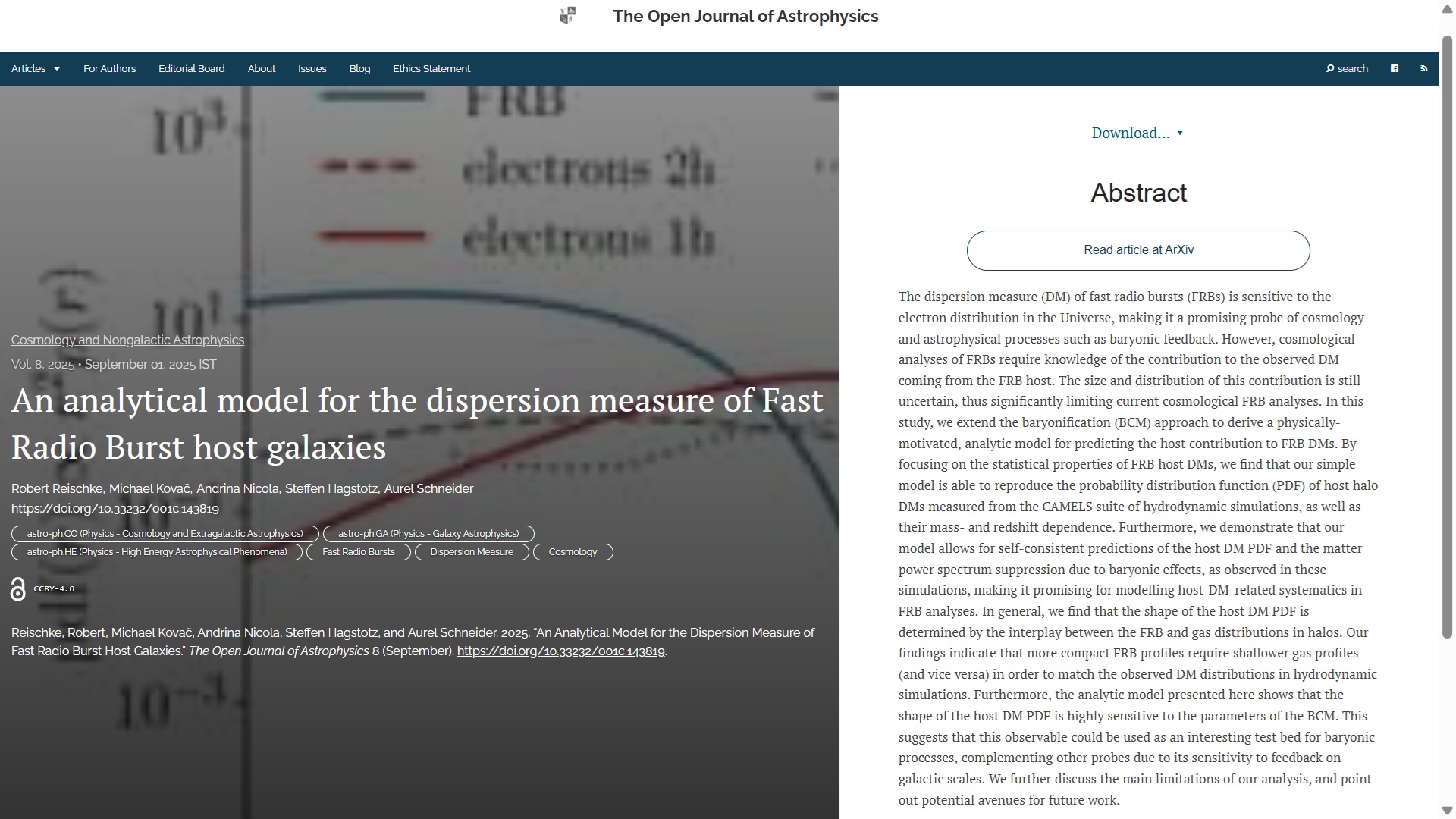
 

You can make this larger by clicking on it.  The officially accepted version of this paper can be found on the arXiv here.

The second paper this week, published on Wednesday 3rd Sepember in the folder Solar and Stellar Astrophysics, is “Complex spectral variability and hints of a luminous companion in the Be star + black hole binary candidate ALS 8814” by Kareem El-Badry (Caltech, USA), Matthias Fabry (Villanova U., USA), Hugues Sana (KU Leuven, Belgium), Tomer Shenar (Tel Aviv U., Israel) and Rhys Seeburger (MPA Heidelberg, Germany).

The overlay for this one is here:


You can find the officially accepted version on arXiv here.

And that’s all the papers for this week. It’s still a bit slow as we emerge from the summer vacations, we have a lot of papers in the pipeline that I expect to emerge pretty soon.
Making Massive Black Hole Binaries Merge

Posted in The Universe and Stuff with tags , , , , , on February 16, 2016 by telescoper

Many fascinating questions remain unanswered by last week’s detection of gravitational waves produced by a coalescing binary black hole system (GW150914) by LIGO. One of these is whether the fact that the similarity of the component masses (29 and 36 times the mass of the Sun respectively) is significant.

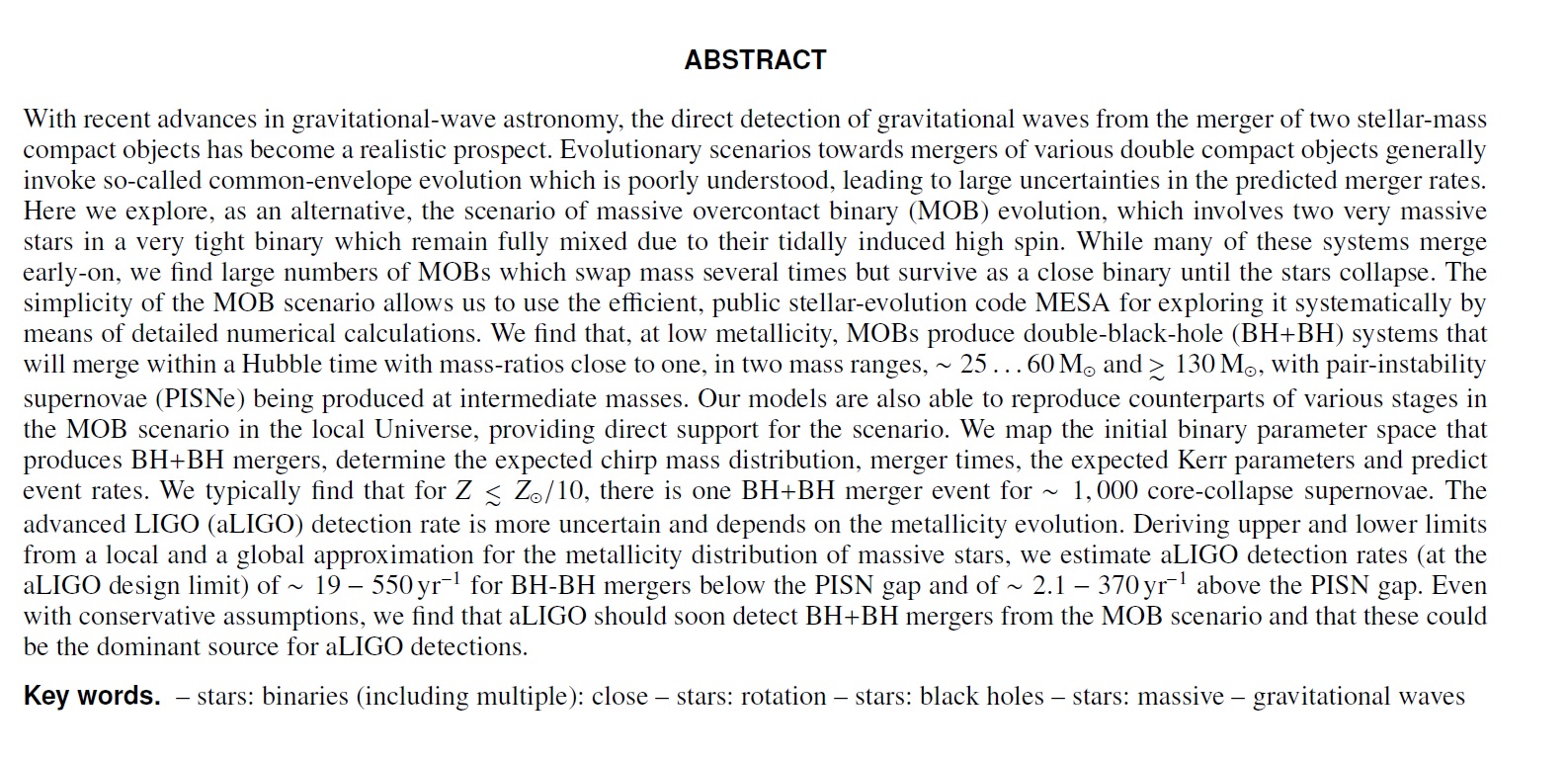
An interesting paper appeared on the arXiv last week by Marchant et al. that touches on this. Here is the abstract (you can click on it to make it larger):

BinaryBH


Although there is some technical jargon, the point is relatively clear. It appears that very masssive, very low metallicity binary stars can evolve into black hole binary systems via supernova explosions without disrupting their orbit. The term ‘low metallicity’ characteristises stars that form from primordial material (i.e. basically hydrogen and helium) early in the cycle of stellar evolution. Such material has very different opacity properties from material with significant quantities of heavier elements in it, which alters the dynamical evolution considerably.

(Remember that to an astrophysicist, chemistry is extremely simple. Hydrogen and helium make up most of the atomic matter in the Universe; all the rest is called “metals” including carbon, nitrogen, and oxygen…. )

Anyway, this theoretical paper is relevant because the mass ratios produced by this mechanism are expected to be of order unity, as is the case of GW150914.  One observation doesn’t prove much, but it’s definitely Quite Interesting…

Incidentally, it has been reported that another gravitational wave source may have been detected by LIGO, in October last year. This isn’t as clean a signal as the first, so it will require further analysis before a definitive result is claimed, but it too seems to be a black hole binary system with a mass ratio of order unity…

You wait forty years for a gravitational wave signal from a binary black hole merger and then two come along in quick succession…