Archive for black hole

LIGO: Live Reaction Blog

Posted in The Universe and Stuff with tags , , , , on February 11, 2016 by telescoper

So the eagerly awaited press conference happened this afternoon. It started in unequivocal fashion.

“We detected gravitational waves. We did it!”

As rumoured, the signal corresponds to the coalescence of two black holes, of masses 29 and 36 times the mass of the Sun.

The signal arrived in September 2015, very shortly after Advanced LIGO was switched on. There’s synchronicity for you! The LIGO collaboration have done wondrous things getting their sensitivity down to such a level that they can measure such a tiny effect, but there still has to be an event producing a signal to measure. Collisions of two such massive black holes are probably extremely rare so it’s a bit of good fortune that one happened just at the right time. Actually it was during an engineering test!

Here are the key results:


LIGO


Excellent signal to noise! I’m convinced! Many congratulations to everyone involved in LIGO! This has been a heroic effort that has taken many years of hard slog. They deserve the highest praise, as do the funding agencies who have been prepared to cover the costs of this experiment over such a long time. Physics of this kind is a slow burner, but it delivers spectacularly in the end!

You can find the paper here, although the server seems to be struggling to cope! One part of the rumour was wrong, however, the result is not in Nature, but in Physical Review Letters. There will no doubt be many more!

And right on cue here is the first batch of science papers!

No prizes for guessing where the 2016 Nobel Prize for Physics is heading, but in a collaboration of over 1000 people across the world which few will receive the award?

So, as usual, I had a day filled with lectures, workshops and other meetings so I was thinking I would miss the press conference entirely, but in the end I couldn’t resist interrupting a meeting with the Head of the Department of Mathematics to watch the live stream…

P.S. A quick shout out the UK teams involved in this work, including many old friends in the Gravitational Physics Group at Cardiff University (see BBC News item here) and Jim Hough and Sheila Rowan from Glasgow. If any of them are reading this, enjoy your trip to Stockholm!

That Big Black Hole Story

Posted in The Universe and Stuff with tags , , , , , , , , on February 28, 2015 by telescoper

There’s been a lot of news coverage this week about a very big black hole, so I thought I’d post a little bit of background.  The paper describing the discovery of the object concerned appeared in Nature this week, but basically it’s a quasar at a redshift z=6.30. That’s not the record for such an object. Not long ago I posted an item about the discovery of a quasar at redshift 7.085, for example. But what’s interesting about this beastie is that it’s a very big beastie, with a central black hole estimated to have a mass of around 12 billion times the mass of the Sun, which is a factor of ten or more larger than other objects found at high redshift.

Anyway, I thought perhaps it might be useful to explain a little bit about what difficulties this observation might pose for the standard “Big Bang” cosmological model. Our general understanding of galaxies form is that gravity gathers cold non-baryonic matter into clumps  into which “ordinary” baryonic material subsequently falls, eventually forming a luminous galaxy forms surrounded by a “halo” of (invisible) dark matter.  Quasars are galaxies in which enough baryonic matter has collected in the centre of the halo to build a supermassive black hole, which powers a short-lived phase of extremely high luminosity.

The key idea behind this picture is that the haloes form by hierarchical clustering: the first to form are small but  merge rapidly  into objects of increasing mass as time goes on. We have a fairly well-established theory of what happens with these haloes – called the Press-Schechter formalism – which allows us to calculate the number-density N(M,z) of objects of a given mass M as a function of redshift z. As an aside, it’s interesting to remark that the paper largely responsible for establishing the efficacy of this theory was written by George Efstathiou and Martin Rees in 1988, on the topic of high redshift quasars.

Anyway, this is how the mass function of haloes is predicted to evolve in the standard cosmological model; the different lines show the distribution as a function of redshift for redshifts from 0 (red) to 9 (violet):

Note   that the typical size of a halo increases with decreasing redshift, but it’s only at really high masses where you see a really dramatic effect. The plot is logarithmic, so the number density large mass haloes falls off by several orders of magnitude over the range of redshifts shown. The mass of the black hole responsible for the recently-detected high-redshift quasar is estimated to be about 1.2 \times 10^{10} M_{\odot}. But how does that relate to the mass of the halo within which it resides? Clearly the dark matter halo has to be more massive than the baryonic material it collects, and therefore more massive than the central black hole, but by how much?

This question is very difficult to answer, as it depends on how luminous the quasar is, how long it lives, what fraction of the baryons in the halo fall into the centre, what efficiency is involved in generating the quasar luminosity, etc.   Efstathiou and Rees argued that to power a quasar with luminosity of order 10^{13} L_{\odot} for a time order 10^{8} years requires a parent halo of mass about 2\times 10^{11} M_{\odot}.  Generally, i’s a reasonable back-of-an-envelope estimate that the halo mass would be about a hundred times larger than that of the central black hole so the halo housing this one could be around 10^{12} M_{\odot}.

You can see from the abundance of such haloes is down by quite a factor at redshift 7 compared to redshift 0 (the present epoch), but the fall-off is even more precipitous for haloes of larger mass than this. We really need to know how abundant such objects are before drawing definitive conclusions, and one object isn’t enough to put a reliable estimate on the general abundance, but with the discovery of this object  it’s certainly getting interesting. Haloes the size of a galaxy cluster, i.e.  10^{14} M_{\odot}, are rarer by many orders of magnitude at redshift 7 than at redshift 0 so if anyone ever finds one at this redshift that would really be a shock to many a cosmologist’s  system, as would be the discovery of quasars with such a high mass  at  redshifts significantly higher than seven.

Another thing worth mentioning is that, although there might be a sufficient number of potential haloes to serve as hosts for a quasar, there remains the difficult issue of understanding precisely how the black hole forms and especially how long it takes to do so. This aspect of the process of quasar formation is much more complicated than the halo distribution, so it’s probably on detailed models of  black-hole  growth that this discovery will have the greatest impact in the short term.

From Darkness to Green

Posted in History, The Universe and Stuff with tags , , , , , , , , , , on March 7, 2014 by telescoper

On Wednesday this week I spent a very enjoyable few hours in London attending the Inaugural Lecture of Professor Alan Heavens at South Kensington Technical College Imperial College, London. It was a very good lecture indeed, not only for its scientific content but also for  the plentiful touches of droll humour in which Alan specialises. It was also followed by a nice drinks reception and buffet. The talk was entitled Cosmology in the Dark, so naturally I had to mention it on this blog!

At the end of the lecture, the vote of thanks was delivered in typically effervescent style by the ebullient Prof. Malcolm Longair who actually supervised Alan’s undergraduate project at the Cavendish laboratory way back in 1980, if I recall the date correctly. In his speech, Malcolm referred to the following quote from History of the Theories of the Aether and Electricity (Whittaker, 1951) which he was kind enough to send me when I asked by email:

The century which elapsed between the death of Newton and the scientific activity of Green was the darkest in the history of (Cambridge) University. It is true that (Henry) Cavendish and (Thomas) Young were educated at Cambridge; but they, after taking their undergraduate courses, removed to London. In the entire period the only natural philosopher of distinction was (John) Michell; and for some reason which at this distance of time it is difficult to understand fully, Michell’s researches seem to have attracted little or no attention among his collegiate contemporaries and successors, who silently acquiesced when his discoveries were attributed to others, and allowed his name to perish entirely from the Cambridge tradition.

I wasn’t aware of this analysis previously, but it re-iterates something I have posted about before. It stresses the enormous historical importance of British mathematician and physicist George Green, who lived from 1793 until 1841, and who left a substantial legacy for modern theoretical physicists, in Green’s theorems and Green’s functions; he is also credited as being the first person to use the word “potential” in electrostatics.

Green was the son of a Nottingham miller who, amazingly, taught himself mathematics and did most of his best work, especially his remarkable Essay on the Application of mathematical Analysis to the theories of Electricity and Magnetism (1828) before starting his studies as an undergraduate at the University of Cambridge which he did at the age of 30. Lacking independent finance, Green could not go to University until his father died, whereupon he leased out the mill he inherited to pay for his studies.

Extremely unusually for English mathematicians of his time, Green taught himself from books that were published in France. This gave him a huge advantage over his national contemporaries in that he learned the form of differential calculus that originated with Leibniz, which was far more elegant than that devised by Isaac Newton (which was called the method of fluxions). Whittaker remarks upon this:

Green undoubtedly received his own early inspiration from . . . (the great French analysts), chiefly from Poisson; but in clearness of physical insight and conciseness of exposition he far excelled his masters; and the slight volume of his collected papers has to this day a charm which is wanting in their voluminous writings.

Great scientist though he was, Newton’s influence on the development of physics in Britain was not entirely positive, as the above quote makes clear. Newton was held in such awe, especially in Cambridge, that his inferior mathematical approach was deemed to be the “right” way to do calculus and generations of scholars were forced to use it. This held back British science until the use of fluxions was phased out. Green himself was forced to learn fluxions when he went as an undergraduate to Cambridge despite having already learned the better method.

Unfortunately, Green’s great pre-Cambridge work on mathematical physics didn’t reach wide circulation in the United Kingdom until after his death. William Thomson, later Lord Kelvin, found a copy of Green’s Essay in 1845 and promoted it widely as a work of fundamental importance. This contributed to the eventual emergence of British theoretical physics from the shadow cast by Isaac Newton which reached one of its heights just a few years later with the publication a fully unified theory of electricity and magnetism by James Clerk Maxwell.

But as to the possible reason for the lack of recognition for John Michell who was clearly an important figure in his own right (he was the person who first developed the concept of a black hole, for example) you’ll have to read Malcolm Longair’s forthcoming book on the History of the Cavendish Laboratory!

Black Hole Firewalls, etc.

Posted in Biographical, The Universe and Stuff with tags , , on September 2, 2013 by telescoper

Well, just back to the office after taking a restful weekend in Cardiff to recover from the trials and tribulations of the meeting of the Astronomy Grants Panel of the Science and Technology Facilities Council in Swindon last week. I’ve got a lot to catch up on, so I’ll just post this video which explains all about the issue of Black Hole Paywalls Fire Sales Firewalls about which there’s a not inconsiderable to-do and hoo-ha going on in the world of Physics. Pity they couldn’t put a firewall around Swindon, that’s all I can say…

Haloes, Hosts and Quasars

Posted in The Universe and Stuff with tags , , , , , , , , on July 20, 2011 by telescoper

Not long ago I posted an item about the exciting discovery of a quasar at redshift 7.085. I thought I’d return briefly to that topic in order (a) to draw your attention to a nice guest post by Daniel Mortlock on Andrew Jaffe’s blog giving more background to the discovery, and (b) to say  something  about the theoretical interpretation of the results.

The reason for turning the second theme is to explain a little bit about what difficulties this observation might pose for the standard “Big Bang” cosmological model. Our general understanding of galaxies form is that gravity gathers cold non-baryonic matter into clumps  into which “ordinary” baryonic material subsequently falls, eventually forming a luminous galaxy forms surrounded by a “halo” of (invisible) dark matter.  Quasars are galaxies in which enough baryonic matter has collected in the centre of the halo to build a supermassive black hole, which powers a short-lived phase of extremely high luminosity.

The key idea behind this picture is that the haloes form by hierarchical clustering: the first to form are small but  merge rapidly  into objects of increasing mass as time goes on. We have a fairly well-established theory of what happens with these haloes – called the Press-Schechter formalism – which allows us to calculate the number-density N(M,z) of objects of a given mass M as a function of redshift z. As an aside, it’s interesting to remark that the paper largely responsible for establishing the efficacy of this theory was written by George Efstathiou and Martin Rees in 1988, on the topic of high redshift quasars.
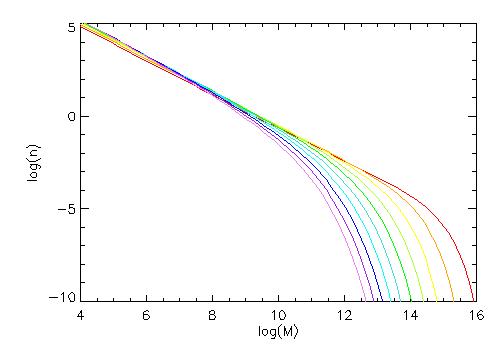
Anyway, courtesy of my estimable PhD student Jo Short, this is how the mass function of haloes is predicted to evolve in the standard cosmological model (the different lines show the distribution as a function of redshift for redshifts from 0 to 9):

It might be easier to see what’s going on looking instead at this figure which shows Mn(M) instead of n(M).

You can see that the typical size of a halo increases with decreasing redshift, but it’s only at really high masses where you see a really dramatic effect.

The mass of the black hole responsible for the recently-detected high-redshift quasar is estimated to be about 2 \times 10^{9} M_{\odot}. But how does that relate to the mass of the halo within which it resides? Clearly the dark matter halo has to be more massive than the baryonic material it collects, and therefore more massive than the central black hole, but by how much?

This question is very difficult to answer, as it depends on how luminous the quasar is, how long it lives, what fraction of the baryons in the halo fall into the centre, what efficiency is involved in generating the quasar luminosity, etc.   Efstathiou and Rees argued that to power a quasar with luminosity of order 10^{13} L_{\odot} for a time order 10^{8} years requires a parent halo of mass about 2\times 10^{11} M_{\odot}.

The abundance of such haloes is down by quite a factor at redshift 7 compared to redshift 0 (the present epoch), but the fall-off is even more precipitous for haloes of larger mass than this. We really need to know how abundant such objects are before drawing definitive conclusions, and one object isn’t enough to put a reliable estimate on the general abundance, but with the discovery of this object  it’s certainly getting interesting. Haloes the size of a galaxy cluster, i.e.  10^{14} M_{\odot}, are rarer by many orders of magnitude at redshift 7 than at redshift 0 so if anyone ever finds one at this redshift that would really be a shock to many a cosmologist’s  system, as would be the discovery of quasars at  redshifts significantly higher than seven.

Another thing worth mentioning is that, although there might be a sufficient number of potential haloes to serve as hosts for a quasar, there remains the difficult issue of understanding how precisely the black hole forms and especially how long that  takes. This aspect of the process of quasar formation is much more complicated than the halo distribution, so it’s probably on detailed models of  black-hole  growth that this discovery will have the greatest impact in the short term.

Bright and Early

Posted in The Universe and Stuff with tags , , , , , , on June 29, 2011 by telescoper

Some interesting astronomy news emerged this evening relating to a paper published in 30th June issue of the journal Nature. The press release from the European Southern Observatory (ESO) is quite detailed, so I’ll refer you there for the minutiae, but in a nutshell:

A team of European astronomers has used ESO’s Very Large Telescope and a host of other telescopes to discover and study the most distant quasar found to date. This brilliant beacon, powered by a black hole with a mass two billion times that of the Sun, is by far the brightest object yet discovered in the early Universe.

and the interesting numbers are given here (with links from the press release):

The quasar that has just been found, named ULAS J1120+0641 [2], is seen as it was only 770 million years after the Big Bang (redshift 7.1, [3]). It took 12.9 billion years for its light to reach us.

Although more distant objects have been confirmed (such as a gamma-ray burst at redshift 8.2, eso0917, and a galaxy at redshift 8.6, eso1041), the newly discovered quasar is hundreds of times brighter than these. Amongst objects bright enough to be studied in detail, this is the most distant by a large margin.

When I was a lad, or at least a postdoc, the most distant objects known were quasars, although in those days the record holders had redshifts just over half that of the newly discovered one. Nowadays technology has improved so much that astronomers can detect “normal” galaxies at even higher redshifts but quasars remain interesting because of their extraordinary luminosity. The standard model for how a quasar can generate so much power involves a central black hole onto which matter falls, liberating vast amounts of gravitational energy.

You can understand how efficient this is by imagining a mass m falling onto a black hole of Mass M from a large distance to the horizon of the black hole, which is at the Schwarzschild radius R=2GM/c^2. Since the gravitational potential energy at a radius R is -GMm/R the energy involved in bringing a mass m from infinity to the horizon is a staggering \frac{1}{2} mc^2, i.e. half the rest mass energy of the infalling material. This is an overestimate  for various reasons but it gives you an idea of how much energy is available if you can get gravity to do the work; doing the calculation properly still gives an answer much higher than the amount of energy that can be released by, e.g., nuclear reactions.

The point is, though, that black holes aren’t built in a day, so if you see one so far away that its light has taken most of the age of the Universe to reach us then it tells us that its  black hole must have grown very quickly. This one seems to be a particularly massive one, which means it must have grown very quickly indeed. Through observations like this  we learn something potentially very interesting about the relationship between galaxies and their central black holes, and how they both form and evolve.

On the lighter side, ESO have also produced the following animation which I suppose is quite illustrative, but what are the sound effects all about?