Archive for BrExit

We and They

Posted in Biographical, Literature, Politics with tags , , , , , , on November 25, 2018 by telescoper

All good people agree,
And all good people say,
All nice people, like Us, are We
And every one else is They.

(from `We and They‘, by Rudyard Kipling.)

A few days ago one of my colleagues here in Maynooth mentioned that he found it amusing that, although I’ve been living and working here in Ireland for less than a year, I have already taken to referring to the British as `They’ rather than `We’. He went on to point out that he noticed this transformation from First Person to Third Person some months ago.

I hadn’t realised that I was doing this, but I suppose it is a reflection of the fact that I have accepted that I will almost certainly be spending the rest of my working life in Ireland, and will probably end my days here too. It has taken relatively little time of observing Britain from the other side of the Irish Sea to recognize that it is changing into something grotesque and horrible. I want no part of what it is becoming, a squalid xenophobic rathole run by crooks, liars, and narrow-minded bigots. My new home is far from perfect, but it’s a damn sight better than Brexit Britain.

About a year ago I wrote (from Cardiff) about my reasons for moving to Maynooth. Here is a quote:

Because I’ve lived here all my life I thought I would find it difficult to leave Britain. I was quite traumatised by the Brexit referendum, as one would be by the death of a close relative, but it made me re-examine my life. There is a time when you have to move on, and that’s what I’m doing. I’m done here.

I haven’t changed my mind.

Not that I now consider myself fully Irish. Passport and citizenship notwithstanding, I still feel like a foreigner here and probably always will. I lived for over fifty years in Britain and do not have sufficient experience of Ireland to feel really part of it. Yet. That may come. But to appropriate the phrase Theresa May used in her Lancaster House speech last year I am proud to be for the time being, and perhaps forever, a `Citizen of Nowhere’. I don’t mind that, and a little bit of autobiography that might explain why I see things the way I do.

I was born in Wallsend (on Tyneside) in the North East of England. My parents were both born just before World War II started, also in the area where I was born. Of my four grandparents, one was born in England, one in Northern Ireland, one in Scotland, and one in Wales. I always smile when I had to put my nationality on a form, because I always put `United Kingdom’. Of course being born in England makes me English too, but I find that less defining than `UK’ or `British’ or even `Geordie’, and now of course there’s the Irish dimension. To be honest, my ancestry means that I generally find the whole concept of nationality fundamentally silly. I find nationalism silly too, except for those occasions – regrettably frequent nowadays – when nationalism takes on the guise of xenophobia. Then it is truly sinister. Nationalism is a tool by which unscrupulous individuals whip up hatred for political gain, regardless of the economic or social consequences. This is what lies behind Brexit.

Anyway, talking about Theresa May, it appears that the Prime Minister has written a letter to the British public asking for them to support her `deal’. I find it very curious that she has done this when, without another referendum or a General Election, the British public is denied any way of either expressing or withholding such support. Is this an admission that there will have to be another vote?

It appears from her letter that the PM is particularly happy about one aspect of the deal:

We will take back control of our borders, by putting an end to the free movement of people once and for all.

Apart from the fact that the UK always had control of its borders anyway, I find it absolutely astonishing that any politician could brag about removing from its own citizens the right to free movement across 27 countries. Freedom of movement was and is one of the great benefits of the European Union. Outside the EU, Theresa May’s `hostile environment’ in which all foreigners are viewed with suspicion and contempt will become even more hostile. It is just a matter of time before the unlawful deportations that the Home Office have inflicted on members of the Windrush generation will begin happening to Europeans currently living in the United Kingdom.

Towards the end of her awful letter, there is this:

We will then begin a new chapter in our national life. I want that to be a moment of renewal and reconciliation for our whole country. It must mark the point when we put aside the labels of ‘Leave’ and ‘Remain’ for good and we come together again as one people.

Excuse me, but the time for reconciliation was in the immediate aftermath of the 2016 Referendum result. Instead, Mrs May went out of her way to insult, denigrate and marginalize everyone who voted Remain; she never apologized for the `Citizens of Nowhere’ jibe and her pals in the right-wing added other pejoratives like ‘saboteur’ and ‘enemy of the people’. Like so many other things she says and does, Mrs May’s letter is so phony it is painful.

Worse, the Prime Minister has continued to insult European citizens working in the UK by accusing them of `jumping the queue’. It seems that the Prime Minister just can’t stop her deep-seated xenophobia showing itself from time to time. It’s her defining characteristic, and it is sure to be the defining characteristic of post-Brexit Britain.

What are we going to do now?

Posted in Politics, Television with tags , on November 15, 2018 by telescoper

On this tumultuous day in British politics, this blog is proud to be able to show exclusive behind-the-scenes footage of the Cabinet discussions at Number 10 Downing Street:

Dean’s Lecture – Prof. AC Grayling

Posted in Politics with tags , , on October 11, 2018 by telescoper

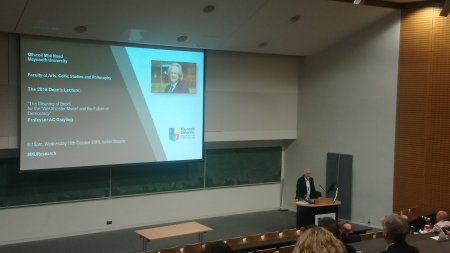
Just a quick note to mention that yesterday evening I attended the annual Dean’s Lecture in the Faculty of Arts, Celtic Studies and Philosophy at Maynooth University. This year it was delivered by the renowned philosopher Professor A.C .Grayling and was on the subject of The Meaning of Brexit for the ‘Westminster Model’ and the Future of Democracy. It was a fascinating talk, that involved a historical survey of the development of Parliamentary democracy in the UK (and elsewhere) in the light of the ongoing Brexit fiasco, ending with the case for a `People’s Vote’ as the only likely way out of the current impasse.

You can find a longer review of the lecture by a fellow Maynooth blogger here.

It was also pleasant to have the chance to have a brief chat with the speaker over a glass of wine at a reception after the lecture. Professor Grayling seems a very nice chap! I just wish I shared his optimism. I hope I’m proved wrong, but I fear that things are going to get very nasty in Britain very soon.

The Brexit Wormhole

Posted in Politics, The Universe and Stuff with tags , , , on October 2, 2018 by telescoper

Since I have been passed over yet again for the physics Nobel Prize, I thought I’d pull out all the stops for next year and reveal my latest research which will surely satisfy the necessary criteria by conferring the “greatest benefit on mankind”.

One of the concerns facing those hoping to be involved in trade between post-Brexit Britain and the civilized world is the necessity of customs checks, especially at Dover, which will bring gridlock to the M20 and jeopardize the `just-in-time’ delivery systems used by most modern manufacturing enterprises e.g. the car industry.

My solution to this problem is to install at Dover a series of Einstein-Rosen Bridges (as illustrated above), connecting the United Kingdom to various points in the space-time continuum. Travelling through traversible wormholes will effectively allow British lorries to reach superluminal velocity, thereby not only avoiding delays on the M20 but also allowing goods to be delivered even before they have been ordered.

I am willing to lease the Brexit Wormhole device to representatives of the UK government for the modest fee* of £350 million per week, in the hope that the extent of this generosity will put me in line for the Nobel Peace Prize in addition to the Nobel Prize for Physics.

*Payment to be made in Euros only please.

In addition to fulfilling this important geopolitical function, it will also be possible for wealthy individuals to lease smaller versions of the device for their own use, e.g. Mr Rees-Mogg may be interested in using one to travel back in time to the 18th Century.

P.S. As if the Brexit wormhole were not enough to garner these prestigious awards, I can further announce that I have found a most marvelous solution of the Irish Border Problem but this blog post is too narrow to contain it.

On the Plural of Referendum

Posted in Pedantry, Politics with tags , , , , on September 5, 2018 by telescoper

Quite a few people are suggesting that one way out of the current Brexit fiasco is to have another referendum when the terms of the withdrawal agreement (if any) are known. Bafflingly, Theresa May has argued that a second plebiscite would be `a betrayal of democracy’ and has categorically ruled out that possibility. Given her U-turn about last year’s General Election one might reasonably infer that a second referendum is now a racing certainty, but she called the election because she was confident she would win. All the signs are now that if given a chance to vote again the UK would vote to remain in the European Union, so the PM will need a very hard push to allow a second referendum.  A smart politician would have used the evidence of electoral misconduct by the Leave campaigns as a way out, but we’re not dealing with smart politicians on either side of the House nowadays.

Whether or not there is a second referendum an important question arises from the possibility, i.e. what is the proper plural of “referendum”?

Regular readers of this blog know that I’m never pedantic about such matters. Well, maybe a little bit, sometimes. Latin was my best subject at O-level, though, so I can’t resist making a comment.

Any dictionary will tell you that “referendum” is obtained from the Latin verb referre which is itself formed as re- (prefix meaning “back”) + ferre (to carry), thus its literal meaning is “carry back” or, more relevantly to the current discussion, “to refer”. Ferre is actually an irregular verb, which complicates the discussion a bit, so I’ll use simpler examples of regular verbs below

Latin grammar includes two related concepts derived from a verb, the gerund and the gerundive.

The gerund is a verbal noun; such things exist in English in forms that mean `the act of something’, e.g. running, eating, loving.The word formed from a verb with the ending `ing’ can also function as a present participle in English, but we wont be going there. It may easy to muddle up gerunds with participles in English, but not in Latin as they are formed in distinctly different ways.

IAs an example, in the case of `loving’ the  relevant Latin verb is the first conjugation amare (amo amas amat and all that) and the appropriate gerund is amandus. You can this sort of Latin construction surviving in such English words as “graduand”. Note, however, that a gerund has no plural form because that would make no sense in Latin. There are plural forms in English such as `doings’ and `comings and goings’ but I don’t think these are relevant here as I interpret them as jocular, and pedantry is a very serious business. Moreover

Related to the gerund is the gerundive which, as its name suggests, is an adjectival form related to the gerund, specifically expressing necessity. In Latin, an adjective takes an ending that depends on the gender of the noun it describes; the gerundive also follows this pattern.

In the loving example above, the gerundive form is amandus in a masculine case or, if referring to a female entity, amanda, hence the name Amanda, which means “deserving or requiring love”, or amandum for a neuter noun. In cases where the noun is plural the forms would be amandi, amandae, and amanda. Endings for other gerundives formed from other verbs are constructed in a similar fashion depending on their conjugation.

From this discussion you can see that in Latin amandum could mean either “loving” (gerund) or “a thing to be loved” (gerundive). Latin grammar is sufficiently precise, however, that the actual meaning will be obvious from the context.

As an aside, based on my own experiences in mathematics and physics, the abbreviation `QED’ which is often placed at the end of a proof is short for `Quod Erat Demonstrandum’, meaning `which was required to be shown’ rather than `Quite Easily Done’.  I’m surprised how many people use QED without knowing what it means!

Now, back to referendum. It seems clear to me that this is a gerundive and thus means “a thing to be referred” (the thing concerned being of no gender, as is normal in such cases in Latin). So what should be the word for more than one referendum?

Think about it and you’ll realise that referenda would imply “more than one thing to be referred”. The familiar word agenda is formed precisely this way and it means “(a list of things) to be done”. But this is not the desired meaning we want, ie “more than one example of a thing being referred”.

I would therefore argue that referenda is clearly wrong, in that it means something quite different from that needed to describe more than one of what a single referendum is.

So what should we use? This is a situation where there isn’t a precise correspondence between Latin and English grammatical forms so it seems to me that we should just treat referendum as an English noun and give it the corresponding English plural. So “referendums” it is.

Any questions?

P.S. In a forthcoming post I shall give the full conjugation of the verb brexire, as brexit must be formed from that verb  in the same way that exit is formed from exire (i.e. third person singular in the active voice; exire is an irregular verb but basically similar to fourth conjugation). On this basis the gerund of brexire would be brexeundum and the gerundive brexeundus

Farewell to Brexit Britain

Posted in Biographical, Politics with tags , , on July 23, 2018 by telescoper

I popped into the office at Cardiff University today to finish off one piece of outstanding business I didn’t have time to complete on Friday and to collect the last of my possessions – including a number of bottles of wine! – before flying to Ireland tomorrow morning.

I couldn’t resist doing a quick post about the chaotic state of UK politics towards Brexit. For all the turmoil of the past two weeks, In a sense nothing has changed since I wrote about this almost exactly a year ago. The so-called `Chequers Plan’ was greeted with predictable disdain by the EU negotiators who must be exasperated that Theresa May seems not to have understood anything that’s said about the European Single Market for the last two years, as well as signalling that she wanted to renege on agreements already reached in December. And then we had the new Brexit Secretary, Dominic Raab, announcing that he intended that the UK would not pay its outstanding bills if a Trade Deal were not agreed, despite the UK having agreed to this months ago too.

All this is consistent with what I have always felt would be this government’s approach to the Brexit negotiations, which is not to negotiate at all. Their plan, as it has always been, is just to go through the motions until they able to find some pretext to storm out, blaming the EU for trying to bully them. The staged walkout will probably happen in October, after a summer media offensive against the EU supported by propaganda pieces in the Daily Express, Mail and Telegraph. That is, I believe, the Government’s plan. The new Foreign Secretary more or less said so today. It is why Theresa May called a snap election, hoping to build up a larger majority and a full parliamentary term to withstand the inevitable backlash. That gamble backfired, but the Conservatives are still in power and the plan remains in place.

This strategy might just allow the Tories to cling onto power while the economy suffers as we crash out of the EU in the most disorderly fashion possible. This will not only cause chaos for trade and commerce but will also be awful for for EU residents in the UK and UK residents in the EU. Above all, it will show that the UK government has not been acting in good faith at all throughout the process, and will ensure for generations to come that the United Government is entirely untrustworthy. And that’s before you even consider the fact that the 2016 referendum has now been demonstrated beyond all reasonable doubt to have been crooked, due to unlawfully excessive spending by both Leave campaigns, and other dirty tricks such as illegal use of personal data.

So why has the Government decided to adopt this position? Simple. It does not have the wherewithal even to formulate a negotiating position, let alone deliver a successful outcome., because no possible end result can deliver the economic and political benefits of remaining in the European Union. If we’re going to make people suffer, the reasoning goes, we might as well find a scapegoat to deflect criticism away from our poor choices.

And what about the EU position? Well, they hold all the cards so they won’t be worried. Their priority will be to take over all the business opportunities that we have decided we no longer want. Whatever happens with the negotiations, the UK leaves the EU in March 2019. That’s plenty of time for EU companies to relocate their operations to mainland Europe, to write British producers out of their supply chains, and to expand its portfolio of trade agreements to the further disadvantage of the UK economy, like it has recently done with Japan.

The UK government views my new home, Ireland, as the Achilles Heel of the European Union. Things could get very tough in the Republic when the UK crashes out of the EU, no doubt to the delight of the Tory party’s henchmen in the DUP. But even if that is the case I’d much rather be living in Ireland than in Brexit Britain. Just as a xenophobic backward-looking insular and authoritarian agenda grips the UK, Ireland is moving in the opposite direction, towards a modern outward-looking progressive liberal democracy.

Oh, and if you’re an academic who is as fed up with the UK as I am, take a look at Science Foundation Ireland’s Future Research Leaders scheme. Maynooth University is particularly keen to welcome applicants to the Scheme!

Hands off the Good Friday Agreement!

Posted in Biographical, Politics with tags , , , , , , on February 22, 2018 by telescoper


I’ve been watching with increasing alarm the concerted attempt that certain extremist `Brexiteers’ have been trying to make a case for scrapping the Good Friday Agreement that came about in 1998 after decades of violent conflict in Northern Ireland and elsewhere.  These reckless fools think that derailing the peace process is a price worth paying for their ideological obsession with rejecting anything that involves the EU, in this case the Customs Union that allows an open border between the Republic of Ireland (whose future lies in the vibrant and outward-looking European Union) and Northern Ireland (which will remain shackled to the corpse of the United Kingdom, at least for the time being, until the creation of a united Ireland…). Not surprisingly, Irish politicians and the Irish are incensed about the reckless statements being made by some UK politicians.

Incidentally, the Good Friday Agreement was supported by simultaneous referendums in Northern Ireland (71.1% in favour) and the Republic  of Ireland  (94.4% in favour) ; a majority of the NI electorate also voted against leaving th European Union.  It’s strange how selectively some people are prepared to accept `The Will of the People’…

Anyway, just as a reminder of what is at stake, here are three examples based on my own experiences of what things were like before the GFA, when I lived in London (which I did for about eight years, between 1990 and 1998). During that time I found myself in relatively close proximity to three major bomb explosions, though fortunately I wasn’t close enough to be actually harmed. I also concluded that my proximity to these events was purely coincidental.

The first, in 1993, was the Bishopsgate Bombing. I happened to be looking out of the kitchen window of my flat in Bethnal Green when that bomb went off. I had a clear view across Weavers Fields towards the City of London and saw the explosion happen. I heard it too, several seconds later, loud enough to set off the car alarms in the car park beneath my window.

This picture, from the relevant Wikipedia page, shows the devastation of the area affected by the blast.

The other two came in quick succession. First, a large bomb exploded in London Docklands on Friday February 8th 1996, at around 5pm, when our regular weekly Astronomy seminar was just about to finish at Queen Mary College on the Mile End Road. We were only a couple of miles from the blast, but I don’t remember hearing anything and it was only later that I found out what had happened.

Then, on the evening of Sunday 18th February 1996, I was in a fairly long queue trying to get into a night club in Covent Garden when there was a loud bang followed by a tinkling sound caused by pieces of glass falling to the ground. It sounded very close but I was in a narrow street surrounded by tall buildings and it was hard to figure out from which direction the sound had come from. It turned out that someone had accidentally detonated a bomb on a bus in Aldwych, apparently en route to plant it somewhere else (probably King’s Cross). What I remember most about that evening was that it took me a very long time to get home. Several blocks around the site of the explosion were cordoned off. I lived in the East End, on the wrong side of sealed-off area, so I had to find a way around it before heading home. No buses or taxis were to be found so I had to walk all the way. I arrived home in the early hours of the morning.


Does anyone really  want to go back to experiencing this kind of event on a regular basis? If  the UK government is persuaded in its weakness to ditch the Good Friday Agreement then there is a real risk of that happening. And if it does, those calling for it will have blood on their hands.


Hypocrisy Illustrated

Posted in Politics with tags , , , on January 3, 2018 by telescoper

The playwright Alan Bennett recently said that “England excels at one thing…hypocrisy”. If you needed any evidence that he was right, take a look at these results from a 2014 COMRES survey:

Why I’m moving to Ireland

Posted in Biographical, Education with tags , , , , , , , , , on December 20, 2017 by telescoper

Over the past few weeks quite a number of people have asked me why I decided to move to Ireland, so thought I’d write a post about it in case anyone out there is interested.

The simple answer that I was offered a full-time permanent and rather well paid job at Maynooth University. I’m currently on a part-time fixed term contract at Cardiff University.  The salary wasn’t the main factor, but the low value of the £ relative to the € means that I will do quite well financially out of the move. On top of that I will be joining a final salary pension scheme which has far more favourable terms that the scheme that applies to UK academic staff. Oh, and there’s neither a Research Excellence Framework nor a Teaching Excellence Framework nor a Knowledge Exchange Framework nor punitive levels of student tuition fees nor any of the many other  idiocies that have been inflicted on UK universities in recent years. It will be a relief to be able to teach and do research in environment which, at least for the time being, regards these as things of value in themselves rather than as means of serving the empty cycle of production and consumption that defines the modern neoliberal state. Above all, it’s a good old-fashioned professorship. You know, teaching and research?

That’s the simple answer, but there’s a bit more to it than that. I left Sussex in 2016 with the intention of taking early retirement as soon as I could do so. My short exposure to  a role in senior management, as Head of the School of Mathematical and Physical Sciences at the University of Sussex, convinced me that I didn’t want to spend the rest of my life  in a system that I felt had lost all sight of what universities are and what they are for. I was (and still am) deeply grateful to Cardiff University for throwing me a lifeline that enabled me to escape from what I increasingly saw as a dead-end job, and giving me an interesting job to do to tide me over until next year, when I am 55 and therefore eligible for early retirement.

I think I have done everything that was asked of me in my current position at Cardiff, on a half-time salary but often up against very short timescales. The two MSc courses I was brought in to set up are both now running and looking to expand. On top of that we also managed to secure funding for a Centre for Doctoral Training. I only played a small part in doing that, but I think it has put the Data Innovation Research Institute on the map.  When both of these successes had been secured earlier this year, I felt that there was no way that leaving now would have a negative effect either on the Data Innovation Institute or the School of Physics & Astronomy. By about April this year I had firmly decided to retire completely from academia in mid-2018.

The problem with this plan had been apparent since 2016: Brexit.  I think it’s still quite possible that the Brexit project will fail under the weight of its own contradictions, but that no longer matters. The damage has already been done. The referendum campaign, followed by the callous and contemptuous attitude of the current UK Government towards EU nationals living in Britain, unleashed a sickening level of xenophobia that has made me feel like a stranger in my own country. Not everyone who voted `Leave’ is a bigot, of course, but every bigot voted for Brexit and the bigots are now calling all the shots. There are many on the far right of UK politics who won’t be satisfied until we have ethnic cleansing. Even if Brexit is stopped the genie of intolerance is out of the bottle and I don’t think it well ever be put back. Brexit will also doom the National Health Service and the UK university system, and clear the way for the destruction of workers’ rights and environmental protection. The poor and the sick will suffer, while only the rich swindlers who bought the referendum result will prosper. The country in which I was born, and in which I have lived for the best part of 54 years, is no longer something of which I want to be a part.

So, having spent most of my working life in the UK higher education system and decided that my heart was no longer in that, I then had to face that my heart was no longer in this country at all. Could I face years of retirement in mean-spirited down-market Brexit Britain? What was I to do?

I’ve mentioned many times on this blog how lucky I have been that opportunities have come along at exactly the right time. In May, a friend pointed out the advertisement for a job in Maynooth with an application deadline just a few days away. Cosmology was specifically mentioned as one of the possible areas. I felt that they would probably be looking for someone younger, and my research output over the last few years has been patchy given my other commitments, but at the last minute I sent off an application.

Ireland has a particularly strong attraction for me because I have Irish ancestry through which I am eligible for citizenship without having to go through the naturalisation process (which takes 5 years, still less than many EU countries). Together with an Irish EU passport comes a continuation of the rights – especially freedom of movement – that UK citizens will shortly lose.

It seemed like outrageously good luck that the position in Maynooth came up just at the right time, but the end of July came and went without any news. I assumed I hadn’t been shortlisted, so forgot about the idea.

Then, in September I received a letter inviting me for interview just a couple of weeks later. I’m not sure why the process was  so delayed, but was overjoyed to find out there was still a chance. The date clashed with a prior commitment, so I had to do the interview via Skype (over a flaky internet connection from a hotel room) rather than in person.  I thought it went very badly, but I ended up being offered the job. I visited Maynooth University shortly after being informed of this, to discuss terms.

The people at Maynooth were keen to have me start there as soon as possible, but given the lateness of the interview date I had already committed to teaching in Cardiff this forthcoming Semester and I wasn’t going to leave my current colleagues and students in the lurch. There was an obvious solution, however. I am employed here at 50% FTE so I could start in Maynooth at up to 50% without having to resign. We quickly agreed this transitional arrangement was workable, and I started there on 1st December.  The period from February to April will be very busy, as I will be working either side of the Irish Sea, but it’s only for a relatively short time. Next summer I plan to relocate completely to Ireland.

You probably think I’m a bit old to be starting a new life in another country, even one that’s relatively nearby, but I reckon I have time for this one last adventure before I retire. In the words of Tennyson’s Ulysses, `It is not too late to seek a newer world’.  I have worked in British universities since 1988. That’s almost 30 years. I reckon I can still contribute something in the last 10 I have before I pull down the shutters for good. Who knows, maybe I’ll even experience the joy of living in a United Ireland before long?

The press have covered a number of stories of EU nationals who have been living in Britain and who have decided to leave because of Brexit. Surprisingly little attention has been paid to those, like myself, who are also EU nationals but who happen have been born in Britain. I know more than a few academics who are weighing up their options, as well as those born abroad I know who have already departed.  The Brexodus has already begun and its pace seems likely to accelerate very quickly indeed. Others have personal situations that are more complicated than mine, especially those who have partners and children, so not everyone will find it easy to follow a similar path to the one I’ve chosen, but I those that can get out will do so.

Because I’ve lived here all my life I thought I would find it difficult to leave Britain. I was quite traumatised by the Brexit referendum, as one would be by the death of a close relative, but it made me reexamine my life. There is a time when you have to move on, and that’s what I’m doing. I’m done here.

Problems with two-year degrees

Posted in Education with tags , , , , , on December 13, 2017 by telescoper

I see that the Minister responsible for UK universities, Jo Johnson, has decided that universities should offer two-year degrees, claiming that this will somehow attract more students into higher education.

The idea seems to be that students will get the same `amount’ of teaching, but concentrated in two full calendar years rather than spread over three academic years. This fast-track degree will be offered at a lower level of fee than a normal three-year Bachelors programme.

I can just about accept that this will work in some disciplines and at some universities. The (private) University of Buckingham, for example, already offers such programmes. On the other hand, the University of Buckingham did not participate in the latest Research Excellence Framework, no doubt for the reason that teaching all-year round leaves its academic staff no time to do research or even attend conferences, which (I find) these days is only possible during the summer recess.

Call me old-fashioned, but I think an institution that does not combine teaching and research – and indeed one in which the teaching is not led by research – does not merit the name of `University’. The old polytechnics offered a range of valuable opportunities that complemented the traditional honours degree, but that capacity was basically eliminated in 1992 when all such institutions became universities.

Though my main objection to two-year degrees is their impact on research, there are problems from the teaching side too. One is that keeping up the intensity of full-time study throughout a whole year will, in my opinion, exacerbate the difficulty many students have managing their workload without stress or other mental health difficulties. Moreover, many students currently use the long summer vacation either to work, either to earn money to help offset the cost of study, or to participate in placements, internships or other activities to help make them more employable after graduation.

It would be particularly difficult to manage two-year degrees in STEM disciplines, as the teaching laboratories need maintenance and installation of new equipment, for which the proposed system allows no time. And how would project work fit into the fast-track system? On top of all that there’s the fact that the current fee level does not cover the cost of teaching in STEM disciplines, so having to do it faster and for less money is not going to be possible. Incidentally, many STEM students currently pursue undergraduate programmes that last four years, not three…

These points have no doubt been made before, but there is another point that is less widely understood. The fact is that a two-year Bachelors degree may not be a recognised qualification outside the UK. This is, in fact, already a problem with the four-year undergraduate programmes we call, e.g., MPhys, and regard as Masters level in this country: these are not regarded as Masters qualifications in many European countries. Perhaps this is part of some cunning plan to stop graduates leaving the UK after Brexit?

In the light of these difficulties it is no surprise to me that not a single undergraduate I’ve spoken to thinks that a two-year degree is a sensible option. If the government wants to make studying cheaper, said one Physics student I was chatting to, why don’t they just cut the fees for normal degree programmes?

The impression one gets from all this `thinking’ is that the Government increasingly regards universities as businesses that trade in a commodity called `education’, where the word ‘education’ is narrowly construed as `training’ in the skills needed for future employment. I believe a University education is (or should be) far more about developing critical thinking, problem-solving ability, intellectual curiosity than it is about teaching them, e.g., programming skills. Skills are important, of course, but we also need to educate students in what to use them for.