Archive for BrExit

The Days of the Double Bind

Posted in Biographical, Literature, Politics with tags , , , , , , , on December 5, 2017 by telescoper

The last few days I’ve been trying to deal with the sort of apparently insoluble problem usually called a double bind, similar to the logical paradox which provided the central plot device of Joseph Heller’s classic novel Catch-22. I’ve seen this particular double bind happen to so many colleagues from abroad wanting to work in the United Kingdom that in a sense it’s quite reassuring that the same thing happens in much the same way in other countries too, specifically Ireland.

The problem facing me is that I need to find somewhere to rent temporarily in Maynooth until I can find longer-term accommodation (i.e. by buying a house). As convenient as St Patrick’s College is as a short-term residence, it’s not somewhere I would want to live for weeks and months. The trouble is that in order to secure private rented accommodation you need to prove that you are able to pay the rent, which generally means having a bank account. On the other hand, in order to open a bank account you need to have proof of an address. No address, no bank account and no bank account, no address.

This is not exactly the same as Heller’s Catch-22 (which is basically that an airman can’t be discharged from military service on grounds of being insane because his wanting to be discharged from military service means that he can’t actually be insane), but it belongs to the same broad class of logical quandaries where there appears to be no solution.

Although it’s quite intimidating to be put in a seemingly impossible position, Robert M. Persig’s Zen and the Art of Motorcycle Maintenance offers a way out: you just need to `unask the question’, and proceed in a way that denies the (binary) premises on which the conundrum is based. Engaging in a bit of lateral thinking, calling on the assistance of influential bodies, and employing a bit of gentle persuasion you often find that what look initially like hard rules turn out to have a surprising degree of flexibility.  Anyway, to cut a long story short, and with fingers crossed, I should have my bank account and place of residence both sorted out before I return to Cardiff on Thursday.

For me of course this isn’t anything like a life-or-death situation. I have been around long enough not to let bureaucracy get to me. Things like this seem very serious at the time, but there’s always a way to resolve the, usually because there are still some reasonable people in the world. And I am lucky. I can cope with the uncertainty and frustration of being in a double bind as I have resources to fall back on if there are problems. It would no doubt have been more difficult had I just arrived in the country as a recent graduate with no savings. I’ve seen many others at all kinds of stages in their career go through a similar impasse and, though it’s troublesome, such things invariably sort themselves out in time. Still, it’s nice to get such things settled sooner rather than later.

Thinking about this as I listened to the radio this morning, I was struck by another, much larger, more important, and slightly more complex, paradox. That is the inability of the UK government to find a solution to the Irish border problem in the Brexit negotiations. In essence, the nature of this pickle is that the EU insists (as it always said it would) that there should be no hard border between Northern Ireland and the Republic of Ireland. That is possible if the UK leaves the EU but seems to require that Northern Ireland  remains in  the Single Market and Customs Union in some form. However, the PM has insisted that the United Kingdom must leave the Single Market and Customs Union. Moreover, the Democratic Unionist Party, which is propping up the Conservative government, insists (as it always said it would) that Northern Ireland should not be treated differently from the rest of the UK. If cast in these terms, there seems to be no solution to the problem.

Incidentally, and I now digress, here is a map showing the Four Provinces of Ireland, together with the current border:
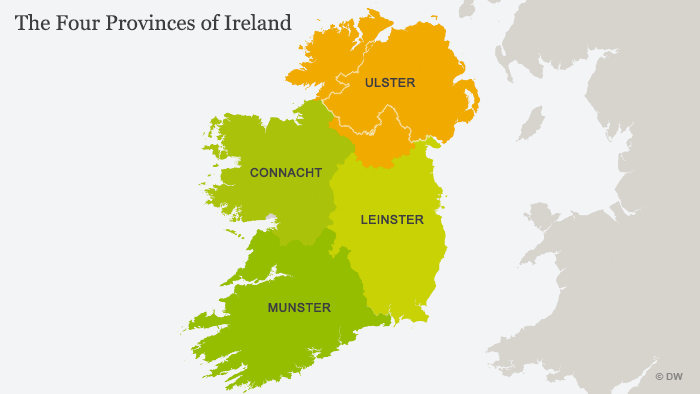
These are historical divisions and nowadays have no political or administrative role, but I think the map is interesting because it shows, if you didn’t know it before, that: (a) the current Irish border does not coincide with the boundary of Ulster; and (b) the most northerly point of the island of Ireland (Malin Head  on the Inishowen Peninsula, in County Donegal)  is in the Irish Republic, not in Northern Ireland. Maynooth, incidentally, is in Leinster.

Anyway, I think the current stalemate over the Irish Border is the inevitable outcome of one of Theresa May’s `red lines’ which seem to me to make a negotiated settlement impossible a priori. The only option for the Prime Minister seems to me to be to frame the problem another way. One way of making progress would be to abandon the red line on SM and CU membership. I don’t think that will happen as it would look too much like an admission of failure. Another way to do it would be to use gentle persuasion to get the DUP to shift its position. That is more likely, but will prove costly in both political and financial terms.  The best way to unask this particular question is, of course, to abandon the Brexit project altogether. I’m not going to quote odds, but the possibility of the United Kingdom remaining in the European Union is increasing by the day. That won’t affect me directly very much, as I’ll be remaining in the EU come what may.

Physics of the EU – Revised Syllabus

Posted in Politics, The Universe and Stuff with tags , , on October 25, 2017 by telescoper

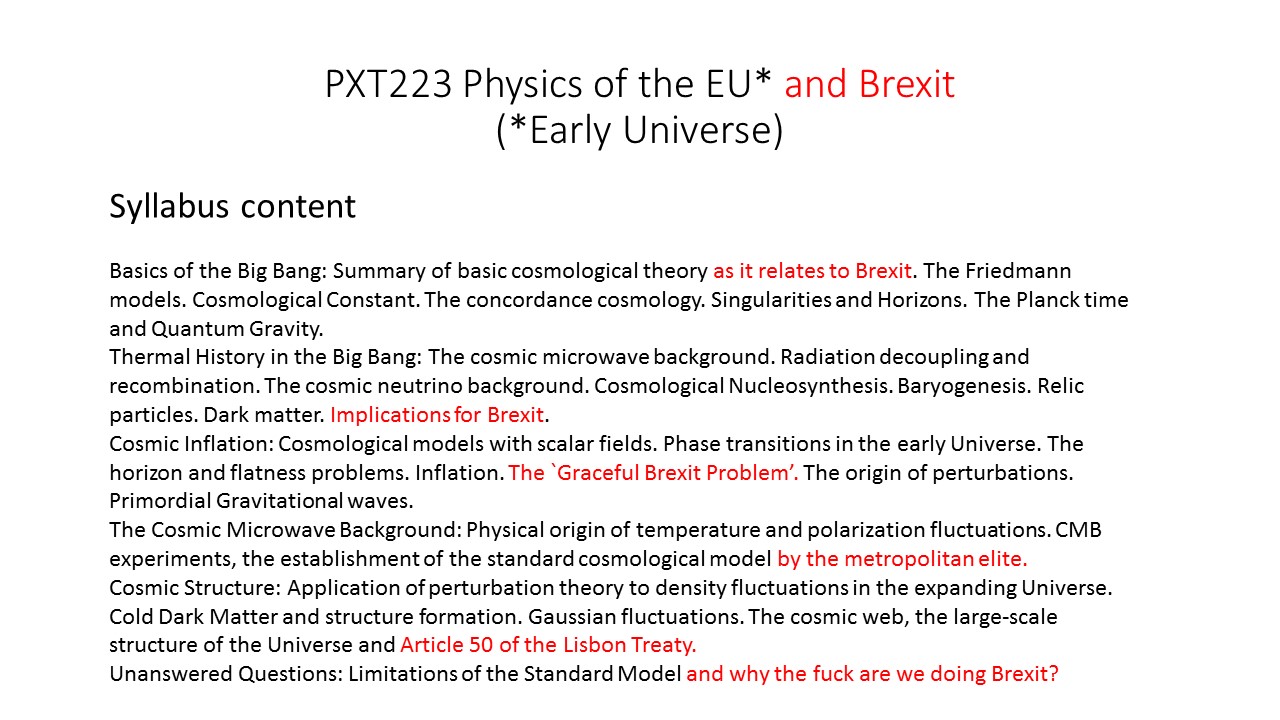
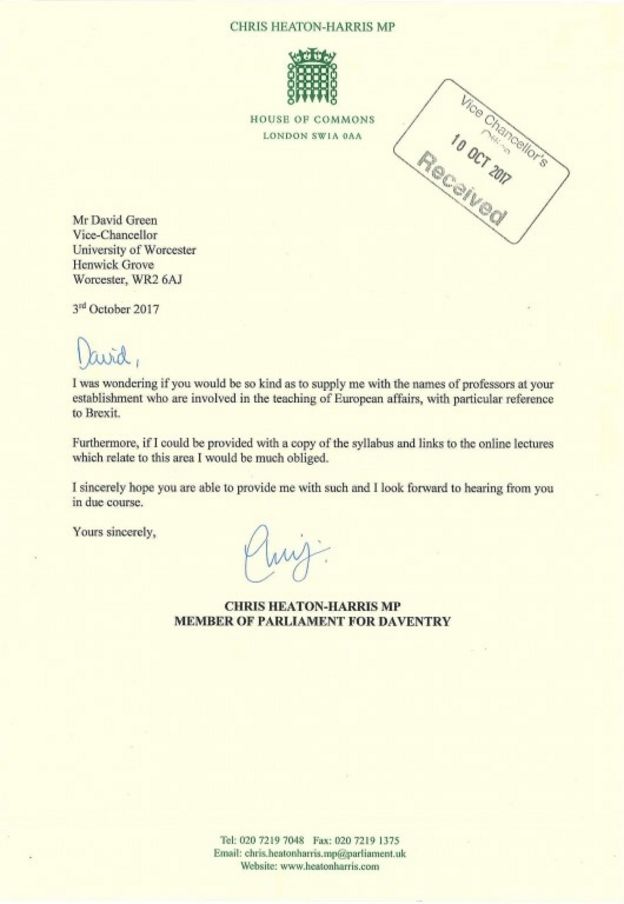
Yesterday, Tory MP Christopher Heaton-Harris wrote to all Vice-Chancellors of UK universities asking them to send him the names of professors teaching about “European affairs” together with links to relevant syllabuses and course materials. There has been an overwhelmingly negative response to this sinister request, which comes from an arch-Brexiteer apparently intent on thought control.

Not wishing to fall foul of the Brexit Police, I have updated my syllabus for next term and include it here so Mr McCarthy Heaton-Harris can read it:

I’m afraid that, for any further information and/or course materials relating to this module, Mr Heaton-Harris will have to register and pay the requisite fee which, thanks to his government is £9250.

P.S. I posted this slide on Twitter yesterday, and it got as close as any of my tweets have ever done to going viral (with over 800 retweets).

Science and Innovation after Brexit

Posted in Politics, Science Politics with tags , , on September 7, 2017 by telescoper

I’ve been busy most of today so I only have a little time for a short post pointing out that the long-awaited `position paper’ about collaboration on science and innovation between the UK and EU after Brexit has now been published. Those of you intending to remain in the United Kingdom if and when it leaves the European Union might be interested in reading it. I say `might be’ rather than `will be’ as it doesn’t really say anything concrete about anything.

Here’s the overall summary:

In preparing to leave the EU, one of the UK’s core objectives is to “seek agreement to continue to collaborate with European partners on major science, research, and technology initiatives”. It is the UK’s ambition to build on its unique relationship with the EU to ensure that together we remain at the forefront of collective endeavours to improve the world in which we live. The UK believes this is in the joint interest of the UK and EU, and would welcome discussion on how best to shape our future partnership in this area.

The answer to the last bit is, of course, easy. The best way to shape our future partnership in this area is unquestionably for the United Kingdom to remain in the European Union. This document says as much itself. As with most of these papers it consists primarily of a long list of the benefits in this area that the United Kingdom has enjoyed as a direct result of our membership of the European together with a desire to keep most of them after our departure. It offers no real ideas as to how to square the many circles that would involve. In particular, many EU schemes, including those funded by the European Research Council, depend on the freedom of movement the European Union guarantees. Given the leaked Home Office document outlining how it intends to deter EU citizens from coming here I don’t see how we can possibly remain an attractive destination for scientists, or anyone else for that matter.

Meanwhile, today, Parliament is debating the European Union Withdrawal Bill which, if passed, would give the Government sweeping powers – the so-called `Henry VIII’ powers – to bypass Parliament and directly repeal or amend any law it doesn’t like the look of without debate. This is exactly the right-wing power grab that many of who voted Remain feared would happen. If this Bill passes without significant amendment then we can say goodbye to our parliamentary democracy. The parallel with the Enabling Act of 1933 that gave absolute power to Adolf Hitler is frightening.

Things Falling

Posted in Finance, Politics with tags , , , , , , on August 3, 2017 by telescoper

A very busy but also very interesting day at the office in the Niels Bohr Institute ended this evening with a thunderstorm, complete with spectacular lightning and torrential rain. I got wet on the walk back to my small home, but I managed to get inside before the worst of it started. I seem to remember a similar thing happened last time I was in Copenhagen. Maybe it’s the time of year.

Anyway, torrential rain isn’t the only thing that’s been falling today. The Pound dropped sharply against the Euro, so it is currently around €1.1069, not far from its lowest point in the last year. That’s not directly relevant to my visit to Denmark, which isn’t in the Eurozone, but the Pound has tumbled against the Danish Kroner too. In fact it’s been falling steadily over the past three months:

At 8.234 Kroner to the Pound, this the worst exchange rate I can remember in all the approximately 30 years I’ve been travelling to Copennhagen. The rate has usually been about 10:1 or even higher. Copenhagen has always seemed a rather expensive place, but converting prices into Pounds at the current exchange rate makes your eyes water. Fortunately I’m getting my local expenses paid by the NBI so the increased cost won’t really affect me, but it’s definitely noticeable. Such is the shambolic state of our government that I wouldn’t bet against the pound reaching parity with the Euro before too long.

Of course one is not allowed to suggest that the falling pound and sluggish economic growth might be something to do with BrExit because that would be `talking the country down’. The worrying thing, though, is that we haven’t left the European Union yet. Just wait until March 2019 when we leave the European Union, together with the Single Market and Customs Union without any trade agreement. Where will the pound be then, I wonder?

The Brexit Non-negotiations

Posted in Politics with tags , , , on July 17, 2017 by telescoper

daviddavis

The above picture was taken in Brussels this morning, it shows British government minister David Davis MP (right, centre of three) and the chief negotiator for the European Union, Michel Barnier (left, centre of three).

Notice that the EU negotiating team has come prepared with stacks of paperwork (probably including the detailed briefing papers that have been published by the European Union). By contrast, the British team have brought no papers at all.

It turns out that David Davis spent just an hour or so in Brussels before returning to London. With the clock ticking on the UK’s departure from the EU you would think that the Minister would want to make full use of the negotiations to secure a good outcome for this country, but by all accounts his team have yet to produce any position papers at all, unless you count the calculatedly mean-spirited `offer’ to EU citizens resident in the UK, which falls well short of what the EU had already tabled some months ago.

So what’s going on?

All this is consistent with what I have always felt would be this government’s approach to the Brexit negotiations, which is not to negotiate at all. Their plan, as it has always been, is just to go through the motions until they able to find some pretext to storm out, blaming the EU for trying to bully them. The most likely time for the staged walkout is in the autumn, probably after the German federal elections.

This gambit will no doubt be supported by propaganda pieces in the Daily Express, Mail and Telegraph and it might just allow the Tories to cling onto power while the economy suffers as we crash out of the EU in the most disorderly fashion possible. Not to mention the chaos it will cause for EU residents in the UK and UK residents in the EU.

That is, I believe, the Government’s plan. It is why Theresa May called a snap election, hoping to build up a larger majority and a full parliamentary term to withstand the inevitable backlash. That gamble backfired, but the Conservatives are still in power and the plan remains in place.

So why has the Government decided to adopt this position? Simple. It does not have the wherewithal even to formulate a negotiating position, let alone deliver a successful outcome. No possible end result can deliver the economic and political benefits of remaining in the European Union. If we’re going to make people suffer, the reasoning goes, we might as well find a scapegoat to deflect criticism away from our poor choices.

And what about the EU position? Well, they hold all the cards so they won’t be worried. Their priority will be to take over all the business opportunities that we have decided we no longer want. Whatever happens with the negotiations, the UK leaves the EU in March 2019. That’s plenty of time for EU companies to relocate their operations to mainland Europe, to write British producers out of their supply chains, and to expand its portfolio of trade agreements to the further disadvantage of the UK economy.

I may of course be completely wrong about this view of how Brexit will pan out, but so far nobody has been able to convince me that I am. You could try, if you like, through the comments box,.


The Irish Question 

Posted in Biographical with tags , , on April 7, 2017 by telescoper

Not surprisingly, given the imminent likelihood of big cuts to UK Astronomy funding as a result of our withdrawal from the European Union, quite a lot of the conversation at this evening’s RAS Club dinner revolved around ways of keeping EU citizenship in the post-BrExit era.

Through a bit of independent investigation I discovered a few weeks ago that, at least in principle, I qualify for Irish citizenship. This is because one of my grandparents (my grandfather on my mother’s side) was born in Northern Ireland. That is sufficient for me to claim Irish nationality, if I can prove it.

The problem is that the grandfather concerned died quite a long  time ago, when I was a kid. In fact, all my grandparents are deceased. To make matters worse I don’t know exactly when he was born or where or when he married my grandmother. This is a problem because I need to produce both his birth certificate and their marriage certificate, along with my mother’s birth certificate (and mine) to establish my case.

It is almost certain my grandfather was born before Ireland was partitioned in 1921, so his birth records may not even be in Northern Ireland but could be held in Dublin.

It looks like I have some interesting research to be getting on with!

We’ll Be Together Again

Posted in Jazz, Politics with tags , , , , , on March 29, 2017 by telescoper

So, we’ve come to it at last.

At 12.30 BST the Prime Minister’s letter invoking Article 50 of the Lisbon Treaty will be delivered to the President of the European Council, Donald Tusk. This will begin the process by which the United Kingdom leaves the European Union. It also begins the process of dismantling the United Kingdom itself. Scottish independence is now an inevitability as is, probably on a slightly longer timescale, the reunification of Ireland.

I am sad beyond words that this country has taken this path to self-destruction, but can only hope that we eventually see sense and change or mind at some point in the next two years, or return to the fold at some later stage.

No artist was better at conveying a sense of tragedy and loss through their music than Billie Holiday, and here’s a track by her that perfectly expresses my feelings at this bleak time:

No tears, no fears
Remember there’s always tomorrow
So what if we have to part
We’ll be together again


March for Europe

Posted in Politics with tags , on March 24, 2017 by telescoper

Just a quick post to say that I’ll be travelling from Cardiff to London first thing tomorrow morning in order to take part in this March to Parliament.

March for Europe

After Wednesday’s terrorist attack near the Palace of Westminster, there has been some talk – some of apparently emanating from BrExit-supporters wanting to sabotage the event – about cancelling this demonstration against the folly of BrExit, and to celebrate the 60th Anniversary of the signing of the Treaty of Rome, but I’m glad to say it is going ahead. I think Wednesday’s events make it even more important that we exercise our democratic rights including the right to engage in peaceful protest. The march goes ahead with the full support of the Police.

For more details please see the facebook page here. I hope this will be a big one!

People are not “Bargaining Chips”

Posted in Politics with tags , , , on February 20, 2017 by telescoper

Today there has been a day of action under the banner of “One Day Without Us” to celebrate the contribution that migrants make to the United Kingdom and to the counter growing tide of racism and xenophobia associated with some elements of the recent campaign for this country to leave the European Union. Here’s a video produced by the campaign.

I wish to make it clear, as someone who was born in the United Kingdom, that I am appalled by the present government’s refusal to guarantee the rights of the millions of EU citizens who have made this country their home and enriched us all with their presence here. Migrants have had a positive effect over all sectors of the UK economy for a very long time, but I wish to highlight from my own experience the enormous contribution “migrants” – or as I prefer to call them “colleagues” – make to our Universities. Non-UK scientists form the backbone of the School of Physics & Astronomy here at Cardiff, just as they did in the School of Mathematical and Physical Sciences at the University of Sussex. Without them I don’t know how we’d carry on.

Now the Article 50 Bill has begun its progress through the House of Lords, I hope that it can be amended to force the government to stop treating such valuable people in such a despicable way. In the meantime all I can do – and I know it’s only a gesture – is say that the government does not speak for me, or for any of my colleagues, and that I hope and believe that it will be made to abandon its repellent notion that people can be treated like bargaining chips.

Ten Years of the European Research Council

Posted in Politics, Science Politics with tags , , , , on February 9, 2017 by telescoper

This little video reminded me that we’re coming up to the tenth anniversary of the founding of the European Research Council (ERC).


In my opinion the ERC has been an outstanding success that has revitalized science across the continent and here in the United Kingdom. Sadly the UK government has decided that the United Kingdom will play no further part in ERC-funded schemes or any other programme funded by the EU.  The participation of UK scientists has already started to diminish and when it dries up completely there will be a significant loss of research income, especially for fundamental science. I’m grateful to Paul Crowther for pointing out that over the past decade there have been no fewer than 176 ERC awards to UK physics departments, meaning over  1/3 of a billion Euros in research funding.

I estimate that most physics & astronomy departments in the UK will lose 20-30% of their research income as a result of leaving the EU. Most also have a similar fraction of staff who are EU nationals, many of whom will leave because of the UK government’s shocking refusal to guarantee their right to remain. I find it sad beyond words that we as a nation are not only about to throw away our leading role in so many excellent research projects but also destroy our own credibility as a civilized nation by the mean-spirited way we are behaving.

But the ERC will at least offer British scientists two ways to continue their involvement with EU programmes. The first is that existing grants are portable, so principal investigators who decided to relocate to an EU country can take their funding with them. The second is that future ERC grants are open to applicants from any country in the world who wish to carry out their research within the EU.

As Niels Bohr famously remarked “prediction is very difficult, especially about the future”. I don’t know whether there will be a significant brain drain to the EU from the UK as a result of BrExit, but I do know many colleagues are talking about it right now. As for myself, if someone were to offer me a job in Europe I’d definitely take it.

(My CV is available on request).