Archive for BrExit

Splitting from Euratom

Posted in Politics, Science Politics with tags , , , , on January 27, 2017 by telescoper

This week the government published a short bill in response to the Supreme Court’s decision, announced on Tuesday morning, that Parliament should be involved in the process of notifying the European Union if and when the United Kingdom decides to leave. The Supreme Court (by a majority of 8-3) upheld the earlier decision of the High Court that  the Executive could not take a decision of such magnitude (effectively using the Royal Prerogative) without explicit Parliamentary approval.

The Article 50 Bill is very short. In fact this is it in full:
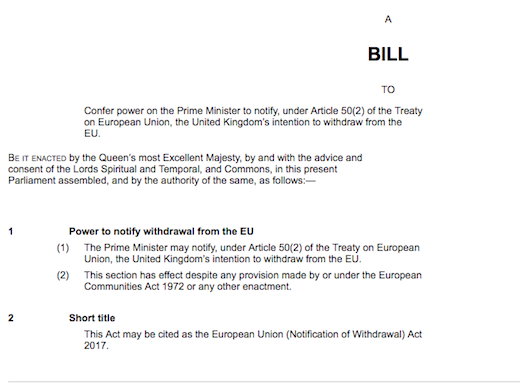
billarticle50

The government plans to force this  through both the House of Lords and the House of Commons in five days, although will undoubtedly be attempts to amend it.  It has subsequently emerged that a White Paper concerning the process of negotiating the withdrawal will be published, but not until after the Article 50 Bill is enacted. It’s readily apparent that the government is merely playing grudging lip-service to the sovereignty of Parliament. Let’s hope Parliament shows some guts for once and stands up for the interests of the United Kingdom by refusing the give the Executive Carte Blanche and insisting on full Parliamentary scrutiny of the process, including giving MPs the chance to call off the whole fiasco when it becomes obvious that we’re better off not leaving the EU after all.

As another example of the contempt for open government, news broke today that in the explanatory notes for the Article 50 bill, the UK government indicates that it intends for the UK to leave the European Atomic Energy Community (Euratom). This organization has a number of regulatory roles concerning nuclear energy supply and distribution, but also has a major research focus on the International Thermonuclear Experimental Reactor (ITER), a project aimed at constructing a fusion reactor, which currently involves a significant number of UK scientists. This project is truly international: involving the EU, Russia, the USA, Japan, Korea and India.

Unlike, e.g. CERN and ESA, the organization of Euratom is legally linked to the European Union, so one can argue that withdrawal from the EU necessarily means leaving Euratom, but to announce this in the explanatory notes without any attempt to discuss it either in Parliament or with the organizations involved seems to me yet another manifestation of the UK government’s desire to avoid any consultation at all, wherever this is possible. The Supreme Court prevented them from excluding Parliament, but it is clear that they will continue to avoid due process whenever they think they can get away with it. This announcement now puts a big question mark over the futures of many scientists involved in nuclear research. You can find a blog post on this by a nuclear physicist, Paul Stevenson of the University of Surrey, here.

The decision to withdraw from Euratom poses very serious questions about our nuclear industry as well as nuclear physics and engineering research so it should be discussed and evaluated. Whatever you think about BrExit, trying to force through such important decisions without consultation is not the proper way for a government to carry on.

Freedom of Movement isn’t the problem – The problem is in the way the UK fails use the available controls

Posted in Politics with tags , , on January 23, 2017 by telescoper

Here’s an important corrective to some of the misinformation about “Freedom of Movement” within the EU. A summary is that controls are available, but the UK government has never implemented them.

I maintain that freedom of movement is one of the benefits of EU membership, not one of the costs. Why are we throwing away so much to deal with a non-existent problem?

This also explains why the David Cameron’s bluster didn’t persuade anyone in the EU to jump through hoops on his behalf. We could have reduced migration ourselves within existing regulations, but decided not to, no doubt because of the positive economic benefits.

RemaininEU's avatarbrexit853

Myth Buster – Debunking the horror stories surrounding the EU Freedom of Movement directive. 

 Currently Theresa May has made stopping FoM a red-line issue even at the expense of the UK’s membership of the Single Market.

Introduction

 One of the four freedoms enjoyed by EU citizens is the free movement of workers. This includes the rights of movement and residence for workers, the rights of entry and residence for family members, and the right to work in another Member State and be treated on an equal footing with nationals of that Member State. Restrictions apply in some countries for citizens of Member States that have recently acceded to the EU.

There appears to be 4 major arguments in favour of stopping EU migrants exercising this freedom to come and work in the UK. It is my intention to debunk each of these arguments as plainly false.

Claim 1 – “Inability…

View original post 1,485 more words

Hard BrExit Reality Bites UK Science

Posted in Politics, Science Politics with tags , , , , , , on January 17, 2017 by telescoper

Before lunch today I listened to the Prime Minister’s much-heralded speech (full text here) at Lancaster House giving a bit more detail about the UK government’s approach to forthcoming negotiations to leave the European Union. As I had expected the speech was mainly concerned with stating the obvious – especially about the UK leaving the so-called Single Market – though there was an interesting, if rather muddled, discussion of some kind of associate membership of the Customs Union.

As I said when I blogged about the EU Referendum result back in June last year

For example, there will be no access to the single market post-BrExit without free movement of people.

The EU has made it perfectly clear all along that it will not compromise on the “four freedoms” that represent the principles on which the Single Market (correct name; “Internal Market”) is based. The UK government has also made it clear that it is running scared of the anti-immigration lobby in the Conservative Party and UKIP, despite the mountain of evidence (e.g. here) that immigration actually benefits the UK economy rather than harming it. A so-called “hard BrExit” approach has therefore been inevitable from the outset.

In any case, it always seemed to me that leaving the EU (and therefore giving up democratic representation on the bodies that govern the single market) but remaining in the Single Market would be completely illogical to anyone motivated by the issue of “sovereignty” (whatever that means).  So I think it always was – and still is – a choice between a hard BrExit and no BrExit at all. There’s no question in my mind – and Theresa May’s speech has hardened my views considerably – that remaining in the EU is by far the best option for the UK. That outcome is looking unlikely now, but there is still a long way to go and many questions have still to be answered, including whether the Article 50 notification can be revoked and whether the devolved assemblies in Scotland and Northern Ireland have to give separate consent. Interestingly, the Conservative Party manifesto for the 2015 General Election included a commitment to work within the Single Market, so it would be within the constitutional limits on the House of Lords to vote down any attempt to leave it.

Overall, I felt the speech was worthwhile insofar as it gave a bit of clarity on some issues, but it was also full of contradictions on others. For example, early on the PM stated:

Parliamentary sovereignty is the basis of our constitution.

Correct, but in that case why did the UK government appeal the High Court’s decision that this was the case (i.e. that Parliamentary consent was needed to invoke Article 50)? Moreover, why if she thinks Parliament is so important did she not give today’s speech in the House of Commons?

This brings me to what the speech might imply for British science in a post-BrExit era. Here’s what I said in June 2016:

It’s all very uncertain, of course, but it seems to me that as things stand, any deal that involves free movement within Europe would be unacceptable to the powerful  UK anti-immigration lobby. This rules out a “Norway” type deal, among others, and almost certainly means there will be no access to any science EU funding schemes post 2020. Free movement is essential to the way most of these schemes operate anyway.

I’m by no means always right, but I think I was right about that. It is now clear that UK scientists will not be eligible for EU funding under the Horizon 2020 programme.  Switzerland (which is in the Single Market) wasn’t allowed to remain in Horizon 2020 without freedom of movement, and neither will the UK. If the PM does indeed trigger Article 50 by the end of March 2017 then we will leave the EU by April 2019. That means that existing EU projects and funding will probably be stopped at that point, although the UK government has pledged to provide short-term replacement funding for grants already awarded. From now on it seems likely that EU teams will seek to exclude UK scientists.

This exclusion is not an unexpected outcome, but still disappointing. The PM’s speech states:

One of our great strengths as a nation is the breadth and depth of our academic and scientific communities, backed up by some of the world’s best universities. And we have a proud history of leading and supporting cutting-edge research and innovation.

So we will also welcome agreement to continue to collaborate with our European partners on major science, research, and technology initiatives.

From space exploration to clean energy to medical technologies, Britain will remain at the forefront of collective endeavours to better understand, and make better, the world in which we live.

Warm words, but it’s hard to reconcile them with reality.  We used to be “leading” EU collaborative teams. In a few years we’ll  be left standing on the touchlines. The future looks very challenging for science, and especially for fundamental science, in the UK.

But the politics around EU science programmes pales into insignificance compared the toxic atmosphere of xenophobia that has engulfed much of the UK. The overt policy of the government to treat EU citizens in the UK as bargaining chips will cause untold stress, as will the Home Office’s heavy-handed approach to those who seek to confirm the permanent residence they will otherwise lose when the UK leaves the EU. Why should anyone – scientist or otherwise – stay in this country to be treated in such a way? 

All of this makes me think those scientists I know who have already left the UK for EU institutions probably made the right decision. The question is how many more will follow?

Why Dublin is Right

Posted in Politics with tags , , , on December 14, 2016 by telescoper

You’ve probably heard via the news that Jolyon Maugham QC is bringing a case through the Irish courts in Dublin to the European Court of Justice in order to establish whether Article 50 of the Lisbon Treaty is reversible, i.e. whether it is possible in principle for the UK government to “untrigger” BrExit for whatever reason.

There’s be an astonishingly level of ill-informed criticism and downright personal abuse flying about as a result of his decision to crowdsource this case, but I think it’s a very good thing. I just wonder why our own government seems to be so unconcerned about the legality of its actions…

Jolyon Maugham's avatarWaiting for Godot

You can read,here, why I believe it is the right thing for both the UK and Ireland that there be legal certainty on whether Article 50, once triggered, can be reversed. I will not repeat my reasoning but I do invite you to re-read that piece.

The greatest possible compliment has been paid to that argument by those who would leave whatever the cost to our nation: they haverefused to engage with it. Instead they have attacked me. Occasional distraction though they are, I do not mind the personal attacks. They reveal more about my opponents’ paucity of thinking on the substance of my argument than they do about me. Everything I have put in the public domain aboutmyself(and mytax practice)is true.

Alongside these personal attacks, there has been some considered focus on whether this is the right step to take or at this…

View original post 645 more words

Judgment Day on Article 50

Posted in Politics with tags , , on November 3, 2016 by telescoper

I couldn’t resist a quick comment on today’s ruling by the High Court that the Prime Minister cannot trigger Article 50 of the Lisbon Treaty (and thus begin the process of taking the United Kingdom out of the European Union) without the approval of Parliament. The case was brought by Gina Miller and Deir Tozetti Dos Santos (the claimants) and has important constitutional implications because it limits the use of the Royal Prerogative.

I’m not by any means a legal expert but reading the full judgment it strikes me that this unanimous decision represents a comprehensive defeat for the Government’s lawyers. The crucial paragraphs of the judgment are 92-94 if you wish to refer to them in the full judgment. Interestingly, the ruling  does not really rest on the claimants’ case at all but instead is based on a complete rejection of the main point of the Government’s submission. It looks like the Government’s lawyers bungled it pretty badly. Although the Government has indicated that it will appeal the result, it’s not obvious what the grounds for such an appeal might be. The appeal will be heard some time in December.

I’ve never made any secret of the fact that I am in favour of the United Kingdom remaining inside the European Union. Events since the referendum – especially the collapse of the pound – have strengthened that opinion, in fact.

I am baffled by the extreme reaction of many “Leave” voters to this judgment, especially those who voted that way in order to “restore Parliamentary sovereignty”. Some such individuals are claiming that this ruling is somehow anti-democratic. I don’t think that view is at all rational. If you voted Leave in order to get your sovereignty back then you should be very happy with this decision. In fact whichever side of the referendum debate you were on you should welcome this decision.

We live in a parliamentary democracy. That means that sovereignty rests in Parliament, not in the Prime Minister. This ruling merely asserts that fact. It does not overturn the referendum result  nor does it prevent Article 50 being triggered. It does assert that the Prime Minister’s chosen way to approach BrExit is unlawful. Democracy is nothing without the rule of law.

Incidentally, the judgment also contains the following statement which I think is worth quoting here:

The 2015 Referendum Act was passed against a background including a very clear briefing paper to Parliamentarians explaining that the referendum would have advisory effect only. Moreover, Parliament must have appreciated that the referendum was intended to be only advisory as the result of a vote in the referendum in favour of leaving the European Union would inevitably leave for future decision many important questions relating to the legal implementation of withdrawal from the European Union.

In other words the referendum in itself has no constitutional force and was specifically intended not to.

The government plans to appeal the Article 50 decision to the Supreme Court, at which point it may or may not be overturned. If the appeal fails, then there is one higher authority: the European Court of Justice. It would be a delicious irony if the UK government were forced to appeal there in order to proceed!

Supposing, though, that all appeals are exhausted and the Government is forced to debate Article 50 in Parliament. What would happen next?

Although a majority of MPs in the House of Commons were in favour of remaining in the European Union, circumstances have changed since the referendum and many would be reluctant to vote against the outcome. However, I can imagine a situation in which Parliament refuses to give approval to an Article 50 until it has sufficient knowledge of the Government’s negotiating position to be assured that the Government is not planning something reckless that would endanger the UK economically and/or politically. It is my personal belief that “something reckless” is precisely what the Government is planning, and that is why they were so keen not to have a vote in Parliament.

There was only one question on the ballot paper for the EU referendum – whether the United Kingdom should remain in the European Union or leave it. But what, if any, of the rights and benefits that currently accrue as a consequence of our membership of the EU can the UK keep if and when it leaves?  Who decides what rights can be removed from UK citizens?

There has been a lot of talk about “Hard BrExit” versus “Soft BrExit”. My personal view is that “Soft BrExit” (by which we would end up in a situation something like Norway) – which a sizable number of Leave voters envisaged when they voted – is not on the agenda at all. I think the Government is headed for a “Hard BrExit”, i.e. no membership of the internal market, no freedom of movement, no free movement of people, etc. That’s partly because of the ideological beliefs of the Tory cabinet and partly because that’s what the process pretty much guarantees. Article 50 is just about the UK leaving the European Union. That process has to be completed before any trade deals with the EU or other countries can be negotiated; such deals could take years to complete and in the meantime our economy will suffer. In the interim, we’ll be out with whatever the EU decides to allow us. I don’t think that will be very much at all.

I think that the Government knows that this outcome is not what a majority voted for, that it will have serious  economic consequences, and will produce a considerable political backlash. That is why the Government want to charge ahead as quickly as possible (in secret) so that nobody can stop them until it’s too late. In other words, they’re planning to use the referendum result as a pretext to further their own agenda. In order to this to work they have to avoid Parliamentary scrutiny. The High Court ruling – if it stands – effectively rules out this strategy. It is a victory for democracy.


Rank Nonsense

Posted in Bad Statistics, Education, Politics with tags , , , , , on September 8, 2016 by telescoper

It’s that time of year when international league tables (also known as “World Rankings”)  appear. We’ve already had the QS World University Rankings and the Shanghai (ARWU) World University Rankings. These will soon be joined by the Times Higher World Rankings, due out on 21st September.

A lot of people who should know a lot better give these league tables far too much attention. As far as I’m concerned they are all constructed using extremely suspect methodologies whose main function is to amplify small statistical variations into something that looks significant enough to justify constructing  a narrative about it. The resulting press coverage usually better reflects a preconceived idea in a journalist’s head than any sensible reading of the tables themselves.

A particularly egregious example of this kind of nonsense can be found in this week’s Guardian. The offending article is entitled “UK universities tumble in world rankings amid Brexit concerns”. Now I make no secret of the fact that I voted “Remain” and that I do think BrExit (if it actually happens) will damage UK universities (as well as everything else in the UK). However, linking the changes in the QS rankings to BrExit is evidently ridiculous: all the data were collected before the referendum on 23rd June anyway! In my opinion there are enough good arguments against BrExit without trying to concoct daft ones.

In any case these tables do not come with any estimate of the likely statistical variation from year to year in the metrics used to construct them, which makes changes impossible to interpret. If only the compilers of these tables would put error bars on the results! Interestingly, my former employer, the University of Sussex, has held its place exactly in the QS rankings between 2015 and 2016: it was ranked 187th in the world in both years. However, the actual score corresponding to these two years was 55.6 in 2015 and 48.4 in 2016. Moreover, Cambridge University fell from 3rd to 4th place this year but its score only changed from 98.6 to 97.2. I very much doubt that is significant at all, but it’s mentioned prominently in the subheading of the Guardian piece:

Uncertainty over research funding and immigration rules blamed for decline, as Cambridge slips out of top three for first time.

Actually, looking closer, I find that Cambridge was joint 3rd in 2015 and is 4th this year. Over-interpretation, or what?

To end with, I can’t resist mentioning that the University of Sussex is in the top 150 in the Shanghai Rankings for Natural and Mathematical Sciences this year, having not been in the top 200 last year. This stunning improvement happened while I was Head of School for Mathematical and Physical Sciences so it clearly can not be any kind of statistical fluke but is entirely attributable to excellent leadership. Thank you for your applause.


The BrExit Threat to British Science

Posted in Politics, Science Politics with tags , , on June 29, 2016 by telescoper

After a couple of days away dealing with some personal business I’ve now time to make a few comments about the ongoing repercussions following last week’s referendum vote to Leave the European Union.

First of all on the general situation. Legally speaking the referendum decision by itself changes nothing at all. Referendums have no constitutional status in the United Kingdom and are not legally binding. The Prime Minister David Cameron has declined to activate (the now famous) Article 50 of the Lisbon Treaty which would initiate a two-year negotiated withdrawal, preferring to leave this to whomever succeeds him following his resignation. None of the likely contenders for the unenviable position of next Prime Minister seems keen to pull the trigger very quickly either. The United Kingdom therefore remains a member of the European Union and there is no clear picture of when that might change.

The rest of the European Union obviously wants the UK to leave as soon as possible, not just because we’ve indicated that we want to, but because  we have always been never been very committed or reliable partners. In the words of Jean-Claude Juncker: ‘It is not an amicable divorce, but it was not an intimate love affair anyway.’

I don’t blame the 27 remaining members for wanting us to get on with getting out, because uncertainty is bad for business. Two years is more than enough time for big European businesses to write British producers out of their supply chains and for international companies now based in the United Kingdom to relocate to continental Europe. The current gridlock at Westminster merely defers this inevitable exodus. In the meantime inward investment is falling as companies defer decisions on future plans, casting a planningblight over the UK economy.

My own view, however, is that the longer the UK waits before invoking Article 50 the greater the probability that it will never be invoked at all.  This is because the next PM – probably Boris Johnson – surely knows that he will simply not be able to deliver on any of the promises he has made.

For example, there will be no access to the single market post-BrExit without free movement of people. There won’t be £350 million per week extra for the NHS either, because our GDP is falling and we never sent £350 million anyway.  All the possible deals will be so obviously far worse than the status quo that I don’t think Parliament will ever pass legislation to accept a situation is so clearly against the national interest. I may be wrong, of course, but I think the likeliest scenario is that the referendum decision is kicked into the long grass for at least the duration of the current Parliament.

That doesn’t solve the issue of BrExit blight, however. Which brings me to British science in a possible post-BrExit era. It’s all very uncertain, of course, but it seems to me that as things stand, any deal that involves free movement within Europe would be unacceptable to the powerful  UK anti-immigration lobby. This rules out a “Norway” type deal, among others, and almost certainly means there will be no access to any science EU funding schemes post 2020. Free movement is essential to the way most of these schemes operate anyway.

It has been guaranteed that funding commitments will be honoured until the end of Horizon 2020, but that assumes that holders of such grants don’t leave the UK taking the grants with them. I know of four cases of this happening already. They won’t come back even if we’re still in the European Union then.

Another probable outcomes are that:

  1. the shrinking economy will cause the UK government to abandon its ring-fence on science funding, which will  lead to cuts in domestic provision also;
  2. a steep decline in EU students (and associated income) will halt the expansion of UK science departments, and may cause some to shrink or even close;
  3. non-UK EU scientists working in the UK decide to leave anyway because the atmosphere of this country has already been poisoned by xenophobic rhetoric.

British science may “endure” after BrExit but it definitely won’t prosper. What is the least bad solution, if we cannot remain?

Answers through the comments box please!


Six Things We Know About EU Referendum Campaigns

Posted in Politics with tags , on May 11, 2016 by telescoper

Interesting comments on referendums authored by academics from the University of Sussex, although it seems to me that the thing that most affects the outcome of a referendum is how many people vote on each side…


epern's avatarEPERN

Kai Oppermann and Paul Taggart

Donald Rumsfeld famously talked about ‘known knowns’ and ‘known unknowns’. Looking systematically at referendums and at the experience of these in Europe, we can learn from what has happened in other European referendums to help us in looking at what may happen in the UK’s referendum on EU membership. There may be uncertainty ahead but we can know what we don’t know from previous experience. We suggest that there are six lessons we can learn

  1. Referendum outcomes are hard to predict

The one ‘known known’ we have is the state of the polls at the outset. But early in the campaign, opinion polls tell us very little about what the outcome of the referendum will be on 23 June. Around 20% of voters are still undecided. More than that, voting behaviour in referendums is much less settled and more fluid than in general elections. This…

View original post 1,298 more words

Why EU funding is so important for UK science

Posted in Politics, Science Politics, Uncategorized with tags , , , , , , , on April 12, 2016 by telescoper

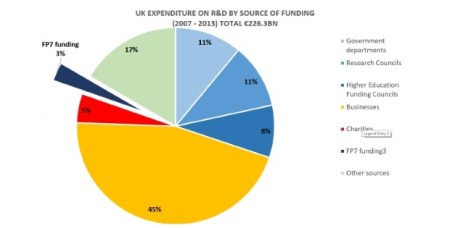
One of the figures bandied about by the Leave campaign and in particular by the strangely litigious group  that calls itself “Scientists for Britain” (which has only six members that I know of, not all of them scientists) is that the EU is not important for British science because it only funded 3% of UK R&D between 2007 and 2013). They’ve even supplied a helpful graphic:

UK_RD_2007-2013

The figures are taken from a Royal Society report and are, as far as I’m aware, accurate. It’s worth noting however that the level of funding  under the FP7 “Framework Programme” which funds research is much smaller than the current Horizon2020 programme.

However, as Stephen Curry has pointed out in a typically balanced and reasonable blog post, the impact of a BrExit on UK science is much more complex than this picture would suggest. I want to add just a few  points from my specific perspective as a university-based researcher.

First, the 3% figure is arrived at by a tried-and-tested technique of finding the smallest possible numerator and dividing it by the lowest possible denominator. A fairer comparison, in my view, would just look at research funded by the taxpayer (either directly from the UK or via the EU). For one thing we don’t know how much of the research funded by businesses in the UK is funded by businesses which are only here in the UK because we’re part of the European Union. For another these figures are taken over the whole R&D effort and they hide huge differences from discipline to discipline.

From my perspective as an astrophysicist – and this is true of many researchers in “blue skies” areas – most of the pie chart is simply not relevant. The main sources of funding that we can attempt to tap are the UK Research Councils (chiefly STFC and EPSRC) and EU programmes; we also get a small amount of research income from charities, chiefly the Leverhulme Trust. The situation is different in other fields: medical research, for example, has much greater access to charitable funding.

As it happens I’ve just received the monthly research report of the School of Mathematical and Physics Sciences at the University of Sussex (of which I am currently Head) and I can tell you the EU counts not for 3% of our  income but 21% (which is in line with the proportions) above; most of that comes from the European Research Council. The possibility of losing access to EU funding  alarms me greatly as it would mean the loss of about one-fifth of our research base. I know that figure is much higher in some other institutions and departments.

But it’s not just the money that’s important, it’s also the kind of programmes that the EU funds. These are often to do with mobility of researchers, especially those early in their careers (including PhD students), grants that allow us to exploit facilities that we would otherwise not be able to access, and those that sustain large collaborations. It’s not just the level of cash that matters but the fact that what it funds is nicely complementary to the UK’s own programmes. The combination of UK and EU actually provides a much better form of “dual funding” than the UK can achieve on its own.

Some say that BrExit would not change our access to EU funding, but I maintain there’s a huge risk that this will be the case. The loss of the UK’s input into the overall EU budget will almost certainly lead to a revision of the ability of non-member states to access these programmes. The best that even BrExit campaigners argue for is that access to EU funding will not change. There is therefore, from a science perspective, there is no chance of a gain and a large risk of a loss. For me, that kind of a decision is a no-brainer. I’m not the only one who thinks that either: 150 Fellows of the Royal Society agree with me, as do the vast majority of scientists surveyed in a poll conducted by Nature magazine.

Of course there will be some who will argue that this “blue skies” academic research in universities isn’t important and we should be spending more money on stuff that leads to wealth creation. I can think of many arguments against that, but for the purposes of this post I’ll just remind you that 45% of UK research is done in industry and commercial businesses of various kinds. Where do you think the supply of science graduates come from, what kind of research draws students into science courses in the first place, and where do the teachers come from that educate the next generations?

As a scientist who cares passionately about the sustainability of Britain’s research base, I think we should definitely remain in the European Union.