Archive for Cardiff University

Cardiff University in Crisis

Posted in Cardiff, Education with tags , , on January 28, 2025 by telescoper

I saw in the news today that Cardiff University has announced a series of mergers, closures and widepsread job cuts in order to deal with a financial deficit. If I understand the announcement correctly, the intention is to terminate the equivalent of 400 full-time academic posts, which is over 10% of the academic staff complement. No doubt there will also be job losses among the important professional services and support staff. There is plenty of doubt, however, as to whether they will extend to members of the Senior Management Team who made today’s announcement and who should really be the ones held to account.

Cardiff is by no means the only UK university being decimated in this way. It is just the latest in a long list. The crisis in UK higher education has been brewing since Brexit, and the subsequent reduction in overseas students needed to balance the books in the absence of significant ncreases in tuition fees for UK students. A burst of inflation post-Covid and, more recently, increased National Insurance contributions have taken many institutions to the brink of solvency. That’s the official line. You can add, unofficially, poor decision-making at senior management level, in many cases pursuing expensive and over-ambitious vanity projects that have ultimately proved unaffordable but impossible to cancel.

One has to remember that when university managers make decisions on closing down units, it’s not often on the basis that those units are losing money. For a start, universities operate according to complicated and arbitrary financial models small adjustments to which can easily move a department from black to red or vice versa. Moreover, over half the income of a university is not spent on the front-line activities of teaching and research: a huge slice is absorbed by the central administration to fund “strategic” investments (i.e. risky projects) and of course to pay vast salaries to the VC, PVCs and other assorted cronies. Departments therefore tend to be judged not on whether they can cover their own costs but whether they return a surplus to The Centre.

(Incidentally, while the UK Higher Education sector is in turmoil, there is no sign of vice-chancellor pay packages being cut. Quite the opposite, in fact.)

I’d be the first to admit that running a large university is a difficult job. Even in the lower levels of management as Head of School at Sussex, I agonized over many decisions. During that time I came to the conclusion that being a successful manager of something is very stressful if you actually care about it. This is why so many of the people who prosper in senior university management circles are not people who care at all about what makes a university what it is. They just see everything as a sterile combination of metrics and spreadsheets and boxes to be ticked. This, not the funding shortfall per se, is why universities are experiencing an “existential crisis”.

Anyway, among the specific proposals at Cardiff are the closures of courses and whole Departments in Ancient History, Modern Languages, Music, Nursing and Religion & Theology. Job cuts (or, as the announcement puts it, “reductions in staff FTE”) will affect (among others) the Schools of Biosciences, Chemistry, Computer Sciences, Engineering, Mathematics, and Medicine. The list of Schools to face job losses look to me to be mainly those who had relied strongly on overseas students as a source of revenue, a source which must have dried up.

Another proposal (one of four mergers of Schools) involves the creation of a new School of Natural Sciences formed by merging Chemistry, Earth Sciences and “Physics”. The latter should be “Physics & Astronomy“, not “Physics”. I hope that carelessness is not typical of the forthcoming process. Physics & Astronomy is not earmarked for losses of academic jobs, but the merger is almost certainly intended to allow cuts in support staff. As per the above paragraph, Chemistry staff will be cut, so the new School of Natural Sciences will not be off to a happy start.

I worked at Cardiff University for many years, and am in regular touch with a number of friends and former colleagues still there, so this news is very distressing. All I can do is offer a message of solidarity and encourage everyone who is not in a Union to join immediately! I have a terrible feeling that today’s announcement is only the start.
The Cuts in UK Higher Education

Posted in Biographical, Cardiff, Education, Maynooth, Politics with tags , , , , on November 28, 2024 by telescoper

Today friend of mine send me a message pointing out that in order to save money the University of Sussex is planning to make about 300 staff redundant; you can see an article about it in the Times Higher here. For the time being it seems the plan to make these savings via a voluntary severance scheme. I don’t know whether academic and administrative staff will be treated equally, either.

This is grim news. I worked at Sussex from 2013 until 2016 when I resigned my post as Head of School of Mathematical and Physical Sciences. I took that decision largely for personal reasons but there were professional reasons too. From 2013 the University had embarked on an ambitious growth plan based on buoyant student numbers and the fee income generated thereby. Staff numbers grew too, to cope with the increased demand for teaching. Unfortunately the management was unable to match this with real improvements in infrastructure, largely due to the disastrous outsourcing of campus estates and services. Many promises made to me as Head of School by Senior Management were broken. I wasn’t the only Head of School to compain of this, either. Although things were still going relatively well when I left in 2016, and I was optimistic for the future of the School then, there were severe risks to its financial stability if student recruitment dived. Sadly, that’s exactly what happened. Falling student numbers – especially from overseas – left the institution very vulnerable, especially since the fee per student did not change. That problem was exacerbated by a burst of inflation. AlthoughIt has clearly been a very difficult time for the University of Sussex, largely due to national and international forces beyond its control, but exacerbated by ineffective, and at times incompetent, institutional management. It should be said also that many University leaders enthusiastically embraced the fees-based system that has led their institutions where they are now, though most of them have now departed and left others to carry the can.

It worries me that Maynooth University is also trying to grow very quickly, without adequate investment in infrastructure especially teaching. It isn’t increasing the number of academic staff much either, preferring to hire more and more managers; yet another such position was advertised this week. I don’t know whether Maynooth’s financial trajectory will follow that of Sussex. The funding environment is very different in Ireland compared to the UK, so it may not. It is clear that the enviroment for education and research here is being steadily degraded by the current leadership.

Anyway, when I saw the announcement about Sussex, I checked other Universities I’ve worked in over the years. There’s a list here. It seems that while there are particular factors at play at Sussex, there are similar difficulties across the Board. Cardiff University has a deficit of £35 million and the VC has refused to rule out compulsory redundancies there. I’m not sure how this is all affecting the School of Physics & Astronomy. Nottingham University, where I worked from 1999 to 2007, has deficit of £30 million, in response to which it has opened a voluntary severance scheme, introduced hiring freezes, cut non-pay budgets, and refused to renew 500 fixed-term contracts.

There certainly are cold winds blowing across the University landscape in the United Kingdom, and there is no sign of any respite. This is just the start.

REF 2021 Results and Ranking

Posted in Biographical, Cardiff with tags , , , on May 12, 2022 by telescoper

The results of the UK’s Research Excellence Framework (REF) 2021 have now been published. You can find them all here at the REF’s own website because they are presented there in a much more informative way than the half-baked “rankings” favoured by, e.g., The Times Higher.

To give some background: the overall REF score for a Unit of Assessment (UoA; usually a Department or School) is obtained by adding three different components: outputs (quality of research papers); impact (referring to the impact beyond academia); and environment (which measures such things as grant income, numbers of PhD students and general infrastructure). Scores are assigned to these categories, e.g. for submitted outputs on a scale of 4* (world-leading), 3* (internationally excellent), 2* (internationally recognized), 1* (nationally recognized) and unclassified. Similar star ratings are applied to the impact and environment. These are weighted at 60%, 25% and 15% respectively in the current incarnation of REF.

You can find further discussion of the REF submission rules, especially concerning changes with respect to 2014, here.

The way the star ratings are often reported is via a Grade Point Average reflecting the percentage of in each band. A hypothetical UoA that scored 100% in the top category would have a GPA of 4.0, for example. One that had 50% 4* and 50* 3* would be 3.5, and so on.

In the 2014 REF institutions were allowed to be selective in the number of staff submitted so the GPA wasn’t really a very appropriate measure: some institutions chose to submit only their very best research in order to get a high GPA. The funding allocated as a result of REF turned out to be highly weighted towards 4* so this was a sensible strategy for them, but it made the simple GPA-based rankings even more meaningless than usual. That didn’t stop e.g. The Times Higher making such rankings though.

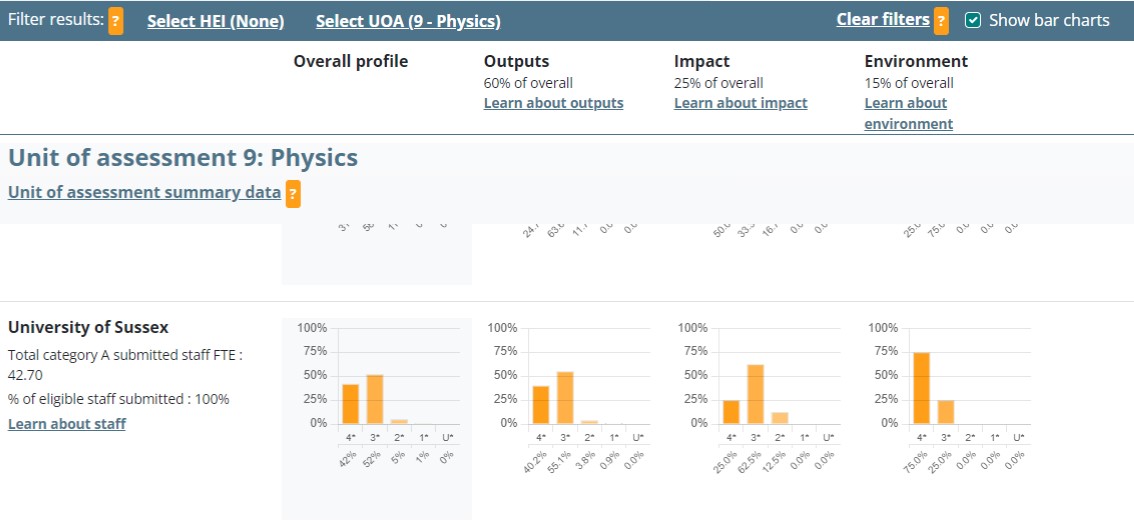
This time the rules on selection are stricter so the GPA is arguably more relevant, though many institutions have achieved selectivity anyway by moving certain staff onto teaching-only contracts. Staff on such contracts do not have to be submitted. I note that the main REF website does not use the GPA at all but instead gives profiles like this:

I show the example of Sussex because of my bad memories of the last REF (the 2014 exercise). I had moved to Sussex in 2013 at which point preparations were not well advanced and although everyone concerned worked very hard to put together the best submission for Physics & Astronomy we had to face the problem that our staff numbers had grown significantly in 2013 response to an increase in student numbers. While new staff could bring publications with them they couldn’t bring impact or environment, and while the outputs scored well the latter two categories didn’t so the Department of Physics & Astronomy did poorly in the ensuing rankings.

It must be said however that the primary purpose of the REF (allegedly) is to allocate blocks of funding- the so-called QR funding – to support research in the UoA concerned and while the GPA at Sussex was disappointing the fact that the money depends on the number of staff submitted meant that we got a substantial increase in QR dosh. Note further that the formula for allocation of funds to 4*, 3*, etc is not even specified in advance of the exercise: it is likely to be highly concentrated on research graded 4* and that the funding formula will probably different in England, Wales, Scotland and Northern Ireland. A ranking in terms of money earned is likely to look rather different from one based on GPA.

Another, even more fundamental, problem with the GPA is that the scores are so close together that the differences are of doubtful significance. In the Physics UoA, for example, the gap between top GPA (Sheffield) and 5th place (Bristol) is just 0.05 (3.65 versus 3.60) respectively. I see also that Cardiff is ranked equal 18th (with Imperial College) on a GPA of 3.45.

I say these things just to illustrate how much more subtle the criteria for success are compared to a simple GPA. It’s even hard to tell on an objective basis who to congratulate and who to commiserate.

Anyway, back to Sussex I see that Physics & Astronomy has done far better on environment and impact than last time round and the outputs (95% of which are either 4* or 3*) are comparable to last time (96%) so by those measures they have done well although this might not be reflected in a GPA-based ranking. Sussex is 26th in the rankings with a GPA of 3.35, if you’re interested, which is better than last time, though they will probably be disappointed at the presence of 2* elements in their profile.

Indeed, looking through the Physics list I can’t see any UoA that has a lower GPA this time than last time. The pot of money to be allocated for QR funding is fixed so if every UoA does better that doesn’t mean every UoA gets more money; some institutions will no doubt find that their improved GPA is accompanied by a cut in QR funding.

I’ll end by re-iterating that, having moved to Ireland in 2017, I’m very glad to be out of the path of the bureaucratic juggernaut that is the REF. In its first incarnations (as the Research Assessment Exercise) it did fulfil a useful purpose and did, I believe, improve the quality of UK research. Since then, however, it has become an industry that is largely self-serving. I quote from an article in the Times Higher itself:

The allocation of QR funding could be done in a much simpler and fairer way but the REF is now such a huge edifice it will resist being replaced by something smaller. No doubt before long the staff who spent so much time preparing for REF 2021 will start work on the next exercise. And so it goes on.

The changes in ranking that now occur from exercise to exercise are generally small in magnitude and in number. In other words, huge effort and cost are being invested to discover less and less information.

P.S. For completeness I should say that I am glad we don’t have an equivalent of the REF here in Ireland, we don’t have an equivalent of the QR funding either. This latter is a serious problem for the sustainability of research in third-level institutions, and it is not addressed at all in the recent proposals for reform.

The REF goes on

Posted in Biographical, Cardiff, Maynooth with tags , , , , on March 27, 2021 by telescoper

A few communications with former colleagues from the United Kingdom last week reminded me that, despite the Covid-19 pandemic, the deadline for submissions to the 2021 Research Excellence Framework is next week. It seems very strange to me to push ahead with this despite the Coronavirus disruption, but it’s yet another sign that academics have to serve the bureaucrats rather than the other way round.

I know quite a few people at quite a few institutions that are completely exhausted by the workload required to deal with the enormous exercise in paperwork that is intended to assess the quality and impact of research at UK universities.

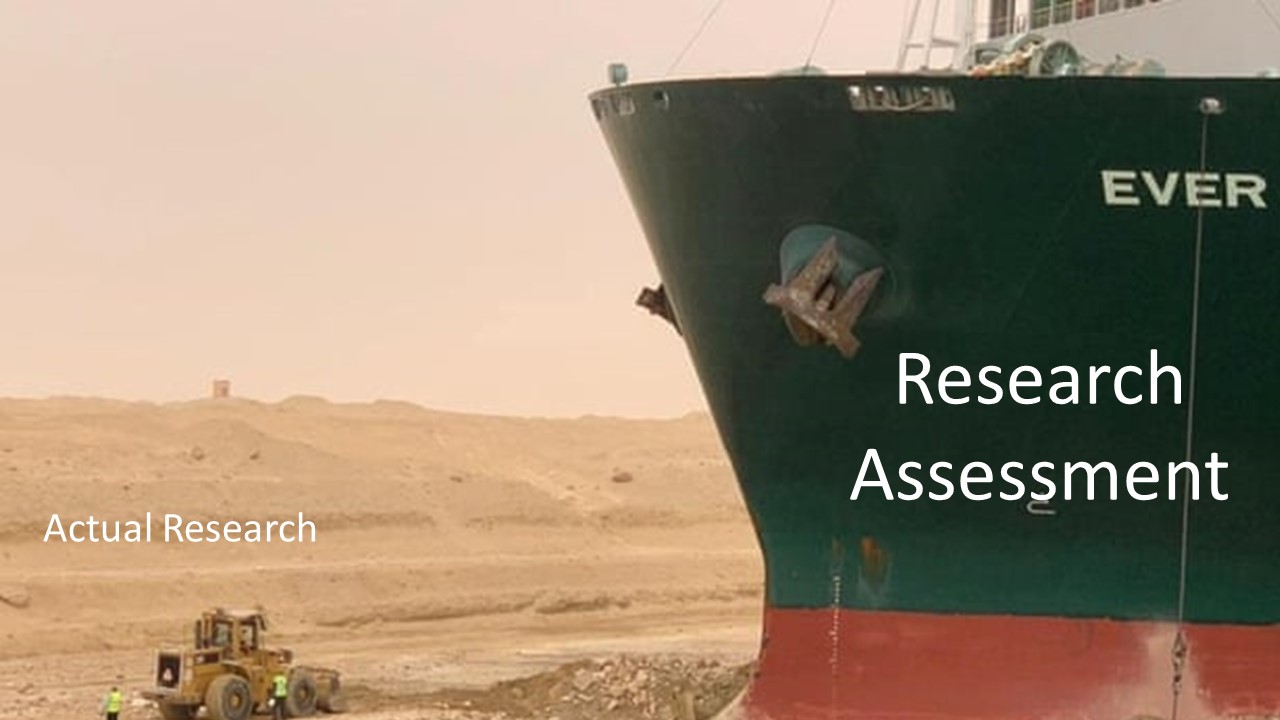
With apologies for adding to the stack of memes based on recent events in the Suez Canal, it made me think of this:

One of the major plusses of being in Ireland is that there is no REF, so I’m able to avoid the enormous workload and stress generated by this exercise in bean-counting. That’s good because there are more than enough things on my plate right now, and more are being added every day.

My memories of the last REF in 2014 when I was Head of School at Sussex are quite painful, as it went badly for us then. I hope that the long-term investments we made then will pay off, though, and I hope things turn out better for Sussex this time especially for the Department of Physics & Astronomy for which the impact and environment components of the assessment dragged the overall score down.

Not being involved personally in the REF this time round I haven’t really paid much attention to the changes that have been adopted since 2014. One I knew about is that the rules make it harder for institutions to leave staff out of their REF return. Some universities played the system in 2014 by being very selective about whom they put in. Only staff with papers considered likely to be rated top-notch were submitted.

Having a quick glance at the documents I see two other significant differences.

One is that in 2014, with very few exceptions, all staff had to submit four research outputs (i.e. papers) to be graded. in 2021 the system is more flexible: the total number of outputs must equal 2.5 times the summed FTE (full-time equivalent) of the unit’s submitted staff, with no individual submitting more than 5 and none fewer than 1 (except in special cases related to Covid-19). Overall, then there will be fewer outputs than before, the multiplier of FTE being 2.5 (2021) instead of 4 (2014). There will still be a lot of papers, of course, not least because many Departments have grown since 2014, so the panels will have a great deal of reading to do. If that’s what they do with the papers. They’ll probably just look up citations…

The other difference relates to staff who have left an institution during the census period. In 2014 the institution to which a researcher moved got all the credit for the publications, while the institution they left got nothing. In 2021, institutions “may return the outputs of staff previously employed as eligible where the output was first made publicly available during the period of eligible employment, within the set number of outputs required.” I suppose this is to prevent the departure of a staff member causing too much damage to the institution they left and also to credit the institution where the work was done rather than specifically the individual who did it.

Thinking about the REF an amusing thought occurred to me about Research Assessment. My idea was to set up a sort of anti-REF (perhaps the Research Inferiority Framework) based not on the best outputs produced by an institutions researchers, but on the worst. The institutions producing the highest number of inferior papers could receive financial penalties and get relegated in the league tables for encouraging staff to write too many papers that nobody ever reads or are just plain wrong. My guess is that papers published in Nature might figure even more prominently in this…

Anyway, let me just take this opportunity to wish former colleagues at Cardiff and Sussex all the best for their REF submission on Wednesday 31st March. I hope it turns out well

Three Years in Maynooth

Posted in Biographical with tags , , on December 1, 2020 by telescoper

It’s 1st December 2020 which means that it’s now been three whole years since I started my job as Professor of Theoretical Physics in the Department of Theoretical Physics at Maynooth University, in County Kildare in the Irish Republic.

Until the Summer of 2018 I was working part-time at Cardiff and part-time in Maynooth, which required a lot of flying to and from between Wales and Ireland.  That situation would have been impossible to sustain during the pandemic for reasons of quarantine and also because FlyBe went bust. The timing of my move to Maynooth was providential in many ways apart from that.

I didn’t think it would take me the best part of three years to buy a house in Ireland, but owing to a combination of circumstances it took until the end of this summer to do that. Still, all’s well that ends well and I’m very happy with my home.

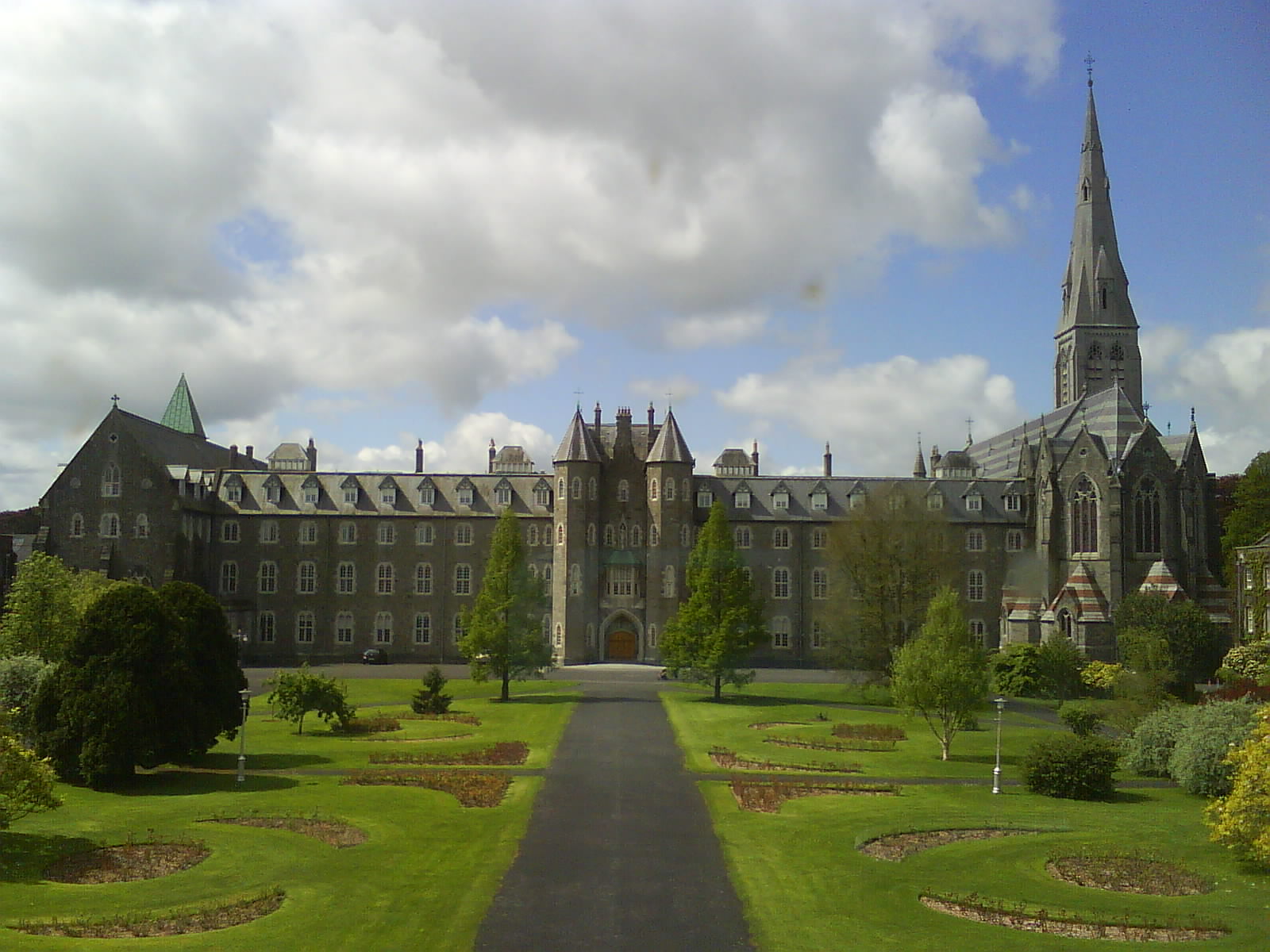
When I first arrived in Maynooth I stayed in St Patrick’s House (above), part of the Roman Catholic seminary on Maynooth University’s South Campus. I took this picture of the corridor I was on the night I arrived because it reminded me of  The Shining:

The arrival of the Covid-19 Pandemic earlier this year has been another completely unexpected development. I wonder what fate has next in store?

Out of the REF

Posted in Biographical, Cardiff, Maynooth with tags , , , , on November 25, 2020 by telescoper

I was talking over Zoom with some former colleagues from the United Kingdom last week, and was surprised to learn that, despite the Covid-19 pandemic, the 2021 Research Excellence Framework is ploughing ahead next year, only slightly delayed. There’s no stopping bureaucratic juggernauts once they get going…

One of the major plusses of being in Ireland is that, outside the UK academic system, there is no REF. One can avoid the enormous workload and stress generated by this exercise in bean-counting My memories of the last REF in 2014 when I was Head of School at Sussex are quite painful, as it went badly for us then. I hope that the long-term investments we made then will pay off, though, and I hope things turn out better for Sussex this time especially for the Department of Physics & Astronomy for which the impact and environment components of the assessment dragged the overall score down.

The census period for the new REF is 1st August 2013 to 31st July 2020. Not being involved personally in the REF this time round I haven’t really paid much attention to the changes that have been adopted since 2014. One I knew about is that the rules make it harder for institutions to leave staff out of their REF return. Some universities played the system in 2014 by being very selective about whom they put in. Only staff with papers considered likely to be rated top-notch were submitted.

Having a quick glance at the documents I see two other significant differences.

One is that in 2014, with very few exceptions, all staff had to submit four research outputs (i.e. papers) to be graded. in 2021 the system is more flexible: the total number of outputs must equal 2.5 times the summed FTE (full-time equivalent) of the unit’s submitted staff, with no individual submitting more than 5 and none fewer than 1 (except in special cases related to Covid-19). Overall, then there will be fewer outputs than before, the multiplier of FTE being 2.5 (2021) instead of 4 (2014). There will still be a lot, of course, so the panels will have a great deal of reading to do. If that’s what they do with the papers. They’ll probably just look up citations…

The other difference relates to staff who have left an institution during the census period. In 2014 the institution to which a researcher moved got all the credit for the publications, while the institution they left got nothing. In 2021, institutions “may return the outputs of staff previously employed as eligible where the output was first made publicly available during the period of eligible employment, within the set number of outputs required.” I suppose this is to prevent the departure of a staff member causing too much damage to the institution they left.

I was wondering about this last point when chatting with friends the other day. I moved institutions twice during the relevant census period, from Sussex to Cardiff and then from Cardiff to Maynooth. In principle, therefore, both former employees could submit my outputs I published while I was there to the 2021 REF. I only published a dozen or so papers while I was at Sussex – the impact of being Head of School on my research productivity was considerable – and none of them are particularly highly cited so I don’t think that Sussex will want to submit any of them, but they could if they wanted to. They don’t have to ask my permission!

I doubt if Cardiff will be worried about my papers. Among other things they have a stack of gravitational wave papers that should all be 4*.

Anyway, thinking about the REF an amusing thought occurred to me about Research Assessment. My idea was to set up a sort of anti-REF (perhaps the Research Inferiority Framework) based not on the best outputs produced by an institutions researchers but on the worst. The institutions producing the highest number of inferior papers could receive financial penalties and get relegated in the league tables for encouraging staff to write too many papers that nobody ever reads or are just plain wrong. My guess is that papers published in Nature might figure even more prominently in this

Diversity in Physics – LGBTQ+ STEMDay

Posted in Biographical, Books, Talks and Reviews, Cardiff, LGBTQ+ with tags , , , , on November 14, 2020 by telescoper

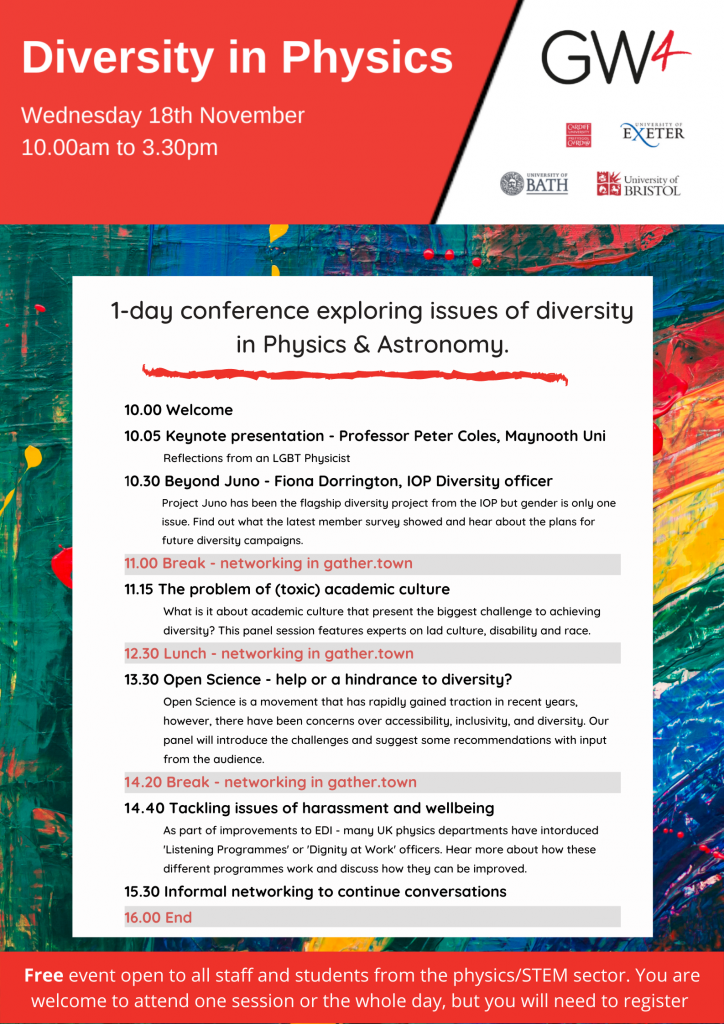
The nice people involved with Physics at Cardiff University, Prism Exeter and the GW4 group generally have organized a (virtual) event to celebrate Diversity and Inclusion for LGBTQ+ STEM Day 2020 which is to take place on November 18th (that’s next Wednesday). I’m very honoured to have been invited to give a keynote talk at this event, the poster for which is below, and am looking forward to it.

There’s a blog post here that gives more information about the event, including how to register in order to receive the Zoom connection.

I won’t be able to stay for the whole event as I am teaching later that day. I’d have been particularly interested in the session on Open Science…

Moving On..

Posted in Biographical, Cardiff with tags , , , , on August 22, 2019 by telescoper

After attending my second Repeat Examination Board of the week (this one in the Department of Engineering) it’s now time to begin the task of moving the contents of my office into the new one I’ll be in as Head of Department. Roughly simultaneously, the current Head of Department, Jonivar Skullerud, will be moving his clobber from the Head of Department’s office into my current office. Some coordination may be necessary to avoid collisions and/or other confusion, but I’m confident of a successful outcome…

While I’m on the subject of moving to a new job, though in my case remaining at the same institution, this very afternoon my wonderful former colleague from the School of Mathematical and Physical Sciences at the University of Sussex, Dorothy Lamb, is having a leaving do. She will soon be moving to a position at the University of Birmingham (in the Midlands). I’m very sad that I couldn’t be there for her farewell party, but the least I can do is wish Dorothy (aka Miss Lemon) all the best in her new job, and hope that her move from Brighton to Birmingham, after (I think) 25 years, goes as smoothly and as free from stress as possible.

UPDATE: You can read Dorothy’s farewell edition of the MPS Newslettter here.

Dorothy isn’t the only former colleague to be moving on to pastures new. I heard this morning that Ian Harvey and Unai Lopez from the Data Innovation Research Institute at Cardiff University are leaving soon. Unai is taking up a Lectureship at the University of the Basque Country in Bilbao so Bon Voyage Unai!


Should students be (financially) compensated for strike action by lecturers?

Posted in Cardiff, Education, Politics with tags , , , , on May 22, 2019 by telescoper

Regular readers of this blog will know that last year I was still employed part of the time at Cardiff University and during that period I was participating in strike action called by the Universities and Colleges Union (UCU) over pensions. As a result of that action students on my module on Physics of the Early Universe missed quite a lot of lectures (and I was docked a large fraction of my pay).

I refused to do extra lectures after the strike was over to make up for those lost, as it seemed to me that defeated the point of the strike action, but I did make notes available for the students (which I do anyway). Students were also given access to recordings of the previous year’s lectures on the same module. I know some lecturers also adjusted their examinations and/or other assessments to exclude material that had not been covered.

It seems practice for dealing with this (admittedly difficult) situation has varied from institution to institution, and some students who feel that they missed out as a result of the strike have apparently asked to be compensated by their University. Institutions could of course pay compensation to students out of the money saved by not paying lecturers, but that wouldn’t go very far because only a small part of the £9000+ students pay in fees goes to the salaries of teaching staff. Another issue is that I recall one or two students didn’t come to lectures even before the strike started. Should they be compensated too?

Anyway I thought this might be an interesting topic for a poll, so here goes:

As always views are welcome through the comments box too!

The New IOP Physics Technician Award

Posted in Education, The Universe and Stuff with tags , , , , on May 8, 2019 by telescoper

Picture Credit: Cardiff University School of Physics & Astronomy

I remember a few years ago one of my colleagues when I worked in the School of Physics & Astronomy at Cardiff University, Steven Baker, won an award for being the best STEM Technician in the category of Physical Sciences in the whole country! At the time this was a new award set up by the Higher Education Academy, so Steven was the inaugural winner of it.

Now there’s another new award, this time from the Institute of Physics and dedicated to Physics technicians (not necessarily in universities). I quote:

The IOP Technician Award enables the community to recognise and celebrate the skills and experience of technicians and their contribution to physics.

You can find full details of how to nominate an awardee here. The deadline is 14th June 2019. The prize is worth £1000, but more importantly it serves to encourage Physics departments to reflect on the vital role played by technicians. I feel very strongly that the contribution made by support staff in university departments is drastically undervalued.  No Physics department can run without a dedicated technical support team who apply their skills and expertise in both teaching and research laboratories. Even a department like mine dedicated purely to Theoretical Physics needs computing support, and there are many more people – including clerical staff, library staff, etc – without whom many of our activities would grind to a halt. None of these support staff gets the recognition they deserve; they are often poorly paid and lack an appropriate career structure that reflects the importance of the work they do.

As well as being a nice award this is an opportunity to remind us academics that we couldn’t do what we do without others doing all the difficult stuff!

So please get your nominations in!