Archive for Cardiff University

Replacement Plug

Posted in Biographical, Education, The Universe and Stuff with tags , on June 11, 2013 by telescoper

Time moves on. I just noticed that an advertisement has appeared for my old job at Cardiff University.

Faculty Position in Theoretical Astrophysics or Cosmology

(Senior Lecturer/Reader/Professor depending on experience)

The School of Physics and Astronomy at Cardiff University has an immediate vacancy for a permanent faculty position in Theoretical Astrophysics or Cosmology. Applications are particularly welcome from applicants who can work closely with existing observational astronomers in the School.  The position can be at any level from Senior Lecturer to full Professor depending on the experience of the appointed candidate.

 The appointee will be expected to strengthen further the existing programme and have demonstrated a world-class programme of research. The appointee will also be expected to teach theoretical astrophysics and physics courses at undergraduate and postgraduate level.

 Further information about the School may be found at http://www.astro.cf.ac.uk/ and further details about employment at Cardiff University as well as downloadable application forms may be found on the University website at http://www.cardiff.ac.uk/jobs/  under vacancy number 1046BR.

 Informal enquiries regarding this position may be made to Professor Walter Gear, Head of School (Walter.Gear@astro.cf.ac.uk).

If the person that eventually gets the job applies as a result of seeing the advert here it would be rather ironic! I’d consider applying for it myself, but it says the applicant  must “have demonstrated a world-class programme of research”, which clearly rules me out!

Final Goodbyes

Posted in Biographical, Education, Literature with tags , , on June 1, 2013 by telescoper

Yesterday, as the week drew to a close, along with the month of May itself, I found myself in a visitor’s office in the School of Physics & Astronomy at Cardiff University, nursing a hangover, and finishing off a few final matters arising from my time as a member of staff here. I took part in a couple of viva voce examinations for 4th year project students. Now the reports are written up, marks agreed, and paperwork handed in. When I’ve handed in my keys and ID card that will be that. I’ll be back at the University of Sussex next week, having fulfilled my obligations (as best I could) to the students whose interest in their projects outweighed the virtually complete absence of their supervisor for half the year.

The project assessments and the examination period in general at Cardiff  now being over, it’s time for final-year undergraduate students to think about packing up their things and heading out into the big wide world, to return only briefly in July (perhaps) for their graduation ceremony. It seems that no sooner do students’ faces become familiar than they disappear, most of them never to be seen again, and sometimes without so much as a word of goodbye…

I don’t really know why but this reminded me of Brutus’ famous goodbye to Cassius on the plains of Philippi  in Scene V of Julius Caesar:

And whether we shall meet again I know not.
Therefore our everlasting farewell take:
For ever, and for ever, farewell, Cassius!
If we do meet again, why, we shall smile;
If not, why then, this parting was well made.

Technical Support

Posted in Education with tags , , , on April 18, 2013 by telescoper

We’re approaching the end of term here at the University of Sussex and there are lots of things that need to get finished before then, so it’s a very busy day. Just time for a quick post to pass on some great news and a comment.

One of my colleagues when I worked in the School of Physics & Astronomy at Cardiff University, Steven Baker, has won an award for being the best STEM Technician in the category of Physical Sciences in the whole country! This is an new award set up by the Higher Education Academy, so Steven is the inaugural winner of it.  Although I suspect he won’t enjoy being the centre of attenti0n very much I’m very pleased that he won this award. Among many other things he was central in setting up the  gear that enabled current 4th-year Cardiff MPhys students to have a much wider selection of modules, by accessing lectures from Swansea University by video link.

I’m also delighted that this award has been set up generally because I feel very strongly that the contribution made by support staff in university departments.  No Physics department can run with out a dedicated crew of technicians who apply their expertise in both teaching and research laboratories, but there are many more people – clerical staff, computer officers, etc – without whom many of our activities would grind to a halt. None of these support staff gets the recognition they deserve; they are often poorly paid and lack an appropriate career structure that reflects the importance of the work they do.

So Steven’s award is an occasion not just for him to celebrate, but also to remind us academics that we couldn’t do what we do without people like him doing all the difficult stuff!

The Quantum of Teaching

Posted in Education with tags , , , , on February 19, 2013 by telescoper

I’m gradually finding out enough about the way things are organized here at the University of Sussex to make some comparisons between teaching in the School of Mathematical and Physical Sciences here and in the School of Physics and Astronomy at my former employer, Cardiff University.

One difference I’ve noticed is probably something you find rather trivial, but I think it’s quite important. In the usual scheme of undergraduate teaching, which applies across most of the United Kingdom, students gain “credit” for taking and passing modules. A normal year would correspond to 120 credits, so that a three-year BSc degree involves a total of 360 credits and a four-year MPhys (or equivalent) is 480. In universities that run a two-semester teaching year the load per semester is thus 60 credits.

The question then is what is the best way to divide up that 60 credits into smaller pieces? Until recently at Cardiff the basic unit of teaching was a 10-credit module, which meant that students were typically doing six different things alongside each other. An ordinary ten-credit module would involve two lectures per week. Not all of these are lecture courses, however; there’s usually laboratory or computational work as one of the 10 credit chunks. During a recent course review it was decided to increase the size of some of the modules to 20 credits. That’s how it came to pass that I taught a new module of that size last semester (for the first and last time).

The motivation for increasing the size of modules was twofold. One is that having lots of small modules makes the overall study programme disjointed and “bitty”, with students having lots of things on the go at the same time and little opportunity to study any topics in real depth. The other is that having four hours per week instead of two allows the lecturer to use the time more flexibly, in particular with  sessions intended to develop problem-solving skills.

Although the “core” modules at Cardiff increased to 20 credits, the others remained at 10. There was a lot of discussion about increasing all modules, but in the end the new programme was left as a mixture.

Interestingly, here at Sussex the normal module size is 15 credits (and “modules” are also called “courses”), meaning that students actually only do four things at the same time in a typical semester.  In fact this was what I originally suggested when we started the teaching review at Cardiff, but it was thrown out immediately on the grounds that the University had decreed that modules must be multiples of 10 credits only. I’m not sure whether there was an educational reason for this, or just that it made the arithmetic simpler.

Anyway, I like 15 credits as a basic unit but am not sure how many other Schools and Departments run that system. I’d be interested to learn about module sizes favoured elsewhere through the comments box, and here’s a poll so you can vote:

Another difference is that although Sussex has two teaching semesters, the School of Mathematical and Physical Sciences (MPS) does not have mid-year examinations, so First Semester courses are examined in the Summer along with the Second Semester ones.  In Cardiff, modules are examined at the end of the semester in which they are taught. There are pros and cons with this. I think students who are used to mid-year examinations like the fact that the examinations are not all concentrated in one period during the summer and also that they get some feedback on their progress during the year. On the other hand, students may see an end-of-semester examination as an encouragement to close the lid on a particular module and forget about it as soon as it is over, making it harder to understand how different aspects of physics interconnect.

Students at Sussex seem keen not to have mid-year examinations, while those at Cardiff seem equally keen to retain them. I don’t know what that means, so here’s another  poll to see if there’s any clear opinion one way or another among my readers…

Critical Masses

Posted in Education, Science Politics with tags , , , , , , , on January 26, 2013 by telescoper

One of the interesting bits of news floating around academia at the moment is the announcement that my current employer (until the end of next week), Cardiff University is to join forces with the Universities of Bath, Exeter and Bristol in an alliance intended to create a ‘critical mass of knowledge’ and help Cardiff  ‘better compete for more research income’ (apparently by pretending to be in England rather than in Wales).  How successful this will be – or even what form this alliance will take – remains to be seen.

There’s been a lot of gossip about what inspired this move, but it’s not the first attempt to create a collaborative bloc of this kind. Last year five universities from the Midlands announced plans to do something similar. The “M5” group of   Birmingham, Leicester, Loughborough, Nottingham and Warwick got together primarily to share infrastructure in order to help them win grants, which is probably what also lies behind the Cardiff-Bath-Exeter-Bristol deal.

Of course there are also a myriad  alliances at the level of individual Schools and Departments. I’ll shortly be joining the University of Sussex, which is a major player in SEPNET – the South-East Physics Physics Network which was set up with help from HEFCE There are other such networks in England, as well as SUPA in Scotland, funded by the devolved Scottish Funding Council. Attempts to form a similar arrangement for Physics in Wales were given short shrift by the Welsh Funding Agency, HEFCW. The inability or unwillingness of HEFCW to properly engage with research in Wales is no doubt behind Cardiff’s decision to seek alliances with English universities but I wonder how it will translate into funding. Surely HEFCE wouldn’t be allowed to fund a Welsh University, so presumably this is more aimed at funding from the research councils or further afield, perhaps in Europe. Or perhaps the idea is that if GW4 can persuade HEFCE to fund Bath, Bristol and Exeter, HEFCW will be shamed into stumping up something for Cardiff? Sneaky.

Anyway, good luck to the new “GW4” alliance. Although I’m moving to pastures new I’ll certainly keep an eye on any developments, and hope that they’re positive. The only thing that really disturbs me is that the name “Great Western Four” is apparently inspired by the Great Western Railway, now run by an outfit called First Great Western. My recent experiences of travelling on that have left a lot to be desired and I’m sure the name will have negative connotations in the minds of many who are fed up of their unreliable, overcrowded, overpriced and poorly managed services. They say a rose by any other name would smell as sweet, but so far this is only a name – and one with a distinctly questionable odour.

The Planck Rumour Mill

Posted in The Universe and Stuff with tags , , , , on December 28, 2012 by telescoper

I gather the internet is crawling with people searching for rumours about the Planck mission. It would obviously be entirely inappropriate for me to direct my readers to any website where they might obtain access to confidential information about this experiment, the results from which are embargoed until well into the New Year. So naturally that’s what I’m going to do. Well, blog traffic doesn’t generate itself does it?

As a Telescoper exclusive I am able to offer you a sneak preview of the top secret Planck data well in advance of official release. If you want to see what Planck scientists have been looking since Planck was launched in 2009, just click here.

Open Day and Subject Fair

Posted in Education with tags , , , , , on November 28, 2012 by telescoper

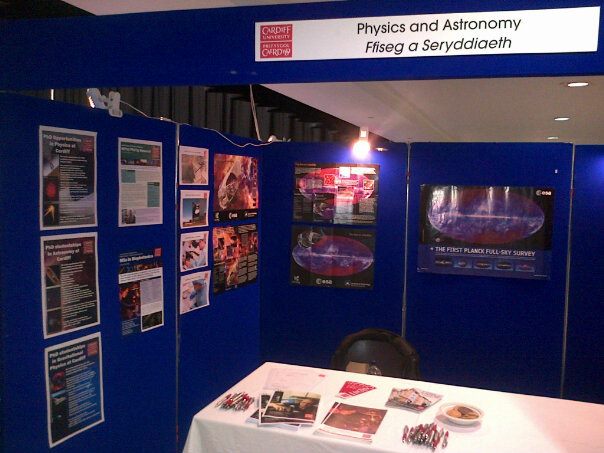
Today was the Postgraduate Open Day for Cardiff University, so I trooped off at lunchtime to man person the School of Physics & Astronomy stand in the Great Hall of the Students in the Students’ Union for the Subject Fair. It’s the first time I’ve ever been in the Great Hall, in fact, for no other reason than it’s for the students not the staff. Anyway, I have to say it didn’t look all that great, although at least it was warm. There’s no heating in my office right now, you see. And they provided coffee and biscuits.

Other than that it was just me, some leaflets and an uncountable infinity of Herschel Space Observatory souvenir pens sitting there for two hours. And there was lousy mobile coverage so I couldn’t even tweet. I got a bit bored, actually. I wish I’d taken my knitting. I did take a picture though…

It has to be said that a general Postgraduate Open Day like this isn’t a very effective method of recruiting postgraduate students, not in Physics and Astronomy at least. Most potential applicants come to apply by looking at web pages and/or listening to advice from people in the department where they are doing or did their first degree. People have already decided between Physics and, say, Astronomy and certainly between either of those and Sociology, so the idea of stalls competing for custom is a bit absurd.

Still, as Director of Postgraduate Studies I decided that it was good for Physics and Astronomy to show willing by maintaining a presence at such events, and if as a bonus we recruit even one promising PhD student then it’s probably worth the investment in time. The additional complication with this now is that I’m soon leaving to go to Sussex University, so I was tempted to tell visitors about opportunities there. I didn’t though. Mainly because I hardly spoke to anyone all afternoon…

The moral of this tale – if there is one – is that recruitment in different subjects is very different, so the “one size fits all” centralised approach isn’t always the right way to proceed. Schools and departments know their market better than anyone, so they need to be allowed to do their own thing at least part of the time.

I suspect this is an argument I’ll shortly be making elsewhere.

Skepsis Revived

Posted in Politics, The Universe and Stuff with tags , , , , , , , , on November 14, 2012 by telescoper

I appear to be in recycling mode this week, so I thought I’d carry on with a rehash of an old post about skepticism.  The excuse for this was an item in one of the Guardian science blogs about the distinction between Skeptic and sceptic. I must say I always thought they were simply alternative spellings, the “k” being closer to the original Greek and “c” being Latinised (via French). The Oxford English dictionary merely states that “sceptic” is more widespread in the UK and Commonwealth whereas “skeptic” prevails in North America. Somehow, however, this distinction has morphed into one variant meaning a person who has a questioning attitude to or is simply unconvinced by what claims to be knowledge in a particular area, and another meaning a “denier”, the latter being an “anti-sceptic” who believes wholeheartedly and often without evidence in whatever is contrary to received wisdom. A scientists should, I think, be the former, but the latter represents a distinctly unscientific attitude.

Anyway, yesterday I blogged a little bit about dark energy as, according to the standard model, this accounts for about 75% of the energy budget of the Universe. It’s also something we don’t understand very well at all. To make a point, take a look at the following picture (credit to the High-z supernova search team).

 What is plotted is the redshift of each supernova (along the x-axis), which relates to the factor by which the universe has expanded since light set out from it. A redshift of 0.5 means the universe was compressed by a factor 1.5 in all dimensions at the time when that particular supernova went bang. The y-axis shows the really hard bit to get right. It’s the estimated distance (in terms of distance modulus) of the supernovae. In effect, this is a measure of how faint the sources are. The theoretical curves show the faintness expected of a standard source observed at a given redshift in various cosmological models. The bottom panel shows these plotted with a reference curve taken out so the trend is easier to see. Actually, this is quite an old plot and there are many more points now but this is the version that convinced most cosmologists when it came out about a decade ago, which is why I show it here.

The argument drawn from these data is that the high redshift supernovae are fainter than one would expect in models without dark energy (represented by the \Omega_{\Lambda}  in the diagram. If this is true then it means the luminosity distance of these sources is greater than it would be in a decelerating universe. Their observed properties can be accounted for, however, if the universe’s expansion rate has been accelerating since light set out from the supernovae. In the bog standard cosmological models we all like to work with, acceleration requires that \rho + 3p/c^2 be negative. The “vacuum” equation of state p=-\rho c^2 provides a simple way of achieving this but there are many other forms of energy that could do it also, and we don’t know which one is present or why…

This plot contains the principal evidence that has led to most cosmologists accepting that the Universe is accelerating.  However, when I show it to first-year undergraduates (or even to members of the public at popular talks), they tend to stare in disbelief. The errors are huge, they say, and there are so  few data points. It just doesn’t look all that convincing. Moreover, there are other possible explanations. Maybe supernovae were different beasties back when the universe was young. Maybe something has absorbed their light making them look fainter rather than being further away. Maybe we’ve got the cosmological models wrong.

The reason I have shown this diagram is precisely because it isn’t superficially convincing. When they see it, students probably form the opinion that all cosmologists are gullible idiots. I’m actually pleased by that.  In fact, it’s the responsibility of scientists to be skeptical about new discoveries. However, it’s not good enough just to say “it’s not convincing so I think it’s rubbish”. What you have to do is test it, combine it with other evidence, seek alternative explanations and test those. In short you subject it to rigorous scrutiny and debate. It’s called the scientific method.

Some of my colleagues express doubts about me talking as I do about dark energy in first-year lectures when the students haven’t learned general relativity. But I stick to my guns. Too many people think science has to be taught as great stacks of received wisdom, of theories that are unquestionably “right”. Frontier sciences such as cosmology give us the chance to demonstrate the process by which we find out about the answers to big questions, not by believing everything we’re told but by questioning it.

My attitude to dark energy is that, given our limited understanding of the constituents of the universe and the laws of matter, it’s the best explanation we have of what’s going on. There is corroborating evidence of missing energy, from the cosmic microwave background and measurements of galaxy clustering, so it does have explanatory power. I’d say it was quite reasonable to believe in dark energy on the basis of what we know (or think we know) about the Universe.  In other words, as a good Bayesian, I’d say it was the most probable explanation. However, just because it’s the best explanation we have now doesn’t mean it’s a fact. It’s a credible hypothesis that deserves further work, but I wouldn’t bet much against it turning out to be wrong when we learn more.

I have to say that too many cosmologists seem to accept the reality of dark energy  with the unquestioning fervour of a religious zealot.  Influential gurus have turned the dark energy business into an industrial-sized bandwagon that sometimes makes it difficult, especially for younger scientists, to develop independent theories. On the other hand, it is clearly a question of fundamental importance to physics, so I’m not arguing that such projects should be axed. I just wish the culture of skepticism ran a little deeper.

Another context in which the word “skeptic” crops up frequently nowadays is  in connection with climate change although it has come to mean “denier” rather than “doubter”. I’m not an expert on climate change, so I’m not going to pretend that I understand all the details. However, there is an interesting point to be made in comparing climate change with cosmology. To make the point, here’s another figure.

There’s obviously a lot of noise and it’s only the relatively few points at the far right that show a clear increase (just as in the first Figure, in fact). However, looking at the graph I’d say that, assuming the historical data points are accurate,  it looks very convincing that the global mean temperature is rising with alarming rapidity. Modelling the Earth’s climate is very difficult and we have to leave it to the experts to assess the effects of human activity on this curve. There is a strong consensus from scientific experts, as monitored by the Intergovernmental Panel on Climate Change, that it is “very likely” that the increasing temperatures are due to increased atmospheric concentrations of greenhouse gas emissions.

There is, of course, a bandwagon effect going on in the field of climatology, just as there is in cosmology. This tends to stifle debate, make things difficult for dissenting views to be heard and evaluated rationally,  and generally hinders the proper progress of science. It also leads to accusations of – and no doubt temptations leading to – fiddling of the data to fit the prevailing paradigm. In both fields, though, the general consensus has been established by an honest and rational evaluation of data and theory.

I would say that any scientist worthy of the name should be skeptical about the human-based interpretation of these data and that, as in cosmology (or any scientific discipline), alternative theories should be developed and additional measurements made. However, this situation in climatology is very different to cosmology in one important respect. The Universe will still be here in 100 years time. We might not.

The big issue relating to climate change is not just whether we understand what’s going on in the Earth’s atmosphere, it’s the risk to our civilisation of not doing anything about it. This is a great example where the probability of being right isn’t the sole factor in making a decision. Sure, there’s a chance that humans aren’t responsible for global warming. But if we carry on as we are for decades until we prove conclusively that we are, then it will be too late. The penalty for being wrong will be unbearable. On the other hand, if we tackle climate change by adopting greener technologies, burning less fossil fuels, wasting less energy and so on, these changes may cost us a bit of money in the short term but  frankly we’ll be better off anyway whether we did it for the right reasons or not. Of course those whose personal livelihoods depend on the status quo are the ones who challenge the scientific consensus most vociferously. They would, wouldn’t they?

This is a good example of a decision that can be made on the basis of a  judgement of the probability of being right. In that respect , the issue of how likely it is that the scientists are correct on this one is almost irrelevant. Even if you’re a complete disbeliever in science you should know  how to respond to this issue, following the logic of Blaise Pascal. He argued that there’s no rational argument for the existence or non-existence of God but that the consequences of not believing if God does exist (eternal damnation) were much worse than those of behaving as if you believe in God when he doesn’t. For “God” read “climate change” and let Pascal’s wager be your guide….
Value Added?

Posted in Bad Statistics, Education with tags , , , , , on October 22, 2012 by telescoper

Busy busy busy. Only a few minutes for a lunchtime post today. I’ve a feeling I’m going to be writing that rather a lot over the next few weeks. Anyway, I thought I’d use the opportunity to enlist the help of the blogosphere to try to solve a problem for me.

Yesterday I drew attention to the Guardian University league tables for Physics (purely for the purposes of pointing out that excellent departments exist outside the Russell Group). One thing I’ve never understood about these legal tables is the column marked “value added”. Here is the (brief) explanation offered:

The value-added score compares students’ individual degree results with their entry qualifications, to show how effective the teaching is. It is given as a rating out of 10.

If you look at the scores you will find the top department, Oxford, has a score of 6 for “value added”;  in deference to my alma matter, I’ll note that Cambridge doesn’t appear in these tables.  Sussex scores 9 on value-added, while  Cardiff only scores 2. What seems peculiar is that the “typical UCAS scores” for students in these departments are 621, 409 and 420 respectively. To convert these into A-level scores, see here. These should represent the typical entry qualifications of students at the respective institutions.

The point is that Oxford only takes students with very high A-level grades, yet still manages to score a creditable 6/10 on “value added”.  Sussex and Cardiff have very similar scores for entry tariff, significantly lower than Oxford, but differ enormously in “value added” (9 versus 2).

The only interpretation of the latter two points that makes sense to me would be if Sussex turned out many more first-class degrees given its entry qualifications than Cardiff (since their tariff levels are similar, 409 versus 420). But this doesn’t seem to be the case;  the fraction of first-class degrees awarded by Cardiff Physics & Astronomy is broadly in line with the rest of the sector and certainly doesn’t differ by a factor of several compared to Sussex!

These aren’t the only anomalous cases. Elsewhere in the table you can find Exeter and Leeds, which have identical UCAS tariffs (435) but value added scores that differ by a wide margin (9 versus 4, respectively).

And if Oxford only accepts students with the highest A-level scores, how can it score higher on “value added” than a department like Cardiff which takes in many students with lower A-levels and turns at least some of them into first-class graduates? Shouldn’t the Oxford “value added” score be very low indeed, if any Oxford students at all fail to get first class degrees?

I think there’s a rabbit off. Can anyone explain the paradox to me?

Answers on a postcard please. Or, better, through the comments box.

Will University Swapping Work?

Posted in Education with tags , , , , , on October 21, 2012 by telescoper

Yesterday’s crossword having been more straightforward than usual, I found myself with time to peruse the Independent newspaper at my leisure. While doing so I came across a little item describing a plan suggested by Lord Rees that students from “disadvantaged backgrounds” should be allowed to swap universities after two years of a three-year degree and transfer to a Russell group institution. Apparently this idea is based on a scheme that runs “successfully” in the University of California.

The purported aim of this is to give “a second chance” to students who didn’t do well enough at A-level to get into an “elite” university – which is laudable – but it doesn’t deal with the underlying problem, namely that our pre-university education system is a mess, for two reasons.  First, students can have the misfortune to attend a school where certain subjects are taught badly or not at all. This is a particular problem in my own field, physics. Second, the A-level examinations on which most institutions base their entry criteria do not provide a reasonable assessment of a candidate’s suitability for university study.

Because of these problems many students either don’t apply to top universities or fail to make the grades required. Such universities are reluctant to drop their grades to make special allowance because they would then get penalised in the league tables –  a high entry requirement at A-level is perceived to be a mark of quality. I’m convinced that this is a major flaw in the system. Some of the very best students I’ve had the pleasure to work with at Cardiff, for example, came in at a time when our recruitment team was struggling to meet its quota,  with modest A-level scores that would not normally have been high enough to get in. I worry a great deal about how many more talented young people there are out there who lacked that bit of luck and missed out entirely.

Lord Rees is correct in saying that it will take a very long time to fix the pre-university education system, and his proposal is an attempt to provide a sticking-plaster solution later on. If you like, it’s an admission of defeat. Elite universities will be allowed to carry on using inappropriate criteria to reject talented students applying to join the first year of a degree, but will be allowed to cherry-pick the best performers from other institutions into Year 3.

Although I think this proposal contains some good ingredients, there are several things about it that worry me. I don’t know how many students will want to move after two years in the first place. They will have made friends, formed relationships, and generally settled in at their original university and to up sticks in order to travel to another university for their final year would be very disruptive. Steps would have to be taken to ensure continuity of curriculum too. And what about the financial and other implications for the original institution, which would have to be prepared to lose an indeterminate number of its best students at the end of Year 2, with consequent impact on the quality of its graduating class?

I don’t think it’s fair for the so-called “elite” to exploit the hard work put in by other departments and institutions in order to mask its own failure to recruit appropriately. The only fair solution is to fix the university admission system, which means fixing our  broken A-levels.

And another thing. I’m shortly moving from Cardiff (which is a member of the Russell group) to Sussex (which isn’t).  Look at the league tables for Physics and tell me which one should be regarded as “elite”. Should students choose their University on the basis of which one provides the best education, or on the basis that it provides membership of a prestigious club?

On balance, I don’t think this scheme is workable in the way suggested. There is a variant, however, which I think is more promising. I think we should scrap the current confused system of 4-year undergraduate degrees (MPhys, MSci, etc) and adopt a standard system of 3-year Bachelors degrees. The next level of degree should be standalone postgraduate Masters. I’d prefer these to be two years, actually, but that’s not essential to this argument. Students could then transfer after their Bachelors’ degree into an “elite” university for their Masters if they so wish.