Archive for CERN Membership

Ireland, CERN and Science

Posted in Science Politics, The Universe and Stuff with tags , , , , , on November 15, 2023 by telescoper

And lo! it came to pass that Minister for Further and Higher Education, Research, Innovation and Science Simon Harris TD has today secured Government approval to submit Ireland’s formal application to join the European Organization for Nuclear Research (CERN) as an Associate Member.

I have posted about this before, for example here. Currently Ireland is in the anomalous position of not having any form of association agreement with CERN; the list of Full and Associate Member states can be found here.

There is an important point about CERN membership, however, which I hope is not sidelined. The case for joining CERN made at political levels is largely about the return in terms of the potential in contracts to technology companies based in Ireland from instrumentation and other infrastructure investments. This was also the case for Ireland’s membership of the European Southern Observatory, which Ireland joined about five years ago. The same thing is true for involvement in the European Space Agency, which Ireland joined in 1975. These benefits are of course real and valuable and it is entirely right that arguments should involve them.

Looking at CERN membership from a scientific point of view, however, the return to Ireland will be negligible unless there is a funding to support scientific exploitation of the facility. That would include funding for academic staff time, and for postgraduate and postdoctoral researchers to build up an active community as well as, e.g., computing facilities. This need not be expensive even relative to the modest cost of associate membership (approximately  €1.9M). I would estimate a figure of around half that would be needed to support CERN-based science.

The problem is that research funding for fundamental science (such as particle physics) in Ireland is so limited as to be virtually non-existent by a matter of policy at Science Foundation Ireland, which basically only funds applied research. Even if it were decided to target funding for CERN exploitation, unless there is extra funding that would just lead to the jam being spread even more thinly elsewhere.

As I have mentioned before, Ireland’s membership of ESO provides a cautionary tale. The Irish astronomical community was very happy about the decision to join ESO, but that decision was not accompanied by significant funding to exploit the telescopes. Few astronomers have therefore been able to benefit from ESO membership. While there are other benefits of course, the return to science has been extremely limited. The phrase “to spoil a ship for a ha’porth of tar” springs to mind.

Although Ireland joined ESA almost fifty years ago, the same issue applies there. ESA member countries pay into a mandatory science programme which includes, for example, Euclid. However, did not put any resources on the table to allow full participation in the Euclid Consortium. There is Irish involvement in other ESA projects (such as JWST) but this is somewhat piecemeal. There is no funding programme in Ireland dedicated to the scientific exploitation of ESA projects.

Under current arrangements the best bet in Ireland for funding for ESA, ESO or CERN exploitation is via the European Research Council but to get a grant from that one has to compete with much better developed communities in those areas.

A significant shake-up of research funding in Ireland is in view, with Science Foundation Ireland and the Irish Research Council set to merge into a single entity called Research Ireland. If I had any say in the new structure I would set up a pot of money specifically for the purposes I’ve described above. Funding applications would have to be competitive, of course, and I would argue for a panel with significant international representation to make the decisions. But for this to work the overall level of public sector research funding will have to increase dramatically from its current level, well below the OECD average. Ireland is currently running a huge Government surplus which is projected to continue growing until at least 2026. Only a small fraction of that surplus would be needed to build viable research communities not only in fundamental science but also across a much wider range of disciplines. Failure to invest now would be a wasted opportunity.
Research Matters

Posted in Science Politics, The Universe and Stuff with tags , , , , , on September 10, 2023 by telescoper

One of the things that happened last week while I was preoccupied with ITP2023 is that, finally, the UK Government has decided to re-join the European Union’s Horizon 2020 project. I’m very happy about this, and can’t understand why it has taken so long to reach an agreement. I know many researchers in the UK who will be mightily relieved too. Of course things won’t immediately get back to normal. It’s not just that the UK contributions will start in January 2024 so there will have to be some sort of transitional arrangement. More importantly it remains to be seen how long it takes to repair the damage done to goodwill by all the political shenanigans.

While I’m on about research I should also mention that there was a short talk at ITP2023 by a particle physicist by the name of Ronan McNulty who is based at University College Dublin. The topic of that talk was the history of Ireland’s non-membership of CERN; I have blogged about this before, for example here. Currently Ireland is in the anomalous position of not having any form of association agreement with CERN; the list of Full and Associate Member states can be found here. It does seem, however, that Ireland is at last about to lodge an application for Associate Membership, perhaps as early as January 2024.

Ronan made a particularly important point about membership, which I hope is not sidelined in the discussions. The case for joining CERN made at political levels is largely about the return in terms of the potential in contracts to technology companies based in Ireland from instrumentation and other infrastructure investments. This was also the case for Ireland’s membership of the European Southern Observatory, which Ireland joined about five years ago. The same thing is true for involvement in the European Space Agency, which Ireland joined in 1975. These benefits are of course real and valuable and it is entirely right that arguments should involve them.

Looking at CERN membership from a scientific point of view, however, the return to Ireland will be negligible unless there is a funding to support scientific exploitation of the facility. That would include funding for academic staff time, and for postgraduate and postdoctoral researchers to build up an active community as well as, e.g., computing facilities. This need not be expensive even relative to the modest cost of associate membership (approximately  €1.5M). I would estimate a figure of around half that would be needed to support CERN-based science.

The problem is that research funding for fundamental science (such as particle physics) in Ireland is so limited as to be virtually non-existent by a matter of policy at Science Foundation Ireland, which basically only funds applied research. Even if it were decided to target funding for CERN exploitation, unless there is extra funding that would just lead to the jam being spread even more thinly elsewhere.

As I have mentioned before, Ireland’s membership of ESO provides a cautionary tale. The Irish astronomical community was very happy about the decision to join ESO, but it was not accompanied by significant funding to exploit the telescopes. Few astronomers have therefore been able to benefit from ESO membership. While there are other benefits of course, the return to science has been extremely limited. The phrase “to spoil a ship for a ha’porth of tar” springs to mind.

Although Ireland joined ESA almost fifty years ago, the same issue applies there. ESA member countries pay into a mandatory science programme which includes, for example, Euclid. However, did not put any resources on the table to allow full participation in the Euclid Consortium. There is Irish involvement in other ESA projects (such as JWST) but this is somewhat piecemeal. There is no funding programme in Ireland dedicated to the scientific exploitation of ESA projects.

Under current arrangements the best bet in Ireland for funding for ESA, ESO or CERN exploitation is via the European Research Council but to get a grant from that one has to compete with much better developed communities in those areas.

A significant shake-up of research funding in Ireland is in view, with Science Foundation Ireland and the Irish Research Council set to merge into a single entity. If I had any say in the new structure I would set up a pot of money specifically for the purposes I’ve described above. Funding applications would have to be competitive, of course, and I would argue for a panel with significant international representation to make the decisions. But for this to work the overall level of public sector research funding will have to increase dramatically from its current level, well below the OECD average. Ireland is currently running a huge Government surplus which is projected to continue growing until at least 2026.

Only a small fraction of that surplus would be needed to build viable research communities not only in fundamental science but also across a much wider range of disciplines. Failure to invest now would be a wasted opportunity.

Ireland and CERN

Posted in Maynooth, Politics, Science Politics, The Universe and Stuff with tags , , , on December 30, 2022 by telescoper

Not long ago I posted an item about Ireland’s potential membership of CERN. There seems to have been some progress at political levels in this direction. In Mid-December, the Seanad called for a detailed proposal for CERN membership to be drawn up. More recently still, Minister Simon Harris has indicated that he will bring such a proposal to Cabinet on the matter.

There’s an article in yesterday’s Irish Times by Cormac O’Raifeartaigh reviewing the situation.

As I understand things, if the Irish Government were to decide to take Ireland into CERN then it would first have to become an Associate Member, which would cost around €1.5 million per year. That’s a modest contribution, and the financial returns to Irish industry and universities are likely to far exceed that. This Associate member stage would last up to 5 years, and then to acquire full membership a joining fee of around €16.8 million would have to be paid, though that could be spread out over ten years, along with an annual contribution of around €13.5m.

While I support the idea of Ireland joining CERN I feel obliged to stress my concerns. The most important of these is that there seems to me to be a real danger that the Government would simply appropriate funding for CERN membership from within existing programmes leaving even less for other forms of scientific research. In order to reap the scientific reward of CERN membership the Government will have to invest the additional resources needed to exploit the access to facilities membership would provide. Without a related increase in research grant funding for basic science, the opportunity to raise the level of scientific activity in Ireland would be lost and science overall may end up worse off.

Ireland recently joined the European Southern Observatory (ESO), a decision which gave Irish astronomers access to some amazing telescopes. However, there is no sign at all of Irish funding agencies responding to this opportunity by increasing funding for academic time, postdocs and graduate students needed to do the actual science. In one respect ESO is very like CERN: the facilities do not themselves do the science. We need people to do that. CERN membership could turn out to be like a very expensive Christmas gift that looks very exciting until you open the box and find that the batteries are not included.

P.S. At least Cormac’s employers in Waterford have been quick off the mark in exploiting the potential of CERN by renaming their entire institution after it…

Is Ireland about to join CERN?

Posted in Politics, Science Politics, The Universe and Stuff with tags , , on November 16, 2022 by telescoper

Way back in 2019 I posted a piece about the case for Ireland to join CERN and revived the discussion about six months ago after talking about it to particle physicist John Ellis.

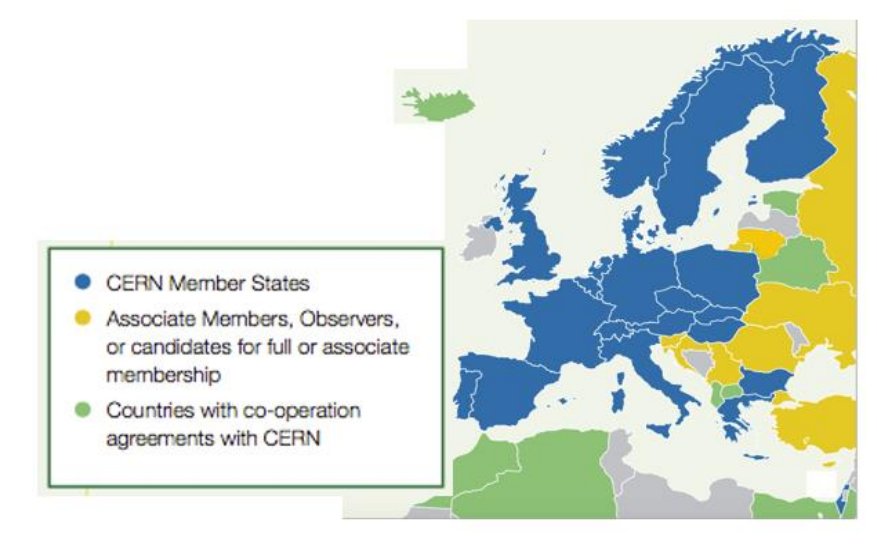
Well it seems there has been progress and, according to the Irish Times, a proposal to join CERN is going to be tabled by the Minister Simon Harris. This follows a long hiatus after a move reported in the news here in Ireland several years ago of a report from a Committee of the Houses of the Oireachtas making the case for Ireland to join CERN. You can download the report here (PDF) and you’ll find this rather striking graphic therein:

You will see that there are only three European countries other than Ireland that don’t have any form of membership or other agreement with CERN: Latvia, Bosnia-Herzegovina, Moldova. The fact that almost everyone else is in is not in itself necessarily a good argument for Ireland to join, but it does make one wonder why so many other countries have found it important to join or have an agreement with CERN while Ireland has not.

As the document explains, if the Irish government  were to decide to take Ireland into CERN then  it would first have to become an Associate Member, which would cost around €1.2 million per year. That’s small potatoes really, and  the financial returns to Irish industry and universities are likely to far exceed that, so the report strongly recommends this step be taken. This Associate member stage would last up to 5 years, and then to acquire full membership a joining fee of around €15.6 million would have to be paid, which is obviously a much greater commitment but in my view still worthwhile.

There were some positive noises when the document came out, but that was near the end of 2019. Not far into 2020 the pandemic struck and the idea sank without trace. Now it looks like the idea is alive again. It’s not exactly a done deal but at least there’s some movement.

While I strongly support the idea of Ireland joining CERN I do have a couple of concerns about the case as presented in the Oireachtas report.

One is that I’m very sad that the actual science done at CERN is downplayed in that report. Most of it is about the cash return to industry, training opportunities, etc. These are important, of course, but it must not be forgotten that big science projects like those carried out at CERN are above all else science projects. The quest for knowledge does have collateral benefits, but it a worthy activity in its own right and we shouldn’t lose sight of that.

My other (related) concern is that joining CERN is one thing, but in order to reap the scientific reward the government has to invest in the resources needed to exploit the access to facilities membership would provide. Without a related increase in research grant funding for basic science the opportunity to raise the level of scientific activity in Ireland would be lost.

Ireland recently joined the European Southern Observatory (ESO), a decision which gave Irish astronomers access to some amazing telescopes. However, there is no sign at all of Irish funding agencies responding to this opportunity by increasing funding for academic time, postdocs and graduate students needed to do the actual science. In one respect ESO is very like CERN: the facilities do not themselves do the science; we need people to do that. The jam for research is already spread very thinly in Ireland so having an extra thing to spread it on will not necessarily be a good thing for science in general.

Revisiting the Case for Irish Membership of CERN

Posted in Politics, Science Politics, The Universe and Stuff with tags , , , , on May 31, 2022 by telescoper

At last week’s Irish Theoretical Physics meeting I had the opportunity to have lunch with particle physicist Professor John Ellis (of King’s College London). Among other things we discussed whether or not it was likely that Ireland might join CERN. Currently Ireland has no official relationship with CERN, not even associate membership, which makes it anomalous among European countries. In November 2019 I blogged about the issue here.

There was a move reported in the news here in Ireland of a report from a Committee of the Houses of the Oireachtas making the case for Ireland to join CERN. You can download the report here (PDF) and you’ll find this rather striking graphic therein:

You will see that there are only three European countries other than Ireland that don’t have any form of membership or other agreement with CERN: Latvia, Bosnia-Herzegovina, Moldova. The fact that almost everyone else is in is not in itself necessarily a good argument for Ireland to join, but it does make one wonder why so many other countries have found it to join or have an agreement with CERN while Ireland has not.

As the document explains, if the Irish government  were to decide to take Ireland into CERN then  it would first have to become an Associate Member, which would cost around €1.2 million per year. That’s small potatoes really, and  the financial returns to Irish industry and universities are likely to far exceed that, so the report strongly recommends this step be taken. This Associate member stage would last up to 5 years, and then to acquire full membership a joining fee of around €15.6 million would have to be paid, which is obviously a much greater commitment but in my view still worthwhile.

There were some positive noises when the document came out, but that was near the end of 2019. Not far into 2020 the pandemic struck and the idea sank without trace. Perhaps now is a good time to raise the issue again?

While I strongly support the idea of Ireland joining CERN I do have a couple of concerns about the case as presented in the Oireachtas report.

One is that I’m very sad that the actual science done at CERN is downplayed in the  report. Most of it is about the cash return to industry, training opportunities, etc. These are important, of course, but it must not be forgotten that big science projects like those carried out at CERN are above all else science projects. The quest for knowledge does have collateral benefits, but it a worthy activity in its own right and we shouldn’t lose sight of that.

My other (related) concern is that joining CERN is one thing, but in order to reap the scientific reward the government has to invest in the resources needed to exploit the access to facilities membership would provide. Without a related increase in research grant funding for basic science the opportunity to raise the level of scientific activity in Ireland would be lost.

Ireland recently joined the European Southern Observatory (ESO), a decision which gave Irish astronomers access to some amazing telescopes. However, there is no sign at all of Irish funding agencies responding to this opportunity by increasing funding for academic time, postdocs and graduate students needed to do the actual science. In one respect ESO is very like CERN: the facilities do not themselves do the science; we need people to do that. The jam is already spread very thinly in Ireland so having an extra thing to spread it on will not necessarily be a good thing for science in general.

The Case for Irish Membership of CERN

Posted in Politics, The Universe and Stuff with tags , , , , on November 16, 2019 by telescoper

In the news here in Ireland this week is a new report from a Committee of the Houses of the Oireachtas making the case for Ireland to join CERN. You can download the report here (PDF) and you’ll find this rather striking graphic therein:

You will see that there are only three European countries that don’t have any form of membership or other agreement with CERN: Latvia, Bosnia-Herzegovina and Ireland. The fact that almost everyone else is in is not in itself necessarily a good argument for Ireland to join, but it does make one wonder why so many other countries have found it to join or have an agreement with CERN while Ireland has not.

As the document explains, if the Irish government  were to decide to take Ireland into CERN then  it would first have to become an Associate Member, which would cost around €1.2 million per year. That’s small potatoes really, and  the financial returns to Irish industry and universities are likely to far exceed that, so the report strongly recommends this step be taken. This Associate member stage would last up to 5 years, and then to acquire full membership a joining fee of around €15.6 million would have to be paid, which is obviously a much greater commitment but in my view still worthwhile.

While I strongly support the idea of Ireland joining CERN I do have a couple of concerns.

One is that I’m very sad that the actual science done at CERN is downplayed in the Oireachtas report. Most of it is about return to industry, training opportunities, etc. These are important, of course, but it must not be forgotten that big science projects like those carried out at CERN are above all else science projects. The quest for knowledge does have collateral benefits, but it a worthy activity in its own right and we shouldn’t lose sight of that.

My other (related) concern is that joining CERN is one thing, but in order to reap the scientific reward the government has to invest in the resources needed to exploit the access to facilities membership would provide. Without a related increase in research grant funding for basic science the opportunity to raise the level of scientific activity in Ireland would be lost.

Ireland recently joined the European Southern Observatory (ESO), a decision which gave Irish astronomers access to some amazing telescopes. However, there is no sign at all of Irish funding agencies responding to this opportunity by increasing funding for academic time, postdocs and graduate students needed to do the actual science.

Although astronomy is clearly much more interesting than particle physics (😉) in one respect the case of ESO is very like the case of CERN – the facilities do not themselves do the science. We need people to do that.