Archive for Charlie Parker

Space is the Place: 100 Years of Sun Ra

Posted in Jazz, The Universe and Stuff with tags , , , , on May 22, 2014 by telescoper

When I’m struggling to find the time or the inspiration to write a blog post, serendipity usually comes to the rescue. A post on Twitter just alerted me to the fact that today is the 100th birthday of  Sun Ra, one of the most extraordinary composers and bandleaders of the 20th Century; was born Herman Poole Blount in Bimingham, Alabama, on 22nd May 1914. From the 1950s, until his death in 1993, Sun Ra led various combinations of musician in bands with various permutations of names involving the word Arkestra, such as the Blue Universe Arkestra and the Solar Myth Arkestra. He himself played keyboards, sometimes solo and sometimes with huge bands  of over 30 musicians; his music touched on virtually the entire history of jazz, from ragtime to swing music, from bebop to free jazz. He was also  one of the first musicians, in any genre to make extensive use of electronic keyboards.

He never achieved mainstream commercial success, but was a prolific recording artist with a cult following, partly fuelled by his outrageous claims to have been born not on Earth but on Saturn and the fact that much of his music was to do with space travel. Quoted in Jazziz magazine

They really thought I was some kind of kook with all my talk about outer space and the planets. I’m still talking about it, but governments are spending billions of dollars to go to Venus, Mars, and other planets, so it’s no longer kooky to talk about space

Quite. In fact, Sun Ra developed a complex performing identity based on his music, “cosmic” philosophy, and poetry. He abandoned his birth name, took on the persona of Sun Ra (Ra being the ancient Egyptian god of the sun), and often dressed in the style of an ancient Egyptian pharoah, as in the video clip. In other words, he was very odd.

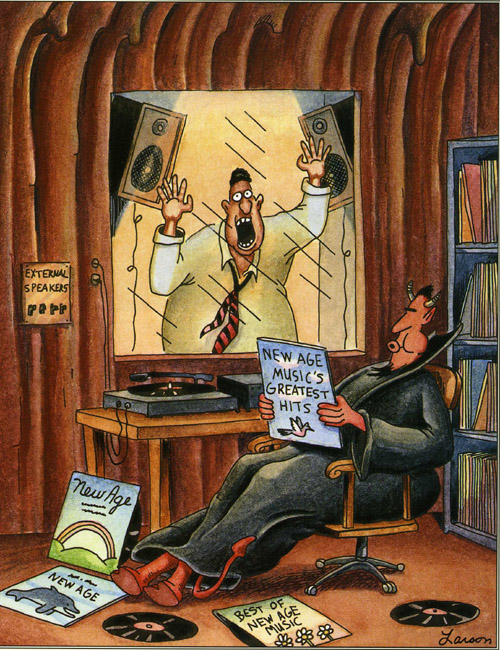
At this point you’re probably thinking this is all a bit “New Age” and heading in the direction of Charlie Parker‘s Private Hell, one of my favourite Gary Larson cartoons:

However, although I admit Sun Ra’s music is eclectic, outrageous and sometimes downright mystifying, it also has a marvellous coherence to it maintained as his style evolved over four decades and is consistently imbued with a powerful sense of the Jazz tradition.  In fact, I think Charlie Parker would have approved. I know I do! Anyway, whatever I think, the music of Sun Ra has withstood its skeptics and detractors for generations and long may it continue to do so. The world needs more of his kind.

To give a taste of his music, here is the classic album Space is the Place in its entirety (at least until it gets taken off Youtube for copyright violation!):


The Quintet at Massey Hall

Posted in Jazz with tags , , , , , , , , , on February 23, 2014 by telescoper

Time for a quick Jazz review, I think. This time I thought I’d pick a classic live performance from May 15th 1953 at Massey Hall in Toronto. Originally released as a vinyl LP with only 6 tracks on it, and called The Quintet of the Year, but subsequently re-released in various versions on CD, with various titles including Jazz at Massey Hall. The whole concert  is now available on Youtube here:

This concert was planned to unite the greatest stars of the bebop era who had performed together earlier in their careers but had gradually evolved different styles over the intervening years. The line-up is Charlie Parker on alto, Dizzy Gillespie on trumpet, Bud Powell on piano, Charles Mingus on bass and the great Max Roach on drums which is stellar by any criterion!

Gatherings of star jazz players have often turned out to be disappointing, largely because very great musicians can sometimes interfere negatively rather than positively with each other, not necessarily consciously but because they can have ideas incompatible with one another. This evening, however,  was a glorious exception to this rule, doubtless because all the musicians had worked together in the past, and their subsequent individual development had not taken them too far beyond their shared musical background. It is true that the ensemble passages are slight, but that doesn’t matter much because the solos are of such a remarkable and consistently high standard. Charlie Parker turns in some of the very best of his later recorded work, giving the lie to those who argue that his musical abilities were in decline at this time. He might not play as elegantly as he did on the classic Dial and Savoy sessions, but he is significantly more adventurous, with startling melodic contrasts in much of his work. At times this is a bit of a problem in that he seems to full of ideas that what comes out is a sequence of breathtaking fragments rather than a cohesive solo. This happens on A Night in Tunisia, for example, which never quite fulfills the promise of its magnificent opening break. On other tracks, though, especially Hot House his improvisations are just brilliant. It’s hard to imagine listening to this that in less than two years he would be dead.

Dizzy Gillespie matches Parker in superb fashion, betraying none of the offhandedness that often afflicted his later recorded performances, and the pyrotechnical quality of his playing is as exhilarating as it is instantly recognizable. Gillespie was an extrovert on stage and his frequent dancing around on the stage results in him going on and off mike from time to time, but it doesn’t detract from the performance once you realize why he’s fading in and out. It is, after all, a live performance and if you shut your eyes you can imagine Dizzy Gillespie the showman without any difficulty at all!

Most Jazz reviewers confine their comments on the rhythm section to a few kind words, but in this case that would be a travesty. The limitations of live recording technology in 1953 result in a rather unbalanced mix, but the flip side of that is that you can hear  particularly well the pivotal importance of the bass playing of Charles Mingus. Between them Mingus and Max Roach lay down a relentlessly propulsive beat as well as taking gripping solos; the drum workouts in Wee and Salt Peanuts are astonishing in their interplay of rhythm and texture. Trumping even them, however, is the genius of Bud Powell who plays at a level consistently high even by his own standards.

Bud Powell is a fascinating musician for many reasons. Much less of a formalist than many Jazz pianists he nevertheless seems to generate a real sense of unity, more through the  emotional drive underpinning his phrases than by imposing any set structure on his improvisations. His solo on Wee offers a fine example of this: moving inexorably towards a shattering climax as the right hand figures vary ceaselessly in their length and the chords punched out by the left hand grow more frequent and more percussive.

This album is another must-have for any serious collector of post-War jazz. The individual parts are all superb, but the whole is even greater than their sum.

PS. I had the pleasure of attending a concert at Massey Hall myself, when I was on sabbatical in Toronto in 2005/6.

Music for Zen Meditation

Posted in Jazz, Music with tags , , , on January 12, 2014 by telescoper

Given my current location I thought I’d try this one out readers of this blog. I bought the album Music for Zen Meditation about 20 years ago; it was recorded in 1964 and features jazz clarinettist Tony Scott with two Japanese musicians, Shinichi Yuize (who plays the koto, a 13-stringed Japanese harp) and Hōzan Yamamoto (shakuhachi, a kind of bamboo flute). I think the music, and especially Scott’s lovely tone on the clarinet, creates a wonderful sense of peace, and it’s fascinating to hear the blending of styles. However, I played some of the music for my Japanese friend Chiaki some time ago and he said it sounded like something you would hear in an elevator. Ouch!

This album is often said to have been the first ever recording in the musical genre that came to be known as New Age, most of which I can’t stand. That reminds me of one of my favourite Gary Larson cartoons:

charlie_parker_hell

Music for Zen Meditation is certainly a far cry from bebop, but I’ll leave it to you to make your own mind up about it. See what you think. This track is the first one on the album and is entitled Is All Not One?

Bird’s Nest

Posted in Jazz with tags , , , , , on August 25, 2013 by telescoper

I know it’s a Bank Holiday weekend, but I’ve got so many things to do that I don’t have time for anything but a brief post today. I heard this track on BBC Radio 3 last night and it brought back a lot of memories for me so I thought I’d post it here with some brief comments. When I was at school most of my friends seemed to be into heavy metal, which I found completely tedious, so while they were out buying LPs by Hawkwind or Iron Maiden I was acquiring a secret collection of classic jazz records. Among my most prized purchases was a boxed set of six vinyl discs entitled The Legendary Dial Masters; they’re now available on CD, of course. I listened to these records over and over again and can easily understand why they’re regarded as some of the greatest musical performances of the twentieth century, not only in Jazz but in all music.

There’s a curious story about the Dial sessions, in that they took place in Hollywood California as part of an “exclusive” one-year contract (signed in 1946) between Dial records and Charlie Parker, who just happened to have signed another exclusive contract with the Savoy label based in New York.   By this time in his life, Parker was already seriously addicted to heroin and this example of duplicity is consistent with other aspects of his behaviour: he regularly cheated and scrounged off friends and strangers in  order to feed his habit and probably gave relatively little thought to the consequences of being found out. In this case, the clear breach of contract was pretty quickly rumbled, which could have led to a lawsuit, but it seems to have been settled amicably by the record labels, who agreed that both sets of recordings could be made commercially available.

It would take scores of blog posts to do justice to these great tracks, so I’ll just make a few comments now. First thing to mention is that the LPs forming the boxed set don’t just include the final versions as released, but usually a number of incomplete or discarded takes. At the session in question, recorded on February 19th 1947, there are 13 takes in all for just four tunes. It’s fascinating listening to these alternative versions (which are often, in my view, just as good if not better than the “final” version), not least because they demonstrate the wonderful spontaneity of Charlie Parker’s playing. They also have an experimental feel to them. The track I heard last night, Bird’s Nest, is, on one level, yet another bebop composition based on the chord changes of the George Gershwin standard “I got rhythm”, but what’s very special about it is just how free his improvisation is, both rhythmically and harmonically. It is, of course, well known that Charlie Parker’s nickname was “Bird” (originally Yardbird), and this track in particularly demonstrates that his playing really was very like birdsong – agile, quirky and above all intensely beautiful. The main difference is that most birdsong is actually atonal, which Bird’s music was not.

Another thing worth mentioning about this track is the identity of the piano player. When I heard it last night it triggered a vague memory that Errol Garner made some records with Charlie Parker. Was this one of them? I honestly couldn’t remember, but became increasingly convinced when I heard the piano solo. Later on, a quick search through my discography revealed that I was right. It is indeed a young Errol Garner. Although he doesn’t play badly, he doesn’t sound to me either comfortable or convincing playing bebop. Nevertheless, this session gives an important glimpse into the musical development of a major artist. You could say the same thing about the other tracks made around the same time by Bird and the young Miles Davis.

But that’s enough words. The whole point about music is that it says something that can’t be said with words. Birds manage perfectly well without them too.

Laura

Posted in Film, Jazz with tags , , , on August 30, 2012 by telescoper

Last week’s post about Vincent Price reminded me of the film that really established him as a movie actor, the classic film noir Laurain which he played the parasitic boyfriend of the eponymous heroine. If you’ve never seen the film, you should because in my opinion it hasn’t dated at all even though it was made in 1944. A song with the same name written for the film in 1945 (after the filming was completed) became a popular hit at the time as well as a favourite for jazz musicians, spawning numerous cover versions including one by the great Charlie Parker. Those of you who associate Bird with jagged bebop tunes played at a frenetic pace might be surprised to hear his take on this romantic ballad, particularly as it involves him playing with strings. The Charlie Parker with Strings session recorded in 1950 received mixed reviews from the critics, primarily because many of the arrangements are a bit bland, but while  I don’t like all these tracks, I do think Parker’s version of  Laura is a gem in which he  reveals a sensitive side to his music-making that isn’t often appreciated.

My Little Suede Shoes

Posted in Jazz with tags , , , , on June 23, 2012 by telescoper

If this wonderful video is anything to go by, the late great Johnny Griffin had splendid taste in footwear..as he got these shoes from Charlie Parker himself.

Remembering Bird

Posted in Jazz with tags , , , , on March 18, 2012 by telescoper

Last week saw the 57th anniversary of the death of Charlie Parker, aka Bird, a musical genius on the saxophone whose influence not only on jazz but on twentieth century music is incalculable. I’ve posted quite a few tracks by Bird over the years and one thing I’ve learned from doing that is that he’s by no means everyone’s cup of tea. I can’t do anything about that, of course, but I can at least point out the existence of his wonderful legacy to those (regrettably many) people who’ve never heard of him or his musicI still remember the mixture of astonishment and exhilaration I felt when I first heard him on record and if I can give that sense of joy to just one person via the blogosphere then it’s worth a hundred posts.

Here’s Kim, another one of Bird’s tunes based on the rhythm changes, with an alto sax solo improvised at breakneck speed and with incredible virtuosity. The other day I was talking to a friend of mine who only has a passing interest in jazz and he asked me whether Charlie Parker really was that good. Well, if you’re asking that question to yourself, listen to this and then you’ll have the answer. As far as I’m concerned this is three minutes of pure awesome….

Now’s The Time

Posted in Jazz with tags , , on August 20, 2011 by telescoper

I’m up early and going to be out of here for the day, so here’s a bit of music to keep you going. It’s another of Charlie Parker‘s variations on the blues in F, this time called Now’s the Time.  It’s definitely one of the bluesiest of Bird’s blues, and indeed it’s quite close to the usual 12-bar chord progression:

| F7| F7| F7 |F7 | B♭7| B♭7| F7| F 7| C7| B♭7| F7| F7|

In fact this goes – if I’ve heard it right –

| F7| F7 | F7| F7| B♭7| B♭7|F7| D7| Gmi| C7| F7| C7|

No doubt people will correct* me for having cloth ears if I’m wrong but in any case it’s an all-time classic, so enjoy!

*Indeed so, and a more accurate set of changes that has been suggested to me is

F7|Bb7|F7|Cmi7 F7| Bb7|Bb7|F7|D7#9| Gmi7|C7|F7 D7|Gmi7 F7|

Billie’s Bounce

Posted in Jazz with tags , , , , on July 28, 2011 by telescoper

I thought I’d put this up because I’ve just found it and I think it’s great. It’s an interesting facet of jazz history that the clarinet, a mainstay of jazz styles from the New Orleans roots through to the Swing Era, fell into disfavour in the post-war era with the advent of bebop when it was largely replaced by the saxophone. Very few musicians persisted with the clarinet into the era of modern jazz, but this is one that did. It’s the superb Buddy DeFranco, one of the most technically accomplished clarinettists in all of jazz – few have ever been able to match his control in the upper register. The tune they’re playing is a Charlie Parker composition called Billie’s Bounce, another tune based on the standard 12-bar blues sequence (in F) but with some alterations. As far as my chord book says, it basically goes like this:

| F7| F7 | B♭7| F7|| B♭7| B♭7|F7| F7| G7| C7| F7| C7|

while the standard blues progression in F would go like

| F7| F7| F7 |F7 | B♭7| B♭7| F7| F 7| C7| B♭7| F7| F7|

It’s a Charlie Parker trademark to have a “turnaround” at the end, with the dominant chord C7 instead of the tonic F and, as you’ll hear, these changes produce quite a different feel to the standard blues sequence.

Anyway, one thing I particularly love about this performance is the perfunctory instruction given by Buddy DeFranco at the start: “Play the Blues in F for a while”. That’s all they needed to send them on their way.

Slim’s Jam

Posted in Jazz with tags , , , , , on August 5, 2010 by telescoper

It’s been a tiring and frustrating day during which I accomplished very little, apart from becoming tired and frustrated. I think I’m going to have an early night, but before doing that I thought I’d share this old record with you. There’s not much information about it on Youtube, but I actually have it on an very battered vinyl LP. The sleevenote doesn’t give the exact date of the recording session, but it was somewhere around the middle of December 1945.

The band is dubbed Slim Gaillard and his Orchestra, but it’s just a seven-piece band. It is, however, notable for the presence on it of two giants of the bebop era, Charlie Parker and Dizzy Gillespie. I thought I’d put it on here primarily because it has such a relaxed atmosphere and is a lot of fun to listen to, as well as providing a fascinating window into this transitional period of American Jazz in which Charlie Parker was the leading figure.

Before 1945 Charlier Parker had worked mainly as a featured soloist in big bands of the swing era, including those of Jay McShann, Earl Hines and Billy Eckstine; after 1945 he almost exclusively performed and recorded in small groups. The year 1945 was also important for two other reasons: it was the first year he was able to record any of his own compositions and it was the first time he was able to record with Dizzy Gillespie in a band made entirely of like-minded musicians, rather than a mixed bag as on this track.

Another quite interesting thing I almost forgot to mention is that this particular 1945 track is – I think – the earliest known recording of Charlie Parker’s voice…

This period also marked the beginning of Parker’s acceptance as an important solo voice by music critics and by the “hipper” sections of the American public. This spreading awareness of his importance is why both he and Dizzy were invited to perform on the West Coast of America, specifically at Billy Berg’s club in Hollywood. It was during a short residency there that Slim’s Jam was recorded.

Apart from Charlie Parker (alto sax) and Dizzy Gillespie (trumpet), the band also contained the relatively unknown swing-era musician Jack Mcvea (tenor sax) as well as young bebop devotee Dodo Marmarosa (piano). The drummer was the great Zutty Singleton, who in fact played on some of the Hot Five recordings with Louis Armstrong in the 1920s, and the bass was “Bam” Brown. Slim Gaillard played guitar on this track as well as doing the intros in characteristic fashion.

Slim Gaillard was a truly remarkable character who led a remarkable life, as his wikipedia page makes clear. He was a talented musician in his own right, but also a wonderful comedian and storyteller. He’s most famous for the novelty jazz acts he formed with musicians such as Slam Stewart and, later, Bam Brown; their stream of consciousness vocals ranged far afield from the original lyrics along with wild interpolations of nonsense syllables such as MacVoutie and O-reeney; one such performance figures in the 1957 novel On the Road by Jack Kerouac. It’s also very much the style of the commentary he adds to this track.

In later life Slim Gaillard travelled a lot in Europe – he could speak 8 languages in addition to English – and spent long periods living in London. He died there, in fact, in 1991, aged 75. I saw him a few times myself when I used to go regularly to Ronnie Scott’s Club. A tall, gangly man with a straggly white beard and wonderful gleam in his eye, he cut an unmistakeable in the bars and streets of Soho. He rarely had to buy himself a drink as he was so well known and such an entertaining fellow that a group always formed around him whenever he went into a pub in order to enjoy his company. You never quite knew what he was going to do next, in fact. I once saw him sit down and play a piano with his palms facing upwards, striking the notes with the backs of his fingers. Other random things worth mentioning are that Slim Gaillard’s daughter was married to Marvin Gaye and it is generally accepted that the word “groovy” was coined by him (Slim). I know it’s a cliché, but he really was a larger-than-life character and a truly remarkable human being.

They don’t make ’em like Slim any more, but you can get a good idea of what a blast he was by listening to this record, which is bound to bring a smile to the  most crabbed of faces. But alongside the offbeat  humour there’s some terrific playing too. Charlie Parker’s virtuoso blues-inflected choruses and Dizzy Gillespie’s dissonant pyrotechnics  form a strong stylistic contrast with Jack McVea’s earlier tenor sax solo which sounds positively old-fashioned by comparison.

Anyway, it’s time for bed-o-voutie so I’ll say goodbye-o-reenie with a little hot cocoa on it. I gotta get up early in the mornin’ myself…