Yesterday, after yet another Sunday afternoon in my office on the University of Sussex campus, I once again encountered the baffling nature of the “real time boards” at the bus-stop at Falmer Station (just over the road from the University). These boards are meant to show the expected arrival times of buses; an example can be seen on the left of the picture below, taken at Churchill Square (in the City Centre).
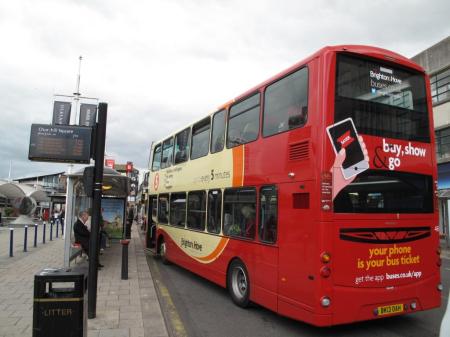
The real-time board system works pretty well in central Brighton, but it’s a very different story at Falmer, especially for the Number 23 which is my preferred bus home. Yesterday provided a typical illustration of the problem: the time of the first bus on the list, a No. 23, was shown as “1 min” when I arrived at the stop. It then quickly moved to “due” (a word which I’ll comment about later). It then moved back to “2 mins” for about 5 minutes and then back to “due” again. It stayed like that for over 10 minutes at which point the bus that was second on the list (a No. 28 from Lewes) appeared. Rather than risk waiting any longer for the 23 I got on the 28 and had a slightly longer walk home from the stop at the other end. Just as well I did because the 23 vanished entirely from the screen as soon as I boarded the other bus. This apparent time-travel isn’t unusual at Falmer, although I’ve never really understood why.
By sheer coincidence when I got to the bus stop to catch a bus to campus this morning there was a chap from Brighton and Hove buses there. He was explaining what sometimes goes wrong with the real time boards to a lady, so I joined in the conversation and asked him if he knew why Falmer is so unreliable. He was happy to oblige. It turns out that the way the real-time boards work depends on each bus having a GPS system that communicates to a central computer via a radio link. If the radio link drops out for some reason – as it apparently does quite often up at Falmer (mobile phone connectivity is poor here also) – the system looks up the expected time of the bus after the one that it has lost contact with. Thus it is that a bus can apparently be “due” and then apparently go back in time. Also, if a bus has to divert from the route programmed into the GPS tracker then it is also removed from the real-time boards.
However, there is another system in operation alongside the GPS tracker. When a bus actually stops at a stop and opens its doors the onboard computer communicates this to the central system at the same time as the location signs inside the bus are updated. At this point the real-time boards are reset.
The unreliability I’ve observed at Falmer is in fact caused by two problems: (i) the patchy radio coverage as the bus wanders around the hilly environs of Falmer campus; and (ii) the No. 23 is on a new route around the back of campus which means that it vanishes from the system entirely when it wanders off the old route, as would happen if the bus were to break down.
Mystery solved then, in a sense, but it means there’s a systematic problem that isn’t going to be fixed in the short-term. Would it be better to switch off the boards than have them show inaccurate information? Perhaps, but only if it were always wrong. In fact the boards seem to work OK for the more frequent bus, the No. 25. My strategy is therefore never to rely on the information provided concerning the No. 23 and just get the first bus that comes. It’s not a problem anyway during the week because there’s a bus every few minutes, but on a Sunday evening it is quite irksome to see apparently random times on the screens.
All this talk about real-time boards reminds me of a question I was asked in a lecture last week. I was starting a new section of my Theoretical Physics module for 2nd Year students on Complex Analysis: the Cauchy-Riemann equations, Conformal Transformations, Contour Integrals and all that Jazz. To start the section I went on a bit of a ramble about the ubiquity of complex numbers in physics and whether this means that imaginary numbers are, in some sense, real. You can find an enjoyable polemic on this subject, given the answer “no” to the question here.
Anyway, I got the class to suggest examples of the use of complex numbers in physics. The things you’d expect came up such as circuit theory, wave propagation etc. Then somebody mentioned that somewhere they had heard of imaginary time. The context had probably been provided Stephen Hawking who mentioned this in his book A Brief History of Time. In fact the trick of introducing imaginary time is called a Wick Rotation and the basic idea is simple. In special relativity we deal with four-dimensional space-time intervals of the form
 ,
,
i.e. the metric describing Minkowski space. The minus sign in front of the time bit is essential to the causal structure of space-time but it causes quite a few mathematical difficulties. However if we make the substitution

then the metric becomes
 ,
,
which corresponds to a four-dimensional Euclidean space which is in many situations much easier to handle mathematically.
Complex variables and complex functions provide the theoretical physicist with a host of extremely elegant techniques for solving tricky problems. But does that mean they are somehow “built in” to nature? I don’t think so. I don’t think the Brighton & Hove Bus company uses imaginary time on its display boards either, although it does sometimes seem that way.
POSTSCRIPT. I forgot to include my planned rant about the use of the word “due”. The boards displaying train times at railway stations usually give the destination and planned departure time of the train, e.g. “Brighton 11.15”. If things are running to schedule this information is supplemented by the phrase “On Time”. If not, which is sadly a more likely contingency in the UK, this changes to “due 11.37” or some such. This really annoys me.: the train is due at 11.15. If it doesn’t come until after then, it’s overdue or, in other words, late.

 In the Dark