Two recent news items about Cardiff caught my attention so I thought I’d do a quick post. The first piece was about the terrible state of traffic congestion in the city. This doesn’t affect me directly as I normally work to work and back, but it has definitely got much worse in the last few years. The roads are regularly gridlocked, a situation made worse by the interminable and apparently pointless roadworks going on everywhere as well as absurdly slow and dysfunctional traffic lights. There’s a common view around these parts that this is being allowed to happen – or even engineered – so that Cardiff City Council can justify the introduction of congestion charging. This would be an unpopular move among motorists, but I think a congestion charge would not be a bad idea at all, as what the city really needs is to reduce the number of motor vehicles on its streets, to deal with the growing problem of pollution and long journey times.
One day, about six years ago, I was almost run over three different times by three different vehicles. The first was near the car park in Sophia Gardens, where there are signs and road marking clearly indicating that there is a speed limit of 5 mph but where the normal speed of cars is probably more like 35; the guy who nearly killed me was doing about 60.
Next, in Bute Park, a heavy lorry belonging to the Council, engaged in some sort of “tree-management” business, thundered along the footpath past me. These paths used to be marked 5mph too, but the Council removed all the signs when it decided to build a huge road into the Park and encourage more vehicles to drive around inside. The lorry wasn’t going as fast as the Boy Racer of Sophia Gardens, but the size of the truck made it just as scary.
Finally, using a green light at the pedestrian crossing at Park Place I was narrowly missed by another car who had clearly jumped a red light to get onto the dual carriageway (Dumfries Place) leading to Newport Road.
I have to say things like this aren’t at all unusual, but that is the only time I’ve had three close encounters in one day! Although most car drivers behave responsibly, there seems to be a strong concentration of idiots in Cardiff whose antics are exacerbated by the hare-brained Highways Department of the local council. There are many things to enjoy about living in Cardiff, and the quality of life here is very good for a wide range of reasons, but of all the cities I’ve lived in it is by a long way the least friendly to pedestrians and cyclists.
Which brings me to the second news item, which is about Cardiff City Council’s ambitious new Cycling Strategy, which aims to double the number of trips made using cyclists over the next ten years. That still wouldn’t reach the level of Cambridge, where 30% of all journeys in the city are done by bicycle.
Cardiff has a long way to go to match Cambridge and further still to be like Copenhagen, one of the loveliest and most livable cities I’ve ever experienced, partly because of its traffic policies.
In the interest of balance I should also point out that I was once actually hit on a pedestrian crossing in Cardiff by a bicycle steered by a maniac who went through a red light. In this case, however, I did manage to push him off his bike as he tried to get away, so he ended up more seriously hurt than I was. I was hoping that a friendly car would run over his bike, which was lying in the road, but sadly that didn’t happen.
I hope in their desire to increase the number of cyclists, the town planners don’t forget those of us who travel on foot!
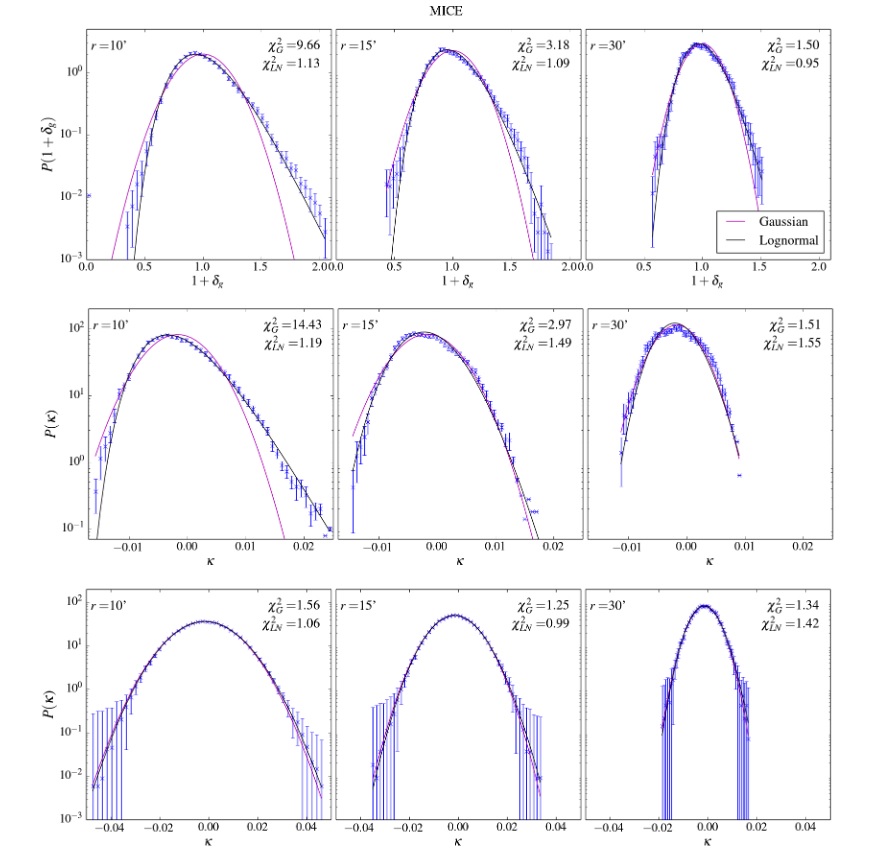
The points here are from MICE simulations. Not simulations of mice, of course, but simulations of MICE (Marenostrum Institut de Ciencies de l’Espai). Note how well the curves from a simple lognormal model fit the calculations that need a supercomputer to perform them!
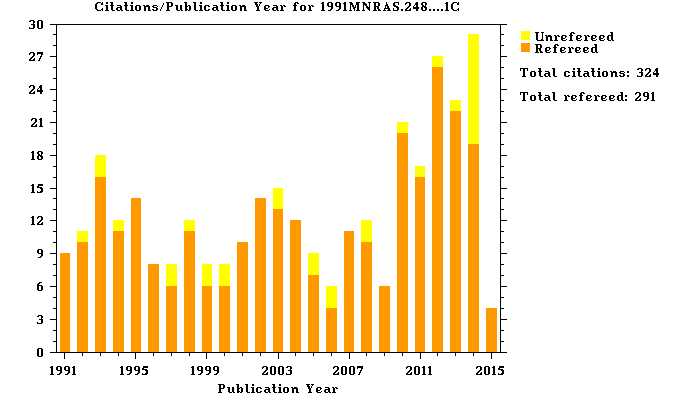
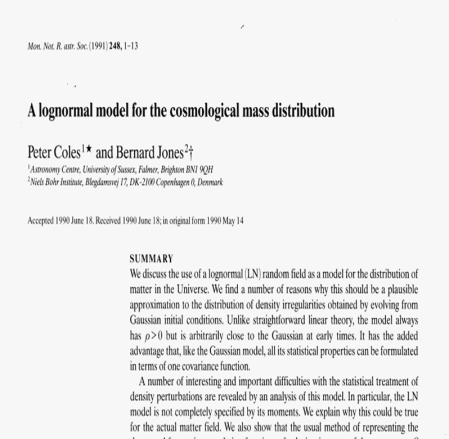
The lognormal model used in the paper is basically the same as the one I developed in 1990 with Bernard Jones in what has turned out to be my most-cited paper. In fact the whole project was conceived, work done, written up and submitted in the space of a couple of months during a lovely visit to the fine city of Copenhagen. I’ve never been very good at grabbing citations – I’m more likely to fall off bandwagons rather than jump onto them – but this little paper seems to keep getting citations. It hasn’t got that many by the standards of some papers, but it’s carried on being referred to for almost twenty years, which I’m quite proud of; you can see the citations-per-year statistics even seen to be have increased recently. The model we proposed turned out to be extremely useful in a range of situations, which I suppose accounts for the citation longevity:
Citations die away for most papers, but this one is actually attracting more interest as time goes on! I don’t think this is my best paper, but it’s definitely the one I had most fun working on. I remember we had the idea of doing something with lognormal distributions over coffee one day, and just a few weeks later the paper was finished. In some ways it’s the most simple-minded paper I’ve ever written – and that’s up against some pretty stiff competition – but there you go.
The lognormal seemed an interesting idea to explore because it applies to non-linear processes in much the same way as the normal distribution does to linear ones. What I mean is that if you have a quantity Y which is the sum of n independent effects, Y=X1+X2+…+Xn, then the distribution of Y tends to be normal by virtue of the Central Limit Theorem regardless of what the distribution of the Xi is If, however, the process is multiplicative so Y=X1×X2×…×Xn then since log Y = log X1 + log X2 + …+log Xn then the Central Limit Theorem tends to make log Y normal, which is what the lognormal distribution means.
The lognormal is a good distribution for things produced by multiplicative processes, such as hierarchical fragmentation or coagulation processes: the distribution of sizes of the pebbles on Brighton beach is quite a good example. It also crops up quite often in the theory of turbulence.
I’ll mention one other thing about this distribution, just because it’s fun. The lognormal distribution is an example of a distribution that’s not completely determined by knowledge of its moments. Most people assume that if you know all the moments of a distribution then that has to specify the distribution uniquely, but it ain’t necessarily so.
If you’re wondering why I mentioned citations, it’s because they’re playing an increasing role in attempts to measure the quality of research done in UK universities. Citations definitely contain some information, but interpreting them isn’t at all straightforward. Different disciplines have hugely different citation rates, for one thing. Should one count self-citations?. Also how do you apportion citations to multi-author papers? Suppose a paper with a thousand citations has 25 authors. Does each of them get the thousand citations, or should each get 1000/25? Or, put it another way, how does a single-author paper with 100 citations compare to a 50 author paper with 101?
Or perhaps a better metric would be the logarithm of the number of citations?
I was looking up the reference for an old paper of mine on ADS yesterday and was surprised to find that it is continuing to attract citations. Thinking about the paper reminds me off the fun time I had in Copenhagen while it was written. I was invited there in 1990 by Bernard Jones, who used to work at the Niels Bohr Institute. I stayed there several weeks over the May/June period which is the best time of year for Denmark; it’s sufficiently far North (about the same latitude as Aberdeen) that the summer days are very long, and when it’s light until almost midnight it’s very tempting to spend a lot of time out late at night..
As well as being great fun, that little visit also produced what has turned out to be my most-cited paper. In fact the whole project was conceived, work done, written up and submitted in the space of a couple of months. I’ve never been very good at grabbing citations – I’m more likely to fall off bandwagons rather than jump onto them – but this little paper seems to keep getting citations. It hasn’t got that many by the standards of some papers, but it’s carried on being referred to for almost twenty years, which I’m quite proud of; you can see the citations-per-year statistics even seen to be have increased recently. The model we proposed turned out to be extremely useful in a range of situations, which I suppose accounts for the citation longevity:
I don’t think this is my best paper, but it’s definitely the one I had most fun working on. I remember we had the idea of doing something with lognormal distributions over coffee one day, and just a few weeks later the paper was finished. In some ways it’s the most simple-minded paper I’ve ever written – and that’s up against some pretty stiff competition – but there you go.
The lognormal seemed an interesting idea to explore because it applies to non-linear processes in much the same way as the normal distribution does to linear ones. What I mean is that if you have a quantity Y which is the sum of n independent effects, Y=X1+X2+…+Xn, then the distribution of Y tends to be normal by virtue of the Central Limit Theorem regardless of what the distribution of the Xi is If, however, the process is multiplicative so Y=X1×X2×…×Xn then since log Y = log X1 + log X2 + …+log Xn then the Central Limit Theorem tends to make log Y normal, which is what the lognormal distribution means.
The lognormal is a good distribution for things produced by multiplicative processes, such as hierarchical fragmentation or coagulation processes: the distribution of sizes of the pebbles on Brighton beach is quite a good example. It also crops up quite often in the theory of turbulence.
I’ll mention one other thing about this distribution, just because it’s fun. The lognormal distribution is an example of a distribution that’s not completely determined by knowledge of its moments. Most people assume that if you know all the moments of a distribution then that has to specify the distribution uniquely, but it ain’t necessarily so.
If you’re wondering why I mentioned citations, it’s because it looks like they’re going to play a big part in the Research Excellence Framework, yet another new bureaucratical exercise to attempt to measure the quality of research done in UK universities. Unfortunately, using citations isn’t straightforward. Different disciplines have hugely different citation rates, for one thing. Should one count self-citations?. Also how do you aportion citations to multi-author papers? Suppose a paper with a thousand citations has 25 authors. Does each of them get the thousand citations, or should each get 1000/25? Or, put it another way, how does a single-author paper with 100 citations compare to a 50 author paper with 101?
Or perhaps the REF panels should use the logarithm of the number of citations instead?
I thought I’d share this video about an installation called Ice Watch, which involves one hundred tonnes of inland ice from Greenland meltinging on the Radhusplads, Copenhagen’s City Hall Square. With Ice Watch, Olafur Eliasson and Minik Rosing direct attention to the publication of the IPCC’s 5th Assessment Report on the Earth’s Climate. The ice now melted, which happened faster than expected owing to the unusually warm weather for this time of year…
Yesterday afternoon I skived off the last session of the workshop I’m attending and took the train to the small town of Humlebæk, which is about 35 north of Copenhagen and is the site of the Louisiana Museum of Modern Art. The purpose of my visit was to attend an invitation-only preview of a new installation by Olafur Eliasson called Riverbed. The invitation to this came relatively recently and it was only the coincidence of my being here at this workshop that made it possible for me to attend.
As it turned out, I arrived quite early and the weather was fine, so I took the chance to wander around the sculpture park before the main event. There are many fine works there. This, for example, is by Henry Moore:
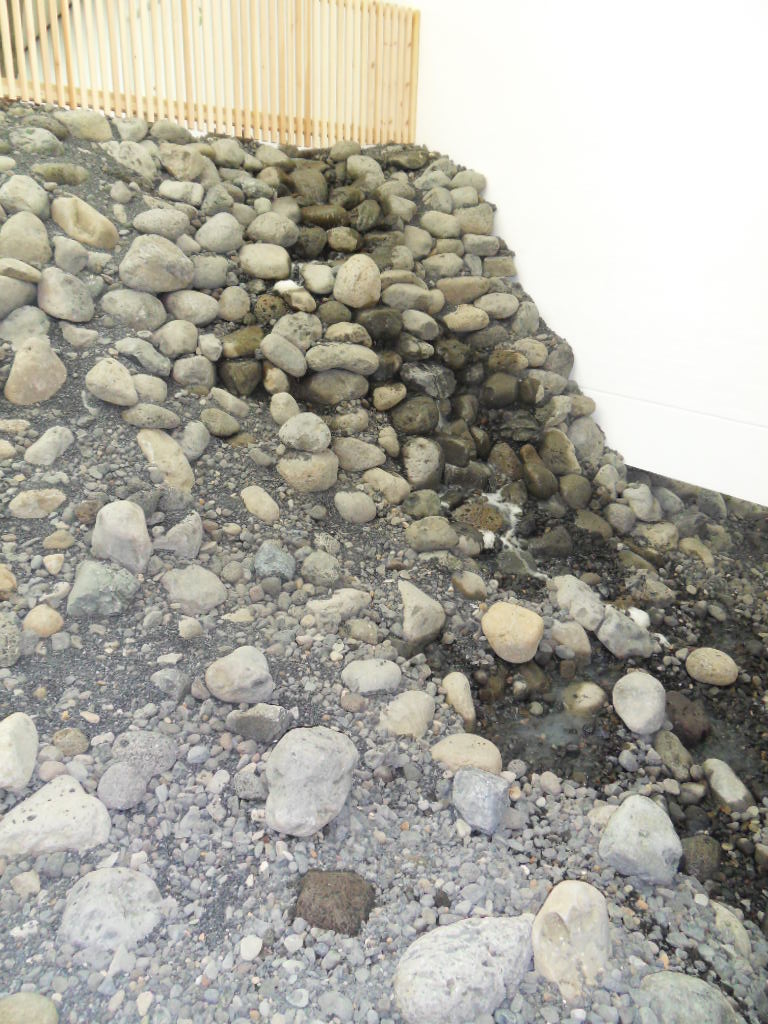
And so to Riverbed. This is a large work featuring boulders and gravel, brought all the way from Iceland, which have been used to recreate a section of the landscape of Olafur’s native land. The distinctive colouring and granularity of the raw material produces terrain of a texture that must look very alien to anyone who has never been to Iceland. The installation is contained within a space which is contained within and divided by stark white-painted walls, with rectangular gaps where necessary to let the water through from room to room. These boundaries, with their geometrically precise edges, affect the experience of the naturalistic landscape in a very interesting way. The Riverbed itself may look “natural” but the structures surrounding it constantly remind you that it isn’t. Viewers are permitted to wander through the piece wherever they like and interact however they please, sitting down on a boulder, paddling in the stream or even just watching the other people (which is mainly what I did). I don’t know what’s more interesting, the work itself or the way people behave when inside it!
Here are some pictures I took, just to give you a flavour:
Anyway, after that we adjourned for a drinks reception and a splendid dinner in the Boat House, which part of the Louisiana complex. Being neither an artist nor an art critic I felt a bit of an outsider, but I did get the chance to chat to quite a few interesting people including, by sheer coincidence, a recent graduate of the University of Sussex. The Boat House looks out towards the island of Hven, home of the observatory of Tycho Brahe, so naturally I took the opportunity to drink a toast to his memory:
After that I had to return to Copenhagen to write my talk, as I was on first this morning at 9.30. This afternoon we have a bit of a break before the conference excursion and dinner this evening. The excursion happens to be to Louisiana Museum of Modern Art (although we’re all going by bus this time); dinner is in the cafeteria rather than the Boat House, though..
Since I’m in Denmark I thought I’d put up one of the wonderfully witty little poems written by Danish mathematician Piet Hein. He called each of these verses a “grook” (or actually, in Danish, the word is gruk) and he wrote thousands of them over his long life. I’ve posted one of these before but this one is even shorter but it makes a deep point, the danger of becoming be trapped by your own assumptions. I won’t comment on the relevance of this to the cosmology workshop I’m attending…
Our choicest plans
have fallen through
our airiest castles
tumbled over
because of lines
we neatly drew
and later neatly
stumbled over.
So here I am, then, in Copenhagen. Yesterday evening, as far as I’m concerned, at least, my wavefunction collapsed along with the rest of me into a definite location. Ibsen’s Hotel, in fact. I had a pleasantly uneventful journey to Heathrow by train. The plane thence arrived in Copenhagen twenty minutes ahead of time, and then I had the chance to marvel at wonderful Copenhagen’s wonderfully efficient public transport in the form of the Metro that took me to about 100 metres from my hotel. All very relaxed and stress-free.
This morning I got up bright and early, determined to avoid the queues at breakfast, but was inevitably foiled by dozens of uber-efficient Germans who were already there at 7am when it opened. Fortunately I managed to find a quiet place in the corner to drink my coffee while they basked in their own smugness and barked orders at the waitresses.
Anyway, it’s still pretty dark outside so I thought I’d post something before walking to the Niels Bohr Institute for the day’s business. Since I’m in Denmark I thought I’d put up one of the wonderfully witty little poems written by Danish mathematician Piet Hein. He called each of these verses a “grook” (or actually, in Danish, the word is gruk) and he wrote thousands of them over his long life. Many, like this one, are utterly brilliant.
Whenever you’re called on to make up your mind,
and you’re hampered by not having any,
the best way to solve the dilemma, you’ll find,
is simply by spinning a penny.
No – not so that chance shall decide the affair while you’re passively standing there moping; but the moment the penny is up in the air, you suddenly know what you’re hoping.
I’m still at home at 10am on a weekday, which is unusual, but that’s because I’m soon going to be doing the familiar schlepp to Heathrow airport in order to get a flight to Copenhagen. The purpose of this little trip is to participate in a PhD examination at the Niels Bohr Institute. I’ve never taken part in a Thesis Defence in the Danish system before, although I’ve done many equivalent examinations elsewhere, so I’m quite looking forward to finding out how it works. Will it be much different from the system we have in the UK? Probably, as it is a much more public occasion. Will that necessarily make it better? I don’t know. I was reading the thesis last night, actually, and it’s very interesting which is another reason to look forward to the occasion. I might even get time for some shopping too.
Anyway, before going to the airport I am going to pop along to the local polling station. Today is the day for the Election of the Police and Crime Commissioner for the South Wales Police Area. I’m going to the polling station not because I have a burning desire to vote – the list of candidates is extremely uninspiring – but because I feel I should register a protest at this farcical waste of public money at what is supposed to be a time of austerity. The political class in this country has never been held in lower esteem than at present and the last thing we need is more politicians, helping themselves to six-figure salaries at taxpayers’ expense. More politicians does not mean more democracy. We already have local council elections, Welsh Assembly elections, General (Parliamentary) Elections and European Parliament Elections. We don’t need any more! This Election is a complete waste of time and money.
I intend, therefore, to visit the polling station and, instead of putting a cross in a box, write a strongly (but politely) worded message voicing my opinion on the matter thus spoiling my ballot paper. It will be the first time I’ve ever done such a thing, but this is the first time we’ve had such a stupid election.
It being a lovely day in Copenhagen yesterday I decided to go for a long walk. My destination was the famous Assistens Kirkegård which is in the Nørrebro district of the city. You might think that was a rather morbid choice of place to go for a stroll in the sunshine, but actually it’s not that way at all. It’s actually a rather beautiful place, a very large green space criss-crossed by tree-lined paths. We British have a much more reserved attitude to cemeteries than the Danes seem to have, at least judging by yesterday; joggers and cyclists pass through Assistens Cemetery at regular intervals, and many people were having picnics or just sunbathing between the gravestones. And of course there were many tourists wandering around, myself included. I found this matter-of-fact attitude to the dead rather refreshing, actually.
Incidentally, I was also surprised to see a number of Jewish burials among the Christian ones. I don’t know if this happens in British graveyards.
Part of the attraction of Assistens Kirkegård – the name derives from the fact that it was originally an auxiliary burial place, outside the main city, designed to take some of the pressure off the smaller cemeteries in the inner areas – is the large number of famous people buried there. The cemetery is extremely large (about 25 hectares), and the maps don’t show the locations of all the famous people laid to rest there, but I did find quite a few.
Here for example is the memorial to one of the most famous Danes of all, Hans Christian Andersen
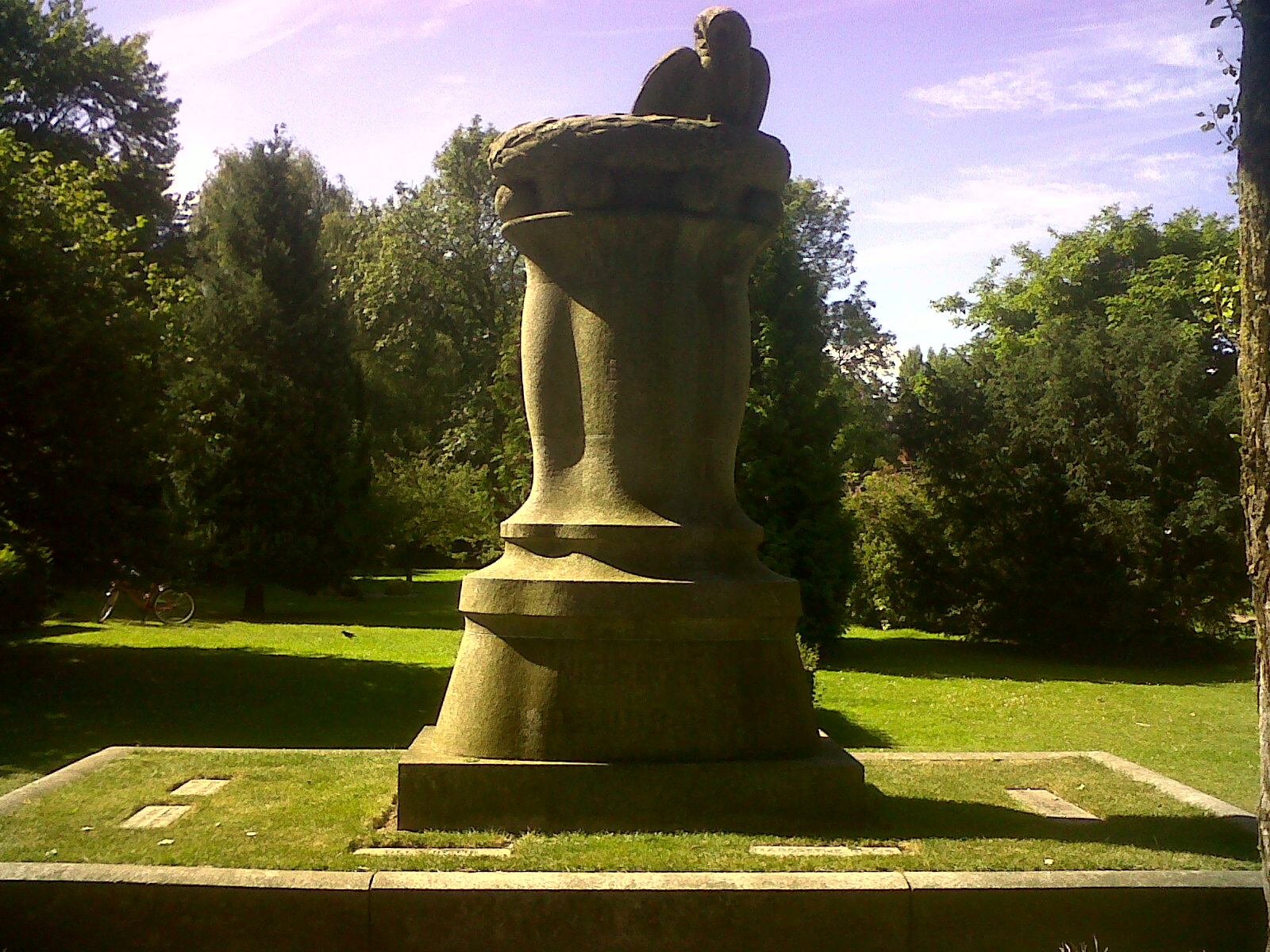
Going by the number of signposts pointing to it, this must be one of the most popular sites for visitors to the cemetery, along with the grave of the philosopher Søren Kierkegaard. One can also quite easily locate the memorial which marks the last resting place of Niels Bohr and various other members of his family:
But it’s not only Danes that are buried here. There’s a corner of one plot occupied by a number of famous American Jazz musicians, including pianist Kenny Drew and, most famously of all, tenor saxophonist Ben Webster whose gravestone is rather small, but clearly very well tended, no doubt by a Danish jazz lover:
Unfortunately, I was unable to locate one of the graves I wanted to find, that of the great HeldentenorLauritz Melchior. I was surprised to find his name was absent from the main index. I know he was cremated and his ashes buried there, and I even found a picture of his memorial on the net, but the cemetery is so large that without further clues I couldn’t find it. I’ll have to go back on a subsequent visit after doing a bit more research.
It’s very interesting that some of the smaller graves are extremely well-tended whereas many of the more opulent memorials are in a state of disrepair. My ambition is to be forgotten as quickly as possible after my death so the idea of anyone erecting some grandiose marble monument on my behalf fills me with horror, but I have to say I do find graveyards are strangely comforting places. Rich and poor, clever and stupid, ugly and beautiful; death comes to us all in the end. At least it’s very democratic.
And after about three hours strolling around in the cool shade of the trees in Assistens Kirkegård the thought did cross my mind there still seems to be plenty of room…
An early morning walk around Copenhagen this morning reminded me of a longer visit I made here about 25 years ago, during which I rented a room in a nice large apartment on Frederiksberg Allé, which is in a rather posh part of the city called Frederiskberg. The landlord, who also lived on the premises, was a Mr Vagn Jul Pedersen, a nice old man who had lived in that part of the city all his life. One evening we sat talking over a beer or two and he told me of a terrible thing that he had seen during the latter stages of the Second World War when he was a young man, and I thought some of you might be interested to learn about it.
In March 1945, the British decided to carry out a low-level bombing attack on a target in Copenhagen, which was under German occupation at the time. The mission was given the codename Operation Carthage and its primary objective was the Shellhus (“Shell House”) originally owned by the oil company, but commandeered by the Nazis for wartime use as the Gestapo headquarters. The request to bomb the Shellhus came from the Danish Resistance, despite the fact that it was known that the top floor of the building was being used to house Danish prisoners as a kind of human shield.
I have based the following on a post I found elsewhere on the net. You can also read the official RAF account here.
By the end of 1944 the Danish resistance movement in Copenhagen was in danger of being wiped out by the Geheime Staatspolizei (Gestapo). Many of their leaders were arrested and a lot of material was filed in the Gestapo archives in the Shell house. Leading members of the resistance-movement requested an attack by air on the Shell House via the Special Operations Executive (SOE) in London.
Eventually on 21 March 1945, 20 de Havilland Mosquito fighter-bombers from 2nd TAF escorted by 28 Mustang Mk. III fighters from 11 Group took off from RAF Fersfield in Norfolk, England. 18 of the Mosquito bombers were F.B. Mk. VIs and 2 were Mosquito B. Mk. IVs from the Photographic Reconnaissance Unit (PRU). The Mosquito force attacked in 3 waves: 1st wave with 7 Mosquitoes (one PRU); the 2nd wave with 6 Mosquitoes; and finally the 3rd wave with 7 Mosquitoes (one PRU). The primary objective for the Mustangs was to engage, distract, suppress and, if possible, destroy anti-aircraft “Flak” batteries concentrated in central Copenhagen.
The first wave approached their target from the South West but, as they passed Enghave Station, which is near the famous Carlsberg brewery, Mosquito SZ 977, with Pilot W/Cdr. Peter A Kleboe and Navigator F/O K Hall, struck a 30 metre lamppost or pylon; the wingtip of the Mosquito then hit the roof of No 106 Sonder Boulevard. The two 500lb bombs carried by the aircraft ripped off and exploded, killing twelve civilians. Flying at roof-top level over a densely populated area it was inevitable that there would be casualties if a plane crashed or were shot down, but the Fates that day were in an especially cruel mood and far worse was to follow.
The stricken Mosquito “T for Tommy” crashed seconds later in a garage near the Jeanne d`Arc French Catholic school on Frederiksbergs Allé. The front part with the cockpit with the two crew members landed on Dr. Priemesvej; they were badly burned and later died of their injuries. Pilot W/C Peter A. Kleboe and Navigator F/O Reginald J.W. Hall were laid to rest in Bispebjerg Cemetery on 28 March 1945.
The rest of the first wave found and bombed the Gestapo Headquarters successfully. In all six bombs exploded in the Western wing and, of the nine prisoners in this part of the building, six were killed instantly and another died when jumping from the 5th floor to the ground.
But the tragedy that had begun to unfold at Frederiksberg Allé was about to get even darker. The 2nd wave of Mosquitoes became confused by the smoke and flames from the crashed Mosquito and thought it must be their target. Two of the Mosquitoes in the 2nd wave dropped their bombs on the French school and only one proceeded to bomb the Shell House. The 3rd wave approached Copenhagen from the West, and again became confused. All but one of the Mosquitoes dropped their bombs by mistake on the French Jeanne d`Arc Catholic School killing 86 children and 16 adults out of 482 children and adults, while 67 children and 35 adults were wounded.
This is the site of the modern Shell House, the original being completely destroyed during Operation Carthage. It’s quite easy to find, on the North side of Kampmannsgade, just to the East of Sankt Jørgens Sø, between Nyropsgade and Vester Farimagsgade. It’s actually quite close to the splendid modern Tycho Brahe Planetarium.
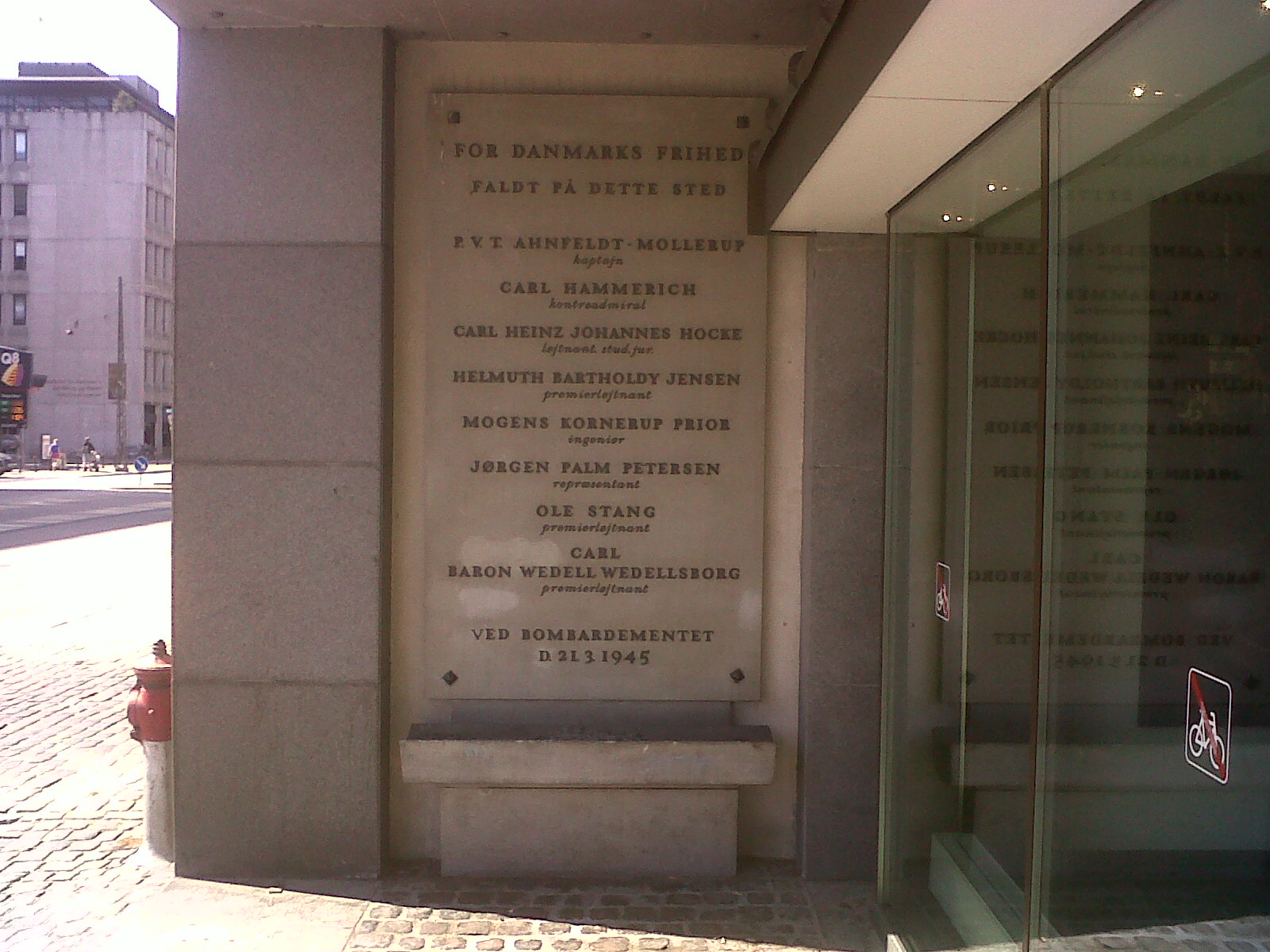
Inside the doorway at the far right of this building as seen in the above view is the following inscription, giving the names of the Danish resistance members who died that day
You can see here below a map showing the location. Enghave Station is to the South-West, the natural direction from which the incoming planes would have come. The Mosquito “T for Tommy” must have veered North, i.e. to its left, after its collision with the pylon in order to have crashed where it did.
Reading about this terrible episode, I was at first surprised that so many pilots misidentified the target, especially since the correct one is so close to Sankt Jørgens Sø, a prominent expanse of water that makes up one of a string of shallow lakes that extend along most of the Western side of Copenhagen’s city centre, which one would have thought was easily identifiable by its absence at the French School. The pilots had, after all, been shown detailed models of the location before the raid. But then I’m sitting at a desk with a map in front of me, not screaming along at 400mph, over rooftops bristling with anti-aircraft guns, into the teeth of withering Flak fire.
I walked the distance from the Jeanne D’arc School to the Shell House and I reckon it’s not much further than 1km, perhaps less as the Mosquito flies. That’s just seconds at the speed the planes would have been flying. That, together with the general confusion of smoke, gunfire and fear, could easily account for the navigational errors.
Owing to the presence of planes from the RAF photographic unit, there is remarkable film footage shot during the actual raid, some of which can be seen in the following film. It’s interesting how little Copenhagen’s skyline has changed; much of the city is immediately recognizable. There is also some very moving eye-witness testimony.
Even to a non-expert like me this was clearly an extremely dangerous mission. Mr Pedersen told me he saw Mosquitoes flying between the houses, along some of Copenhagen’s admittedly very wide roads, below the level of the rooftops; presumably the anti-aircraft guns were unable to aim downwards. A total of 4 Mosquitoes and 2 Mustangs were lost to flak with 9 crewmen KIA and 1 POW. Incidentally, one of the two Mustangs shot down that day crashed in Fælledparken, the park just behind the Niels Bohr Institute.
Mounted on the wall of the present Shell House is a bronze cast of a propeller from one of the downed Mosquitoes. A plaque is placed below the propeller with the names of the 9 crew members who were killed in the attack.
A total of 133 Danes died during and after the raid, including 86 children and 18 adults (including many nuns, and some bystanders who had tried to help) at the French School. At the Shell House, 8 Gestapo prisoners were killed and 18 managed to escape; 55 German soldiers and 47 Danish employees of the Gestapo died. In those days they hadn’t invented bland phrases like “collateral damage” to disguise the real horror of war, and it wasn’t possible to use unmanned drones as deployed by the US in their covert “war on terror”. Although Operation Carthage did achieve its objective, the loss of innocent life was so appalling it remains difficult to see it as a success.
I remember very well the tears in Mr Pedersen’s eyes when he told me about what had happened at the French School that day; it was only later that he found out what the actual objective of the raid was. At the end he said “You are lucky that you will never have to witness anything like that.” That goes for all of us who have had the good fortune to live in a time of peace. But let’s not forget the other parts of space-time where things are/were very different.
The views presented here are personal and not necessarily those of my employer (or anyone else for that matter).
Feel free to comment on any of the posts on this blog but comments may be moderated; anonymous comments and any considered by me to be vexatious and/or abusive and/or defamatory will not be accepted. I do not necessarily endorse, support, sanction, encourage, verify or agree with the opinions or statements of any information or other content in the comments on this site and do not in any way guarantee their accuracy or reliability.









 In the Dark