It’s Saturday again, so it’s time for another summary of the week’s new papers at the Open Journal of Astrophysics. Since the last update we have published seven new papers, which brings the number in Volume 8 (2025) up to 134, and the total so far published by OJAp up to 369. We seem to be emerging for the slight late-summer hiatus we have experienced over the last few weeks.
Anyway, the first paper to report this week is “Observing the Sun with the Atacama Large Aperture Submillimeter Telescope (AtLAST): Forecasting Full-disk Observations” by Mats Kirkaune & Sven Wedemeyer (U. Oslo, Norway), Joshiwa van Marrewijk (Leiden U., Netherlands), Tony Mroczkowski (ESO, Garching, Germany) and Thomas W. Morris (Yale, USA). This paper discusses possible strategies and parameters for full-disk observations of the Sun using the proposed Atacama Large Aperture Submillimeter Telescope (AtLAST). It was published on Tuesday 9th September 2025 in the folder Solar and Stellar Astrophysics.
The overlay is here:

You can make this larger by clicking on it. The officially accepted version of this paper can be found on the arXiv here.
The second paper this week, published on Wednesday 10th September in the folder Cosmology and NonGalactic Astrophysics, is “The exact non-Gaussian weak lensing likelihood: A framework to calculate analytic likelihoods for correlation functions on masked Gaussian random fields” by Veronika Oehl and Tilman Tröster (ETH Zurich, Switzerland). This paper shows how to calculate likelihoods for the correlation functions of spin-2 Gaussian random fields defined on the sphere in the presence of a mask with applications to weak gravitational lensing.
The overlay is here:
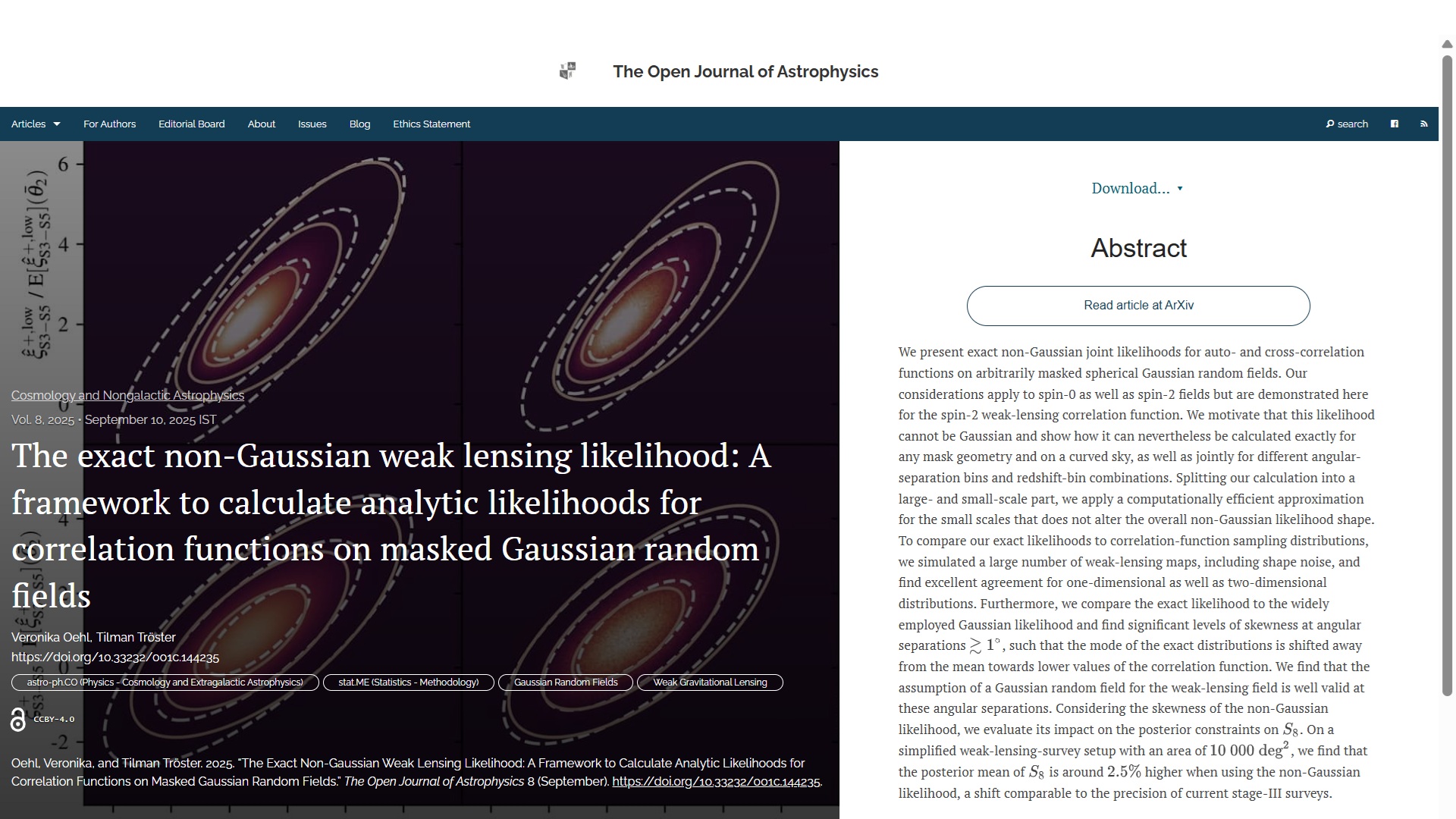
and you can find the final accepted version on arXiv here.
Next one up, the third paper this week, is “Subspace Approximation to the Focused Transport Equation. II. The Modified Form” by B. Klippenstein and Andreas Shalchi (U. Manitoba, Canada). This was also published on 10th September 2025 in the folder Solar and Stellar Astrophysics. It is about solving the focused transport equation analytically and numerically using the subspace method in two or more dimensions.
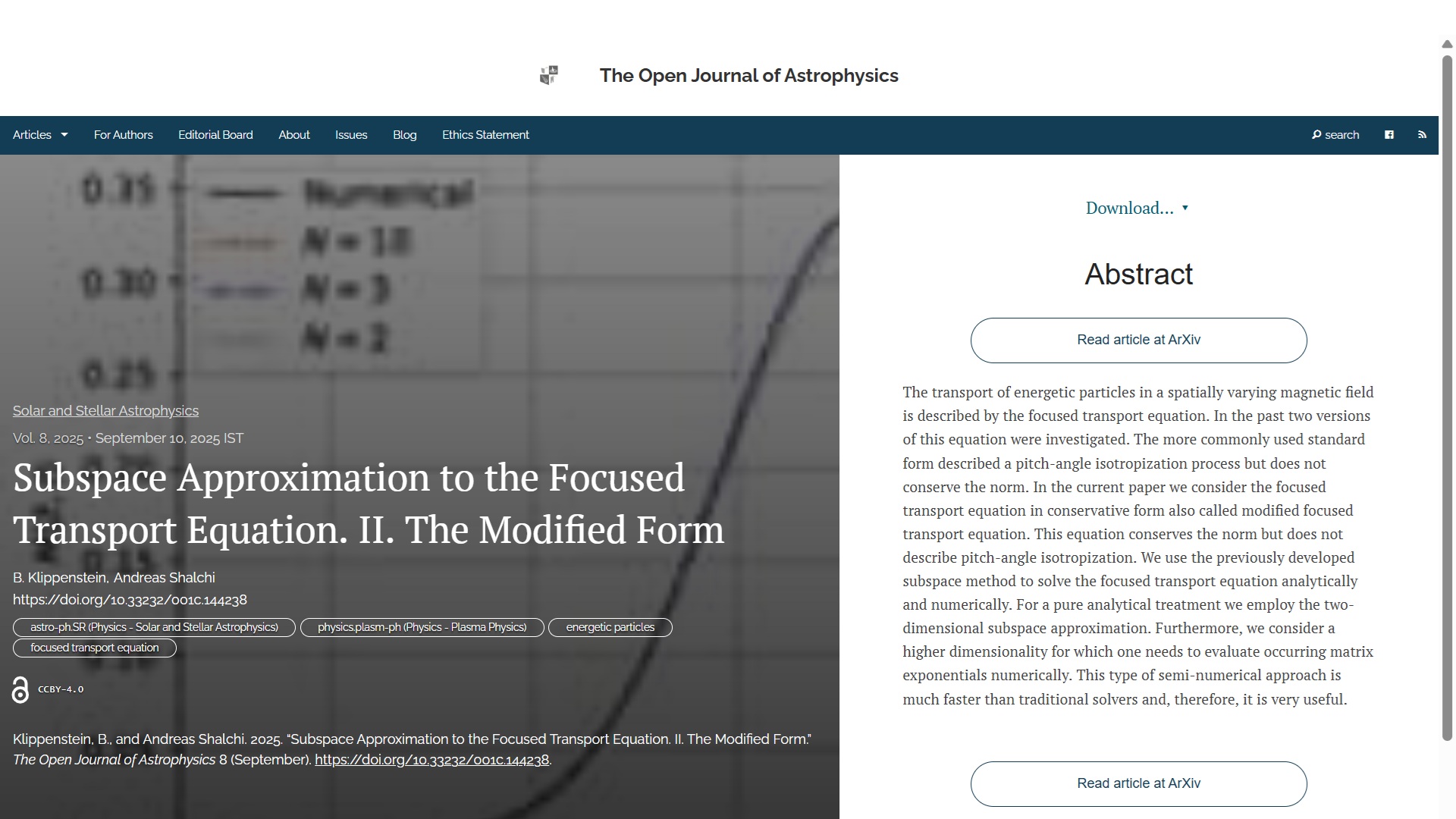
You can find the final accepted version on arXiv here.
The fourth paper of this week was also published on Wednesday 10th September. It is “Mass models of galaxy clusters from a non-parametric weak-lensing reconstruction” by Tobias Mistele (Case Western Reserve U., USA), Federico Lelli (INAF, Firenze, Italy), Stacy McGaugh (Case Western), James Schombert (U. Oregon, USA) and Benoit Famaey (Université de Strasbourg, France). Published in the folder Cosmology and NonGalactic Astrophysics, it presents new, non-parametric deprojection method for weak gravitational lensing applied to a sample of galaxy clusters. The overlay is here: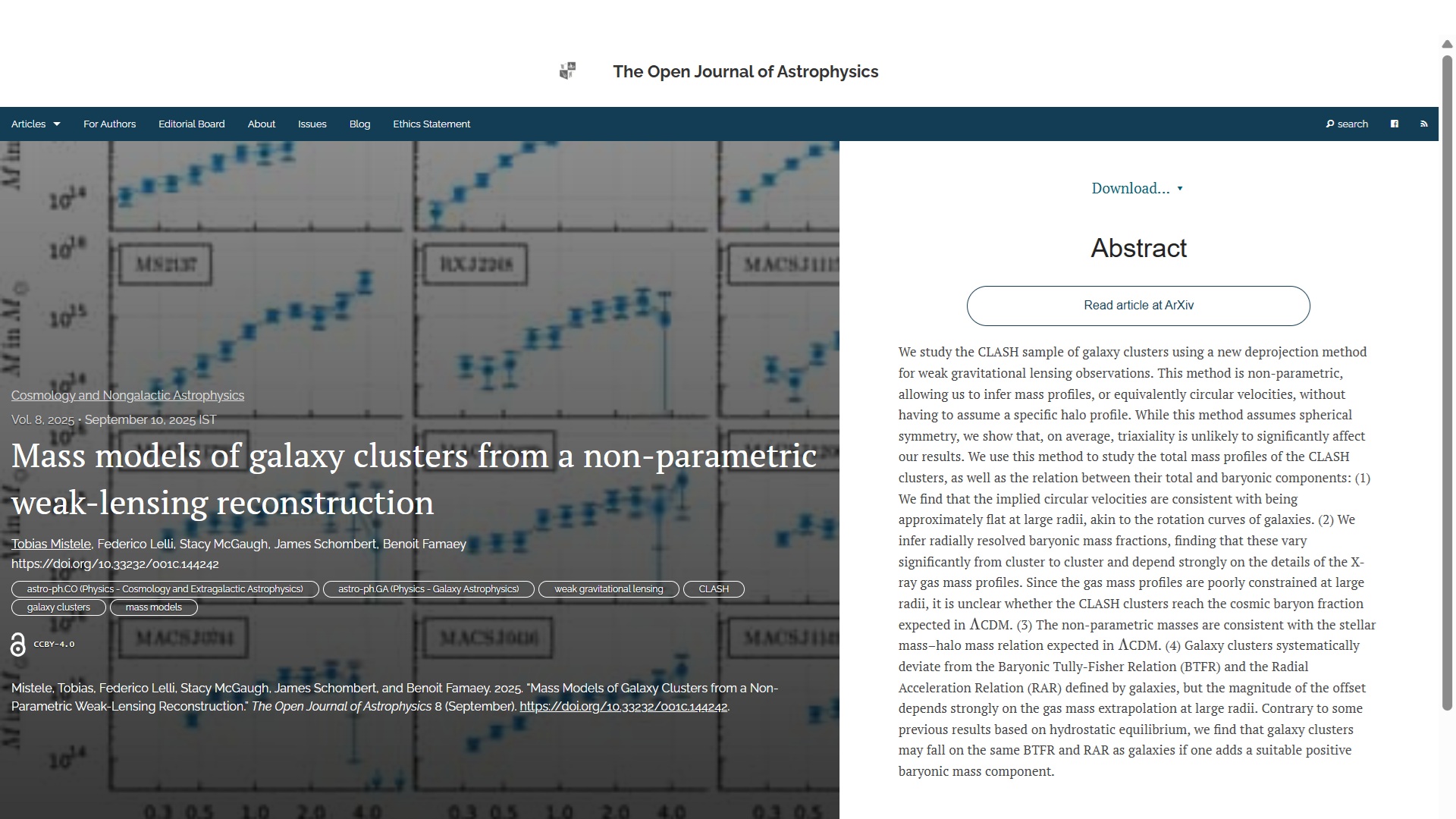
You can find the officially accepted version on arXiv here.
The fifth paper of the week is “A Swift Fix II: Physical Parameters of Type I Superluminous Supernovae” by Jason T. Hinkle & Benjamin J. Shappee (U. Hawaii, USA) and Michael A. Tucke (Ohio State, USA). This one was published on Thursday 11th September 2025 in the folder High-Energy Astrophysical Phenomena. The paper uses recalibrated Swift photometry to recompute peak luminosities and other properties of a sample of superluminous Type I supernovae. The overlay is here:
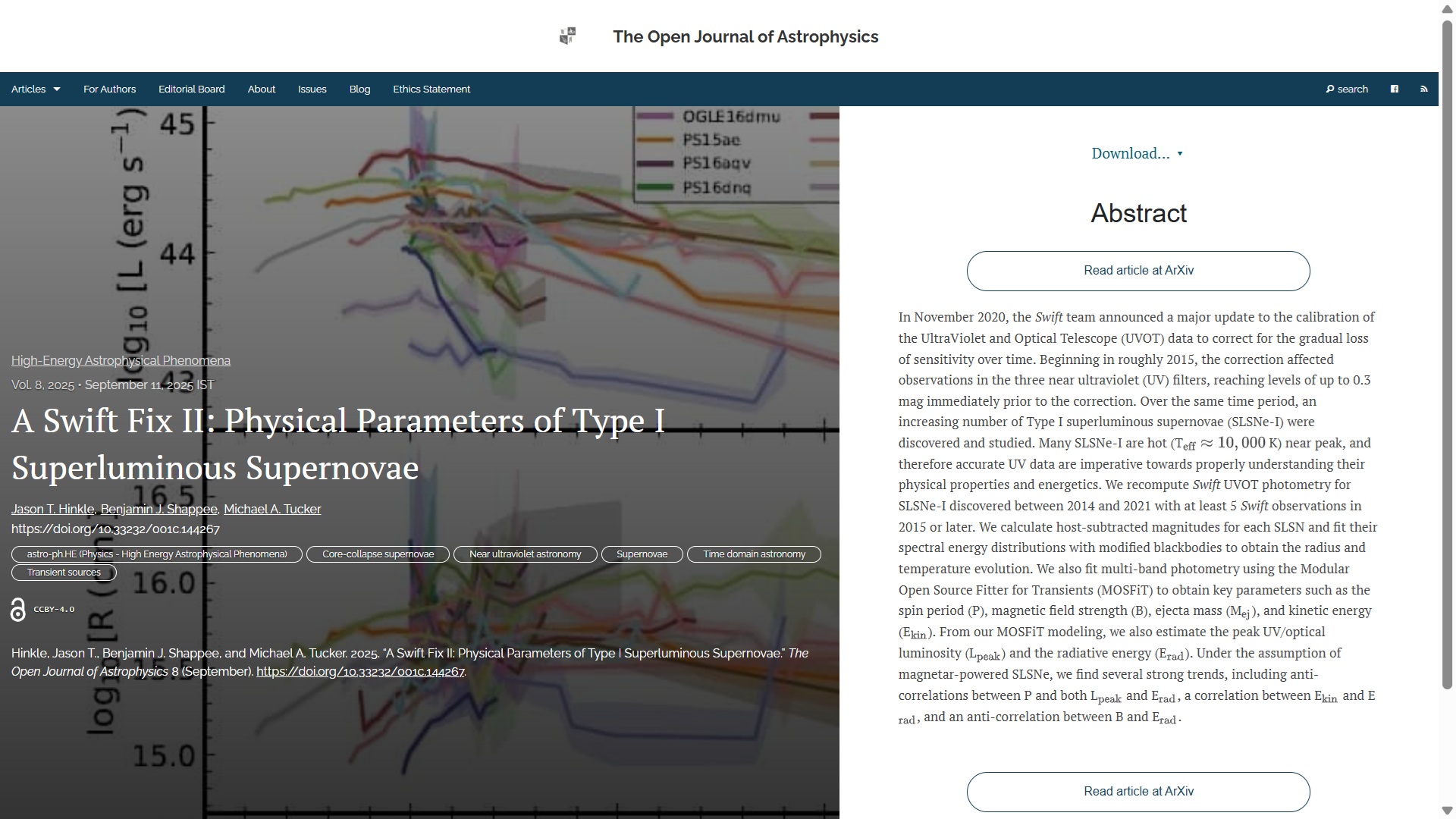
You can find the official accepted version on arXiv here.
Paper No. 6 for this week is “Detailed Microwave Continuum Spectra from Bright Protoplanetary Disks in Taurus” by Caleb Painter (Harvard, USA) and 11 others, too numerous to mention by name, based in the USA, Germany, Mexico and Taiwan. This one was published in the folder marked Solar and Stellar Astrophysics on September 11th 2025. It presents new observations sampling the microwave (4-360 GHz) continuum spectra from eight young stellar systems in the Taurus region. The overlay is here:

The final version can be found on arXiv here.
The last paper for this update is “On Soft Clustering For Correlation Estimators” by Edward Berman (Northeastern University, USA) and 13 others based in the USA, France, Denmark and Finland and Cosmos-Web:The JWST Cosmic Origins Survey. This was published on Friday 12th September 2025 in the folder Instrumentation and Methods for Astrophysics. It presents an algorithm for estimating correlations that clusters objects in a probabilistic fashion, enabling the uncertainty caused by clustering to be quantified simply through model inference. The overlay is here:

You can find the final version on arXiv here.
And that’s all the papers for this week. I’ve noticed a significant recent increase in the number of papers in Solar and Stellar Astrophysics, which means we’re broadening our impact across the community. Which is nice.
P.S. I found out last week that, according to NASA/ADS, papers in OJAp have now accumulated over 5000 citations.


 In the Dark