Archive for Cosmic Microwave Background

Why the Big Bang wasn’t as loud as you think…

Posted in The Universe and Stuff with tags , , , , , on March 31, 2015 by telescoper

So how loud was the Big Bang?

I’ve posted on this before but a comment posted today reminded me that perhaps I should recycle it and update it as it relates to the cosmic microwave background, which is what I work on on the rare occasions on which I get to do anything interesting.

As you probably know the Big Bang theory involves the assumption that the entire Universe – not only the matter and energy but also space-time itself – had its origins in a single event a finite time in the past and it has been expanding ever since. The earliest mathematical models of what we now call the  Big Bang were derived independently by Alexander Friedman and George Lemaître in the 1920s. The term “Big Bang” was later coined by Fred Hoyle as a derogatory description of an idea he couldn’t stomach, but the phrase caught on. Strictly speaking, though, the Big Bang was a misnomer.

Friedman and Lemaître had made mathematical models of universes that obeyed the Cosmological Principle, i.e. in which the matter was distributed in a completely uniform manner throughout space. Sound consists of oscillating fluctuations in the pressure and density of the medium through which it travels. These are longitudinal “acoustic” waves that involve successive compressions and rarefactions of matter, in other words departures from the purely homogeneous state required by the Cosmological Principle. The Friedman-Lemaitre models contained no sound waves so they did not really describe a Big Bang at all, let alone how loud it was.

However, as I have blogged about before, newer versions of the Big Bang theory do contain a mechanism for generating sound waves in the early Universe and, even more importantly, these waves have now been detected and their properties measured.
Planck_CMB

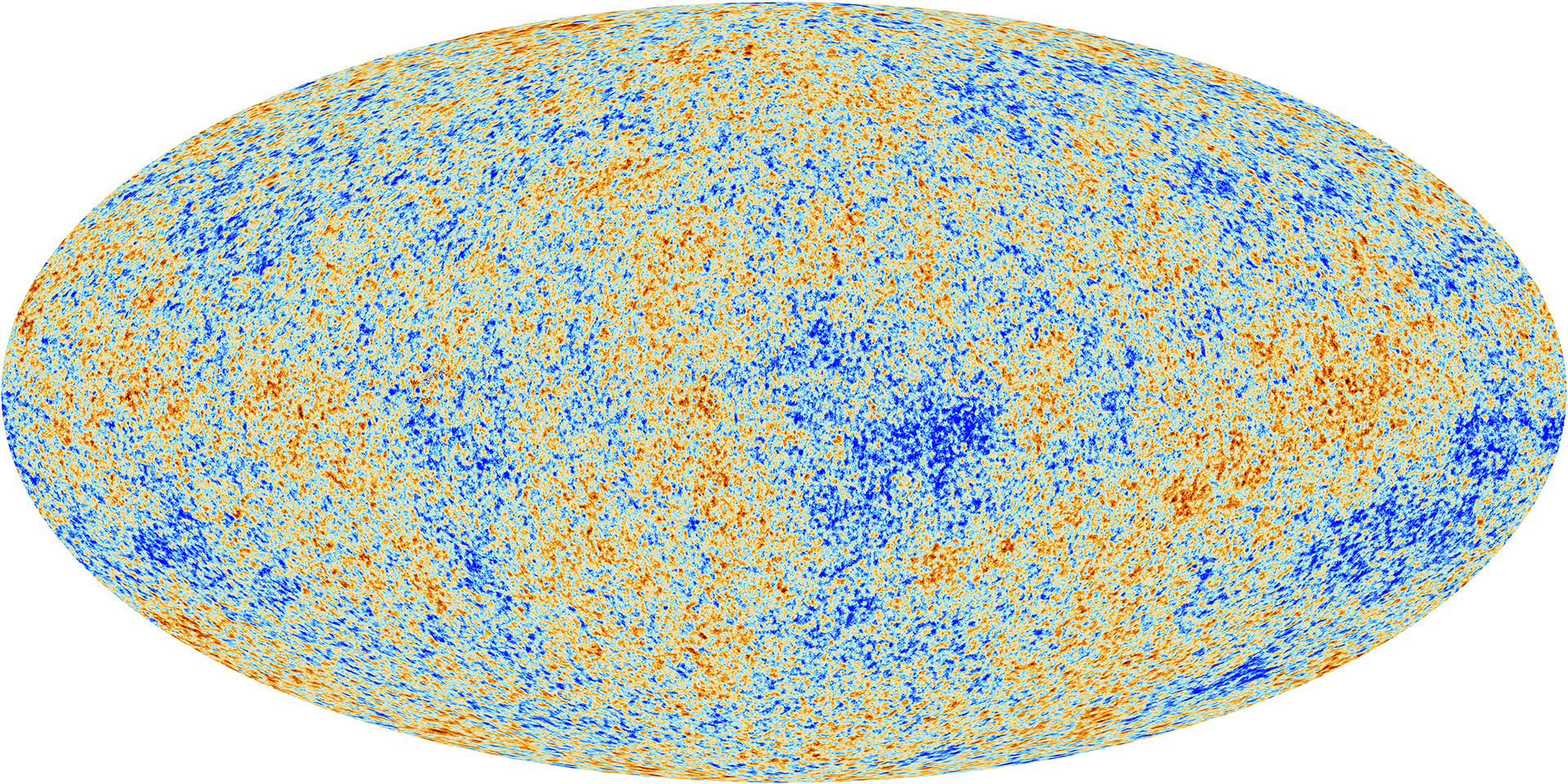
The above image shows the variations in temperature of the cosmic microwave background as charted by the Planck Satellite. The average temperature of the sky is about 2.73 K but there are variations across the sky that have an rms value of about 0.08 milliKelvin. This corresponds to a fractional variation of a few parts in a hundred thousand relative to the mean temperature. It doesn’t sound like much, but this is evidence for the existence of primordial acoustic waves and therefore of a Big Bang with a genuine “Bang” to it.

A full description of what causes these temperature fluctuations would be very complicated but, roughly speaking, the variation in temperature you corresponds directly to variations in density and pressure arising from sound waves.

So how loud was it?

The waves we are dealing with have wavelengths up to about 200,000 light years and the human ear can only actually hear sound waves with wavelengths up to about 17 metres. In any case the Universe was far too hot and dense for there to have been anyone around listening to the cacophony at the time. In some sense, therefore, it wouldn’t have been loud at all because our ears can’t have heard anything.

Setting aside these rather pedantic objections – I’m never one to allow dull realism to get in the way of a good story- we can get a reasonable value for the loudness in terms of the familiar language of decibels. This defines the level of sound (L) logarithmically in terms of the rms pressure level of the sound wave Prms relative to some reference pressure level Pref

L=20 log10[Prms/Pref].

(the 20 appears because of the fact that the energy carried goes as the square of the amplitude of the wave; in terms of energy there would be a factor 10).

There is no absolute scale for loudness because this expression involves the specification of the reference pressure. We have to set this level by analogy with everyday experience. For sound waves in air this is taken to be about 20 microPascals, or about 2×10⁻¹⁰ times the ambient atmospheric air pressure which is about 100,000 Pa.  This reference is chosen because the limit of audibility for most people corresponds to pressure variations of this order and these consequently have L=0 dB. It seems reasonable to set the reference pressure of the early Universe to be about the same fraction of the ambient pressure then, i.e.

Pref~2×10⁻¹⁰ Pamb.

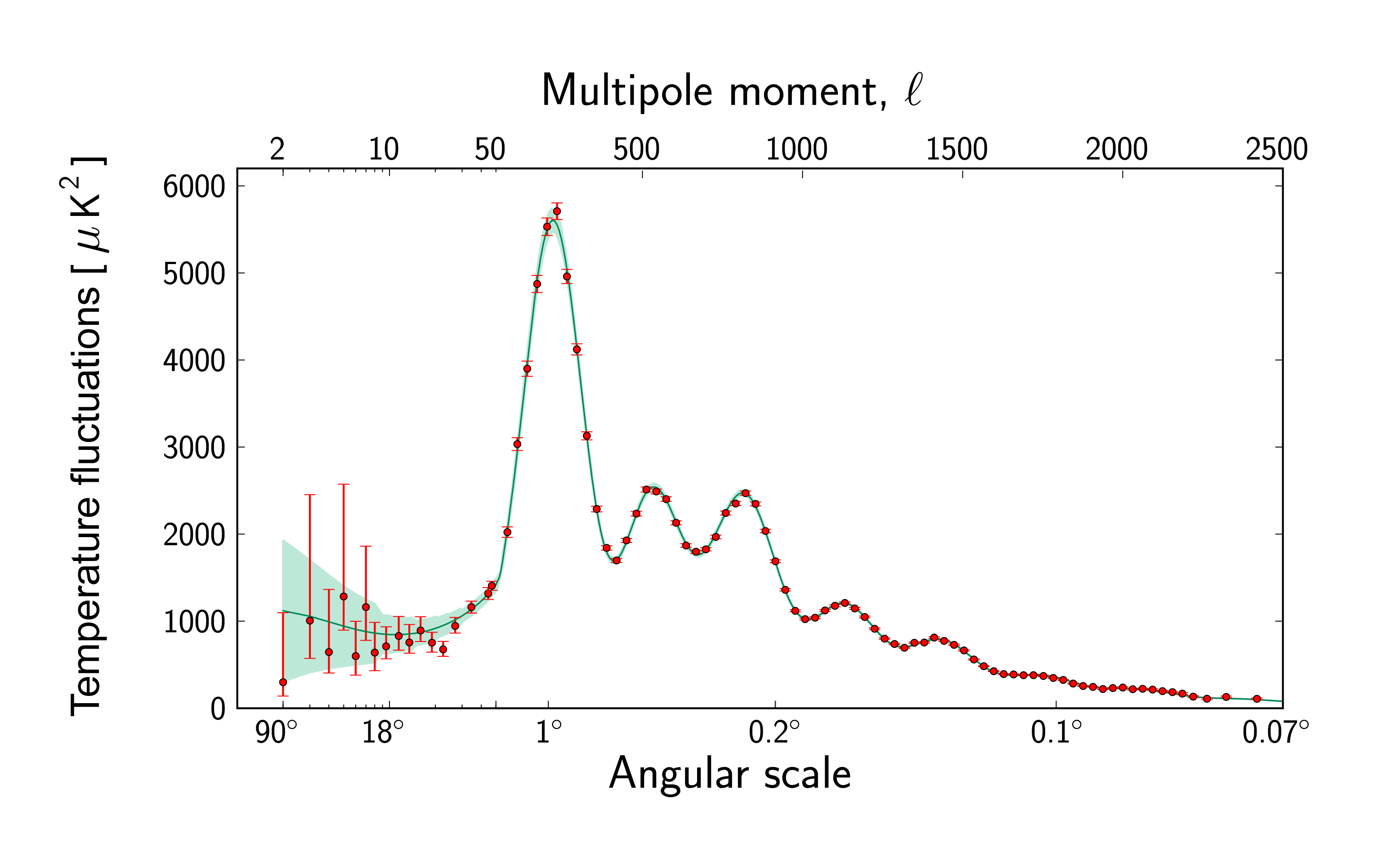
The physics of how primordial variations in pressure translate into observed fluctuations in the CMB temperature is quite complicated, because the primordial universe consists of a plasma rather than air. Moreover, the actual sound of the Big Bang contains a mixture of wavelengths with slightly different amplitudes. In fact here is the spectrum, showing a distinctive signature that looks, at least in this representation, like a fundamental tone and a series of harmonics…
Planck_power_spectrum_orig


If you take into account all this structure it all gets a bit messy, but it’s quite easy to get a rough but reasonable estimate by ignoring all these complications. We simply take the rms pressure variation to be the same fraction of ambient pressure as the averaged temperature variation are compared to the average CMB temperature,  i.e.

Prms~ a few ×10-5Pamb.

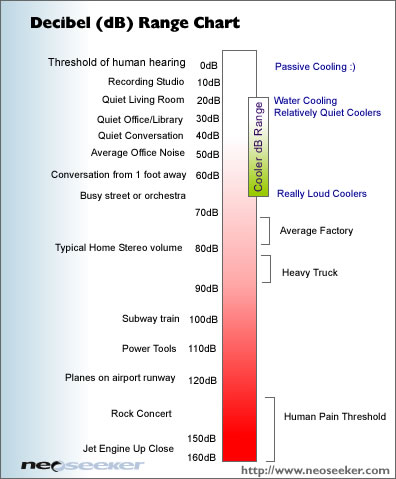
If we do this, scaling both pressures in logarithm in the equation in proportion to the ambient pressure, the ambient pressure cancels out in the ratio, which turns out to be a few times 10-5. With our definition of the decibel level we find that waves of this amplitude, i.e. corresponding to variations of one part in a hundred thousand of the reference level, give roughly L=100dB while part in ten thousand gives about L=120dB. The sound of the Big Bang therefore peaks at levels just a bit less than 120 dB.
cooler_decibel_chart

As you can see in the Figure above, this is close to the threshold of pain,  but it’s perhaps not as loud as you might have guessed in response to the initial question. Modern popular beat combos often play their dreadful rock music much louder than the Big Bang….

A useful yardstick is the amplitude  at which the fluctuations in pressure are comparable to the mean pressure. This would give a factor of about 1010 in the logarithm and is pretty much the limit that sound waves can propagate without distortion. These would have L≈190 dB. It is estimated that the 1883 Krakatoa eruption produced a sound level of about 180 dB at a range of 100 miles. By comparison the Big Bang was little more than a whimper.

PS. If you would like to read more about the actual sound of the Big Bang, have a look at John Cramer’s webpages. You can also download simulations of the actual sound. If you listen to them you will hear that it’s more of  a “Roar” than a “Bang” because the sound waves don’t actually originate at a single well-defined event but are excited incoherently all over the Universe.

Last days on the Ice

Posted in The Universe and Stuff with tags , , on January 25, 2015 by telescoper

Earlier this month I reblogged a post about the launch of the balloon-borne SPIDER experiment in Antarctica. Here’s a follow up from last week. Spider parachuted back down to the ice on January 17th and was recovered successfully. Now the team will be leaving the ice and returning home, hopefully with some exciting science results!

I’d love to go to Antarctica, actually. When I was finishing my undergraduate studies at Cambridge I applied for a place on the British Antarctic Survey, but didn’t get accepted. I don’t suppose I’ll get the chance now, but you never know…

annegambrel22's avatarSPIDER on the Ice

Four of the last five of the SPIDER crew– Don, Ed, Sasha, and I– are slated to leave the Ice tomorrow morning. That means this is probably my last blog post– at least until SPIDER 2! It has been an incredible few months, but I can’t say I’m all that sad for it to be ending. I’m ready to have an adventure in New Zealand and then get home to all the people I’ve missed so much while I’ve been away.

As is the nature of field campaigns, it has been an absolute roller coaster, but the highs have certainly made the lows fade in my memory. We got SPIDER on that balloon, and despite all of the complexities and possible points of failure, it worked. That’s a high I won’t be coming down from any time soon.

On top of success with our experiment, we’ve also had the privilege of…

View original post 98 more words

The Durham YETI

Posted in Talks and Reviews, The Universe and Stuff with tags , , , , on January 9, 2015 by telescoper

On Wednesday afternoon, after an important meeting that took up most of the morning, I headed off my train to Durham. Unusually by the standards of my recent experiences of railways, the trip went smoothly and I arrived on time. The cathedral was looking rather spectral when I arrived:

Durham

The occasion of my vist was the Young Experimentalists and Theorists Institute (YETI for short), a gathering of early career particle physicists, mainly graduate students. I was scheduled to give a 90-minute lecture on Cosmic Microwave Background Theory to the 40-50 folks attending the workshop. It was nice to get the chance to get away from budgets and spreadsheets for a time and talk about cosmology, and it was an interesting audience different from the usual more specialist crowd I get to talk to at graduate workshops. It’s good, especially for beginning research students, to find out about subjects outside their immediate research topic and I’m glad the YETI organizers appreciate that. On the other hand, CMB theory is a huge topic so it was difficult to decide what to put in and what to leave out.

Incidentally, 2015 sees the 50th anniversary of the discovery of the Cosmic Microwave Background, and with yet more exciting results due out soon I’m sure the CMB will be in the news a lot this year.

I spent Wednesday night at Collingwood College, where the conference delegates were accommodated, and gave my 90-minute talk, starting at 9am yesterday morning, paused for quick cup of coffee and then legged it back to Durham station for the return journey back to Brighton. It’s a pity I didn’t get the chance to stay longer, especially because the second speaker of the morning, on CMB Observations, was Jo Dunkley of Oxford University who this afternoon is giving a talk at the Royal Astronomical Society because she has just been awarded the Society’s Fowler Prize. I can’t attend that meeting because of work commitments either. Sigh.

The train journey back to Brighton went smoothly and on time too. Wonders never cease!

Anyway, thanks to the organizers of YETI for inviting me. I hope the talk was reasonably comprehensible. Apologies to my other friends at Durham for not hanging around, but I really didn’t have time to stop for a natter or, more importantly, a beer or several.

Launch!

Posted in The Universe and Stuff with tags , , , on January 3, 2015 by telescoper

Meanwhile, in Antarctica, the search for signatures of primordial gravitational waves in the polarization of the cosmic microwave background goes on. Here’s a fascinating blog by a member of the SPIDER team, whose balloon-borne experiment was recently launched and is currently circling the South Pole taking data. Here’s hoping it works out as planned!

annegambrel22's avatarSPIDER on the Ice

This is surreal.

I have been working on SPIDER for three and a half years, and much of the rest of the collaboration has been working for many years beyond that. We have all gone through intense times of stress and disappointment, victories and defeats. The personal sacrifice on the part of every individual on the team to get SPIDER to the point of flight readiness has been a weight on all of our shoulders as we prepared to launch our hopes and dreams on a balloon.

Ballooning is incredibly risky. Everything can work flawlessly on the ground, and then one thing can break during launch, or freeze or overheat at float altitude, and no amount of commanding from afar can bring it back to life. This happens so often in ballooning, and all you can do is obsess over every aspect of the experiment, have redundancy where possible, and…

View original post 760 more words

Planck Talks Online!

Posted in The Universe and Stuff with tags , , , , , on December 11, 2014 by telescoper

After yesterday’s frivolity, I return to community service mode today with a short post before a series of end-of-term meetings.

You may recall that not long ago  I posted an item about a meeting in Ferrara which started on 1st December and which  concerned results from the Planck satellite. Well, although the number of new results was disappointingly limited, all the talks given at that meeting are now available online here. Not all of the talks are about new Planck results, and some of those that do are merely tasters of things that will be more completely divulged in due course, but there is still a lot of interesting material there so I recommend cosmology types have a good look through. Any comments would be welcome through the usual channel below.

I’ll take this opportunity to pass on another couple of related items. First is that there is another meeting on Planck, in Paris next week. Coincidentally, I will be in Paris on Monday and Tuesday for a completely unrelated matter (of which more anon) but I will try to keep up with the cosmology business via Twitter etc and pass on whatever I can pick up.

The other bit of news is that there is to be a press conference on December 22nd at which I’m led to believe the outcome of the joint analysis of CMB polarization by Planck and BICEP2 will be unveiled. Now that will be interesting, so stay tuned!

Oh, and my poll on this subject is still open:


Planck 2014: The Results That Weren’t….

Posted in The Universe and Stuff with tags , , , , , on December 1, 2014 by telescoper

A big conference started today in Ferrara, Italy, which my duties here at the University of Sussex unfortunately did not allow me to attend. The purpose of the meeting was to announce the latest science results and data products from the Planck mission. There was quite a lot of excitement in advance of today’s session as there was supposed to be a press conference at which some exciting results would be announced. Although I’m in Sussex rather than Italy, I have been doing my best to keep up with some of the goings-on via Twitter.

From what I have gathered, it has so far been a bit of an anti-climax. For a start, it was announced some time ago that the full data sets would not be released during this meeting after all, with the effect the conference would just give a preview of the final Planck results. Here’s an explanation from the Planck website:

– The data products and scientific results will be presented at a public conference in Ferrara.

– It is planned to release full mission data products and scientific papers to the public before the end of 2014. A few of the derived products will need a little more time to be readied for release, but will be made public within the month of January 2015.

So the results were to be “presented”, but not “released”. Hmm..

The press conference scheduled for this morning didn’t actually happen either, so we had to wait for the science sessions for juicy information. Not being there in person I had to pick up what I could from Twitter, which included only a few images with accompanying text (only in French).

Here, for example are the main power-spectra for temperature (TT), E-mode polarization (EE) and the cross-spectrum between the two (TE), together with a picture of the temperature pattern across the sky:

france_120114.005

Lovely results of course – look how accurately the data fit the theoretical model curves – but notice that both the TE and EE spectra are cut off at low l. That’s because the polarization signal on large angular scales is so heavily affected by systematics that measurements for l<30 are unreliable. It’s not clear when, if ever, those systematic issues will be resolved. There’s no measurement of the primordial B-mode spectrum to compare with BICEP2, either, although there is a strong detection of a B-mode lensing signal obtained by cross-correlating Planck data with galaxy maps.

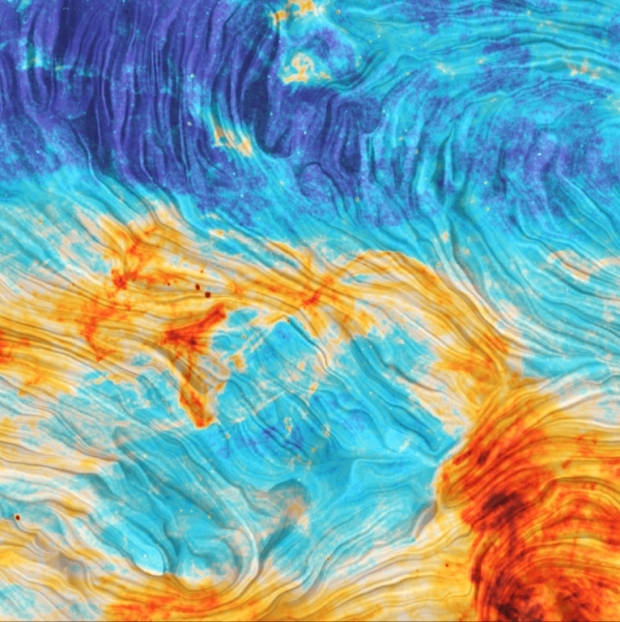
Still, that doesn’t mean that there is no polarization data at all. There is for example, this rather beautiful visualization of the polarized emission at 353 GHz, together with the Galactic magnetic field, shown over a thirty-degree square region of the sky:

lic_3_page_7

The science results that I’ve been able to glean from social media largely amount to minor corrections to last year’s results, with only small changes (less than ~1σ)  to the cosmological parameters derived from them. Good science, of course, but nothing to get too worked up about. What with the “now you see it, now you don’t” press conference, the decision not to release the data, and the polarization data  still being in a mess, I can’t help feeling distinctly underwhelmed by the whole thing. This might be a bit harsh, but I think it’s been a bit of a farce…

Still, at least I’m no longer sad I couldn’t make the conference!


BICEP2 bites the dust.. or does it?

Posted in Bad Statistics, Open Access, Science Politics, The Universe and Stuff with tags , , , , , , , , on September 22, 2014 by telescoper

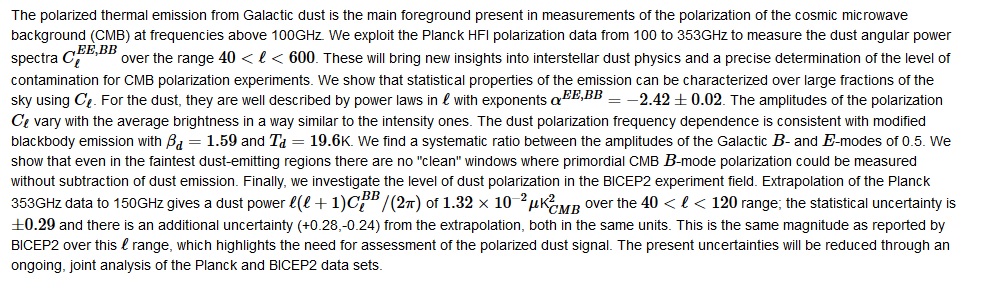
Well, it’s come about three weeks later than I suggested – you should know that you can never trust anything you read in a blog – but the long-awaited Planck analysis of polarized dust emission from our Galaxy has now hit the arXiv. Here is the abstract, which you can click on to make it larger:

PlanckvBICEP2

My twitter feed was already alive with reactions to the paper when I woke up at 6am, so I’m already a bit late on the story, but I couldn’t resist a quick comment or two.

The bottom line is of course that the polarized emission from Galactic dust is much larger in the BICEP2 field than had been anticipated in the BICEP2 analysis of their data (now published  in Physical Review Letters after being refereed). Indeed, as the abstract states, the actual dust contamination in the BICEP2 field is subject to considerable statistical and systematic uncertainties, but seems to be around the same level as BICEP2’s claimed detection. In other words the Planck analysis shows that the BICEP2 result is completely consistent with what is now known about polarized dust emission.  To put it bluntly, the Planck analysis shows that the claim that primordial gravitational waves had been detected was premature, to say the least. I remind you that the original  BICEP2 result was spun as a ‘7σ’ detection of a primordial polarization signal associated with gravitational waves. This level of confidence is now known to have been false.  I’m going to resist (for the time being) another rant about p-values

Although it is consistent with being entirely dust, the Planck analysis does not entirely kill off the idea that there might be a primordial contribution to the BICEP2 measurement, which could be of similar amplitude to the dust signal. However, identifying and extracting that signal will require the much more sophisticated joint analysis alluded to in the final sentence of the abstract above. Planck and BICEP2 have differing strengths and weaknesses and a joint analysis will benefit from considerable complementarity. Planck has wider spectral coverage, and has mapped the entire sky; BICEP2 is more sensitive, but works at only one frequency and covers only a relatively small field of view. Between them they may be able to identify an excess source of polarization over and above the foreground, so it is not impossible that there may a gravitational wave component may be isolated. That will be a tough job, however, and there’s by no means any guarantee that it will work. We will just have to wait and see.

In the mean time let’s see how big an effect this paper has on my poll:


Note also that the abstract states:

We show that even in the faintest dust-emitting regions there are no “clean” windows where primordial CMB B-mode polarization could be measured without subtraction of dust emission.

It is as I always thought. Our Galaxy is a rather grubby place to live. Even the windows are filthy. It’s far too dusty for fussy cosmologists, who need to have everything just so, but probably fine for astrophysicists who generally like mucking about and getting their hands dirty…

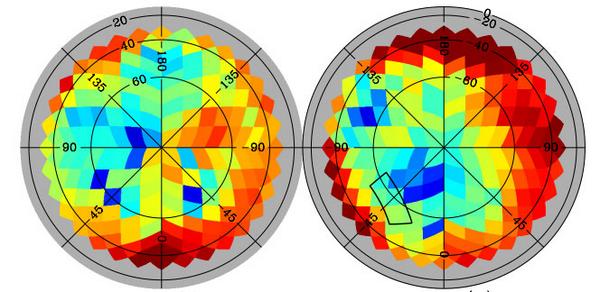
This discussion suggests that a confident detection of B-modes from primordial gravitational waves (if there is one to detect) may have to wait for a sensitive all-sky experiment, which would have to be done in space. On the other hand, Planck has identified some regions which appear to be significantly less contaminated than the BICEP2 field (which is outlined in black):

Quieter dust

Could it be possible to direct some of the ongoing ground- or balloon-based CMB polarization experiments towards the cleaner (dark blue area in the right-hand panel) just south of the BICEP2 field?

From a theorist’s perspective, I think this result means that all the models of the early Universe that we thought were dead because they couldn’t produce the high level of primordial gravitational waves detected by BICEP2 have no come back to life, and those that came to life to explain the BICEP2 result may soon be read the last rites if the signal turns out to be predominantly dust.

Another important thing that remains to be seen is the extent to which the extraordinary media hype surrounding the announcement back in March will affect the credibility of the BICEP2 team itself and indeed the cosmological community as a whole. On the one hand, there’s nothing wrong with what has happened from a scientific point of view: results get scrutinized, tested, and sometimes refuted.  To that extent all this episode demonstrates is that science works.  On the other hand most of this stuff usually goes on behind the scenes as far as the public are concerned. The BICEP2 team decided to announce their results by press conference before they had been subjected to proper peer review. I’m sure they made that decision because they were confident in their results, but it now looks like it may have backfired rather badly. I think the public needs to understand more about how science functions as a process, often very messily, but how much of this mess should be out in the open?


UPDATE: Here’s a piece by Jonathan Amos on the BBC Website about the story.

ANOTHER UPDATE: Here’s the Physics World take on the story.

ANOTHER OTHER UPDATE: A National Geographic story

Stokes V – The Lost Parameter

Posted in The Universe and Stuff with tags , , , , , , on August 27, 2014 by telescoper

Some years ago I went to a seminar on the design of an experiment to measure the polarization of the cosmic microwave background. At the end of the talk I asked what seemed to me to be an innocent question. The point of my question was the speaker had focussed entirely on measuring the intensity of the radiation (I) and the two Stokes Parameters that measure linear polarization of the radiation (usually called Q and U). How difficult, I asked, would it be to measure the remaining Stokes parameter V (which quantifies circular polarization)?

There was a sharp intake of breath among the audience and the speaker responded with a curt “the cosmic microwave background is not circularly polarized”. It is true that in the standard cosmological theory the microwave background is produced by Thomson scattering in the early Universe which produces partial linear polarization, so that Q and U are non-zero, but not circular polarization so V=0. However, I had really asked my question because I had an idea that it might be worth measuring V (or at least putting an upper limit on it) in order to assess the level of instrumental systematics (which are a serious issue with polarization measurements).

I was reminded of this episode when I saw a paper on the arXiv today by Asantha Cooray, Alessandro Melchiorri and Joe Silk which points out that the CMB may well have some level of circular polarization. When light travels through a region containing plasma and a magnetic field, circular polarization can be generated from linear polarization via a process called Faraday conversion. For this to happen, the polarization vector of the incident radiation (defined by the direction of its E-field) must have non-zero component along the local magnetic field, i.e. the B-field. Charged particles are free to move only along B, so the component of E parallel to B is absorbed and re-emitted by these charges, thus leading to phase difference between it and the component of E orthogonal to B and hence to the circular polarization. This is related to the perhaps more familiar process of Faraday rotation, which causes the plane of linear polarization to rotate when polarized radiation travels through a region containing a magnetic field.

Anyway, here is the abstract of the paper

The primordial anisotropies of the cosmic microwave background (CMB) are linearly polarized via Compton-scattering. The Faraday conversion process during the propagation of polarized CMB photons through regions of the large-scale structure containing magnetized relativistic plasma, such as galaxy clusters, will lead to a circularly polarized contribution. Though the resulting Stokes-V parameter is of order 10-9 at frequencies of 10 GHz, the contribution can potentially reach the total Stokes-U at low frequencies due to the cubic dependence on the wavelength. In future, the detection of circular polarization of CMB can be used as a potential probe of the physical properties associated with relativistic particle populations in large-scale structures.

It’s an interesting idea, but it’s hard for me to judge the feasibility of measuring a value of Stokes V as low as 10-9. Clearly it would only work at frequencies much lower than those probed by current CMB experiments such as BICEP2 (which operates at 150 GHz). Perhaps if the speaker had answered my question all those years ago I’d be in a better position to decide!

The truth is out there

Posted in Biographical, The Universe and Stuff with tags , , , , , on August 23, 2014 by telescoper

So here I am, then, sitting in my hotel room in Copenhagen and drinking coffee, filling in time before I check out and travel to the airport for the journey home. I don’t have to be there until this afternoon so today is going to be a bit more leisurely than the rest of the week has been. It’s nice to get a couple of hours to myself.

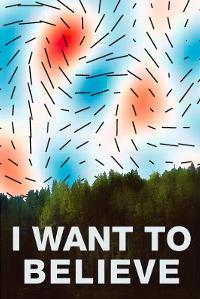
It was an interesting little workshop, with lots of time for discussions, but lurking in the background of course was the question mark  over BICEP2. Many theorists have clearly been beavering  away on models which assume that BICEP2 has measured primordial gravitational waves and I suspect most of them really want the result to be correct. When I posted a message on Twitter about this, Ian Harrison posted this homage to a famous poster for the TV series The X-files. There’s more than a little truth in the comparison!

BICEP_Xfiles

Whatever the truth about the BICEP2 measurements there’s no question that it’s a brilliant experiment, with exquisite sensitivity. There is no question that it has detected something so faint that it boggles the mind. Here is a slide from Phil Lubin’s talk at the meeting, which shows the unbelievably rapid improvement in sensitivity of microwave detectors:


IMG-20140820-00388

I don’t think cosmologists ever pay enough credit to the people behind these technological developments, as it is really they who have driven the subject forward. In the case of BICEP2 the only issue is whether it has picked up a cosmological signal or something from our own Galaxy. Whatever it is, it’s an achievement that deserves to be recognized.

And as for the claims of the person responsible for the post I reblogged yesterday that the cosmic microwave background is a fraud, well I can assure you it is not. Any scientific result is open to discussion and debate, but the ultimate arbiter is experimental test. Several independent teams are working in competition on CMB physics and any fraud would be easily exposed. The cosmic microwave background is out there.

And so is the truth.

The Zel’dovich Universe – Days 5 & 6 Summary

Posted in History, The Universe and Stuff with tags , , , , , on June 29, 2014 by telescoper

Well, it’s Sunday morning and it’s raining in Tallinn. I’ve got a few hours to kill but fortunately don’t have to check out of the hotel until noon so I thought I’d briefly summarize Days Five and Six of IAU Symposium No. 308, The Zel’dovich Universe just to complete the story.

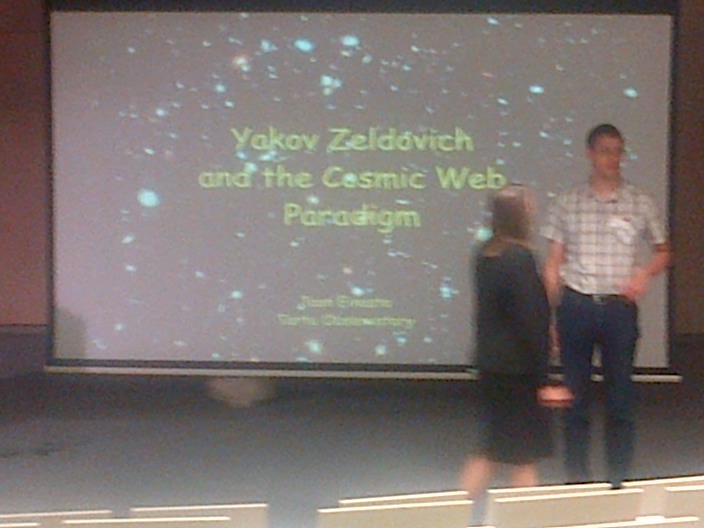
Day Five (Friday) began with a talk by Jaan Einasto, recent winner of the Gruber Prize for Cosmology. As you can see from this picture I took before his talk commenced,  the topic was Yakov Zel’dovich and the Comic Sans Cosmic Web Paradigm:

IMG-20140627-00354

The following talk was by the ebullient Rashid Sunyaev, whose name is associated with Zel’dovich in so many contexts, including the Sunyaev-Zeld’ovich effect. Sunyaev is such a big personality that he is unconstrained by the banal notions of time, and his talk set the schedule back for the rest of the morning. Among the things I remember from his contribution was a discussion of the Berkeley-Nagoya distortion. This was a hot topic during the time I was a graduate student, as it was a measurement that suggested the spectrum of the cosmic microwave background departed significantly from a black-body (Planck) curve in the Wien part of the spectrum; this is now usually known as a y-distortion. Anyway, lots of theorists wrote papers explaining the measured excess in terms of this that and the other and then it was shown to be an error; the excess emission came not from the Big Bang but from the exhaust of the rocket carrying the measurement. The thing I remember most strongly about this was that as soon as the error was identified it ceased to be the Berkeley-Nagoya distortion and became instead the Nagoya-Berkeley distortion…

Rashid Sunyaev was himself a winner of the Gruber prize some years ago, as indeed were Dick Bond and Brent Tully who spoke erlier in the conference, so the organizers decided to form a Gruber-panel to discuss various topics suggested by the audience. Here is Sunyaev, hogging the microphone:

IMG-20140627-00355

Carlos Frenk is also a Gruber prize winner, but he only arrived after lunch so wasn’t part of this discussion. The afternoon was all about cosmological simulations of various aspects of the Cosmic Web. This gives me an opportunity to repeat how the Oxford English Dictionary defines “simulation”:

1. a. The action or practice of simulating, with intent to deceive; false pretence, deceitful profession.

b. Tendency to assume a form resembling that of something else; unconscious imitation.

In the World Cup players can even get sent off for simulation, although regrettably they seldom are.

Anyway, Friday evening found us at the famous House of Blackheads (aptly on Pikk Street) for an evening of very long speeches punctuated by small amounts of food and wine (and of course some very lovely music as I described yesterday). When the party was over a group of us adjourned to a local bar, from which I returned to my hotel at about 2am.

Day Six was a half-day, with some very interesting talks about gravitational len-sing in the first session and “superstructures” in the cosmic web. Then we were into the final furlong as it were. Nick Kaiser was put in Session (No. 21) all of his own. As usual, given how annoyingly brilliant he is, Nick gave  fabulously interesting talk full of insights and ideas. The organizers had definitely saved the best for second-to-last.

Then, after five-and-a-half days and almost 100 talks, it was down to me to give the conference summary. Obviously I couldn’t really summarize all that such I just picked up a few things that occurred to me during the course of the conference (some of which I’ve written about over the last week or so on this blog) and made a few jokes, primarily at the expense of Carlos Frenk. I was interested to see that signs like this had been put up around Tallinn advertising my talk:

IMG-20140628-00356

The OMG and WOW are self-explanatory, but I was a bit confused about the SAH so I googled it and found that it means the Society of Architectural Historians. I’ve never heard it put quite like that before, but I guess that’s what we cosmologists are: trying to understanding the origins and time evolution of the architecture of the Universe.

A number of speakers at this conference referred to a conference in Hungary in 1987 at which they had met Zel’dovich (who died later that year). I was a graduate student (at Sussex) at that time and owing the shortage of travel funds I wasn’t able to go; I went to a meeting in Cambridge called The Post-Recombination Universe instead. If memory serves that’s when I gave my first conference talk. Anyway, Carlos Frenk gave a talk at that meeting in Hungary which he decribed in his talk at this conference on Friday afternoon. Somebody back in 1987 had written a series of limericks to describe that meeting, so I was challenged to come up with one to conclude this one. Here’s my effort, which is admittedly pretty feeble, but at least the sentiments behind it are genuine..

In Tallinn (IAU 308)
The sessions invariably ran late
But despite being tired
We still much inspired
By Yakov Zel’dovich (the Great).