Archive for Cosmic Web

R.I.P. Sergei Shandarin (1947-2025)

Posted in Biographical, R.I.P., The Universe and Stuff with tags , , , , on March 18, 2025 by telescoper

It is my sad duty to pass on the sad news of the death of Sergei Shandarin, who passed away yesterday at the age of 77. He had been suffering from cancer for some time and had been undergoing chemotherapy, alas to no avail. Last week he was moved onto palliative care and we knew he would soon be leaving us. I was going to post something last night when I heard that he had died, but I just couldn’t find the words. I send my deepest condolences to his family, friends and colleagues who are grieving.

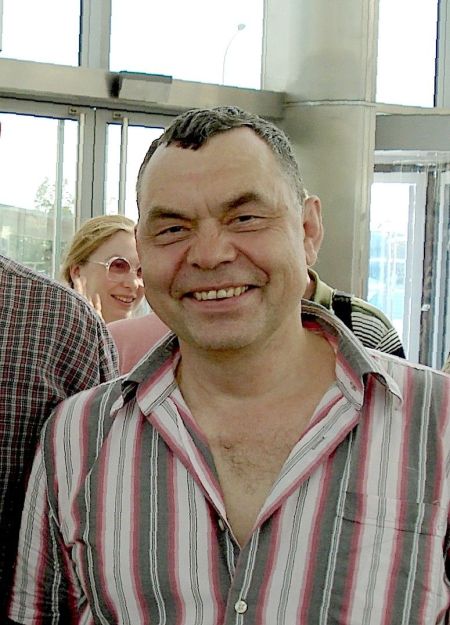
(The picture on the left shows Sergei in 2006; I’m grateful to John Peacock for letting me use it here.)

Sergei Fyodor Shandarin was born in 1947 and gained his PhD at the Moscow Institute of Physics and Technology in 1974. He was a student of the great physicist Yakov Borisovich Zeldovich (whom I blogged about here). Sergei moved to the USA in 1991 to take up a Professorship at the University of Kansas, in Lawrence, where he remained until his retirement. More recently he and his wife Vika moved to Toronto to be closer to his daughter Anya and their grandchildren.

Sergei’s main research interests were the dynamics and statistics of the “Cosmic Web” – the supercluster- void network in spacial distribution of galaxies. In particular, he was interested in nonlinear dynamics of gravitational instability, which is the major mechanism for the formation of a large variety of objects in the universe, and in geometrical and topological statistical descriptors of the distribution of mass and galaxies in space.

These topics overlap considerably with my own and I was delighted to have the opportunity to work with Sergei in 1992 when I was invited by Adrian Melott as a visitor to Lawrence fro about a month. My first impression of Sergei was that he was a bit scary – in that typical Russian physicist sort of way – but I soon discovered that, beneath his initially rather fierce demeanour, he was actually a kind and friendly person with a fine sense of humour. I remember that research visit very well, in fact, not only because of Adrian’s and Sergei’s hospitality, but also because the project we did together went so well that we not only completed the research, but I returned to London with a completed manuscript; the paper that resulted was published in early 1993.

After that I kept in touch with Sergei mainly at conferences. Last night after I heard the news that he has passed away I brought a box of old photographs down from the loft and rummaged around for some pictures. Here are two from a meeting in India in 1994, in which you can see Sergei very much in the centre of things:
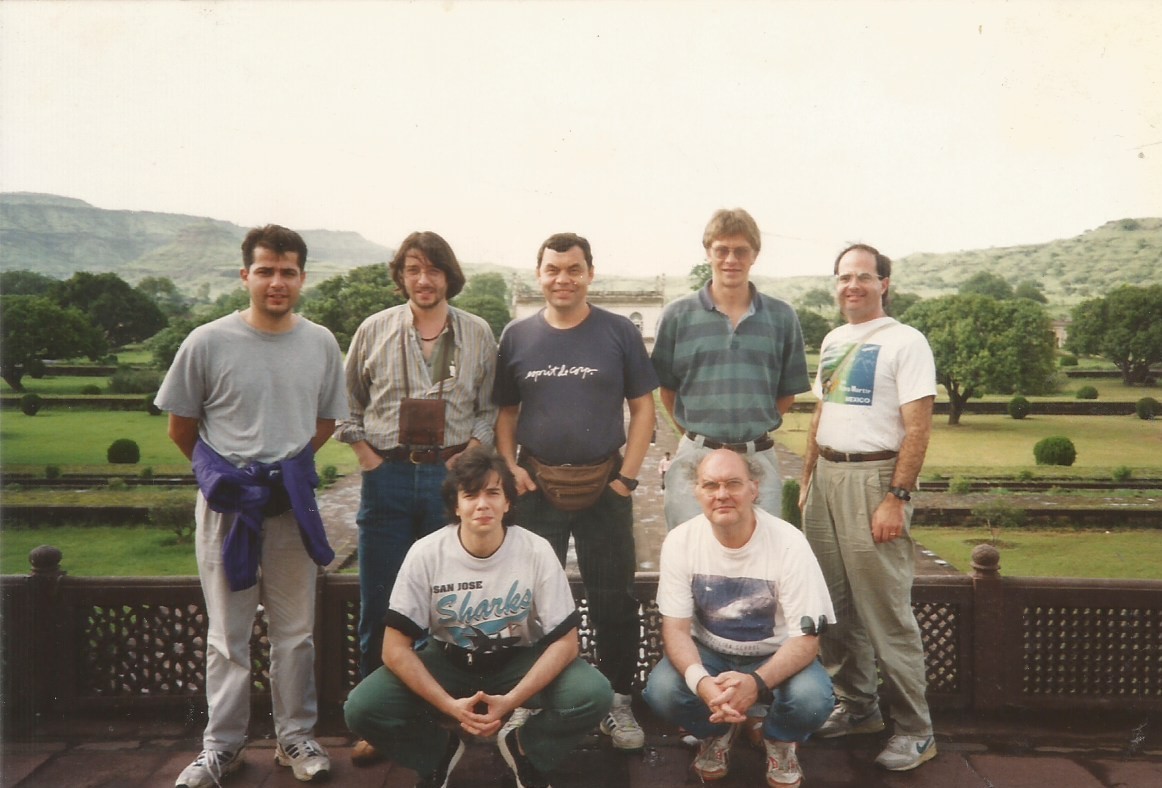
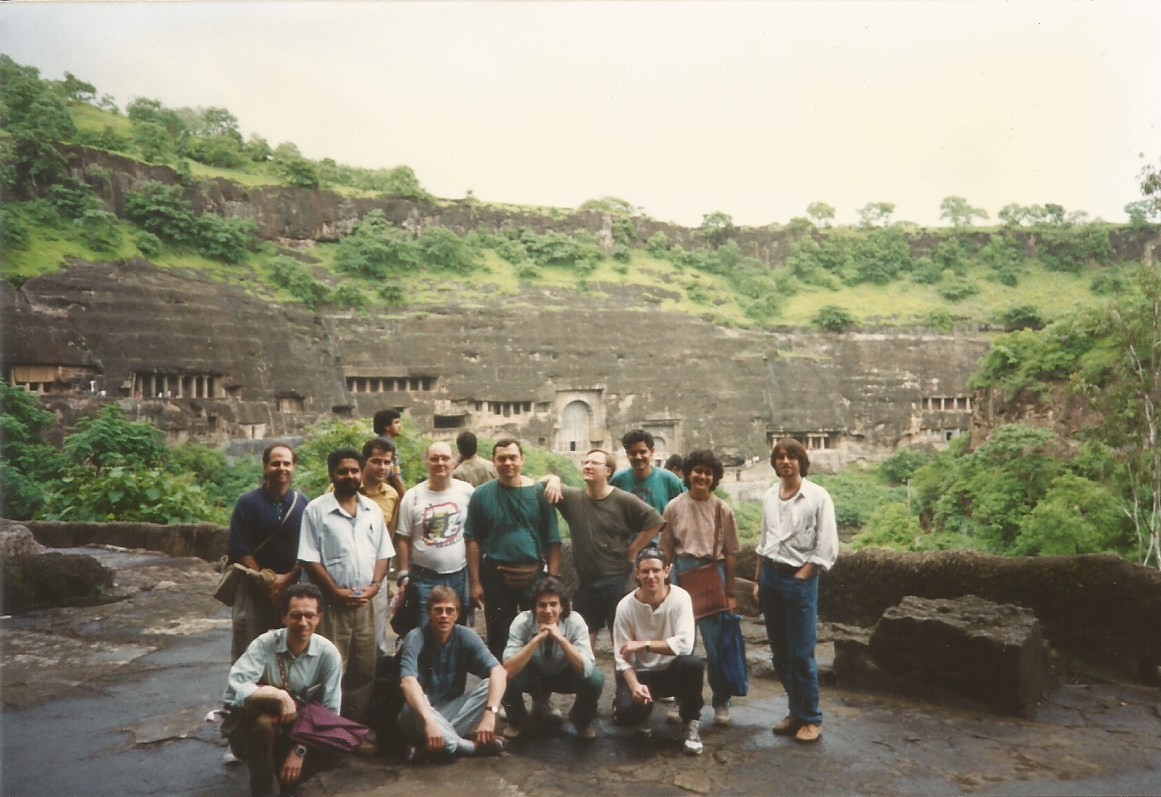
The picture on the left shows: (standing, L to R) Francis Bernardeau, Paolo Catelan, Sergei, ?*, Paul R. Shapiro; (crouching) Enzo Branchini and Bernard Jones. The picture on the right has the addition of, among others, Varun Sahni (between Paul Shapiro and Bernard Jones), Dick Bond (with his arm on Sergei’s shoulder) and Sabino Matarrese (front left); I’m on the right of the front row. I remember these pictures were taken on an excursion from Pune to see the historic caves and temples at Ajanta and Ellora.

(*I think the unidentified person might be Lars Hernquist, but I’m not sure: I’d be grateful for any information.)

I also particular remember meeting up with Sergei at meetings in Los Angeles, Nice, Valencia (the meeting at which the first picture was taken). and most recently in Estonia (for a meeting to celebrate the centenary of the birth of Zel’dovich). He was always up for scientific discussions, but also liked to relax with a drink or several; he also liked to watch football.

Sergei was a wonderful scientist as well as a warm and generous human being who was held in a very high regard by the cosmological community worldwide. We will all miss him terribly.

Rest in peace, Sergei Fyodor Shandarin (1947-2025)
Guest Post – by A.I. Addio

Posted in The Universe and Stuff with tags , , , , on December 6, 2022 by telescoper

Quite a few people have been playing around with a new-fangled AI tool called ChatGPT the developers of which say this:

We’ve trained a model called ChatGPT which interacts in a conversational way. The dialogue format makes it possible for ChatGPT to answer followup questions, admit its mistakes, challenge incorrect premises, and reject inappropriate requests. ChatGPT is a sibling model to InstructGPT, which is trained to follow an instruction in a prompt and provide a detailed response.

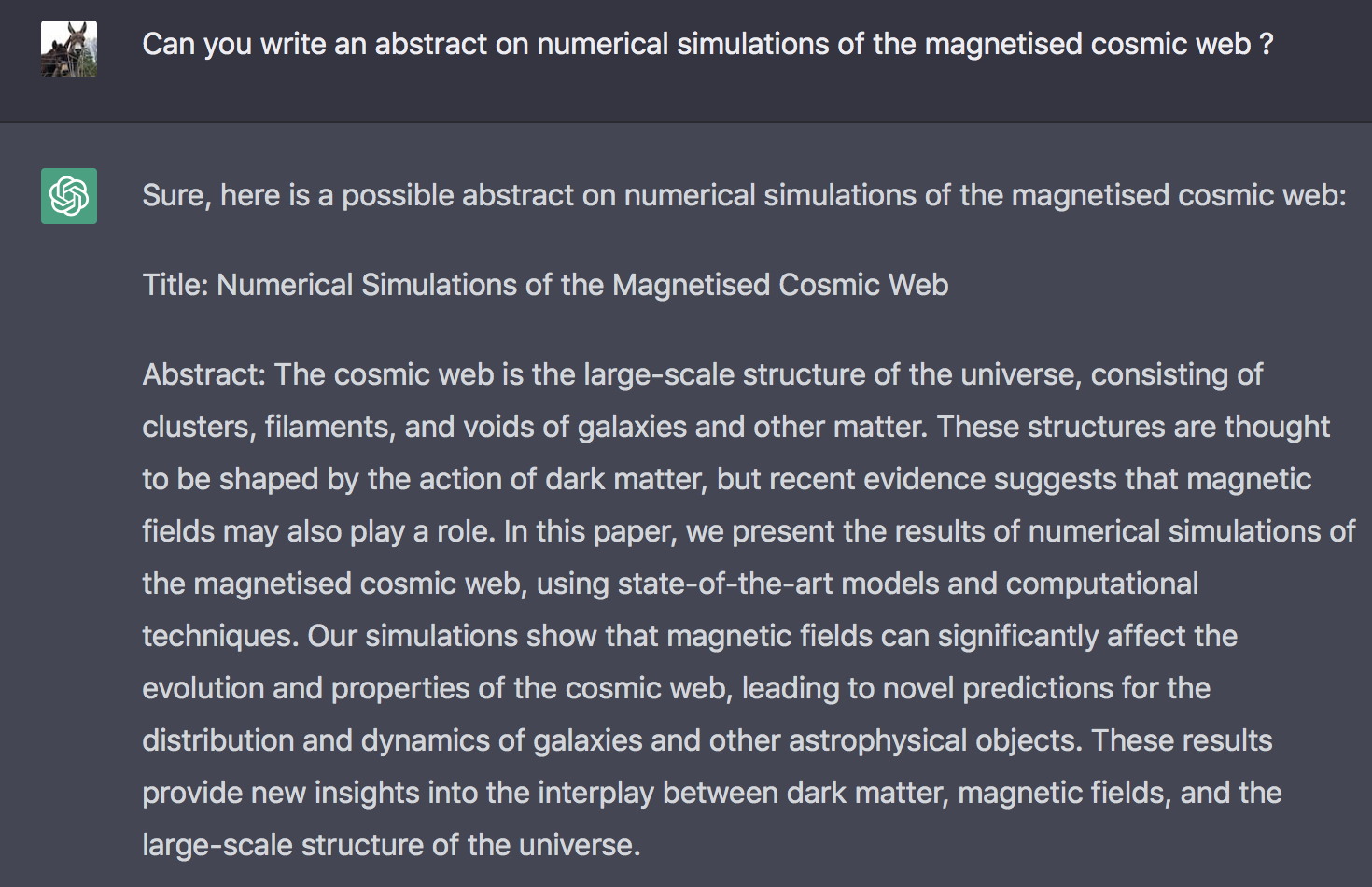
Here is an example (stolen from here) wherein this “model” creates the abstract of a scientific paper on a suggested topic:

This makes me wonder how many abstracts on astro-ph are actually written this way!

Please note that no papers of mine involved the use of any form of Artificial Insemination. I hope this clarifies the situation.

That Was The (Space) Week That Was

Posted in Biographical, Maynooth, The Universe and Stuff with tags , , , , on October 7, 2022 by telescoper

Last night I participated in an event at Maynooth for Space Week which I think went very well. We had a big audience so the decision to move to a bigger lecture theatre was a good one. Nobody took count but I think we had as many as 400 people of all ages, including some very young kids, some students and a variety of others.

I was the last one up to speak and took a few pictures at the three talks before mine but obviously couldn’t take a picture of mine so I’ve included a pic of some of the hi-tech equipment I used for a couple of demonstrations:

If anyone wants to see the pictures I showed you can find them here:

There was an official photographer there last night so I’ll upload any pictures I come across in due course. Watch this space.

UPDATE: Here’s a picture of the four speakers

Last night’s four speakers: Créidhe O’Sullivan, Me, Emma Whelan and John Regan

Anyway, thank you to everyone for coming last night and especially to all the people who helped organize and run the event, including our student volunteers. We’re planning to do similar event for space week next year and hopefully this will become a regular feature in the calendar.

GAA Clustering

Posted in Bad Statistics, GAA, The Universe and Stuff with tags , , , , , , on July 25, 2022 by telescoper
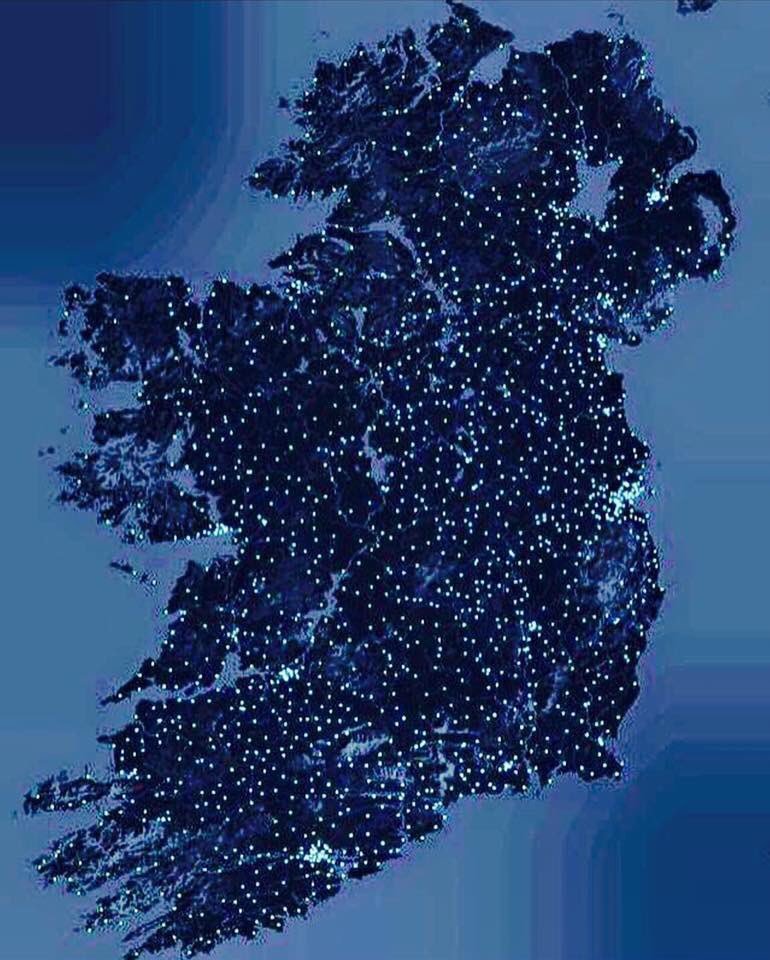
The distribution of GAA pitches in Ireland

The above picture was doing the rounds on Twitter yesterday ahead of this year’s All-Ireland Football Final at Croke Park (won by favourites Kerry despite a valiant effort from Galway, who led for much of the game and didn’t play at all like underdogs).

The picture above shows the distribution of Gaelic Athletics Association (GAA) grounds around Ireland. In case you didn’t know, Hurling and Gaelic Football are played on the same pitch with the same goals and markings on the field. First thing you notice is that the grounds are plentiful! Obviously the distribution is clustered around major population centres – Dublin, Cork, Limerick and Galway are particularly clear – but other than that the distribution is quite uniform, though in less populated areas the grounds tend to be less densely packed.

The eye is also drawn to filamentary features, probably related to major arterial roads. People need to be able to get to the grounds, after all. Or am I reading too much into these apparent structures? The eye is notoriously keen to see patterns where none really exist, a point I’ve made repeatedly on this blog in the context of galaxy clustering.

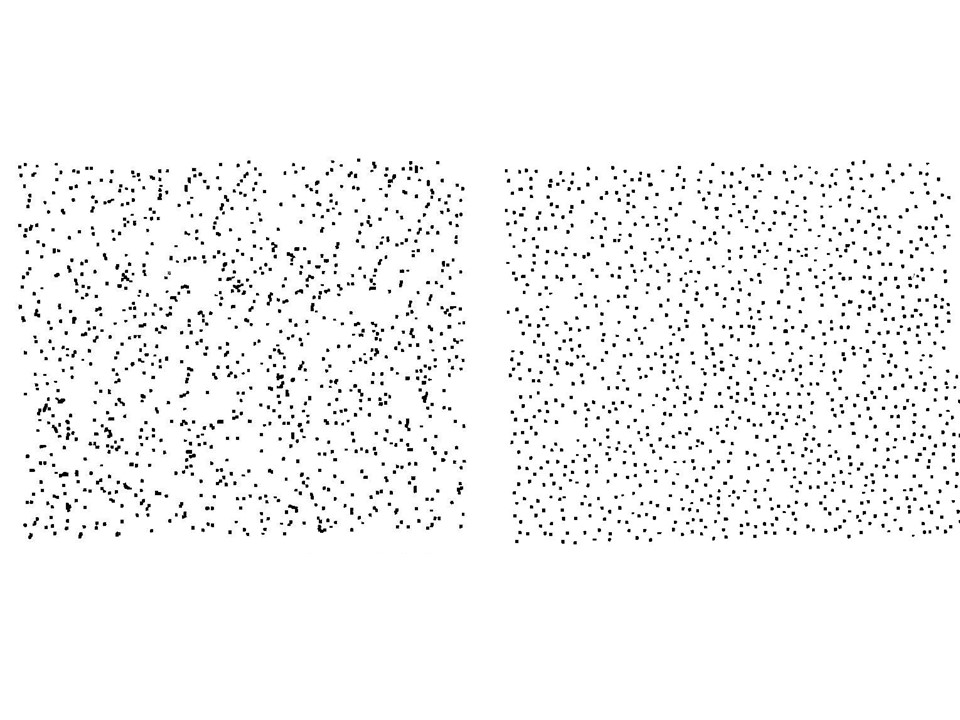
The statistical description of clustered point patterns is a fascinating subject, because it makes contact with the way in which our eyes and brain perceive pattern. I’ve spent a large part of my research career trying to figure out efficient ways of quantifying pattern in an objective way and I can tell you it’s not easy, especially when the data are prone to systematic errors and glitches. I can only touch on the subject here, but to see what I am talking about look at the two patterns below:

You will have to take my word for it that one of these is a realization of a two-dimensional Poisson point process and the other contains correlations between the points. One therefore has a real pattern to it, and one is a realization of a completely unstructured random process.

random or non-random?

I show this example in popular talks and get the audience to vote on which one is the random one. The vast majority usually think that the one on the right that  is random and the one on the left is the one with structure to it. It is not hard to see why. The right-hand pattern is very smooth (what one would naively expect for a constant probability of finding a point at any position in the two-dimensional space) , whereas the left-hand one seems to offer a profusion of linear, filamentary features and densely concentrated clusters.

In fact, it’s the picture on the left that was generated by a Poisson process using a  Monte Carlo random number generator. All the structure that is visually apparent is imposed by our own sensory apparatus, which has evolved to be so good at discerning patterns that it finds them when they’re not even there!

The right-hand process is also generated by a Monte Carlo technique, but the algorithm is more complicated. In this case the presence of a point at some location suppresses the probability of having other points in the vicinity. Each event has a zone of avoidance around it; the points are therefore anticorrelated. The result of this is that the pattern is much smoother than a truly random process should be. In fact, this simulation has nothing to do with galaxy clustering really. The algorithm used to generate it was meant to mimic the behaviour of glow-worms which tend to eat each other if they get  too close. That’s why they spread themselves out in space more uniformly than in the random pattern.

Incidentally, I got both pictures from Stephen Jay Gould’s collection of essays Bully for Brontosaurus and used them, with appropriate credit and copyright permission, in my own book From Cosmos to Chaos.

The tendency to find things that are not there is quite well known to astronomers. The constellations which we all recognize so easily are not physical associations of stars, but are just chance alignments on the sky of things at vastly different distances in space. That is not to say that they are random, but the pattern they form is not caused by direct correlations between the stars. Galaxies form real three-dimensional physical associations through their direct gravitational effect on one another.

People are actually pretty hopeless at understanding what “really” random processes look like, probably because the word random is used so often in very imprecise ways and they don’t know what it means in a specific context like this.  The point about random processes, even simpler ones like repeated tossing of a coin, is that coincidences happen much more frequently than one might suppose.

I suppose there is an evolutionary reason why our brains like to impose order on things in a general way. More specifically scientists often use perceived patterns in order to construct hypotheses. However these hypotheses must be tested objectively and often the initial impressions turn out to be figments of the imagination, like the canals on Mars.

The Largest Map of the Universe

Posted in The Universe and Stuff with tags , , , on January 14, 2022 by telescoper

Now I’m going to have to update the bit of my popular talks (e.g this one) about `Mapping the Universe’!

After just seven months of operations of the Dark Energy Spectroscopic Instrument (DESI) we now have the largest galaxy redshift survey – and it’s only about 10% of the way through its 5-year programme. Currently mapping the positions of about 7.5 million galaxies, the map will contain over 35 million by the time the survey is complete. Even now it is larger than all previous spectroscopic galaxy redshift surveys put together. The speed of DESI is accounted for by its use of 5000 robotically-positioned fibre-optic cables that can generate spectra of thousands of galaxy from a single pointing of the 4-m telescope on which it is mounted.

You can read more about the latest results from DESI here. I’ll just whet your appetite with this groovy animated picture:

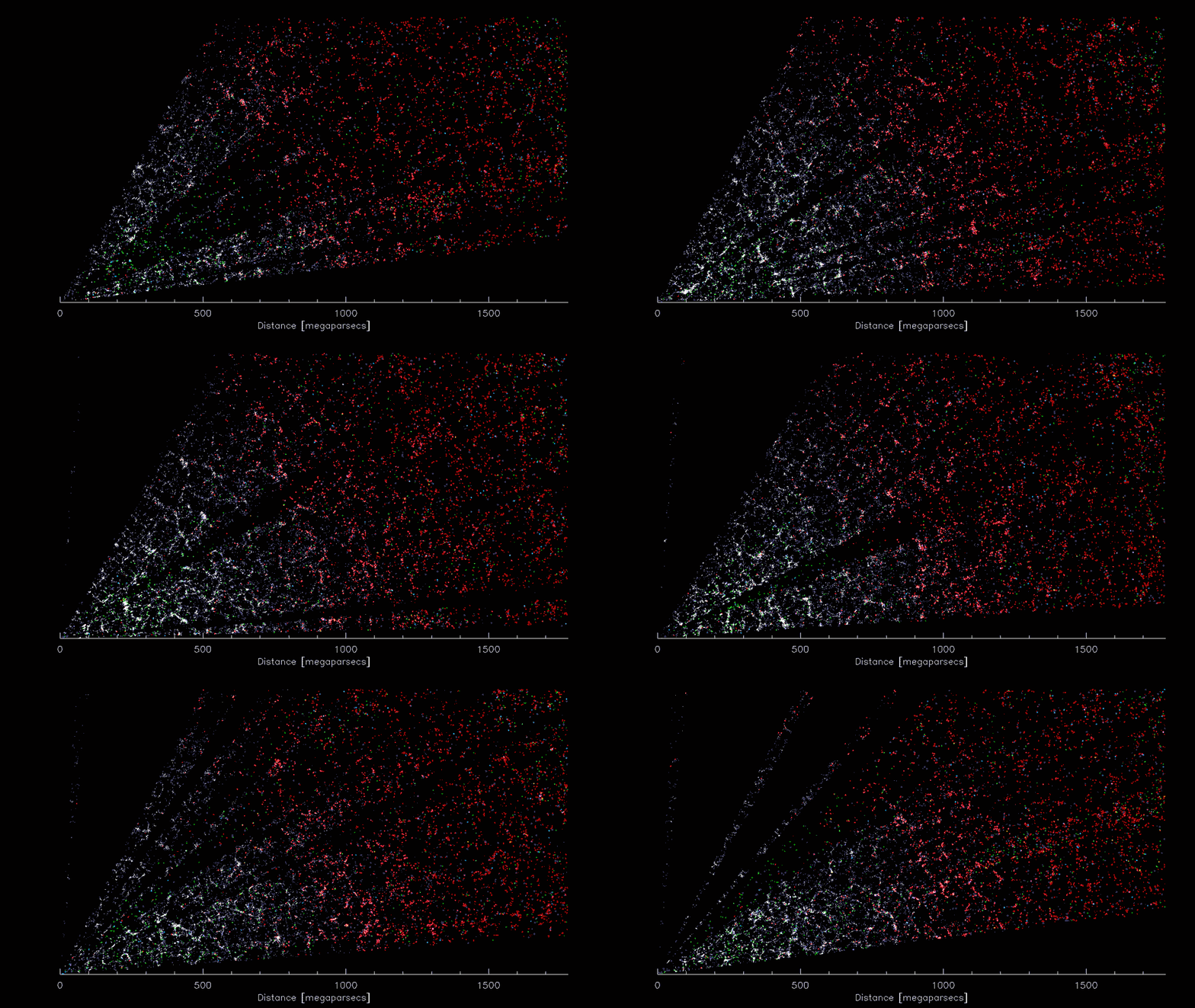
DESI’s three-dimensional “CT scan” of the Universe. We are at in the lower left, looking out over 5 billion light years in the direction of the constellation Virgo. As the video progresses, the perspective sweeps toward the constellation Bootes. Each colored point represents a galaxy; gravity has pulled the galaxies into a “cosmic web” of dense clusters, filaments and voids. (Credit: D. Schlegel/Berkeley Lab using data from DESI)

The twinkling effect arises from the fact that you are viewing different thin slices through the 3D distribution. The dark sections that appear and disappear from time to time are just bits not yet included in the survey.

For those of you not familiar with astronomical distance measurements, 1500 megaparsecs = 1.5 Gigaparsecs = 4.5 billion light years (approximately), so this map is not only mapping the spatial distribution of galaxies but also how this distribution has evolved with cosmic time over billions of years.