Archive for Cosmology

Planck (but only in name?)

Posted in Science Politics, The Universe and Stuff with tags , , , , , , on March 3, 2013 by telescoper

First, a serious announcement. It appears that the announcement of results from the Planck Mission will be streamed live from ESA HQ on 21st March from 10.00 to 12.00 CET (whatever that is). The UK will remain on GMT until 31st March so the  ESA web server will probably crash at 9am British time on 21st March.

There’s a short press release making this announcement here. It says:

On Thursday 21 March 2013, the main scientific findings from the European Space Agency’s Planck spacecraft will be announced at a press briefing to be held at ESA’s Headquarter in Paris. Simultaneously with this event, data products and scientific papers based on the “nominal” operations period will be made public through the Planck Legacy Archive.

I was interested in the appearance of the word “nominal” in quotes in there so I searched for its meaning in the One True Chambers Dictionary, where I found:

nominal, adj relating to or of the nature of a name or noun; of names; by name; only in name; so-called, but not in reality; inconsiderable, small, minor, in comparison with the real value, hardly more than a matter of form…

Interesting. It seems that the “nominal” could mean, on the one hand, that ESA are being unusually modest about the importance of the forthcoming Planck results or, on the other, that there will now be a host of conspiracy theorists suggesting that the Planck results aren’t real….

That reminds me that years and years ago I had an idea for a crime novel with a plot that revolves around the murder of a prominent cosmologist just as some important scientific discovery is about to be announced. Suspicion gathers that the whole thing is an enormous hoax and the discovery bogus. But the experiment is shrouded in secrecy, and so expensive that it can’t easily be repeated, so  who can tell, and how?

It’s very difficult to know for sure whether any scientific discoveries are genuine or not, even if the data and analysis procedures are made public. There’s always the possibility that everything might have been fabricated simulated, but in most cases the experiment can be repeated at a later date and the fraud eventually exposed, such as in the Schön Scandal.  In Big Science, this may not be practicable. However, Big Science requires big teams of people and the chances are someone would blow the whistle, or try to…

Anyway, I know that there are people out there who take everything I write on this blog absurdly literally so I’ll spell it out that I am in no way suggesting that the Planck mission is a fraud. Or predicting that there’ll be a murder just before the announcements on March 21st. Any similarity purely coincidental and all that. And I’ve never had time to write the book anyway – perhaps a publisher might read this and offer me an advance as an incentive?

Moreover, going back to the Chambers Dictionary, I note the final definition omitted above

…according to plan (space flight)

So that’s that. Nothing sinister. I’m not sure how “nominal” acquired that meaning, mind you, but that’s another story…

The End of Cosmology?

Posted in Biographical, The Universe and Stuff with tags , , on February 21, 2013 by telescoper

A very busy day interviewing candidates for a job in Experimental Particle Physics was made even busier by the arrival by the boxes containing all my books and other knick-knacks from Cardiff. Anyway, the net result of all this is that I only have time for a brief post before I go home and lapse into a coma. I can at least do something useful, however, which is to pass on the following announcement:

Presentation of the first cosmologic results of Planck mission as well as its first all-sky images of the Cosmic Microwave Background

Launched in 2009, Planck studies the Cosmic Microwave Background – the relic radiation from the Big Bang – to allow cosmologists to zero-in on theories that describe the Universe’s birth and evolution. The first all-sky images of the Cosmic Microwave Background will be presented at the press conference held in Paris ESA HQ on March 21st, 2013.

We’ve been expecting that the “cosmologic” results from Planck would be announced sometime early this year. Now we know when. March 21st 2013 is the date to put in your diary, and that’s only about a month from now. Exciting times.

Will Planck confirm the standard cosmological model and measure its parameters more precisely? Or will there be the first hints of physics outside the standard model? Will cosmology be all done and dusted, or will we find out that we didn’t understand the Universe as well as we originally thought?

I don’t know. Yet.

Infinities in Cosmology

Posted in The Universe and Stuff with tags , , , , on February 7, 2013 by telescoper

Only time to post a quick advertisement I received in an email from the one of the organizers of a 4-day series of talks on Infinities in Cosmology, at the Department of Applied Mathematics and Theoretical Physics (DAMTP), Centre for Mathematical Sciences, Cambridge, from 18-21 March 2013.

This is one in a series of thematic programmes on Cosmology and Philosophy organised by a collaboration of cosmologists and philosophers of science at Oxford and Cambridge Universities. Speakers include A. Aguirre, M. Dafermos, M.R. Douglas, G.F.R. Ellis, M. Hogarth, and S. Saunders.

This is taken from the conference website:

Cosmology involves infinities, or at least the prospect of infinities, in various ways: the most obvious being the potentially infinite age and size of the universe, and the possible occurrence of actual infinities at local spacetime singularities or at the beginning of the Universe. But there are also other kinds of infinity to consider; for example, the possibility of enhanced spatiotemporal scope for computation, or the unlimited proliferation inherent in the concept of the multiverse and the problems encountered in defining probabilities in this context. These topics will be explored in this three-day series and the following full-day workshop.

Looks quite interesting to me, although I don’t think I’ll be able to make time to go!

Further details and online registration for the conference are now available at

http://www.damtp.cam.ac.uk/events/infinities2013/

The Planck Rumour Mill

Posted in The Universe and Stuff with tags , , , , on December 28, 2012 by telescoper

I gather the internet is crawling with people searching for rumours about the Planck mission. It would obviously be entirely inappropriate for me to direct my readers to any website where they might obtain access to confidential information about this experiment, the results from which are embargoed until well into the New Year. So naturally that’s what I’m going to do. Well, blog traffic doesn’t generate itself does it?

As a Telescoper exclusive I am able to offer you a sneak preview of the top secret Planck data well in advance of official release. If you want to see what Planck scientists have been looking since Planck was launched in 2009, just click here.

WMAP: The Last Judgement

Posted in The Universe and Stuff with tags , , , , , , on December 21, 2012 by telescoper

It seems the the Wilkinson Microwave Anisotropy Probe, or rather the estimable team of people working on it, have produced yet another set of maps and key results. I believe this will be the final release from WMAP. The paper is on the arXiv here and it represents a synthesis of no less than nine years of measurements of the cosmic microwave background radiation:

Here’s the abstract:

We present the final nine-year maps and basic results from the WMAP mission. We provide new nine-year full sky temperature maps that were processed to reduce the asymmetry of the effective beams. Temperature and polarization sky maps are examined to separate CMB anisotropy from foreground emission, and both types of signals are analyzed in detail. The WMAP mission has resulted in a highly constrained LCDM cosmological model with precise and accurate parameters in agreement with a host of other cosmological measurements. When WMAP data are combined with finer scale CMB, baryon acoustic oscillation, and Hubble constant measurements, we find that Big Bang nucleosynthesis is well supported and there is no compelling evidence for a non-standard number of neutrino species (3.26+/-0.35). The model fit also implies that the age of the universe is 13.772+/-0.059 Gyr, and the fit Hubble constant is H0 = 69.32+/-0.80 km/s/Mpc. Inflation is also supported: the fluctuations are adiabatic, with Gaussian random phases; the detection of a deviation of the scalar spectral index from unity reported earlier by WMAP now has high statistical significance (n_s = 0.9608+/-0.0080); and the universe is close to flat/Euclidean, Omega_k = -0.0027 (+0.0039/-0.0038). Overall, the WMAP mission has resulted in a reduction of the cosmological parameter volume by a factor of 68,000 for the standard six-parameter LCDM model, based on CMB data alone. For a model including tensors, the allowed seven-parameter volume has been reduced by a factor 117,000. Other cosmological observations are in accord with the CMB predictions, and the combined data reduces the cosmological parameter volume even further. With no significant anomalies and an adequate goodness-of-fit, the inflationary flat LCDM model and its precise and accurate parameters rooted in WMAP data stands as the standard model of cosmology.

The main reason for posting this is to acknowledge the remarkable impact WMAP has had on the field of cosmology. The standard model does indeed account for most available cosmological data extremely well. I’m not entirely sure about the “no significant anomalies” bit in the last sentence, in fact, but I won’t argue with it as it depends entirely upon what you mean by significant. It’s not exactly proven that the fluctuations have “random phases” either. We’ll just have to see whether data from Planck, due to be released next year, will reveal evidence of any physics beyond the standard framework WMAP did so much to establish.

Das Letzte Gericht

Posted in Art, Astrohype, The Universe and Stuff with tags , , , on December 20, 2012 by telescoper

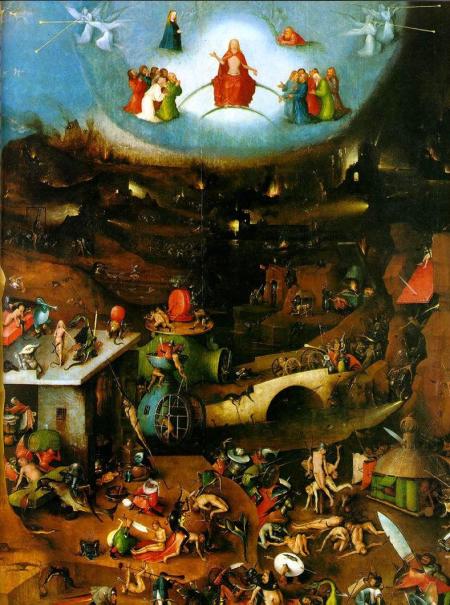
Apparently the world is due to end tomorrow, so I’ve saved quite a lot of money by not having done my Christmas shopping yet. Anyway, the forthcoming Apocalypse reminded me of the painting that I often use to introduce cosmology talks. I usually use this piece of Hieronymus Bosch Das letzte Gericht (The Last Judgement) to illustrate my feelings about the standard cosmological model:

das_letzte_gericht

The top part represents the concordance cosmology. It clearly features an eminent cosmologist surrounded by postdoctoral researchers. Everything appears to be in heavenly harmony, surrounded by a radiant glow of self-satisfaction. The trumpets represent various forms of exaggerated press coverage.

But if you step back from it, and get the whole thing in a proper perspective, you realise that there’s an awful lot going on underneath that’s not so pleasant or easy to interptet. I don’t know what’s going down below there, although the unfortunate figures slaving away in miserable conditions and suffering unimaginable torments, are obviously supposed to represent graduate students. The large knife visible in the bottom right corner clearly symbolises budget cuts looming in the next Comprehensive Spending Review.

The main point is that the concordance model is based on rather strange foundations: nobody understands what the dark matter and dark energy are, for example. Even more fundamentally, the whole thing is based on a shotgun marriage between general relativity and quantum field theory which is doomed to fail somewhere along the line.

Far from being a final theory of the Universe I think we should treat our standard model as a working hypothesis and actively look for departures from it. I’m not at all against the model. As models go, it’s very successful. It’s a good one, but it’s still just a model.

Passo del Tonale Winter School 2012

Posted in Biographical, Books, Talks and Reviews with tags , , on December 18, 2012 by telescoper

I’m having a restful morning at home because (a) it was our Departmental Christmas Lunch yesterday meaning that I’m feeling a bit fragile and (b) there’s a planned electrical shutdown in our building this morning meaning that there’s not much point going in until it’s all back up anyway.

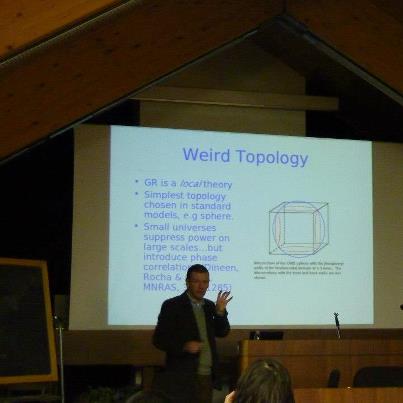
Anyway, since various people made the odd facetious comment accusing me of skiving off last week, I thought I’d take the opportunity to reflect a little on the Winter School that I was lecturing at last week. This took place at Passo del Tonale, in the Italian Alps and was the Sixth in a series of schools for graduate students and postdocs held there annually. When I was invited to take part, I was asked to give five lectures as a sort of overview of the current state of cosmology. Subsequently one of the other speakers dropped out so instead of inviting a replacement, the remaining four were given an extra lecture each. Then one of those was taken ill during the summer school so I stepped in at short notice to give another one. And so it came to pass that I gave seven lectures altogether, in the space of five days. That’s considerably more lecturing than I would have done had I stayed in Cardiff.

Anyway, here’s a picture of me during one of the lectures (taken by one of the participants, Chris Crowe).

Tonale

Afternoons were kept free for skiing and snowboarding, but my dodgy knees don’t allow me to participate in such activities. I am not shap’d for sportive tricks nor made to court an amorous looking-glass. I had lectures to prepare anyway.

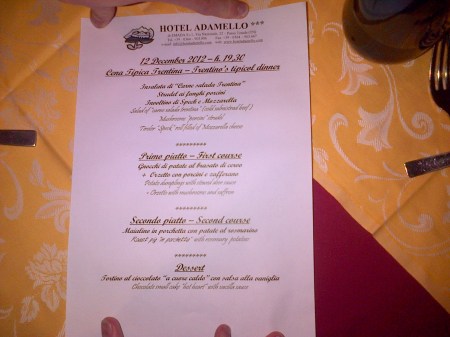
However the hosts looked after us well and there was a fine conference dinner on Wednesday evening,

IMG-20121212-00008

the main course featuring a roast pig brought into the room by the chefs with some aplomb:

IMG-20121212-00009

Everything was eaten. I was given the honour of having one of the ears, in fact. A bit chewy, but quite tasty in case you were wondering. I don’t know what the vegetarians did.

IMG-20121212-00010

Anyway, at the end of the school the lecturers were presented with bottles of fine Grappa. I’ll no doubt be sampling mine over the Christmas vacation!

Simulations and False Assumptions

Posted in The Universe and Stuff with tags , , , , on November 29, 2012 by telescoper

Just time for an afternoon quickie!

I saw this abstract by Smith et al. on the arXiv today:

Future large-scale structure surveys of the Universe will aim to constrain the cosmological model and the true nature of dark energy with unprecedented accuracy. In order for these surveys to achieve their designed goals, they will require predictions for the nonlinear matter power spectrum to sub-percent accuracy. Through the use of a large ensemble of cosmological N-body simulations, we demonstrate that if we do not understand the uncertainties associated with simulating structure formation, i.e. knowledge of the `true’ simulation parameters, and simply seek to marginalize over them, then the constraining power of such future surveys can be significantly reduced. However, for the parameters {n_s, h, Om_b, Om_m}, this effect can be largely mitigated by adding the information from a CMB experiment, like Planck. In contrast, for the amplitude of fluctuations sigma8 and the time-evolving equation of state of dark energy {w_0, w_a}, the mitigation is mild. On marginalizing over the simulation parameters, we find that the dark-energy figure of merit can be degraded by ~2. This is likely an optimistic assessment, since we do not take into account other important simulation parameters. A caveat is our assumption that the Hessian of the likelihood function does not vary significantly when moving from our adopted to the ‘true’ simulation parameter set. This paper therefore provides strong motivation for rigorous convergence testing of N-body codes to meet the future challenges of precision cosmology.

This paper asks an important question which I could paraphrase as “Do we trust N-body simulations too much?”.  The use of numerical codes in cosmology is widespread and there’s no question that they have driven the subject forward in many ways, not least because they can generate “mock” galaxy catalogues in order to help plan survey strategies. However, I’ve always worried that there is a tendency to trust these calculations too much. On the one hand there’s the question of small-scale resolution and on the other there’s the finite size of the computational volume. And there are other complications in between too. In other words, simulations are approximate. To some extent our ability to extract information from surveys will therefore be limited by the inaccuracy of our calculation of  the theoretical predictions.

Anyway,  the paper gives us quite a few things to think about and I think it might provoke a bit of discussion, which is why I mentioned it here – i.e. to encourage folk to read and give their opinions.

The use of the word “simulation” always makes me smile. Being a crossword nut I spend far too much time looking in dictionaries but one often finds quite amusing things there. This is how the Oxford English Dictionary defines SIMULATION:

1.

a. The action or practice of simulating, with intent to deceive; false pretence, deceitful profession.

b. Tendency to assume a form resembling that of something else; unconscious imitation.

2. A false assumption or display, a surface resemblance or imitation, of something.

3. The technique of imitating the behaviour of some situation or process (whether economic, military, mechanical, etc.) by means of a suitably analogous situation or apparatus, esp. for the purpose of study or personnel training.

So it’s only the third entry that gives the intended meaning. This is worth bearing in mind if you prefer old-fashioned analytical theory!

In football, of course, you can even get sent off for simulation…

Three Astronomy Jobs at Sussex – The Deadline Approaches!

Posted in The Universe and Stuff with tags , , , on November 29, 2012 by telescoper

I’m taking the liberty of repeating this advertisement in case anybody out there missed it. Here is an announcement of three (new, permanent) jobs in Astronomy at the University of Sussex. You can also find an advertisment in the November AAS Jobs Register. In fact this is it. The deadline is 30th November, i.e. tomorrow, so if you want to apply then you had better get your skates on!

Full details of the positions are in the above links, but the gist is that applications are invited for 3 permanent, full-time faculty positions within the Astronomy Centre.

The 8 existing faculty have research interests that span the observation, modelling/simulation and theory of extragalactic astronomy and cosmology.  We are seeking talented and ambitious colleagues whose research interests complement and extend our current activity.

I’ll be interested to see how many people apply as a result of seeing this here announcement, so if you do fill in an application form  be sure to answer the question “Where did you see this post advertised” with “In the Dark”!

Skepsis Revived

Posted in Politics, The Universe and Stuff with tags , , , , , , , , on November 14, 2012 by telescoper

I appear to be in recycling mode this week, so I thought I’d carry on with a rehash of an old post about skepticism.  The excuse for this was an item in one of the Guardian science blogs about the distinction between Skeptic and sceptic. I must say I always thought they were simply alternative spellings, the “k” being closer to the original Greek and “c” being Latinised (via French). The Oxford English dictionary merely states that “sceptic” is more widespread in the UK and Commonwealth whereas “skeptic” prevails in North America. Somehow, however, this distinction has morphed into one variant meaning a person who has a questioning attitude to or is simply unconvinced by what claims to be knowledge in a particular area, and another meaning a “denier”, the latter being an “anti-sceptic” who believes wholeheartedly and often without evidence in whatever is contrary to received wisdom. A scientists should, I think, be the former, but the latter represents a distinctly unscientific attitude.

Anyway, yesterday I blogged a little bit about dark energy as, according to the standard model, this accounts for about 75% of the energy budget of the Universe. It’s also something we don’t understand very well at all. To make a point, take a look at the following picture (credit to the High-z supernova search team).

 What is plotted is the redshift of each supernova (along the x-axis), which relates to the factor by which the universe has expanded since light set out from it. A redshift of 0.5 means the universe was compressed by a factor 1.5 in all dimensions at the time when that particular supernova went bang. The y-axis shows the really hard bit to get right. It’s the estimated distance (in terms of distance modulus) of the supernovae. In effect, this is a measure of how faint the sources are. The theoretical curves show the faintness expected of a standard source observed at a given redshift in various cosmological models. The bottom panel shows these plotted with a reference curve taken out so the trend is easier to see. Actually, this is quite an old plot and there are many more points now but this is the version that convinced most cosmologists when it came out about a decade ago, which is why I show it here.

The argument drawn from these data is that the high redshift supernovae are fainter than one would expect in models without dark energy (represented by the \Omega_{\Lambda}  in the diagram. If this is true then it means the luminosity distance of these sources is greater than it would be in a decelerating universe. Their observed properties can be accounted for, however, if the universe’s expansion rate has been accelerating since light set out from the supernovae. In the bog standard cosmological models we all like to work with, acceleration requires that \rho + 3p/c^2 be negative. The “vacuum” equation of state p=-\rho c^2 provides a simple way of achieving this but there are many other forms of energy that could do it also, and we don’t know which one is present or why…

This plot contains the principal evidence that has led to most cosmologists accepting that the Universe is accelerating.  However, when I show it to first-year undergraduates (or even to members of the public at popular talks), they tend to stare in disbelief. The errors are huge, they say, and there are so  few data points. It just doesn’t look all that convincing. Moreover, there are other possible explanations. Maybe supernovae were different beasties back when the universe was young. Maybe something has absorbed their light making them look fainter rather than being further away. Maybe we’ve got the cosmological models wrong.

The reason I have shown this diagram is precisely because it isn’t superficially convincing. When they see it, students probably form the opinion that all cosmologists are gullible idiots. I’m actually pleased by that.  In fact, it’s the responsibility of scientists to be skeptical about new discoveries. However, it’s not good enough just to say “it’s not convincing so I think it’s rubbish”. What you have to do is test it, combine it with other evidence, seek alternative explanations and test those. In short you subject it to rigorous scrutiny and debate. It’s called the scientific method.

Some of my colleagues express doubts about me talking as I do about dark energy in first-year lectures when the students haven’t learned general relativity. But I stick to my guns. Too many people think science has to be taught as great stacks of received wisdom, of theories that are unquestionably “right”. Frontier sciences such as cosmology give us the chance to demonstrate the process by which we find out about the answers to big questions, not by believing everything we’re told but by questioning it.

My attitude to dark energy is that, given our limited understanding of the constituents of the universe and the laws of matter, it’s the best explanation we have of what’s going on. There is corroborating evidence of missing energy, from the cosmic microwave background and measurements of galaxy clustering, so it does have explanatory power. I’d say it was quite reasonable to believe in dark energy on the basis of what we know (or think we know) about the Universe.  In other words, as a good Bayesian, I’d say it was the most probable explanation. However, just because it’s the best explanation we have now doesn’t mean it’s a fact. It’s a credible hypothesis that deserves further work, but I wouldn’t bet much against it turning out to be wrong when we learn more.

I have to say that too many cosmologists seem to accept the reality of dark energy  with the unquestioning fervour of a religious zealot.  Influential gurus have turned the dark energy business into an industrial-sized bandwagon that sometimes makes it difficult, especially for younger scientists, to develop independent theories. On the other hand, it is clearly a question of fundamental importance to physics, so I’m not arguing that such projects should be axed. I just wish the culture of skepticism ran a little deeper.

Another context in which the word “skeptic” crops up frequently nowadays is  in connection with climate change although it has come to mean “denier” rather than “doubter”. I’m not an expert on climate change, so I’m not going to pretend that I understand all the details. However, there is an interesting point to be made in comparing climate change with cosmology. To make the point, here’s another figure.

There’s obviously a lot of noise and it’s only the relatively few points at the far right that show a clear increase (just as in the first Figure, in fact). However, looking at the graph I’d say that, assuming the historical data points are accurate,  it looks very convincing that the global mean temperature is rising with alarming rapidity. Modelling the Earth’s climate is very difficult and we have to leave it to the experts to assess the effects of human activity on this curve. There is a strong consensus from scientific experts, as monitored by the Intergovernmental Panel on Climate Change, that it is “very likely” that the increasing temperatures are due to increased atmospheric concentrations of greenhouse gas emissions.

There is, of course, a bandwagon effect going on in the field of climatology, just as there is in cosmology. This tends to stifle debate, make things difficult for dissenting views to be heard and evaluated rationally,  and generally hinders the proper progress of science. It also leads to accusations of – and no doubt temptations leading to – fiddling of the data to fit the prevailing paradigm. In both fields, though, the general consensus has been established by an honest and rational evaluation of data and theory.

I would say that any scientist worthy of the name should be skeptical about the human-based interpretation of these data and that, as in cosmology (or any scientific discipline), alternative theories should be developed and additional measurements made. However, this situation in climatology is very different to cosmology in one important respect. The Universe will still be here in 100 years time. We might not.

The big issue relating to climate change is not just whether we understand what’s going on in the Earth’s atmosphere, it’s the risk to our civilisation of not doing anything about it. This is a great example where the probability of being right isn’t the sole factor in making a decision. Sure, there’s a chance that humans aren’t responsible for global warming. But if we carry on as we are for decades until we prove conclusively that we are, then it will be too late. The penalty for being wrong will be unbearable. On the other hand, if we tackle climate change by adopting greener technologies, burning less fossil fuels, wasting less energy and so on, these changes may cost us a bit of money in the short term but  frankly we’ll be better off anyway whether we did it for the right reasons or not. Of course those whose personal livelihoods depend on the status quo are the ones who challenge the scientific consensus most vociferously. They would, wouldn’t they?

This is a good example of a decision that can be made on the basis of a  judgement of the probability of being right. In that respect , the issue of how likely it is that the scientists are correct on this one is almost irrelevant. Even if you’re a complete disbeliever in science you should know  how to respond to this issue, following the logic of Blaise Pascal. He argued that there’s no rational argument for the existence or non-existence of God but that the consequences of not believing if God does exist (eternal damnation) were much worse than those of behaving as if you believe in God when he doesn’t. For “God” read “climate change” and let Pascal’s wager be your guide….