Archive for dark matter

The 2015 Nobel Prize for Physics: could it be Vera Rubin?

Posted in Science Politics, The Universe and Stuff with tags , , , on October 4, 2015 by telescoper

Just a quick note to point out that the 2015 Nobel Prize for Physics will be announced next Tuesday, 6th October. According to the Nobel Foundation’s website the announcement will be made “no earlier than 11.45am” Swedish time, which is one hour ahead of British Summer Time.

As is the case every year there’s quite a lot of speculation going on about who might garner this year’s prize. There’s a piece in Nature and another in Physics World, to give just two examples. There’s also the annual prediction from Thomson Reuters, which has never to my knowledge been correct (although some of the names they have suggested for a given year have won it in a subsequent year); perhaps they will strike lucky this time round.

For myself, I’ll just say that I think Vera Rubin is conspicuous by her absence from the list of Nobel Physics laureates – her classic work on galactic rotation and the evidence for dark matter in galaxies surely deserves an award, possibly alongside Kent Ford. Most Nobel Prizes are awarded for work done decades before the year of the award; the research in this case was mostly done in the 1970s. I think recognition is long overdue. I’m biased in favour of astronomy, of course, but my fingers will be crossed that Vera Rubin’s time will come on Tuesday!

I’m not going to open a book  – even Ladbrokes stopped taking bets on the Nobel Prize for Physics some years ago! – but I’d be interested to hear opinions through the comments box…

The Curious Case of the 3.5 keV “Line” in Cluster Spectra

Posted in Bad Statistics, The Universe and Stuff with tags , , , , , , on July 22, 2015 by telescoper

Earlier this week I went to a seminar. That’s a rare enough event these days given all the other things I have to do. The talk concerned was by Katie Mack, who was visiting the Astronomy Centre and it contained a nice review of the general situation regarding the constraints on astrophysical dark matter from direct and indirect detection experiments. I’m not an expert on experiments – I’m banned from most laboratories on safety grounds – so it was nice to get a review from someone who knows what they’re talking about.

One of the pieces of evidence discussed in the talk was something I’ve never really looked at in detail myself, namely the claimed evidence of an  emission “line” in the spectrum of X-rays emitted by the hot gas in galaxy clusters. I put the word “line” in inverted commas for reasons which will soon become obvious. The primary reference for the claim is a paper by Bulbul et al which is, of course, freely available on the arXiv.

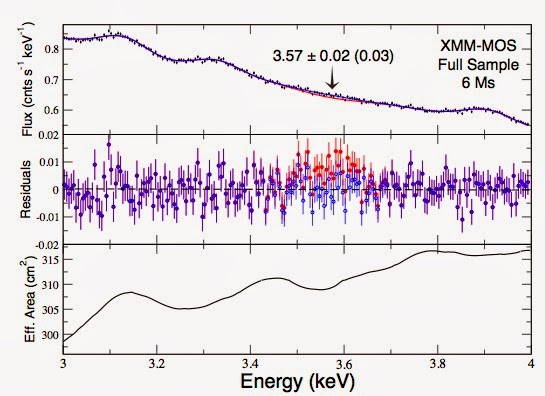
The key graph from that paper is this:

XMMspectrum

The claimed feature – it stretches the imagination considerably to call it a “line” – is shown in red. No, I’m not particularly impressed either, but this is what passes for high-quality data in X-ray astronomy!

There’s a nice review of this from about a year ago here which says this feature

 is very significant, at 4-5 astrophysical sigma.

I’m not sure how to convert astrophysical sigma into actual sigma, but then I don’t really like sigma anyway. A proper Bayesian model comparison is really needed here. If it is a real feature then a plausible explanation is that it is produced by the decay of some sort of dark matter particle in a manner that involves the radiation of an energetic photon. An example is the decay of a massive sterile neutrino – a hypothetical particle that does not participate in weak interactions –  into a lighter standard model neutrino and a photon, as discussed here. In this scenario the parent particle would have a mass of about 7keV so that the resulting photon has an energy of half that. Such a particle would constitute warm dark matter.

On the other hand, that all depends on you being convinced that there is anything there at all other than a combination of noise and systematics. I urge you to read the paper and decide. Then perhaps you can try to persuade me, because I’m not at all sure. The X-ray spectrum of hot gas does have a number of known emission features in it that needed to be subtracted before any anomalous emission can be isolated. I will remark however that there is a known recombination line of Argon that lies at 3.6 keV, and you have to be convinced that this has been subtracted correctly if the red bump is to be interpreted as something extra. Also note that all the spectra that show this feature are obtained using the same instrument – on the XMM/Newton spacecraft which makes it harder to eliminate the possibility that it is an instrumental artefact.

I’d be interested in comments from X-ray folk about how confident we should be that the 3.5 keV “anomaly” is real…

Dark Matter from the Dark Energy Survey

Posted in The Universe and Stuff with tags , , , on April 14, 2015 by telescoper

I’m a bit late onto this story which has already been quite active in the media today, and has generated an associated flurry of activity on social media, but I thought it was still worth passing it on via the medium of this blog. The Dark Energy Survey has just released a number of papers onto the arXiv, the most interesting of which (to me) is entitled Wide-Field Lensing Mass Maps from DES Science Verification Data. The abstract reads as follows (the link was added by me):

Weak gravitational lensing allows one to reconstruct the spatial distribution of the projected mass density across the sky. These “mass maps” provide a powerful tool for studying cosmology as they probe both luminous and dark matter. In this paper, we present a weak lensing mass map reconstructed from shear measurements in a 139 deg^2 area from the Dark Energy Survey (DES) Science Verification (SV) data overlapping with the South Pole Telescope survey. We compare the distribution of mass with that of the foreground distribution of galaxies and clusters. The overdensities in the reconstructed map correlate well with the distribution of optically detected clusters. Cross-correlating the mass map with the foreground galaxies from the same DES SV data gives results consistent with mock catalogs that include the primary sources of statistical uncertainties in the galaxy, lensing, and photo-z catalogs. The statistical significance of the cross-correlation is at the 6.8 sigma level with 20 arcminute smoothing. A major goal of this study is to investigate systematic effects arising from a variety of sources, including PSF and photo-z uncertainties. We make maps derived from twenty variables that may characterize systematics and find the principal components. We find that the contribution of systematics to the lensing mass maps is generally within measurement uncertainties. We test and validate our results with mock catalogs from N-body simulations. In this work, we analyze less than 3% of the final area that will be mapped by the DES; the tools and analysis techniques developed in this paper can be applied to forthcoming larger datasets from the survey.

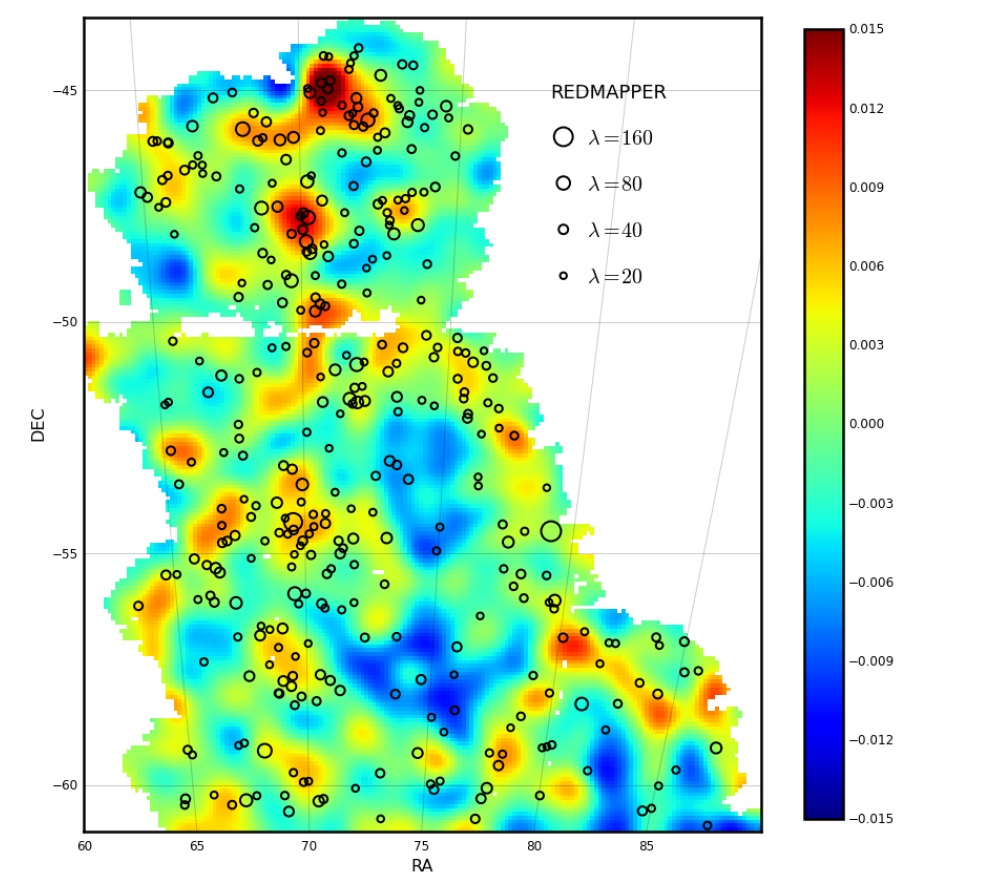
This is by no means a final result from the Dark Energy Survey, as it was basically put together in order to test the telescope, but it is interesting from the point of view that it represents a kind of proof of concept. Here is one of the key figures from the paper which shows a reconstruction of the mass distribution of the Universe (dominated by dark matter) obtained indirectly by the Dark Energy Survey using distortions of galaxy images produced by gravitational lensing by foreground objects, onto which the positions of large galaxy clusters seen in direct observations have been plotted. Although this is just a small part of the planned DES study (it covers only 0.4% of the sky) it does seem to indicate that the strong concentrations of dark matter (red) do corrrelate with the positions of concentrations of galaxy clusters.

DES_MAP

It all seems to work, so hopefully we can look forward to lots of interesting science results in future!

P.S. When I first saw the map it looked like a map of the North of England Midlands and I was surprised to see that the survey showed such strong support for the Greens…

That Big Black Hole Story

Posted in The Universe and Stuff with tags , , , , , , , , on February 28, 2015 by telescoper

There’s been a lot of news coverage this week about a very big black hole, so I thought I’d post a little bit of background.  The paper describing the discovery of the object concerned appeared in Nature this week, but basically it’s a quasar at a redshift z=6.30. That’s not the record for such an object. Not long ago I posted an item about the discovery of a quasar at redshift 7.085, for example. But what’s interesting about this beastie is that it’s a very big beastie, with a central black hole estimated to have a mass of around 12 billion times the mass of the Sun, which is a factor of ten or more larger than other objects found at high redshift.

Anyway, I thought perhaps it might be useful to explain a little bit about what difficulties this observation might pose for the standard “Big Bang” cosmological model. Our general understanding of galaxies form is that gravity gathers cold non-baryonic matter into clumps  into which “ordinary” baryonic material subsequently falls, eventually forming a luminous galaxy forms surrounded by a “halo” of (invisible) dark matter.  Quasars are galaxies in which enough baryonic matter has collected in the centre of the halo to build a supermassive black hole, which powers a short-lived phase of extremely high luminosity.

The key idea behind this picture is that the haloes form by hierarchical clustering: the first to form are small but  merge rapidly  into objects of increasing mass as time goes on. We have a fairly well-established theory of what happens with these haloes – called the Press-Schechter formalism – which allows us to calculate the number-density N(M,z) of objects of a given mass M as a function of redshift z. As an aside, it’s interesting to remark that the paper largely responsible for establishing the efficacy of this theory was written by George Efstathiou and Martin Rees in 1988, on the topic of high redshift quasars.

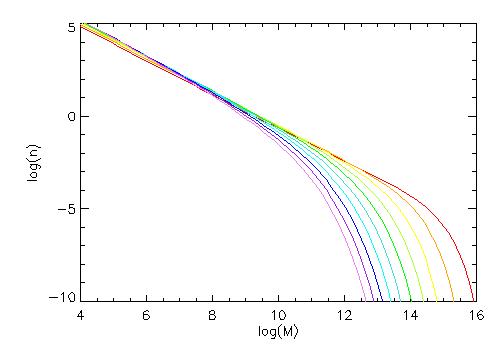
Anyway, this is how the mass function of haloes is predicted to evolve in the standard cosmological model; the different lines show the distribution as a function of redshift for redshifts from 0 (red) to 9 (violet):
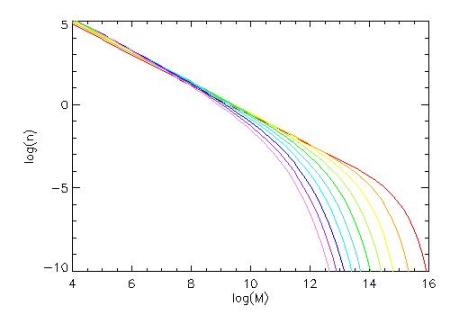
Note   that the typical size of a halo increases with decreasing redshift, but it’s only at really high masses where you see a really dramatic effect. The plot is logarithmic, so the number density large mass haloes falls off by several orders of magnitude over the range of redshifts shown. The mass of the black hole responsible for the recently-detected high-redshift quasar is estimated to be about 1.2 \times 10^{10} M_{\odot}. But how does that relate to the mass of the halo within which it resides? Clearly the dark matter halo has to be more massive than the baryonic material it collects, and therefore more massive than the central black hole, but by how much?

This question is very difficult to answer, as it depends on how luminous the quasar is, how long it lives, what fraction of the baryons in the halo fall into the centre, what efficiency is involved in generating the quasar luminosity, etc.   Efstathiou and Rees argued that to power a quasar with luminosity of order 10^{13} L_{\odot} for a time order 10^{8} years requires a parent halo of mass about 2\times 10^{11} M_{\odot}.  Generally, i’s a reasonable back-of-an-envelope estimate that the halo mass would be about a hundred times larger than that of the central black hole so the halo housing this one could be around 10^{12} M_{\odot}.

You can see from the abundance of such haloes is down by quite a factor at redshift 7 compared to redshift 0 (the present epoch), but the fall-off is even more precipitous for haloes of larger mass than this. We really need to know how abundant such objects are before drawing definitive conclusions, and one object isn’t enough to put a reliable estimate on the general abundance, but with the discovery of this object  it’s certainly getting interesting. Haloes the size of a galaxy cluster, i.e.  10^{14} M_{\odot}, are rarer by many orders of magnitude at redshift 7 than at redshift 0 so if anyone ever finds one at this redshift that would really be a shock to many a cosmologist’s  system, as would be the discovery of quasars with such a high mass  at  redshifts significantly higher than seven.

Another thing worth mentioning is that, although there might be a sufficient number of potential haloes to serve as hosts for a quasar, there remains the difficult issue of understanding precisely how the black hole forms and especially how long it takes to do so. This aspect of the process of quasar formation is much more complicated than the halo distribution, so it’s probably on detailed models of  black-hole  growth that this discovery will have the greatest impact in the short term.
Dark Matter from the Sun?

Posted in The Universe and Stuff with tags , , , , , , , on October 16, 2014 by telescoper

This afternoon while I was struggling to pay attention during one of the presentations at the conference I’m at, when I noticed a potentially interesting story going around on Twitter. A little bit of research revealed that it relates to a paper on the arXiv, with the title Potential solar axion signatures in X-ray observations with the XMM-Newton observatory by Fraser et al. The first author of this paper was George Fraser of the University of Leicester who died the day after it was submitted to Monthly Notices of the Royal Astronomical Society. The paper has now been accepted and the final version has appeared on the arXiv in advance of its publication on Monday. The Guardian has already run a story on it.

This is the abstract:

The soft X-ray flux produced by solar axions in the Earth’s magnetic field is evaluated in the context of ESA’s XMM-Newton observatory. Recent calculations of the scattering of axion-conversion X-rays suggest that the sunward magnetosphere could be an observable source of 0.2-10 keV photons. For XMM-Newton, any conversion X-ray intensity will be seasonally modulated by virtue of the changing visibility of the sunward magnetic field region. A simple model of the geomagnetic field is combined with the ephemeris of XMM-Newton to predict the seasonal variation of the conversion X-ray intensity. This model is compared with stacked XMM-Newton blank sky datasets from which point sources have been systematically removed. Remarkably, a seasonally varying X-ray background signal is observed. The EPIC count rates are in the ratio of their X-ray grasps, indicating a non-instrumental, external photon origin, with significances of 11(pn), 4(MOS1) and 5(MOS2) sigma. After examining the constituent observations spatially, temporally and in terms of the cosmic X-ray background, we conclude that this variable signal is consistent with the conversion of solar axions in the Earth’s magnetic field. The spectrum is consistent with a solar axion spectrum dominated by bremsstrahlung- and Compton-like processes, i.e. axion-electron coupling dominates over axion-photon coupling and the peak of the axion spectrum is below 1 keV. A value of 2.2e-22 /GeV is derived for the product of the axion-photon and axion-electron coupling constants, for an axion mass in the micro-eV range. Comparisons with limits derived from white dwarf cooling may not be applicable, as these refer to axions in the 0.01 eV range. Preliminary results are given of a search for axion-conversion X-ray lines, in particular the predicted features due to silicon, sulphur and iron in the solar core, and the 14.4 keV transition line from 57Fe.

The paper concerns a hypothetical particle called the axion and I see someone has already edited the Wikipedia page to mention this new result. The idea of the axion has been around since the 1970s, when its existence was posited to solve a problem with quantum chromodynamics, but it was later realised that if it had a mass in the correct range it could be a candidate for the (cold) dark matter implied to exist by cosmological observations. Unlike many other candidates for cold dark matter, which experience only weak interactions, the axion feels the electromagnetic interaction, despite not carrying an electromagnetic charge. In particular, in a magnetic field the axion can convert into photons, leading to a number of ways of detecting the particle experimentally, none so far successful. If they exist, axions are also expected to be produced in the core of the Sun.

This particular study involved looking at 14 years of X-ray observations in which there appears to be an unexpected seasonal modulation in the observed X-ray flux which could be consistent with the conversion of axions produced by the Sun into X-ray photons as they pass through the Earth’s magnetic field. Here is a graphic I stole from the Guardian story:

axions

Conversion of axions into X-rays in the Earth’s magnetic field. Image Credit: University of Leicester

I haven’t had time to do more than just skim the paper so I can’t comment in detail; it’s 67 pages long. Obviously it’s potentially extremely exciting but the evidence that the signal is produced by axions is circumstantial and one would have to eliminate other possible causes of cyclical variation to be sure. The possibilities that spring first to mind as an alternatives to the axion hypothesis relate to the complex interaction between the solar wind and Earth’s magnetosphere. However, if the signal is produced by axions there should be characteristic features in the spectrum of the X-rays produced that would appear be very difficult to mimic. The axion hypothesis is therefore eminently testable, at least in principle, but current statistics don’t allow these tests to be performed. It’s tantalising, but if you want to ask me where I’d put my money I’m afraid I’d probably go for messy local plasma physics rather than anything more fundamental.

It seems to me that this is in some sense a similar situation to that of BICEP2: a potentially exciting discovery, which looks plausible, but with alternative (and more mundane) explanations not yet definitively ruled out. The difference is of course that this “discovery paper” has been refereed in the normal way, rather than being announced at a press-conference before being subjected to peer review…

Talking About Undergraduate Physics Research…

Posted in Education, The Universe and Stuff with tags , , , , , , , on July 2, 2014 by telescoper

One of the courses we offer in the School of Physics & Astronomy here at the University of Sussex is the integrated Masters in Physics with a Research Placement. Aimed at high-flying students with ambitions to become research physicists, this programme includes a paid research placement as a Junior Research Associate each summer vacation for the duration of the course; that means between Years 1 & 2, Years 2 & 3 and Years 3 & 4 . This course has proved extremely attractive to a large number of very talented students and it exemplifies the way the Department of Physics & Astronomy integrates world-class research with its teaching in a uniquely successful and imaginative way.

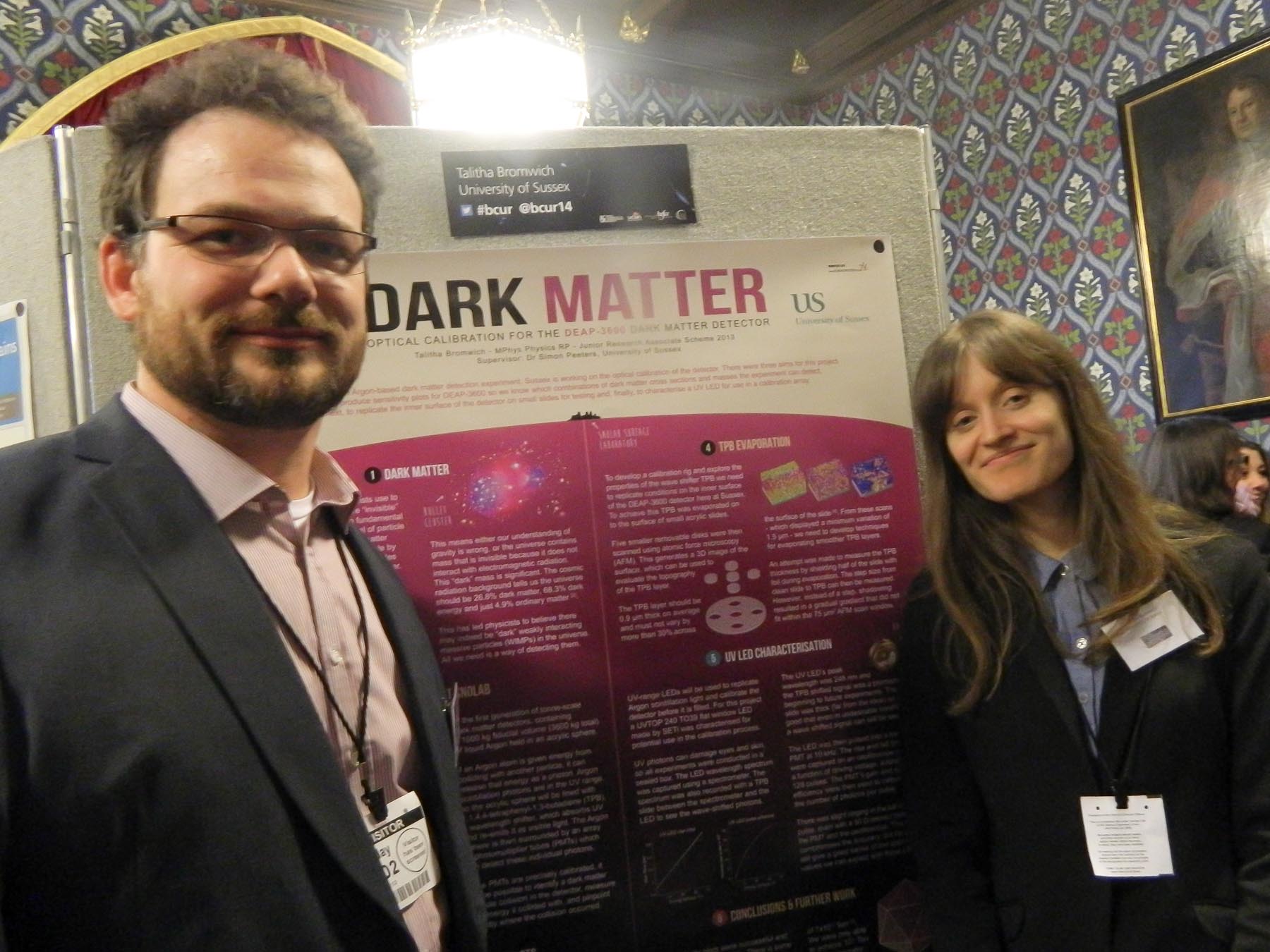
Some time ago I blogged about  some very good news about one of our undergraduate researchers, Talitha Bromwich, who is about to graduate from her MPhys degree, after which she will be heading to Oxford to start her PhD DPhil; she is pictured below with her supervisor Dr Simon Peeters:

Talitha Bromwich with her JRA supervisor Dr Simon Peeters at 'Posters in Parliament' event 25 Feb 14

Talitha spent last summer working on the DEAP3600 dark-matter detector after being selected for the University’s Junior Research Associate scheme. Her project won first prize at the University’s JRA poster exhibition last October, and she was then chosen to present her findings – alongside undergraduate researchers from 22 other universities – in Westminster yesterday as part of the annual Posters in Parliament exhibition, organized under the auspices of the British Conference of Undergraduate Research (BCUR).

A judging panel – consisting of Ben Wallace MP, Conservative MP for Wyre and Preston North; Sean Coughlan, Education Correspondent for the BBC; and Professor Julio Rivera, President of the US Council of Undergraduate Research; and Katherine Harrington of the Higher Education Academy – decided to award Talitha’s project First Prize in this extremely prestigious competition.

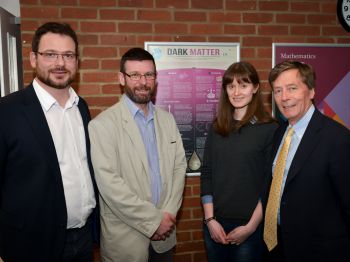
We held a small drinks party in the School of Mathematical and Physical Sciences to congratulate Talitha on her success. Here are a couple of pictures of that occasion:

3479.item

From left to right you see Simon Peeters, myself, Talitha and Prof. Michael Farthing (the Vice Chancellor of the University of Sussex); the winning poster is in the background. Here’s me presenting a little gift:

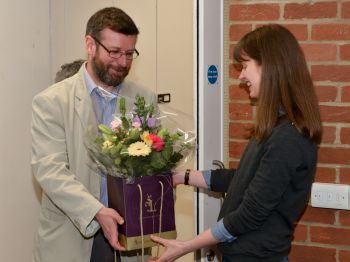
3478.item

More recently still, the MPS Elves have made a little video featuring Talitha talking about her research placement:

We take undergraduate research very seriously here at the University of Sussex, and are now extending the Research Placement scheme to Mathematics. Many Departments talk about how important it is that their teaching is based on state-of-the-art research, but here at Sussex we don’t just talk about research to undergraduates – we let them do it!


Sussex University – the Place for Undergraduate Physics Research!

Posted in Education, The Universe and Stuff with tags , , , , , , , on February 27, 2014 by telescoper

One of the courses we offer in the School of Physics & Astronomy here at the University of Sussex is the integrated Masters in Physics with a Research Placement. Aimed at high-flying students with ambitions to become research physicists, this programme includes a paid research placement as a Junior Research Associate each summer vacation for the duration of the course; that means between Years 1 & 2, Years 2 & 3 and Years 3 & 4 . This course has proved extremely attractive to a large number of very talented students and it exemplifies the way the Department of Physics & Astronomy integrates world-class research with its teaching in a uniquely successful and imaginative way.

Here’s a little video made by the University that features Sophie Williamson, who is currently in her second year (and who also in the class to whom I’m currently teaching a module on Theoretical Physics:

This week we had some very good news about another of our undergraduate researchers, Talitha Bromwich, who is now in the final year of her MPhys degree, and is pictured below with her supervisor Dr Simon Peeters:

Talitha Bromwich with her JRA supervisor Dr Simon Peeters at 'Posters in Parliament' event 25 Feb 14

Talitha spent last summer working on the DEAP3600 dark-matter detector after being selected for the University’s Junior Research Associate scheme. Her project won first prize at the University’s JRA poster exhibition last October, and she was then chosen to present her findings – alongside undergraduate researchers from 22 other universities – in Westminster yesterday as part of the annual Posters in Parliament exhibition, organized under the auspices of the British Conference of Undergraduate Research (BCUR).

A judging panel – consisting of Ben Wallace MP, Conservative MP for Wyre and Preston North; Sean Coughlan, Education Correspondent for the BBC; and Professor Julio Rivera, President of the US Council of Undergraduate Research; and Katherine Harrington of the Higher Education Academy – decided to award Talitha’s project First Prize in this extremely prestigious competition.

Congratulations to Talitha for her prizewinning project! I’m sure her outstanding success will inspire future generations of Sussex undergraduates too!

Lux et Veritas

Posted in The Universe and Stuff with tags , , , , on October 31, 2013 by telescoper

There’s an important and interesting paper just out on the arxiv by the Lux Dark Matter Collaboration. Here is the abstract:

The Large Underground Xenon (LUX) experiment, a dual-phase xenon time-projection chamber operating at the Sanford Underground Research Facility (Lead, South Dakota), was cooled and filled in February 2013. We report results of the first WIMP search dataset, taken during the period April to August 2013, presenting the analysis of 85.3 live-days of data with a fiducial volume of 118 kg. A profile-likelihood analysis technique shows our data to be consistent with the background-only hypothesis, allowing 90% confidence limits to be set on spin-independent WIMP-nucleon elastic scattering with a minimum upper limit on the cross section of 7.6×10−46 cm2 at a WIMP mass of 33 GeV/c2. We find that the LUX data are in strong disagreement with low-mass WIMP signal interpretations of the results from several recent direct detection experiments.

For those of you not up with the lingo, a WIMP in this context is a Weakly Interacting Massive Particle, one of the preferred candidates for the dark matter that most cosmologists think pervades the Universe.

The most important thing about the LUX results is that they pretty much exclude results from previous experiments, especially DAMA/LIBRA, that have claimed evidence for dark matter particles at low mass (i.e. 6-10 GeV WIMPS): LUX had expected 1550 dark matter events if the other detections were valid, but could not claim any events that were not consistent with background. They also set new limits on higher mass dark matter, which is 20 times better than previous limits. These new limits are from 85 days of running the experiment; further results will be reported after an additional 300 days in 2014/2015, when the results will increase the sensitivity by a factor of five or so.

So the question is, if LUX is correct, what on Earth is going on at DAMA? Answers on a postcard, or through the comments box, please!

Cosmic Swirly Straws Feed Galaxy

Posted in The Universe and Stuff with tags , , , , , on June 5, 2013 by telescoper

I came across this video on youtube and was intrigued because the title seemed like a crossword clue (to which I couldn’t figure out the answer). It turns out that it goes with a piece in the Guardian which describes a computer simulation showing the formation of a galaxy during the first 2bn years of the Universe’s evolution. Those of us interested in cosmic structures on a larger scale than galaxies usually show such simulations in co-moving coordinates (i.e. in a box that expands at the same rate as the Universe), but this one is in physical coordinates showing the actual size of the objects therein; the galaxy is seen first to condense out of the expanding distribution of matter, but then grows by accreting matter in a complicated and rather beautiful way.

This calculation includes gravitational and hydrodynamical effects, allowing it to trace the separate behaviour of dark matter and gas (predominantly hydrogen).  You can see that this particular object forms very early on; the current age of the Universe is estimated to be about 13 – 14 billion years. When we look far into space using very big telescopes we see objects from which light has taken billion of years to reach us. We can therefore actually see galaxies as they were forming and can therefore test observationally whether they form as theory (and simulation) suggest.

Dark Matter from AMS? Not really…

Posted in The Universe and Stuff with tags , on April 4, 2013 by telescoper

Here’s a refreshingly hard-nosed take on the recently-announced results from the Alpha Muon Spectrometer (which were rather excessively hyped, in my opinion…)

Matt Strassler's avatarOf Particular Significance

The Alpha Magnetic Spectrometer [AMS] finally reported its first scientific results today. AMS, a rather large particle physics detector attached to the International Space Station, is designed to study the very high-energy particles found flying around in outer space. These “cosmic rays” (as they are called, for historical reasons) have been under continuous study since their discovery a century ago, but they are still rather mysterious, and we continue to learn new things about them. They are known to be of various different types — commonly found objects such as photons, electrons, neutrinos, protons, and atomic nuclei, and less common ones like positrons (antiparticles of electrons) and anti-protons.  They are known to be produced by a variety of different processes. It is quite possible that some of these high-energy particles come from physical or astronomical processes, perhaps very exciting ones, that we have yet to discover. And…

View original post 1,518 more words