Archive for Dead of Night

Dead of Night

Posted in Film, The Universe and Stuff with tags , , , on June 6, 2022 by telescoper

Last week I was chatting to one of my colleagues about old films, particularly those made in the immediate post-war years by Ealing Studios. Nowadays this film production company is most strongly associated with superb comedy films, including such classics as Passport to Pimlico, Whisky Galore, The Ladykillers and The Lavender Hill Mob among many more. But there was more to Ealing Studios than the Ealing Comedies. During the war the company was involved in making propaganda films to help with the war effort, most of which are now forgettable but at least one, Went the Day Well, about people in an English village attempting to resist ruthless German paratroopers, is genuine shocking to this day because of its unusually frank depiction (for the time) of brutality and violence in a normally tranquil and familiar setting. The image of Thora Hird taking on the invaders with a Lee Enfield rifle is one that stays in my mind.

Horror films were banned during the War but in 1945 Ealing Studios released one which was to become enormous influential in the genre and which holds up extremely well to this day. As a matter of fact, I watched it again, for the umpteenth time, last night.
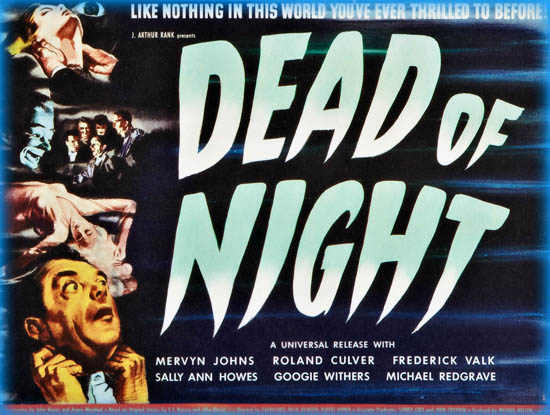
I’ve actually blogged about a bit of this film before. There is a sequence (to me by far the scariest in the  film) about a ventriloquist (played by Michael Redgrave) who is gradually possessed by his evil dummy which came up in a post I did about Automatonophobia many moons ago.

Anyway, you only have to watch Dead of Night to watch it to appreciate why it its held in such high regard by critics to this day. Indeed you can see ideas in it which have been repeated in a host of subsequent (and usually inferior) horror flicks. I’m not going to spoil it by saying too much about the plot. I would say though that it’s basically a portmanteau film, i.e. a series of essentially separate stories (to the extent of having a different director for each such segment) embedded within an overall narrative. It also involves an intriguing plot device similar to those situations in which you are dreaming, but in the dream you wake up and don’t know whether you’re actually awake or still dreaming.

In this film the architect Walter Craig arrives at a country cottage, is greeted by his host Elliot Foley who has invited him to discuss possible renovations of the property. He is shown into a room with several other guests. Despite apparently never having been to the property before it seems strangely familiar and despite never having met the guests before he says he has seen them all in a recurring dream. One by one the guests recount strange stories. When they’ve all had their turn the film reaches a suitably nightmarish ending but Craig then wakes up in bed at home and realizes it was all a dream. Then the phone rings and it’s Elliot Foley inviting him to his country cottage to discuss possible renovations. The film ends with Craig arriving at the cottage just as he did at the start of the film.

Here is the trailer:

It’s the “dream-within-a-dream” structure (presumably repeated forever) – what physicists would call a self-similar hierarchy – of the overall framework of this movie that gives it its particular interest from the point of view of this blog, because it played an important role in the evolution of theoretical cosmology. One evening in 1946 the mathematicians and astrophysicts Fred Hoyle, Hermann Bondi and Tommy Gold went to see Dead of Night in Cambridge. Discussing the film afterwards they came up with the idea of the steady state cosmology, the first scientific papers about which were published in 1948. For the best part of two decades this theory was a rival to the now-favoured “Big Bang” (a term coined by Fred Hoyle which was intended to be a derogatory description of the opposing theory).

In the Big Bang theory there is a single “creation event”, so this particular picture of the Universe has a definite beginning, and from that point the arrow of time endows it with a linear narrative. In the steady state theory, matter is created continuously in small bits (via a hypothetical field called the C-field) so the Universe has no beginning and its time evolution not unlike that of the film.

Modern cosmologists sometimes dismiss the steady state cosmology as a bit of an aberration, a distraction from the One True Big Bang but it was undeniably a beautiful theory. The problem was that so many of its proponents refused to accept the evidence that they were wrong.  Supporters of  disfavoured theories rarely change their minds, in fact. The better theory wins out because younger folk tend to support it, while the recalcitrant old guard defending  theirs in spite of the odds eventually die out.

And another thing. If Fred Hoyle had thought of it he might have  called the field responsible for creating matter a scalar field, rather than the C-field, and it would now be much more widely recognized that he (unwittingly) invented many elements of modern inflationary cosmology. In fact, in some versions of inflation the Universe as a whole is very similar to the steady state model, only the continuous creation is not of individual particles or atoms, but of entire Big-Bang “bubbles” that can grow to the size of our observable Universe. So maybe the whole idea was actually right after all..

Dead of Night

Posted in The Universe and Stuff with tags , , , , , , , on January 22, 2012 by telescoper

It not being possible to watch Match of the Day last night – I didn’t particularly want to watch the horror story of Newcastle’s 5-2 drubbing by Fulham – I rummaged around in my stack of DVDs of old films and came up with Dead of Night. I was actually very happy to have the excuse  to watch this classic British horror film for the umpteenth time. I’ve actually blogged about a bit of this film before. There is a sequence (to me by far the scariest in the  film) about a ventriloquist who is gradually possessed by his evil dummy which came up in a post I did about Automatonophobia some time ago.

Anyway, Dead of Night was made in 1945 by Ealing Studios and you only have to watch it to appreciate why it its held in such high regard by critics to this day. Indeed you can see ideas in it which have been repeated in a host of subsequent (and usually inferior) horror flicks. I’m not going to spoil it by saying too much about the plot. I’m sure there are many (younger) readers who have never heard of this wonderful film and I don’t want to spoil their enjoyment of it by giving away too much. I would say though that it’s basically a portmanteau film, i.e. a series of essentially separate stories (to the extent of having a different director for each such segment) embedded within an overall narrative. It also involves an intriguing plot device similar to those situations in which you are dreaming, but in the dream you wake up and don’t know whether you’re actually awake or still dreaming…

Anyway, you can watch the whole film on Youtube if you like but you have to keep clicking through the different sections used to be able to watch it on Youtube, but it’s sadly now been removed

It’s the “dream-within-a-dream” structure – what physicists would call a self-similar hierarchy – of the overall framework of this movie that gives it its particular interest from the point of view of this blog, because it played an important role in the evolution of theoretical cosmology. One evening in 1946 the mathematicians and astrophysicts Fred Hoyle, Hermann Bondi and Tommy Gold went to see Dead of Night in Cambridge. Discussing the film afterwards they came up with the idea of the steady state cosmology, the first scientific papers about which were published in 1948. For the best part of two decades this theory was a rival to the now-favoured “Big Bang” (a term coined by Fred Hoyle which was intended to be a derogatory description of the opposing theory).

In the Big Bang theory there is a single “creation event”, so this particular picture of the Universe has a definite beginning, and from that point the arrow of time endows it with a linear narrative. In the steady state theory, matter is created continuously in small bits (via a hypothetical field called the C-field) so the Universe has no beginning and its time evolution not unlike that of the film.

Modern cosmologists sometimes dismiss the steady state cosmology as a bit of an aberration, a distraction from the One True Big Bang but it was undeniably a beautiful theory. The problem was that so many of its proponents refused to accept the evidence that they were wrong.  Supporters of  disfavoured theories rarely change their minds, in fact. The better theory wins out because younger folk tend to support it, while the recalcitrant old guard defending  theirs in spite of the odds eventually die out.

And another thing. If Fred Hoyle had thought of it he might have  called the field responsible for creating matter a scalar field, rather than the C-field, and it would now be much more widely recognized that he (unwittingly) invented many elements of modern inflationary cosmology. In fact, in some versions of inflation the Universe as a whole is very similar to the steady state model, only the continuous creation is not of individual particles or atoms, but of entire Big-Bang “bubbles” that can grow to the size of our observable Universe. So maybe the whole idea was actually right after all..

Automatonophobia

Posted in Biographical with tags , , , on October 25, 2009 by telescoper

OK. I admit it. I’m  automatonophobic.

I don’t think I have many irrational fears. I don’t like snakes, and am certainly a bit frightened of them, but there’s nothing irrational about that. They’re nasty and likely to be poisonous. I don’t like slugs either, especially when they eat things in my garden. They’re unpleasant but easy to deal with and I’m not at all scared of them. Likewise spiders and insects.

But  ventriloquists’ dummies give me nightmares every time.

 When I was a little boy my grandfather took me to the Spanish City in Whitley Bay. There was an amusement arcade there and one of the attractions was thing called   The Laughing Sailor. You put a penny in the slot and a hideous  automaton  – very similar to the dummy a ventriloquist might use, except in mock-nautical attire – began to lurch backwards and forwards, flailing its arms, staring maniacally and emitting a loud mechanical cackle that was supposed to represent a laugh. The minute it started doing its turn I burst into tears and ran screaming out of the building. I’ve hated such things ever since.

The anxiety that these objects induce has now been given a name: automatonophobia, which is defined as “a persistent, abnormal, and unwarranted fear of ventriloquist’s dummies, animatronic creatures or wax statues”. Abnormal? No way. They’re simply horrible.

I’m clearly not the only one who thinks so, because there was an article in The Independent a few years ago by Neil Norman that exactly expressed the fear and loathing I feel about these creepy little dolls. Feature films  including Magic and Dead of Night, and episodes of The Twilight Zone and Hammer House of Horror have taken it further by playing with the idea that  a ventriloquist’s dummy has been possessed by some sort of malign power which  uses it to wreak terror on those around.

 We’re not talking about a benign wooden doll like Pinocchio who metamorphoses into a real boy; we’re talking about a ghastly staring-faced mannequin that is brought to life by its operator, the ventriloquist,  by inserting his hand up its backside. The dummy never looks human, but can speak and displays some human traits, usually nasty ones. The essence of a ventriloquist act is to generate the illusion  that one is watching two personalities sparring with each other when in reality the two voices are coming from the same person. Schizophrenia here we come.

It must be very clever to be able to throw your voice,  but I always had the nagging suspicion that ventriloquists use dummies to express the things they find it difficult to say through their own mouth, and so to give life to their darkest thoughts. 

Best of all the attempts to realise the sinister potential of this relationship in a movie is the “Ventriloquist’s Dummy” episode, directed by Alberto Cavalcanti, in Dead of Night, the 1945 portmanteau that some regard as Britain’s greatest horror film. Here is the part that tells  the tale of Michael Redgrave’s ventriloquist being sweatily possessed by the spirit of his malevolent dummy, Hugo. It’s old and creaky, but I find it absolutely terrifying.

So what is it about these man-child mannequins – they are always male – that makes them so creepy? First, there is their appearance: the mad, swivelling, psychotic eyes beneath arched eyebrows and that crude parody of a mouth (with painted teeth) that opens and shuts with a mechanical sound like a trap. Then there are the badly articulated limbs,  like those of a dead thing. When at rest,  their eyes remain open, their mouths fixed in a diabolic grimace. Moreover, with their rouged cheeks, lurid red lips and unnatural eyelashes, all ventriloquist’s dummies look like the badly embalmed corpses of small boys. And they always end up sitting on the knee of a horrible pervert.  Necrophilia and paedophilia all in one sick package. Yuck.

Worst of all, perhaps, is the voice. The high-pitched squawk that emerges is one of the most unpleasant sounds a human being can make. Even if you find it tolerable when you know that it comes from the ventriloquist, the last thing you want  is the dummy to start talking on its own.

I started writing this with the cathartic intention of exorcising the demon that appears whenever I see one of these wretched things. It didn’t work. However, I have now decided to take my mind off this track with a change of thread. Here’s a little quiz. I wonder if anyone can spot the connection between this post and the history of cosmology?

Alternatively, if you’re brave, you could try a bit of catharsis of your own and reveal your worst phobias through the comments box…