Archive for Dmitri Shostakovich

Clyne, Tchaikovsky and Shostakovich at the National Concert Hall

Posted in Biographical, Music with tags , , , , , , , , on October 18, 2025 by telescoper

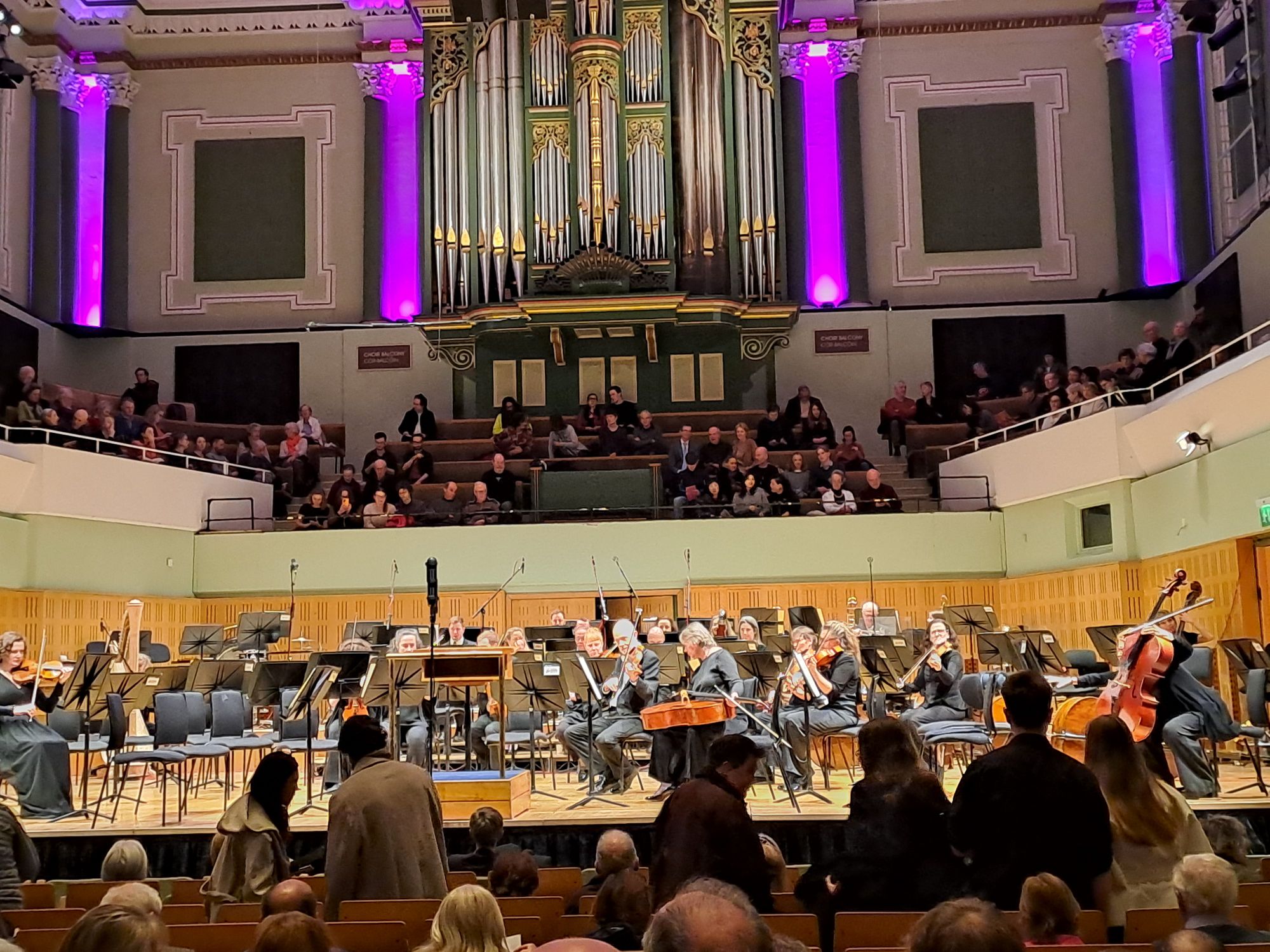
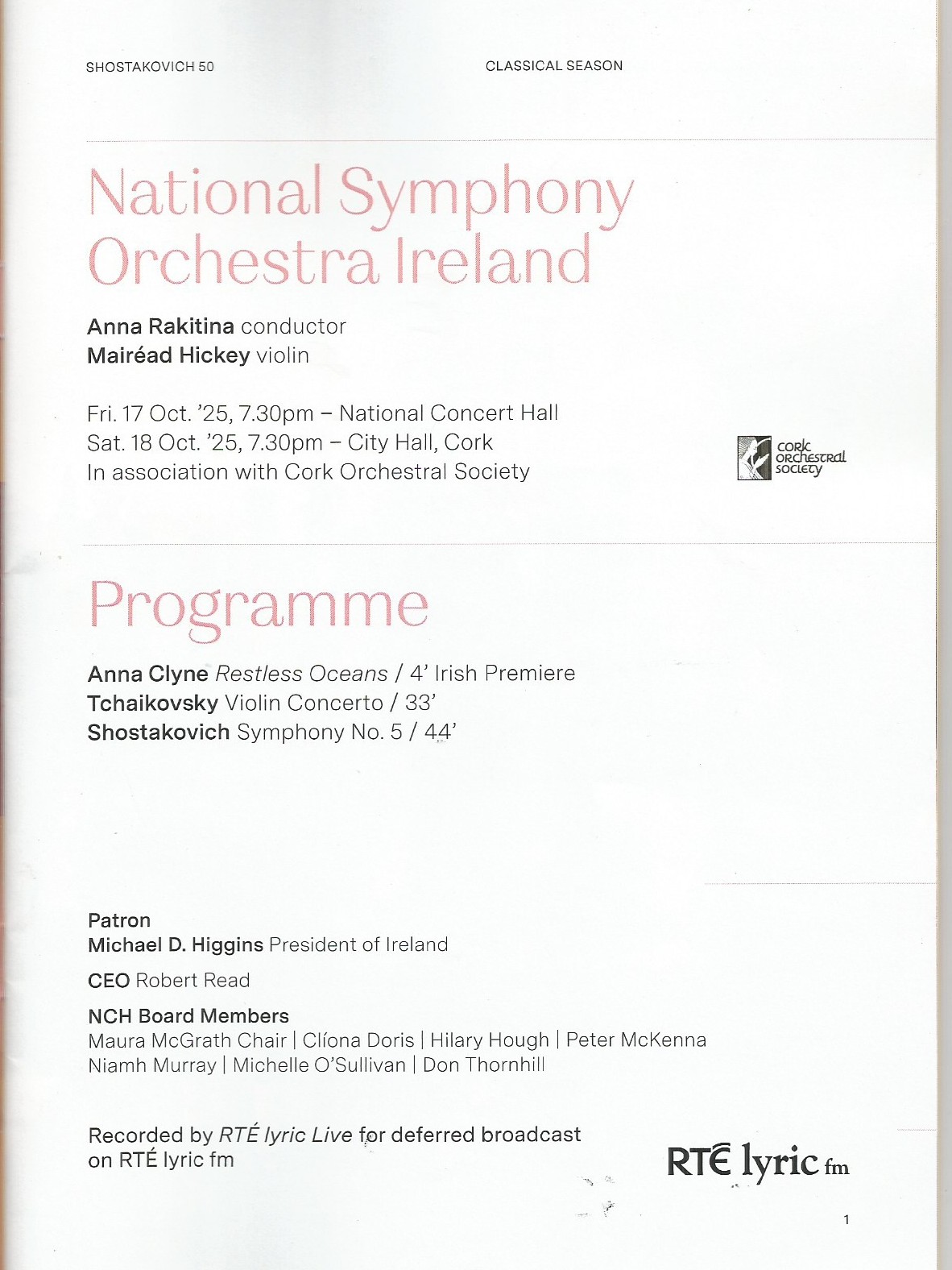
It had been over a month since my last visit to the National Concert Hall in Dublin so I was happy to be able to attend this week’s Friday night concert last night. It was great to see that the venue was very full too. I think that was at least partly down to the fact that one of the pieces featured Irish violinist Mairéad Hickey who has a sizeable local following. Conductor for the evening with National Symphony Orchestra Ireland was Anna Rakitina (who was born in Russia).

The concert began with a short piece by Anna Clyne called Restless Oceans. This is an energetic and an excellent way to get the orchestra revved up for the rest of the evening. I’d never heard this work before and I think it must be the first time I’ve seen a performance in which the string section sang or hummed a wordless accompaniment in one part and, in another, the whole orchestra provided extra percussion by stamping their feet.

After that zesty appetiser, Mairéad Hickey appeared on stage, resplendent in a green dress, to perform the first course proper, the Violin Concerto by Pyotr Ilyich Tchaikovsky. This is a familiar work but it was ravishingly played by Mairéad Hickey, who seem to revel in the virtuosic elements of this work, as well as bringing out the lyricism in the more romantic passages. The only things I don’t like about this composition are the gratuitously showy cadenzas which go on far too long, in my opinion. The audience clearly loved the performance, though, as did I, and we were treated to an encore in the form of some traditional Irish fiddle playing which was lovely.

After the wine break, we had the main dish for the evening, the Symphony No. 5 by Dmitri Shostakovich. This is a very famous work and one of the higlights of the entire symphonic repertoire. It is also perhaps the most accessible of all the Shostakovich symphonies. It was an immediate success with Soviet critics and public alike when it was first performed in 1937, and though it marked Shostakovich’s return to favour with the authorities after his denunciation by Stalin, this work has the composer’s very characteristic sense of things not being quite as they seem on the surface. Indeed, in this and many other of his compositions, seems to manage to say one thing at the same time as saying the exact opposite of that thing; nowadays this might be called `constructive ambiguity’. This is especially true in the finale, in which the sense of triumph it ostensibly portrays seems rather forced, so it approaches a parody of itself. This tension between possible interpretations gives the piece a palpable sense of danger.

Overall the Fifth Symphony is a sombre work, the dark undertone established right at the start with an imposing theme on the cellos and double basses, but it has passages of great beauty too, especially in the slow third movement. Like all great symphonies – and this is one of the greatest – it takes you on a journey full of of excitement and interest. It was a compelling performance by the NSOI, with outstanding playing by the whole orchestra, but especially the woodwinds.The 45 minutes or so of this performance seemed to fly by. It’s ending ending was greeted with rapturous applause and a standing ovation from many in the audience.

It’s interesting to consider that only 60 years had elapsed between the composition of these pieces by Tchaikovsky and Shostakovich, but what different musical worlds they represent!

Shostakovich 50 at the National Concert Hall

Posted in Uncategorized with tags , , , , , , , , on May 10, 2025 by telescoper

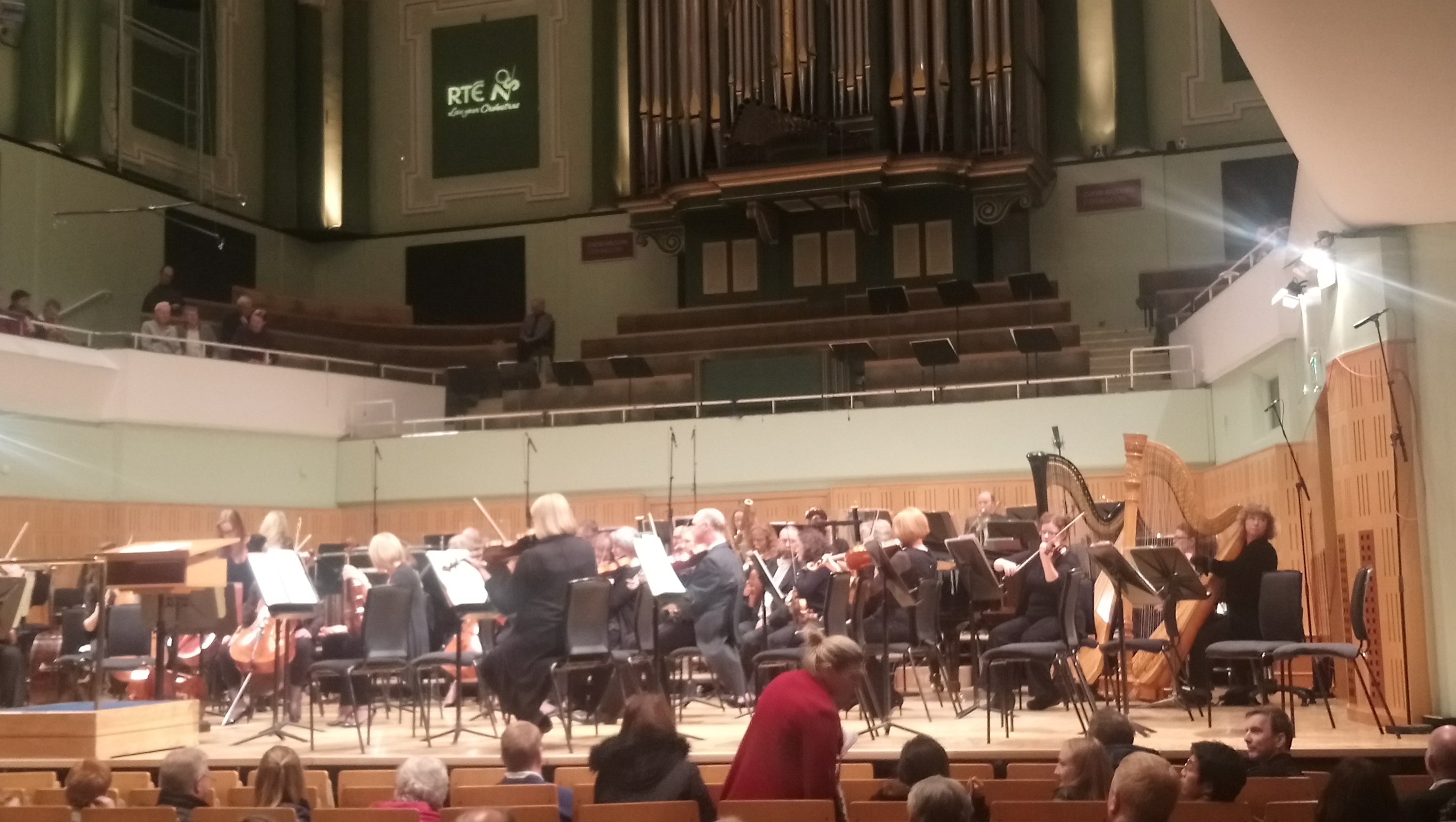
Last night’s concert at the National Concert Hall in Dublin was billed Shostakovich 50 because 2025 marks the 50th anniversity of the death in 1975 of Dmitri Shostakovich, whose First Symphony was performed after the interval, by the National Symphony Orchestra under the direction of guest conductor John Storgårds. As you can see, though, the programme was quite varied and no fewer than three other composers were represented.

The first piece was The Oceanides, tone poem by Jean Sibelius intended to evoke the sea nymphs of Greek mythology. It’s quite a short piece – only eleven minutes in performance – but full of movement, suggesting the ebb-and-flow of the sea and its different moods, from tranquil to stormy. Its place on the programme made it a good workout for the orchestra and a wonderful starter to whet their appetite of the audience for the rest of the menu.

After that appetizer we had a performance of the Rhapsody on a Theme by Paganini by Sergei Rachmaninov with soloist Yukine Kuroki at the piano. This piece comprises a set of 24 variations on a them from one of Paganini’s caprices for solo violin. The Rhapsody on a theme of Paganini is piece full of contrasts: sometimes pyrotechnical, sometimes lyrical. My favourite section is the 18th variation, in which a lovely romantic melody emerges and is picked up by the whole orchestra in a manner that’s very characteristic of Rachmaninov. This tune is just an inversion of the theme transposed into a different  key and slowed down.

The Rachmaninov alone was worth the cost of the ticket. I was amazed how pianist Yukine Kuroki coped with the technical challenges of this work but also how she managed to generate so much power for a person of such slight build. Rachmaninov himself was quite a large man who had hands like shovels, so his work often places difficult demands on a soloist. Not last night, though, as Yukine Kuroki not only played with great accomplishment but also clearly enjoyed herself. In the passages during which the piano was not playing she was bouncing up and down and tapping her feet waiting for her cue. It was lovely to watch as well as to listen to. I’ll also mention that she was wearing a gorgeous one-shoulder dress with a vivid red colour.

After the wine break interval we returned for a piece that was new to me, the Symphony No. 3 ‘White Interment’ by Ukrainian composer Victoria Vita Polyova. This is described a symphony, but it doesn’t have the traditional structure in terms of movements. It has instead a rather static structure, consisting of thematic blocks based on a poem Now always snows. It’s a sombre and rather minimalist piece, with little of the development you would expect from a true symphony, but the sound world it creates is layered in interesting ways. I enjoyed the performance.

And finally we have the Symphony No. 1 by Dmitri Shostakovich which I don’t think I had heard in concert before. The most astonishing thing about this work was that he wrote it as a graduation piece for the St Petersburg Conservatory. Its first performance was in 1926, when the composer was only 19. It is a substanial work over four movements (the last two played without interruption) and there are passages within it in which you can see that he had already found much of the distinct voice that he used in his later compositions. This piece isn’t really reminiscent of any other composers, either.

The performance was excellent, with particularly strong work by the woodwinds and brass. It was very well received by the NCH audience which is always very generous with its applause.

Shostakovich – The Leningrad Symphony

Posted in History, Music with tags , , , on October 27, 2018 by telescoper

I don’t know. You wait 50-odd years for the opportunity to hear a live performance of Symphony No. 7 in C by Dmitri Shostakovich, and then two come along within a year. It was last November in Cardiff that I first heard this epic work in concert, and last night I was at the National Concert Hall in Dublin where it was performed by the RTÉ National Symphony Orchestra conducted by Stanislav Kochanovsky.

The first half of last night’s concert featured two works by Dmitry Kabalevesky (a contemporary of Shostakovich): his overture to the Opera Colas Breugnon and is Cello Concerto No. 1 with soloist Richard Harwood. Both of these were pleasant enough but I (and, I think, most of the rest of the audience) had their minds firmly on the main event to come after the interval.

The Leningrad Symphony is a piece that evokes particular memories for me as I first heard it about thirty years ago on the radio while sitting in a car that was driving through a torrential downpour in the middle of the night from Kansas City to Lawrence in the mid-West of the USA. The repeating theme and snare drum figures in the 1st Movement that represent the remorseless advance of the invading army had even more powerful effect when accompanied by the incessant driving rain. I’ve heard this piece on recordings and live broadcasts on many occasions since then, but had never heard it performed live until last November.

Shostakovich in a fireman’s uniform in Leningrad, 1941

What can I say about this work? Well, not much that hasn’t been said before. It was dedicated to the city of Leningrad where the composer lived, until he was evacuated during the siege, and where he wrote most of the 7th Symphony. He served as a volunteer fireman in Leningrad during the early part of the Second World War (see above), having been turned down for military service owing to his poor eyesight. Leningrad was besieged by German forces for almost 900 days, from September 1941 until January 1944, and it’s impossible not to see the work in this historical context.

Though the four movements have themes – `War’, `Memories’, `My Native Field’ and `Victory’ – this is not really a programmatic piece. It does, however, succeed in invoking the terror and brutality of armed conflict in a manner that is so compelling that it’s almost overpowering. Many symphonies have as a theme some kind of struggle between light and dark, or between good and evil, but it always seemed to me that this work is not so much like that as it is a representation of a struggle simply for survival against annihilation. Even the end of the intense fourth movement, when the music finally resolves into the key of C Major, suggesting a kind of `victory’, echoes of the previous conflict persist, suggesting (to me anyway) that this particular battle does not intend in any kind of triumph but in a sense of grim endurance that is more resignation than resolution. The composer himself, however, explained later in life that the ending represented

..the victory of light over darkness, wisdom over frenzy, lofty humanism over monstrous tyranny.

We could do with a victory of that sort these days.

Musicologists tend not to like this Symphony so much as some of Shostakovich’s others and its reputation dwindled in the West in the post-War period. Maybe it is true that it has defects when thought of as an exercise in composition, but fortunately I am not a professional critic so I am quite content to say that for me, personally, this work has an emotional impact like few others and it is one of my favourites in the whole symphonic repertoire. Last night the RTÉ Symphony Orchestra delivered an impassioned performance that confirmed everything I felt about this work but with the added dimensions that you can only get from a live performance.

At the beginning I wasn’t sure I was going to enjoy last night’s performance. I thought it began at an uncomfortably brisk tempo, but once the orchestra had settled down it turned into a magnificent performance. From the immaculately controlled crescendo representing the advancing invaders that erupts into a nightmarish depiction of the ensuing battle right through to the last movement with its ending in resolution tempered in bitterness and regret, this performance had me gripped at least as much as last year’s.

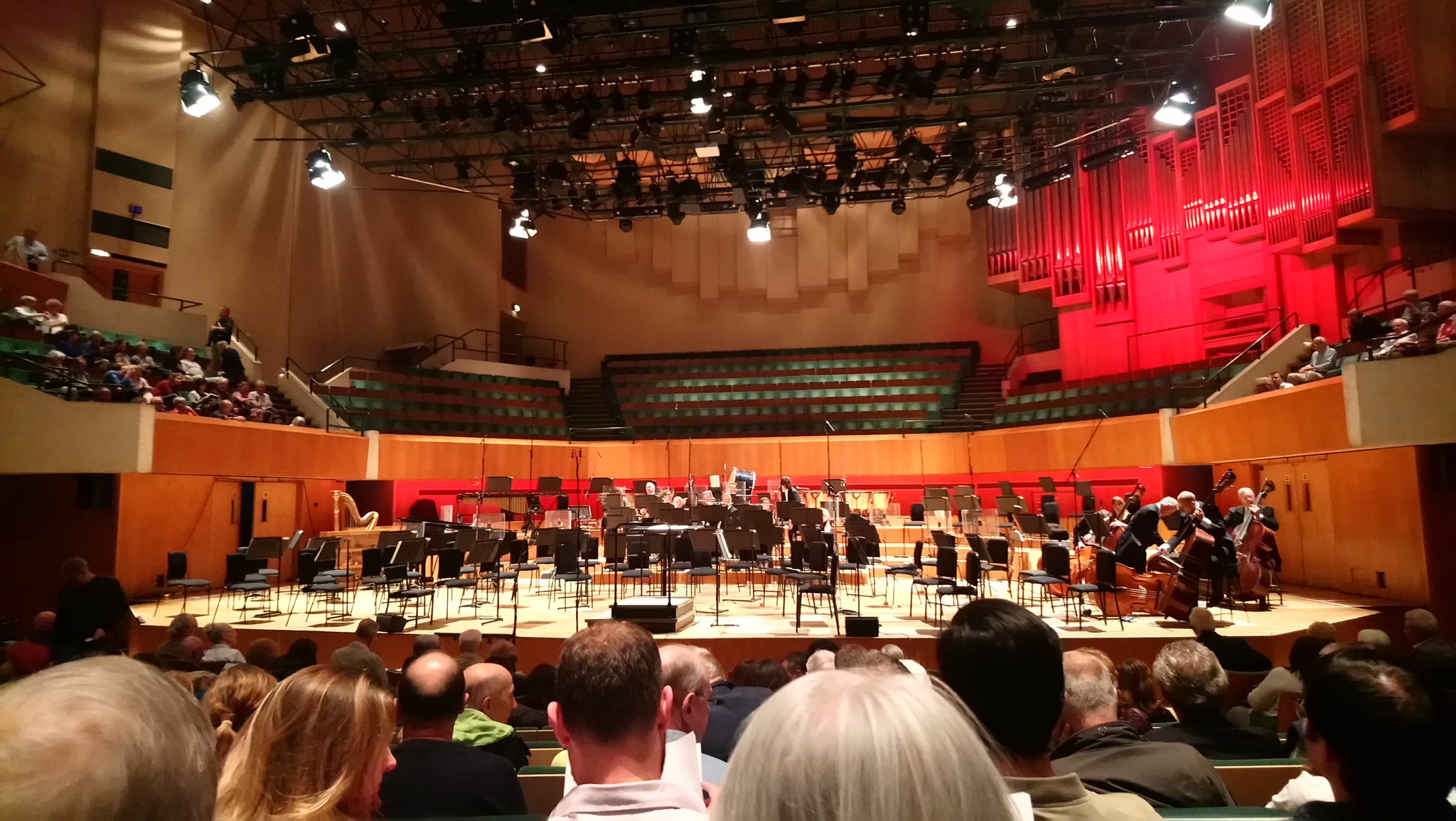
In the first movement, Kochanovsky had the strings playing with a strident, agonized sound that was remarkably affecting . But the highlight of the evening came from the brass section placed in the choir stalls (four French horns, three trombones and three trumpets; you can see their empty desks in the picture I took before the start of the concert). When they stood up and let rip at the climax of the first movement crescendo the effect was absolutely thrilling. Their position high above the stage made it seem they were playing right in your face. When the glorious noise eventually subsided I realized that I had been gripping the armrests of my seat and my knuckles had turned white. I don’t think you can experience music with such intensity unless you hear it live.

At the end there was an immediate outbreak of cheering and a well-deserved standing ovation. I wish I could have stayed longer but I had to leave to catch a train back to Maynooth. (The Leningrad Symphony being rather long, I thought I might have to dash off at the end so I booked an end-row seat.) Let me at least use the opportunity afforded by this blog to congratulate Stanislav Kochanovsky and all the musicians last night for a magnificent performance of an epic masterpiece.

BBC NOW: Tchaikovsky and Shostakovich at St David’s Hall

Posted in Biographical, Music with tags , , , , , on June 8, 2018 by telescoper

Last night I took my seat in St David’s Hall for a concert by the BBC National Orchestra of Wales under the direction of Principal Conductor Thomas Søndergård. It was an all-Russian menu, and very enjoyable it was.

The first course was the Violin Concerto by Pyotr Ilyich Tchaikovsky. It’s a familiar work but it was ravishingly played by Latvian soloist Baiba Skride, who seemed to revel in the virtuosic elements of this work, as well as bringing out the lyricism in the more romantic passages. The Orchestra were on top form too. I particularly enjoyed the way they dealt with the introduction of the famous `big tune’ in the first movement: brisker and with less of the tendency to wallow in it than you find in many performances.

Then, after the wine break, we had the main dish for the evening, the Symphony No. 5 by Dmitri Shostakovich. This is a very famous work and is perhaps the most accessible of all the Shostakovich symphonies. It was an immediate success with Soviet critics and public alike when it was first performed in 1937, and though it marked Shostakovich’s return to favour with the authorities after his denunciation by Stalin, this work has the composer’s very characteristic sense of things not being quite as they seem on the surface. Indeed, in this and many other of his compositions, he seems to manage to say one thing at the same time as saying the exact opposite of that thing; nowadays this might be called `constructive ambiguity’. This is especially in the finale, in which the sense of triumph is almost a parody of itself. Overall the Fifth Symphony is a sombre work, the dark undertone established right at the start with an imposing theme on the cellos and double basses, but it has passages of great beauty too, especially in the slow third movement. Like all great symphonies – and this is one of the greatest – it takes you on a journey full of of excitement and interest. The 45 minutes or so of this performance seemed to fly by, and its ending was greeted with rapturous applause and a standing ovation from many in the audience.

It’s interesting to consider that only 60 years had elapsed between the composition of these two pieces, but what different worlds they represent!

Anyway, the full strength National Orchestra of Wales, produced a gripping performance of this tremendous work with every section playing at the top of its form and the finale really brought the house down. But you don’t have to take my word for it – the whole concert will be broadcast on BBC Radio 3 next Tuesday, 12th June.

This concert is the last of the BBC National Orchestra of Wales season at St David’s Hall and indeed the last of at St David’s with Thomas Søndergård as Principal Conductor (though he will be conducting the Orchestra a couple of times at the Proms this summer). I wish him all the very best for his future musical adventures. It’s also the last concert by the BBC National Orchestra of Wales I’ll be attending before departing for Ireland. I don’t think I’ll get much chance to hear them after I’ve relocated, so let me take this opportunity to thank every single member of the Orchestra for the many performances I’ve enjoyed over the years, and to wish them well for the future.

The Leningrad Symphony

Posted in History, Music with tags , , , , , , , on November 24, 2017 by telescoper

Last night I went with a group of friends and colleagues to St David’s Hall in Cardiff for concert that I had been looking forward to for some time, featuring the Orchestra of Welsh National Opera under the baton of WNO’s Music Director Tomáš Hanus in a programme of music by Mahler and Shostakovich. It turned out to be no disappointment!

Before the interval the Orchestra was joined by young mezzo-soprano Tara Erraught for the song-cycle Lieder eines fahrenden Gesellen by Gustav Mahler, featuring settings of four poems written by the composer (though clearly influenced by other sources). The four pieces are of contrasting mood, with the second being the most upbeat and the third the most despairing (as well as the most operatic in style) and they were written in response to an unrequited passion. I thought Tara Erraught sang very beautifully indeed, bring out the emotional depths of this piece. Unusually for Mahler, the orchestra for this work was not excessively large, and a good balance with the solo voice was achieved that allowed the subtleties of both vocal and orchestral parts to be enjoyed to full effect.

After the interval the stage was much fuller as the orchestral forces required for the second work were much larger. Symphony No. 7 by Dmitri Shostakovich (“Leningrad”) is a piece that evokes particular memories for me as I first heard it about thirty years ago on the radio while sitting in a car that was driving through a torrential downpour in the middle of the night from Kansas City to Lawrence. The repeating theme and snare drum figures in the 1st Movement that represent the remorseless advance of the invading army had even more powerful affect when accompanied by the incessant driving rain. I’ve heard this piece on recordings and live broadcasts on many occasions since then, but have never heard it performed live until last night.

Shostakovich in a fireman’s uniform in Leningrad, 1941

What can I say about this work? Well, not much that hasn’t been said before. It was dedicated to the city of Leningrad where the composer lived, until he was evacuated during the siege,  and where he wrote most of the 7th Symphony. He served as a volunteer fireman in Leningrad during the early part of the Second World War (see above), having been turned down for military service owing to his poor eyesight. Leningrad was besieged by German forces for almost 900 days, from September 1941 until January 1944, and it’s impossible not to see the work in this historical context.


Though the four movements have themes – `War’, `Memories’, `My Native Field’ and `Victory’ – this is not really a programmatic piece. It does, however, succeed in invoking the terror and brutality of armed conflict in a manner that is so compelling that it’s almost overpowering. Many symphonies have as a theme some kind of struggle between light and dark, or between good and evil, but it always seemed to me that this work is not so much like that as it is a representation of a struggle simply for survival against annihilation. Even the end of the intense fourth movement, when the music finally resolves into the key of C Major, suggesting a kind of `victory’, echoes of the previous conflict persist, suggesting (to me) that this particular battle does not intend in any kind of triumph but in a sense of grim endurance that is more resignation than resolution.

Musicologists tend not to like this Symphony and its reputation dwindled in the West in the post-War period. Maybe it is true that it has defects when thought of as an exercise in composition, but fortunately I am not a professional critic so I am quite content to say that for me, personally, this work has an emotional impact like few others and it is one of my favourites in the whole symphonic repertoire. Last night the Orchestra of Welsh National Opera delivered an impassioned performance that confirmed everything I felt about this work but with the added dimensions that you can only get from a live performance.

From the immaculately controlled crescendo representing the advancing invaders that erupts into a nightmarish depiction of the ensuing battle right through to the last movement with its ending in resolution tempered in bitterness and regret, this performance had me gripped. The Orchestra of Welsh National Opera played as if their lives depended on it, and the climactic moments were authentically terrifying and, it goes without saying, wonderfully loud. Many congratulations to Tomáš Hanus for inspiring his musicians to such heights. He looked absolutely drained at the end, as he acknowledged the applause of a very appreciative audience in St David’s Hall.

It’s a shame that there were so many empty seats. That often seems to be the case when the music is relatively `modern’. The Cardiff audience does seem to have rather conservative tastes in that way. On the way out of the Hall after the performance all the comments I heard – and those afterwards on Twitter – were overwhelmingly enthusiastic. I feel privileged to have been among those present at this thrilling event.

UPDATE: I didn’t realise it was being broadcast live on BBC Radio 3 and is now available on iPlayer here for you to share the experience!

Romance – from the Gadfly

Posted in Music with tags , , on July 17, 2014 by telescoper

It’s too hot today to stay inside blogging at lunchtime, so here’s some lovely music from the Gadfly Suite by Dmitri Shostakovich. I’ve been called a Gadfly myself from time to time, but I’m also partial to a bit of romance now and then….