Archive for DORA

How to Fight Fraudulent Publishing

Posted in mathematics, Open Access with tags , , , , , , , on September 23, 2025 by telescoper

There’s a short article on arXiv with the title How to Fight Fraudulent Publishing in the Mathematical Sciences: Joint Recommendations of the IMU and the ICIAM which is well worth reading. The abstract is not useful but the prelude reads:

PreludeIn November 2023, Clarivate announced that it had excluded the entire field of mathematics from the latest edition of its influential list of ‘highly cited researchers’. This prompted the IMU and the ICIAM to conduct a more thorough investigation into the problem of fraudulent publishing in the mathematical sciences (see [1]). Understanding the problem is one thing; finding a way out and regaining control is another. With the recommendations given below, we would like to start the discussion on how, as a global community, we can achieve this. We are all concerned. It affects the very core of the science we love so much. I.A.

arXiv:2509.09877

The paper correctly identifies predatory journals and citation cartels as two consequences of the effort to quantify and rank the quality of research through scientific ‘performance indicators’, in the form of bibliometric measures and suggests some possible remedies.

Many of the recommendations are already included in the San Francisco Declaration on Research Assessment (SFDORA). Many also apply beyond the mathematical sciences (which is why I dropped the Mathematical Sciences bit in the title of the paper from the title of this blog post) and it’s not a long paper so I suggest you read it.

In my view one of the most important steps to take is to ditch the reliance on such companies as Scopus and Clarivate, who have deliberately constructed a system that is so easy to game. All higher education institutes should follow the examples of the Sorbonne University in Paris and, more recently, Utrecht University in the Netherlands. The academic publishing racket is inherently fraudulent. Too many universities, and indeed researchers employed by them, are willing participants in the system.
Academic Publishing is a Lucrative Scam

Posted in OJAp Papers, Open Access with tags , , , , , , , , on July 17, 2024 by telescoper

I saw an article in the Guardian yesterday with the title Academic journals are a lucrative scam – and we’re determined to change that. It’s written by Arash Abizadeh who is Professor of Political Science at McGill University in Canada. I urge you to read the piece if you’re interested in Open Access and the issues surrounding it.

I agree with virtually everything in the article. Indeed I’ve been saying much the same thing for about 15 years! I’m also determined to change things too, which is why we set up the Open Journal of Astrophysics, a “Diamond” Open Access Journal. Talking about the system of Gold Open Access, Prof. Abizadeh writes:

There is an obvious alternative: universities, libraries, and academic funding agencies can cut out the intermediary and directly fund journals themselves, at a far lower cost. This would remove commercial pressures from the editorial process, preserve editorial integrity and make research accessible to all. The term for this is “diamond” open access, which means the publishers charge neither authors, editors, nor readers (this is how our new journal will operate). Librarians have been urging this for years. So why haven’t academics already migrated to diamond journals?

I think the reason more academics haven’t already migrated to Diamond Open Access journals is that there are relatively few such journals. The reason for that is that although there are lots of people talking about Diamond Open Access there are many fewer actually taking steps to implement it. The initiative mentioned in the Guardian article is therefore very welcome. Although I think in the long run this transition is inevitable, it won’t happen by itself. It certainly won’t be helped by the Academic Publishing Industry either. We academics have to provide the push.

Here’s another excerpt:

Career advancement depends heavily on publishing in journals with established name recognition and prestige, and these journals are often owned by commercial publishers. Many academics – particularly early-career researchers trying to secure long-term employment in an extremely difficult job market – cannot afford to take a chance on new, untested journals on their own.

This is true, up to a point.

First of all any institution that has signed up to the San Francisco Declaration On Research Assessment (DORA) should not be relying on (often bogus) indicators of prestige such as the Journal Impact Factor or the journal’s presence in the Scopus index. If Diamond Open Access is to gain further traction it has to be accompanied to a wholesale change towards fairer research assessment practices.

Second, although it is true that it has taken some years to reach the volume it has now, I have been pleasantly surprised how many early career researchers in astrophysics have been keen to try out the Open Journal of Astrophysics. I think that’s because (a) early career researchers have not been indoctrinated into the absurdities of existing publishing practices and (b) they can see that the citation rates on OJAp are no worse than other allegedly more “prestigious” journals.

Academic Publishing: Never Mind the Quality…

Posted in Open Access with tags , , , , , , , , on March 16, 2024 by telescoper

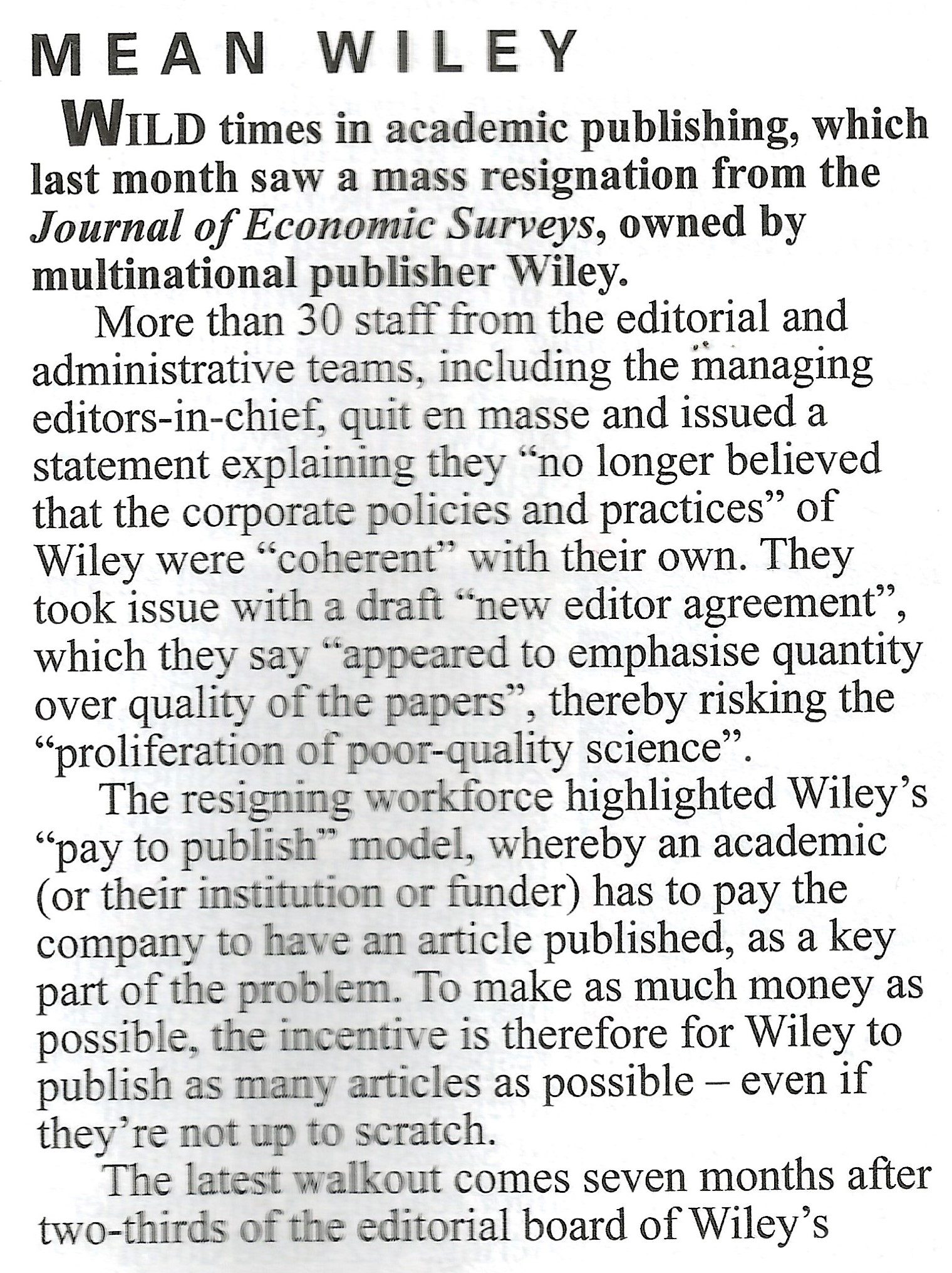
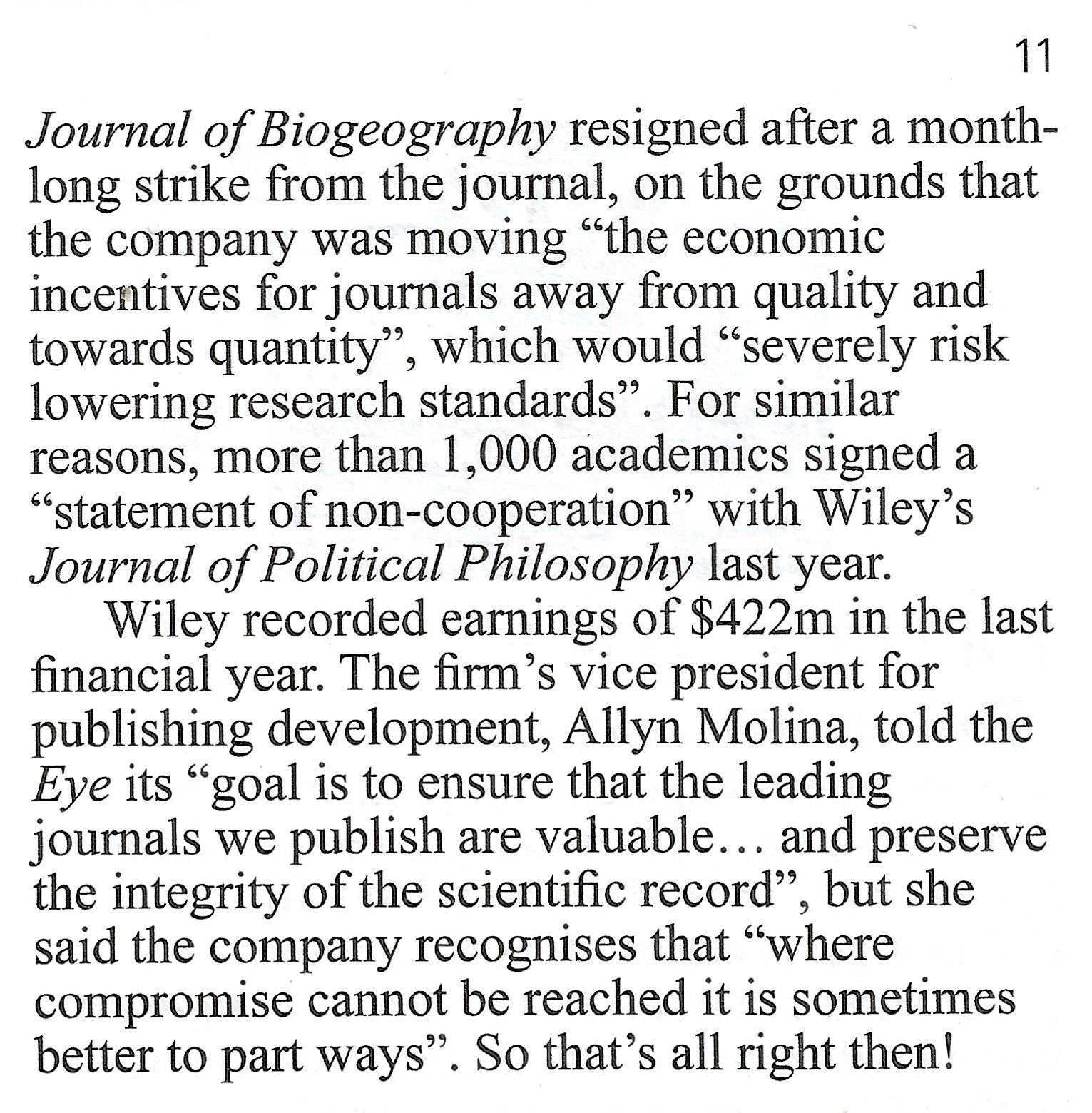
I was interested to see that the latest issue of Private Eye contains a short item about academic publishing:

I’ve heard many stories of this type, with publishers putting pressure on their Editorial Boards to allow more papers to be published. This is undoubtedly motivated by the Gold Open Access model in which authors or their institutions are forced to pay thousands of dollars upfront to publish papers. Since the publisher makes an eye-watering profit on every article, why not publish as many as possible? The recent decision by the Royal Astronomical Society adopt this model is highly likely to have a similar effect there, as its journals will be able to increase revenue at the expense of quality. Under the older subscription-based system, publishers could sell their product to libraries on the basis of quality but they no longer need to do that to make a profit.

The academic publishing industry is perverse enough without adding this obvious incentive to lower editorial standards. There are far too many low quality papers being published already, a situation driven not only by the profiteering of the publishing industry but also by the absurd policies of academia itself which require researchers to churn out huge numbers of papers to get promotion, win research grants, etc.

This part of the academic system is definitely broken. To fix it, academic publishing must be taken out of the hands of commercial publishers and put into the care of research institutions whose libraries are perfectly capable of publishing and curating articles on a non-profit basis. But that won’t be enough: we need also to overhaul how we do research assessment. The principles outlined in the San Francisco Declaration on Research Assessment would be a start.

Reformscape – the Video!

Posted in Education, Maynooth with tags , , , on February 2, 2024 by telescoper

Not long ago, I posted an item about the San Francisco Declaration on Research Assessment (DORA). I was interested this week to see the latest initiative from DORA which is called Reformscape. You can read much more about here. Here are some excerpts from the introduction:

  • The old ways of assessing the quality of research and progressing the careers of researchers are no longer fit for purpose. These dated approaches are neither fair nor responsible and often leave talented people overlooked, holding back progress in diversity, equity and inclusion. Institutions are increasingly expected to move with the times and update their assessment practices, but making meaningful change isn’t easy. 
  • Luckily, many have gone before you. Institutions around the world have been busy figuring out how to overcome the challenges of reforming academic career assessment, and we are here to help you learn from their experiences.
  • DORA Reformscape is an online tool where you can explore examples of how to bring responsible assessment for hiring, promotion and tenure into your institution, and to share your approach with others.
  • DORA Reformscape is an online tool where you can explore examples of how to bring responsible assessment for hiring, promotion and tenure into your institution, and to share your approach with others.

There’s also an introductory video:

Since my own institution, Maynooth University, is a signatory of DORA I am sure that it will already be working to implement the Reformscape recommendations into its own processes…

Signatories of DORA

Posted in Maynooth, Open Access, Science Politics with tags , on November 22, 2023 by telescoper

Following on from comments on a number of previous posts I just wanted to encourage anyone involved in research of any kind who hasn’t done so already to sign the San Francisco Declaration on Research Assessment (DORA) as an individual and if your institution hasn’t done so yet please encourage them to do so. You can check whether your organization has signed it here.

The Number One recommendation of DORA is:

Do not use journal-based metrics, such as Journal Impact Factors, as a surrogate measure of the quality of individual research articles, to assess an individual scientist’s contributions, or in hiring, promotion, or funding decisions.

San Francisco Declaration on Research Assessment

You can read the other recommendations for funders, publishers, institutions, and researchers, here.

I am well aware that some institutions have signed DORA but don’t really pay attention to it in their internal processes. Maynooth University is a signatory and certainly does take it into consideration when dealing with, e.g., recruitment and promotion but it, along with other signatories, has to deal with inconsistencies in the outside world. One of these is that, while Science Foundation Ireland and the Irish Research Council are both signatories of DORA, the Irish Government itself is not, so the Department of Further and Higher Education, Research, Innovation and Science is not bound by it. That makes no sense to me at all!

Cardiff Bound

Posted in Biographical, Cardiff, Maynooth with tags , , , on April 21, 2018 by telescoper

Just time for a quick post using the airport WIFI to fill some time before my flight leaves from Dublin Airport. Once again on a Saturday morning I was up at 5am to get the 6am bus here from Maynooth. The journey back to Cardiff is far from arduous, but I won’t be sorry when I won’t have to do it every week. Fortunately, term is coming to an end and after teaching finishes I won’t be dictated to by the timetables of Cardiff and Maynooth Universities. And after July I won’t have to do the trip at all!

This morning a large group – I believe the correct collective noun is a murder – of crows gathered to give the bus a sendoff. I did think of Hitchcock’s The Birds but the birds in this case were more interested in rummaging through the rubbish bin than attacking any of us waiting for the bus. Incidentally, it was the anniversary of Daphne Du Maurier’s death on 19th April; she wrote the short story on which that film was based.

Anyway, it’s a lovely sunny morning. Yesterday was a nice day too, both in terms of weather and other things. In the afternoon there was a staff barbecue and an awards ceremony at Maynooth University. There was a big crowd already there when I arrived, a bit late because I’d been at a seminar. Standing at the back I couldn’t really hear the speeches. I didn’t win any awards, of course, but I did get a glass of wine and a beefburger.

On my way home I bumped into the President, Philip Nolan, who is the equivalent of a Vice-Chancellor. To my surprise he mentioned a point I had raised in a recent Faculty meeting about the possibility of Maynooth signing up to the San Francisco Declaration on Research Assessment (DORA). To my even greater surprise he went on to say that this was going to be in the University’s strategic plan. Good news!

Anyway, I’d better make my way to the gate.  Have a nice day!