Archive for Easter

Finding Easter

Posted in History, The Universe and Stuff with tags , , , , , , on April 3, 2026 by telescoper

As an Astronomist I am often asked “How do they calculate the date of Easter?”, so here goes.

The simple answer is that Easter Sunday is on the first Sunday after the first full Moon on or after the Vernal equinox. The Vernal Equinox took place this year on March 20th and the first full moon after that was on April 2nd.

I say “simple” answer above because it isn’t quite how the date of Easter is reckoned for purposes of the liturgical calendar.

For a start, the ecclesiastical calculation of the date for Easter – the computus – assumes that the Vernal Equinox is always on March 21st, while in reality these days it is more frequently 20th March, like this year.

On top of that there’s the issue of what reference time and date to use. The equinox is a precisely timed astronomical event but it occurs at different times and possibly on different days in different time zones. Likewise the full Moon. In the ecclesiastical calculation the “full moon” does not currently correspond directly to any astronomical event, but is instead the 14th day of a lunar month, as determined from tables (see below). It may differ from the date of the actual full moon by up to two days.

There have been years (1974, for example) where the official date of Easter does not coincide with the date determined by the simple rule given above. The actual rule is a complicated business involving Golden Numbers and Metonic cycles and whatnot.

Here is an excerpt from the Book of Common Prayer that shows Anglicans how to determine the date of Easter for any year up to 2199:

The calculations are based on the approximately 19-year metonic cycle, which is why the above table will not work indefinitely

For this year we find that (2026+1=2027) ÷19=106 with a remainder of 13 (106 × 19 being 2014). The Golden Number for this year is therefore 13, or XIII in the Table. This gives the date of the Paschal Full Moon, which occured this year on 2nd April, which is indeed the day in the centre column next to XIII in the left-hand column in the table. The Sunday Letter is determined by the remainder of (2026+506+6)÷7, which is 4, so this year’s Sunday Letter is D. The date of Easter Sunday is given by the entry in the centre column next to the first occurrence of D in the right-hand column after the Golden Number XIII appears in the left-hand column, i.e. April 5th. I hope this clarifies the situation.
From the Study Break…

Posted in Biographical, Education, Maynooth, Poetry with tags , , , , , on March 22, 2026 by telescoper

So now after a half-term mid-semester study break, including one day of actual holiday, that was both pleasant and eventful it will soon be time to return to the fray, at least for 9 working days. A full week of lectures, labs and tutorials starts tomorrow but the following week end a day early, on Thursday 2nd April, because 3rd April is Good Friday. Campus is closed then, as it is on Easter Monday and there are no lectures for the rest of that week. I’ll miss a lecture on Good Friday. I’m sure the students will be distraught, but that’s the way of things.

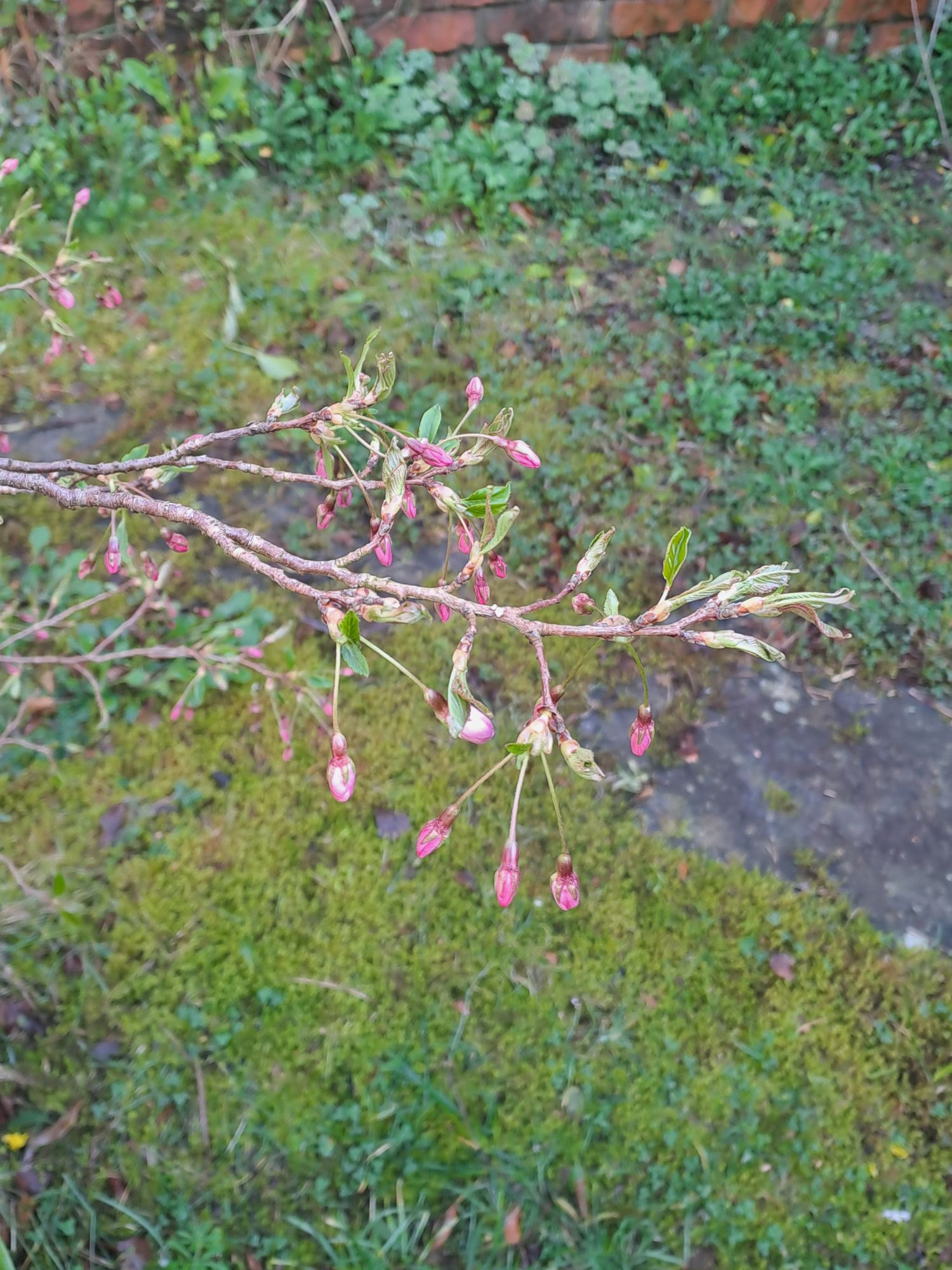
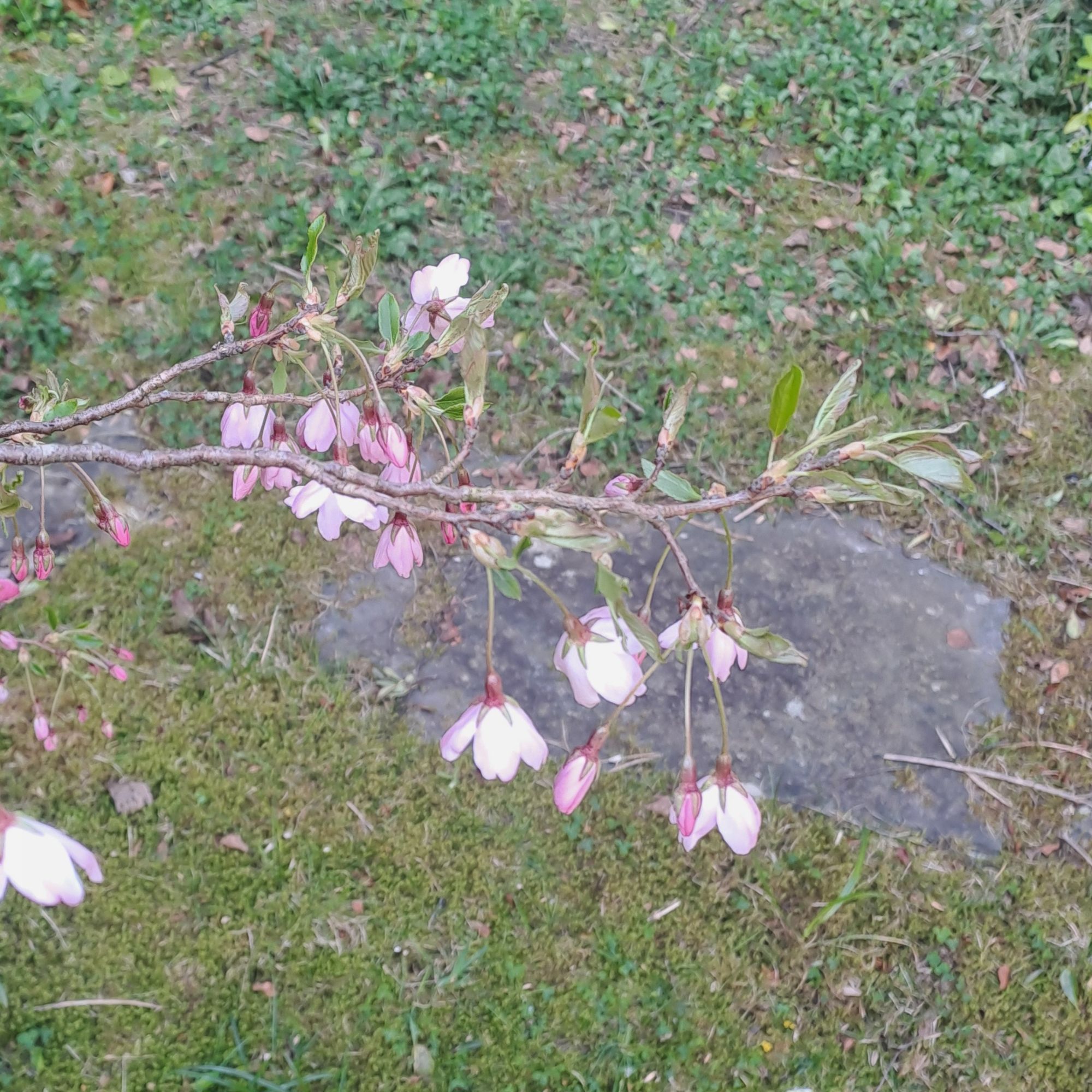
Anyway, with the Eastertide coming in and yesterday being World Poetry Day I thought I’d share a couple of pictures (taken two days apart) of the Japanese cherry trree in my back garden along with this haiku on a theme by A.E. Housman:

Loveliest of trees?
Not yet, but soon there will be
Bloom along the bough...

Resurrection, by R. S. Thomas

Posted in Literature with tags , , on April 17, 2022 by telescoper

Easter. The grave clothes of winter
are still here, but the sepulchre
is empty. A messenger
from the tomb tells us
how a stone has been rolled
from the mind, and a tree lightens
the darkness with its blossom.
There are travellers upon the road
who have heard music blown
from a bare bough, and a child
tells us how the accident
of last year, a machine stranded
beside the way for lack
of petrol, is crowned with flowers.

by R.S. Thomas (1913-2000)

Easter Hymn, by A.E. Housman

Posted in Poetry with tags , , , , on April 4, 2021 by telescoper

If in that Syrian garden, ages slain,
You sleep, and know not you are dead in vain,
Nor even in dreams behold how dark and bright
Ascends in smoke and fire by day and night
The hate you died to quench and could but fan,
Sleep well and see no morning, son of man.

But if, the grave rent and the stone rolled by,
At the right hand of majesty on high
You sit, and sitting so remember yet
Your tears, your agony and bloody sweat,
Your cross and passion and the life you gave,
Bow hither out of heaven and see and save.

by A.E. Housman (1859-1936)

Housman was an atheist. This poem was not published in his lifetime, but is the first poem in More Poems which was published shortly after his death.


Yesterday was nearly Easter

Posted in History, The Universe and Stuff with tags , , , on March 29, 2021 by telescoper

As as Astronomist I am often asked “How do they calculate the date of Easter?”, to which my answer is usually “Look it up on Wikipedia!“.

The simple answer is that Easter Sunday is on the first Sunday after the first full Moon on or after the Vernal equinox. The Vernal Equinox took place this year on March 20th and the more observant among you will have noticed that yesterday was (a) Sunday and (b) a Full Moon. Yesterday was not Easter Sunday because the rule says Easter is on the first Sunday after the first full Moon on or after the Vernal equinox, which does not include a Full Moon on the first Sunday on or after the vernal equinox. Accordingly Easter 2021 is next Sunday 4th April. If the Full Moon had happened on Saturday, yesterday would have been Easter Sunday.

That is just as well really because next weekend is when the holidays and sporting events have been arranged.

I say “simple” answer above because it isn’t quite how the date of Easter is reckoned for purposes of the liturgical calendar.

For a start the ecclesiastical calculation of the date for Easter – the computus – assumes that the Vernal Equinox is always on March 21st, while in reality it can be a day or two either side of that. This year it was on March 20th.

On top of that there’s the issue of what reference time and date to use. The equinox is a precisely timed astronomical event but it occurs at different times and possibly on different days in different time zones. Likewise the full Moon. In the ecclesiastical calculation the “full moon” does not currently correspond directly to any astronomical event, but is instead the 14th day of a lunar month, as determined from tables (see below). It may differ from the date of the actual full moon by up to two days.

There have been years (1974, for example) where the official date of Easter does not coincide with the date determined by the simple rule given above. The actual rule is a complicated business involving Golden Numbers and Metonic cycles and whatnot.

I’m grateful to Graham Pointer on Twitter for sending this excerpt from the Book of Common Prayer that sheweth how to determine the date of Easter for any year up to 2199:

I don’t care what happens after that as I’ll be retired by then. If you apply this method to 2021 you will find it is an 8C. Next year will be a 9B. Further calculations are left as an exercise to the reader.

The Vernal Equinox 2021

Posted in History, Maynooth with tags , , , , on March 20, 2021 by telescoper

It is 9.37am Local Time in Ireland on Saturday 20th March 2021 which means that the Vernal Equinox or Spring Equinox (in the Northern hemisphere) is taking place right now!

The Spring Equinox jumped back a day last year because 2020 was a leap year and now is gradually moving forward again. Of course the actual date depends on where you are in the world. The date last year was 20th March (early in the morning) in Ireland, but 19th March (late at night) in New York.

People sometimes ask me how one can define the `equinox’ so precisely when surely it just refers to a day on which day and night are of equal length, implying that it’s a day not a specific time?

The answer is that the equinox is defined by a specific event, the event in question being when the plane defined by Earth’s equator passes through the centre of the Sun’s disk (or, if you prefer, when the centre of the Sun passes through the plane defined by Earth’s equator). Day and night are not necessarily exactly equal on the equinox, but they’re the closest they get. From now until the Autumnal Equinox days in the Northern hemisphere will be longer than nights, and they’ll get longer until the Summer Solstice before beginning to shorten again.

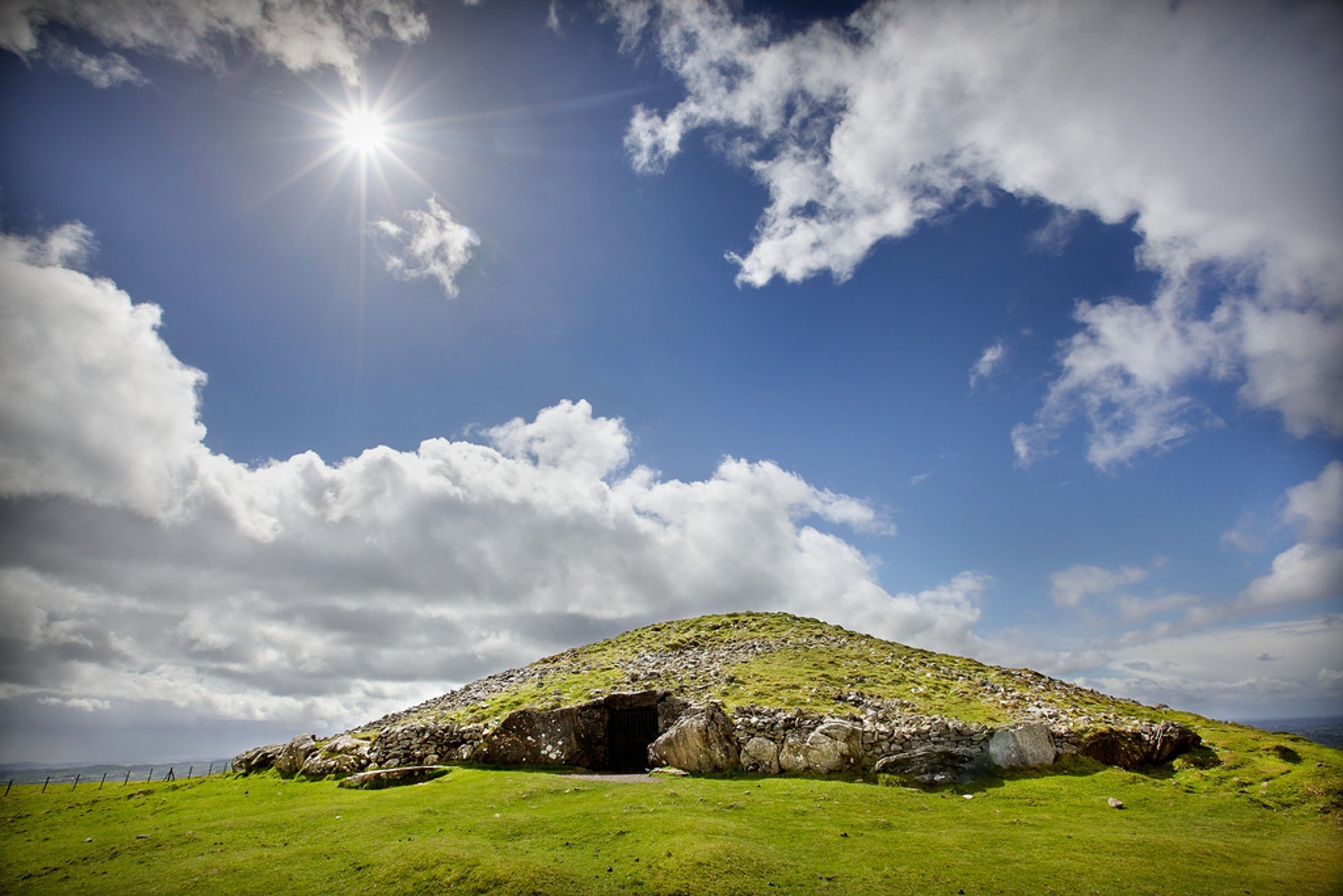
Loughcrew (County Meath), near Newgrange, an ancient burial site and a traditional place to observe the sunrise at the Equinox

Here in Ireland we celebrated Saint Patrick’s day on March 17th, the reputed date of his death in 461 AD. Nobody really knows where St Patrick was born, though, so it would be surprising if the when were any better known.

In any case, it wasn’t until the 17th Century that Saint Patrick’s feast day was placed on the universal liturgical calendar in the Catholic Church. In the thousand years that passed any memory of the actual date was probably lost, so the Equinox was perhaps rebranded for the purpose.

The early Christian church in Ireland incorporated many pre-Christian traditions that survived until roughly the 12th century, including the ancient festival of Ēostre (or Ostara), the goddess of spring associated with the spring equinox after whom Easter is named. During this festival, eggs were used a symbol of rebirth and the beginning of new life and a hare or rabbit was the symbol of the goddess and fertility. In turn the Celtic people of Ireland probably adapted their own beliefs to absorb much older influences dating back to the stone age. St Patrick’s Day and Easter therefore probably both have their roots in prehistoric traditions around the Spring Equinox, although the direct connection has long been lost.

The Vernal Equinox 2020

Posted in History, Maynooth with tags , , , , on March 20, 2020 by telescoper

With everything else going on I quite forgot that the Vernal Equinox or Spring Equinox (in the Northern hemisphere) took place today (Friday 20th March) at 3.49am (Irish Time). This is in fact the earliest Spring Equinox for 124 years, the fact that 2020 is a leap year moving it a day earlier in our calendar. It’s a lovely day in Maynooth too!

People sometimes ask me how one can define the `equinox’ so precisely when surely it just refers to a day on which day and night are of equal length, implying that it’s a day not a specific time?

The answer is that the equinox is defined by a specific event, the event in question being when the plane defined by Earth’s equator passes through the centre of the Sun’s disk (or, if you prefer, when the centre of the Sun passes through the plane defined by Earth’s equator). Day and night are not necessarily exactly equal on the equinox, but they’re the closest they get. From now until the Autumnal Equinox days in the Northern hemisphere will be longer than nights, and they’ll get longer until the Summer Solstice before beginning to shorten again.

Loughcrew (County Meath), near Newgrange, an ancient burial site and a traditional place to observe the sunrise at the Equinox

Here in Ireland we celebrated Saint Patrick’s day on March 17th, the reputed date of his death in 461 AD. Nobody really knows where St Patrick was born, though, so it would be surprising if the when were any better known.

In any case, it wasn’t until the 17th Century that Saint Patrick’s feast day was placed on the universal liturgical calendar in the Catholic Church. In the thousand years that passed any memory of the actual date was probably lost, so the Equinox was perhaps rebranded for the purpose.

The early Christian church in Ireland incorporated many pre-Christian traditions that survived until roughly the 12th century, including the ancient festival of Ēostre (or Ostara), the goddess of spring associated with the spring equinox after whom Easter is named. During this festival, eggs were used a symbol of rebirth and the beginning of new life and a hare or rabbit was the symbol of the goddess and fertility. In turn the Celtic people of Ireland probably adapted their own beliefs to absorb much older influences dating back to the stone age.

St Patrick’s Day and Easter therefore probably both have their roots in prehistoric traditions around the Spring Equinox, although the direct connection has long been lost.

Marking the End of Term

Posted in Maynooth with tags , , , , , on May 11, 2019 by telescoper

So here we are, then. The term is finally over. Lectures officially finished yesterday, and there’s now another week or so before examinations start (next Friday, 17th May). The examinations for my two modules take place on Tuesday 21st and Wednesday 22nd May, and after that I’ll be busy with marking for a while. In fact, I’ll probably be getting much busier in general pretty soon, but more of that in due course…


Marking doesn’t just mean written examinations. I have been teaching a module on Computational Physics to 3rd Year students here in Maynooth, and 40% of the assessment for that is a mini-project (usually done in groups of two or three). Early on the term, I put up a list of a dozen or so projects and ask them to pick first second and third choices so I can form groups in such a way that most students get to work on a project they like the look of. This year I made up a new set of projects, but I feel a bit sorry for one of them (`Scattering in a Spherical Potential’), which didn’t appear anywhere \at all on any student’s list of preferences. That’s a shame as I thought it was a well-rounded project, with lots of potential. Hopefully it will prove more popular next year…

Anyway, the deadline for projects to be handed in came yesterday so I’ve got a stack of those to mark which, you will realise, why I am indulging in a displacement activity by writing this blog post. My plan is to mark these next week so that they’re done before the written examinations come in.

Before I get on with what I should be doing I’ll just mention another thing that happened yesterday: the President of Ireland (Uachtarán na hÉireann), Michael D. Higgins visited Maynooth University yesterday:

That’s him at the front, on the right, of course. The reason for his visit was to attend a memorial service.

Back to Sunny Ireland

Posted in Biographical, Cardiff, Maynooth with tags , , , , , on April 22, 2019 by telescoper

Well here I am, back in Maynooth, after a week’s restful leave in Cardiff. The weather here is just as nice as it was in Wales when I left yesterday: sunny and about 20 degrees. I’m enjoying the warm weather very much indeed, as my arthritis seems to have eased off considerably.

I was planning to return to Ireland today (Monday) but the flights were far cheaper yesterday. The plane I took yesterday (Sunday) less than half full. Incidentally, after their recent rescue and restructuring FlyBe have announced that after this summer they will no longer operate jets from Cardiff. Flights to Dublin will therefore be by their smaller Bombardier turboprops rather than the Embraer aircraft that I took yesterday.

Today is a Bank holiday in Ireland, as it is in the UK, but after that the Easter break is over; I’m officially back to work tomorrow. This semester will have been divided into three pieces, firstly by the half-term study week (around St Patrick’s Day) and now by a one-week Easter break. Last year these two breaks were contiguous, but Easter is quite late this year so they are separate this time.

Anyway, we now have three weeks of teaching left followed by the May examination period and, of course, the inevitable Marking of the Scripts.

The three remaining weeks include two Bank Holiday Mondays including today, Easter Monday, and the May Day Holiday on 6th May). I have lectures on Mondays I will miss two sessions, leaving only seven lectures remaining for Engineering Mathematics. I’d better make sure that in the short time remaining I cover everything that is in the examination!

Anyway, although it’s a holiday I’ve got to get my lecture together for tomorrow morning so I’d better get to work. It’s a shame not to be out and about in the sunshine but there you go. That is the price you pay for having a week off. No doubt there is a ton of emails to reply to as well; I’ve tried not to look at my inbox while I’ve been off. I’ve made that a rule for holidays now: put the out of office message on and leave the email alone!

Easter Fatigue 

Posted in Biographical, Education with tags , on April 4, 2017 by telescoper

This is Week 11, which is the last week of teaching here at Cardiff University before the Easter break. In the early hours of this morning I finished marking my last set of coursework for the term and later on delivered my last (2-hour) lecture on the Physics of the Early Universe.

I’ve booked two weeks of annual leave from Friday and am really looking forward to a bit of rest, though I will have quite a few private matters to deal with while I’m away from work.

Such is the topsy-turvy world we live in that I note that this month’s meeting of the Royal Astronomical Society is  on this Friday, 7th April. This is contrary to the settled order of Nature, as these meetings are always on the second Friday of the month. This year, however, the 2nd Friday of April is Good Friday. This, after all, is Eastertide, when Christians celebrate the invention of the chocolate egg by doing arms deals with despotic middle-eastern governments. 

I’m only joking. Of course. Chocolate eggs have nothing to do with the true message of Easter, which is depicted in the following.

Anyway, it’s the fact that Easter moves about in the calendar that is the reason this term has been so long and I am tired and grumpy. I don’t like chocolate either.

On the bright side I did receive two pieces of good news today in between the other stuff. I hope to be able to pass them on tomorrow, or at any rate before I go off on my hols…