Archive for education

The Great A-level Scandal

Posted in Education, Politics with tags , , on August 14, 2020 by telescoper

The full scale of the scandal of this year’s A-level results is now becoming clear and it is bad enough to bring down a Government. Unfortunately there are so many scandals surrounding the UK Government (e.g. corrupt procurement deals, collapsing economy, terrible Covid-19 mortality figures, fiddled Covid-19 testing statistics, not to mention Boris Johnson himself) that nobody seems to care about that one more probably won’t make much difference.

Yesterday Qfqual released its report on this year’s A-level results which reveals that in arriving at the final grades, the algorithm deployed was based on past performance of pupils at the candidate’s school. in many cases this has resulted in students being downgraded by several grades in a manner that is both arbitrary and cruel.

Update: I’ve just heard from a physics, in an institute in which I once worked, that a student with original grade A* in Physics A-level has been assigned a final grade E. Unbelievable.

That starting point of the Ofqual approach is indefensible. A student’s examination grade should be determined by the student’s own performance, not by the performance of previous generations of students who happened to go to the same school at some time in the past.

Not surprisingly, the Ofqual approach has benefited students who went to private schools and severely disadvantaged students at less privileged establishments. The rightwing media are justifying this on the grounds that teachers at some state schools have inflated their students’ estimated grades. The attitude is that working class kids can’t possibly deserve an A* so their teachers must have cheated! I can’t believe this bias is unintentional. The Tory message to the less privileged is that they need to know their place. You needn’t ask who is behind this deliberate demographic* profiling. It stinks of the unofficial Prime Minister Dominic Cummings

But even within its own flawed terms the Ofqual algorithm is garbage. Table E8 in the report shows that when applied to last year’s input data (mock exams and centre-based assessments), even in the best case subject (History) the prediction was only accurate for 67% of students; the figure falls to less than 50% for, e.g., Further Mathematics. When the Ofqual panel saw that they should have abandoned their algorithm immediately. The fact that they pursued it knowing how deeply problematic means that they are more interested in serving their political masters than the students whose prospects they have deliberately blighted.

In my view a system should be introduced that gives the student the benefit of the doubt. Grades should be awarded based on what the student has achieved. If that ends up being too generous to a few students then that’s surely better than the opposite? Whenever I’ve been involved in University examinations processes when emergency changes were required we have always implemented a `no detriment to the students’ policy. It’s the obvious fair thing to do.

Oh, and you might ask why universities don’t show some humanity and accept students whose grades have been reduced. The answer to that is simple. If they do, they will go down in the league tables. And for many senior managers that’s all that matters.

*which means, of course, (indirect) racial profiling too.

Time, Money and Guidance in Higher Education

Posted in Covid-19, Education, Maynooth with tags , , , , on July 27, 2020 by telescoper

There was a welcome announcement last week of a package of supports for further and higher education institutions and students in Ireland to cover costs incurred by third level institutions during the Covid-19 pandemic and enable further and higher education students to return to college this September.

There wasn’t much sign of any help at all coming under the previous Government, so this is perhaps a sign that the new Department of Further and Higher Education, Research, Innovation and Science might be a force to be reckoned with in the new administration.

If this funding is to achieve its aim, however, it will have to reach its targets very quickly. The new academic year is to commence at the end of September, which is just two months away. The slice that is intended to go directly to students to help them buy laptops or tablets can probably be spent quite quickly, but the money intended for colleges and universities to buy equipment will take much longer to filter through.

Speaking for myself, as Head of a Department of Theoretical Physics I’d say we desperately need better video equipment for both live and recorded material. At present we have no lecture capture facilities at all in any lecture theatres. We also need graphics tablets to help lecturers show mathematical working via remote means. There is likely to be a big rush for this sort of thing between now and September, and no guarantee we will have it in time for the start of lectures.

You might well ask `why don’t you buy this stuff now?’. The answer is simple: I haven’t got the money!

Things are even tougher for schools. Here there is another big support package on the way, this time of €350 million to allow them to open at the end of August. Getting kids back to school is obviously important not only for their education but also to allow their parents to return to work. However, the time available to prepare all the things necessary is just a month, even shorter than it is at third level.

Among the funds being made available is €75 million for `building works’. I’m sure that investment is very welcome, but can it do anything between now and the end of August? It’s actually rather difficult to spend money that quickly if due process is followed. Just look at how the UK government has squandered tens of millions on phony contracts, such as the £12 million it blew on a Covid-19 tracing app that never worked.

On top of that 1000 new schoolteachers are going to be provided. Will they be recruited in time?

Another announcement to appear last week contained guidance for further and higher education on returning to on-site activity in 2020. This guidance has been interpreted in the media in a rather unhelpful way, causing many of my colleagues to go into a panic. This, for example, from the Irish Times:

Physical distancing rules of two metres will apply on college campuses from September in a move which will severely limit the ability of universities to hold lectures and graduation ceremonies.

A strict requirement of 2 metre distancing at all times would indeed severely reduce the capacity of lecture theatres, but if you look at the guidance it is considerably more nuanced than this. The real problem with this guidance is that it is so vague. We can only hope we get something a bit more concrete soon so we can plan for September. Alternatively we could just wing it. All of it. At the moment this seems the only viable strategy.

How to Solve Physics Problems

Posted in Cute Problems, Education, Maynooth, The Universe and Stuff, YouTube with tags , , on May 14, 2020 by telescoper

Since the examination period here at Maynooth University begins tomorrow I thought I would use the opportunity provided by my brand new YouTube channel to present a video version of a post I did a few years ago about how to solve Physics problems. These are intended for the type of problems students might encounter at high school or undergraduate level either in examinations or in homework. I’ve tried to keep the advice as general as possible though so hopefully students in other fields might find this useful too.

Winging IT

Posted in Biographical, Covid-19, Education with tags , , , , , on April 2, 2020 by telescoper

The current restrictions resulting from the Covid-19 outbreak have forced many of us academics to adapt to using IT in ways we hadn’t even imagined just a month ago. It’s not only remote teaching via virtual learning environments with live and/or prerecorded video lectures, but also meetings held by videoconferencing platforms such as Zoom or Microsoft Teams.

Few of us have had much training in the use of these things, so when it comes to Information Technology we’re all winging it. Still, necessity is the mother of invention and we just have to get on with it.

I’m gradually getting used to Microsoft Teams, for example. I’ve even got proper kit to wear.

Incidentally, yesterday I learned that the expression ‘to wing it’ actually comes from the Theatre, where it alludes to an actor studying their lines in the wings (at the side of the stage) because they haven’t had time to learn their part before the performance (usually because they are replacing another actor at short notice).

Nowadays ‘winging it’ means generally improvising or making it up as you go along. I’m finding winging it to be rather hard work but quite fun, actually. While we’ve been trying to flatten the Covid-19 curve the learning curve has definitely been getting steeper.

Boards and Consultations

Posted in Education, Maynooth with tags , , , on June 10, 2019 by telescoper

Back from Helsinki, I’m now in the midst of Examination Board business. That’s two Boards for me, one for the Department of Theoretical Physics and the other for the Department of Engineering (as I’ve been teaching Engineering Mathematics).  We’ve already Preliminary meetings for both and this afternoon had the `Final’ Board for Engineering in the presence of the external examiners. The Final ‘Board’ for Theoretical Physics with the external is on Thursday. But that’s not the end of it – there is an overall University Examination Board that covers all courses in the University to formally bring an end to the examination process.

That’s quite a lot of Boards.

It is not until after all the Boards have done their business that the students get their marks and not long after that we have a Consultation Day, where

Staff will be available in all Departments to discuss results with students. Students are entitled to see their examination scripts if they wish, these will be generally available on this day or at another mutually convenient time.

When I was Head of the School of Mathematical and Physical Sciences at Sussex University I tried to introduce such a system there, but it was met with some resistance from staff who thought this would not only cause a big increase in workload and but also lead to  difficulties with students demanding their marks be increased. That has never been my experience elsewhere: only a handful take up the opportunity and those that do are told quite clearly that the mark cannot be changed.  Last year I had only one student who asked to go through their script. I was happy to oblige and we had a friendly and (I think) productive meeting.

If I had my way we would actually give all students their marked examination scripts back as a matter of routine. The fact that we don’t is no doubt one reason for relatively poor performance in student satisfaction surveys about assessment and feedback. Obviously examination scripts have to go through a pretty strict quality assurance process involving the whole paraphernalia of examination boards (including external examiners), so the scripts can’t be given back immediately but once that process is complete there doesn’t seem to me any reason why we shouldn’t give their work, together with any feedback written on it,  back to the students in its entirety.

I have heard some people argue that under the provisions of the Data Protection Act students have a legal right to see what’s written on the scripts – as that constitutes part of their student record – but that’s not my point here. My point is purely educational, based on the benefit to the student’s learning experience.

Anyway, I don’t know how widespread the practice is of giving examination scripts back to students so let me conduct a totally unscientific poll. Obviously most of my readers are in physics and astronomy, but I invite anyone in any academic discipline to vote:

And, of course, if you have any further comments to make please feel free to make them through the box below!

Is there a role for rote learning?

Posted in Education, Maynooth with tags , , , , , , , on May 7, 2019 by telescoper

So here we are, then, back to work here in Maynooth for the last week of teaching. Or, to be precise, the last four days – yesterday was a Bank Holiday. With university and school examinations looming, it is no surprise to find an article griping about the Irish Leaving Certificate examinations and the fact that teachers seem to encourage students to approach them by by rote learning. This is something I’ve complained about before in the context of British A-levels and indeed the system of university examinations.

Over my lifetime the ratio of assessment to education has risen sharply, with the undeniable result that academic standards have fallen – especially in my own discipline of physics. The modular system encourages students to think of modules as little bit-sized bits of education to be consumed and then forgotten. Instead of learning to rely on their brains to solve problems, students tend to approach learning by memorizing chunks of their notes and regurgitating them in the exam. I find it very sad when students ask me what derivations they should memorize to prepare for examinations because that seems to imply that they think their brain is no more than a memory device. It has become very clear to me over the years that school education in the UK does not do enough to encourage students to develop their all-round intellectual potential, which means that very few have confidence in their ability to do anything other than remember things. It seems the same malaise affects the Irish system too.

On the other hand, there’s no question in my mind that a good memory is undoubtedly an extremely important asset in its own right. I went to a traditional Grammar school that I feel provided me with a very good education in which rote learning played a significant part. Learning vocabulary and grammar was an essential part of their approach to foreign languages, for example. How can one learn Latin without knowing the correct declensions for nouns and conjugations for verbs? But although these basic elements are necessary, they are not sufficient. You need other aspects of your mental capacity to comprehend, translate or compose meaningful pieces of text. I’m sure this applies to many other subjects. No doubt a good memory is a great benefit to a budding lawyer, for example,  but the ability to reason logically must surely be necessary too.

The same considerations apply to STEM disciplines. It is important to have a basic knowledge of the essential elements of mathematics and physics as a grounding, but you also need to develop the skill to apply these in unusual settings. I also think it’s simplistic to think of memory and creative intelligence as entirely separate things. I seems to me that the latter feeds off the former in a very complex way. A good memory does give you rapid access to information, which means you can do many things more quickly than if you had to keep looking stuff up, but I think there’s a lot more to it than that. Our memories are an essential part of the overall functioning of our brain, which is not  compartmentalized in  a simple way.  For example, one aspect of problem-solving skill relies on the ability to see hidden connections; the brain’s own filing system plays a key role in this.

Recognizing the importance of memory is not to say that rote learning is necessarily the best way to develop the relevant skills. My own powers of recall are not great – and are certainly not improving with age – but I find I can remember things much better if I find them interesting and/or if I can see the point of remembering them. Remembering things because they’re memorably is far easier than remembering because you need to remember them to pass an examination!

But while rote learning has a role, it should not be all there is and my worry is that the teaching-to-the-test approach is diminishing the ability of educators to develop other aspects of intelligence. There has to be a better way to encourage the development of the creative imagination, especially in the context of problem-solving. Future generations are going to have to face many extremely serious problems in the very near future, and they won’t be able to solve them simply by remembering the past.

University News

Posted in Education, Politics with tags , , , , , , on April 28, 2019 by telescoper

As we stagger towards Week 11 of this twice-interrupted Semester I’m back in the office preparing stuff for another set of lectures. This term seems to have gone on forever, largely because of the two breaks (one at half-term around St Patrick’s Day, and other other for Easter). Now, though, the end is in sight. Or at least the examination period is: there are just two more weeks of lectures, ending on 10th May then a short break, then examinations start (on 17th May). Then, of course, there is marking, checking, conflating exam grades with coursework marks, examination boards, and all the other stuff that go on behind the scenes.

I noticed that this weekend’s edition of the Irish Times included a hard copy of a report called Delivering for Ireland: The Impact of Irish Universities which was produced by the Irish Universities Association. In fact the thing given away with the paper is just a summary report (you can download it in PDF format here). The full report (all 86 pages of it) can be downloaded here.

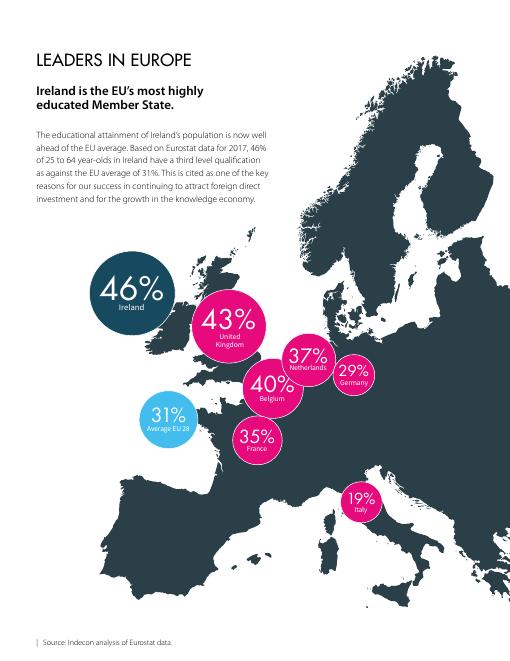
The report is full of interesting information, including this (which I didn’t know before):

The report was produced with the aim of making the case for further investment in Ireland’s universities. It remains to be seen whether the current Irish government will be persuaded. I’m not holding my breath. right-wing governments never seem to be interested in investing in the future. I think the best we can hope for is that Ireland does not continue its policy of slavishly copying English Higher Education policy, especially with the introduction of student loans and high tuition fees.

And talking of the idiocies of the English University system, there is a story going around that the UK Government is planning to make EU students pay full `Overseas’ fees after Brexit. Actually, Higher Education policy is a devolved matter so this can only be directly enforced on English universities. It will, however, be hard for Scottish Welsh and Northern Irish institutions to resist the consequences.

In fact I’ve long felt that the existing system – in which Home and EU students have to be treated the same way as a matter of law but non-EU students can be charged different (i.e. higher) fees is completely immoral. Once at university students are all taught the same way so why should some be charged more than others because they happen to come from China? What would you think of a shop that tried to charge people different prices for the same goods depending on the nationality of the customer?

This decision is of course an inevitable consequence of Theresa May’s interpretation of the EU referendum result as a mandate for policies of extreme xenophobia, as is the withdrawal from Erasmus. It is just another symptom of the UK’s descent into narrow-minded insularity. The message this decision sends out is that Britain hates foreigners but it likes their money so the rich ones who can pay extortionate fees will be graciously allowed to come here to get fleeced. Does the government really think that EU citizens are daft enough to come to a country that identifies itself in such a way? I don’t think they are. They’ll just find somewhere else to go, and the consequence for UK universities will be severe. I am confident this will push more than one UK higher education institution into bankruptcy.

Anyway, even if the the Irish university continues to be under-resourced, it will at least continue to welcome students from the EU on the same basis as before. So if you’re a European student who was thinking about studying in England, why not come to Ireland instead? It’s far cheaper, and we even have the same weather…

More Order-of-Magnitude Physics

Posted in Cute Problems with tags , , , on April 25, 2019 by telescoper

A very busy day today so I thought I’d just do a quick post to give you a chance to test your brains with some more order-of-magnitude physics problems. I like using these in classes because they get people thinking about the physics behind problems without getting too bogged down in or turned off by complicated mathematics. If there’s any information missing that you need to solve the problem, make an order-of-magnitude estimate!

Give  order of magnitude answers to the following questions:

  1. What is the maximum distance at which it could be possible for a car’s headlights to be resolved by the human eye?
  2. How much would a pendulum clock gain or lose (say which) in a week if moved from a warm room into a cold basement?
  3. What area would be needed for a terrestrial solar power station capable of producing 1GW of power?
  4. What mass of cold water could be brought to the boil using the energy dissipated when a motor car is brought to rest from 100 km/h?
  5. How many visible photons are emitted by a 100W light bulb during its lifetime?

There’s no prize involved, but feel free to post answers through the comments box. It would be helpful if you explained a  bit about how you arrived at your answer!

Failing A-levels

Posted in Education with tags , , on April 17, 2019 by telescoper

As it is tangentially related to yesterday’s post I thought I’d comment on an article in The Times with the headline

University grades: firsts for quarter of students with lowest A levels

The piece (which you probably won’t read as it is behind a paywall) goes on to imply that the success at degree level of students who got poor A-levels results is the result of ‘grade inflation’.

My take on this is somewhat different. To me it just confirms what I’ve thought for years, namely that A-levels are virtually useless, either as a preparation for undergraduate study or as an indicator of academic potential. If they are are a guide to anything at all, it is to the quality of the school the student was lucky enough to attend.

It’s not only a shame that UK universities rely on A-levels so heavily for student recruitment but also a disgrace that institutions are punished in league tables whenever they take on students with low results. And if they do a good job educating such students to high levels of achievement they get attacked in churlish articles accusing them of lowering standards.

The assumption behind this is that there should be a near-perfect correlation between entry and exit qualifications. That is not the case at all, and why on earth should it be?

Look at this the other way round. Oxbridge only accepts students with the highest A-levels results, so why do these Universities not award more first-class degrees? Dare I suggest that perhaps not all the students they select have the aptitude their school qualifications suggest?

I noticed this the other day. It’s a list of skills needed for the job market in 2020.

Strangely, ‘rote learning’, ‘uncritical regurgitation of factoids’, and ‘ability to perform formulaic tasks’ are not on the list. They’re not much use as a preparation for university study either. So why does the UK school education system place such an emphasis on precisely these useless activities, to the exclusion of actually useful things?

Answers on a postcard please.

In Praise of Omnibus Science

Posted in Education, Maynooth with tags , , , on April 16, 2019 by telescoper

I’m taking a few days off at the moment so this morning I had a bit of time to catch up on various things. One news item I stumbled across points out that first-choice applications to study at Maynooth University are the highest ever. Within the overall increase of about 7% there is a growth of 17% in Science subjects, which is very good news for the Department of Theoretical Physics as well as the other Departments in the Faculty of Science and Engineering.

Anyway, this spurred me to comment on what I think is one of the strengths of Maynooth University: the Omnibus Science programme.

Currently, most students doing Science subjects here enter on the Omnibus programme, a four-year science course that involves doing four subjects in the first year, but becoming increasingly specialised thereafter. That’s not unlike the Natural Sciences course I did at Cambridge, except that students at Maynooth can do both Theoretical Physics and Experimental Physics in the first year as separate choices. Other possibilities include Chemistry, Computer Science, Biology, etc.

In Year 1 students do four subjects (one of which is Mathematics). That is narrowed down to three in Year 2 and two in Year 3. In their final year, students can stick with two subjects for a Joint Honours degree, or specialise in one, for Single Honours.

I like this programme because it does not force the students to choose a specialism before they have had a taste of the subject, and that it is flexible enough to accommodate Joint Honours qualifications in, e.g., Theoretical Physics and Mathematics. It also allows us to enrol students onto Physics degrees who have not done Physics as part of the Leaving Certificate.

I think it’s a strength that students take such a broad first year rather than locking themselves into one discipline from the start. Part of the reason is that I went to do my own degree at Cambridge expecting to end up specialising in Chemistry, but enjoyed the physics far more, eventually specialising in Theoretical Physics. I’m sure there were others who went the other way too!

One problem with the Omnibus Science programme is that the range of possible final qualifications is perhaps not as clearly advertised as it could be, so some clearer signposting would do no harm.