Archive for education

General Science at Maynooth

Posted in Education, Maynooth with tags , , , , , , , on May 27, 2024 by telescoper

Following on – sort of – from yesterday’s post – here is a little promotional video about the ‘Omnibus’ Bachelor of Science undergraduate course (codename MH201). I have blogged about this course before (e.g. here) but this gives me an opportunity to repeat the salient points.

Currently, most students doing Science subjects here in Maynooth enter on the General Science programme a four-year Omnibus BSc course that involves doing four subjects in the first year, but becoming increasingly specialized thereafter. That’s not unlike the Natural Sciences course I did at Cambridge, except that students at Maynooth can do both Mathematical Physics and Experimental Physics in the first year as separate choices. I’d recommend anyone who wants to do Physics in the long run to do both of these, as they do complement each other. Other possibilities include Chemistry, Computer Science, Biology, etc.

In Year 1 students do four subjects (one of which has to be Mathematics). That is narrowed down to three in Year 2 and two in Year 3. In their final year, students can stick with two subjects for a Joint Honours (Double Major) degree, or specialise in one, for Single Honours.

I like this programme very much because it does not force the students to choose a specialism before they have had a taste of the subject, and that it is flexible enough to accommodate Joint Honours qualifications in, e.g., Theoretical Physics and Mathematics. It also allows us to enrol students onto Physics degrees who have not done Physics or Applied Mathematics as part of the Leaving Certificate.

Anyway, this video features Oisín Davey, who took Mathematical Physics, Experimental Physics, Chemistry and Mathematics in his first year. As a matter of fact I taught him in Year 1 (Mechanics & Special Relativity) and Year 2 (Vector Calculus and Fourier Series) but, despite that, as he explains, he has decided to persist with Mathematical Physics. He will be in the final year next academic year, after he returns from his summer in CERN, and I’ll be back from sabbatical.

Free Atkins!

Posted in Biographical, Education, The Universe and Stuff with tags , , , , , , on May 26, 2024 by telescoper

I took my first degree in the Natural Sciences Tripos at the University of Cambridge. This involved doing a very general first year comprising four different elements that could be chosen flexibly. I quickly settled on Physics, Chemistry and  Mathematics for Natural Sciences to reflect my A-level results but was struggling for the fourth. In the end I picked the one that seemed most like Physics, a course called Crystalline Materials. I didn’t like that at all, and wish I’d done some Biology instead – Biology of Cells and Biology of Organisms were both options – or even Geology, but I stuck with it for the first year.

Having to do such a wide range of subjects was very challenging. The timetable was densely packed and the pace was considerable. In the second year, however, I was able to focus on Mathematics and Physics and although it was still intense it was a bit more focussed. I ended up doing Theoretical Physics in my final year, including a theory project.

My best teacher at School, Dr Geoeff Swinden,  was a chemist (he had a doctorate in organic chemistry from Oxford University) and when I went to Cambridge I fully expected to specialisze in Chemistry rather than Physics. I loved the curly arrows and all that. But two things changed. One was that I found the Physics content of the first year far more interesting – and the lecturers and tutors far more inspiring – than Chemistry, and the other was that my considerable ineptitude at practical work made me doubt that I had a future in a chemistry laboratory. And so it came to pass that I switched allegiance to Physics, a decision I am very glad I made.

(It was only towards the end of my degree that I started to take Astrophysics seriously as a possible specialism, but that’s another story…)

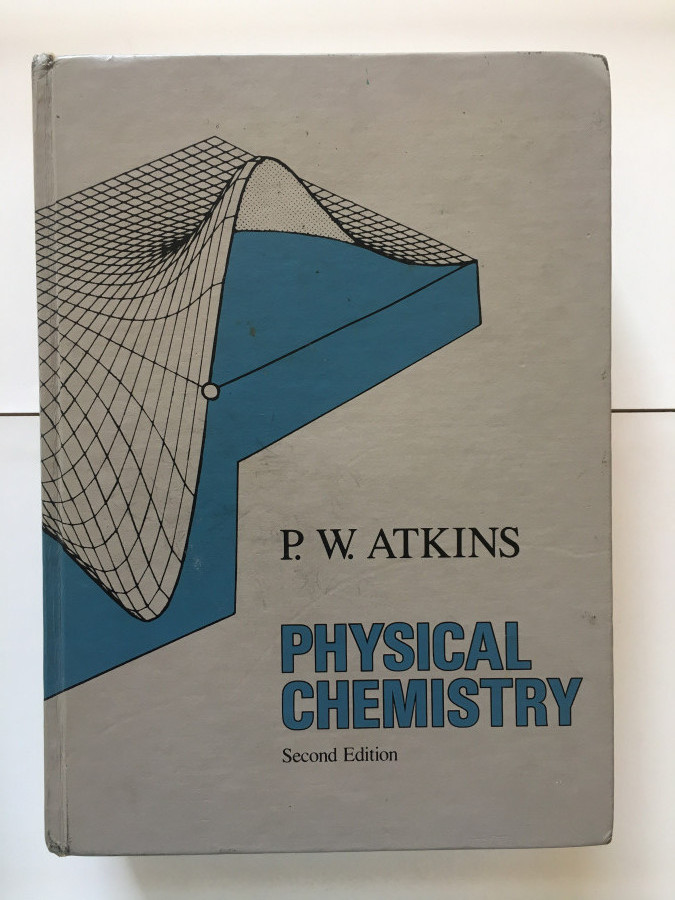
Anyway, when I turned up at Cambridge over 40 years ago to begin my course, and having Chemistry as a probable end point, I bought all the recommended text books, one of which was Physical Chemistry by P.W. Atkins. I found a picture (above) of the 1982 edition which may well be the one I bought (although I vaguely remember the one I had being in paperback). I thought it was a very good book, and it has gone into many subsequent editions. I also found the Physical part of Chemistry quite straightforward because it is basically Physics. I even got higher marks in Chemistry in the first year than I did in Physics but that didn’t alter my decision to drop Chemistry after the first year. When I did so, I followed tradition and sold my copy to a new undergraduate along with the other books relating to courses that I dropped.

Yesterday I found out that Peter Atkins has decided to make one of his books available to download. The book concerned is however not the compendious tome I bought, but a shorter summary called Concepts in Physical Chemistry, which was published in 1995. This is no doubt a very useful text for beginning Chemistry students so I thought I’d pass on this information. You can download it here, although you have to do it chapter by chapter in PDF files.

P.S. Chemistry in Spanish is ‘Química’. Since Physics and Chemistry share the same building in the University of Barcelona, where I am currently working, I frequently walk past rooms with doors marked ‘Quim’ (but I have never taken the opportunity to enter one).

My First Maynooth PhD!

Posted in Maynooth, The Universe and Stuff with tags , , , , , , on March 14, 2024 by telescoper

Today saw the viva voce examination of the first PhD student at Maynooth to have completed their degree under my supervision, although in this case the student started his postgraduate degree under another supervisor and I only took over responsibility when that person retired, a few years ago.

Anyway, I delayed my return to Barcelona so I could be present today. It’s not normal practice for the supervisor of a PhD to be present at the examination of the candidate. The rules allow for it – usually at the request of the student – but the supervisor must remain silent unless and until invited to comment by the examiners. I think it’s a very bad idea for both student and supervisor, and the one example that I can recall of a supervisor attending the PhD examination of his student was a very uncomfortable experience. My presence today was limited to supplying a couple of anticipatory bottles of champagne and then waiting nervously for the examination to finish.

I always feel nervous when a student of mine is having their viva voce examination, probably because I’m a bit protective and such an occasion always brings back painful memories of the similar ordeal I went through thirty-odd years ago. However, this is something a PhD candidate has to go through on their own, a sort of rite of passage during which the supervisor has to stand aside and let them stand up for their own work.

The examination turned out to be quite a long one – about three and a half hours – but ended happily. Unfortunately, I had to leave the celebrations early in order to do yet another Euclid-related Zoom call but when that was over I was able to find the pub to which everyone had adjourned and had a pint there with them. I have a feeling the celebrants might make a night of it tonight, but I’m a bit too tired after recent exertions to join them.

The student’s name, by the way, is Aonghus Hunter-McCabe and the title of the thesis is Differential geometric and general relativistic techniques in non-relativistic laboratory systems. If you’re looking for a postdoc to work in related areas then Aonghus might just be the person you want!

P.S. About a decade ago I did a post on the occasion of the PhD examination of another student of mine, Ian Harrison. I found out recently that Ian now has a permanent position at Cardiff University. Congratulations to him!

The Age Thing

Posted in Biographical, Education with tags , , , , , on January 2, 2024 by telescoper

When I was younger, so much younger than today, I thought I would hate getting old. Now that I’m sixty though I have to say in all honesty that it’s not too bad at all. I could do without the arthritis, of course, but that’s more of an inconvenience than anything else. I am also fortunate to be comfortably off and in a secure job, with the prospect of a decent pension. When I was younger I was frequently under stress, with bouts of insomnia and other issues. Although I am subjected to a bit of aggravation now and then, I seem to have learnt to deal with it better.

I think part of this is that as I’ve got older I’ve become more resistant to peer pressure. Nowadays I go out only when I really want to, and do only what I want to do. Gone are the days when friends used to drag me out to places I didn’t really want to go to. I used to go because I thought people would label me as ‘boring’ if I didn’t. Nowadays, I don’t mind being called boring. I may be boring to you but I am rarely ever bored. I always find plenty to occupy myself.

Another thing that helps is working in a University, which is a good way of being surrounded by interesting young people. So many people of my age seem to resent the young, to the extent of criticizing virtually everything they do. I find the vast majority students friendly, hard-working and engaged, although they have to put up with much more than I had to when I was in their situation.

Teaching physics is interesting because the current generation of undergraduates has to learn a lot of what I had to when I was a student. Every year therefore provides a reminder of the time when I was the age of the new intake, as many of their educational and social experiences are similar. Of course not all. When I was an undergraduate we had no internet or anything like that. There were no social media, either. 

Students these days seem to like using Instagram. I do have an account on Instagram but it is very quiet, probably because I’m not very good at it. Some students follow me there, but I have been told that it would be “inappropriate” to follow them back. That’s probably fair, but I do worry that I appear rude for not following back. It’s not that I’m snobbish or anything. I just feel that I would be intruding, in much the same way as if I wandered into a bar full of students I know. It’s not that I don’t like them, just that I find it awkward (as I’m sure they do). Not having had Instagram when I was young, I suppose I just don’t really understand the etiquette.

One of the things about Instagram is that people do sometimes share quite personal things, and sometimes things that might be quite compromising in a work context, e.g. pictures of themselves in a  state of inebriation. I suppose that’s why it’s a rather contentious issue whether a member of academic staff in a University should or not be “friends” with their undergraduate students on social media. Indeed, this is the official advice given by some institutions to staff. Most wouldn’t have a problem with having social media interactions with their graduate students, though. The nature of the relationship between a PhD student and supervisor is different from that between an undergraduate and a lecturer.

There is a point on social media where professionalism might be compromised just as there is in other social interactions. The trouble is knowing precisely where that boundary lies, which is easy to misjudge. I’ve never felt that it was in any way improper to be friendly to students. Indeed I think that could well improve the students’ experience of education. If the relationship with staff is too distant students may not  feel comfortable asking for help with their work, or advice about wider things. Why should being “professional” mean not treating students as human beings? One can take friendliness too far, however. There have to be some boundaries, and intrusive or demanding behaviour that makes students uncomfortable should be avoided.

I realize I have digressed into social media. Aside from that, though, I’m sure much of student was similar in my day. I’m pretty sure that neither the subject of physics nor students of physics have changed that much over the years. The only difference from my perspective is that every year they look younger! That’s the other side of the coin: the students remind you of your younger self, but not in such a way as to delude you into thinking that you’re still the same person! I think that’s the one thing I’ll miss when I retire, hopefully in the not-too-distant future.

All of this is a roundabout way of saying that I don’t mind getting old. In fact, I feel that my whole life so far has been practice for this.

Spanish Practices

Posted in Barcelona, Education, History, Maynooth with tags , , , , , on October 20, 2023 by telescoper

When I was a lad, during the 1970s, the term Spanish Practices was used pejoratively in a union-bashing sense to describe restrictive practices in the workplace. Until recently I thought it was a modern invention that relied on a stereotypical view of Spanish people as being lazy. In fact it seems the term dates back to Tudor times and is religious in origin, referring to Roman Catholic rites, in contrast to the simpler Protestant forms of worship. Anyway, none of that is what this post is about. I just used the title as clickbait.

I’ve been here in Barcelona, and working in the University of Barcelona, for four weeks now and I thought I’d share a few observations about differences in practice here and in the Ireland (and the UK).

The other night I went out for dinner with colleagues from the Department. The restaurant was much closer to the University than to my flat so instead of going home first I stayed in my office and walked straight there. My route out of the building takes me past a number of teaching rooms. During this warm weather, most of the rooms have the doors open so it’s easy to have a quick look at what’s going on inside. On my way out at about 7.30pm I was surprised to see a number of classes still going on, and they weren’t sparsely attended either.

In Maynooth the latest regular lectures finish at 6pm. Even during the 5pm to 6pm lectures, many students have to leave before the end to catch the one and only bus back to their place of residence. Here the public transport system is so good that isn’t really an issue even for those who don’t live near the campus. As far as I know lectures start at 9am, so students potentially have a very long day. They work hard.

I have to say that I wouldn’t like to have teach late in the evening. I used to do that on Fridays at Queen Mary for the MSc course and didn’t enjoy it. I don’t mind doing 9am lectures, though, but I don’t think students agree – partly because of the difficulty of getting to campus at that time.

In the Faculty of Physics, all the lecture halls, classrooms and laboratories are in one building rather than spread around the campus like they are in Maynooth (and many places in the UK). Fortunately, the building has been designed with students in mind and there is plenty of space for students to use socially or for private study between teaching sessions.

In this picture you can see the inner courtyard of the building occupied by the Faculties of Chemistry and Physics. It’s a big open space, with teaching rooms, etc, on either side. In the far right-hand corner there is a café/bar where one can buy lunch, a coffee, or even a beer, to be consumed either inside or in the seating area in the courtyard. Many students seem to prefer bring their own lunch and eat it in this space., although the food available is pretty good and cheap compared to back home.

As well as being able to eat and drink here, there is plenty of room for students simply to hang out or to study, either alone or in groups. If they don’t feel like that they can use the tram, bus or Metro to go home, and come back later if they have a long gap between classes. None of this is possible at Maynooth.

This particular kind of open space would not work so well in Ireland or the UK because of the weather, though you can probably see in the picture that there had been a bit of rain before I took the photograph, but I hope I’ve made the point that having social spaces makes a huge amount of difference to the student experience, not least because it feels that the University has thought about them. In the neoliberal system that dominates in the UK and Ireland, students are simply a commodity, a source of revenue, to be crammed into every available space and processed as cheaply as possible. In Maynooth students have been, and are being, forced to pay an extra levy for a notional student centre that will probably never be built.

The contrast is very disheartening.

Getting back to educational matters, another thing I’ve noticed walking past classrooms is that it’s not unusual to see a student standing at the blackboard in front of the class going through a problem. I’ve seen that a number of times with quite large classes. Sometimes we ask students to do that sort of thing in tutorials, but I’ve never done so in a full lecture. I think our students would be shocked if we asked, but it’s clearly not unexpected here. That’s a Spanish Practice I’d be quite happy to try.

The Term Ahead

Posted in Biographical, Education, Maynooth with tags , , , , on January 29, 2023 by telescoper

It’s the day before the start of a new Semester in Maynooth. Last week we finished all due processes relating to the First Semester examinations and the provisional results will be uploaded to “The System” next week. They’re provisional at this stage because they’re not set in stone until the final meeting of the Examination Board. Obviously I can’t discuss the results here. I could comment here about how clunky the whole process is, including multiple downloads of spreadsheets and subsequent uploads somewhere else, but I won’t bother. Nobody seems to be interesting in fixing it. Perhaps by the time I retire “The System” will have been replaced by something that doesn’t waste an enormous amount of staff time. But I doubt it.

It’s a curiosity of the teaching allocation in the Department of Theoretical Physics that I do first-year and second-year modules (MP110 Mechanics and Special Relativity and MP201 Vector Calculus & Fourier Series) in Semester 1 while in Semester 2 it’s the third and fourth year students who have to put up with my ramblings.

The menu for this term involves MP354 Computational Physics 1, which entails just one hour of lectures per week but two two-hour lab sessions. Each student attends one of these sessions, so they get 3 contact hours per week but I have to look after both sessions. Our computer lab has a small cluster of Linux machines and, this term, a brand new display screen which I am looking forward to playing with. I’m also looking forward to seeing how the infamous ChatGPT copes with the Python coding exercises I give the students to do in class: I’ve only tried one so far, without much success. This is the first module I taught at Maynooth, back in 2018, so this will be the 6th time I’ve done it.

My other class is MP465 Advanced Electromagnetism, which I’m doing for the 3rd time now. This is a standard chalk-and-talk kind of module covering a well-established syllabus, and involving two lectures per week plus a tutorial. At least I’m teaching in a classroom rather than online like when I first did this module!

In 2020/21 (during the Pandemic restrictions) I did five modules as well as being Head of Department. At this time two academic staff departures left us severely short-staffed and struggling to deliver our programmes. My workload then was unmanageable and I asked to step down. I changed my mind when were eventually allowed to recruit two lecturers and saw out my three-year term to the end. I had better not repeat here what I think of the deliberate management decisions that left us reeling and had such negative effects on staff morale and on the education of students in the Department. I just hope the damage is not irreparable.

Although I am doing the same number of modules as last term, the number of contact hours I have to do is higher (8 versus 5) because of the labs and the fact that we don’t have tutors for 4th-year modules so lecturers have to do the tutorials themselves. Four modules a year is a much heavier teaching load than a Full Professor at a UK university would be expected to carry, but it seems normal in Ireland where the funding for sciences is far less than adequate. The impact on research productivity is obvious and is systemic. There are excellent physicists in Maynooth but they are given little time or other resources. It’s a big waste of potential. That’s another “System” that needs changing, but I see little appetite for change of the required sort at institutional level. It’s all about recruiting more and more students to be taught with fewer and fewer resources.

The impact of this on staff careers is severe: teaching loads are so heavy that it’s very difficult to reach the level of research productivity required for promotion. For myself, though, the next career step will be retirement so I don’t have to worry about promotion. Fortunately too, I enjoy teaching, so I’ll just get on with it. So I’ll stop writing and get on with preparing my first week of lectures and lab sessions!

Girls, Physics and “Hard Maths”

Posted in Education, Maynooth with tags , , , on April 28, 2022 by telescoper

There was an appropriately hostile reaction from people who know things yesterday to bizarre comments by Katharine Birbalsingh, who is apparently a UK Government commissioner for something or other, but who seems to know very little. Birbalsingh is in charge of a school in which only 16% of the students taking physics A-level are female, whereas the national average is about 23%. She tried to explain this by saying that girls don’t like doing “hard maths” and as a consequence…

..physics isn’t something that girls tend to fancy. They don’t want to do it, they don’t like it.

There is an easy rebuttal of this line of “reasoning”. First, there is no “hard maths” in Physics A-level. Most of the mathematical content (especially calculus) was removed years ago. Second, the percentage of students taking actual A-level Mathematics in the UK who are female is more like 40% than 20%. The argument that girls are put off Physics because it includes Maths is therefore demonstrably bogus.

An alternative explanation for the figures is that schools (especially the one led by Katharine Birbalsingh, where the take-up is even worse than the national average) provide an environment that actively discourages girls from being interested in Physics by reinforcing gender stereotypes even in schools that offer Physics A-level in the first place. The attitudes of teachers and school principals undoubtedly have a big influence on the life choices of students, which is why it is so depressing to hear lazy stereotypes repeated once again.

There is no evidence whatsoever that women aren’t as good at Maths and Physics as men once they get into the subject, but plenty of evidence that the system dissuades then early on from considering Physics as a discipline they want to pursue. Indeed, at University female students generally out-perform male students in Physics when it comes to final results; it’s just that there are few of them to start with.

Anyway, I thought of a way of addressing gender inequality in physics admissions about 8 years ago. The idea was to bring together two threads. I’ll repeat the arguments here.

The first is that, despite strenuous efforts by many parties, the fraction of female students taking A-level Physics has flat-lined at around 20% for at least two decades. This is the reason why the proportion of female physics students at university is the same, i.e. 20%. In short, the problem lies within the school system.

The second line of argument is that A-level Physics is not a useful preparation for a Physics degree anyway because it does not develop the sort of problem-solving skills or the ability to express physical concepts in mathematical language on which university physics depends. In other words it not only avoids “hard maths” but virtually all mathematics and, worse, is really very boring. As a consequence, most physics admissions tutors that I know care much more about the performance of students at A-level Mathematics than Physics, which is a far better indicator of their ability to study Physics at University than the Physics A-level.

Hitherto, most of the effort that has been expended on the first problem has been directed at persuading more girls to do Physics A-level. Since all UK universities require a Physics A-level for entry into a degree programme, this makes sense but it has not been very successful.

I believe that the only practical way to improve the gender balance on university physics course is to drop the requirement that applicants have A-level Physics entirely and only insist on Mathematics (which has a much more even gender mix). I do not believe that this would require many changes to course content but I do believe it would circumvent the barriers that our current school system places in the way of aspiring female physicists, bypassing the bottleneck at one stroke.

I suggested this idea when I was Head of the School of Mathematical and Physical Sciences at Sussex, but it was firmly rejected by Senior Management because we would be out of line with other Physics departments. I took the view that in this context being out of line was a positive thing but that wasn’t the view of my bosses so the idea sank.

In case you think such a radical step is unworkable, I give you the example of our Physics programmes in Maynooth. We have a variety of these, including Theoretical Physics & Mathematics, Physics with Astrophysics, and Mathematical Physics and/or Experimental Physics through our omnibus science programme. Not one of these courses requires students to have taken Physics in their Leaving Certificate (roughly the equivalent of A-level).

End of Term Blog

Posted in Biographical, Covid-19, Education, Maynooth with tags , , , , , on December 18, 2021 by telescoper

Yesterday was the last day of teaching at Maynooth University for 2021 and, although I didn’t have any teaching to do, I walked to the Department partly to get a bit of fresh air having been stuck at home on Thursday after my booster jab, and partly to collect a few things before the break. I also discovered that a lovely parcel of goodies had been sent to me and I was anxious to collect the items before Christmas.

I’ll be keeping myself to myself over the break, apart from the odd trip to the shops, and am glad to be doing so. We are yet to see the steep increase in Covid-19 cases associated with the omicron variant happening in the UK and elsewhere in Europe. If anything case numbers are currently declining slowly. But the new wave will undoubtedly hit Ireland soon.

UPDATE: not half an hour after I posted this, the HSE announced 7333 new cases of Covid-19 in Ireland, more than double yesterday’s figure and the highest number seen since early January. And this is before the Christmas surge.

The jury is still out on whether omicron is more or less dangerous than previous variants but it is clearly more transmissible, and I don’t see the point of taking chances, so I agree with the Irish Government on the need to take precautions. I don’t think the latest restrictions go anywhere near far enough though.

Yesterday we received at work an email from University management that said, among other things, that

At present the aim is to resume teaching on 31 January, as in Semester 1.

The phrase “as in Semester 1” means that large lectures will be online-only but everything else will be face-to-face. That is a reasonable starting point because the extent of the omicron wave is as yet unknown, but I think it’s more likely than not that in the end we’ll find ourselves doing everything online. I just hope a decision on that is made in reasonable time for us to put Plan B into action. We don’t start lectures again until January 31st and there should be enough data by then to make an informed decision.

I don’t want to sound unduly pessimistic but I don’t see any sign that we are anywhere near the end of this pandemic. With a bit of luck we might find that we’re roughly halfway through, but as long as governments allow large pools of virus to circulate, mutations will continue to occur and new variants will continue to emerge. To end this cycle will require a majority of the world’s population to be vaccinated, and I don’t see that happening soon.

I don’t know how to teach…

Posted in Education, Maynooth with tags , , , , , on October 25, 2021 by telescoper

Making use of this Bank Holiday Monday morning to tidy up some things on my computer I realized I had bookmarked this short clip of Richard Feynman answering a question about teaching. I clearly intended to blog about it at some point but forgot to do so, so I’m correcting that now.

Feynman was of course a renowned lecturer both for university students and for public audiences. I think one of the things that made him so successful is that he liked talking about his subject and liked being the centre of attention; people who like neither of those things are unlikely to make good lecturers!

But the thing that really struck me about what he says in this clip is near the beginning where he says he thinks the way to approach teaching is “be chaotic” to “use every possible way of doing it”. Now some of us are occasionally chaotic by accident, but I think there is a great deal of truth in what he says. I also agree with him when he says “I really don’t know how to do it..” I don’t either

If you start from the premise that every student is different, and will consequently learn in a different way, then you have to accept that there is no one unique style of teaching that will suit everyone. It makes sense therefore to try different kinds of things: worked examples, derivations, historical asides, question-and-answer sessions, and so on. And we shouldn’t rely exclusively on lectures: there must be a range of activities: problems classes, tutorials, supplementary reading, etc. With a bit of luck the majority of your class will find something that stimulates and/or enlightens them.

The point about using every possible method at your disposal has become especially relevant now that we have had about 18 months’ experience of online teaching. I feel very strongly that we should make recordings of lectures routinely available to all students, not as a replacement for the “live” experience but to add to the set of resources a student can draw on. The same goes for other things which came into regular use doing our online period, such as printed lecture notes (again, not as a replacement for a student’s own notes but as a supplement).

I think it also helps to acknowledge that what you can actually achieve in a lecture is very limited: you shouldn’t be simply trying to “deliver” material for later regurgitation. You should be pointing out the particularly interesting aspects, explaining why they are particularly interesting, and what things students should follow up in private study where in textbooks and on the net they will find yet more different ways of approaching the subject.

After over thirty years of teaching have come to the conclusion that the main purpose of university education is to convince students that their brain is more than simply a memory device, i.e. that it can also be used for figuring things out. I’m not saying that a good memory is worthless. It can be extremely useful and memory skills are important. I’m just saying that the brain can do other things too. Likewise, examinations should not be simple memory tests. Sadly school education systems seem to be focussed on coaching students passing exams by rote learning.

We see particular evidence of this in physics, with many students afraid to even attempt to solve problems they haven’t seen before. One infers that they passed exams by simply memorizing answers to questions very similar to those on the paper. Our job is to remove that fear, not by pretending that physics is easy, but by giving students the confidence to start believing that they can do things that they previously thought were too difficult. In other words, university education is often about undoing some of the limitations imposed on students by their school education.

Back to lecturing, there are some obvious basics which lecturers need to do in order to teach competently, including being prepared, talking sufficiently loudly, writing clearly (if relevant), and so on. And of course turning up at the right theatre at the right time. But there are also those things that turn mere competence into excellence. Of course there are many ways to lecture, and you have to put your own personality into what you do, but the main tips I’d pass on to make your lectures really popular can be boiled down into the Three Es. I add that these are things that struck me while watching others lecture, rather than me claiming to be brilliant myself (which I know I’m not). Anyway, here we go:

Enthusiasm. The single most obvious response on student questionnaires about lecturing refers to enthusiasm. My take on this is that we’re all professional physicists, earning our keep by doing physics. If we can’t be enthusiastic about it then it’s clearly unreasonable to expect the students to get fired up. So convey the excitement of the subject! I don’t mean by descending into vacuous gee-whizz stuff, but by explaining how interesting things are when you look at them properly as a physicist, mathematics and all.

Engagement. This one cuts both ways. First it is essential to look at your audience, ask questions, and make them feel that they are part of a shared experience not just listening to a monologue. The latter might be fine for a public lecture, but if a teaching session is to be successful as a pedagogical exercise it can’t be passive. And if you ask a question of the audience, make your body language tell them that it’s not just rhetorical: if you don’t look like you want an answer, you won’t get one. More importantly, try to cultivate an atmosphere wherein the students feel they can contribute. You know you’ve succeeded in this when students point out mistakes you have made. On the other hand, you can’t take this too far. The lecturer is the person who is supposed to know the stuff so fundamentally there’s no symmetry between you and the audience. You have to be authoritative, though that doesn’t mean you have to behave like a pompous schoolmaster. Know your subject, explain it well and you’ll earn respect without needing to bluster.

Entertainment. As I said above, lecturing is very limited as a way of teaching physics. That is not to say that lectures don’t have a role, which I think is to highlight key concepts and demonstrate their applicability;  the rest, the details, the nuts and bolts are best done by problem-based learning. I therefore think it does no harm at all if you make your lectures fairly light on detail and (with reason) enjoyable as pieces of entertainment. By all means introduce the odd joke, refer to surprising examples, amusing analogies, and so on.  As long as you don’t overdo it, you’ll find that a bit of light relief will keep the attention levels up. A key element of this is spontaneity. A lecture should appear as if it develops naturally, in an almost improvised fashion. Of course your spontaneity will probably have to  be very carefully rehearsed, but the sense of a live performance always adds value. A lecture should be a happening, not just a presentation. Lecture demonstrations also play this role, although they seem to be deployed less frequently  nowadays than in the past. Being a showman doesn’t come naturally to everyone, and the audience will know if you’re forcing it so don’t act unnaturally, but at the very least try to move about. Believe me, watching a lecturer drone on for an hour while rooted to the spot is a very tedious experience (especially on a video recording). You’d be surprised how much difference it makes if you can convey at least the impression of being alive.

On this last point, I’ll offer a few quotes from a physicist who definitely knew a thing or two about lecturing, Michael Faraday. First, his opinion was that the lecturer should not be

…glued to the table or screwed to the floor. He must by all means appear as a body distinct and separate from the things around, and must have some motion apart from that which they possess.

Conventional wisdom nowadays suggests that one should take breaks in lectures to stop students losing concentration. I’m not sure I agree with this, actually. It’s certainly the case that attention will flag if you persist with a dreary monotone for an hour, but  I think a lecture can have a natural dynamic to it which keeps the students interested by variation rather than interruption. Faraday also thought this.

A flame should be lighted at the commencement and kept alive with unremitting splendour to the end…I very much disapprove of breaks in the lecture.

Finally, here is one of my all-time  favourite physics quotes, Faraday’s take on the need for lectures to be entertaining:

..for though to all true philosophers science and nature will have charms innumerable in every dress, yet I am sorry to say that the generality of mankind cannot accompany us one short hour unless the path is strewn with flowers.

Marking Blues

Posted in Covid-19, Education, Maynooth with tags , , , on May 21, 2021 by telescoper

“May is a pious fraud of the almanac.” – James R. Lowell

The rainy weather we’ve been having for the last few days has at least deprived me of distractions from the job at hand: the marking of examinations and other assessments. Examinations started here in Maynooth last Friday (14th May) , a week ago today, and as I write this morning another one has just started. That’s the third in the past week. Yesterday I managed to finish all the assessments for one Module, just in time for today’s batch to arrive. It’s not only examination marking of course, I’ve also had computational physics projects to assess and feedback to write. Suffice to say that it’s a busy time of year.

When I was getting this morning’s examination online timed assessment ready it suddenly struck me that some of the students taking it belong the year group that entered the University in September 2018, and are the first students I will have seen all the way through the degree as they are taking their last set of exams now and will graduate this summer.

Of course when I say “will have seen” I’m not really being honest. I’ve hardly seen any of them since last March. Although I have spoken to them via Teams I haven’t even seen them virtually, as students virtually always have their video on mute during online teaching sessions.

Because of the Covid-19 restrictions, the students on three-year programmes have had most of their teaching online since last Spring, and by the time they finish the current set of examinations half their assessment will have been online.

You’ll have to ask students whether the lack of face-to face interactions has impacted their learning, but speaking for myself as a lecturer it has made life very difficult. Lecturing to a camera is not easy, and the absence of visual cues from the audience makes it difficult to know whether what you’re saying is sinking in. I guess we’ll find out when we look at the examination grades.

Thinking about the group of students who will form the graduating class for this year, though, the saddest thing is that they will shortly finish their exams and complete their degrees. We the staff won’t have the chance to congratulate them properly, nor will they the students be able to celebrate properly with each other (as they are scattered all over the country).

Although we’ve worked very hard to do what we can over the past year and a bit, I can’t rid my mind of the feeling that this group in particular has been let down very badly. I know the circumstances are beyond our control and all that, but they just haven’t had the educational experience they expected and deserve. At least – we hope – other groups can look forward to something like normality, possibly from next year, but for this group that’s it for their third level education. It’s really not fair.

I have said so before on this blog that I think any student who wishes to should be able to repeat the last year at university free of charge in recognition that they have been severely short-changed. It seems to me that would be the right thing to do, which is why I don’t think the Government will allow it.

Now, it’s still raining so I’ll try to get some more marking done while the exam goes on.