Archive for England

Would Scottish Independence be Good for English Science?

Posted in Politics, Science Politics with tags , , , , on November 13, 2013 by telescoper

On Monday the Minister for Universities and Science, David Willetts, visited Edinburgh where he took in, among other things, the UK Astronomy Technology Centre and was treated to an explanation of how adaptive optics work. There being less than a year to go before the forthcoming referendum on Scottish independence, the visit was always likely to generate political discussion and this turned out to be the case.

According to a Guardian piece

Scientists and academics in Scotland would lose access to billions of pounds in grants and the UK’s world-leading research programmes if it became independent, the Westminster government has warned.

David Willetts, the UK science minister, said Scottish universities were “thriving” because of the UK’s generous and highly integrated system for funding scientific research, winning far more funding per head than the UK average.

Unveiling a new UK government paper on the impact of independence on scientific research, Willetts said that despite its size the UK was second only to the United States for the quality of its research.

“We do great things as a single, integrated system and a single integrated brings with it great strengths,” he said.

Overall spending on scientific research and development in Scottish universities from government, charitable and industry sources was more than £950m in 2011, giving a per capita spend of £180 compared to just £112 per head across the UK as a whole.

It is indeed notable that Scottish universities outperform those in the rest of the United Kingdom when it comes to research, but it always struck me that using this as an argument against independence is difficult to sustain. In fact it’s rather similar to the argument that the UK does well out of European funding schemes so that is a good argument for remaining in the European Union. The point is that, whether or not a given country benefits from the funding system, it still has to do so by following an agenda that isn’t necessarily its own. Scotland benefits from UK Research Council funding, but their priorities are set by the Westminster government, just as the European Research Council sets (sometimes rather bizarre) policies for its schemes. Who’s to say that Scotland wouldn’t do even better than it does currently by taking control of its own research funding rather than forcing its institutions to pander to Whitehall?

It’s also interesting to look at the flipside of this argument. If Scotland were to become independent, would the “billions” of research funding it would lose (according to Willetts) benefit science in what’s left of the United Kingdom? There are many in England and Wales who think the existing research budget is already spread far too thinly and who would welcome an increase south of the border. If this did happen you could argue that, from a very narrow perspective, Scottish independence would be good for English science.

For what it’s worth, I am a complete agnostic about Scottish independence – I really think its for the Scots to decide – but I don’t think it would benefit the rest of the UK from the point of view of science funding. I think it’s much more likely that if Scotland were to leave the United Kingdom then the part of the science budget it currently receives would be cancelled rather than redistributed, which would leave us no better off at all.

Switching Allegiances

Posted in Biographical, Education, Football, Rugby with tags , , , , , on February 3, 2013 by telescoper

So here I am, then, in the office on a Sunday afternoon,which I suspect is going to be a pretty regular occurrence for the foreseeable future. I mainly came in to sort out papers for tomorrow’s Senior Management Group meeting, which will be the first such meeting I’ll be attending in my new capacity. I have managed to prepare for it in fine style by losing my diary, which isn’t a very good start to my career as any kind of manager.

Yesterday was taken up with flat-hunting which, if all turns out well this time, was successful. I also had time to watch a bit of the opening match of the Six Nations Rugby between Wales and Ireland. For the last five years or so I’ve always been in Cardiff for Wales’ first home game of the competition, although I’ve never actually managed to get a ticket for the match. It felt a bit strange not being there anyway. It has to be said that Wales were pretty chronic in the first half, going into the break at 30-3 down, but they recovered in the second half and it was quite an absorbing match all considered. Ireland’s excellent defence held off a spirited Welsh comeback and Ireland won 30-22.

Although I’ve lived in Wales for a while, and have enjoyed the match-day atmosphere in Cardiff, I’ve never switched allegiance from England as far as rugby is concerned. Later on yesterday England beat Scotland in their opening match of the Six Nations, showing quite a bit of flair in doing so but also making quite a lot of mistakes. The 38-18 scoreline flattered England, I felt, and they’ll have to up their game a lot if they’re going to match Wales’ Grand Slam last season.

Football is another matter in which allegiances are difficult to change. Many’s the time I’ve thought of giving up being a Newcastle United supporter but I’ve never managed it. I disapprove of people who think they have an option concerning which team to support, actually. I was born in Newcastle therefore I support Newcastle United. That’s the end of it. We all have our cross to bear. Anyway, yesterday brought an unexpected ray of sunshine into a gloomy season for the Toon with a 3-2 victory over Chelsea. Following a first away win of the season against Aston Villa last week it may even be possible that they’ll avoid relegation. Perhaps.

Switching allegiances between universities is almost as difficult. In today’s academic world we’re supposed to think of higher education as a marketplace in which different institutions compete for funding for both teaching and research. I’ve never felt comfortable with the idea that opening up higher education to “market forces” is in anyone’s interests. Certainly on the research side, there are so many collaborations between groups in different universities that cooperation is more the rule than competition although, as with any rule, there are exceptions. Friendly rivalry is as good a thing in higher education as it is in football, but anything more serious than that can only be justified in the case of Sunderland.

Monty Sunshine

Posted in Cricket with tags , , , , on November 26, 2012 by telescoper

It’s a dark and wet Monday morning in November and I’m up early again for my nine o’clock lecture. Before I go however I couldn’t resist a quick post to mark the England cricket team’s splendid victory in the 2nd Test Match in Mumbai, India.  It’s an especially good result because it comes after a weak performance in the First Test in which they were comprehensively beaten.

I know I wasn’t alone in thinking that it was madness to have gone into the First Test with  Graham Swann as their only spinner. That, some inaccurate bowling by the other bowlers, and poor fielding led to England conceding over 500 runs in India’s First Innings. I was relieved, therefore, that the selectors saw sense this time and put Monty Panesar in the team. He bowled beautifully, achieving exceptional bounce and turn from Day 1. Here you can see a few examples of his bowling in India’s First Innings.

I’ve always liked Monty, actually. It’s not just that he’s a fine spin bowler, and I always enjoy watching a good spinner. Nor is it his infectious, almost child-like, enthusiasm. Most of all it’s the fact that he’s clearly by no means a natural athlete; he’s a man who has had to work very hard at his game to get where he is. We’ve always known he could bowl, but when he started out he was a truly hopeless fielder. He subsequently put long hours in during practice and is now at least competent. As for a his batting, he’s a genuine No. 11 but he tries hard at that too. And of course there was that memorable day in Cardiff in 2009 when he and Jimmy Anderson held on (somehow) to save the First Ashes Test against Australia.

So from a cold and gloomy morning in Wales, here’s a heartfelt “thank you” to the England team, and especially to Monty Panesar, for bringing us a bit of sunshine from the sub-continent. Now I’m looking forward to the remaining two test matches in what is already a fascinating series.

P.S. Apologies if you thought this post was going to be about jazz clarinettist Monty Sunshine.

The Day at Lord’s

Posted in Cricket with tags , , , , on August 19, 2012 by telescoper

Just time for a quick post to record the fact that yesterday I made my annual pilgrimage to Lord’s to watch the third day’s play of the third Test between England versus South Africa. I had to get up at 5.30 to catch an early morning train to London, hence yesterday’s “full many a glorious morning have I seen” post. That choice was motivated more by the forecast than immediate reality, however, because it was raining in Cardiff when I set out. I did however, take a sun hat and shades with me, which turned out to be a wise move as there was bright sunshine when I arrived in London. Lord’s is conveniently situated a relatively short walking distance from Paddington, but even at 9.30 in the morning I could feel the heat, so there was a glorious morning after all…

Once again, courtesy of my old friend Anton I found myself among the member’s guests in the Warner Stand, with an excellent view of the proceedings, from a position a few rows back in the direction of fine leg for a batsman at the Pavilion End. There was a bit of high cloud early on, but it soon cleared. We had warm and sunny conditions for the duration, and a full day’s cricket ensued.

England resumed on 208-5, chasing South Africa’s first innings total of 309. Bairstow and Prior started pretty well. Mindful of the match situation they played carefully and scored quite slowly. Then, after 9 overs, South Africa took the new ball, a dangerous moment in any innings, so I expected the England batsman to play even more carefully. Prior, however, had a mad moment against the very first delivery with the new ball, played an awful shot at a wide ball and departed. England were on 221-6, and hopes of them reaching South Africa’s total were fading fast. Bairstow batted well, but when he got into the 90s nerves clearly got the better of him. He was becalmed on 95 for what seemed like an eternity, and then fell. A fine innings, and such a pity he didn’t get a maiden Test century at Lord’s. At 264-8 it looked certain South Africa would get a first innings lead, but Swann and Finn added 32 for the last wicket and England eventually closed after lunch on 315 all out, just 6 runs in front.

To have any chance of winning the match, England needed to take South African wickets quickly with the new ball. Unfortunately, that didn’t happen. Indeed, Swann was the only bowler who looked really threatening. Although England tried hard, the South African batting is very strong and the bowlers just couldn’t put enough pressure on them consistently to break through. South Africa finished the day on 145-3.

My prediction, I’m afraid, is that South Africa (who only need to draw this game to win the series and displace England at the top of the world rankings) will bat England out of the game today. If they can reach a score over 300, which seems very likely, and the weather remains good, I think they’ll win this game. But I’m not complaining. I think South Africa have outplayed England this summer, and thoroughly deserve their success.

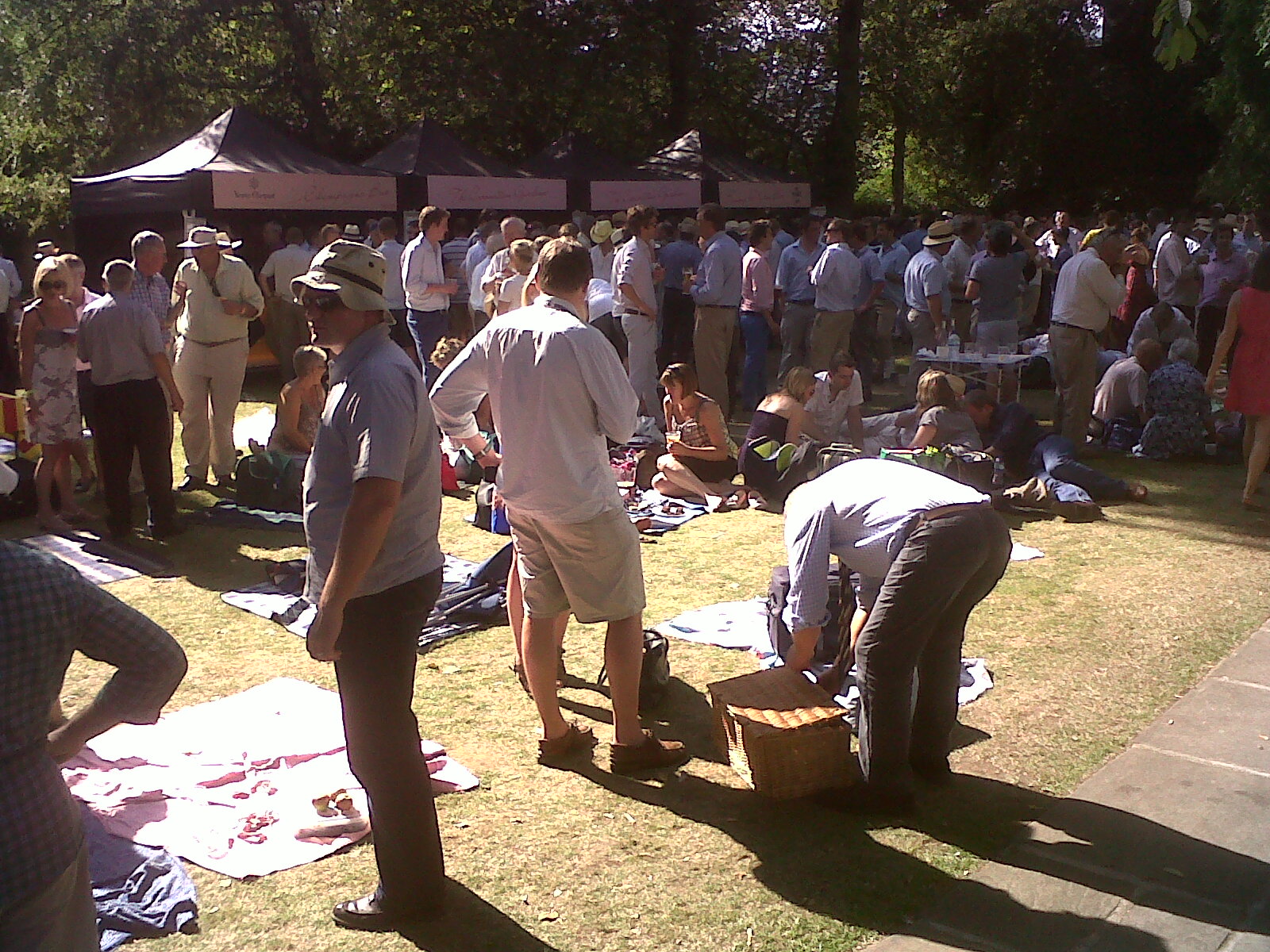
Not many runs were scored in the day, but it was absorbing stuff. There’s nothing to match the ebb and flow of Test cricket. But anyone who has ever been to a Test match at Lord’s knows that it’s not just about the cricket. Few people remain in their seats for the whole day; you can easily pop out for some refreshment, stroll around the various shops and other facilities, or even just sit down and have a picnic.

Unfortunately, the combination of the heat and excessive consumption of “refreshments” was too much for one gentleman I saw flaked out as I stretched my legs. The stewards and the police between them were politely suggesting that it was time for him to go home…

Admissions Latest

Posted in Education, Politics with tags , , , , , , , on November 28, 2011 by telescoper

Only time for a short post today, so I thought I’d just pass on a link to the latest  Higher Education application  statistics, as reported by the Universities and Colleges Admissions Service (UCAS).

It’s still several weeks before the UCAS deadline closes in January so it’s too early to see exactly what is happening, but the figures do nevertheless make interesting reading.

The total number of applications nationally  is down by 12.9% on last year, but the number of  applications from UK domiciled students has fallen by 15.1%; an increase in applications from non-EU students is responsible for the difference in these figures.

Non-science subjects seem to be suffering the biggest falls in application numbers; physical sciences are doing better than average, but still face a drop of 7% in numbers. Anecdotal evidence I’ve gleaned from chatting to Physics & Astronomy colleagues is that some departments are doing very well, even increasing on last year, while others are significantly down. It is, however, far too early to tell how these numbers will translate into bums on seats in lecture theatres.

A particular concern for us here in Wales are the statistics of applications to Welsh universities.  The number of English-domiciled applicants to Welsh universities is down by 17.4% while the number of Welsh applicants to Welsh universities is down by 15.2%. On the other hand, the number of Welsh applicants to English universities is down by just 5.3%.

The pattern of cross-border applications is particularly important for Welsh Higher Education  because of the Welsh Assembly Government’s policy of subsidizing Welsh-domiciled students wherever they study in the United Kingdom, a policy which is generous to students but which is paid for by large cuts in direct university funding.  The more students take the WAG subsidy out of Wales, the larger will be the cuts in grants to Welsh HEIs.

Moreover, in the past, about 40% of the students in Welsh universities come from England.  If the fee income from incoming English students is significantly reduced relative to the subsidy paid to outgoing Welsh students then the consequences for the financial health of Welsh universities are even more dire.

Although it is early days the figures as they stand certainly suggest the possibility that the  number of Welsh students  studying in England will increase both relative to the number staying in Wales and relative to the number of English students coming to study in Wales. Both these factors  will lead to a net transfer of funds from Welsh Higher Education Institutions to their English counterparts.   I think the policy behind this is simply idiotic, but by the time the WAG works this out it may be too late.

Another interesting wrinkle on the WAG’s policy can be found in a piece in last week’s Times Higher. We’re used to the idea that people might relocate to areas where schools or  local services are better or cheaper, but consider the incentives on an English  family who are thinking of the cost of sending their offspring to University. The obvious thing for them  to do is to relocate to Wales in order to collect the WAG subsidy which they can then spend sending their little dears to university in England. That will save them tens of thousands of pounds per student, all taken directly from the Welsh Higher Education budget and paid into to the coffers of an English university.

There are already dark rumours circulating that the WAG subsidy will turn out to be so expensive that the Higher Education Funding Council for Wales is thinking of cancelling all its research funding. That means that Welsh universities face the prospect of having to take part in the burdensome Research Excellence Framework, in competition with much better funded English and Scottish rivals, but getting precisely no QR funding at the end of it.

And all this is because the Welsh Assembly Government wants to hand a huge chunk of its budget back to England. Is this how devolution is supposed to work? Madness.

The Lord’s Day

Posted in Cricket with tags , , , , , , on July 24, 2011 by telescoper

Time for a brief report on yesterday’s Big Day Out to London to watch the third day’s play of the First Test between England and India at Lord’s. The journey there passed off without a hitch, and I got into London a shade after 9am. It’s a fairly short walk from Paddington to Lord’s (if you know the way!) and the queue to get in moved pretty quickly, so  I was inside the ground well before 10am, scoffing a splendid bacon sandwich in the Warner stand, adjacent to the pavilion.

The weather wasn’t quite as good as I’d hoped – overcast most of the day, and not particularly warm – but we got started on time at 11am and had a full day’s play. The ground was full, and there was a good atmosphere, with a sizeable contingent of Indian supporters adding to that special buzz you get on the Saturday of a Test Match at Lord’s.

Conditions, being conducive to swing, were fairly helpful to the bowlers, although it took them a while to find their line (especially in the case of Tremlett, who also kept bowling no-balls). Of the two Indian openers, Mukund looked far the more assured; his partner, Gambhir struggled in comparison. This pair took the total to 63 without too many alarms until Stuart Broad was brought into the attack and proved to be the pick of the England bowlers. He quickly disposed of Gambhir for a slow 15 of 46 balls, managing to squeeze a full delivery between bat and pad.

That brought in Raul Dravid, who batted most of the rest of the day for a very fine century (103 not out). Mukund, who had scored the lion’s share of the runs in the opening partnership, got to 49 and stuck there for quite some time, held up by the accuracy of England’s bowling and, one suspects, nerves at the prospect of a half-century at Lord’s. Eventually he reached for a wide ball from Broad to drive and, rather unluckily, played on.

That brought in one of the all-time greats Sachin Tendulkar (to a warmly-felt standing ovation from the Lord’s crowd). I had been looking forward for ages to see him play.  One or two early alarms notwithstanding, Tendulkar and Dravid looked increasingly secure and began to score freely against the attacking field placings set by England captain Andrew Strauss. It was starting to look like  a mammoth Indian score might be on the cards when, somewhat surprisingly to me, Tendulkar edged one from Broad and a sharp chance was snaffled by Swann at slip; he was gone for 34 and India were 158 for 3.

There then followed a fascinating period of play, in which Swann (who hadn’t bowled before lunch) twirled away from the Pavilion End while a combination of quick bowlers (first Broad, and then Tremlett) steamed in from the Nursery End. England dropped two catches in one over from Broad, and Swann was posing problems but not making a breakthrough. Laxman, who had come in to replace Tendulkar looked all at sea and eventually played a rash lofted pull shot, which was caught right in front of us at deep backward square leg. India 182 for 4 was soon 183-5 as Raina went lbw to Swann, who deserved a wicket, although he did tend to bowl a bit short on occasions.

Mindful of the possibility of a collapse, the Indian batsmen went into their shells and there followed an absorbing period of attritional cricket, as Dhoni and Dravid steadied the ship. Then Dhoni was caught at slip of Tremlett – who bowled much better later in the day – to be replaced by Harbhajan Singh who survived one no-ball before playing a dreadful shot which resulted in him being caught at the wicket by Prior.

At 241-7 India were in real danger of being forced to follow on (which can be enforced if the team batting second does not get within 200 runs of the first innings total; England scored 474-8, so India needed to reach 275 to avoid it). In strode Kumar who made it quite clear what his strategy was going to be by clubbing his first ball for 4. He played  a variety of shots in his short innings – some authentic, some agricultural – not only adding entertainment value, but also taking India to 276 before skying a hook shot and getting caught.  Neither the injured Khan (batting with a runner) nor Sharma troubled to scorers and India ended up all out for 286, with Dravid remaining unbeaten until the end.

It was getting fairly dark at this point, about 6.30pm, and England couldn’t have been relishing the 5 overs they had to face before the close but they survived without loss, and I headed off back to Paddington. A thoroughly enjoyable day’s cricket and, I might add, quite a few beers. I also took a bit of time off the cricket to take a stroll around the perimeter of the stadium, which is an interesting thing to do as there are many shops and catering outlets around. The main shop at Lord’s is a bit of a disappointment, however, full of ugly overpriced tat, but  at least no hideous paperweights.

Anyway, many thanks to my genial host for the day – we were in the part of the ground reserved for members and their guests – old friend and regular contributor this blog, Anton.

Unfortunately the journey home wasn’t so enjoyable. I got the train on time, but we stopped just past Swindon where it appeared that all power had been lost on the signals between Swindon and Bristol Parkway. We sat motionless and then trundled back to Swindon, eventually setting off again via Gloucester, of all places. I’m glad I took a good long book with me, as the crossword didn’t take very long. I was supposed to be at Cardiff Central at 21.47, but didn’t actually arrive until 11.27, 1 hour and 40 minutes late. Columbo was most annoyed.

Never Say Never …

Posted in Cricket with tags , , , , on May 30, 2011 by telescoper

It was tipping down with rain this morning so I wrote off the prospect of there being any result in the First Test between England and Sri Lanka at Cardiff which I’ve blogged about once already. However, the weather steadily improved and play eventually got started at about 3pm. England, resuming on 491 for 5, batted on for a couple of overs to allow Ian Bell to get his century then – perhaps surprisingly – declared on 496-5, with a lead of 96 on the first innings. An unusually adventurous decision by Strauss to declare so early, in fact. Nevertheless, a draw looked a virtual certainty to me (and most sports writers) so I wasn’t paying much attention to the cricket at first, deciding instead to get on with some other stuff at home.

When I checked the score around 4 o’clock I discovered Sri Lanka had lost a couple of early wickets and had gone in for tea at 33-2. It being free to get in for the last session and the weather now being very sunny, I finally decided to go and watch the final stages. A draw still seemed the likeliest outcome – Sri Lanka only had to bat out time for 35 overs or so. However, we don’t get much Test cricket in Cardiff and the last match here had an exciting finish, so I walked to the ground just after tea. There couldn’t have been more than a few hundred spectators in the ground, but what we saw turned out to be a demonstration of what Test cricket is all about.

I had hardly got to my seat when Tremlett produced a beauty that found the edge of M. Jayawardene’s bat and was caught at slip. Sri Lanka 33-3. A few minutes later Samaraweera played an inexplicable slash at spinner Graham Swann and dragged the ball onto his stumps; 36-4. Swann then disposed of Sangakkara and Maharoof, and Tremlett took the wicket of P. Jayawardene, all with the score on 43. Sri Lanka’s batting, so solid in the first innings was now in pieces on the floor. In came Herath with the air of a man wishing to commit suicide. Eventually he succeeded, playing an agricultural swipe at a delivery from Swann; he missed and the ball hit him on the back leg, plumb in front of the wicket. At 52-8 Sri Lanka looked doomed. Perera decided to take the attack to England. He played some good shots, as well as some lucky ones, and was fortunate to be dropped when two fielders ran into each other. Nevertheless, he and Mendis steadied the Sri Lankan ship for a while. I on the other hand was literally shaking with excitement and anticipation, hoping that I was about to witness a spectacular finale.

The score quickly moved onto 82 and it looked like Sri Lanka might at least have a chance of making England bat again. Then Broad replaced Tremlett, Perera tried to flick him away and Ian Bell took a superb reaction catch at short leg. 82-9. Last man Lakmal departed without troubling the scorers just three balls later, caught at 3rd slip by Alastair Cook. England had won by an innings and 14 runs. Amazing.

It had all been so exciting I hadn’t even had time to think about going for a beer. I think I’ll have one while I watch the highlights on TV.

There really is nothing like Test cricket, you know…

Testing Times

Posted in Cricket with tags , , , , on May 29, 2011 by telescoper

It’s raining this morning (again), delaying the start of the fourth day’s play in the First Test between England and Sri Lanka which is taking place at the SWALEC Stadium here in Cardiff, just a few hundred yards from my house.

One of the advantages of living so close to the ground is that I can stay home and dry when there is a delayed start and simply toddle down there when start of play is announced on the radio. That’s my plan for today, in fact. It was a similar state of affairs yesterday. There was heavy rain first thing, which had been forecast, but it was exacerbated by persistent heavy drizzle for hours afterwards, which hadn’t. The covers therefore stayed on all morning with the result that (a) play didn’t start until 2pm but (b) I had time to write a lengthy blog post about Friday’s concert and (c) have lunch at home before walking to the ground.

The match was interestingly poised, with Sri Lanka all out for exactly 400 and England on 47-1 having lost Andrew Strauss late on Friday evening. Jimmy Anderson, who had come in as nightwatchman, departed almost immediately on Saturday, bringing in Jonathan Trott to join Alastair Cook. The pair batted steadily on. And on. Seventy overs passed, in fact, and the two accumulated runs in remorseless fashion without offering any significant chances, adding 240 runs to bring England to 287-2 at stumps, both reaching fine centuries. It wasn’t thrilling strokeplay of the crash-bang-wallop style you get in Twenty20, but good old-fashioned Test cricket. I thought it was magnificent, although it’s probably precisely the kind of cricket that puts some people off Test matches.

Unfortunately, the state of the game and the weather both mean that anything other than a draw is extremely unlikely. There’s already been quite a lot of time lost to the rain and only Sri Lanka’s first innings is complete. The forecast for today is showery – it’s raining right now, in fact – so it’s unlikely we’ll get a full day’s play. The forecast for Day 5 is even worse – with heavy rain in store most of the day. It’s hard to see how two more innings can possibly be completed. Moreover, England’s best bowler, James Anderson, is injured and will not be bowling in the Sri Lanka second innings (if there is one). The Cardiff wicket is basically a good batting pitch, although it is a bit on the slow side,  and I don’t see how England can bowl out Sri Lanka with only two seamers and a spinner. If England could have got to 600 plus then with a full bowling attack they might have had a chance at an inning’s victory – especially if the pitch starts to turn, which it shows signs of doing – but that seems very unlikely now.

At the risk of being too critical, I think this all illustrates the folly of England’s selection policy. They went into this game knowing that Sri Lanka was a good batting side, and Sri Lanka’s fine first innings display should not have come as a surprise. I wasn’t at the first two days’ but it seems that the England bowling attack looked quite ordinary even at full strength. I think a Test team really needs five bowlers. In the absence of a genuine all-rounder, England should not have picked a specialist batsman (Morgan) at number 6, but another bowler and the top-order batsmen told to stand up and be counted (which is precisely what they are doing). Wicket-keeper Prior should be at 6, with Broad and Swann counting as half an all-rounder each. The injury to Anderson reinforces this argument, as does Broad’s obvious lack of match fitness. They might get away with it for this game, but think they need to rethink this before taking on India who are a much stronger side than Sri Lanka.

I had been hoping to take a few snaps in the ground, but like the idiot I am I forgot to charge my phone up beforehand and when I got there the battery was almost flat. I decided to preserve what juice there was for emergency calls – though that was an unlikely contingency – by refraining even from Tweeting for the duration, regular intakes of beer staving off any sense of boredom. It was well after 7pm when the final over was bowled, and I only just got home to watch Barcelona’s comprehensive dismantling of Manchester United in the Champion’s League final.

UPDATE: Just for the record, England ended day 4 on 491-5 with Trott out for 203 and Bell unbeaten on 98. Great batting from everyone, except Pietersen. Not much chance of a result, though, especially if the weather forecast for tomorrow is accurate…

True North

Posted in Uncategorized with tags , on April 25, 2011 by telescoper

Following on from an earlier post in which, amongst other things, I tried to educate the residents of internetshire about the facts of English geography, let me put an end to the argument about what is the North and what isn’t.

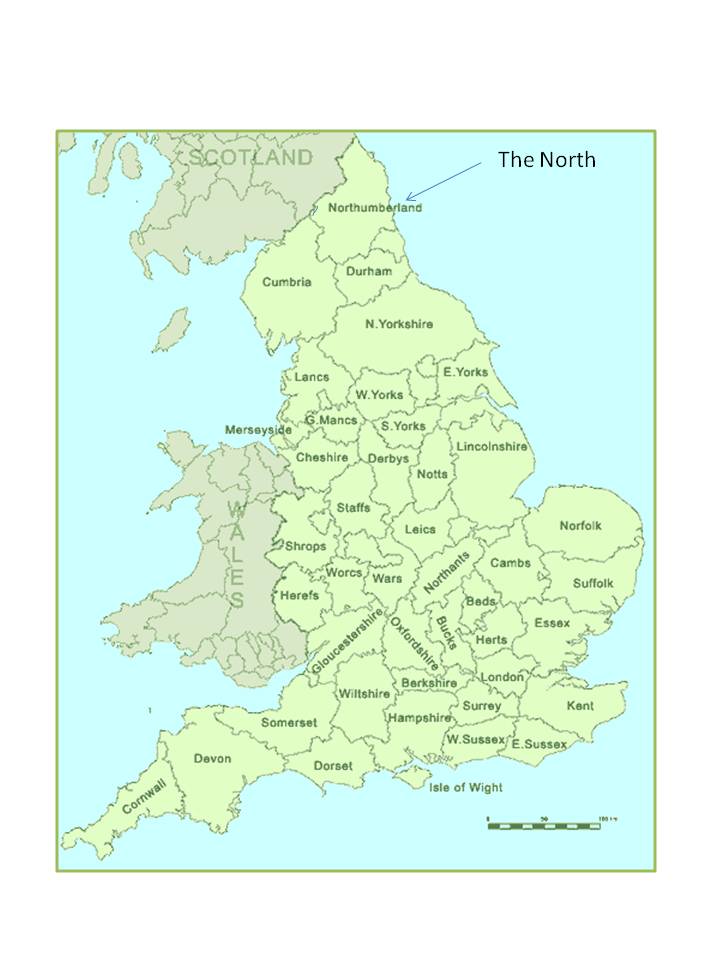
For reference please consult the following map, kindly supplied by an angry commenter calling himself Chris from Yorkshire (The North)…

..I’m sure this proves beyond all reasonable doubt that “The North”  actually means Northumberland – the clue’s in the name, really. The nameless County between Northumberland and Durham is Tyne and Wear – a relatively recent invention which confuses the issue slightly, but which I include in my definition of “The North” for historical reasons.

Anyway, my point is that Manchester, Leeds, Liverpool etc are all much further South than The North. Even North Yorkshire isn’t really in the North, as any objective reading of the map proves. Sorry, Chris from Yorkshire (The Midlands). I rest my case.

P.S. Looking at the peculiarities of the border between England and Wales has helped me understand why the train crossed in and out of England so many times between Cardiff and Llandudno last week!

Ashes Victory

Posted in Cricket, Poetry with tags , , , , , on January 7, 2011 by telescoper

Well, there you have it. England’s cricketers finally won the final Test of the Ashes series in Sydney by an innings and 83 runs, to win the series outright. It has been a wonderful performance by the England team down under which has warmed the cold English (and Welsh) winter.

Commiserations to Australian cricket fans. Their team just wasn’t as good as England, with bat or ball. They have a lot of rebuilding to do, but you can be sure they’ll be back challenging for the Ashes again before long.

I thought I’d put up a poem to celebrate. This one is called The Game and was written by John Groves. It represents an idyllic view of what many English crickets fans surely regard as the match of any season – the Lord’s Test – which we can now look forward to with relish in the summer. However, I chose this poem for this occasion primarily because of the final couplet which takes us far beyond the boundaries of St John’s Wood.

A painter’s sky over Lord’s.
A gentle zephyr, blowing without brace,
The crowd engaged in all that joy affords
And England batting with admired grace.
The sun ablaze, an unforgiving pitch,
A bowler with a patriotic itch,
A ticking scoreboard and a close-run thing,
A resolute gull, high on a drowsy wing.

Though one team triumph, victory’s all the same:
The winner is the beauty of the game.


Share/Bookmark