Archive for ESA

Spazio Commerciale

Posted in Science Politics, The Universe and Stuff with tags , , , , , on March 23, 2010 by telescoper

So here we are then. The United Kingdom has its own brand new Space Agency, courtesy of Lords Mandelson and Drayson (or Peter and Paul as they’re known to their fans). It was launched today at a glitzy do in Westminster attended by everyone who’s anyone in space science, which obviously doesn’t include me. There’s even a new logo.

According to the BBC, the new agency will be “muscular”, but I’m not really sure what that means. Perhaps brains might be more useful than brawn in this context (unless it’s Werner Von, geddit?) In fact I’m not at all sure what the new agency is about at all. The UK is already part of the European Space Agency (ESA) and a big slice of the new agency’s budget will presumably be eaten up by the ESA subscription. Much of what we do in space exploration and astronomy is dictated by decisions at the ESA level so I don’t think the new UK Agency will have much impact on that. On the other hand, the only current UK space agency is the British National Space Centre (BNSC), which is an organisation notable only for its irrelevance. I’m not even sure whether it exists at all as anything other than a logo and an accommodation address above a chip shop in Swindon.

It’s somewhat easier to see what the new UK Space Agency isn’t about. The accompanying press release doesn’t mention astronomy at all, so it’s clearly not going to help us lowly scientists who would like to use space observatories to do interesting science. It seems that it is primarily aimed at commercial space activities, and the science bit will continue to be managed mismanaged by the Science and Technology Facilities Council.

I’ve got nothing against the commercial exploitation of space, in principle, although it did provoke my feeble attempt at an Italian joke in the title of this post. The French, Germans and Italians spend much more than we do and this is obviously an area of great potential growth. I don’t object to the government using public money to help the space sector grow, either. In principle. The problem is that in these tough times the money has to be taken from somewhere else in the budget. Many of us were still hoping that the government might intervene to reverse the awful cuts we’ve suffered in physics and astronomy recently, but hiving space science off into a separate pot will probably make life even tougher for those of us left with the rump of STFC. I fear it means even less money in future going into fundamental science, and our decline is therefore set to accelerate even further.

There have always been tensions within the astronomy and space science community. Space exploration has scored many recent triumphs – such as the joint ESA-NASA Cassini-Huygens probe – but there are always difficult questions about the scientific value for money involved in sending things pottering around our backyard in the  solar system compared to, e.g., building observatories (either in space or on the ground) that can see things across the other side of the Universe. It’s difficult to see what the implications of the new agency are for this, but it seems likelyto me  that increasing amounts of public money will go on exploration at the expense of observation. I’m biased, of course, but I think there’s a lot more interesting science in the distant universe than there is nearby. In fact there’s more of everything further away than there is nearby! We may end up killing off ground-based astronomy in order to put a British flag on the Moon. That would be very sad.

But maybe this is too pessimistic. We don’t know yet how things will be divvied up between the new agency and the old STFC. Will there be any science  in UK Space, or will it be entirely commercial? Perhaps new missions and experiments will be funded through that route while exploitation continues to be  (under)funded by STFC?

Or maybe, since the new agency comes into existence on 1st April 2010, it’s all just an elaborate joke?

And while I’m being facetious, I wonder how many of you are thinking that the new logo looks like it was taken from the opening credits of Dad’s Army? I wonder if that choice was awfully wise, Captain Mainwaring?

STFC Chief Executive Keith Mason is very keen on the new outfit and is looking forward to working with it.  I know what Private Frazer would have said. We’re doomed.

PS. Andy Lawrence was there, and invites you to pump him  in the debriefing room over at the e-astronomer.

PPS. The new agency has now got a wikipedia page. It says there that the space agency will take over responsibility for space technology and instrumentation funding from other research councils. Presumably exploitation of space missions will either remain the responsibility of STFC or there won’t be any at all, which may amount to the same thing.

Planck and the Cold Galaxy

Posted in The Universe and Stuff with tags , , , , , , on March 17, 2010 by telescoper

Just a quick post to show a cool result from Planck which has just been released by the European Space Agency (ESA). It will be a while before any real cosmological results are available, but in the meantime here are a couple of glimpses into the stuff we cosmologists think of as foreground contamination but which are of course of great interest in themselves to other kinds of astronomers.

The beautiful image above (courtesy of ESA and the HFI Consortium) covers a portion of the sky about 55 degrees across. It is a three-colour combination constructed from Planck’s two shortest wavelength channels (540 and 350 micrometres, corresponding to frequencies of 545 and 857 GHz respectively), and an image at 100 micrometres obtained with the Infrared Astronomical Satellite (IRAS). This combination effectively traces the dust temperature: reddish tones correspond to temperatures as cold as 12 degrees above absolute zero, and whitish tones to significantly warmer ones (a few tens of degrees above absolute zero) in regions where massive stars are currently forming. Overall, the image shows local dust structures within 500 light years of the Sun.

Our top man in the HFI Consortium,  Professor Peter Ade, is quoted as saying

..the HFI is living up to our most optimistic pre-flight expectations.  The wealth of the data is seen in these beautiful multicolour images exposing previously unseen detail in the cold dust components of our galaxy.  There is much to be learned from detailed interpretation of the data which will significantly enhance our understanding of the star formation processes and galactic morphology.

This Planck image was obtained during the first Planck all-sky survey which began in mid-August 2009. By mid-March 2010 more than 98% of the sky has been observed by Planck. Because of the way Planck scans the sky 100% sky coverage for the first survey will take until late-May 2010.

Other new results and a more detailed discussion of this one can be found here and here.

Cosmic Vision

Posted in Science Politics, The Universe and Stuff with tags , , , , , , , , , on February 20, 2010 by telescoper

It’s nice to have a bit of science stuff to blog about for a change. Just this week the European Space Agency (ESA) has  announced the results of its recent selection process for part of its Cosmic Visions programme, which represents ESA’s scientific activity for the period 2015-2025.

The selection process actually began in 2007, with over 50 proposals. This list was then whittled down so that there were six candidate missions under consideration for the so-called M-class launch slots (M meaning medium-sized), and three in the L-class list of larger missions. The latest exercise was to select three of the M-class missions for further study. They succeeded in selecting three, but have also kept another, much cheaper, mission in the frame.

As far as I understand it, only two M-class missions are actually envisaged so the race isn’t over yet, but the missions still in the running are:

PLATO.  The PLATO mission is planned to study planets around other stars. This would include terrestrial planets in a star’s habitable zone, so-called Earth-analogues. In addition, PLATO would probe stellar interiors by through stellar seismology. In some sense, this mission is the descendant of a previous proposal called Eddington. (PLATO stands for PLAnetary Transits and Oscillations of stars – I’ll give it 3/10 for quality of acronym).

EUCLID. Euclid would address key questions relevant to fundamental physics and cosmology, namely the nature of the mysterious dark energy and dark matter. Astronomers are now convinced that these substances dominate ordinary matter. Euclid would map the distribution of galaxies to reveal the underlying ‘dark’ architecture of the Universe. I don’t think this is meant to be an acronym, but I could be wrong. Perhaps it’s European Union Cosmologists Lost in Darkness?

SOLAR ORBITER. Disappointingly, this is neither an acronym nor a Greek person. It would take the closest look at our Sun yet possible, approaching to just 62 solar radii. It would deliver images and data that include views of the Sun’s polar regions and the solar far side when it is not visible from Earth.

These are the three main nominations, but the panel also decided to endorse another mission, SPICA, because it is much cheaper than the approximately 500 Million Euro price tag on the other contenders. SPICA would be an infrared space telescope led by the Japanese Space Agency JAXA. It would provide ‘missing-link’ infrared coverage in the region of the spectrum between that seen by the ESA-NASA Webb telescope and the ground-based ALMA telescope. SPICA would focus on the conditions for planet formation and distant young galaxies.

Many of Cardiff’s astronomers will be very happy if SPICA does end up being selected as it is the one most directly related to their interests and also their experience with Herschel which is, incidentally,  continuing to produce fantastic quality data. If SPICA is to happen, however, extra money will have to be found and that, in the current financial climate, is far from guaranteed.

Which of these missions will get selected in the end is impossible to say at this stage. There are dark mutterings going on about how realistic is the price tag that has been put on some of the contenders. Based on past experience, cost overruns on space missions are far from unlikely and when they happen they can cause a great deal of damage in budgets. Let’s hope the technical studies do their job and put realistic figures on them so the final selection will be fair.

Whatever missions fly in the end, I also hope that the Science and Technology Research Council (STFC) – or whatever replaces it – remembers that these are science missions, and its responsibility extends beyond the building of instruments to fly on them. Let’s to hope we can count on their support for research grants enabling us to answer the science questions they were designed to address.

Astronomy Look-alikes, No. 3

Posted in Astronomy Lookalikes with tags , , on December 31, 2009 by telescoper

Well, I seem to be on a roll but I don’t want to use them all up at once so here’s a last one for the day. Has anyone ever noticed the remarkable similarity between Professor David Southwood, Director of Science at the European Space Agency, and the erstwhile TV Sports presenter Des Lynam?

Des Lynam

David Southwood

Space Anomaly

Posted in Science Politics, The Universe and Stuff with tags , , on December 17, 2009 by telescoper

After yesterday’s marathon, I’m not planning today to post another lengthy item about the STFC prioritisation exercise which is now public. However, a number of people have asked me about an apparent anomaly in the rankings and, despite the hostile reception I received on the e-astronomer when I posted a comment there, I’ve decided to mention it briefly here in an attempt to explain what looks at first sight like a very strange state of affairs.

BepiColombo (no relation) is a Mercury Orbiter mission by the European Space Agency (ESA). It was selected as a result of a lengthy Europe-wide process. The UK space science community showed relatively little interest in the mission, but it had sufficient support elsewhere to avoid being cancelled about three years ago. So it was picked for the programme, and is now scheduled for launch in 2014. It will take about 6 years to reach Mercury and will take data for a year or two after that.

As is the case with these big ESA “cornerstone” missions, participating countries are called upon to bid to build instruments to fly on the spacecraft. Although this requires an additional investment from the funding agencies (in this case STFC) beyond the annual subscription, this is essentially the only way of securing a science return for UK Plc on the ESA subscription. The UK is in fact involved in two instruments on BepiColombo, a magnetometer and an X-ray spectrometer, although it is the second of these that has the main funding commitment from STFC. Roughly speaking, STFC has commissioned UK scientists and given them funds to build a UK part of BepiColumbo.

I’ll remark here that I always thought the most interesting thing about Mercury is its magnetic field – it’s quite surprising even that it has one – so given the chance I’d prefer to have seen the UK getting more involved in that. But what do I know? I’m just a physicist…

Anyway, in the UK’s recent prioritisation exercise, BepiColombo was graded 1 on a scale of 1 (low) to 5 (high), reflecting the relatively low interest in this mission among UK space scientists. Many projects rated 3 were cancelled, and even those rated 4 and 5 are going to have their funds cut by 15 to 20% so it looks very strange to have BepiColombo retained in the final programme, especially if you’re working on an alpha-3 project that’s just been canned.

However, it’s all a bit more complicated than that. While the UK itself wasn’t particularly interested in this mission, it did attract strong support in the rest of Europe. The UK signed up to the whole ESA menu and was thus obliged to go along with it; a la carte was not an option. ESA decides its programme, with UK input, but we do not have a veto. STFC (and previously PPARC) entered into various agreements, including a Memorandum of Understanding, from which it would be disastrous to back out.

I don’t know how much BepiColombo is costing STFC, but it’s likely to run into millions. That money could have supported other things in the astronomy programme, including postdoctoral grants. But before you jump to the conclusion that astronomy has been stitched up, remember that the ESA subscription has also opened up new areas of research through missions such as Planck and Herschel. These are a boon to our research, but the privilege of being allowed to participate in them comes at the price of having to support things the UK astronomy community is less keen on. In this particular example the politics of the situation and the need to fulfil our obligations within ESA have trumped the scientific judgement of the UK community.

To put this another way, would you want to scrap UK participation in this mission if it also meant binning our involvement in Herschel, Planck, JWST and all the rest.

I’m not advocating we scrap BepiColombo any more than we should scrap any of the other primary elements of the ESA programme. However, I do think that the nature of this balancing act should be more widely known. Otherwise, as things stood, it just looks like some vested interest has taken the funds from more deserving causes in order to promote a pet project. I hope I’ve made it clear that did not happen and that STFC had no choice but to fund BepiColombo.

I think it helps to get these things out in the open, in apparent contrast to some colleagues in the space lobby who seem to prefer to silence debate rather than engage with it. It’s no wonder people get suspicious when that’s the attitude shown by those in positions of responsibility on STFC committees.

If I’ve said anything unfair or unreasonable here please feel free to comment, as long as you can refrain from gratuitous abuse…

Spire Spectra

Posted in The Universe and Stuff with tags , , , , , , on November 27, 2009 by telescoper

OK, so it turns out I lied about not posting today. It’s not because I’m a dishonest professor, though. It’s just that I couldn’t resist drawing your attention to the new results that have just been released by the European Space Agency. To whet your appetite, have a shufty at this exquisite far infrared spectrum of the star VY Canis Majoris taken using the SPIRE instrument for which Cardiff is the lead institute.

VY Canis Majoris (VY CMa) is a red hypergiant, an enormous evolved star located in the constellation Canis Major. With a radius 2600 times that of the Sun, it is the largest known star and it is also one of the most luminous stars known. It is located about 4900 light years away from Earth, has a luminosity in excess of 100,000  solar luminosities, and a mass in the range 30-40 solar masses.

The shell of gas it has ejected displays a complex structure, the so-created circumstellar envelope is among the most remarkable chemical laboratories known in the universe, creating a rich set of organic and inorganic molecules and dust species. Through stellar winds, these inorganic and organic compounds are injected into the interstellar medium, from which new stars orbited by new planets may form. Most of the carbon supporting life on planet Earth was probably made by this kind of evolved star. VY CMa is close to the end of its life and could explode as a supernova at any time.

Spectroscopic results may be a bit less photogenic than pretty pictures, but they often yield much more physically relevant information than simple images. As I’ve mentioned before, it is in spectroscopy where we find the difference between astronomy and astrophysics (or, less politely, between stamp collecting and science).  In this case the spectrum gives a detailed breakdown of the chemical mixture present in the matter ejected by this star.

You can find other stunning examples of Herschel’s infrared spectroscopic capabilities here and you can read more about the involvement of Cardiff astronomers in these stunning new science results on our own pages here.

There’s also a story on the BBC Website.

Planck’s Progress

Posted in The Universe and Stuff with tags , , on November 10, 2009 by telescoper

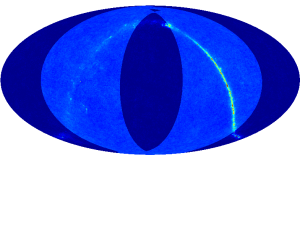
Only time for a very quick post today, so I thought I’d just pass on some news I got via Chris North about how Planck is doing. As it happens, the satellite has recently reached  the point where it has observed about half the sky. It spins on its axis in rather stately fashion (at about one revolution per minute) and, as it moves in its orbit, that sweeps the telescope across the celestial sphere. Each scan is almost a great circle, but  these gradually creep around over about a six month period to cover the whole sky.

The nice picture below, in ecliptic coordinates, shows how far it has got. You can also see the Galactic plane, arching across the sky and showing up clearly at the frequencies Planck is sensitive to.

Planck3NovSkyCoverage

The Planck Consortium had an official meeting last week in Bologna at which they drank lots of wine and ate lots of food, but other than that nobody who was there has told me anything.

It’s all very hush hush don’t you know.