Archive for European Space Agency

It’s Official, it’s PLATO!

Posted in Science Politics, The Universe and Stuff with tags , , , , on February 19, 2014 by telescoper

Just a quick post to pass on the news that the European Space Agency has officially selected the third M-Class mission to form part of its Cosmic Vision Programme (which covers the period 2015-2025). The lucky winner is PLATO (PLAnetary Transits and  Oscillations of stars) and it will detect extra-solar planets by monitoring relatively nearby stars, searching for tiny, regular dips in brightness as planets transit in front of them. It will also study astroseismological activity, enabling a precise characterisation of the host star of each planet discovered, including its mass, radius and age.

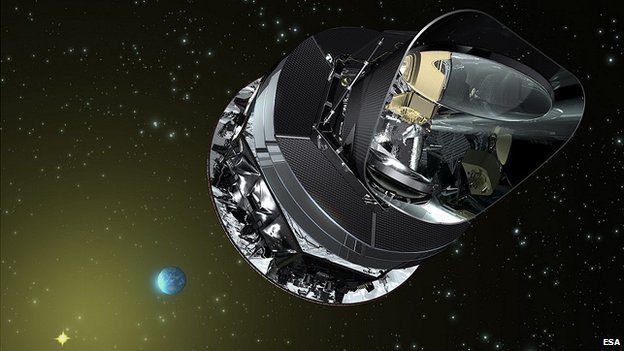
plato_satelliteIt is expected that PLATO will find and analyse thousands of  such exoplanetary systems in this way, with an emphasis on discovering and characterizing Earth-sized planets and super-Earths in the habitable zone of their parent star. PLATO will be launched on a Soyuz rocket from Europe’s Spaceport in Kourou by 2024 for an initial six-year mission. It will operate from the Second Lagrange Point, or L2 for short. It’s an intriguing design consisting of 34 small telescopes (left).

PLATO joins Solar Orbiter and Euclid, which were chosen in 2011 as ESA’s first two M-class missions. Solar Orbiter will be launched in 2017 to study the Sun and solar wind from a distance of less than 50 million km, while Euclid, to be launched in 2020, will focus on dark energy, dark matter and the structure of the Universe.

The decision to select PLATO wasn’t exactly a surprise as it was singled out as the leading candidate by an expert panel last month, but there was nevertheless some nervousness among certain senior astronomers at the Royal Astronomical Society on Friday in advance of the formal decision. I suspect they’ll all be out celebrating tonight!

Top Ten Gaia Facts

Posted in Astrohype, The Universe and Stuff with tags , , , on December 20, 2013 by telescoper
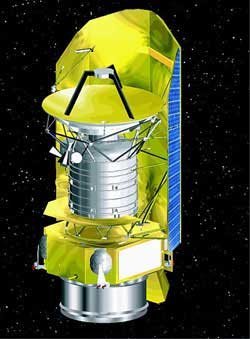
Gaia looks nothing like the Herschel Space Observatory shown here.

Gaia looks nothing like the Herschel Space Observatory shown here.

Since yesterday’s successful launch of the European Space Agency’s Gaia mission I have been inundated with requests for more information about this impressive satellite and the science behind it. As a service to the community, and for the edification of the public at large, I therefore thought I’d share my list of top ten Gaia facts via the medium of this blog:

  1. The correct pronunciation of GAIA is as in “gayer”. Please bear this in mind when reading any press articles about the mission.
  2. The GAIA spacecraft will orbit the Sun at the Second Lagrange Point, the only place in the Solar System where the  effects of cuts in the UK science budget can not be felt.
  3. The data processing challenges posed by GAIA are immense; the billions of astrometric measurements resulting from the mission will be analysed using the world’s biggest Excel Spreadsheet.
  4. To provide secure backup storage of the complete GAIA data set, the European Space Agency has commandeered the world’s entire stock of 3½ inch floppy disks.
  5. As well as measuring billions of star positions and velocities, GAIA is expected to discover thousands of new asteroids and the hiding place of Lord Lucan.
  6. GAIA can measure star positions to an accuracy of a few microarcseconds. That’s the angle subtended by a single pubic hair at a distance of 1000km.
  7. The precursor to GAIA was a satellite called Hipparcos, which is not how you spell Hipparchus.
  8. The BBC will be shortly be broadcasting a new 26-part TV series about GAIA. Entitled WOW! Gaia! That’s Soo Amaazing… it will be presented by Britain’s leading expert on astrometry, Professor Brian Cox.
  9. Er…
  10. That’s it.

Countdown to GAIA

Posted in The Universe and Stuff with tags , , , on December 18, 2013 by telescoper

Just a quick post to point out that tomorrow morning at 9.12am GMT will see the launch of the European Space Agency’s Gaia mission.  You can watch the launch live here from about 8.50 GMT. I’ll be in a meeting at 9am tomorrow morning, so I’m probably going to miss it.

Gaia arrives on the Launchpad at Kourou, French Guyana, on 13th December

Gaia arrives on the Launchpad at Kourou, French Guyana, on 13th December

I remember first hearing about Gaia about 15 years ago when I was on a PPARC advisory panel and was simultaneously amazed  by the ambition of its objectives and sceptical that it would ever get off the ground. Now its almost ready to go, so fingers crossed for a successful launch tomorrow.

Coincidentally, Gaia is among the various telescopes and observatories featured in the STFC Roadshow we put on  viewfor an Astronomy Master Class we have been putting on for local schools over the last couple of days here at the University of Sussex:

IMG-20131218-00248

Gaia is a global space astrometry mission, which will make the largest, most precise three-dimensional map of our Galaxy by surveying more than a thousand million stars. In some sense it is the descendant of the Hipparcos mission launched in 1989, but it’s very much more than that. Gaia will monitor each of its target stars about 70 times over a five-year period. It is expected to discover hundreds of thousands of new celestial objects, such as extra-solar planets and brown dwarfs, and observe hundreds of thousands of asteroids within our own Solar System. The mission is also expected to yield a wide variety of other benefits, including new tests of the  General Theory of Relativity.

Gaia will create an extraordinarily precise three-dimensional map of more than a thousand million stars throughout our Galaxy (The Milky Way) and beyond, mapping their motion, luminosity, temperature and chemical composition as well as any changes in such properties. This huge stellar census will provide the data needed to tackle an enormous range of important problems related to the origin, structure and evolutionary history of our Galaxy. Gaia will do all this by repeatedly measuring the positions of all objects down to an apparent magnitude of 20. A thousand million stars is about 1% of the entire stellar population of the Milky Way.

For the brighter objects, i.e. those brighter than magnitude 15, Gaia will measure their positions to an accuracy of 24 microarcseconds, comparable to measuring the diameter of a human hair at a distance of 1000 km. Distances of relatively nearby stars will be measured to an accuracy of 0.001%. Even stars near the Galactic Centre, some 30 000 light-years away, will have their distances measured to within an accuracy of 20%.

It’s an astonishing mission that will leave an unbelievably rich legacy not only for the astronomers working on the front-line operations of Gaia but for generations to come. I have a feeling that there might be  a few sleepless nights tonight waiting for the launch, but I suppose astronomers should be used to that!

UPDATE: 19/12/2013 Success! Launch went smoothly, separation of the Gaia spacecraft achieved. Now we have to wait for a month or so for it to get to L2, settle itself down, and then start doing science. The first data release isn’t due for 22 months…Bon Voyage!

Planck and Being Human

Posted in The Universe and Stuff with tags , , , on October 23, 2013 by telescoper

On Saturday 19th October the instruments and cooling systems on the European Space Agency’s Planck spacecraft were switched off, marking the end of the scientific part of the Planck mission, after about four years of mapping the cosmic microwave background.  Later, a piece of software was uploaded that would prevent  the spacecraft systems being  accidentally switched on again after being switched off and the transmitter from causing interference with any future probes.  Planck is already “parked” indefinitely in a what is called a “disposal” orbit, far from the Earth-Moon system, having been nudged off its perch at the 2nd Lagrangian Point (L2) in August by a complicated series of manoeuvres. On October 21st the spacecraft’s thrusters were fired to burn up the last of its fuel, an important aspect of rendering the spacecraft inert, as required by ESA’s space debris mitigation guidelines.

Planck

These preliminaries having been completed, today, at 12.00 GMT,  a final instruction will be transmitted to the spacecraft  to close it down permanently; thereafter Planck will circle the Sun as a silent memorial to the stunning success it achieved when active. I’m sure all those who worked on the Planck mission will pause as the final shutdown command is given and ponder the lonely future  of the spacecraft that had supplied so much interesting data.

But although this will be the end of the Planck mission, it is by no means the end of the Planck Era. Vast amounts of data still need to be fully analysed and key science results are still in the pipeline,  relating in particular to the polarization of the microwave background radiation. Moreover, the numerous maps, catalogues and other data products will be a priceless legacy to this generation, and no doubt many future generations, of scientists.

The fate of Planck illustrates two contrasting aspects of the human experience. On the one hand, there’s the fragility of our existence in a cosmos too vast for us to comprehend. Like the defunct spacecraft, our Earth too circles this little Sun of ours in a precarious orbit while the rest of the Universe – with its countless billion upon billion of other suns – carries on, oblivious to our very existence. Planck makes us painfully aware of our own insignificance.

But on the other hand there’s the sense of fulfillment, and even of joy, at finding things out. We may have puny monkey brains and many things are likely to remain forever beyond our mental grasp, but trying to figure things out is one of the things that defines us as human.  Experiments like Planck (and, for that matter, the Large Hadron Collider) are not the wasteful extravagance some people claim them to be. We need them not just for the sake of science, but to remind us of our common humanity.

UPDATE: And now, from ESA, confirmation that Planck has received its last command. Goodbye, and enjoy your retirement!

Has Planck closed the window on the Early Universe?

Posted in The Universe and Stuff with tags , , , , , , , , on April 7, 2013 by telescoper

A combination of circumstances – including being a bit poorly – has made me rather late in getting around to reading the papers released by the Planck consortium a couple of weeks ago. I’ve had a bit of time this Sunday so I decided to have a look. Naturally I went straight for, er, paper No. 24, which you can find on the arXiv, here.

I picked this one to start with because it’s about primordial non-Gaussianity. This is an important topic because the simplest theories of cosmological inflation predict the generation of small-amplitude irregularities in the early Universe that form a statistically homogeneous and isotropic Gaussian random field. This means that the perturbations (usually defined in terms of departures of the metric from a pure Robertson-Walker form) are defined by probability distributions which are invariant under translations and rotations in 3D space.

In a nutshell, such perturbations arise quite simply in inflationary cosmology as zero-point oscillations of a scalar quantum field, in a very similar way the Gaussian distributions that arise from the quantized harmonic oscillator. Assuming the fluctuations are small in amplitude the scalar field evolves according to

\ddot{\Phi} +3H\dot{\Phi} + V^{\prime}(\Phi),

which is similar to that describing a ball rolling down a potential V, under the action of a force given by the derivative V^{\prime}, opposed by a “frictional” force depending on the ball’s speed; in the inflationary context the frictional force depends on the expansion rate H(\Phi, \dot{\Phi}). If the slope of the potential is relatively shallow then there is a slow-rolling regime during which the kinetic energy of the field is negligible compared to its potential energy; the term in \ddot{\phi} then becomes negligible in the above equation. The universe then enters a near-exponential phase of expansion, during which the small Gaussian quantum fluctuations in \Phi become Gaussian classical metric perturbations.

On the one hand, Gaussian fluctuations are great for a theorist because so many of their statistical properties can be calculated analytically: I played around a lot with them in my PhD thesis many moons ago, long before Planck, in fact long before any fluctuations in the cosmic microwave background were measured at all! The problem is that if we keep finding that everything is consistent with the Gaussian hypothesis then we have problems.

The point about this slow-rolling regime is that it is an attractor solution that resembles the physical description of a body falling through the air: eventually such a body reaches a terminal velocity defined by the balance between gravity and air resistance, but independent of how high and how fast it started. The problem is that if you want to know where a body moving at terminal velocity started falling from, you’re stumped (unless you have other evidence). All dynamical memory of the initial conditions is lost when you reach the attractor solution. The problem for early Universe cosmologists is similar. If everything we measure is consistent with having been generated during a simple slow-rolling inflationary regime, then there is no way of recovering any information about what happened beforehand because nothing we can observe remembers it. The early Universe will remain a closed book forever.

So what does all this have to do with Planck? Well, one of the most important things that the Planck collaboration has been looking for is evidence of non-Gaussianity that could be indicative of primordial physics more complicated than that included in the simplest inflationary models (e.g.  multiple scalar fields, more complicated dynamics, etc).  Departures from the standard model might just keep the window on the early Universe open.

A simple way of defining a parameter that describes the level of non-Gaussianity is as follows:

\phi = \phi_{G} + f_{NL} \left( \phi_{G}^2 -< \phi_{G}^2 > \right)

the parameter f_{NL} describes a quadratic contribution to the overall metric perturbation \phi: you can think of this as being like a power series expansion of the total fluctuation in terms of a Gaussian component \phi_{G}; the term in angle brackets is just there to ensure the whole thing averages to zero. This definition of non-Gaussianity is not the only one possible, but it’s the simplest and it’s the one for which Planck has produced the most dramatic result:

f_{NL}=2.7 \pm 5.8,

which is clearly consistent with zero. If this doesn’t look impressive, bear in mind that the typical fluctuation in the metric inferred from cosmological measurements is of order 10^{-5}. The quadratic terms are therefore of order 10^{-10}, so the upper limit on the level of non-Gaussianity allowed by Planck really is minuscule. This is one of the reasons why some people have described the best-fitting model emerging from Planck as the Maximally Boring Universe

So it looks like only very unwise investors will be buying shares in cosmological non-Gaussianity at least in the short-term. More fundamentally we may be approaching the limit of what we can learn about inflation in particular, or even the early Universe in general, using the traditional techniques of observational cosmology. But there remain very intriguing questions that may yet shed light on the pre-inflationary epoch. Among these are the large-scale anomalies seen in the very same Planck data that have put such stringent limits on non-Gaussianity. But that question, described in Planck Paper 23, will have to wait for another day…

Planck (but only in name?)

Posted in Science Politics, The Universe and Stuff with tags , , , , , , on March 3, 2013 by telescoper

First, a serious announcement. It appears that the announcement of results from the Planck Mission will be streamed live from ESA HQ on 21st March from 10.00 to 12.00 CET (whatever that is). The UK will remain on GMT until 31st March so the  ESA web server will probably crash at 9am British time on 21st March.

There’s a short press release making this announcement here. It says:

On Thursday 21 March 2013, the main scientific findings from the European Space Agency’s Planck spacecraft will be announced at a press briefing to be held at ESA’s Headquarter in Paris. Simultaneously with this event, data products and scientific papers based on the “nominal” operations period will be made public through the Planck Legacy Archive.

I was interested in the appearance of the word “nominal” in quotes in there so I searched for its meaning in the One True Chambers Dictionary, where I found:

nominal, adj relating to or of the nature of a name or noun; of names; by name; only in name; so-called, but not in reality; inconsiderable, small, minor, in comparison with the real value, hardly more than a matter of form…

Interesting. It seems that the “nominal” could mean, on the one hand, that ESA are being unusually modest about the importance of the forthcoming Planck results or, on the other, that there will now be a host of conspiracy theorists suggesting that the Planck results aren’t real….

That reminds me that years and years ago I had an idea for a crime novel with a plot that revolves around the murder of a prominent cosmologist just as some important scientific discovery is about to be announced. Suspicion gathers that the whole thing is an enormous hoax and the discovery bogus. But the experiment is shrouded in secrecy, and so expensive that it can’t easily be repeated, so  who can tell, and how?

It’s very difficult to know for sure whether any scientific discoveries are genuine or not, even if the data and analysis procedures are made public. There’s always the possibility that everything might have been fabricated simulated, but in most cases the experiment can be repeated at a later date and the fraud eventually exposed, such as in the Schön Scandal.  In Big Science, this may not be practicable. However, Big Science requires big teams of people and the chances are someone would blow the whistle, or try to…

Anyway, I know that there are people out there who take everything I write on this blog absurdly literally so I’ll spell it out that I am in no way suggesting that the Planck mission is a fraud. Or predicting that there’ll be a murder just before the announcements on March 21st. Any similarity purely coincidental and all that. And I’ve never had time to write the book anyway – perhaps a publisher might read this and offer me an advance as an incentive?

Moreover, going back to the Chambers Dictionary, I note the final definition omitted above

…according to plan (space flight)

So that’s that. Nothing sinister. I’m not sure how “nominal” acquired that meaning, mind you, but that’s another story…

Herschel at the Royal Society

Posted in The Universe and Stuff with tags , , , on July 2, 2012 by telescoper

I found this nice little video about the forthcoming Royal Society Summer Science Exhibition which opens tomorrow at the Royal Society’s premises in Carlton House Terrace in London.

Astronomers from Cardiff University are heavily involved in one of the exhibits related to the Herschel Telescope – To infrared and beyondI’m actually doing a couple of shifts on the Herschel stand myself, on  Thursday and Friday afternoons, as well as during a posh black tie  “soirée” on Thursday evening. Last time I attended such an event (in 2009) was during a heat wave, which made the soirée an uncomfortably sticky experience, but the forecast suggests the weather might be a bit different this time round…

ESA Endorses Euclid

Posted in Euclid, Science Politics, The Universe and Stuff with tags , , , , , , on June 20, 2012 by telescoper

I’m banned from my office for part of this morning because the PHYSX elves are doing mandatory safety testing of all my electrical whatnots. Hence, I’m staying at home, sitting in the garden, writing this little blog post about a bit of news I found on Twitter earlier.

Apparently the European Space Agency, or rather the Science Programme Committee thereof, has given the green light to a space mission called Euclid whose aim is to “map the geometry of the dark Universe”, i.e. mainly to study dark energy. Euclid is an M-class mission, pencilled in for launch in around 2019, and it is basically the result of a merger between two earlier proposals, the Dark Universe Explorer (DUNE, intended to measure effects of weak gravitational lensing) and the Spectroscopic All Sky Cosmic Explorer (SPACE, to measure wiggles in the galaxy power spectrum known as baryon acoustic oscillations); Euclid will do both of these.

Although I’m not directly involved, as a cosmologist I’m naturally very happy to see this mission finally given approval. To be honest, I am a bit sceptical about how much light Euclid will actually shed on the nature of dark energy, as I think the real issue is a theoretical not an observational one. It will probably end up simply measuring the cosmological constant to a few extra decimal places, which is hardly the issue when the value we try to calculate theoretically is a over a hundred orders of magnitude too large! On the other hand, big projects like this do need their MacGuffin..

The big concern being voiced by my colleagues, both inside and outside the cosmological community, is whether Euclid can actually be delivered within the agreed financial envelope (around 600 million euros). I’m not an expert in the technical issues relevant to this mission, but I’m told by a number of people who are that they are sceptical that the necessary instrumental challenges can be solved without going significantly over-budget. If the cost of Euclid does get inflated, that will have severe budgetary implications for the rest of the ESA science programme; I’m sure we all hope it doesn’t turn into another JWST.

I stand ready to be slapped down by more committed Euclideans for those remarks.

The case for JUICE

Posted in Science Politics, The Universe and Stuff with tags , , , on May 8, 2012 by telescoper

Here’s a nice blog peace giving the case for JUICE (The Jupiter Icy Moon Explorer recently selected by the European Space Agency for its next L-class mission).

Duncan Forgan's avatarWell-Bred Insolence

There’s been a lot of chatter in astronomy circles about the negative consequences of ESA’s latest L-class (i.e. large) space mission selection.  JUICE (The JUpiter Icy moon Explorer) was selected over two rival missions – the New Gravitational wave Observatory (NGO), and the Advanced Telescope for High ENergy Astrophysics (ATHENA).  In the current age of global austerity, one group’s win is several groups’ losses, and understandably the X-Ray and gravitational wave communities are upset at the choice.  Indeed, reading the comments section on astro blogs might make planetary scientists go a little pale. Not least the fact that ATHENA supporters have already delivered a 1450 signature petition demanding a rethink.  The fact that the decision making process has been somewhat cloudy doesn’t help matters.

It does indeed suck that this is a zero-sum game (in fact, probably…

View original post 802 more words

Controversy brewing at ESA?

Posted in Science Politics with tags , , , , on April 23, 2012 by telescoper

Interesting stuff over at the e-astronomer relating to ESA’s handling of the process of selecting its next L-class mission. The plot thickens.

andyxl's avatarThe e-Astronomer

So the Athena folk are somewhat miffed at being pipped by Juice. (This metaphor doesn’t seem quite right ? Ed.) But what about Horse Number Three ? Aren’t the NGO folk doing a Grand Petition ? Nope. It seems their tactic is a semi-formal complaint about inadeqacies in the process : an email letter direct to Gimenez. I am not sure how widely it has been circulated, but I understand it is stern stuff, bringing up issues of inappropriate revisions of costings and risk factors, and inadequately resolved conflicts of interest. Feel free to comment if you have clear knowledge, but please (a) do not leak things that are confidential, and (b) keep coments about process and not about individuals.

Its not really clear what competition means when a very small number of items is under consideration, and moreoever each item represents one community-segment, each of which ESA wishes to…

View original post 356 more words