Archive for Exploring the Cosmos

Exploring the Cosmos at Maynooth

Posted in Maynooth, The Universe and Stuff with tags , , on October 4, 2023 by telescoper

Being away on sabbatical I almost forgot to post a reminder of the event I blogged about a few weeks ago at Maynooth University entitled Exploring the Cosmos. I’m told this has attracted a huge amount of interest, but the room for the event is very large and there may well be some space left.

Best wishes to everyone taking part and I hope it goes well!

On the 5th of October, at 6.30pm, in the TSI Building Maynooth University will host an all-ages event to explore the vastness of space. Using stunning visualisations Maynooth University Astrophysicists will examine star and planet formation, peer back in time with our physicists trying to image the very edges of our visible universe, and take a journey into the unknown as we trace the origin and evolution of black holes.

Programme:

18.30 Welcome

18.35: John Regan: “Black Holes in Our Universe”

Black Holes are among the most exotic objects in our Universe. In this talk John will discuss the basics of black hole formation, how we can detect them today and the future of black hole hunting using gravitational wave observatories that Maynooth University is a part of. John will also discuss some of the strange effects you might encounter near a black hole – like time slowing down!

18.55: Aoibhinn Gallagher: “The Dark Universe”

There is so much in our universe which is unknown to us, most of it in fact. What is dark matter, what is dark energy? We will go on a journey during this talk through the history of our universe and the history of cosmology (the study of the universe) itself to try and arrive at answers to these questions. Also I will talk about the real life science happening at Maynooth university on these very topics.

19.15: Tea & Coffee Break

19.45: Neil Trappe: “Seeing the Invisible Universe – Terahertz Astronomy”

When you look outside at the clear night sky you will see many thousands of stars overheard. The Moon, stars, planets, comets and galaxies can all be observed if you know where to look just using your eyes, binoculars or a telescope.

Astronomers spend many hours looking at the night sky with large automated telescopes from many exotic places around the world to add to our knowledge of the Universe and understand difficult questions like how did the Sun and our Solar System form, how are stars born and how do they die, is there life elsewhere in the Universe, and indeed how did the Universe come into existence at all?

In Maynooth University a team of researchers develop telescopes to see the Universe with different kinds of light, specifically far infrared or “terahertz” light. Why do we do this – we see the Universe differently and can learn lots more information ‘seeing’ with terahertz radiation that is invisible to our eyes.

20.05: Patrick Kavanagh: “The First Year of the James Webb Space Telescope”

The James Webb Space Telescope has made unexpected and groundbreaking discoveries almost routine in its first year. It has produced captivating images of our own Solar System, measured the content of atmospheres around other stars, viewed the stellar birth and death in amazing detail, revealed the skeletal structure of galaxies, and peered deep in to the cosmic past in search of the first stars and galaxies. In this talk Dr. Kavanagh will give an overview of Webb and present some of the highlights of the first year of this revolutionary telescope.

20.30: Finish

It should be a fun evening. If you’re around please come along. This event is free to attend but you need to register, which you can do here. Please feel free to share this with friends and colleagues.
Exploring the Cosmos at Maynooth

Posted in Maynooth, The Universe and Stuff with tags , , on September 21, 2023 by telescoper

Regular readers of this blog – both of them – may remember that last year there was an event at Maynooth University entitled Exploring the Cosmos which was very well attended, with over 400 people showing up. That event was held during Space Week 2022 and it was such a success that it’s being repeated during this year’s Space Week.

I gave a talk at last year’s event but won’t be there this year as I’ll be away on sabbatical. Some of the other speakers are different too. The fact that the line-up has changes is good because it means that people who came last year will get a different set of presentations.

On the 5th of October, at 6.30pm, in the TSI Building Maynooth University will host an all-ages event to explore the vastness of space. Using stunning visualisations Maynooth University Astrophysicists will examine star and planet formation, peer back in time with our physicists trying to image the very edges of our visible universe, and take a journey into the unknown as we trace the origin and evolution of black holes.

Programme:

18.30 Welcome

18.35: John Regan: “Black Holes in Our Universe”

Black Holes are among the most exotic objects in our Universe. In this talk John will discuss the basics of black hole formation, how we can detect them today and the future of black hole hunting using gravitational wave observatories that Maynooth University is a part of. John will also discuss some of the strange effects you might encounter near a black hole – like time slowing down!

18.55: Aoibhinn Gallagher: “The Dark Universe”

There is so much in our universe which is unknown to us, most of it in fact. What is dark matter, what is dark energy? We will go on a journey during this talk through the history of our universe and the history of cosmology (the study of the universe) itself to try and arrive at answers to these questions. Also I will talk about the real life science happening at Maynooth university on these very topics.

19.15: Tea & Coffee Break

19.45: Neil Trappe: “Seeing the Invisible Universe – Terahertz Astronomy”

When you look outside at the clear night sky you will see many thousands of stars overheard. The Moon, stars, planets, comets and galaxies can all be observed if you know where to look just using your eyes, binoculars or a telescope.

Astronomers spend many hours looking at the night sky with large automated telescopes from many exotic places around the world to add to our knowledge of the Universe and understand difficult questions like how did the Sun and our Solar System form, how are stars born and how do they die, is there life elsewhere in the Universe, and indeed how did the Universe come into existence at all?

In Maynooth University a team of researchers develop telescopes to see the Universe with different kinds of light, specifically far infrared or “terahertz” light. Why do we do this – we see the Universe differently and can learn lots more information ‘seeing’ with terahertz radiation that is invisible to our eyes.

20.05: Patrick Kavanagh: “The First Year of the James Webb Space Telescope”

The James Webb Space Telescope has made unexpected and groundbreaking discoveries almost routine in its first year. It has produced captivating images of our own Solar System, measured the content of atmospheres around other stars, viewed the stellar birth and death in amazing detail, revealed the skeletal structure of galaxies, and peered deep in to the cosmic past in search of the first stars and galaxies. In this talk Dr. Kavanagh will give an overview of Webb and present some of the highlights of the first year of this revolutionary telescope.

20.30: Finish

It should be a fun evening. If you’re around please come along. This event is free to attend but you need to register, which you can do here. Please feel free to share this with friends and colleagues.
Last Call for Exploring the Cosmos

Posted in Maynooth, Talks and Reviews, The Universe and Stuff with tags , on October 5, 2022 by telescoper

A couple of weeks ago I announced that we’re holding a Space Week event here at Maynooth University called Exploring the Cosmos. Well, the inexorable march of time means that event is actually tomorrow so I’m posting this as a last chance for you to register, which you can do here.

The demand for tickets so far has been a bit overwhelming. So much so, in fact, that we’ve moved to a bigger room, organized microphones, and enlisted various people to help, e.g. to guide people into the venue. Fortunately all I have to do is give the last talk and then go to the pub.

Exploring the Cosmos at Maynooth

Posted in Maynooth, The Universe and Stuff with tags , , on September 26, 2022 by telescoper

I’ve had a very busy day so far, what with giving my first lecture to the first-year Mathematical Physics students accidentally smashing my phone then buying a new one and trying to reinstall various necessary apps on it and now having a Euclid telecon, that all I have time to do now is post an advertisement for a special event on Maynooth Campus next Thursday (6th October) called Exploring the cosmos: from Exoplanets to Black Holes. As you will see, the title really on describes the first half. Here is the official blurb:

On the 6th of October, at 6.30pm, in the TSI Building Maynooth University will host an all-ages event to explore the vastness of space. Using stunning visualisations Maynooth University Astrophysicists will examine star and planet formation, peer back in time with our physicists trying to image the very edges of our visible universe, and take a journey into the unknown as we trace the origin and evolution of black holes.

Programme:

18.30 Welcome

18.35: Emma Whelan: “Planet Hunting: How Maynooth University Astronomers are Searching for New Worlds”.

As of this month over 5000 exoplanets or new worlds have been discovered orbiting far flung stars millions of light years away from us. Emma will explore the hunt for exoplanets – planets outside our own solar system – and what scientists can learn about them. Emma will take you on a behind the scenes tour of the techniques astronomers use for finding new planets and the new insights astronomers hope the James Webb Space Telescope will bring.

18.55: John Regan: “Black Holes in Our Universe”

Black Holes are among the most exotic objects in our Universe. In this talk John will discuss the basics of black hole formation, how we can detect them today and the future of black hole hunting using gravitational wave observatories that Maynooth University is a part of. John will also discuss some of the strange effects you might encounter near a black hole – like time slowing down!

19.15: Tea & Coffee Break

19.45: Creidhe O’Sullivan: “Observations of the early Universe”

Creidhe will take us back to the origins of our universe. In her talk she will show you how scientists observe The Cosmic Microwave Background (CMB) – a specific type of radiation left over from the Big Bang – and what it can tell us about the early Universe and its formation. Creidhe will also take us close to home and talk about the experiments that Maynooth University are involved with to observe the CMB.

20.05: Peter Coles: “The Cosmic Web”

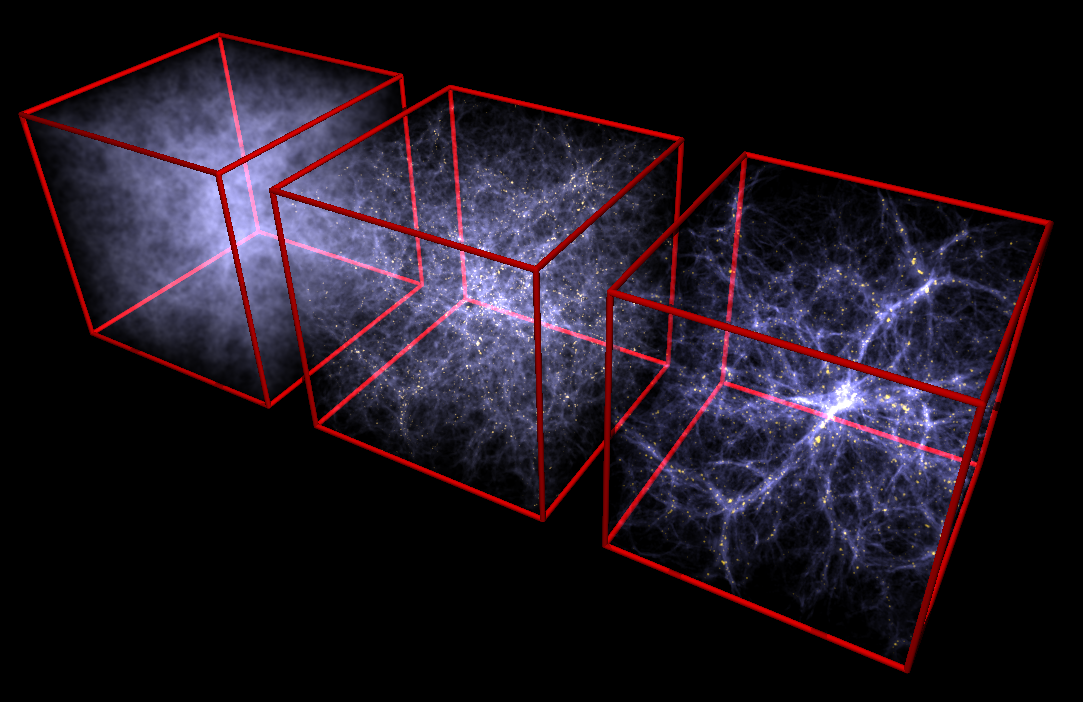
Peter’s talk will focus on the large scale structure of the Universe and the ideas that physicists are weaving together to explain how it came to be the way it is. Over the last few decades astronomers have revealed that our cosmos is not only vast in scale – at least 14 billion light years in radius – but also exceedingly complex, with galaxies and clusters of galaxies linked together in a cosmic web of immense chains and sheets, surrounding giant voids of empty space. Cosmologists have developed theoretical explanations for its origin that involve exotic concepts such as dark matter and dark energy, producing a cosmic web of ideas that is in many ways as rich and fascinating as the Universe itself. Peter will also discuss the Euclid mission – a large ESA mission to map the geometry of the Universe and better understand the mysterious dark matter and dark energy, which make up most of the energy budget of the cosmos. Peter is involved in the European Space Agency’s Euclid mission.

20.30: Finish

It should be a fun evening. After two years of being restricted to online events it’s nice to be able to do public talks like this in person. If you’re around please come along. The event is free but you need to register, which you can do here.