Archive for Facebook

Machine-based Censorship

Posted in Biographical with tags , , , , , , , on November 25, 2024 by telescoper

A very noticeable manifestation of the rise of so-called Artificial Intelligence has been the use of AI bots in censoring posts. The most recent example of this I’ve seen was on Saturday when I wrote a post about the general election candidates for my constituency, Kildare North. As usual when I write an article here it gets posted automatically on a variety of other platforms, including LinkedIn. However, Saturday’s post was blocked:
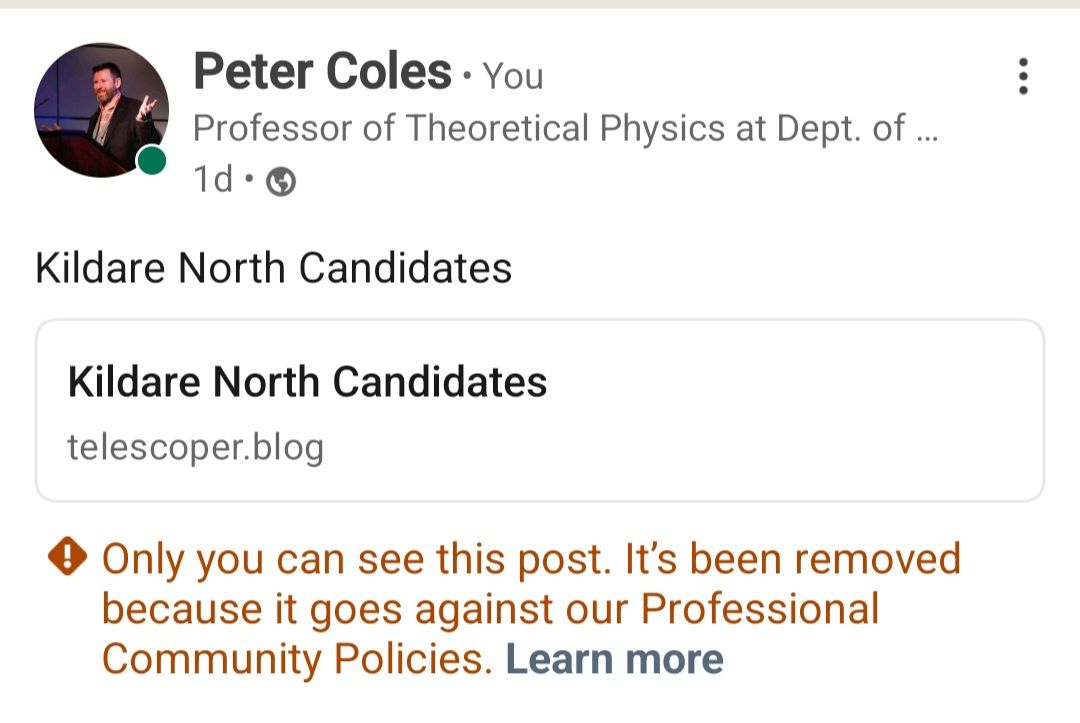
The powers that be did not tell me which of the “Professional Community Policies” that post might have violated so I looked through them all and couldn’t find any plausible reason for blocking that post. I can only assume some defect in the algorithm deployed by LinkedIn had been triggered wrongly. Unfortunately, all this is run by machine so there is no possibility of appeal.

I’ve noticed quite a few bizarre things like this over the past few weeks. The worst offender when it comes to random censorship is Meta (which runs Facebook, Instagram and Threads). I have been posting content automatically on Meta platforms, Facebook and Threads. Recently, however, Meta’s AI algorithm has gone berserk. A couple of weeks ago it blocked this post (about the Edgeworth family) on the grounds that it violated rules concerning “nudity or sexual activity”. Heaven knows how it decided that; you can read the post yourself. I defy you to find any nudity or sexual activity, or reference thereto, or link to any post that mentions such things, anywhere in it!

When I appealed the decision I got this.
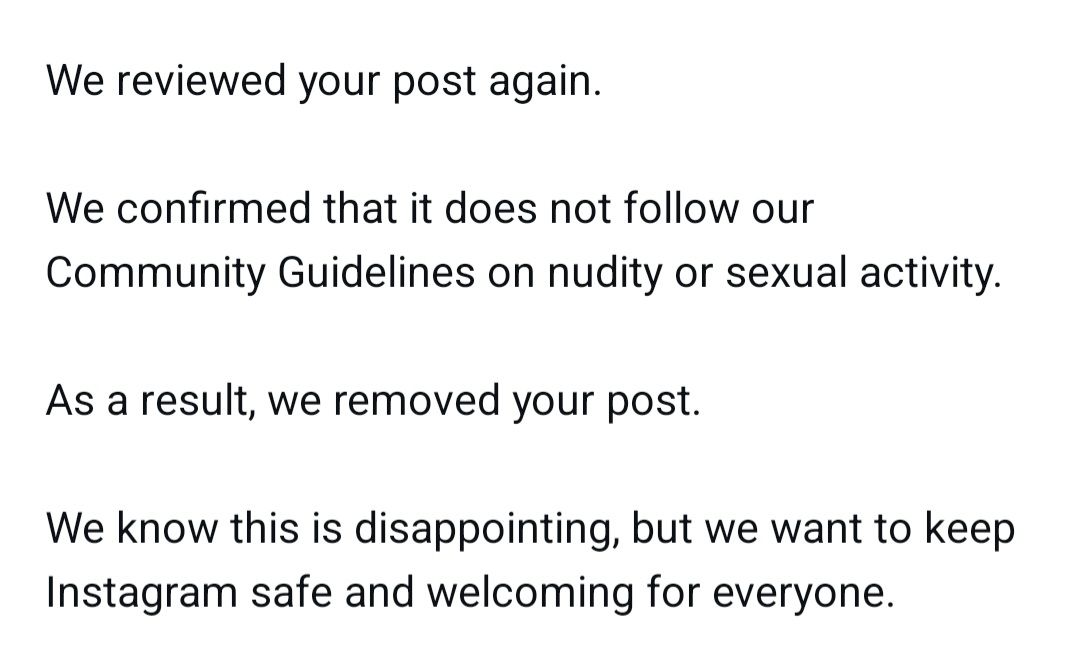
Truly bizarre.

More recently, it blocked this post (one of my regular weekly updates for OJAp) on the grounds that it was identified as spam. I can see the need for an automatic screening given the huge volume of posts, but the problem is that my facebook feed is full of actual spam that gets through these filters while innocent posts get blocked. In other words the algorithm is crap. If you ask for a review of the decision, all Meta does is run the algorithm again – with the same results, which is a waste of time.

The algorithm that screens comments on this blog for spam has also been playing up, with some comments from regular contributors being tagged as spam.

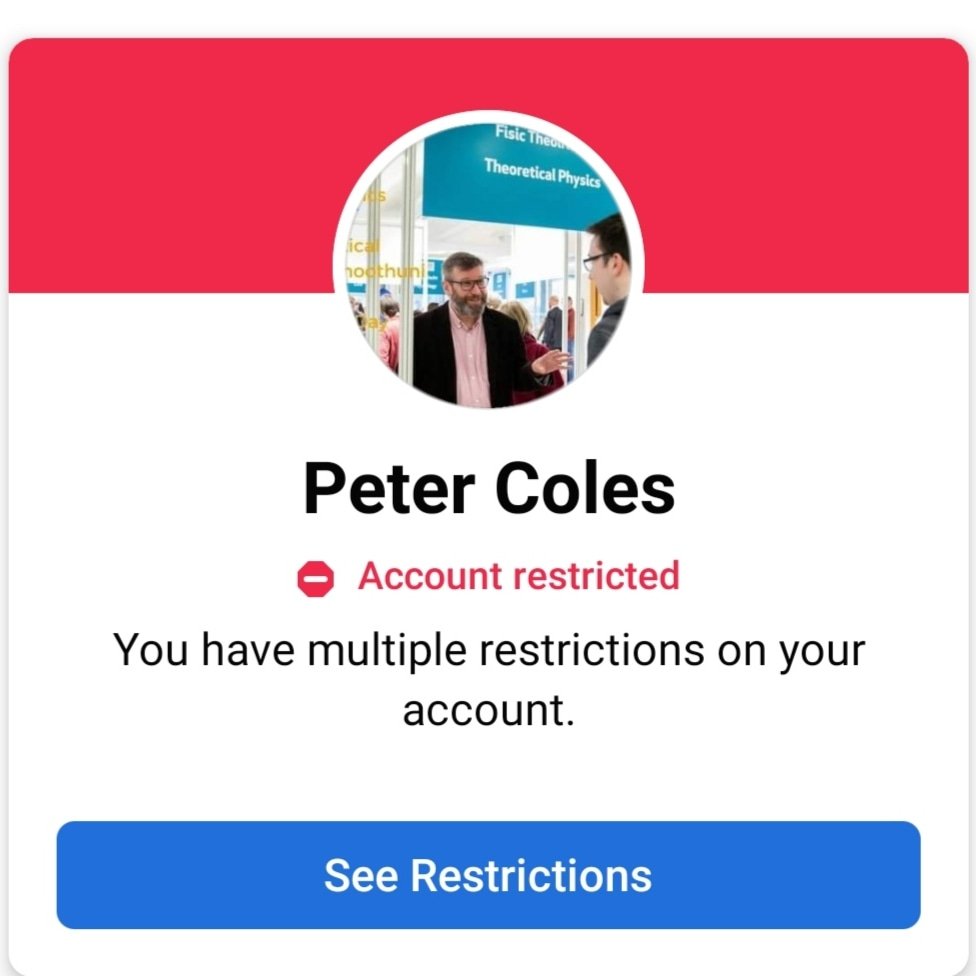
None of these is in itself of any consequence to me personally, not least because I’m not trying to run a business using these platforms. However, such AI engines are being deployed nowadays in a huge range of contexts primarily in order to save money. No doubt such processes do save money, but if they are based on poorly constructed algorithms – which they seem to be – the consequences could be dire. Imagine the horror of a health service based on poorly trained AI…
Social Media Better than Meta

Posted in Biographical with tags , , , , , , on November 16, 2024 by telescoper

You may or may not know that these blog posts appear automatically on various social media platforms.

I have been posting content automatically on Meta platforms, Facebook and Threads. Recently, however, Meta’s AI algorithm has been randomly blocking posts. A couple of weeks ago it blocked this post (about the Edgeworth family) on the grounds that it violated rules concerning “sexually explicit content”. Today it blocked this post (the weekly update for OJAp) on the grounds that it was identified as spam. I can see the need for an automatic screening given the huge volume of posts, but the problem is that my facebook feed is full of actual spam that gets through these filters while innocent posts get blocked. In other words the algorithm is crap. If you ask for a review of the decision, all Meta does is run the algorithm again – with the same results, which is a waste of time.

I haven’t got time to waste on such stupidity so I will shortly be deactivating automatic posts to Facebook and Threads; these generate very little traffic for me anyway.

There are, however, plenty of alternative ways of following this blog. You can subscribe by email or by RSS feed for a start. On other social media platforms I recommend the federated version on Mastodon here:

https://telescoper.blog/@telescoper.blog

They also appear on my personal Mastodon account here:

https://mastodon.social/@telescoper

Posts also appear on LinkedIn here:

https://www.linkedin.com/in/peter-coles-911912216/

and on my BlueSky account:

https://bsky.app/profile/telescoper.bsky.social

WordPress has just set up an automatic integration with BlueSky, on which I now have over 3000 followers, which is nice, but any one of these is better than Meta!

In the Dark on Social Media

Posted in Biographical, Politics with tags , , , , , , on August 12, 2024 by telescoper

It’s almost a year since I deactivated my Twitter account. Or should I call it X? Anyway, it doesn’t matter because I don’t use it any more. Over the past few weeks it seems quite a few more – especially in the UK – have had enough of the antics of Elon Musk (aka Space Karen), especially with his attempts to fan the flames of the recent Farage riots by spreading misinformation. The first thing I noticed was that my BlueSky account was suddenly getting quite a lot of new followers. I now have about 850, still a long way short of the over 7000 I used to have on Twitter, but the level of engagement is far higher. That’s because the algorithm Space Karen introduced on X makes it difficult for your own followers. let alone anyone else, to see your tweets. The one disadvantage of BlueSky is that it doesn’t have an API that allows me to post directly from this blog when I publish a post, so I have to copy the URL by hand.

I also have an account on Mastodon where I have over 1200 followers and similarly good engagement. When I first started there a couple of years ago it didn’t have a WordPress API but it does now, so everything I write here gets posted automatically on my feed. Not only that, this blog is now also now fully federated which means that there is an autonomous feed for the blog posts. Not just a link to each post, as the API produces, but the whole post. This is a nice feature because if I change a post on this WordPress platform it automatically gets changed on the Mastodon feed.

I also have a Facebook Page on which these

And now there’s Threads, which is like a version of Twitter bolted onto Instagram. When this first came out last year it wasn’t available in the EU for data protection issues so I didn’t bother with it. I only just found out at the weekend that has been available since December 2023 but I wasn’t paying much attention to social media then so didn’t catch the news. Anyway, since I already have a (very quiet) Instagram account so I set up a Threads account which you can find here if you like that sort of thing. My first impressions of Threads are not very favourable, but let’s see how it goes. At least it’s not as bad as Twitter. I still think it is indefensible that my employer, along with most other universities, has decided to maintain a presence on that site.

Facebook Folly

Posted in Biographical, Film with tags , , on February 7, 2022 by telescoper

Yesterday I found myself in the Facebook punishment block. My crime? To share a piece from the main RTÉ website about the film In Bruges.

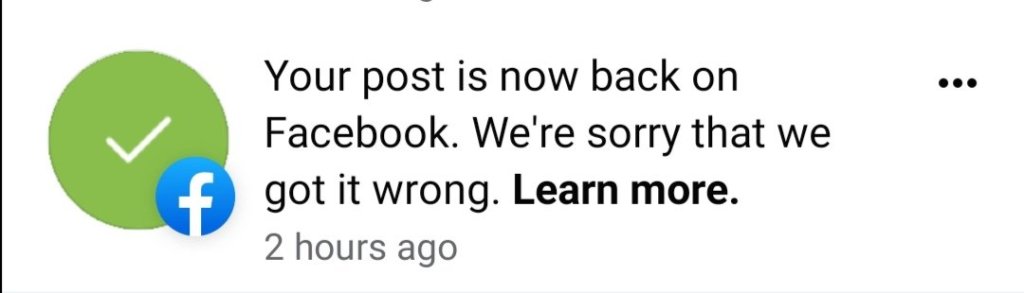
I couldn’t understand the decision to ban me for sharing an innocuous article about a comedy film (though it’s admittedly a very dark comedy) especially when material that is so much worse is allowed. A few hours later, however, I was unbanned. I clicked on the ‘learn more’ link to be taken to a blank page. I assume the whole thing was just a mistake.

Of course this ban/unban episode is of no consequence. What worries me though is that the ban was imposed immediately, suggesting that somebody (or some AI bot) must be watching everything that gets posted by users; the same entity is presumably also checking the constant stream of bigoted bile, anti-vax misinformation, far-right propaganda, and other hateful lunacies one sees on Fashbook every day and deciding that it’s all perfectly acceptable.

Introducing the Icelandverse

Posted in Biographical with tags , , , on November 13, 2021 by telescoper

At the end of another exhausting week this parody of Mark Zuckerberg and his “metaverse” cheered me up no end. It reminds me that I visited Iceland once in 2008 and enjoyed it enormously, but for some reason have never been back…

Ceci n’est pas un restaurant

Posted in Biographical with tags , on May 11, 2021 by telescoper

If you are among the several people who follow this blog on my Facebook Page then I apologize for any confusion caused by the fact that Facebook appears to have decided that I am a restaurant:

I wish to point out for the record that I am not a restaurant and therefore am not available at any time for delivery, and only in certain circumstances for pick-up.

I hope this clarifies the situation.

Mark Zuckerberg is 36.

Should Academics be (Facebook) Friends with Students?

Posted in Biographical, Education with tags , , , , on June 30, 2015 by telescoper

I noticed a short article in the Times Higher last week about a small survey that concluded that more than half academics count students among their Facebook friends. It’s actually a very small survey – of 308 academics, all based in America – of whom 54.4% admitted being “friends” with students.

For those of you who don’t use Facebook, a “Facebook friend” isn’t necessarily an actual real-life friend, it’s just someone else on Facebook with whom  you agree to share information, photographs, music and other stuff. Different people have different policies with regard to whether to accept or decline a friend request (or indeed initiate one). I only ever accept requests from people I know in another context, for example, which restricts the number of people who get to see my Facebook scribblings. Others are less selective and have many many more Facebook friends.

One of the things about Facebook is that people do sometimes share quite personal things, and sometimes things that might be quite compromising in a work context, e.g. pictures of themselves ina  state of inebriation. I suppose that’s why it’s a rather  contentious whether a member of academic staff in a University should or not be “friends” with their undergraduate students. I know many of my friends and colleagues  in academia flatly refuse to befriend undergraduate students (in the Facebook sense) and indeed this is the advice given by some institutions to staff. Most wouldn’t have a problem with having social media interactions with their graduate students, though. The nature of the relationship between a PhD student and supervisor is very different from that between an undergraduate and a lecturer.

There is a point on social media where professionalism might be compromised just as there is in other social interactions. The trouble is knowing precisely where that boundary lies, which is easy to misjudge. I’ve never felt that it was in any way improper to be friendly to students. Indeed I think that could well improve the students’ experience of education. If the relationship with staff is too distant students may not  feel comfortable asking for help with their work, or advice about wider things. Why should being “professional” mean not treating students as human beings?

One can take friendliness too far, however. There have to be some boundaries, and intrusive or demanding behaviour that makes students uncomfortable should be avoided.

I’ve thought about this quite a lot since I joined Facebook, which was in 2007. What I decided to do is simple. If a student initiates a friend request, I usually accept it (as long as I actually know who it is). Not many make such requests, but some do. More often, in fact, students send friend requests after they’ve graduated, when they perhaps feel liberated from the student-teacher relationship. On the other hand, I never initiate friend requests with students, for fear that they might feel pressured to accept it. It’s much the same as with other interactions.  For example, I rarely visit the extensive Student Spaces in the School without being invited there for a specific reason. If I did I’d just feel I was intruding. Many universities don’t bother to provide study space for their undergraduates, so this is probably only relevant here in Sussex.

Anyway, that’s my response. I know it’s a sort of compromise, but there you are. I am however interested in how other academics approach this issue. Plus, I haven’t done a poll for a while. So here we go:


BICEP2, Social Media and Open Science

Posted in Open Access, The Universe and Stuff with tags , , , on March 20, 2014 by telescoper

I’ve been finding it a bit difficult to keep up with all the BICEP2 excitement in between all the other things I’ve had to do this week but at least the blog has been generating some interest and there’s no sign of that abating yet.  In fact, according to the wordpress elves, today is the busiest day I’ve ever had on In the Dark – and it’s not even 6pm yet!

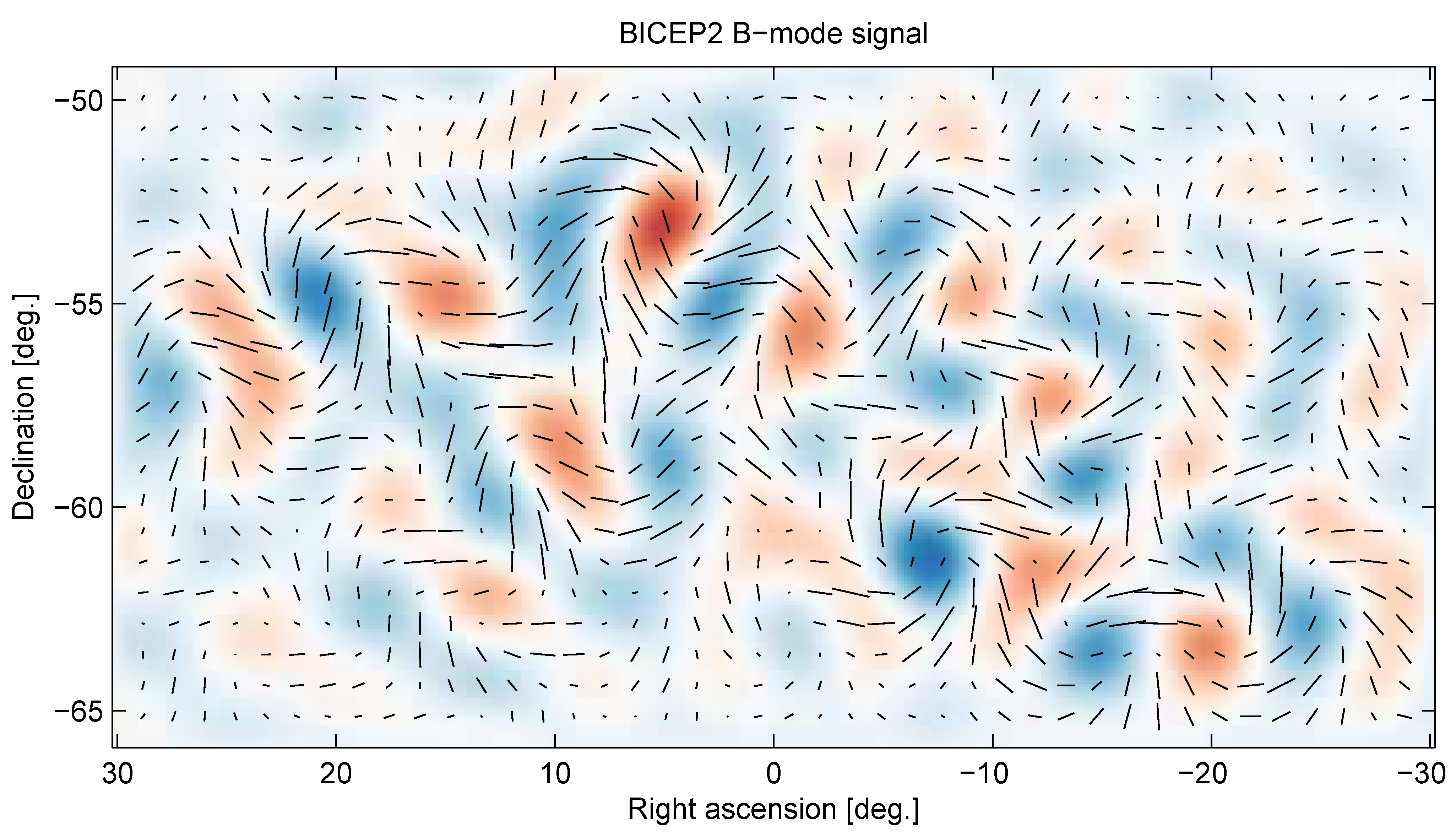
I realize that I’ve posted several items on B-modes without ever showing a picture of what they look like, so here you go, an image of the B-mode polarization seen by the BICEP2 experiment:

b_over_b_rect_BICEP2

When the BICEP2 team announced that  a “major astrophysics discovery” would be announced this Monday I have to admit that I was quite a bit uncomfortable about the way things were being done. I’ve never been keen on “Science by Press Release” and when it became clear that the press conference would be announcing results that hadn’t yet been peer-reviewed my concerns deepened.

However, the BICEP2 team immediately made available not only the “discovery” paper but also the data products, so people with sufficient expertise (and time) could try to unpick the content. This is fully in the spirit of open science and I applaud them for it. Indeed one could argue that putting everything out in the open the way they have is ensuring that that their work is being peer-reviewed in the open by the entire cosmological community not secretly and by one or two anonymous individuals. The more I think about it the more convinced I am becoming that this is a better way of doing peer review than the traditional method, although before I decide that for sure I’d like to know whether the BICEP2 actually does stand up!

One of the particularly interesting developments in this case is the role social media are playing in the BICEP2 story. A Facebook Group was set up in advance of Monday’s announcement and live discussion started immediately the press conference started. The group now has well over 700 members, including many eminent cosmologists. And me. There’s a very healthy scientific discussion going on there which may well prove to be a model of how such things happen in the future. Is this a sign of a major change in the way science is done, the use of digital technology allowing science to break free from the shackles placed on it by traditional publication processes? Maybe.

Anyway, no time to write any more. I just remembered I have to participate in a seminar on Open Access publishing and I have to start thinking about what I’m going to say!

P.S. The Vernal Equinox happened at 16.:57 GMT today, so welcome to Spring!

To Hype or Not to Hype?

Posted in Uncategorized with tags , , , on November 18, 2012 by telescoper

Like many bloggers on this site, I have set up my WordPress account to send a tweet every time I publish a new post. I did have it set up to post to Facebook too, but that mechanism seems no longer to work so I usually post my offerings there by hand. I joined Google+ some time ago, and did likewise, but found it to be a complete waste of time so haven’t logged on for months. Sometimes if a topic comes up that I’ve covered in an old post, I’ll tweet it again, but that’s the extent to which I “pimp” my blog.

However, I have noticed that over the last few months my Twitter feed is increasingly clogged up with multiple copies of blog advertisements from people I follow, often with requests like “Please Retweet”.  I have to say I don’t like this at all. It seems very tacky to me to be constantly screaming for attention in this manner. If people want to retweet or link to my posts then I’m very chuffed, of course, but I don’t think I’d feel the same way if I touted for traffic. Anyone who blogs already runs the risk of being labelled an attention-seeker. That doesn’t bother me, as in my case it’s probably true. But there are limits…

These thoughts came into my head when I stumbled across a couple of posts about self-promotion (here  and here). The author of the first item says:

Whenever I write a blogpost, the extent of my self-promotion is this: tweet my blog-link about 3 or 4 times in the same day it’s published…

I think even that is excessive. I’m very unlikely to read a blog post that’s been rammed down my neck on Twitter four times in a single day, very unlikely to retweet said link,  and indeed very unlikely to read anything further from an author who indulges in such a practice. Call me old-fashioned, but I struggle to keep up with Twitter anyway and I only follow about 100 people. I can do without this unseemly conduct. It’s nearly as bad as the “promoted tweets” (i.e. SPAM) that also plague the Twittersphere. More importantly, people don’t seem to realise that there is such a thing as too much publicity.

The answer is simple. Write interesting stuff, put it out there and people will be interested in it. It’s the same with scientific papers, actually. Write good papers and people will find them and cite them. Simples.

I realise my attitude in this regard is quite unusual and shaped by my own experiences and circumstances. I don’t make any money from this blog – it’s really more of a hobby than anything else – and I don’t particular care how many people read the items I post. If I did I wouldn’t put up things about Jazz or Poetry or Opera, as these have very little popular appeal. I just enjoy writing about such things, and sharing things I come across. I’m not denying that I like it when posts prove popular and/or provoke discussion, of course. But I don’t get upset when others sink without trace, as many do.

Moreover, having more blog hits isn’t going to advance my career one jot. Possibly quite the opposite, actually. I know there are plenty of important and influential people out there who think having a blog is some sort of aberration and in order to keep it going I must be neglecting my duties as an academic (which, incidentally, I don’t), so if anything it probably has a negative overall effect.

I realise that, as an amateur blogger, my attitudes are probably very different from the majority of those who actually earn money from this activity. The Guardian science bloggers, for example, get paid according to the number of page hits they generate. Unfortunately the result is that the Guardian itself repeatedly tweets links to every new post, as does every individual author. The resulting deluge of tedious advertising no doubt generates traffic that helps increase revenue, but its effect on me is that I no longer read any of the posts there.

There. I’ve said it. No doubt there’ll be angry reactions from fellow bloggers. If this post has offended anyone then I’m sorry, but  please remember to retweet it, share on Facebook, Google+, etc.