Archive for Fine Gael

Kildare North Candidates

Posted in Politics with tags , , , , , , , , , , , , , on November 23, 2024 by telescoper

The arrival of my polling card yesterday indicates that the general election in Ireland on Friday 29th November is approaching rapidly, so I thought I’d give a rundown of the 16 candidates who will appear on the ballot paper for my constituency, Kildare North.

Kildare North will return 5 TDs (Teachta Dála, or Deputies), one more than last time because of the population growth in the area. The current TDs are Réada Cronin (SF; Sinn Féin), Bernard Durkan (FG; Fine Gael), James Lawless (FF; Fianna Fáil) and Catherine Murphy (SD; Social Democrats). The latter is retiring so will not be standing at this election. The current government is a coalition of FG, FF and Green Party TDs.

The Single Transferable Vote system is used, meaning that voters have a single ballot paper on which they rank the candidates in order of preference. The candidate with the lowest number of first-preference votes is eliminated and their second preference votes redistributed. Candidates are thus progressively eliminated until the requisite number of TDs is selected.

There are three FG candidates: Bernard Durkan, Joe Neville and Evie Sammon). They are based in Maynooth, Leixlip and Celbridge respectively so are presumably hoping that local voting will work out in their favour. The idea presumably is that Bernard Durkan would be first choice in Maynooth, etc. However, I’ve already had canvassers arguing that I should put Joe Neville first. I won’t be voting for any of the candidates anyway, but I would be very amused if their decision to put three candidates forward backfired. Incidentally, Bernard Durkan is 79 and has been a TD since 1982. The leaflet I got from him promised “New Energy” for Kildare North. Yeah, right…

There are two FF candidates, James Lawless and Naoise Ó Cearúil; the latter was elected to the County Council this summer. I find FF indistinguishable from FG. Together or separately these two parties have governed the Republic since its creation and a change is long overdue.

The two Sinn Féin candidates are the incumbent Réada Cronin and Caroline Hogan. I haven’t seen any posters for Réada Cronin up in Maynooth, so I assume the campaign team is saving their resources for elsewhere. Maynooth is not traditionally an SF stronghold.

With Catherine Murphy not standing, the Social Democrats ran a process to select a replacement candidate, which was won by Aidan Farrelly (who actually works at Maynooth University) who is the official SD candidate. That doesn’t end the story, however. Former SD member Bill Clear is standing as an Independent because he didn’t get selected. Adding to the fact that Catherine Murphy had a considerable personal following, this looks like a bit of a mess for the Social Democrats whose vote will probaboly be reduced and split. It may be in order to capitalize on this that SF added a candidate; they only fielded one last time round.

Now we’re into the (probable) also-rans. Angela Feeney is standing for Labour. She is an active member of the Council, representing Maynooth, but it’s not clear whether she has reach over the rest of the constituency. Vincent Martin represents the Greens who haven’t previously been strong here. The Green Party in Ireland is nowhere near as left-wing as corresponding parties in the UK and elsewere. It often seems like the bicycle division of Fine Gael. Leah Whelan is standing for People Before Profit – Solidarity, the only really left-wing party standing in Kildare North.

Then we have we have a number of generally disagreeable (to me) fringe party candidates: Una O’Connor is standing for Aontú, a reactionary splinter group of people previously in Sinn Féin and Sean Gill for the Centre Party of Ireland, an ironic name for what is far-right splinter group of FG previously known as Renua. Gerry Waters is standing from the Irish Freedom Party. He was struck off the medical register for refusing to administer vaccines and has unsupportable far-right opinions on other issues. Last and by all means least is Avril Corcoran who is candidate for The Irish People, a far-right nationalist party which is part of the National Alliance of like-minded bigots.

It’s probably obvious which 11 candidates I’m not going to be voting for, but I’ll leave you to guess in what order I will rank the other 5!

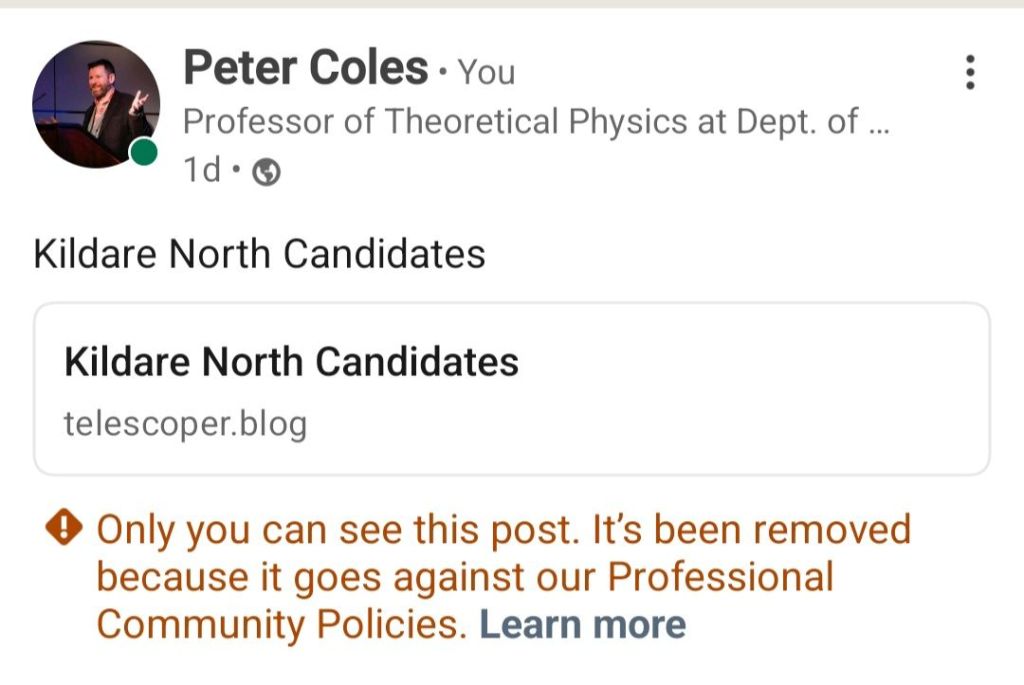
P.S. LinkedIn didn’t like this post:
Election News

Posted in Politics with tags , , , , , on November 10, 2024 by telescoper

On Friday 8th November Taoiseach Simon Harris (left) inspired Ireland’s rugby team to a very disappointing home defeat by New Zealand. Earlier on that day he had visited the President to request a dissolution of the  33rd Dáil and to call a General Election on November 29th 2024.

The Saturday newspapers were full of nonsense about how the “General Election campaign starts now” when in fact I’ve had canvassers knocking at my door for at least a fortnight already. Two of them were for Fine GaeI – far scarier than trick-or-treat! I made it abundantly clear that I wouldn’t be voting for their party and hoped that they wouldn’t bother me again.

Fine Gael’s opening gambit was to announce that if elected they would reduce VAT on the hospitality sector to 11%. There was a budget just a few weeks ago in which they could have announced such a reduction had they really wanted it to happen. If re-elected no doubt they will find an excuse for not doing it. If you believe what they say I have a 340k bike shed to sell you.

Talking about the budget, Ireland’s government is in a very different position from the UK, with a large fiscal surplus thanks to buoyant tax receipts. This year presented a great opportunity to use that cash for much-needed investment in public housing, transport, education, the health service, etc. Instead the Government decided to tinker here and there with allowances and bung some cash to middle-income families in order to buy votes. Simon Harris has the air of a man who would sell his Grandmother if he could buy votes with the proceeds. The FG approach may well work but, if it does, we’re in for many years more of decaying public services, homelessness and high rents. As the Landlord Party in all but name, this will suit Fine Gael very well.

My constituency is Kildare North which in 2020 elected four TDs: 1 Social Democrat, 1 Fianna Fáil, 1 Fine Gael, and 1 Sinn Féin. This time, owing to population growth in the area, the seat will return five TDs. Fine Gael is standing three. I won’t say anything about Fianna Fáil. To all intents and purposes they are indistinguishable from Fine Gael and I won’t be voting for either of them. For me “more of the same” is not an option. I hope it goes without saying that I won’t be voting for any neofascists who get onto the ballot paper either.

Catherine Murphy (SD) is not standing and since she had a strong personal following the SDs will struggle to keep that seat. Angela Feeney, who is very active on the Local Council, is standing for Labour and Réada Cronin for Sinn Féin will be trying to hold onto her seat. Nominations of candidates continue for another week, so I don’t know the final list of candidates. I’ll wait until then before deciding on my order of preferences.

Not that long ago Sinn Féin were riding high in the polls, but a series of missteps have left them trailing Fine Gael. They also did poorly in the local and European elections earlier this year, seeming to have lost supporters of the more extreme nationalist type to overtly right-wing candidates.

The only prediction I am willing to make at this stage is that, owing to disaffection with the mainstream political parties, the number of independent TDs is likely to increase considerably from the 20 last time. This will make the task of forming a government even more complicated than before.

Local Election Result

Posted in Maynooth, Politics with tags , , , , , , , , , , on June 9, 2024 by telescoper

Following Friday’s vote, counting in Ireland’s local elections began Saturday morning. As it happened, Maynooth was one of the first LEAs to start counting and, the electorate being fairly small, was completed last night.

In the system employed in these elections, votes are progressively reallocated in various rounds until one ends up with the top n candidates to fill the available seats. The STV system involves a quota for automatic election which is N/(m+1) + 1 votes, where N is the number of valid ballots cast and m is the number of seats in the constituency.  To see why this is the case consider a four-seat constituency, where the quota would be 20% of the votes cast plus one. No more than four candidates can reach this level so anyone managing to get that many vote is automatically elected. Surplus votes from candidates exceeding quota, as well as those of eliminated candidates, are reallocated to lower-preference candidates in this process.

I thought it might be interesting to show how it went. Here is the state of the poll after the initial count of first preference votes:

Incumbent Councillor Naoise Ó Cearúil (Fianna Fáil) led the first preference votes, exceeding the quota of 1566, and was therefore immediately elected. When his surplus votes were reallocated to second-preference candidates they did not result in anyone else exceeding quota, so Peter Hamilton (who finished last) was eliminated and his votes reallocated, etc. And so it came to pass that Tim Durkan (Fine Gael) was elected on the third count, Angela Feeney (Lab) and Peter Melrose (Social Democrats) on the 6th Count, and Paul Ward (FF) on the 7th Count. Durkan, by the way, is the son of sitting Fine Gael TD Bernard Durkan. For those outside Ireland I should mention that the Irish Social Democrats are quite progressive – in contrast to some parties with the same name in other countries – and they have a TD in the form of Caroline Murphy who has strong local support.

The turnout in Maynooth, by the way, was 45.3%. That’s quite high by the standards of local elections in the UK, but I always find it disappointing when people can’t be bothered to vote.

Anyway, of the five councillors elected (2 FF, 1 FG, 1 Lab & 1 SD) four are incumbent. The only change was sitting Green candidate Hamilton was replaced by newbie Peter Melrose for the Social Democrats. It was a disappointing result for Sinn Féin, similar to what happened five years ago in this LEA. The losing candidate then, however, Réada Cronin, went on to win a seat as TD for North Kildare in the General Election of 2020.

As I write, under a quarter of LEAs have completed their counts but it is fairly clear that it has been a disappointing election for Sinn Féin who, despite riding high in the opinion polls a few months ago, have not really recovered significantly from their poor showing in the 2019 Local Elections. Of course the question asked in opinion polls is about a General Election, which is quite a different kettle of fish compared to a Local election. Lots of pundits are trying to interpret these local results as a kind of opinion poll on the General Election which must happen before next year. They do this in the UK too. I don’t think that is wise. I think most people vote in the Local Elections on the local and rather mundane issues which are actually what the County Councils can actually deal with. Councils have very little power in Ireland and candidates who have grandiose plans far beyond the scope of what a councillor can actually achieve are not likely to do well. There is also a definite advantage on being an incumbent who has done a good job for the past five years. A problem for Sinn Féin is that it had to put up new faces in many LEAs to replace those lost five years ago, and few have been successful.

Anyway, it seems the status quo parties have done better than expected, and a variety of Independents have done well. Fianna Fáil and Fine Gael – to me, indistinguishable conservative neoliberal parties – are currently governing Ireland in coalition with the Greens. It surprises me that there is so much support for establishment parties that have presided over a housing shortage, ever-increasing homelessness and steadily deteriorating public services, but there you go.

We’ll have to wait a considerable time for the European Election count to finish, as it hasn’t even started yet, but it seems likely that Sinn Fein will struggle and that Independent will do well.

A week is a long time…

Posted in Politics with tags , , , , , , on March 30, 2024 by telescoper

“A week is a long time in politics” is a quotation usually ascribed to Harold Wilson, although there’s no record of him ever having said it; it has nevertheless turned out to be true for the island of Ireland.

I have been thinking about writing about the sudden resignation of Leo Varadkar from the office of Taoiseach just ten days ago, and his impending replacement by Simon Harris (the current Minister for Further and Higher Education, Research, Innovation and Science), but I’ve been too busy and thought I’d wait until the holiday weekend to write something.

(To be honest I didn’t have any great insights to offer, so it’s perhaps just as well that I didn’t attempt any kind of in-depth analysis, not that lack of insight prevents media pundits from having a go. I’ll just say that Harris is an energetic tinkerer who is good at doing superficial – and sometimes positive – things to attract headlines, and is clearly enormously ambitious, but I don’t think he’ll offer any significant change of direction. The biggest issue in Ireland right now is the housing shortage, and in his address to Fine Gael members (given here in full) he didn’t mention the housing crisis or rising homelessness once. We can assume that more inaction is in store as the governing coalition limps on towards the next General Election, that must take place within the next year.)

I also found it amusing how many columnists wrote, after the fact, that they had Varadkar’s resignation coming although they were all far too brave to say so ahead of the event.

Anyway, the events of yesterday turned out to be even more surprising – not to say shocking – than Varadkar’s departure. Jeffrey Donaldson MP, Leader of the Democratic Unionist Party (DUP) resigned yesterday. Nobody knows for sure why Leo Varadkar resigned (except the man himself; my best guess is that he just got bored with the job) but the reason for Donaldson’s resignation is well known: he has been charged with sexual offences, including rape. Since his case is now in the hands of the criminal justice system, further comment or speculation about the charges would be highly inappropriate. Whatever you think of Jeffrey Donaldson’s character or politics – and I don’t think very much – he is, like everyone else, entitled to a fair trial. Just as importantly, if he has committed crimes it is important not to say or do anything that may be construed as prefudicial and might prevent a conviction.

This matter is alarming however because the Northern Ireland Assembly has just returned to Stormont after a two-year hiatus. Although Donaldson was largely responsible for its suspension, he was also largely responsible for its return. A sizeable fraction of the DUP were, and presumably still are, opposed to the agreement that led to reinstatement of power sharing and there is a real danger that the Assembly will collapse again. Fortunately, both sides seem to realize what a disaster that would be for the people of Northern Ireland, but that doesn’t guarantee that another crisis can be averted.

“May you live in interesting times” is another frequently misattributed quotation, but it seems we’re in them anyway.

Ireland’s New Government

Posted in Politics with tags , , , , , , , , on June 30, 2020 by telescoper

I remembered this morning that I haven’t posted anything about the news that Ireland has a new Government, so decided to do a quick lunchtime blog on that topic. The election that happened earlier this year left no party with enough seats to form an administration and negotiations to form a coalition were drastically slowed by the Covid-19 pandemic. Last week, however, members of the three parties involved in drafting the Programme for Government – Fine Gael, Fianna Fáil, and the Green Party – all ratified the proposal. A vote in the Dáil Éireann to formally approve the new Taoiseach was held on Saturday and a new Government formed. Its Ministers have now all been appointed.

Ireland’s new Taoiseach (the equivalent of Prime Minister) is Micheál Martin of Fianna Fáil. He replaces Leo Varadkar of Fine Gael who becomes Tánaiste (Deputy Prime Minister). Under the terms of the coalition agreement they will swap places after two and a half years of the five year term, i.e. at the end of 2022 (assuming the Goverment survives that long).

This isn’t the kind of government that I wanted because it seems to only to offer more of the same short-sighted and socially divisive neoliberal economic policies that have led to disintegrating public services and increasing levels of poverty and homelessness over the last decade. Increasing GDP growth while at the same time worsening social outcomes is not successful government in my view. Tempering my disappointment, though, I do think the coalition represents a step forward in some ways. In my view there is very little difference between Fine Gael and Fianna Fáil in terms of policy, which means that there has been little substantive opposition from one when the other has been in power, which has been the way Irish politics has been for decades. Now that similarity in political complexion has been formally recognized and Ireland now has a proper opposition party in the form of a resurgent Sinn Féin led by Mary Lou McDonald. I know better than to try to predict political developments but I can see Sinn Féin rising in popularity in opposition, probably at the expense of Fianna Fáil as the incumbent parties are unlikely to find the immediate future plain sailing. I think Leo Varadkar will be privately happy that Micheál Martin is Taoiseach for what is likely to prove the toughest phase.

Ireland’s electoral system involves a single transferable vote and I know many people who used their ballot to “transfer left”. The Green Party clearly prospered from such transfers during the 2020 election, but now finds itself propping up a Centre-Right coalition. No doubt many who transferred left are dismayed to find that they inadvertently transferred right. What that does for the popularity of the Greens in future remains to be seen. I would comment however that the Greens have been pretty successful in getting their proposals into the Programme for Government and I welcome many of them.

Another thing well worth mentioning is the creation of a new Minister at Cabinet level with responsibility for Higher Education. That was a Fianna Fáil idea but I didn’t see it in the Programme for Government. There is a little bit of confusion* about what the title of this new position is. When it was first announced it was reported as “Minister for Higher Education, Innovation and Research” though that seems to have morphed into “Minister for Higher Education, Innovation and Science”, which has left colleagues in the arts, humanities and social sciences feeling a bit disgruntled. It’s a pity that there isn’t an English word like the German Wissenschaft to use in such general contexts.

*UPDATE: I am reliably informed (by Twitter) that the correct title is “The Department of Further and Higher Education, Research, Innovation and Science”.

Whatever its precise name, the announcement of the creation of this new Ministry has received a cautious welcome from across the third-level sector. I also see this as potentially promising but I think I’ll reserve judgement until we see what it proposes to do. Interesting, though it was a Fianna Fáil policy to create this new cabinet position, the person appointed to it, Simon Harris TD, is actually from Fine Gael and was the Health Minister in the previous administration. I think the general opinion is that he did fairly well in that position, though reading his biography I see that he dropped out of university without getting a degree, which hardly inspires confidence in his commitment to higher education.

This isn’t the sort of Government I voted for, but I hope it can steer Ireland safely through the ongoing crisis reasonably safely. I’ll take it over the dismal collection of crooks and charlatans who are in power across the Irish Sea any day.

Meanwhile, in Ireland…

Posted in Covid-19, Education, Politics with tags , , , , , , , on June 17, 2020 by telescoper

It seems an eternity since we had the 2020 general election in Ireland on February 8th because of the intervention of the Covid-19 outbreak, but it’s still been over four months. Now however it seems we might have a new government fairly soon, as a deal has been agreed to form a coalition between Fine Gael, Fianna Fáil and the Green Party; between them these parties have 84 seats (not counting the Ceann Comhairle), enough to create a majority in the Dáil Éireann. It’s not quite done and dusted, though, as the Green Party has to ballot its membership and a two-thirds majority is needed to endorse the agreement. We should know next week.

In case you think this delay means that Ireland has been in political crisis since February, it hasn’t really. The constitution makes it clear that if a new government can’t be formed the old one continues until one can (or until another election can be held). Leo Varadkar has continued as Taioseach in the mean time. His popularity has increased in this period, at least partly because as a trained medical person, he is perceived to have handled the Covid-19 crisis rather well. It seems that incumbents have generally received the backing of the public when they have coped reasonably with the pandemic. Whether that continues in Ireland remains to be seen. When the truth comes out about how many patients were transferred from hospitals into nursing homes where they were left to die perhaps opinions will change.

It has taken over four months for the the parties to agree a `draft programme for government’ which you can find here. That document is 139 pages long but largely devoid of concrete commitments and indeed devoid of anything other than vague discussions, platitudes, and `reviews’. At a quick reading I’d say the Greens have been far more effective at getting their agenda into it than Fianna Fáil, perhaps because the latter don’t really have an agenda other than wanting to be in power. The Green initiatives are in my opinion the strongest parts of the programme, but the rest seems to me to be just “more of the same”.

I’d say that the one redeeming factor is the document is the emphasis on stimulus rather than austerity as a way out of the current crisis but of course that may turn out not to be what actually happens.

From the point of view of Ireland’s universities and research community there is little to rejoice. On page 114 you can find this:

Higher and Further Education have been greatly affected by the COVID-19 crisis and we will support the sector through these challenges to ensure that educational opportunities remain and are made more accessible to everyone, particularly the most vulnerable in our society. In addition, we will continue to support our research community to tackle the social and scientific problems posed by COVID-19 now and into the future.

We are committed to addressing the funding challenges in third-level education. We want a Higher and Further Education sector that sees education as a holistic and life-long pursuit. We will continue to build strong connections with other education sectors and wider society, while recognising our global and environmental responsibilities. It is vital we invest in our Higher and Further Education sectors so we can continue to tackle inequality based on race, gender, and socio-economic background. We recognise the potential for our Higher and Further Education institutions to be exemplars regionally, nationally and internationally.

At a time of great economic uncertainty, when so many people fear for their future employment, we will ensure that Higher Education plays a vital role in our recovery. We will equip students with the skills necessary to secure employment, while preparing for the opportunities and challenges posed by a changing economy, the move to a low-carbon future and disruptive technologies, as well as offering retraining and reskilling opportunities to help people into employment.

Warm words at the start and then a worryingly blinkered emphasis on universities simply as providers of skills training. We do that of course, but we do so much more that Irish governments seem not to recognize.

Later on we get a commitment to

Develop a long-term sustainable funding model for Higher Level education in collaboration with the sector and informed by recent and ongoing research and analysis.

Sigh. There’s been an OECD Report (2004), the Hunt Report (2011), the Cassells Report (2016), etc. How many times will this issue be kicked into the long grass?

The Fianna Fáil `pledge’ to introduce a Minister for Higher Education and Research has, needless to say, fallen by the wayside in the negotiations.

The plan for the new Government is that the plan is as the leader of the largest party in the coalition, Fianna Fáil, Micheál Martin will take over as Taoiseach for two years, after which Leo Varadkar will return. This is being referred to as a `Rotating Taoiseach’, which is a pretty apt given that the programme has more spin than substance.

In for the Count

Posted in Biographical, Politics with tags , , , , , , , on February 9, 2020 by telescoper

I voted in the 2020 General Election yesterday morning before Storm Cíara arrived in Maynooth, which it did in the early afternoon.I don’t know if the weather or the switch to a Saturday polling day affected the turnout, but it looks to have been about 60% nationally*. One factor in the Dublin area was that a couple of big sporting fixtures took place in the city on Saturday, the Six Nations Rugby between Ireland and Wales at the Aviva Stadium and a Gaelic Football match between Dublin and Monaghan at Croke Park.

Whatever the effect of these things on the overall turnout I’d imagine that a larger fraction of voters turned out earlier in the day than in other elections as few people would want to interrupt their Saturday night pleasures by visiting a polling station!

The worst of Storm Cíara seems to have passed, but it’s still rather windy with the odd heavy rain shower, which is enough to keep me indoors for the count. As the meteorological storm subsides, an electoral storm seems to be brewing – last night’s exit polls the three largest parties tied on about 22% of the vote (with a margin of error around 1.5%).

Taking a look at the preceding opinion polls you will see that outcome is well within the ±3% uncertainty of the last few:

  • Sunday Times/Behaviour & Attitude: FF 32%; FG 20%; SF 19%
  • Irish Times/IPSOS-MRBI: FF 25%; FG 21%; SF 21%
  • BusinessPost/Red C: FF 26%; FG 23%; SF 19%
  • Daily Mail/Ireland Elects: FF 27%; FG 22%; SF 22%
  • Sunday Times/Panelbase: FF 23%; SF 21%; FG 19%
  • Business Post/Red C: FF 24%; SF 24%: FG 21%.
  • Irish Times/IPSOS-MRBI: FF 23%; FG 20%; SF 25%

If this pattern is borne out it will be a bitter disappointment for Fianna Fáil who have had four years in opposition to make inroads but have apparently failed to do so.

The main story however is the remarkable rise of Sinn Féin, which looks likely to shatter the two-party dominance that has held sway in Ireland more or less since its inception as an independent state. Early indications are that they will do very well and return TDs in constituencies where they have never previously won a seat.

My constituency is Kildare North which elected 1 Social democrat, 1 Fine Gael and 2 Fianna Fáil TDs last time. based on early tallies it seems that Catherine Murphy (the Social Democrat), who is a very good candidate with a strong local following, will get re-elected on the first round but the Sinn Féin candidate Réada Cronin looks likely to win a seat too. That is remarkable because she only polled 6.55% of the votes in the last General Election and also lost her County Council seat in the Local Elections last year. It’s been a remarkable turnaround for her and for Sinn Féin generally. If SF do win a seat that means at least one of the incumbents will lose theirs. But who? We’ll have to wait and see!

Counting has really only just started so I won’t comment much until the real results are available, except to say that it is very difficult to see what kind of Government will emerge from all this, which looks essentially like a three-way tie in terms of popular vote, because that will not translate directly into seats owing to the way the Single Transferable Vote works.

For example, take Dublin Central, the constituency of Sinn Féin President Mary Lou McDonald. The STV system involves a quota for automatic election which is N/(m+1) votes, where N is the number of valid ballots cast and m is the number of seats in the constituency. Dublin Central is a four-seater and it seems that Mary Lou got about 36% of the first-preference votes, which is way past the quota of 20%. This surplus (16% of the valid ballots) will be re-distributed among the 2nd preference votes of those who put her first which could make a huge difference to the fortunes of those lower-ranked candidates. But where will they go?

One might imagine that Sinn Féin voters would rank other leftish parties, but there is a fraction who don’t use the whole ballot paper, but just put a 1 next to the SF candidate. Some of the SF surplus may be wasted in this way. Moreover, during the European Elections last summer I noticed some very strange transfers that went from SF to right-wing rather than left-wing alternatives. It’s all very hard to predict, but we’ll know soon enough.

It took several days to get the full results of the European Parliament Elections last year, but in that case the constituencies were much larger (both geographically and in terms of number of voters). There were also many more candidates on each ballot paper. Hopefully there will be a clear picture of the outcome of this General Election later this evening…

*the official turnout figure is 62.9%

Irish Election Update

Posted in Politics with tags , , , , on February 3, 2020 by telescoper

I couldn’t resist one more update before Saturday’s General Election because there has been another opinion poll (Irish Times/IPSOS-MRBI), which I’ve added to the previous ones here:

  • Sunday Times/Behaviour & Attitude: FF 32%; FG 20%; SF 19%
  • Irish Times/IPSOS-MRBI: FF 25%; FG 21%; SF 21%
  • BusinessPost/Red C: FF 26%; FG 23%; SF 19%
  • Daily Mail/Ireland Elects: FF 27%; FG 22%; SF 22%
  • Sunday Times/Panelbase: FF 23%; SF 21%; FG 19%
  • Business Post/Red C: FF 24%; SF 24%: FG 21%.
  • Irish Times/IPSOS-MRBI: FF 23%; FG 20%; SF 25%

This last one is the first to put Sinn Féin in the lead, although to be honest the margin of error is 3% again so there’s really no evidence for a significant change on the last poll by the same outfit.

I still find it very hard to predict what kind of Government Ireland will end up with, but it seems even less likely than before that Leo Varadkar will be leading it.

British friends keep asking me whether all this change is a result of Brexit. I have to say that the answer to that is ‘no’ and neither is it driven entirely by thoughts of a United Ireland. The focus of campaigning is largely on domestic political issues, chiefly housing and health. Most people tend to think Varadkar has handled Brexit pretty well, but his party had failed badly in these other areas.

Irish Election Update

Posted in Biographical, Maynooth, Politics with tags , , , , on February 1, 2020 by telescoper

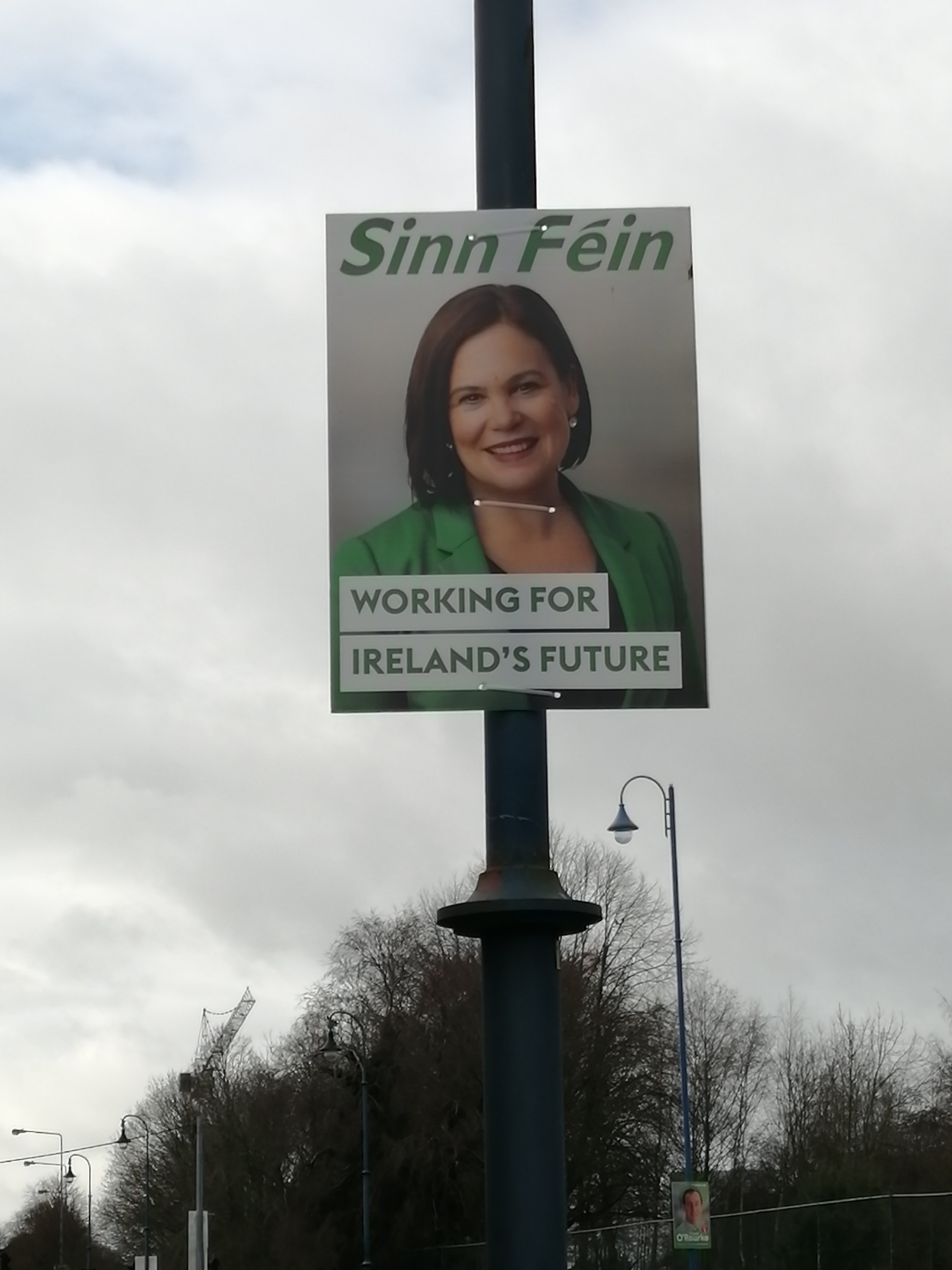
Well. Life goes on, and so does the Irish General Election campaign. A week today I’ll be casting my vote. Sinn Féin seem the most energized by the events of the last week, even to the extent that their posters have been going up around Maynooth. The one above, showing leader Mary Lou McDonald, is on my way into work (the North Campus of Maynooth University is on the other side of the road, beyond the trees).

Since last week’s update there have been other opinion polls (by the Sunday Times/Panel base and Red C), which I’ve added to the previous ones here:

  • Sunday Times/Behaviour & Attitude: FF 32%; FG 20%; SF 19%
  • Irish Times/IPSOS-MRBI: FF 25%; FG 21%; SF 21%
  • BusinessPost/Red C: FF 26%; FG 23%; SF 19%
  • Daily Mail/Ireland Elects: FF 27%; FG 22%; SF 22%
  • Sunday Times/Panelbase: FF 23%; SF 21%; FG 19%
  • Business Post/Red C: FF 24%; SF 24%: FG 21%.

The latest polls (like the others) are based on a small sample (1000) so has a large marging of error (around 3%) and is based on online responses and an uncertain methodology which may create a systematic bias. Those caveats aside, however, they seems to be telling the same story as the others: decline for Fine Gael and a relatively strong showing for Sinn Féin who are up 7% and 5% on the previous Panelbase and Red C numbers, respectively.

I wouldn’t be at all surprised if Sinn Féin end up with a share of the first preference votes around 25%. If that is the case they’ll probably wish they had stood more candidates, which they will probably do next time if they perform strongly in the actual election. They did poorly in the European Elections last year, which probably explains their rather defensive strategy. On the other hand if Fianna Fáil really are polling in the low twenties they may regret standing so many candidates, as their vote may end up splitting so that none reach the quota.

It will be very interesting to see how this all pans out. I find it very hard to predict what kind of Government Ireland will end up with, but I’m willing to bet that Leo Varadkar won’t be leading it.

Taxing Figures

Posted in Bad Statistics, Politics with tags , , , on January 29, 2020 by telescoper

Following the campaign for the forthcoming General Election in Ireland has confirmed (not entirely unexpectedly) that politicians over here are not averse to peddling demonstrable untruths.

One particular example came up in recent televised debate during which Fine Gael leader Leo Varadkar talked about his party’s plans for tax cuts achieved by raising the salary at which workers start paying the higher rate of income tax. Here’s a summary of the proposal from the Irish Times:

Fine Gael wants to increase the threshold at which people hit the higher rate of income tax from €35,300 to €50,000, which it says will be worth €3,000 to the average earner if the policy is fully implemented.

Three thousand (per year) to the average earner! Sounds great!

But let’s look at the figures. There are two tax rates in Ireland. The first part of your income up to a certain amount is taxed at 20% – this is known as the Standard Rate. The remainder of your income is taxed at 40% which is known as the Higher Rate. The cut-off point for the standard rate depends on circumstances, but for a single person it is currently €35,300.

According to official statistics the average salary is €38,893 per year, as has been widely reported. Let’s call that €38,900 for round figures. Note that figure includes overtime and other earnings, not just basic wages.

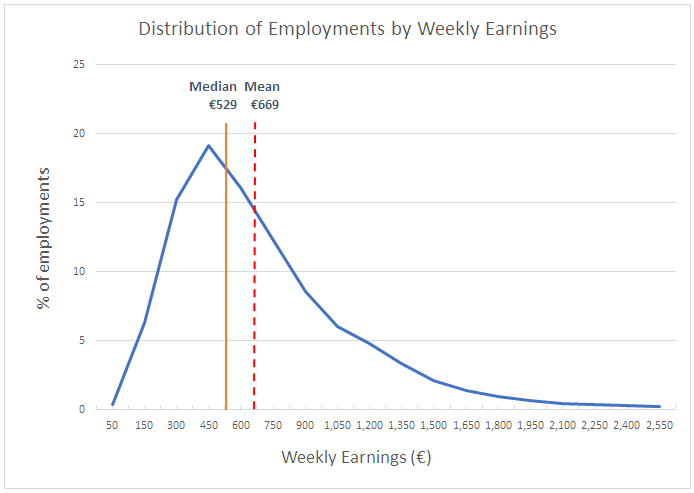
It’s worth pointing out that in Ireland (as practically everywhere else) the distribution of earnings is very skewed. here is an example showing weekly earnings in Ireland a few years ago to demonstrate the point.


This means that there are more people earning less than the average salary (also known as the mean)  than above it. In Ireland over 60% of people earn less than the average.  Using the mean in examples like this* is rather misleading – the median would be less influenced by a few very high salaries –  but let’s continue with it for the sake of argument.

So how much will a person earning €38,900 actually benefit from raising the higher rate tax threshold to €50,000? For clarity I’ll consider this question in isolation from other proposed changes.

Currently such a person pays tax at 40% on the portion of their salary exceeding the threshold which is €38,900 – €35,300 = €3600. Forty per cent of that figure is €1440. If the higher rate threshold is raised above their earnings level this €3600 would instead be taxed at the Standard rate of 20%, which means that €720 would be paid instead of €1440. The net saving is therefore €720 per annum. This is a saving, but it’s nowhere near €3000. Fine Gael’s claim is therefore demonstrably false.

If you look at the way the tax bands work it is clear that a person earning over €50,000 would save an amount which is equivalent to 20% of the difference between €35,300 and €50,000 which is a sum close to €3000, but that only applies to people earning well over the average salary. For anyone earning less than €50,000 the saving is much less.

The untruth lies therefore in the misleading use of the term `average salary’.

Notice furthermore that anyone earning less than the higher rate tax threshold will not benefit in any way from the proposed change, so it favours the better off. That’s not unexpected for Fine Gael. A fairer change (in my view) would involve increasing the higher rate threshold and also the higher rate itself.

All this presupposes of course that you think cutting tax is a good idea at this time. Personally I don’t. Ireland is crying out for greater investment in public services and infrastructure so I think it’s inadvisable to make less money available for these purposes, which is what cutting tax would do.


*Another example is provided by the citation numbers for papers in the Open Journal of Astrophysics. The average number of citations for the 12 papers published in 2019 was around 34 but eleven of the twelve had fewer citations than this: the average is dragged up by one paper with >300 citations.