Archive for Social Democrats

Sport and Politics

Posted in Cricket, Football, Politics with tags , , , , on May 24, 2026 by telescoper

I have found this a very disappointing weekend in many respects for sports. Two Irish rugby teams (Ulster and Leinster) both lost their cup finals against French opposition (Montpellier and Bordeaux in the Challenge Cup and Champions Cup, respectively). Glamorgan’s cricketers lost their first two Twenty20 games of the season (both narrowly). And today’s last round of matches in the English Premier League saw Newcastle lose, an outcome made worse by the fact that Sunderland won.

At least however there was an opportunity to enjoy Ireland’s greatest spectator sport (after hurling, of course): the counting of votes in an election. Friday saw two by-elections, one because of the resignation of Paschal Donohoe (FG) from his seat in Dublin Central in order to take a lucrative job at the World Bank, and the other vacated by Catherine Connolly whose seat in Galway West became vacant when she took on the role of President. Neither of these are constituencies in which I could vote, but it was fun watching the results come on.

These elections, like all elections in Ireland, were held under a system of Proportional Representation (Single Transferable Vote). The constituences return multiple members in a General Election, but in the case of a by-election only one candidate is elected. This simplifies matters a bit because the part of the process that involves transferring surplus votes from candidates who exceed quota is not needed. Voters rank the candidates in order of preference with votes progressively reallocated as the lowest-ranked candidates are eliminated. You can rank all the candidates or just some. In the system employed here one ranks the candidates in order of preference with votes progressively reallocated in various rounds until one ends up with one winner.

There was also the presence of gang leader Gerard Hutch among the candidates in Dublin Central, but in the end he didn’t put up a serious challenge.

Opinion polls gave Sinn Féin’s Janice Boylan a narrow lead on first preferences, but since SF are notoriously transfer-unfriendly, I was very confident that lead would be overturned by Daniel Ennis of the Social Democrats. As it turned out, however, Ennis actually led on first preferences which confirmed me in my opinion that he would win. This is how the transfers panned out.
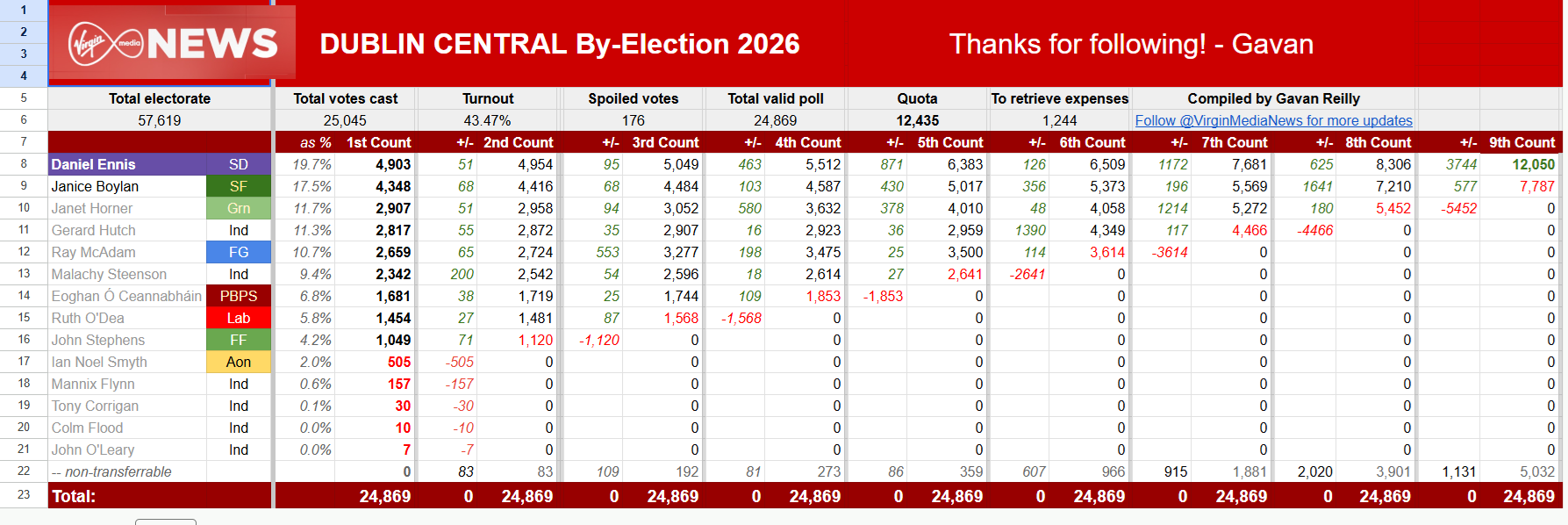
Ennis won comfortably, and John Stephens of Fianna Fáil gaining the distinction of getting the lowest share of first preference votes that his party has ever recorded in an election. There are some bizarre transfers, e.g. from the left-wing PBP (People Before Profit) to Fine Gael. Other than that the outcome was as predicted.

Not long ago Sinn Féin were riding high in the polls and might have expected to win a seat here, especially since Mary Lou McDonald, the Sinn Féin leader, holds a seat in Dublin Central, but their popularity has slumped. I think that’s primarily because they have recently lurched to the right – rather like UK Labour has – and many who want a genuinely progressive alternative to the crumbling neoliberal consensus have decided that they can’t support SF which puts on the mask of a progressive party when it suits them but are quite to remove it when chasing the right-wing vote. is quoted as saying that there is ‘no confusion’ for voters about whether the party was left-wing or right-wing. I think she is correct there, but perhaps not in the way she intended…

A genuinely left-wing party of the size of Sinn Féin should be building coalitions and knocking at the door to power, but instead it has squandered its position by pandering to anti-immigrant sentiment, jumping on the bandwagon of the recent “fuel protests” and signing up to transphobic policies in Northern Ireland. I don’t understand why they have chosen this path, but it looks very foolish to me. I’m not the only one to think this. Is Morgan McSweeney now working for Sinn Féin?

As I write, the count in Galway West is still going on but it has come down to a contest between two unpalatable right-wing candidates so I’m not following it as closely. Oh, the Fine Gael candidate has won.

Kildare North Candidates

Posted in Politics with tags , , , , , , , , , , , , , on November 23, 2024 by telescoper

The arrival of my polling card yesterday indicates that the general election in Ireland on Friday 29th November is approaching rapidly, so I thought I’d give a rundown of the 16 candidates who will appear on the ballot paper for my constituency, Kildare North.

Kildare North will return 5 TDs (Teachta Dála, or Deputies), one more than last time because of the population growth in the area. The current TDs are Réada Cronin (SF; Sinn Féin), Bernard Durkan (FG; Fine Gael), James Lawless (FF; Fianna Fáil) and Catherine Murphy (SD; Social Democrats). The latter is retiring so will not be standing at this election. The current government is a coalition of FG, FF and Green Party TDs.

The Single Transferable Vote system is used, meaning that voters have a single ballot paper on which they rank the candidates in order of preference. The candidate with the lowest number of first-preference votes is eliminated and their second preference votes redistributed. Candidates are thus progressively eliminated until the requisite number of TDs is selected.

There are three FG candidates: Bernard Durkan, Joe Neville and Evie Sammon). They are based in Maynooth, Leixlip and Celbridge respectively so are presumably hoping that local voting will work out in their favour. The idea presumably is that Bernard Durkan would be first choice in Maynooth, etc. However, I’ve already had canvassers arguing that I should put Joe Neville first. I won’t be voting for any of the candidates anyway, but I would be very amused if their decision to put three candidates forward backfired. Incidentally, Bernard Durkan is 79 and has been a TD since 1982. The leaflet I got from him promised “New Energy” for Kildare North. Yeah, right…

There are two FF candidates, James Lawless and Naoise Ó Cearúil; the latter was elected to the County Council this summer. I find FF indistinguishable from FG. Together or separately these two parties have governed the Republic since its creation and a change is long overdue.

The two Sinn Féin candidates are the incumbent Réada Cronin and Caroline Hogan. I haven’t seen any posters for Réada Cronin up in Maynooth, so I assume the campaign team is saving their resources for elsewhere. Maynooth is not traditionally an SF stronghold.

With Catherine Murphy not standing, the Social Democrats ran a process to select a replacement candidate, which was won by Aidan Farrelly (who actually works at Maynooth University) who is the official SD candidate. That doesn’t end the story, however. Former SD member Bill Clear is standing as an Independent because he didn’t get selected. Adding to the fact that Catherine Murphy had a considerable personal following, this looks like a bit of a mess for the Social Democrats whose vote will probaboly be reduced and split. It may be in order to capitalize on this that SF added a candidate; they only fielded one last time round.

Now we’re into the (probable) also-rans. Angela Feeney is standing for Labour. She is an active member of the Council, representing Maynooth, but it’s not clear whether she has reach over the rest of the constituency. Vincent Martin represents the Greens who haven’t previously been strong here. The Green Party in Ireland is nowhere near as left-wing as corresponding parties in the UK and elsewere. It often seems like the bicycle division of Fine Gael. Leah Whelan is standing for People Before Profit – Solidarity, the only really left-wing party standing in Kildare North.

Then we have we have a number of generally disagreeable (to me) fringe party candidates: Una O’Connor is standing for Aontú, a reactionary splinter group of people previously in Sinn Féin and Sean Gill for the Centre Party of Ireland, an ironic name for what is far-right splinter group of FG previously known as Renua. Gerry Waters is standing from the Irish Freedom Party. He was struck off the medical register for refusing to administer vaccines and has unsupportable far-right opinions on other issues. Last and by all means least is Avril Corcoran who is candidate for The Irish People, a far-right nationalist party which is part of the National Alliance of like-minded bigots.

It’s probably obvious which 11 candidates I’m not going to be voting for, but I’ll leave you to guess in what order I will rank the other 5!

P.S. LinkedIn didn’t like this post:

Local Election Result

Posted in Maynooth, Politics with tags , , , , , , , , , , on June 9, 2024 by telescoper

Following Friday’s vote, counting in Ireland’s local elections began Saturday morning. As it happened, Maynooth was one of the first LEAs to start counting and, the electorate being fairly small, was completed last night.

In the system employed in these elections, votes are progressively reallocated in various rounds until one ends up with the top n candidates to fill the available seats. The STV system involves a quota for automatic election which is N/(m+1) + 1 votes, where N is the number of valid ballots cast and m is the number of seats in the constituency.  To see why this is the case consider a four-seat constituency, where the quota would be 20% of the votes cast plus one. No more than four candidates can reach this level so anyone managing to get that many vote is automatically elected. Surplus votes from candidates exceeding quota, as well as those of eliminated candidates, are reallocated to lower-preference candidates in this process.

I thought it might be interesting to show how it went. Here is the state of the poll after the initial count of first preference votes:

Incumbent Councillor Naoise Ó Cearúil (Fianna Fáil) led the first preference votes, exceeding the quota of 1566, and was therefore immediately elected. When his surplus votes were reallocated to second-preference candidates they did not result in anyone else exceeding quota, so Peter Hamilton (who finished last) was eliminated and his votes reallocated, etc. And so it came to pass that Tim Durkan (Fine Gael) was elected on the third count, Angela Feeney (Lab) and Peter Melrose (Social Democrats) on the 6th Count, and Paul Ward (FF) on the 7th Count. Durkan, by the way, is the son of sitting Fine Gael TD Bernard Durkan. For those outside Ireland I should mention that the Irish Social Democrats are quite progressive – in contrast to some parties with the same name in other countries – and they have a TD in the form of Caroline Murphy who has strong local support.

The turnout in Maynooth, by the way, was 45.3%. That’s quite high by the standards of local elections in the UK, but I always find it disappointing when people can’t be bothered to vote.

Anyway, of the five councillors elected (2 FF, 1 FG, 1 Lab & 1 SD) four are incumbent. The only change was sitting Green candidate Hamilton was replaced by newbie Peter Melrose for the Social Democrats. It was a disappointing result for Sinn Féin, similar to what happened five years ago in this LEA. The losing candidate then, however, Réada Cronin, went on to win a seat as TD for North Kildare in the General Election of 2020.

As I write, under a quarter of LEAs have completed their counts but it is fairly clear that it has been a disappointing election for Sinn Féin who, despite riding high in the opinion polls a few months ago, have not really recovered significantly from their poor showing in the 2019 Local Elections. Of course the question asked in opinion polls is about a General Election, which is quite a different kettle of fish compared to a Local election. Lots of pundits are trying to interpret these local results as a kind of opinion poll on the General Election which must happen before next year. They do this in the UK too. I don’t think that is wise. I think most people vote in the Local Elections on the local and rather mundane issues which are actually what the County Councils can actually deal with. Councils have very little power in Ireland and candidates who have grandiose plans far beyond the scope of what a councillor can actually achieve are not likely to do well. There is also a definite advantage on being an incumbent who has done a good job for the past five years. A problem for Sinn Féin is that it had to put up new faces in many LEAs to replace those lost five years ago, and few have been successful.

Anyway, it seems the status quo parties have done better than expected, and a variety of Independents have done well. Fianna Fáil and Fine Gael – to me, indistinguishable conservative neoliberal parties – are currently governing Ireland in coalition with the Greens. It surprises me that there is so much support for establishment parties that have presided over a housing shortage, ever-increasing homelessness and steadily deteriorating public services, but there you go.

We’ll have to wait a considerable time for the European Election count to finish, as it hasn’t even started yet, but it seems likely that Sinn Fein will struggle and that Independent will do well.