Archive for Fluid Mechanics

Solitons in a Swimming Pool

Posted in The Universe and Stuff with tags , , , on December 1, 2014 by telescoper

Here’s a fascinating physics video for your amusement and edification:

I think the video explains what is going on pretty well, but if you want more information (including some connections with other bits of physics) you can look at this paper (whence I’ve nicked the following pictures and description).

Basically what is happening is that the motion of the plate through the water in the pool creates a connected pair of Rankine Vortices, rotating in opposite directions. The kinetic energy and the angular momentum the vortices quickly decay so the structure turns into a pair of dimpled singular surfaces called Falaco Solitons. Although unstable, these structures can survive for several minutes if the water in the pool is otherwise still:

soliton_1

Severing the thin, string-like, structure that connects the two dimples will make them vanish extremely rapidly.

The spooky-looking black discs you can see apparently floating on the surface are actually an optical artefact, formed on the floor of the pool by Snell refraction through the rotationally-induced dimpled surface:

Soliton_2

The physics is quite simple, really, but the result is fascinating to watch. If you agree, you’ll also be interested in this old post of mine about vortex rings.

A (Physics) Problem from the Past

Posted in Cute Problems, Education, The Universe and Stuff with tags , , , , , on September 25, 2012 by telescoper

I’ve been preparing material for my new 2nd year lecture course module The Physics of Fields and Flows, which starts next week. The idea of this is to put together some material on electromagnetism and fluid mechanics in a way that illustrates the connections between them as well as developing proficiency in the mathematics that underpins them, namely vector calculus. Anyway, in the course of putting together the notes and exercises it occurred to me to have a look at the stuff I was given when I was in the 2nd year at university, way back in 1983-4. When I opened the file I found this problem which caused me a great deal of trouble when I tried to do it all those years ago. It’s from an old Cambridge Part IB Advanced Physics paper. See what you can make of it..

(You can click on the image to make it larger…)

Blowing Smoke

Posted in Education, The Universe and Stuff with tags , , , , on July 18, 2012 by telescoper

I’ve been trying to make myself useful over the last few days thinking about the new module I’m supposed to start teaching in October. I’m a bit daunted by it to be honest. The title is The Physics of Fields and Flows and it will be taken by students when they return to start their second year after the summer break.  It’s twice the size of our usual modules, which means a lot of teaching and it’s all new for me, which means a lot of preparation.

The idea behind introducing this module was to teach a number of things together which previously had been taught in separate modules, specifically electromagnetism and vector calculus, or not at all, e.g. fluid mechanics. I’m not sure when or why classical fluid mechanics dropped out the syllabus, but I think it’s an essential part of a physics curriculum in its own right and also helps develop a physical understanding of the mathematics used to describe electric and magnetic fields. It’s one of the unhappy side-effects of modular teaching that it hides the important underlying connections between apparently disparate phenomena which are the essence of what physics is about.

Another thing I reckon we don’t do enough of these days is use lecture demonstrations. That’s harder to do these days because we tend to use pooled lecture theatres that don’t have the specialist equipment that they might have if they were dedicated to physics lectures only.  Practical demonstrations are now usually given second-hand, by using video clips.  That’s fine, but not as good as the real thing.

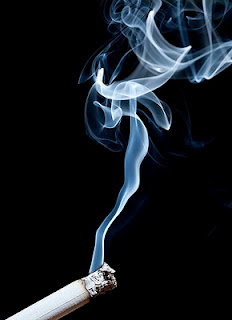
Anyway, it struck me that it would be quite easy to arrange a demonstration of the transition between laminar and turbulent flow using the simple and relatively inexpensive equipment shown in the rather beautiful image. Unfortunately, however, demonstrating this sort of thing isn’t allowed on University premises even for scientific purposes…