Archive for Gold Open Access

Counting the Cost of Gold Open Access

Posted in Open Access with tags , , , , , , , , , on July 10, 2024 by telescoper

If you’re interested in how Article Processing Charges (APCs) have changed over the past five years, the data from six major publishers are now available accompanied by a paper on the arXiv with the abstract:

This paper introduces a dataset of article processing charges (APCs) produced from the price lists of six large scholarly publishers – Elsevier, Frontiers, PLOS, MDPI, Springer Nature and Wiley – between 2019 and 2023. APC price lists were downloaded from publisher websites each year as well as via Wayback Machine snapshots to retrieve fees per journal per year. The dataset includes journal metadata, APC collection method, and annual APC price list information in several currencies (USD, EUR, GBP, CHF, JPY, CAD) for 8,712 unique journals and 36,618 journal-year combinations. The dataset was generated to allow for more precise analysis of APCs and can support library collection development and scientometric analysis estimating APCs paid in gold and hybrid OA journals.

There’s even an interactive data explorer here, at which link you can also find this very informative summary graphic:

Surprise, surprise: the vast majority have gone up!

These figures apply to Gold and Hybrid Open Access publications, but not to Diamond Open Access journals which are free to both authors and readers and avoid these rip-off charges. In my opinion research institutions would be much better off investing in Diamond Open Access publishing than sending their hard-earned cash to profiteering outfits such as Elsevier.

Publishing Revenue and the Learned Societies

Posted in Open Access with tags , , , , , on March 8, 2024 by telescoper

A couple of days ago I posted a reaction to a shockingly dishonest article I saw in Physics World which has led me to resign my Fellowship of the Institute of Physics (IoP). I thought I would spend a bit of time now to raising some wider points (which I’ve raised before) about the extent that such organizations (including, in my field,  the Royal Astronomical Society and the Institute of Physics) rely for their financial security upon the revenues generated by publishing traditional journals and why this is not in the best interests of their disciplines.

Take IOP Publishing. This is a wholly-owned subsidiary of the Institute of Physics that has an annual turnover of around £60M generated from books and journals. This revenue is the largest contribution to the income that the IoP needs to run its numerous activities relating to the promotion of physics.  A similar situation pertains to the Royal Astronomical Society, although on a smaller scale, as it relies for much of its income from Monthly Notices of the Royal Astronomical Society, in which I have published quite a few papers in the past.

Not surprisingly, these and other learned societies are keen to protect their main source of cash and have lobbied very hard for the “Gold” Open Access some authorities are attempting to foist on the research community, rather than the far more sensible and sustainable approaches to Open Access employed, for example, by the Open Journal of Astrophysics.

There are two major reasons why I object to this approach, one practical and one ethical.

First, I consider it to be inevitable that the traditional journal industry will very soon be completely bypassed in favour of  other forms of publishing. The internet has changed the entire landscape of scientific publication. It’s now so cheap and so easy to disseminate knowledge that traditional journals are already virtually redundant, especially in my field of astrophysics where we have been using the arXiv for so long that many of us hardly ever look at journals.

The comfortable income stream that has been used by the IoP to “promote Physics”, as well as to furnish its  building in King’s Cross and office in Dublin, will dry up unless these organizations find a way of defending it. The “Gold” OA favoured by such organizations their attempt to stem the tide. I think this move into Gold `Open Access’, paid for by ruinously expensive Article Processing Charges paid by authors (or their organizations) is unsustainable because the research community will see through it and refuse to pay. I can already see signs of this happening.

The other problematic aspect of the approach of these learned societies is that I think it is fundamentally dishonest. University and other institutional libraries are provided with funds to provide access to published research, not to provide a backdoor subsidy for a range of extraneous activities that have nothing to do with that purpose. The learned societies do many good things – and some are indeed outstandingly good – but that does not give them the right to siphon off funds from their constituents by a sort of stealth levy.  Voluntary institutional affiliation, paid for by a fee, would be a much fairer way of funding these activities.

A couple of days ago I decided to cease paying the annual subscription to, and resign my Fellowship of, the Institute of Physics. I was reasonably comfortable spending some of my own money supporting physics, but don’t agree with  researchers having to fork out huge amounts of money in involuntary payment of APCs to the IOP. I will decide in the next few days whether or not to resign also from the Royal Astronomical Society for the same reason.

Some time ago I had occasion to visit the London offices of a well-known charitable organization which shall remain nameless. The property they occupied was glitzy, palatial, and obviously very expensive. I couldn’t help wondering how they could square the opulence of their headquarters with the quoted desire to spend as much as possible on their good works. Being old and cynical, I came to the conclusion that, although charities might start out with the noblest intentions, there is a grave danger that they simply become self-serving, viewing their own existence in itself as more important than what they do for others.

The commercial academic publishing industry has definitely gone that way. It arose because of the need to review, edit, collate, publish and disseminate the fruits of academic labour. Then the ease with which profits could be made led it astray. It now fulfills little or no useful purpose, but simply consumes financial resources that could be put to much better effect actually doing science. I think the scientific community knows this very well, and hopefully the parasite will die a natural death.

The question for learned societies is whether they can find a sustainable funding model that isn’t reliant upon effectively purloining funds from research budgets. If their revenue from publishing does fall, can they replace it? And, if not, in what form can they survive?

The Cost of Imaging Neuroscience

Posted in Open Access with tags , , , , , , on February 13, 2024 by telescoper

Last year I wrote a piece about the resignation of the entire Editorial Board of an Elsevier journal. The main reason for this action was `extreme’ Article Processing Charges imposed by the publisher for so-called Gold Open Access to the papers. As I wrote then, the

… current system of ‘Gold’ Open Access is a scam, and it’s a terrible shame we have ended up having it foisted upon us. Fortunately, being forced to pay APCs of many thousands of euros to publish their papers, researchers are at last starting to realize that they are being ripped off. Recently, the entire Editorial Board of Neuroimage and its sister journal Neuroimage: Reports resigned in protest at the `extreme’ APC levels imposed by the publisher, Elsevier. I’m sure other academics will follow this example, as it becomes more and more obvious that the current arrangements are unsustainable. Previously the profits of the big publishers were hidden in library budgets. Now they are hitting researchers and their grants directly, as authors now have to pay, and people who previously hadn’t thought much about the absurdity of it all are now realizing what a racket academic publishing really is.

Well, the new journal founded by former Editorial Board of Neuroimage and Neuroimage: Reports has now appeared. It’s called Imaging Neuroscience and its rather website can be found here.

Good news, you would think.

But no…

Imaging Neuroscience is itself a Gold Open Access journal which charges an APC of $1600 per paper. That’s about half the Elsevier were charging ($3,450) but is still far too high. It simply does not cost this much to publish papers online! (There’s a paper that gives a summary of the commercial costs of different aspects of publishing here.) The journal claims to be non-profit making so I’d love to see what they are spending this money on. It can’t be on their website, which is very rudimentary.

It seems that the neuroscientists concerned have just decided to replace Elsevier’s absurd APCs with their own absurd APCs. Oh dear. And they seemed so close to getting it…

Retractions and Resignations

Posted in Open Access with tags , , , , , , , , on December 16, 2023 by telescoper

I saw an article this week in Nature that revealed that more than 10,000 research papers have been retracted so far 2023. The actual number is probably much higher than that, as this is just the fraudulent papers that have been found out. Over 80% of the papers mentioned in the article were published by Hindawi, a known predatory publisher that specializes in Gold Open Access journals that charge Article Processing Charges. Hindawi is owned by Wiley but the brand has become so toxic that Wiley no longer wants to use the name. Presumably it still wants the profits.

(Another bit of news this week makes me think that Hindawi might be the academic publishing equivalent of Tesla…)

Here’s a figure showing how the number of retracted research articles has increased over time:

It has always seemed to me that the shift to “Gold” Open Access in which authors pay to have their work published would lead to a decrease in editorial standards. Since the publisher’s income comes from APCs, the more papers they publish the more money they get. This is another reason Diamond Open Access run on a not-for-profit basis with no fees for either authors or readers is a much better model.

At least some academics are taking a stand. Retraction Watch maintains a list of journals whose editors who have resigned – sometimes en masse from the same journal – in response to the imposition of dodgy practices by their publishers. Take the Journal of Geometric Mechanics, for example. The entire Editorial Board of this journal resigned because of pressure from above to increase “output” (i.e. profits) by lowering academic standards.

This is just a start, of course, but I don’t think it will take long for academic community to accept that the this publishing model is rotten to the core and embraces the only really viable and sustainable alternative.

Learned Societies, Equity, and Open Access

Posted in Open Access with tags , , , , , on November 8, 2021 by telescoper

I’m not getting much time these days to think about new ideas for blog posts so yet again I’m going to rehash an old one, but at least it is somewhat topical because of an interesting blog post I saw recently about the American Sociological Association. Referring to the inequity of the way this particular society is funded the author says

The greatest source of income for the association is publications, which is mostly subscriptions to journals paid by academic libraries, which are being bled dry by profit-making publishers that ASA organizes academic labor to subsidize with free content and editorial services. This is a wealth transfer from poorer, teaching-intensive libraries to richer, research-intensive libraries.

I tthink it’s relevant to raise some points about the extent that such organizations (including, in my field,  the Royal Astronomical Society and the Institute of Physics) rely for their financial security upon the revenues generated by publishing traditional journals and why this is not in the best interests of their disciplines.

Take IOP Publishing, for example. This is a wholly-owned subsidiary of the Institute of Physics that has an annual turnover of around £60M generated from books and journals. This revenue is the largest contribution to the income that the IoP needs to run its numerous activities relating to the promotion of physics.  A similar situation pertains to the Royal Astronomical Society, although on a smaller scale, as it relies for much of its income from Monthly Notices of the Royal Astronomical Society, in which as a matter of fact I have published quite a few papers.

Not surprisingly, these and other learned societies are keen to protect their main source of cash. When I criticized the exploitative behaviour of IoP Publishing some time ago in a recent blog post, I drew a stern response from the Chief Executive of the Institute of Physics, Paul Hardaker. That comment seems to admit that the high prices charged by IOP Publishing for access to  its journals is nothing to do with the real cost of disseminating scientific knowledge but is instead a means of generating income to allow the IoP to pursue its noble aim of  “promoting Physics”.

This is the case for other learned societies too, and it explains why such organizations have lobbied very hard for the “Gold” Open Access some authorities are attempting to foist on the research community, rather than the far more sensible and sustainable approaches to Open Access employed, for example, by the Open Journal of Astrophysics.

Some time ago I came across another blog post, pointing out that other learned societies around the world are also opposing anything other than the most expensive forms of Open Access:

There is also great incentive for the people who manage and run these organisations to defend their cartel. For example, the American Chemical Society, a huge opponent to open access, pays many of its employees, as reported in their 990 tax return, over six figures. These salaries ranged from $304,528 to $1,084,417 in 2010.

The problem with the learned societies behaving this way is twofold.

First, I consider it to be inevitable that the traditional journal industry will very soon be completely bypassed in favour of  other forms of Open Access publishing. The internet has changed the entire landscape of scientific publication. It’s now so cheap and so easy to disseminate knowledge that traditional journals are already virtually redundant, especially in my field of astrophysics where we have been using the arXiv for so long that many of us hardly ever look at journals.

The comfortable income stream that has been used by the IoP to “promote Physics”, as well as to furnish its brand new building in King’s Cross, will dry up unless these organizations find a way of defending it. The “Gold” OA favoured by such organizations their attempt to stem the tide. I think this move into Gold `Open Access’, paid for by ruinously expensive Article Processing Charges paid by authors (or their organizations) is unsustainable because the research community will see through it and refuse to pay.

The other problematic aspect of the approach of these learned societies is that I think it is fundamentally dishonest. University and other institutional libraries are provided with funds to provide access to published research, not to provide a backdoor subsidy for a range of extraneous activities that have nothing to do with that purpose. The learned societies do many good things – and some are indeed outstandingly good – but that does not give them the right to siphon off funds from their constituents in this way.  Institutional affiliation, paid for by fee, would be a much fairer way of funding these activities.

I should point out that, as a FRAS and a FInstP, I pay annual subscriptions to both the RAS and the IoP. I am happy to do so, as I feel reasonably comfortable spending some of my own money supporting astronomy and physics. What I don’t agree with is my department having to fork out huge amounts of money from an ever-dwindling budget for access to scientific research that should be in the public domain because it has already been funded by the taxpayer.

Some time ago I had occasion to visit the London offices of a well-known charitable organization which shall remain nameless. The property they occupied was glitzy, palatial, and obviously very expensive. I couldn’t help wondering how they could square the opulence of their headquarters with the quoted desire to spend as much as possible on their good works. Being old and cynical, I came to the conclusion that, although charities might start out with the noblest intentions, there is a grave danger that they simply become self-serving, viewing their own existence in itself as more important than what they do for others.

The commercial academic publishing industry has definitely gone that way. It arose because of the need to review, edit, collate, publish and disseminate the fruits of academic labour. Then the ease with which profits could be made led it astray. It now fulfills little or no useful purpose, but simply consumes financial resources that could be put to much better effect actually doing science. Fortunately, I think the scientific community knows this and the parasite will die a natural death.

The question for learned societies is whether they can find a sustainable funding model that isn’t reliant upon effectively purloining funds from university library budgets. If their revenue from publishing does fall, can they replace it? And, if not, in what form can they survive?
The AAS goes for Gold

Posted in Open Access, The Universe and Stuff with tags , , , , , , on September 2, 2021 by telescoper

Yesterday there was a big announcement from the American Astronomical Society (AAS) , namely that all its journals will switch to Open Access from 1st January 2022. This transition will affect the Astronomical Journal (AJ), the Astrophysical Journal (ApJ), Astrophysical Journal Letters (ApJL), and the Astrophysical Journal Supplement Series (ApJS). Previously authors were able to opt for Open Access but from next year it will apply to all papers.

The positive aspect to this change is that it makes articles published by the AAS freely available to the public and other scientists without requiring the payment of a subscription.

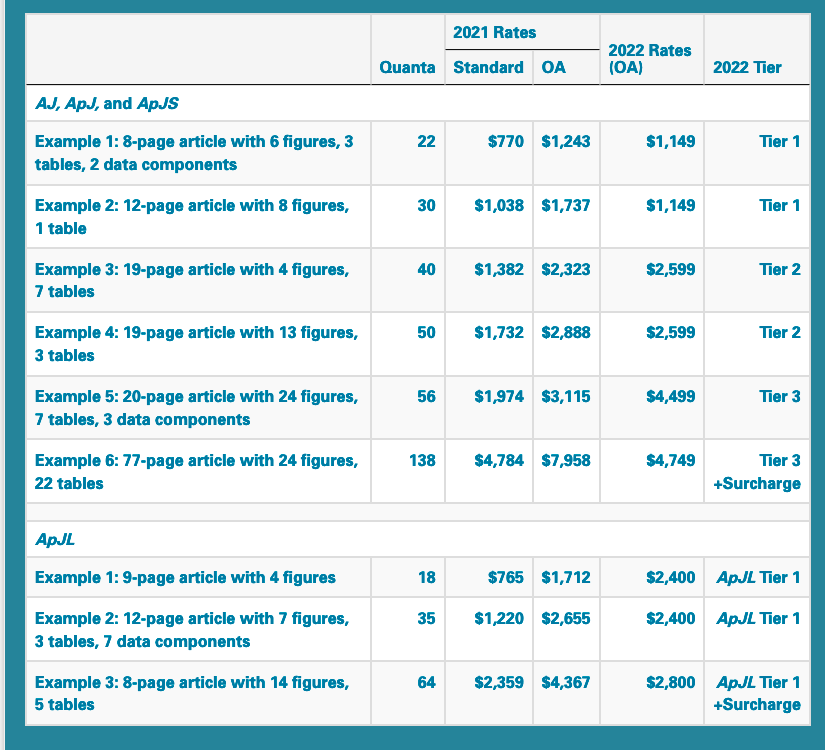
On the other hand, these journals will require authors to pay a hefty sum, equivalent to an Article Processing Charge (APC), that increases with the length and complexity of a paper. AAS journals have in the past levied “page charges” from authors for standard (non-OA) publications. In the new regime these are merged into a unified scheme. Here is a summary of the rates.

What’s on offer is therefore a form of Gold Open Access that switches the cost of publication from subscribers to authors. In my view this level of APC is excessive, which is why I call this Fool’s Gold Open Access. Although the AAS is a not-for-profit organization, its journals are published by the Institute of Physics Publishing which is a definitely-for-profit organization.

The Open Journal of Astrophysics charges neither subscribers nor authors; this form of Open Access is usually called Diamond or Platinum Open Access.

The terminology surrounding Open Access is confusing not least because its usage is evolving. In the current jargon, “Gold” Open Access refers to publication that is free to access at the journal. The principal alternative is “Green” Open Access, which means that free access is offered through depositing the paper in some form of repository separate from the journal. Some astronomical journals allow authors to deposit their articles on arXiv, for example, which is probably the main way in which astrophysicists achieve Green Open Access.

Nowadays “Gold” Open Access refers to anything that is made available freely by a journal regardless of whether an APC is charged or not. The Diamond Open Access provided by the Open Journal of Astrophysics is thus a special case of Gold Open Access. A classification in which Diamond and Platinum are subdivisions of Gold must confuse the heck out of chemists, but that’s where we are at the moment. At least it’s not as bad as in astrophysics where the only terms used to describe chemical elements are hydrogen, helium and “metals”…

While I am glad to see the AAS move its journals into Open Access configurations, I can’t agree with the level of APC. The Open Journal of Astrophysics may be relatively small but it has plenty of capacity for growth while remaining entirely free. The more people realize that it costs tens of dollars rather than thousands to publish a paper the more likely it is that they’ll see the moral case for Diamond Open Access.

Plan S for Open Access: Guidance and Feedback

Posted in Open Access with tags , , , , , on November 27, 2018 by telescoper

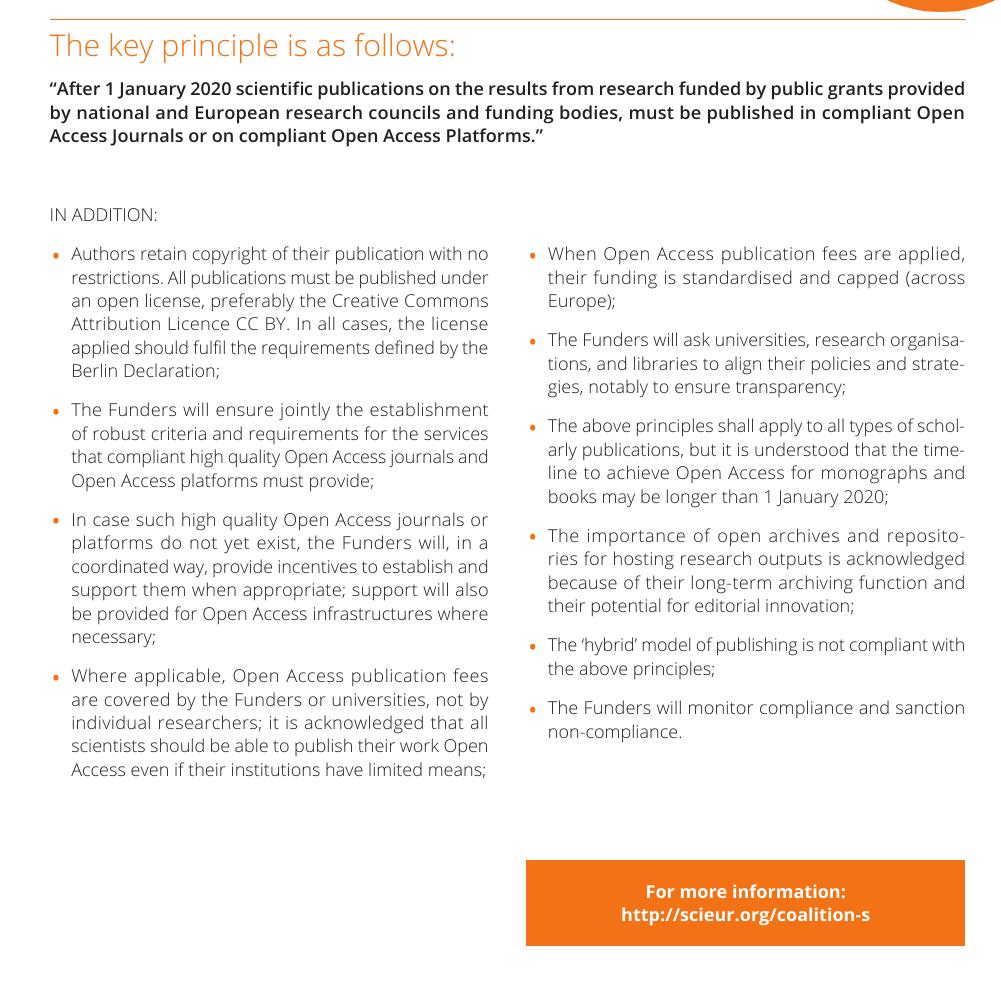
Those of you interested in the topic of Open Access Publishing, and Open Science generally, will no doubt already have heard of `Plan S’. For those that haven’t it is a proposal by 11 European Nations to give the public free access to publicly funded science. The 11 countries involved in this initiative are: France, Italy, Austria, Ireland, Luxembourg, the Netherlands, Norway, Poland, Slovenia, Sweden, and the UK. Together, these nations compise `cOAlition S’ – the `OA’ is for `Open Access’ – to carry out the plan, which can be found here.

Here is a summary:

I have blogged about this and some of the reactions to it before (e.g. here and here).

I’m writing today, however, to pass on an important piece of news, which is that comprehensive technical guidance on how to comply with Plan S has now been issued by Coalition S, where. you can also submit feedback on the guidance.

I’ve got quite a busy day teaching today and have so far only just skimmed the guidance. At first sight it looks a lot more flexible than some people feared. Comments are welcome belo.

My main preoccupation will, however, be to ensure that the Open Journal of Astrophysics can be made compliant (if it isn’t already)..


Learned Societies and Open Access

Posted in Open Access with tags , , , , , on November 8, 2018 by telescoper

Tuesday’s quick post about a letter of opposition to Plan S generated some comments from academics about the role of “Learned Societies” in academic publishing.  I therefore think it’s relevant to raise some points about the extent that these organizations (including, in my field,  the Royal Astronomical Society and the Institute of Physics) rely for their financial security upon the revenues generated by publishing traditional journals.

Take IOP Publishing, for example. This is a wholly-owned subsidiary of the Institute of Physics that has an annual turnover of around £60M generated from books and journals. This revenue is the largest contribution to the income that the IoP needs to run its numerous activities relating to the promotion of physics.  A similar situation pertains to the Royal Astronomical Society, although on a smaller scale, as it relies for much of its income from Monthly Notices of the Royal Astronomical Society, in which as a matter of fact I have published quite a few papers.

Not surprisingly, these and other learned societies are keen to protect their main source of cash. When I criticized the exploitative behaviour of IoP Publishing some time ago in a recent blog post, I drew a stern response from the Chief Executive of the Institute of Physics, Paul Hardaker. That comment seems to admit that the high prices charged by IOP Publishing for access to  its journals is nothing to do with the real cost of disseminating scientific knowledge but is instead a means of generating income to allow the IoP to pursue its noble aim of  “promoting Physics”.

This is the case for other learned societies too, and it explains why such organizations have lobbied very hard for the “Gold” Open Access some authorities are attempting to foist on the research community, rather than the far more sensible and sustainable “Green” Open Access model and its variants.

Some time ago I came across another blog post, pointing out that other learned societies around the world are also opposing Green Open Access:

There is also great incentive for the people who manage and run these organisations to defend their cartel. For example, the American Chemical Society, a huge opponent to open access, pays many of its employees, as reported in their 990 tax return, over six figures. These salaries ranged from $304,528 to $1,084,417 in 2010.

The problem with the learned societies behaving this way is twofold.

First, I consider it to be inevitable that the traditional journal industry will very soon be completely bypassed in favour of some form of green (or at least not gold) Open Access. The internet has changed the entire landscape of scientific publication. It’s now so cheap and so easy to disseminate knowledge that traditional journals are already virtually redundant, especially in my field of astrophysics where we have been using the arXiv for so long that many of us hardly ever look at journals.

The comfortable income stream that has been used by the IoP to “promote Physics”, as well as to furnish its brand new building in King’s Cross, will dry up unless these organizations find a way of defending it. The “Gold” OA favoured by such organizations their attempt to stem the tide. I think this move into Gold `Open Access’, paid for by ruinously expensive Article Processing charges paid by authors (or their organizations) is unsustainable because the research community will see through it and refuse to pay.

The other problematic aspect of the approach of these learned societies is that I think it is fundamentally dishonest. University and institutional libraries are provided with funds to provide access to published research, not to provide a backdoor subsidy for a range of extraneous activities that have nothing to do with that purpose. The learned societies do many good things – and some are indeed outstandingly good – but that does not give them the right to siphon off funds from their constituents in this way.  Institutional affiliation, paid for by fee, would be a much fairer way of funding these activities.

I should point out that, as a FRAS and a FInstP, I pay annual subscriptions to both the RAS and the IoP. I am happy to do so, as I feel comfortable spending some of my own money supporting astronomy and physics. What I don’t agree with is my department having to fork out huge amounts of money from an ever-dwindling budget for access to scientific research that should be in the public domain because it has already been funded by the taxpayer.

Some time ago I had occasion to visit the London offices of a well-known charitable organization which shall remain nameless. The property they occupied was glitzy, palatial, and obviously very expensive. I couldn’t help wondering how they could square the opulence of their headquarters with the quoted desire to spend as much as possible on their good works. Being old and cynical, I came to the conclusion that, although charities might start out with the noblest intentions, there is a grave danger that they simply become self-serving, viewing their own existence in itself as more important than what they do for others.

The commercial academic publishing industry has definitely gone that way. It arose because of the need to review, edit, collate, publish and disseminate the fruits of academic labour. Then the ease with which profits could be made led it astray. It now fulfills little or no useful purpose, but simply consumes financial resources that could be put to much better effect actually doing science. Fortunately, I think the scientific community knows this and the parasite will die a natural death.

The question for learned societies is whether they can find a sustainable funding model that isn’t reliant upon effectively purloining funds from university library budgets. If their revenue from publishing does fall, can they replace it? And, if not, in what form can they survive?
Thoughts on `Plan S’, `cOAlition S’ and Open Access Publishing

Posted in Open Access with tags , , , , , , on September 22, 2018 by telescoper

Those of you who have been following my recent updates on progress with The Open Journal of Astrophysics may be interested to hear about `Plan S’, which is a proposal by 11 European Nations to give the public free access to publicly funded science. The 11 countries involved in this initiative are: France, Italy, Austria, Ireland, Luxembourg, the Netherlands, Norway, Poland, Slovenia, Sweden, and the UK. Since the plan will not come into effect until 1st January 2020, which is after the UK leaves the EU it is by no means clear whether the UK will actually be involved in ERC initiatives after that. Norway is not in the EU but is associated to the ERC. It is unlikely that the UK will have a similar status after Brexit.

Anyway, these 11 countries have formed `cOAlition S’ – the `OA’ is for `Open Access’ – to carry out the plan, which can be found here.

Here is a summary:

You can read more about it here. I have not yet looked at the details of what will be regarded as `compliant’ in terms of Open Access but if the the Open Journal of Astrophysics is not fully compliant as it stands, I expect it can be made so (although we are a genuinely international journal not limited to the 11 countries involved in Plan S).

Anyway, although I support Plan S in general terms what I sincerely hope will not happen with this initiative is that researchers and their institutions get mugged into paying an extortionate `Gold’ Open Access Article Processing Charge (APC) which is simply a means for the academic publishing industry to maintain its inflated profit margins at the expense of actual research. The Open Journal of Astrophysics is Green rather than Gold. In fact the cost of maintaining and running the platform is about $1000 per annum, and the marginal cost for processing each paper is $10 or actually $11 if you count registering published articles with CrossRef (though we do not incur that cost if the article is rejected). In effect running the entire journal costs less than a typical APC for Gold Open Access for one physics paper. Those costs will be born by my institution, Maynooth University. The UK was conned into going down this route some years ago by the publishing lobby, and I hope the other cOAlition S partners do not fall for the same scam.

Open Confusion

Posted in Open Access with tags , , , on March 18, 2013 by telescoper

Catching up yesterday evening with the Times Higher, I found yet another article about the confusion generated by RCUK‘s plans for Open Access publishing. Apparently pressured by the powerful Publishers Association, RCUK has adopted the following “decision tree” to explain how its proposal will work.
RCUK%20decision%20tree

As you can see, this basically says that if you have any money from RCUK  for Open Access you have to spend it on the Gold Open Access which means you have to hand it all over to a publisher. Only when you’re skint can you go Green, and even then you have to tolerate a lengthy embargo.  This is as transparent a scam as you could ever hope to find. The Academic Publishing Industry is clearly out to fleece us for as much as it can get away with, bleeding our block grants dry before allowing us to do the right thing and publish our research the only sensible way, i.e. via Green OA repositories such as the arXiv.

There’s more:

An RCUK spokeswoman confirmed that even when funding for gold is still available via universities’ RCUK-provided block grants, researchers could still choose the green option with its shorter embargo periods.

But this reading of the decision tree was disputed by a spokeswoman for the Publishers Association. She insisted that if funds and gold options were available, researchers should choose gold.

It is obvious from this exchange that the agenda is not being generated by researchers or the research councils, but by the Publishers Association, who have hijacked the entire Open Access debate for their own ends.  Clearly the Academic Publishing Industry doesn’t live in the austere economy the rest of us inhabit – their profits are protected by generous dollops of cash from the taxpayer via RCUK.

And the government seems happy to go along with this hefty backdoor subsidy. I wonder why?