Archive for gravitational waves

BICEP2: New Evidence Of Cosmic Inflation!

Posted in The Universe and Stuff with tags , , on March 18, 2014 by telescoper

Following on from yesterday’s news, here’s a more detailed analysis of the implications of the BICEP2 result from Matt Straessler’s blog. I certainly agree with the statement highlighted in red in his post:

Until this measurement/discovery is confirmed by another experiment, you should consider it provisional. Although this is too large a signal to be likely to be due to a pure statistical fluke, it could still be due to a mistake or problem, or due to something other than gravitational waves from inflation.

Matt Strassler's avatarOf Particular Significance

[For your reference if you can’t follow this post: My History of the Universe, and a primer to help you understand what’s going on today.]

I’m still updating this post as more information comes in and as I understand more of what’s in the BICEP2 paper and data. Talking to and listening to experts, I’d describe the mood as cautiously optimistic; some people are worried about certain weird features of the data, while others seem less concerned about them… typical when a new discovery is claimed.  I’m disturbed that the media is declaring victory before the scientific community is ready to.  That didn’t happen with the Higgs discovery, where the media was, wisely, far more patient.

The Main Data

Here’s BICEP2’s data!  The black dots at the bottom of this figure, showing evidence of B-mode polarization both at small scales (“Multipole” >> 100, where it is due to gravitational…

View original post 1,769 more words

BICEP2 – A Straw Poll

Posted in The Universe and Stuff with tags , on March 17, 2014 by telescoper

I’m not sure whether my scepticism about the BICEP2 results is just a sign of my old age, so it’s time for a quick (and, it goes without saying, totally unscientific)  straw poll to see what people think. Feel free to add comments through the box as well!

Some B-Mode Background

Posted in Astrohype, Science Politics, The Universe and Stuff with tags , , , , , , , , , , , on March 15, 2014 by telescoper

Well, in case you hadn’t noticed, the cosmology rumour mill has gone into overdrive this weekend primarily concerning the possibility that an experiment known as BICEP (an acronym formed from Background Imaging of Cosmic Extragalactic Polarization). These rumours have been circulating since it was announced last week that the Harvard-Smithsonian Center for Astrophysics (CfA) will host a press conference  on Monday, March 17th, to announce “a major discovery”. The grapevine is full of possibilities, but it seems fairly clear that the “major discovery” is related to one of the most exciting challenges facing the current generation of cosmologists, namely to locate in the pattern of fluctuations in the cosmic microwave background evidence for the primordial gravitational waves predicted by models of the Universe that involve inflation.

Anyway, I thought I’d add a bit of background on here to help those interested make sense of whatever is announced on Monday evening.

Looking only at the temperature variation across the sky, it is not possible to distinguish between tensor  (gravitational wave) and scalar (density wave) contributions  (both of which are predicted to be excited during the inflationary epoch).  However, scattering of photons off electrons is expected to leave the radiation slightly polarized (at the level of a few percent). This gives us additional information in the form of the  polarization angle at each point on the sky and this extra clue should, in principle, enable us to disentangle the tensor and scalar components.

The polarization signal can be decomposed into two basic types depending on whether the pattern has  odd or even parity, as shown in the nice diagram (from a paper by James Bartlett)

The top row shows the E-mode (which look the same when reflected in a mirror and can be produced by either scalar or tensor modes) and the bottom shows the B-mode (which have a definite handedness that changes when mirror-reflected and which can’t be generated by scalar modes because they can’t have odd parity).

The B-mode is therefore (at least in principle)  a clean diagnostic of the presence of gravitational waves in the early Universe. Unfortunately, however, the B-mode is predicted to be very small, about 100 times smaller than the E-mode, and foreground contamination is likely to be a very serious issue for any experiment trying to detect it. To be convinced that what is being measured is cosmological rather than some sort of contaminant one would have to see the signal repeated across a range of different wavelengths.

Moreover, primordial gravitational waves are not the only way that a cosmological B-mode signal could be generated. Less than a year ago, a paper appeared on the arXiv by Hanson et al. from SPTpol, an experiment which aims to measure the polarization of the cosmic microwave background using the South Pole Telescope. The principal result of this paper was to demonstrate a convincing detection of the so-called “B-mode” of polarization from gravitational lensing of the microwave background photons as they pass through the gravitational field generated by the matter distributed through the Universe. Gravitational lensing can produce the same kind of shearing effect that gravitational waves generate, so it’s important to separate this “line-of-sight” effect from truly primordial signals.

So we wait with bated breath to see exactly what is announced on Monday. In particular, it will be extremely interesting to see whether the new results from BICEP are consistent with the recently published conclusions from Planck. Although Planck has not yet released the analysis of its own polarization data, analysis of the temperature fluctuations yields a (somewhat model-dependent) conclusion that the ratio of tensor to scalar contributions to the CMB pattern is no more than about 11 per cent, usually phrased in the terms, i.e. R<0.11. A quick (and possibly inaccurate) back-of-the-envelope calculation using the published expected sensitivity of BICEP suggests that if they have made a detection it might be above that limit. That would be really interesting because it might indicate that something is going on which is not consistent with the standard framework. The limits on R arising from temperature studies alone assume that both scalar and tensor perturbations are generated by a relatively simple inflationary model belonging to a class in which there is a direct relationship between the relative amplitudes of the two modes (and the shape of the perturbation spectrum). So far everything we have learned from CMB analysis is broadly consistent with this simplifying assumption being correct. Are we about to see evidence that the early Universe was more complex than we thought? We'll just have to wait and see…

Incidentally, once upon a time there was a British experiment called Clover (involving the Universities of  Cardiff, Oxford, Cambridge and Manchester) which was designed to detect the primordial B-mode signal from its vantage point in Chile. I won’t describe it in more detail here, for reasons which will become obvious.

The chance to get involved in a high-profile cosmological experiment was one of the reasons I moved to Cardiff in 2007, and I was looking forward to seeing the data arriving for analysis. Although I’m primarily a theorist, I have some experience in advanced statistical methods that might have been useful in analysing the output.  Unfortunately, however, none of that actually happened. Because of its budget crisis, and despite the fact that it had spent a large amount (£4.5M) on it already,  STFC decided to withdraw the funding needed to complete it (£2.5M)  and cancelled the Clover experiment. Had it gone ahead it would probably have had two years’ data in the bag by now.

It wasn’t clear that Clover would have won the race to detect the B-mode cosmological polarization, but it’s a real shame it was withdrawn as a non-starter. C’est la vie.

A Time for Honours

Posted in Education, Politics, Science Politics, The Universe and Stuff with tags , , , on June 15, 2013 by telescoper

The word “honour” provides a (tenuous) link between yesterday’s post and this one. After our recent preoccupation with the classification of honours for graduating students (i.e. first class, second class, and so on), today’s news included the Queen’s Birthday Honours List for 2013, which you can download in full here. To make up for the lack of recycling going on in Brighton these days because of the strike that started yesterday, I thought I’d recycle my thoughts from previous years.

The honours system must appear extremely curious to people from outside the United Kingdom. It certainly seems so to me. On the one hand, I am glad that the government has a mechanism for recognising the exceptional contributions made to society by certain individuals. Musicians, writers, sportsmen, entertainers and the like generally receive handsome financial rewards, of course, but that’s no reason to begrudge a medal or two in recognition of the special place they occupy in our cultural life.  It’s  good to see scientists recognized too, although they tend not to get noticed so much by the press.

The name that stood out for me in this year’s list is Professor Jim Hough, who gets an OBE. Jim is Professor of Experimental Physics at the University of Glasgow, and his speciality is in the detection of gravitational waves.  Gravitational waves haven’t actually been detected yet, of course, but the experimental techniques designed to find them have increased their sensitivity by many orders of magnitude in recent years, Jim having played a large part in those improvements. I imagine he will be absolutely thrilled in February 2016, when gravitational waves are finally detected. Jim is also Chief Executive of the Scottish University Physics Alliance, which does so much to nurture Physics and Astronomy North of the Border.

Although I’m of course more than happy to see recognition given to such people, as I did  a couple of years ago I can’t resist stating my objections to the honours system again. One is that the list of recipients  of certain categories of award is overwhelmingly dominated by career civil servants, for whom an “honour”  goes automatically with a given rank. If an honour is considered an entitlement in this way then it is no honour at all, and in fact devalues those awards that are  given on merit to people outside the Civil Service. Civil servants get paid for doing their job, so they should have no more expectation of an additional reward than anyone else. There’s much more honour in a  student who earns a First Class degree than for a career civil servant who gets a knighthood.

Honours have relatively little monetary value on their own, of course so this is not question of financial corruption. An honour does, however, confer status and prestige on the recipient so what we have is a much more subtle form of sleaze. One wonders how many names listed in the current roll of honours are there because of political donations, for example.

I wouldn’t accept an honour myself, but that’s easy to say because I’m sure I’ll never be nominated for one; hopefully this post will dissuade anyone from even thinking of nominating me for a gong. However, I imagine that even people like me who are against the whole system are probably still tempted to accept such awards when offered, as they generate good publicity for one’s field, institution and colleagues.It’s a very personal decision and I have no criticism to make of people who think differently from me about whether to accept an honour.

Sathya’s Cosmic Sirens

Posted in The Universe and Stuff, Uncategorized with tags , , , on January 7, 2013 by telescoper

Bit busy today so I thought I’d just post this talk by Cardiff’s own Prof. Bangalore Sathyaprakash at last year’s TEDX event in Cardiff.
The title is Cosmic Sirens although given that the topic is gravitational waves I hope that “sirens” isn’t intended to mean those entirely mythical entities that lure unsuspecting PhD students to their ultimate destruction…

Anyway, here’s the blurb:

In 1916 Einstein predicted that dynamical mass distribution generates ripples in the very fabric of spacetime that propagates outwards at the speed of light.

For over two decades B.S. Sathyaprakash (Sathya for his family and friends) is engaged in research to detect these ripples called gravitational waves, from cataclysmic cosmic events such as exploding stars, colliding black holes and the big bang. His personal goal is to observe and understand black holes and gravity using gravitational radiation. He is the head of the gravitational physics group at Cardiff University — a centre for modelling astronomical sources of gravitational radiation, discovering innovative algorithms to search for this radiation and analyzing data from gravitational-wave detectors using massive computer clusters.

Although there is firm indirect evidence that certain astronomical systems do emit gravitational waves, so far no one has detected them directly. Sathya and his team are part of a worldwide effort, called the LIGO Scientific Collaboration, to detect these elusive waves using kilometer long laser interferometers in the US, Europe and Japan. Recently, Sathya helped develop the science case for building such a detector in India. He has been involved in the European design study of a third generation underground detector with a 30 km baseline called the Einstein Telescope, chairing the group that developed the science case for this ambitious venture.

And here is the actual talk..

Gravity Waves Detected!

Posted in The Universe and Stuff with tags , , on October 29, 2012 by telescoper

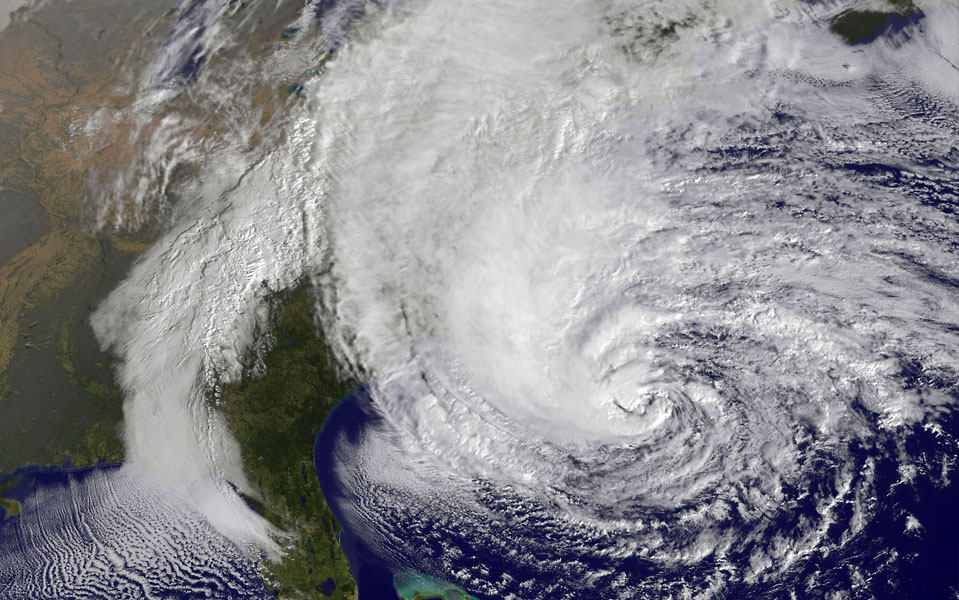
At last, for all you sceptics out there, Hurricane Sandy has finally provided definitive proof of the existence of gravity waves, clearly visible to the South West of the storm…

Apologies if you thought I meant gravitational waves. The confusion was entirely intentional.

R.I.P. Leonid Grishchuk

Posted in The Universe and Stuff with tags , , , on September 14, 2012 by telescoper

As I was travelling to Heathrow airport in order to fly to the USA (from where I am posting this message), I heard the sad news of the death of a dear and respected colleague, Professor Leonid Petrovich Grishchuk.

Leonid was a  Distinguished Research Professor here in Cardiff from  1995 until his retirement in 2009 and was frequently to be found in the department after that. You can read more of his scientific biography and wider achievements here, but it should suffice to say that he was a pioneer of many aspects of relativistic cosmology and particularly primordial gravitational waves. He was also a larger-than-life character,  held in great affection by many scientists and friends around the world.

My first experience of Leonid was many years ago at a scientific meeting at which I attempted to give a talk. Leonid was in the audience and he interrupted me,  rather aggressively. I didn’t really understand his question so he had another go at me in the questions afterwards. I don’t mind admitting that I was quite upset with his behaviour. I think a large fraction of working cosmologists have probably been “Grischchucked” at one time or another. Later on, though, people from the meeting were congregating at a bar when he arrived and headed for me. I didn’t really want to talk to him as I felt he had been quite rude. However, there wasn’t really any way of escaping so I ended up talking to him over a beer. We finally resolved the question he had been trying to ask me and his demeanour changed completely. We spent the rest of the evening having dinner and talking about all sorts of things and were good friends ever since. Over the years I’ve learned that this is very much a tradition amongst Russian scientists of the older school. They can seem very hostile – even brutal – when discussing science, but that was the way things were done in the environment where they learned their trade.  In many cases the rather severe exterior masks a kindly and generous nature, as it certainly did with Leonid. Leonid’s confrontational behaviour was partly sport – once you got used to that twinkle in his eye it was impossible to take offence – but partly a genuine desire to cut away the flannel and get to the heart of things. He detested bullshit and had no time for people who traded in it.

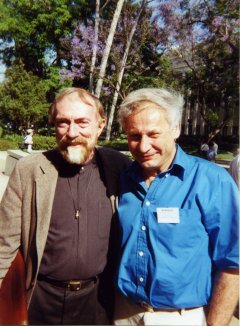
Here’s a picture of Leonid taken a few years ago with his longstanding friend Professor Kip Thorne.

lpg008_test

Some months ago Leonid was struck down by a brain tumour, against which he struggled bravely. On Monday this week, however, the doctors were forced to admit that the treatment had failed and Leonid could not live much longer. Fortunately his death, when it came, was peaceful. He passed away in his sleep on Wednesday night.

Farewell, Leonid. We’ll all miss you.

Wavy Gravy

Posted in Jazz with tags , , , , , on July 31, 2012 by telescoper

I was looking through my collection of old CDs last night and saw a track on Kenny Burrell’s classic album Midnight Blue with the title Wavy Gravy. I hadn’t noticed the name before, but thought it might do as a theme tune for my Cardiff colleagues who work on gravy waves  gravitational waves

Anyway, the album was recorded at the Van Gelder Studio, Englewood Cliffs, New Jersey on April 06-07, 1963, and originally released on Blue Note (4123). The complete personnel listing is: Kenny Burrell (guitar); Stanley Turrentine (tenor saxophone); Major Holley, Jr. (bass); Bill English (drums); Ray Barretto (congas).

Bad News for Astrophysics from ESA

Posted in Science Politics, The Universe and Stuff with tags , , , , , , , , on April 18, 2012 by telescoper

Just a quick post to pass on the news (which I got from Steinn Sigurdsson’s blog) that the ESA Executive (see correction in comments below) Space Science Advisory Committee (SSAC) of the European Space Agency (ESA) has made a recommendation as to the next large mission to be flown. The short list consisted of a mission to Jupiter’s moons (JUICE), an X-ray observatory (ATHENA), and a gravitational wave observatory (NGO). The last two of these are severely de-scoped versions of missions (IXO and LISA respectively) that had to be re-designed in the aftermath of decisions made in the US decadal review not to get involved in them.

Not unexpectedly, the winner is JUICE. Barring a rejection of this recommendation by the ESA Science Programme Committee (SPC) this will be the next big thing for ESA space science.

The School of Physics and Astronomy at Cardiff University has a considerable involvement in gravitational wave physics, so the decision is disappointing for us but not entirely surprising. It’s not such a big blow either, as we are mainly involved in ground-based searches such as LIGO.

The biggest local worry will be for the sizeable community of X-ray astronomers in the UK. With no big new facilities likely for well over a decade one wonders how the expertise in this area can be sustained into the future, even if LOFT is selected as one of the next medium-sized missions. Or, given that STFC funding is already spread extremely thin, perhaps this is time for the UK to organize a strategic withdrawal from X-ray astronomy?

Gravity waves goodbye to LISA?

Posted in Science Politics, The Universe and Stuff with tags , , , on April 8, 2011 by telescoper

It seems that we’re not allowed to have any good news these days without a bit of bad to go with it. This week it has emerged here and there that the US National Aeronautics and Space Administration (better known as NASA) is pulling the plug on one of the most exciting space missions on its drawing board. Feeling the pressure of budget constraints and a ballooning overspend on the James Webb Space Telescope (JWST), NASA has decided not to participate further in the Laser Interferometric Space Antenna, a.k.a. LISA. The project teams working on LISA have been disbanded, and the shutters have been pulled down on a project which would have revolutionised astrophysics by opening up new possibilities of observing astronomical objects using gravitational waves, rather than electromagnetic radiation.

This does not mean that LISA is necessarily completely dead. For one thing, it was always planned to be a partnership between NASA and its European counterpart ESA (the European Space Agency); you can find ESA’s LISA page here. In fact a technological demonstrating mission LISA-Pathfinder, operated by ESA, is scheduled for launch in 2013.
It remains possible that ESA will proceed on its own with some version of LISA, although given its own financial constraints it is unlikely that it will be able to fund the full original mission concept. The best we can hope for, therefore, is probably some slimmed-down low-budget version and perhaps an even later launch date.

I still hold out some hope that LISA might come out of mothballs when gravitational waves are actually detected. This may well be accomplished by Advanced LIGO, a ground-based interferometric system based in the states, although it has to be said that gravitational waves have been “on the brink of detection” for at least 30 years and still haven’t actually been found. When detection does become a reality it might galvanise NASA into finding room in its budget again.

This news will be a particularly concern for the sizeable Gravitational Physics group here in the School of Physics & Astronomy at Cardiff University. However, LISA was very much in the planning and development stages so it won’t impact their current work. I haven’t had the chance to discuss the news about LISA with members of this group, so I’d be interested to receive comments from them, or indeed anyone else who knows more about what NASA’s decision may or not mean for the future of gravitational wave physics.


Share/Bookmark