Archive for Grism

“First Light” Images from Euclid

Posted in Euclid, The Universe and Stuff with tags , , , , , on July 31, 2023 by telescoper

As I promised a couple of days ago, the “first light” images from the European Space Agency’s Euclid mission have now been released. You can find all the details here, but a summary is that these are “engineering” images, rather than part of the full survey to be undertaken by Euclid, and the commissioning of the instruments is not quite finished, but the telescope is now in focus and both instruments (the visual instrument, VIS, and the Near-Infrared Spectrometer & Photometer, NISP) are working well enough to show some preliminary results.

Anyway, here are the pictures released today, first from VIS:
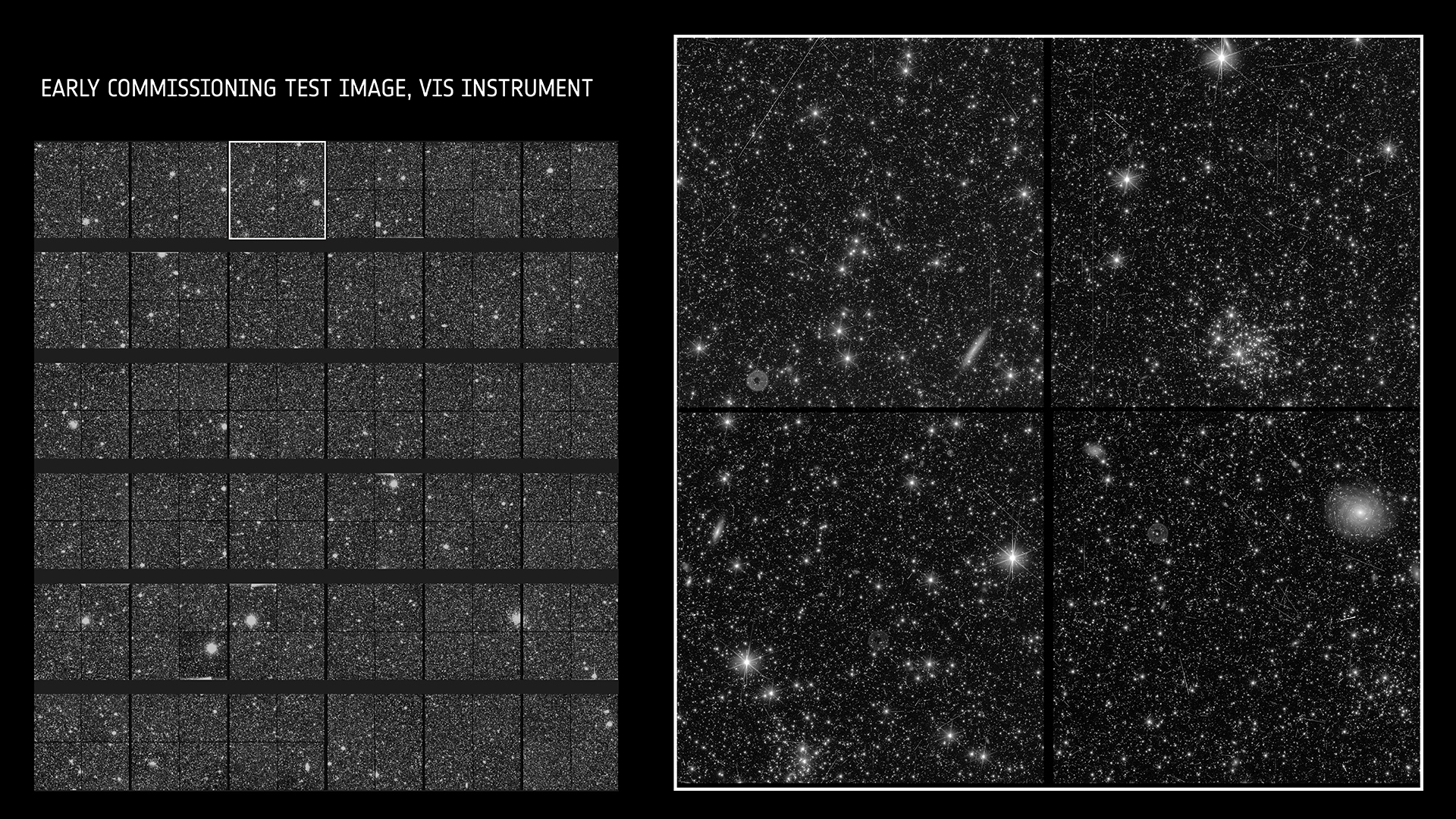
Euclid early commissioning test images, showing an image by the VIS instrument (visible light). The full focal plane of VIS consisting of 36 detectors is shown on the left, and one detector in higher resolution on the right. Credits: © ESA/Euclid/Euclid Consortium/NASA, CC BY-SA 3.0 IGO

The next one is from NISP:

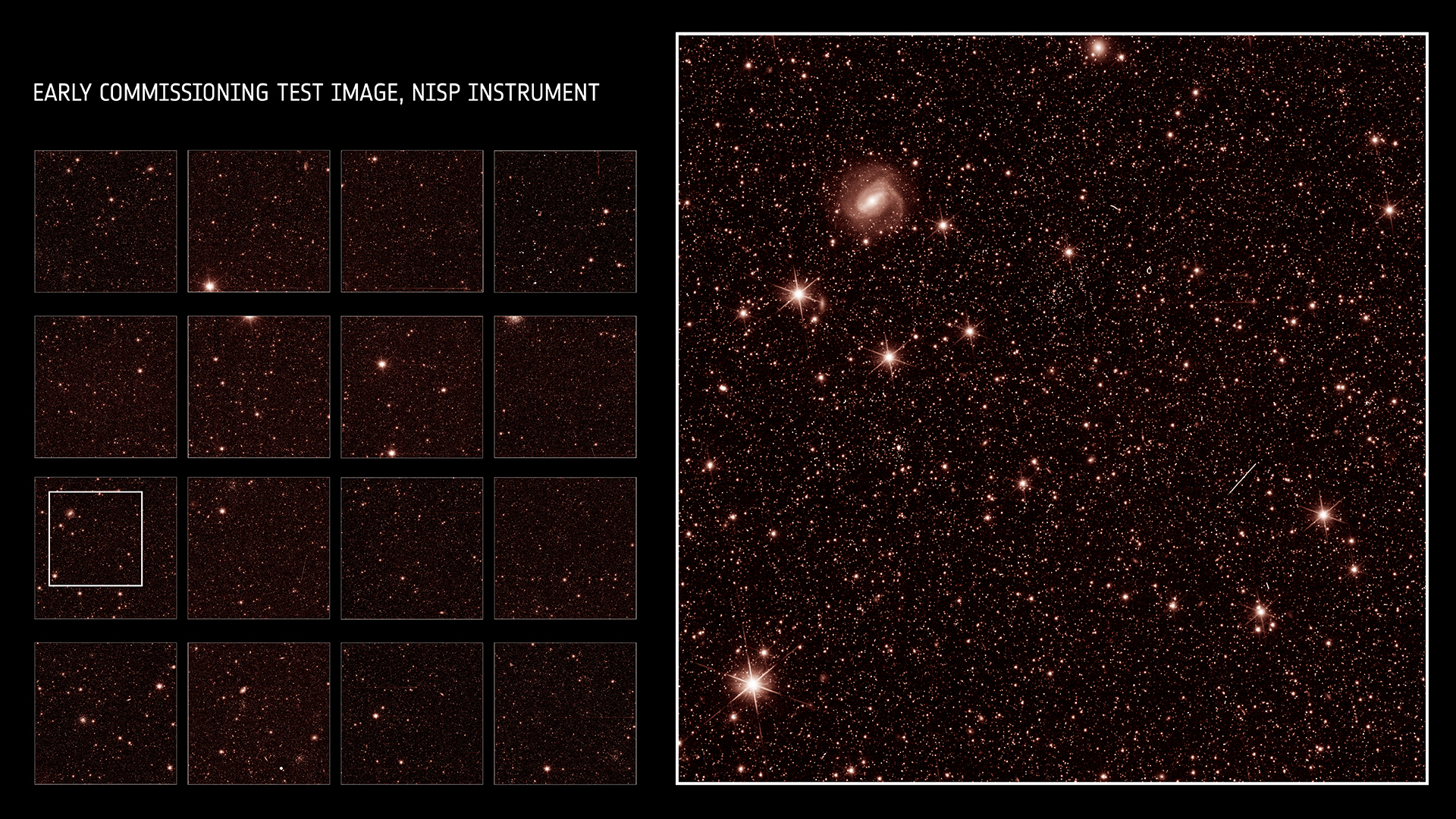
Euclid early commissioning test images, showing an image by the NISP instrument (near-infrared light). The full focal plane of NISP consisting of 16 detectors is shown on the left, and part of one detector in higher resolution on the right. Credits: © ESA/Euclid/Euclid Consortium/NASA, CC BY-SA 3.0 IGO

This final one, also from NISP, shows it working in grism mode, which allows the light from sources to be dispersed into a spectrum, enabling us to get much more information about the sources galaxies than a straightforward image would. The resulting images look a bit strange to the untrained eye – as the light from a point is spread out into a streak – but the result is wonderfully rich in information:
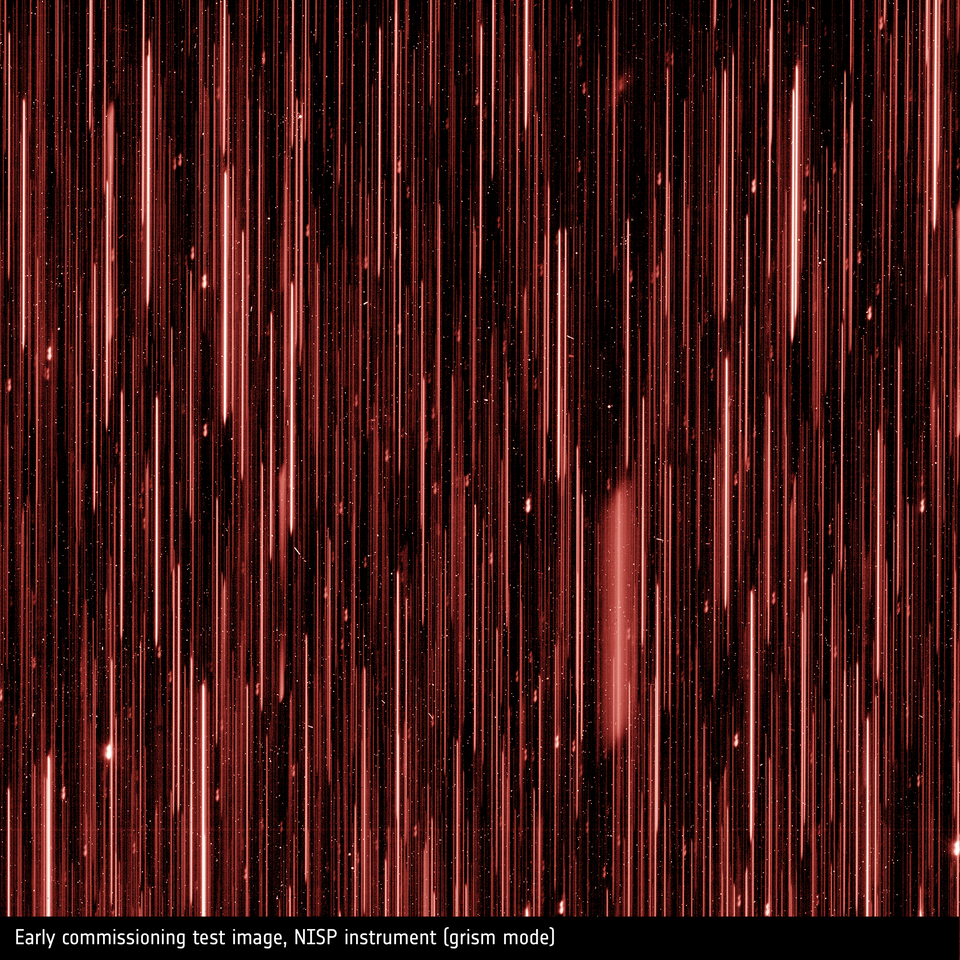
Euclid early commissioning test images, showing an image by the NISP instrument (near-infrared light), in its grism slitless spectroscopy mode. The full focal plane of NISP consists of 16 detectors, here a part of one detector is shown in full resolution. Credits: © ESA/Euclid/Euclid Consortium/NASA, CC BY-SA 3.0 IGO

For more information – and some higher-resolution images – see the official Euclid press release here.

For myself, I’d just say these images are absolutely amazing given that they were taken during the commissioning phase and the instruments aren’t fully tweaked yet. Over the next few weeks, there will be a performance verification phase which will tell us how good Euclid will be at meeting its science goals. But so far it’s all looking very good indeed. I’ve only ever seen simulations of what would come out and it’s very exciting to see what the real thing looks like!

Hats off to the brilliant instrumentation experts who not only designed and built the kit but who have been working so hard on the commissioning. They’ve done so much in the month that has passed since the launch!

P.S. You can find here a nice explainer of some of the instrumental artefacts you might have spotted in the images above.

A Galaxy at Redshift 11.1?

Posted in The Universe and Stuff with tags , , , on March 7, 2016 by telescoper

Back in the office after one Friday off and there’s the inevitable queue at my door and mountain of things that just have to be done immediately. Yeah, right..

Anyway, I couldn’t resit a short blogging break to mention a bit of news that made a splash last week. This is the claim that a galaxy has been observed at a redshift z=11.1 which, if true, would make it the most distant such object ever observed. When I was a lad, z=0.5 was considered high redshift!

If the current standard cosmological model is correct then the lookback time to this redshift is about 13.4 billion years, which means that the galaxy we are seeing formed just 400 million years after the Big Bang. If it is correctly identified then it has to be an object which is forming stars at a prodigious rate. You can find more details in the discovery paper (by Oesch et al.)  here.

I have taken the liberty of extracting the following figure:

Grism

The claim is that the model spectrum on the top right is a much better fit to the data obtained using the Hubble Space Telescope Grism spectrograph than the two alternatives at much lower redshift. However, this depends a great deal on having a good model for the significant contamination from other sources. Moreover I’m sure the residuals are non-Gaussian and I’m not therefore convinced that a simple χ2 is the best way to assess the fit. Obviously I’d like to see a proper Bayesian model comparison!

So, as I have been on previous occasions (e.g. here), I remain not entirely convinced. But then I’m a theorist who is always excessively suspicious of data. Any experts out there want to tell me I’m wrong?