Archive for Gustav Mahler

Season Finale at the National Concert Hall

Posted in Biographical, Music with tags , , , , on May 31, 2025 by telescoper

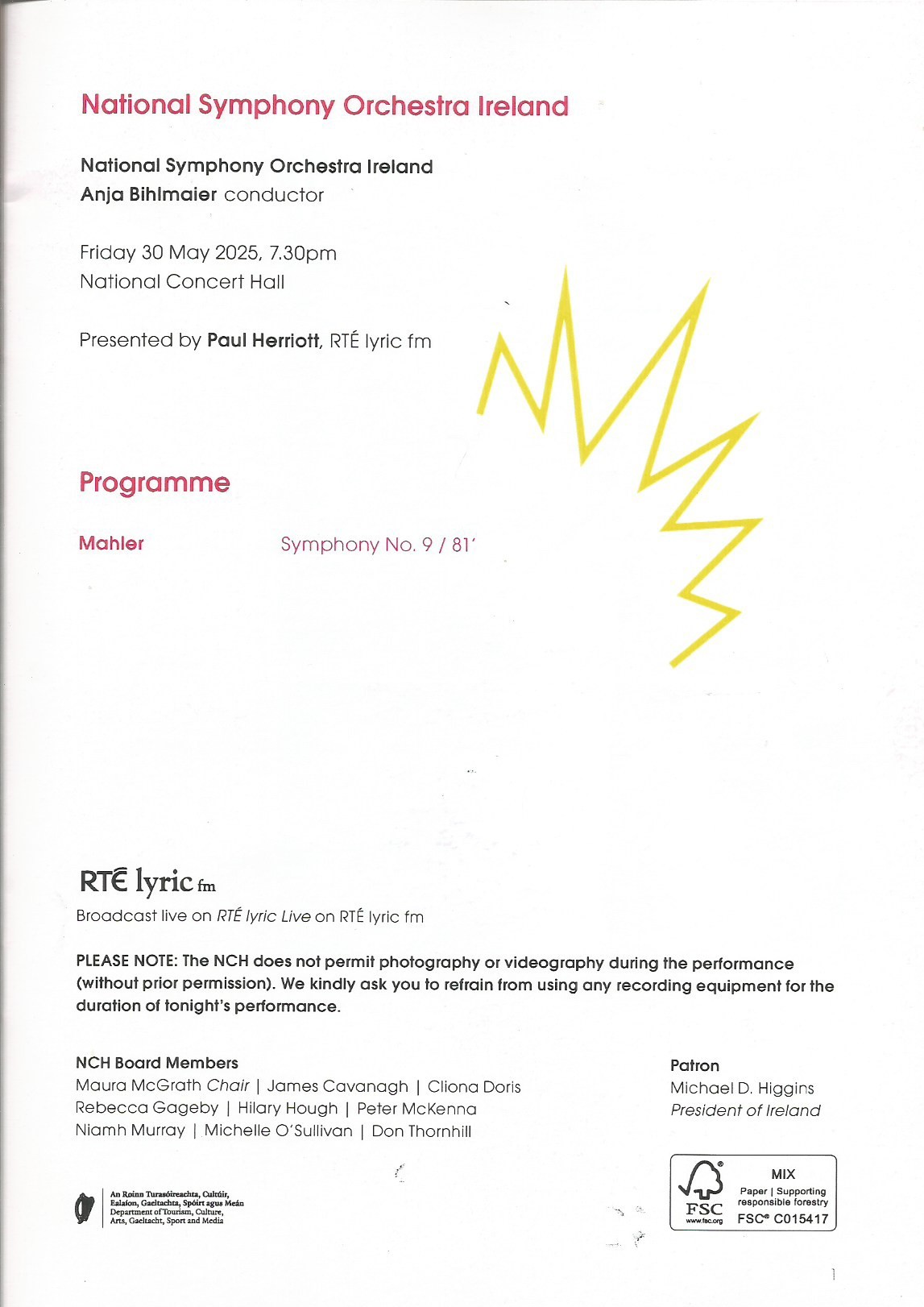
It was very nice to be able to put the marking of examinations behind me and travel into Dublin last night for the final concert of the season at the National Concert Hall in Dublin. It seems the former NSO is now to be called the NSOI, the National Symphony Orchestra Ireland, no doubt for some sort of corporate branding reason. Anyway, last night they were under the direction of guest conductor Anja Bihlmaier for a performance of the Symphony No. 9 by Gustav Mahler.

Looking back through my previous posts about Mahler I see that I haven’t previously written anything about his 9th Symphony. I am pretty sure that last night was the first time I’ve heard it live, although I have it on CD. Mahler wrote it between 1908 and 1909, immediately after finishing Das Lied von der Erde which is a symphony in all but name and which should really be his 9th. He was a very superstitious man, however, and he was worried about the Curse of the 9th, so it wasn’t given a number. After the acual 9th Symphony he went on to compose another, his 10th (though really the 11th), though he didn’t quite finish it before his death in 1911. I hope this clarifies the situation.

The 9th Symphony is a substantial piece last about 80 minutes in performance. That’s far from his longest, but it does justify it being performed on its own. The structure is unusual, with two very long slow movements either side of a pair of shorter movements, a scherzo and a rondo. The former is constructed from dance-like segments, and much of it is in 3/4 time; it reminded me a little of Ravel’s La Valse, which starts out like a standard waltz but disintegrates into a nightmarish parody of that form. The rondo described as “Rondo-Burleske” is very fragmented, grotesque and at times raucous, and also very modern-sounding. It has been described as “ferocious outburst of fiendish laughter at the futility of everything”. I think the final adagio movement is the best, and it brought out the best of the NSOI. The long sweeping passages played by only the strings, with the cellos and double-basses providing deep foundations to Mahler’s sumptuously textured harmonies. Absolutely gorgeous.

The Symphony ends very quietly indeed. Anja Bihlmaier kept her baton in hand for quite a long time before putting it down and letting the applause start. A little silence at the end of a piece of music is a very good thing: it allows the members of the audience a brief moment to reflect on what they have heard. It irks me when people starting clapping and shouting before the sound has even died away.

Anyway, when it was over, the applause was tumultuous. I’ve already mentioned the string sections, but ll the members of the NSOI contributed with outstanding contributions from the woodwinds and brass too.
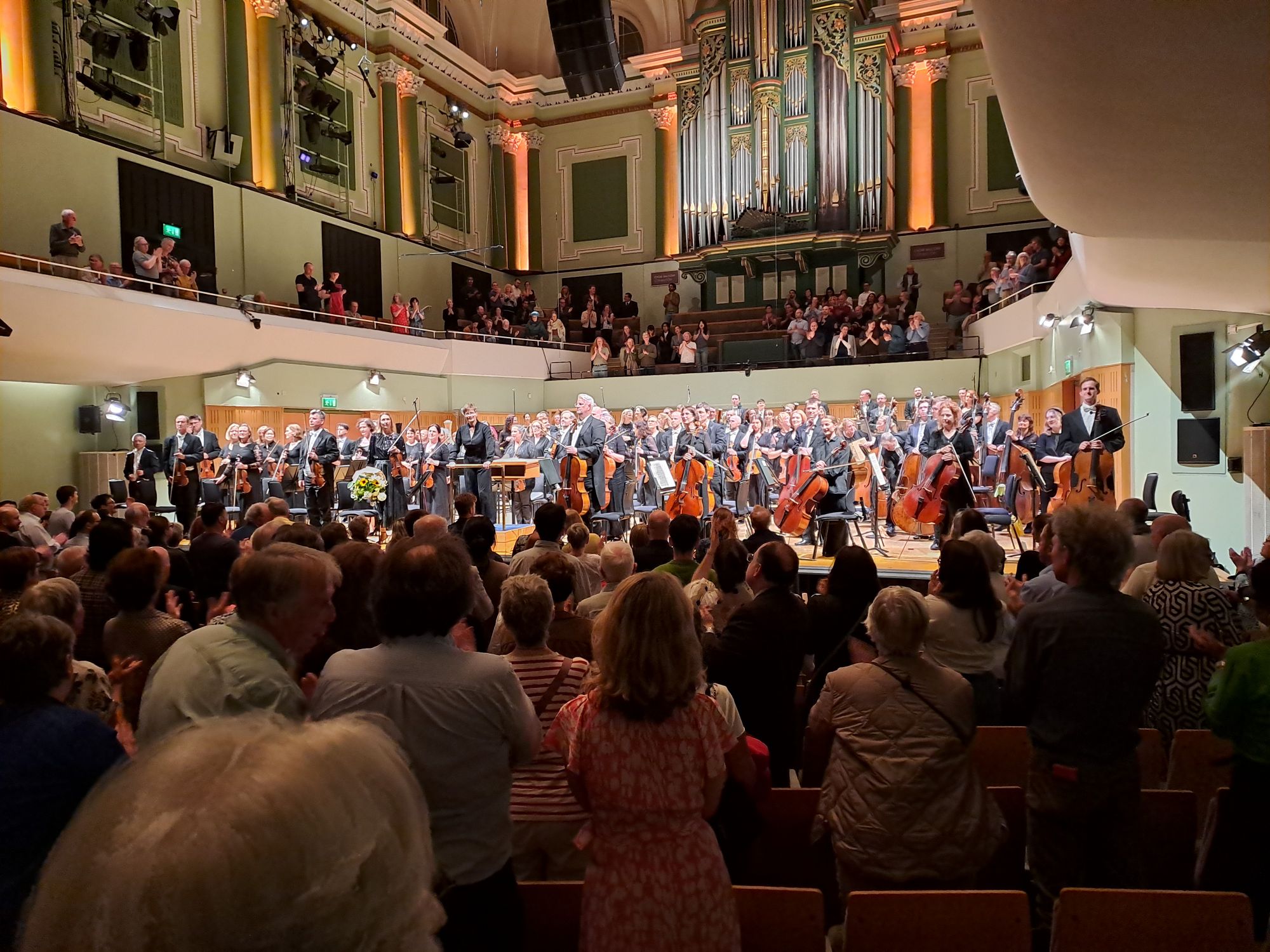
There being only one item on the menu there was no wine break, but not having an interval meant that I had time to have a drink at the end before heading back to Pearse station to get the train back to Maynooth. In the old days the NCH used to treat the audience to a free prosecco after the season finale, but not any more. I had to buy my own.

Well, this season may be over, but the booklet for next season is already out. I had a look through it on the train home. I plan to resume my Friday-night concert-going at the NCH in September, but there will be more music before then.
Das Lied von der Erde

Posted in Biographical, Music with tags , , , , , , , on February 22, 2025 by telescoper

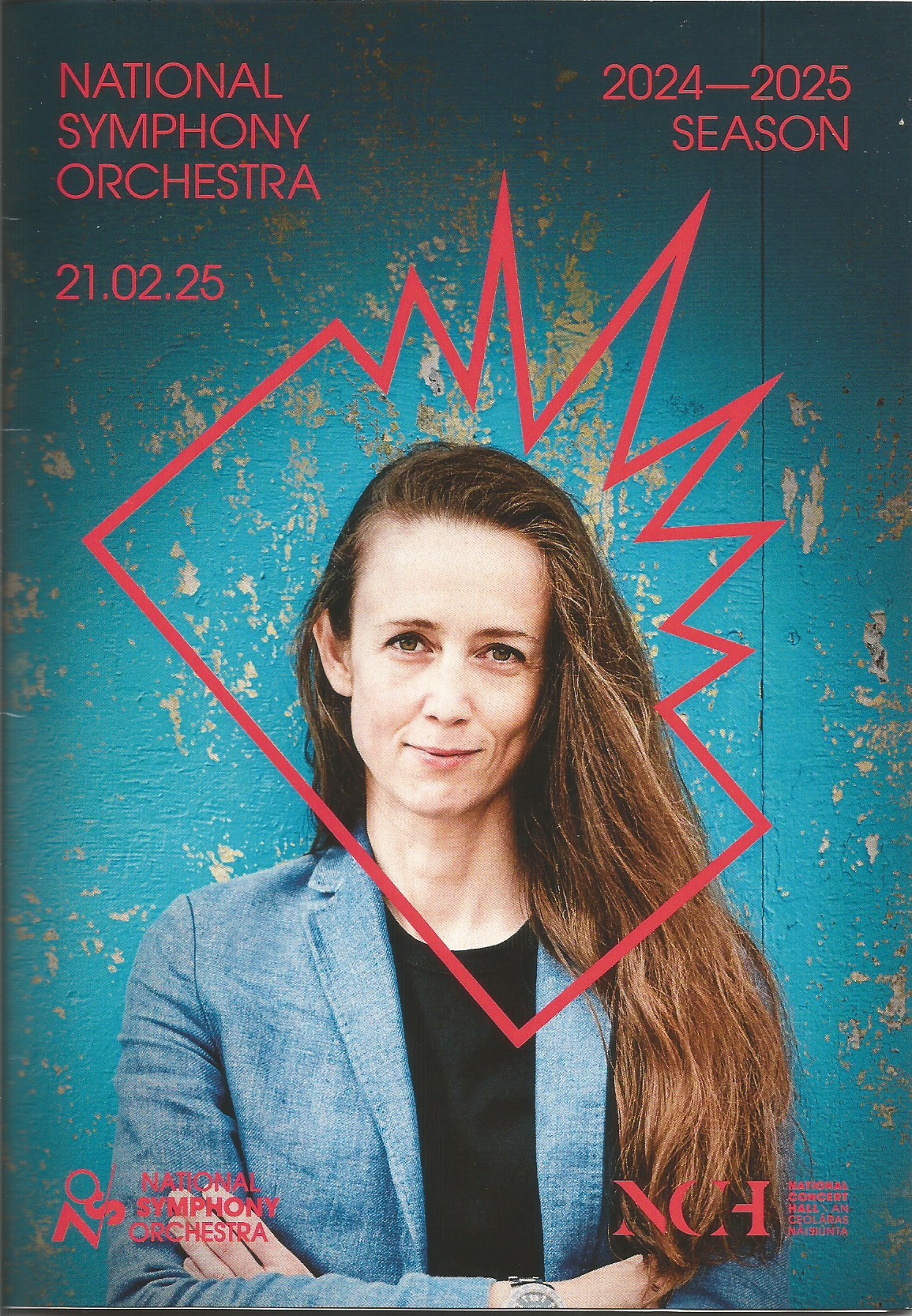
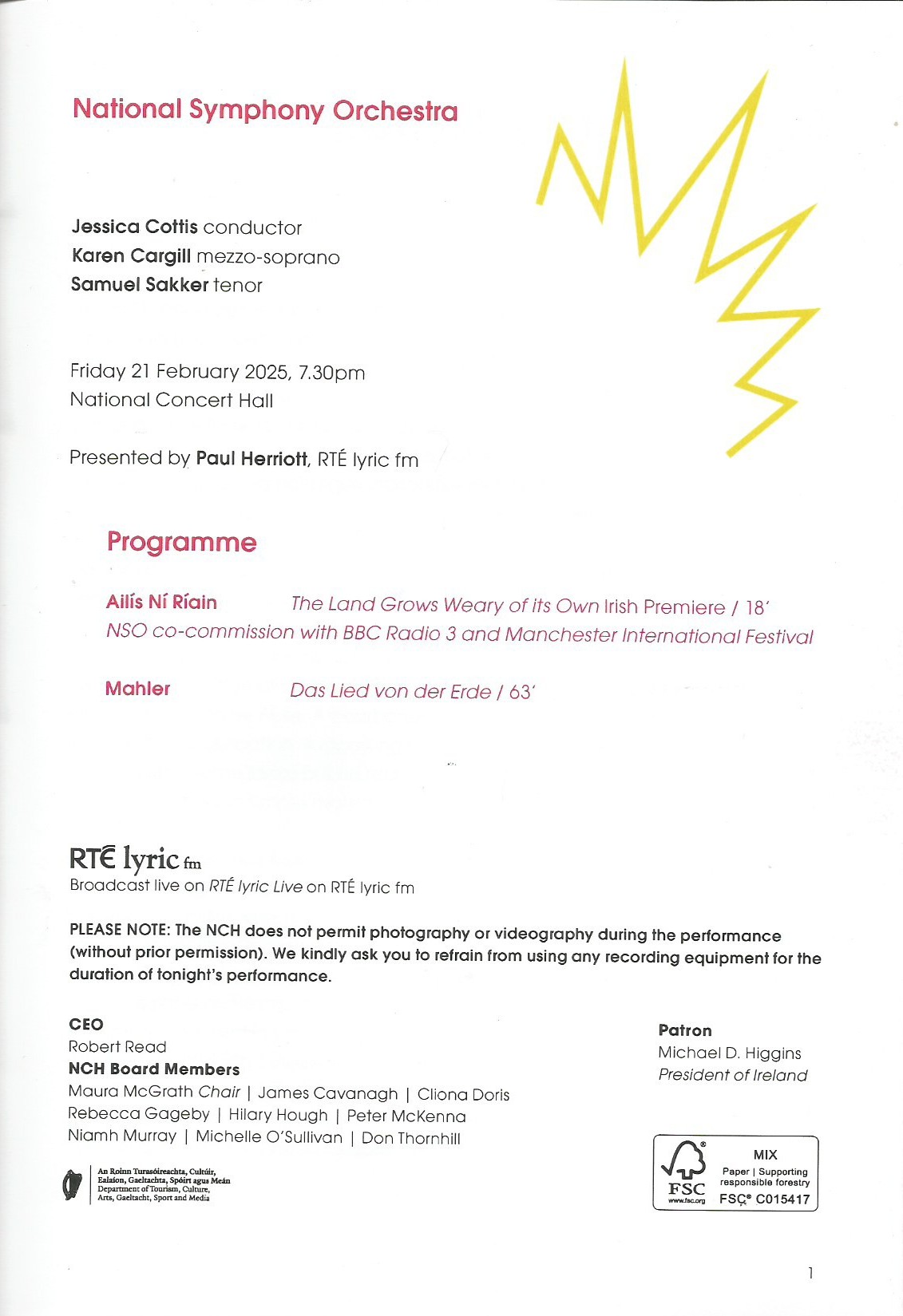
And it came to pass that yesterday evening I travelled into Dublin for another concert at the National Concert Hall. The main item on the menu was Das Lied von der Erde (“The Song of the Earth”), an orchestral work for two voices and orchestra by Gustav Mahler. Sometimes described as a song cycle this piece is a symphony in all but name (and number). Mahler was suspicious about counting this work as his 9th Symphony because of the Curse of the Ninth. He did go on to composer another (numbered) Symphony but did not live to hear it performed. He didn’t live to hear Das Lied von der Erde performed either.

Das Lied von der Erde (“The Song of the Earth”) is a long work – performance time is just over an hour – and it is spread over six movements, thematically linked by translations of classical Chinese poems translated into German by Has Bethge. The final movement, by far the longest, incorporates two texts whereas the others include one each.

This is one of my favourite works but I’ve only ever heard it on the radio or on a recording so I was delighted to see it was coming up at the National Concert Hall. I enjoyed last night’s performance enormously. The National Symphony Orchestra was conducted by Jennifer Cottis with soloists Samuel Sakker (tenor) and Karen Cargill (mezzo-soprano). The start of this piece is difficult for the tenor who has to come in at full volume. At first I thought he was going to struggle, but he hit his straps very quickly and delivered a strong performance. Karen Cargill was superb throughout, her voice very well matched to the demands of the music. I have heard her sing Mahler before, incidentally, in Cardiff, and she was great then too. The whole orchestra played beautifully, but I would pick out the woodwind section for special mention.

That wasn’t the entire concert. There was also the Irish premier of a new work work by Ailís Ní Ríain called The Land Grows Weary of its Own, which is a meditation on the effects on bird populations and migration thereof caused by Earth’s changing climate. It’s an interesting piece, with some fascinatingly complex passages, especially for the percussion. The composer was the audience, but unforunately the auditorium was only about half full for the performance. It only lasts about 20 minutes so the interval came quite quickly. Returning after my glass of wine I could see a much fuller Concert Hall so some people obviously skipped the first piece, which is a shame.

Yesterday was a very rainy and blustery day and on the way home I thought about the number of times I’ve walked from Connolly Station to the NCH yet never been rained on. Last night was no different.

A New Season at the National Concert Hall

Posted in Biographical, Music with tags , , , , , , , , on September 14, 2024 by telescoper

It was just over a year ago that I last went to the National Concert Hall in Dublin. That occasion was the opening of a new season of concerts for 2023-4 by the National Symphony Orchestra. After a year away on sabbatical, last night I went to the season opening of the next year of concerts by the National Symphony Orchestra, this time under the direction of Mihhail Gerts. I’m hoping to see more of the forthcoming season than I did the last!

The programme for the concert is shown in the picture. The first half was dominated by legendary mezzo-soprano Dame Sarah Connolly, resplendent in a turquoise frock, who sang six songs by Alma Mahler (born Alma Schindler) who was of course the wife of Gustav Mahler whose 1st Symphony we heard in the second half. Gustav famously (and reprehensibly) told Alma that she had to give up composing music when they married (which they did in 1902). Until then she had written not only songs but also piano music. Few of her compositions survive, however. Apparently she destroyed many of the manuscripts herself in later life. Of the fifty or so songs she is thought to have written, only 17 (including the 6 we heard last night) still exist on paper. She at least responded by outliving him by more than 50 years: Gustav died in 1911 and Alma Mahler passed away in 1964.

It’s very unfair to compare Alma Mahler’s settings with those of Gustav Mahler, who was a master of the orchestral song cycle. The compositions we heard all all quite short, three or four minutes, and are definitely influenced by Wagner. The first song, for example, deploys the famous Tristan Chord and there are passages that are clearly influenced by the Wesendonck Lieder. None of the manuscripts are dated, but in terms of style they do sound like late Romantic works from around 1900 when she was very young. Overall these works not at the same level of achievement of either Richard Wagner or Gustav Mahler but, with Sarah Connolly in fine voice, there was much to enjoy. I had never heard any of these songs before this evening, and it left me wondering what Alma Mahler might have achieved musically had she continued to compose. We’ll never know.

Before these songs we heard the concert overture In Nature’s Realm by Antonín Dvořák. This is also a piece that feels very late-19th Century (it was composed in 1891). It’s a sort of homage to the beauty of the composer’s native Bohemia with distinct echoes of Beethoven’s Pastoral Symphony, I thought.

After the interval wine break we returned for the second half which consisted of (Gustav) Mahler’s Symphony No. 1 in D Major. This is a very familiar concert work nowadays, but it’s worth remembering that it didn’t exactly set the world on fire when it was first performed in 1889 and Mahler revised it extensively before it arrived at the form now usually performed. Like all Mahler symphonies it covers a vast territory. One of the most famous Mahler quotations is “the symphony is a world”, but in the case of his own symphonies each movement is a world. The first movement begins in hesitant and fragmentary fashion before bursting into life with a metaphorical evocation of daybreak. The second movement is earthier and more forceful, quoting from folk songs and country dances. The third is my favourite, with its humorously up-beat references to Klezmer music before ending in a kind of funeral march. The final movement is tempestuous at first, then calm, then erupts into a glorious finale.

Last night’s performance was broadcast live on RTÉ Lyric FM but what radio listeners won’t have got was the thrilling sight of a symphony orchestra in full flood. At the end of the last movement, members of brass section stood up to give extra power to the climactic resolution of the piece. Mahler does “loud” very well indeed, but I was impressed by the spectacle too: the lights gleaming off the array of trombones and horns as they blasted out the final phrases (in another context I would call them “riffs”). Great stuff, and very well received by the audience.

P.S. On the way into Dublin to see last night’s concert I realized that the Irish Rail timetable had changed while I was away so, instead of terminating at Connolly (the station, not the mezzo-soprano), the train I was on went all the way through to Pearse, thereby saving me a bit of time walking. It only takes about 20 minutes (for me) to walk from Pearse to the NCH, in case you’re wondering, and I do like a bit of a walk to stretch my legs before sitting down for a couple of hours at a concert.

Mahler, Weber, Schubert and Strauss at the NCH

Posted in Biographical, Music with tags , , , , , , , , , , , , on January 14, 2023 by telescoper

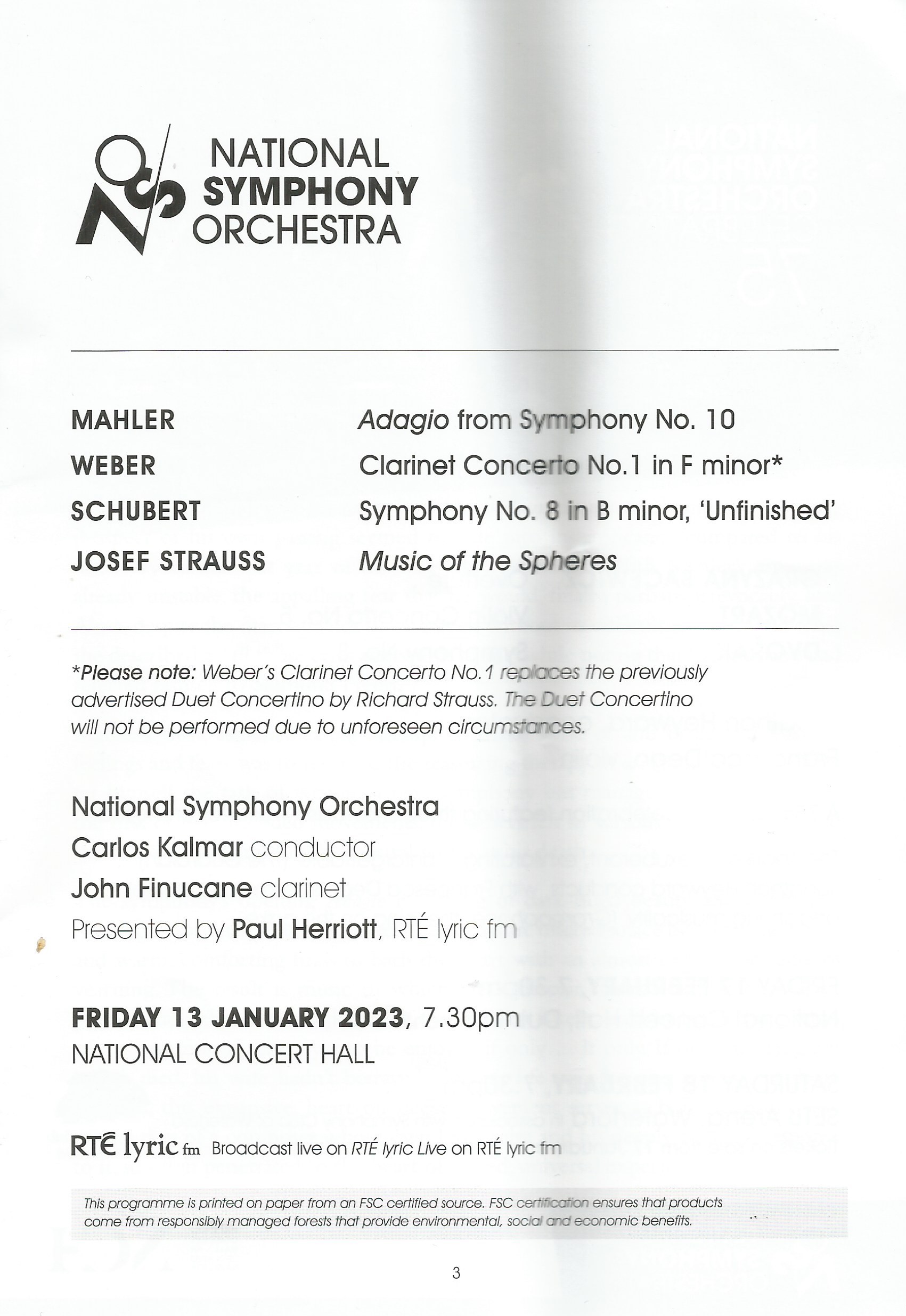
And so it came to pass that last night I took the train into Dublin for my first concert of the year 2023 at the National Concert Hall in Dublin which happened to be by the National Symphony Orchestra under the direction of guest conductor Carlos Kalmar.

It was an unusual programme in terms of its construction. Often the menu for such concerts begin with a short appetizer but this one started with the first movement of  Gustav Mahler‘s 10th Symphony. The composer died a hundred years ago in 1910 having not actually finished the rest of the symphony, but I gather that he left sufficiently detailed sketches and notes that complete versions have been constructed, but nevertheless the first movement is frequently performed on its own. It’s quintessentially Mahler in many ways, but it’s a strange opening for a symphony because it’s a very long Adagio movement (lasting about 30 minutes). It’s a complex and weighty movement for a full orchestra, rather cryptic in nature but overall with a rather dark tone, far from the usual lollipop to start a concert!

Originally this programme was supposed to feature the Duet Concertino by Richard Strauss but it was announced last week that this would be replaced by the Clarinet Concerto No. 1 in F Minor by Carl Maria von Weber with the NSO’s principal clarinettist John Finucane. Unusually for a concerto performance, John Finucane was reading a score, which perhaps suggests he stood in at short notice but in any case the performance was very fine. The third movement, a spirited Rondo kicked off by a very jaunty theme, is probably the most familiar piece, but I particularly enjoyed the interplay between clarinet and horns in the slow (2nd movement). John Finucane had brought his fan club with him, and the audience responded warmly.

After the wine break we had Symphony No. 8 in B Minor by Franz Schubert, the famous “Unfinished Symphony”. Somewhat surprisingly, I am pretty sure that I had never heard this piece performed live until this concert.

Schubert apparently wrote the first two wonderful movements of this piece in the space of only eight days in 1822 but then seems to have abandoned it. The composition wasn’t interrupted by his death – he didn’t pass away until 1828 – so it’s a mystery why he didn’t finish it. It wasn’t even discovered until the 1860s. Unlike Mahler 10, we don’t have any idea what the rest of this symphony would have been but the two existing movements are exceptional, not least for the stream of lovely melodies. This work clearly belongs to the same world as the Weber piece (which was composed in 1811) but having one after the other emphasizes the transition from Classical to Romantic, and having Mahler on the same programme contrasts early and late Romantic in a very illuminating way.

The last piece was Music of the Spheres, a waltz by Josef Strauss, the younger brother of the more famous Johan Strauss II. It’s a jolly enough but rather insubstantial piece that seemed rather incongruous to me in this programme, especially at the end as it is the sort of piece one could imagine as an appetizer. It seems to have been decided that something was needed in place of the missing movement(s) of the Schubert Symphony, so perhaps it was meant to play the role of a dessert?

In any case it was an upbeat way to end the concert which was very enjoyable. I then made my way out into the rain to get the train back to Maynooth. For a Friday night, Dublin was very quiet indeed, perhaps because of the inclement weather and/or the post-Christmas lull. The NCH wasn’t full but there was a decent attendance and the performance was warmly appreciated.

P.S. Note that the National Symphony Orchestra is no longer the RTÉ National Symphony Orchestra owing to some restructuring. Note also that it is planned to close down the NCH for at least two years for extensive refurbishment. I’m not sure what will happen to the NSO during this period.

Berg & Mahler at the National Concert Hall

Posted in Biographical, Maynooth, Music with tags , , , , , , , on September 10, 2022 by telescoper
Obligatory Souvenir Programme

Last night I made it to the National Concert Hall in Dublin for the opening concert of the season for the National Symphony Orchestra directed by Chief Conductor Jaime Martín. It’s been three years since the last full season of these weekly concerts so let’s hope we get a complete set this time.

The programme for last night’s concert comprised two works by Austrian composers, Alban Berg‘s Violin Concerto (with soloist Simone Lamsma) and Gustav Mahler‘s Fifth Symphony. Each of these great pieces in its own way explores a vast emotional landscape and together they made for a compelling and moving performance.

Berg’s Violin Concerto, composed in 1935, is dedicated “to the memory of an Angel”, namely Manon Gropius, who died of polio at the age of just 18. She was the daughter of Alma Mahler and Walter Gropius (Alma Mahler’s second husband, whom she married four years after Mahler’s death).

The work is divided into two movements, each of which is in two parts. It is often described as a completely atonal (serialist) piece but it’s is composed in such a way that the twelve tones are sometimes grouped in such a way as to suggest an underlying tonality. Emotionally the piece ranges from the poignant to the fiery. Anyone who has experienced grief will recognize the sense of rage that at times bursts through. In other passages, though, the music has an austere beauty that is completely compelling.

After the wine break we had Mahler’s Fifth Symphony. This work is best known for the 4th movement Adagietto but I’ve always felt that section fits rather uncomfortably with the rest of the composition. That’s not to say that I dislike the Adagietto, which I think is one of the most beautiful movements in all music, and regularly makes me shed a tear. I just think it’s a bit of a detour from the rest of the work. I suppose one should think of it as a restful interlude before the journey reaches its climax in the 5th movement Rondo which was played with electrifying passion last night.

Like the Berg piece, Mahler’s Fifth Symphony veers across a vast emotional landscape. The conductor Bruno Walter described it as “passionate, wild, pathetic, buoyant, solemn, tender, full of the sentiments of which the human heat is capable, but still ‘only’ music”. Although by no means an atonal work, there isn’t really a clear tonal signature: at least five different keys are used and there are passages in which the key is ambiguous.

The first movement begins with a funeral march, introduced with a solo trumpet statement like a fanfare, followed by lyrical passages from the strings. The second movement is extremely tempestuous, contrasting moods of melancholy and frenzy, with the trumpet theme from the first movement returning. The third movement, a long Scherzo, is unexpectedly playful, with two thematic forms bouncing off each other. Then there’s the soulful longing of the Adagietto, beautifully played last night to a rapt audience and the joyful finale in an unambiguously major key.

Overall this was a superb concert, with the large orchestral forces marshalled superbly by Jaime Martín. I have to mention the brass section in particular, who were brilliant. It wasn’t a full house, which is a shame for the season’s curtain-raiser, but those who were there clearly enjoyed it enormously.

As it happens, last night was the first of five concerts by Garth Brooks (who he? Ed) at Croke Park. The train from Maynooth unto Dublin earlier in the evening was absolutely crammed with people (many in cowboy hats) going there and the train back was similarly full with people leaving. Fortunately I was only slightly delayed getting home by the congestion, though I think there were seriously issues with later trains. There is another concert by him next Friday, when there is another concert at the NCH so fingers crossed that my travel to and from that isn’t too badly affected either…

Mahler & Schubert at the National Concert Hall

Posted in Music with tags , , , , , , on May 28, 2022 by telescoper

Yesterday evening, after a very pleasant wine reception at the end of ITP2022, I walked to the National Concert Hall in Dublin for my second concert in two days. Before the lockdown I used to go regularly to the Friday evening performances by the National Symphony Orchestra but until last night I hadn’t attended one since February 2022. Since I was in Dublin anyway and Mahler was on the menu I couldn’t resist this one and have now at last added to my stock of souvenir programmes. Last night’s concert was actually the last of the season but hopefully I’ll be able to go more frequently from September when the next season starts.

Last night’s performance began with Mahler’s Blumine which began life as the second movement (marked Andante) of his First Symphony but which was subsequently deleted. We heard the four-movement version of the work (i.e. without this part) in the second half of the concert. Blumine is a nice enough piece, relaxed and lyrical, but it is difficult to see how it was supposed to fit in with the rest of the symphony which is now always performed without it. Still, it served as a very good warm-up for the orchestra which, under the direction of Jaime Martín, established a polished tone and warm colour for this piece and for the rest of the evening.

After Blumine a large fraction of the orchestra left the stage to leave a pared-down version for some Lieder by Franz Schubert performed by legendary Swedish mezzo soprano Anne Sofie von Otter who was resplendent for the occasion in an emerald green dress.

You wait two years to go a concert and then along come two in the space of two days! Only one of the songs, the first, Romanze from the incidental music for the play Rosamunde, was actually orchestrated by Schubert; the other were written with piano accompaniment and then orchestrated by others. I have to say I didn’t find the addition of a full orchestra added much to these songs, many of which have a rather spare piano accompaniment that works superbly well. A good example is An Sylvia which has its origins in Shakespeare’s play The Two Gentlemen of Verona. I love the sprightly version of this with piano accompaniment but the orchestrated version was much slower, as if weighed down by the arrangement. Still, these pieces were beautifully sung and that made them very enjoyable. After rapturous applause, Anne Sofie von Otter returned to give an encore of the old song The Last Rose of Summer which, as you can imagine because it is set to a traditional Irish tune, went down very well with the Irish audience.

After the interval the full orchestra returned to deliver a powerfully impressive performance of Mahler’s First Symphony. The programme notes remind us that for much of his life Gustav Mahler was celebrated as a conductor rather than a composer, and the First Symphony was not well received largely because it was deemed in some quarters at the time to have a structure that was insufficiently symphonic. There’s no reason why we should pay much attention the opinions of over a hundred years ago. The symphonic form has been pulled around in many directions since this work, not least by Mahler himself, and I think Mahler 1 is a very fine work. I always particularly enjoy the 3rd movement, with its occasionally raucous evocation of a Klezmer band.

The final movement brought the piece – and the whole concert – to a thrilling climax. Near the end, the entire brass section of the orchestra (7 horns, 5 trumpets, 4 trombones, and a tuba) stood up at which point I thought “this is going to be loud”. It was. Gloriously loud.

I’ve said before on this blog how much I enjoy watching a full orchestra in action. From my position at the right of the auditorium I had a great view of the double basses who were working very hard but clearly enjoying themselves.

Anyway, last night’s concert was broadcast live on the radio and also streamed and you don’t have to take my word for anything because you can watch the whole thing yourself here:

Uri Caine’s Mahler

Posted in Music with tags , , , on October 18, 2019 by telescoper

And now for something completely different. I have recently been listening a lot to a fascinating album Urlicht by jazz pianist and bandleader Uri Caine in which he re-imagines the music of Gustav Mahler with a small band to wonderful effect. The music he produces is not only influenced by jazz but full of references to klezmer music and (to my ears at least) redolent of the music of the Weimar era. I confidently predict that many Mahler fans will absolutely hate this, with its pared-down arrangements and roughness around the edges, but I find it very refreshing. Anyway, you can decide for yourself whether you like it or not. This is Uri Caine’s take on the Funeral March from Mahler’s Symphony No. 5:

Silhouettes of Gustav Mahler – Otto Böhler

Posted in Art, Music with tags , , , , on April 25, 2019 by telescoper

Schattenbilder (Silhouettes) of Gustav Mahler conducting, by Otto Böhler (1847–1913), published posthumously in 1914.

Mahler: Symphony No. 2 (`Resurrection’) at the National Concert Hall, Dublin

Posted in Music with tags , , , , , , , , , , on September 15, 2018 by telescoper

Last night I had the pleasure of attending the opening performance of the new season of the RTÉ National Symphony Orchestra at the National Concert Hall in Dublin. As well as being the first concert of the season, it was also my first ever visit to the National Concert Hall. To mark the occasion we were in the presence of the Uachtarán na hÉireann, Michael D Higgins, and his wife Sabena. By `occasion’ I of course mean the first concert of the season, rather than my first visit to the NCH. After the concert the audience were all treated to a glass of Prosecco on the house too!

I’ve done quite a few reviews from St David’s Hall in Cardiff over the years, so before writing about the music I thought I’d compare the venues a little. The National Concert Hall was built in 1865 and soon after its construction it was converted into the main building of University College Dublin. It was converted to a concert venue when UCD moved out of the city centre, and fully re-opened in 1981. It is a bit smaller than St David’s – capacity 1200, compared with 2000 – and does not have such a fine acoustic, but it is a very nice venue with a distinctive and decidedly more intimate vibe all of its own. I had a seat in the centre stalls, which cost me €40, which is about the same as one would expect to pay in Cardiff.

The NCH is situated close to St Stephen’s Green, which is a 15 minute walk from Pearse Station or a 30 minute walk from Connolly (both of which are served by trains from Maynooth). The weather was pleasant yesterday evening so I walked rather than taking the bus or Luas from Connolly. I passed a number of inviting hostelries on the way but resisted the temptation to stop for a pint in favour of a glass of wine in the NCH bar before the performance.

Anyway, last night’s curtain-raiser involved just one piece – but what a piece! – Symphony No.2 (“Resurrection”) by Gustav Mahler. This is a colossal work, in five movements, that lasts about 90 minutes. The performance involved not only a huge orchestra, numbering about a hundred musicians, but also two solo vocalists and a sizeable choir (although the choir does not make its entrance until the start of the long final movement, about an hour into the piece). The choir in this case was the RTÉ Philharmonic Choir. At various points trumpets and/or French horns moved offstage into the wings and, for the finale, into the gallery beside the choir.

About two years ago I blogged about the first performance I had ever heard of the same work. Hearing it again in a different environment in no way diminished its impact.

Stunning though the finale undoubtedly was, I was gripped all the way through, from the relatively sombre but subtly expressive opening movement, through the joyously dancing second that recalls happier times, the third which is based on a Jewish folk tune and which ends in a shattering climax Mahler described as “a shriek of despair”, and the fourth which is built around a setting of one of the songs from Des Knaben Wunderhorn, sung beautifully by Jennifer Johnson (standing in wonderfully for Patricia Bardon, who was unfortunately indisposed). Jennifer Johnson has a lovely velvety voice very well suited to this piece, which seems more like a contralto part than a mezzo. The changing moods of the work are underlined by a tonality that shifts from minor to major and back again. All that was very well performed, but as I suspect is always the case in performances of this work, it was the climactic final movement – which lasts almost half an hour and is based on setting of a poem mostly written by Mahler himself, sung by Orla Boylan – that packs the strongest emotional punch.

The massed ranks of the RTÉ Philharmonic Choir (all 160 of them) weren’t called upon until this final movement, but as soon as they started to sing they made an immediate impact. As the symphony moved inexorably towards its climax the hairs on the back of my neck stood up in anticipation of a thrilling sound to come. I wasn’t disappointed. The final stages of this piece are sublime, jubilant, shattering, transcendent but, above all, magnificently, exquisitely loud! The Choir, responding in appropriate fashion to Mahler’s instruction to sing mit höchster Kraft, combined with the full force of the Orchestra and the fine concert organ of the NCH to create an overwhelming wall of radiant sound.

Mahler himself wrote of the final movement:

The increasing tension, working up to the final climax, is so tremendous that I don’t know myself, now that it is over, how I ever came to write it.

Well, who knows where genius comes from, but Mahler was undoubtedly a genius. People often stay that his compositions are miserable, angst-ridden and depressing. I don’t find that at all. It’s true that this, as well as Mahler’s other great works, takes you on an emotional journey that is at times a difficult one. There are passages that are filled with apprehension or even dread. But without darkness there is no light. The ending of the Resurrection Symphony is all the more triumphant because of what has come before.

The end of the performance was greeted with rapturous applause (and a well-deserved standing ovation). Congratulations to conductor Robert Trevino, the soloists, choir and all the musicians for a memorable concert. On my way out after the Prosecco I picked up the brochure for the forthcoming season by the RTÉ National Symphony Orchestra, which runs until next May. I won’t be attend all the Friday-night concerts, but I will try to make as many as I can of the ones that don’t involve harpsichords.

Update: I hadn’t realised that the concert was actually broadcast on TV and then put on YouTube; here is a video of the whole thing:

Cardiff Philharmonic Orchestra: Mahler Symphony No. 3

Posted in Biographical, Cardiff, Music with tags , , , , on June 18, 2018 by telescoper

Well, I’m back in Maynooth after a weekend in Cardiff, on the Sunday of which I went to St David’s Hall to see the Cardiff Philharmonic Orchestra playing Gustav Mahler’s Third Symphony. Actually this concert was originally scheduled to take place on the evening of Friday 15th June, which is why I booked a ticket to return from Bonn in time to see it instead of waiting for the formal close of the meeting. As it turns out, my flight was so late I would have missed it but fortunately the Rolling Stones intervened. Because Jagger et al were performing at the Principality Stadium in Cardiff on Friday (with all the consequent congestion and traffic disruption that implies) it was decided to shift the concert to Sunday 18th, but I couldn’t be bothered to change my flight.

Anyway, it proved an excellent way to spend a Sunday afternoon. Gustav Mahler spoke of his Third Symphony as being “of such magnitude that it mirrors the whole world” and you can see what he was getting at by just looking at the scale of the forces arrayed on stage when it’s about to be performed live. For yesterday’s concert at St David’s Hall, the Cardiff Philharmonic Orchestra was augmented by the WNO Community Chorus and the Choristers of St David’s Metropolitan Cathedral Choir, as well as soloist mezzo soprano Kate Woolveridge.

The orchestra needed to perform this extravagant work is much larger than for a normal symphony, and it involves some unusual instrumentation: e.g. two harps, a contrabassoon, heaps of percussion (including tuned bells and double tympanists), etc. The string section was boosted by double-basses galore, and there’s also a part (for what I think was a flugelhorn) to be played offstage. The work is also extremely long, being spread over six movements of which the first is the longest (over 30 minutes). Yesterday the performance stretched to about 1 hour and 40 minutes overall, with no interval. I don’t know of any symphonic works longer than this, actually.

It’s worth pointing out that the orchestra and choir(s) tackling this immense work were non-professional. It’s also worth pointing out that the principal French Horn – who is given a lot to do in this piece – was none other than Dr Bernard Richardson, recently retired from the School of Physics & Astronomy at Cardiff University.

I have to admit I have always had lot of trouble getting to grips with the first movement, in which various themes are repeatedly played off against each other, punctuated by a series of extravagant crescendo passages in which the orchestra threatened to blow the roof off. It is, at times, thrilling but also manic and, to me, rather indecipherable. The second movement, in the form of a minuet, is elegant enough, and was beautifully played (especially by the strings), but in comparison with the wayward exuberance of the first movement it sounds rather conventional.

The third movement, however, is totally gorgeous, especially in the passages featuring the offstage flugelhorn (?) and the string section of the orchestra on stage. From this point this piece started to bring me under its spell. The solo vocalist and choir(s) were marvellous in the fourth and fifth movements, the former a setting of a poem by Nietzsche and the latter a mixture of traditional verse and Mahler’s own words, but it was in the majestic sixth and final movement that the orchestra really reached its peak. This is one of the most romantic movements to be found in all of Mahler, passionate, lyrical and supremely uplifting. At times before the sixth movement the orchestra (especially the brass) had struggled a bit with the demands of the score, but the finale was as good a performance as you’ll hear anywhere.

Mahler’s 3rd Symphony is an epic journey through a landscape filled with dramatic contrasts. At times you wonder where you are going, and sometimes feel in danger of getting completely lost, but by the time you arrive triumphantly at the final destination all those doubts had melted away. Congratulations to the Cardiff Philharmonic on a very fine performance, warmly received by the audience.

After the concert there was a collection on behalf of the Forget-Me-Not Chorus, which supports people with dementia and their families through weekly singing sessions. I think this is a great initiative and made a donation on the way out – if you feel like doing likewise you can do so here.

Well, that’s my concert-going at St David’s Hall over for another season. Indeed, it’s probably the last concert I’ll be attending there for the foreseeable future, as I’ll be relocating fully to Ireland this summer. I’ll have many fine memories of listening to music there.