Here’s another reasoned rant regarding the rapacity of the research racketeers. I think it makes some really good points.
The video clip is worth watching too, it being very funny.
Follow @telescoperHere’s another reasoned rant regarding the rapacity of the research racketeers. I think it makes some really good points.
The video clip is worth watching too, it being very funny.
Follow @telescoperHis Excel-lence (geddit?) Paul Crowther has been at it again, using his favourite packages sophisticated graph-plotting facilities to produce the interesting figures that go with another guest post….
–0–
Last week’s Times Higher Ed included a news item headlined ‘binary creep’, in which HEFCE were considering restricting support for PhD research students to universities of the highest research quality. Concerns were expressed in the article about a two stream future for universities – research intensives in the fast lane and ‘the rest’ in the slow lane. This reminded me of a recent Times Higher Ed interview with the former Commons’ Science and Technology Committee chairman, Lord (Phil) Willis. Lord Willis argued that the UK could probably sustain “no more than 30” universities with the capacity to attract the best global researchers and carry out world-class research, a view no doubt shared by ministers and civil servants within BIS. I should qualify the following line of thought by emphasising that this is not Government policy, although both stories reflect moves by funding agencies to further concentrate increasingly scarce resources on the highest ranked research universities. For example, in England HEFCE is expected to withdraw all quality-related (QR) support from 2* RAE research from 2012 onwards.
Mindful of the fact that in such a vision for the future, there would be a comparatively few, research intensive universities (`winners’) where would that leave the remainder (‘losers’), especially for physics? Research quality can be quantified in all manner of ways, but for simplicity I have adopted the Quality Index (QI) from Research Fortnight which provides a single mark out of 100 based on RAE quality profiles (4*:3*:2*:1* weighted 8:4:2:1). The chart below shows the QI-ranked list of more-or-less all 120 UK universities who were rated in RAE 2008. It will come as no surprise to anyone that Oxbridge, LSE and Imperial top the rankings, closely followed by UCL and a few other high flyers, but beyond the top 10 perhaps more surprising there are no natural breaks in quality from Durham and QMUL in joint 11th place, to Bolton at 107th.
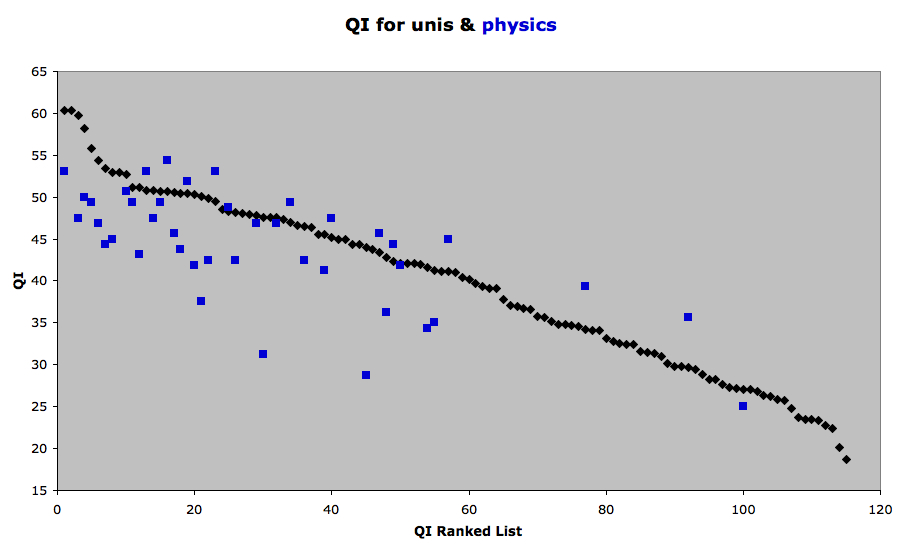

Thinking out loud about Willis’ assertion that the UK should not be spreading the jam more thinly than, say, the leading 30 universities, there would obviously be individual physics departments currently outside the top 30 which are ranked significantly higher than those within the top 30. To illustrate this, the chart also includes (in blue) physics QI scores for all teaching institutions that were assessed under the UOA 19 in RAE 2008. To blindly follow Lord Willis’ suggestion, 16 out of 42 institutions involved with physics research – comprising 37 per cent of all academic staff – would be clear losers. These would include one physics department raked within the top 10 (scoring 49) because its host institution is ranked 34th overall, while winners would include a department scoring 31, i.e. ranked 40th (out of 42) for physics, as a result of its university squeezing into the top 30. Chemistry – within the same RAE sub-panel as physics – reveals a broadly similar distribution, although there is perhaps a greater concentration of the highest research quality in the overall top 20, as the chart below illustrates.
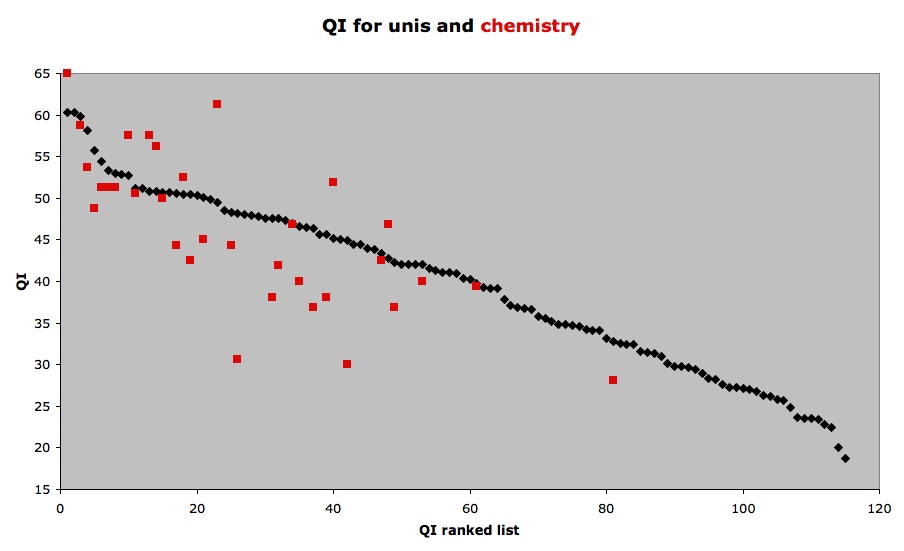

Alternatively, if there is to be further concentration, one could argue that research funding should focus on, say, the top 20 physics departments regardless of the performance of their host institution. Indeed, already 80 percent of STFC spending goes to only 16 universities. Still, as RAE grades indicate, a strength of UK physics is the breadth of high quality research, with no natural break points until beyond 30th place in the rankings, as the final chart shows. Of course, RAE scores aren’t the sole criterion being discussed, with “critical mass” the other main driver. Due in large part to the big four, 70 per cent of physics academic staff submitted for RAE 2008 are in departments that are currently ranked in the top 20. Chemistry has a similar story to tell in the chart, albeit displaying a somewhat steeper QI gradient.


What might be the long-term consequences of a divergence between a small number of “research-facing” universities and the rest? It is apparent that if the number of physics departments involved in research were reduced by a third, some high quality research groups would be lost, regardless of precisely where the cleaver ultimately fell. Let’s too not forget that astrophysics represents the largest sub-field of physics from the last IOP survey, as measured in numbers of academics.
If policy makers don’t see anything fundamentally wrong with A-level physics being taught by teachers qualified, say, in biology, then they might too wonder whether physics degrees could be taught by academics lacking a physics research background? This might work for first year undergraduate courses, but thereafter isn’t more specialist knowledge needed that a research background most readily provides? How would the third of physics academics outside the top 30 universities react to the prospects of a teaching-only future? Many surely would consider jumping ship either to one of the chosen few or overseas, further decreasing the pool of those with research experience in the remaining physics departments. This is further complicated by the expected political desire that physics departments should be appropriately distributed geographically across England, Scotland, Wales and Northern Ireland.
As a final thought experiment, the fate of physics departments facing the prospect of a teaching-only future might also be binary in nature, either (a) whither and die, decreasing the range of institutions offering degrees in physics (or physical sciences, natural sciences etc.); perversely at a time when the Government are anxious to maintain the number of students studying Science, Technology, Engineering and Mathematics (STEM) subjects, or (b) thriving – free from the distractions of chasing dwinding research grants – by adapting to offer shorter duration physics degrees, described as “cheap and cheerful” by Dr David Starkey during the discussion on student fees on last Thursday’s Newsnight. To reiterate, it is not explicit Government policy to actively reduce the number of physics departments that receive research allocations, but this seems to be the general “direction of travel” in policy-makers speak, so I fear a rocky path ahead..

Last week I posted a short item about the looming Kafka-esque nightmare that is the Research Excellence Framework. A few people commented to me in private that although they hate the REF and accept that it’s ridiculously expensive and time-consuming, they didn’t see any alternative. I’ve been thinking about it and thought I’d make a suggestion. Feel free to shoot it down in flames through the box at the end, but I’ll begin with a short introduction.
Those of you old enough to remember will know that before 1992 (when the old `polytechnics’ were given the go-ahead to call themselves `universities’) the University Funding Council – the forerunner of HEFCE – allocated research funding to universities by a simple formula related to the number of undergraduate students. When the number of universities suddenly increased this was no longer sustainable, so the funding agency began a series of Research Assessment Exercises to assign research funds (now called QR funding) based on the outcome. This prevented research money going to departments that weren’t active in research, most (but not all) of which were in the ex-Polys. Over the years the apparatus of research assessment has become larger, more burdensome, and incomprehensibly obsessed with “research concentration”. Like most bureaucracies it has lost sight of its original purpose and has now become something that exists purely for its own sake.
It’s especially indefensible at this time of deep cuts to university budgets that we are being forced to waste an increasingly large fraction of our decreasing budgets on staff-time that accomplishes nothing useful except pandering to the bean counters.
My proposal is to abandon the latest manifestation of research assessment mania, i.e. the REF, and return to a simple formula, much like the pre-1992 system, except that QR funding should be based on research student rather than undergraduate numbers.
There’s an obvious risk of game-playing, and this idea would only stand a chance of working at all if the formula involved the number of successfully completed research degrees over a given period .
I can also see an argument that four-year undergraduate students (e.g. MPhys or MSci students) also be included in the formula, as most of these involve a project that requires a strong research environment.
Among the advantages of this scheme are that it’s simple, easy to administer, would not spread QR funding in non-research departments, and would not waste hundreds of millions of pounds on bureaucracy that would be better spent on research. It would also maintain the current “dual support” system for research.
I’m sure you’ll point out disadvantages through the comments box!
Just a quick post to pass on the news that the Higher Education Funding Council for England (HEFCE) has announced the list of panel members for the forthcoming Research Excellence Framework (REF), a massive exercise in bean counting which will drag on until 2014.
Much as I enjoy ploughing through HEFCE’s fascinating documents, in this case I went straight to the Physics (& Astronomy) sub-panel, which is:

All estimable folk and a good selection of different expertise. There’s also a good geographical spread with members from the English regions, Scotland, Northern Ireland, and of course Wales. Oh, wait a minute. Not Wales. Apparently Wales doesn’t merit any representation on the Physics REF panel. Nor did it last time. Why am I thinking to myself “here we go again”?
To be perfectly honest, I don’t really understand why Welsh universities are being forced to take part in the REF anyway. Or those from Scotland and Northern Ireland for that matter. The REF is driven by an English agenda which is certainly at variance with Welsh priorities. Whereas in England, HEFCE is allocating funding using a formula involving an exceedingly steep weighting towards “internationally leading” research, here in Wales the equivalent body HEFCW is resisting the urge to concentrate research cash so heavily according to such a doubtful measure of research quality.
And don’t get me started on the so-called “impact” measures. All I can say about them is that Kafka would have been proud.
The Welsh Assembly Government has recently taken steps to protect Welsh students against the effects of Higher Education cuts imposed by Westminster. However, there will be substantial cuts in resource to Welsh universities in order to pay for this. At the same time as making “efficiency savings”, as is appropriate for the age of austerity, we’re also being forced to participate in a monstrously wasteful bureaucratic exercise of little relevance to the needs or aspirations of Welsh universities.
I think there’s a strong case for HEFCW to show a bit of real independence and withdraw from the REF altogether.
News broke today about the dreaded “Letter from HEFCE” to heads of English higher education institutions informing them of their funding allocations for the near future. The cuts outlined in the funding letter were not entirely unexpected, but have nevertheless generated quite a lot of reaction – see, e.g., here. For those of you who can’t be bothered to read the Circular Letter, it is of the form:
Dear Vice-Chancellor or Principal,
You’re screwed.
Yours Sincerely,
HEFCE
One of the ramifications of the decisions made by the Higher Education Funding Council for England (for that is HEFCE) is that funding will be further cut for research rated a “mere” 2* in the 2008 Research Assessment Exercise. For those of you who prefer meaningless words to meaningless numbers-with-asterisks, 2* is translated in the HEFCE dictionary as “internationally recognised”. Obviously a waste of money then. By 2013 the only research that will be funded at all under the QR formula will be 3* (“internationally excellent) and 4* (world leading). Of course “world leading” won’t include “nationally leading”, as by then there won’t be anyone in England left to follow the survivors; everyone left after the cull will be doing their best to be a “leader” in order to avoid being labelled a “follower”, a crime for which the punishment is, apparently, death.
I only hope that this mad policy dismantling the Great Pyramind of Research from the bottom upwards isn’t pursued here in Wales too, otherwise I’ll soon be sitting next to the radiator in the local Wetherspoons drinking cheap beer with the rest of the prematurely terminated. For the time being, until HEFCW decides what do do, we in Wales have a stay of execution.
All this reminds me of a story I heard at a conference dinner years ago. I happened to be sitting next to someone Mrs X – the spouse of a physicist who shall remain nameless – who had for a time worked on undergraduate admissions for a Humanities Department of a big American Ivy League university. One application for a place had been accompanied by a lukewarm recommendation from a high school teacher, containing a statement along the lines of John is definitely a follower rather than a leader. On this slim evidence of potential, my dining companion Mrs X decided to offer little Johnny a place.
Bewildered to hear that John had been admitted, the aforementioned teacher telephoned the Department and was put through to Mrs X. “But I thought I made it clear in my reference what I thought! Was the decision to let him in some sort of administrative error?”
“No,” said Mrs X.
“Let me explain. Every year this Department takes in about 500 undergraduate students. Virtually every recommendation letter says this student is a leader rather than a follower. In the light of this huge number of leaders, I feel it is my duty every year to ensure that the Department contains at least one follower.”
One of the other scary bits of news to emerge last week concerns proposed changes to the arrangements for tuition fees in English universities. According to the Times Higher, the Minister responsible for universities, David Willetts, has admitted that the cuts to university budgets announced in the Comprehensive Spending Review, will occur before any new money flows into universities from whatever new fee arrangements emerge from the government’s deliberations following the Browne Report.
One of the recommendations of the Browne Report was that central government funding for arts, humanities and social sciences be scrapped entirely. Although I’m a scientist and I do think Science is Vital this is a very bad move, as I think other forms of scholarship and learning are vital too, for a wide range of reasons including cultural ones. It was never clear whether arts & humanities departments would be able to recoup the money lost as a result of cuts to central funding, but now it appears they will have to survive for an indeterminate time without any prospect of extra income to offset the shortfall.
The upshot of all this will be a huge and immediate cut in the budgets of many university departments, a state of affairs about which Willetts commented only thus:
You have to expect that there will be pressure on universities to save money, and we don’t think they should be exempt from the pursuit of efficiencies.
Can an immediate 40% cut in teaching income be made by efficiency savings? I don’t think so, Mr Willetts. Even making large-scale redundancies won’t help there, as that costs a lot of money up front.
So why is the government pushing through cuts to university funding before ensuring that the new fee arrangements are in place? A variety of answers are possible. One would be incompetence, always a possibility when politicians are involved. However, although this government has tried to rush things through very quickly, I do not believe that this is something that hasn’t been considered very carefully. I think it’s deliberate. I believe that this government wants some universities to fail, and has found an opportunity to push them over the edge.
It’s not about efficiency savings, it’s about survival of the fattest. Only those places able to dig into their reserves for several years will be able to weather the storm. Some will cope, some won’t. That’s the point.
It’s well known that several universities, most of them post-1992 institutions, have been struggling financially for a considerable time. In the past, special procedures have always been implemented to protect organizations of this type that have been close to insolvency. This government has said that will do things differently, and that universities that go bust will now be allowed to fail. This may involve them closing altogether, or being taken over by private companies. If I were working in a university heavily dependent on income from arts, humanities and social science teaching, I would be extremely nervous about the future. I mean, more nervous than I am anyway, working as a scientist in an institution which is financially sound. And that is already very nervous indeed.
The other side of this particularly nasty coin, is that more “prestigious” institutions specialising in non-STEM areas, such as the London School of Economics, are already considering the option of going private. If the government gives them no support directly, yet insists – as seems likely – in capping the fee students pay at a figure around £7K per annum as well as strangling them with yards of red tape as HEFCE is wont to do, then why not just withdraw from the system and set fees at whatever level they like? It’s unlikely that an institution with a strong science base will go down this road, as the taxpayer is going to continue supporting STEM subjects, but it seems to me that it would make sense for the LSE to opt out of a system whether the costs of membership exceed the benefits received.
In the longer term, the squeeze is set of continue. According again to the Times Higher, the net revenue from fees will only replace part of the funding withdrawn over the CSR period. It looks like five years of struggle during which many departments may go under. The more you think about it, the worse it looks.

However, perhaps a better question than the one I asked a couple of paragraphs ago is the following. Why is the government intent on slashing the budgets of HE institutions, when it appears to have let Vodafone off without paying a bill for £6 billion tax?
That amount would have been more than enough to tide the HE sector over until the new fee stream came online…
It’s well after 11am and I’m still at home. Came down last night with some sort of bug that kept me awake nearly all night with frequent visits to the smallest room in the house. Whatever it is is still rumbling on so I’ve decided to stay at home until I give myself the all clear.
This sudden attack of lurgy is probably not connected with yesterday’s dramatic announcements of the results of the comprehensive spending review, which are now being dissected and analysed all over the mainstream press, the blogosphere, and countless common rooms around the country.
I haven’t got the energy right now to go over the ramifications in detail, but encourage you to read the whole thing, which is available in a nifty online reader for your perusal. I will, however, make a few brief comments, with particular emphasis on the situation here in Wales.
First, the announcement of large cuts to the teaching budget administered by HEFCE has clearly sent shockwaves through academia. It appears that only STEM subjects will continue to receive the state contribution and in future students will have to bear the full cost of tuition (but only after they’ve graduated and started to earn over the threshold of £21K). As a supporter of the Science is Vital campaign I was relieved that we seem to won a victory, although the war is far from over. However, I feel great sadness at the cost that our success seems likely to inflict on other disciplines. If you think these are nervous times for scientists, imagine what it must be like working in the Arts and Humanities.
Of course this all applies directly only to English universities: the budgets for Higher Education in Scotland, Wales and Northern Ireland are administered separately, so in principle things could work out very differently for Higher Education here in Wales.
However, the total amount of money available for the Welsh Assembly Government (WAG) to spend is fixed by the Westminster government through the Barnett Formula. This determines the overall cash for the devolved governments by allocating a proportion of what England spends on those things that are devolved., i.e. Wales is notionally allocated an amount for Higher Education which is proportional to HEFCE’s allocation and similar for other areas of spending such as Health. Once the size of the overall pot is fixed, however, the WAG is not obliged to spend its money in the same way that England does.
Buried in the pages of the CSR document is Wales’ allocation over the CSR period, which shows real terms cut of about 7.5% over the term. However, the Welsh Assembly Government’s reaction puts it rather differently:
In real terms, our total Budget is set to fall by around 3.1% per year on average, or 12% in total over the coming four years. This means that our Budget in 2014/15 will be £1.8bn lower in real terms than it is this year. Overall, in cash terms the reductions to our Budget will be 3% over the period.
Our capital Budget has been hit particularly hard, and will be cut by 40% in real terms – 34% in cash terms – over the next four years. This substantial reduction, particularly next year, where the cut is more than 25% in real terms, will clearly have a major impact on the private as well as the public sectors.
These figures seem different from those in the CSR document, which might be because of some nuance such as the way capital expenditure is accounted. If anyone can explain the discrepancy through the comments box I’d be grateful.
The main point is, though, that if Wales is going to keep current levels of investment in Higher Education (or even cut less than the English are doing) then it will have to take the money from elsewhere, which is not going to be easy to get through the Welsh Assembly. The picture, therefore, may not be any better here in Wales than it is in England, and could well turn out even worse, depending on how the WAG sets its own spending priorities. To complicate matters further, there’s an election next year for the Welsh Assembly, so there’s a wider political perspective to consider.
Within the overall issue of Higher Education spending is the question of whether Wales will decide to protect funding for STEM disciplines at the expense of all others. The WAG has already produced a document that suggests a strong focus on the so-called regional agenda, which may mean more money going into Further Education, vocational training, and part-time studies rather than, say, research-led science. I know what I would prefer, but whatever I say, it’s the WAG’s decisions that really count. And so it should be. After all, unlike me, they were elected!
Of course, if STEM subjects aren’t protected in Wales, those of us working in those areas are likely to lose even more ground to English universities, which already out-perform us in many respects. We have to make our case as best we can and see what happens.
However, I will end with some more local news which is extremely promising. Yesterday we had a staff meeting in the School of Physics & Astronomy at Cardiff University during which two extremely positive items came to light. One is that we will shortly be interviewing for the extra physics posts we advertised some time ago. Hopefully there will be a new Professor and three new Lecturers joining the staff in the very near future. I’m told we had a huge number of applicants for these positions, and the shortlists for these positions are very strong indeed. This is all very encouraging.
On top of this there is another exciting development on the horizon. After the disappointing outcome of the last RAE for physics in Wales, we have been thinking very hard at working closer with colleagues at Swansea with a view to building a sort of South Wales Physics Alliance. The departments are complementary in many ways: Swansea does particle physics, but Cardiff doesn’t; Cardiff does astronomy, but Swansea doesn’t. Where we are both relatively weak is in so-called “mainstream” physics, which is in the minority in both departments. With a bit of help, I think these two small(ish) departments could form a research institute that really challenges our competitors abroad (especially in England). I’m strongly in favour of this plan, and hope it goes ahead with full HEFCW support (including extra cash), but in this as in some many things, it’s a case of “fingers crossed”.
I woke up this morning with the Vince Cable Blues, owing to an item on the BBC News concerning a speech by the Secretary of State for Business, Innovation and Skills that clearly signals that the forthcoming Comprehensive Spending Review will entail big cuts to the UK’s science budget.
It was a depressing way to start the day, but I for one wasn’t particularly surprised by the news. We all know big cuts are coming, the only remaining questions are “how big?” and “where?”. However, when the text of the speech was released, I was shocked by what it revealed about the Secretary of State’s grasp of his brief. Read it for yourself and see if you agree with me.

Vince Cable: Out of his Depth
Of course there are the obligatory platitudes about the quality of the UK’s scientific research, a lot of flannel about the importance of “blue skies” thinking, before he settles on the utilitarian line favoured by the Treasury mandarins who no doubt wrote his speech for him: greater concentration of research funding into areas that are “theoretically outstanding” (judged how?) or “commercially useful” (when?). In fact one wonders what the point of this speech was, as it said very little that was specific except that the government is going to cut science. We knew that already.
For what it’s worth I’ll repeat my own view that “commercially useful” research should not be funded by the taxpayer through research grants. If it’s going to pay off in the short term it should be funded by private investors or venture capitalists of some sort. Dragon’s Den, even. When the public purse is so heavily constrained, it should only be asked to fund those things that can’t in practice be funded any other way. That means long-term, speculative, curiosity driven research. You know, science.
So was Cable’s speech was feeble-minded, riddled with clichés, and totally lacking in depth or detail? Yes. Was it surprising? No.
What was surprising, at least to me, is Cable’s deliberate use of spurious numbers to back up his argument. For example,
Its is worth noting in the last RAE 54 per cent of submitted work was defined as world class and that is the area where funding should be concentrated.
This appears to be what Cable was referring to when he stated on the BBC Radio 4 Today Programme that “45% of research grants were not of excellent standard”.
For one thing, there’s a difference between a research grant and the money allocated by HEFCE through the Research Assessment Exercise (RAE); more about that in a moment. Moreover, at least in England, RAE funding is only allocated to grades 3* and 4* anyway, so the concentration he talks about is already happening. The comment is made all the more meaningless, however, because the 54% was actually imposed on the assessment panels anyway; they were told to match the outcome of their deliberations to a target profile. The figure quoted is therefore hardly an objective measure of the quality of scientific research in the UK.
When it comes to research grants – usually obtained from one of the Research Councils, such as the Science and Technology Facilities Council (STFC) scientists apply for funding and their proposals are assessed by panels. In the case of STFC I can assure every one that the only proposals funded are those graded excellent, and there isn’t anything like enough money to fund all the proposals graded that way. Further cuts will simply mean that even more excellent research will have to be scrapped, and even more excellent scientists will go abroad.
This basic misunderstanding convinces me that Vince Cable is completely out of his depth in this job. That’s very unfortunate because it means he will probably be susceptible to manipulation by the dark side (i.e. the anti-science lobby in Whitehall). Already someone – most likely a Civil Service mandarin with an axe to grind – seems to have duped him into thinking that 45% of taxpayer’s money funds mediocre research. What with him already singing so enthusiastically from the Treasury hymn sheet, I fear they have got him exactly where they want him. Rarely has a new arrival in the Whitehall jungle gone native so quickly.
Another remark of his that was quoted today is that “the bar will have to be raised somewhat” in terms of science funding. At the next General Election I hope the British people, especially those foolish enough to opt for the Liberal Democrats last time, will “raise the bar” when it comes to deciding who is worthy of their vote. I’m sure of one thing, though. The fraction of British politicians who are “mediocre” is an awful lot higher than 45%.
So there we are. Britain has a new government. For the time being. Last night David Cameron became the Prime Minister of a coalition government involving the Conservative and Liberal Democrat parties (as I predicted). This is hardly a surprise given the arithmetic; Labour and the LibDems wouldn’t have had enough seats to command a majority anyway. It took five days from the election for the new Prime Minister to take over, much longer than the few hours it normally takes when there is a conclusive result, but nowhere near as long as it takes on the continent where coalition-building involves smaller and more diverse parties. In the UK the three main political parties are all centre-right, at least when it comes to economic policy, and they share a great deal of common ground, so I never thought there would be much problem with the Conservatives and LibDems coming to a deal, which they have done.
Another prediction I got right was that Gordon Brown would resign as leader of the Labour Party, which he has also done. Who will lead the Labour Party now, and for how long, is anyone’s guess.
My third prediction was that the coalition government would fall within a year and there’ll be another general election. As for that, we’ll have to wait and see. It is, after all, a marriage of convenience. I think it won’t be long before a big row develops and the coalition unravels. There’s a lot of overlap between the two parties, but it’s a long way from the left of the LibDems to the right of the Tories. I give it 6 months to the first vote of confidence, assuming the Queen’s Speech passes.
Now that we have a government once more, the unreal business of electioneering is going to be set aside and all the facts that the media have kept quiet about during the election campaign will start to come out. For example, a story in the Financial Times of 11th May (yesterday), which has clearly been on the spike for the duration of the election campaign, reveals how huge cuts in university funding are set to fall hardest on science departments. Vice-chancellors have been making contingency plans for 25% cuts in recurrent funding for some time now, and there’s an obvious temptation to cut the more expensive subjects first.
I’ve already confessed my annoyance that the main parties connived to keep the details of the deep cuts they were all planning to implement out of the election campaign. Now we’re going to find out the true extent of what’s in store, and it’s too late to change.
Niels Bohr once said “Prediction is very difficult, especially about the future”, and I have no idea whether I’m being overly pessimistic here, but here are some of the things I think will affect my own life as an astrophysicist working in a British university.
First, it’s now clear that there’s no chance of a reversal in the fortunes of STFC. There never was much of a chance of that, to be honest. It’s more likely now that STFC will now face further cuts on top of what it has endured already. Fundamental science in the UK is in for a very lean time.
Second, university funding – the part that comes directly from central government – will be cut by at least 25%, probably more. This could be achieved in a number of ways. The unit of resource (the payment made per student by the government to a university) could be cut. The number of students funded could be cut. Students could be charged higher fees or have less generous loan arrangements. These options are by no means exclusive, of course. They might all happen.
University V-Cs will have to make very difficult decisions where to make savings: some may tighten budgets across the board; others may shut entire departments to save the rest.
Another issue with university funding, however, is that it is not entirely the preserve of central government. The Scottish Assembly runs higher education in Scotland, not the Westminster government. The Scottish Funding Council has generally funded universities more generously than HEFCE has in England. It’s also much less likely to implement higher tuition fees. More generally, with only one Scottish Tory MP in Westminster and a Scottish Nationalist-flavoured Assembly government, there’s no way of knowing what will happen in Scotland or, indeed, how much strain will be generated there by an English Tory government very few Scots voted for.
In Wales its a bit different. Here higher education is run by the Welsh Assembly government, which currently comprises a Labour-Plaid Cymru coalition. With the Westminster government consisting of an alliance between the other two major parties in Wales we have two levels of administration roughly orthogonal to each other. In principle, the WAG could decide to protect the university system in Wales against the level of cuts being imposed in England, but since we already get a lower unit of resource from HEFCW than HEFCE allocates to English universities, I doubt we’ll be any different in future.
So this is where we’re headed: fewer science departments with fewer staff with increased teaching loads with less time to do research and with less funding to carry it out and vanishing career opportunities for the scientists they’re supposed to be training.
Still, at least the bankers will get their bonuses.
This week we received the not-altogether-unexpected news that the budgets of Welsh universities will be cut next year. The Higher Education Funding Council for Wales (HEFCW) has announced its detailed allocations for 2010-11 and all but one institution will receive a cash cut. Cardiff University faces a cash cut of 1.74%. Lampeter is the exception, but it gets a cash increase of only 0.32%. After taking inflation into account, even they get a real terms decrease. So it’s real cuts across the board for Welsh Higher Education, with a total of about £30 million in funding taken away.
In fact, it appears that the total amount of money available to HEFCW for next year is level in cash terms compared to last year. The total amount it has distributed in recurrent grants has, however, decreased by about 2% on last year. As far as I understand it, the discrepancy between the income and expenditure is partly explained by the diversion of some funds into a new Strategic Implementation Fund(SIF) to enable HEFCW to meet the goals outlined in the Welsh Assembly Government (WAG) document stating its vision for Higher Education, entitled For our Future. Some elements of SIF are included with the current allocation, but other’s are not, hence the cash cuts seen here.In future, a larger proportion of the budget will move from recurrent, formula-based funding towards initiatives more closely aligned with the WAGs or, more likely, wasted on window-dressing and increased bureaucracy.
We’ll have to see what the impact of the new SIF arrangements will be in the longer term. In the short-term, however, the cuts (though obviously regrettable) are by no means a shock and will probably appear entirely insignificant after the General Election and the real cuts start, probably more like 20% than 2%…
The situation in Wales contrasts with Scotland where the Higher Education has grown by 1% for 2010/11. Some Scottish universities, such as Edinburgh with a cash increase of 2.2%, have done pretty well. A small number of others, such as Stirling have been cut by 3.3% in cash terms.
Allocations for English universities were announced by HEFCE last week. There the situation is more mixed, partly to do with HEFCE rejigging its formula for research funding to concentrate it even more than last time (something that HEFCW – wisely, in my view – decided not to do..). It seems about half the 130 institutions in HEFCE’s remit get a cash increase, although when inflation is factored in the number with a real increase is much smaller. Among the universities with big cash cuts are Reading (-7.7%) and the London School of Economics (-6.3%).
As far as I understand the situation, these figures don’t include the fines for over-recruitment recently demanded by Lord Mandelson and may not take into account cuts in capital allowances, so things may be a lot worse than they appear at first sight.
However, to complicate things a bit more, this week’s budget announced new funding for Science Technology Engineering and Mathematics (STEM) subjects, corresponding to an increase in numbers of about 20,000.This is only for England, as Higher Education in Wales and Scotland is not part of the remit of the Westminster government. One advantage of this for those of us in Wales is that we can’t be affected by pre-election tinkering in the same way England can.
I’m sure the news of new funding is very welcome to my colleagues across the border, but it does look to me like a bit of sticking plaster that looks likely to fall off after polling day.
Anyway, it looks to me like these results are going exactly with the form book. Scotland has always valued Higher Education more strongly than England, and Wales has usually trailed along in third place. The real struggle hasn’t yet started, however, and we have to wait anxiously to see how hard the axe will fall once the election is over.


 In the Dark