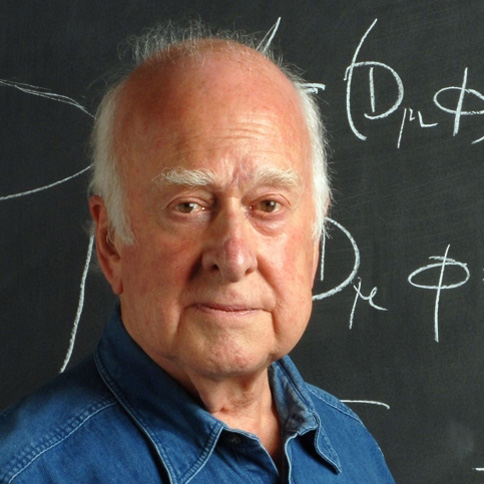
I was very sad this afternoon to hear of the death of theoretical physicist Peter Higgs, on Monday 8th April 2024, at the age of 94. I never met Peter Higgs but I know how greatly liked and respected he was (see, e.g. here) and that he leaves an important legacy as a physicist, particularly the work that led to the award of the 2013 Nobel Prize for Physics (jointly with François Englert) . Condolences to his family, friends and colleagues.
You can read the very nice Guardian obituary here; there are many others published in media from elsewhere in the world (including Ireland and Barcelona).
I’ll add two extremely slight connections. One is that Peter Higgs visited Maynooth University in 2012, not long before his Nobel Prize was announced. The other is that he was born in the Elswick area of Newcastle upon Tyne, not far from Benwell, where I grew up.
With the launch of the Euclid spacecraft due next month, and the last Euclid Consortium meeting before the launch coming up in just over a week, I thought I’d share another one of the nice little taster videos prepared by the European Space Agency:
The Euclid Mission has long been “sold” as a mission to probe the nature of Dark Energy in much the same way that the Large Hardon Collider was often portrayed as an experiment designed to find the Higgs boson. But as this video makes clear, testing theories of dark energy is just one of the tasks Euclid will undertake, and it may well be the case that in years to come the mission is remembered for something other than dark energy. On the other hand, big science like this needs big money, and making the specific case for a single big ticket item is an easier way to persuade funding agencies to cough up the dosh than for a general “let’s do a lot of things we’re sure we’ll fin something” approach. These thoughts triggered a memory of an old post of mine about Alfred Hitchcock so, with apologies for repeating something I have blogged about before, here’s an updated version.
Unpick the plot of any thriller or suspense movie and the chances are that somewhere within it you will find lurking at least one MacGuffin. This might be a tangible thing, such the eponymous sculpture of a Falcon in the archetypal noir classic The Maltese Falcon or it may be rather nebulous, like the “top secret plans” in Hitchcock’s The Thirty Nine Steps. Its true character may be never fully revealed, such as in the case of the glowing contents of the briefcase in Pulp Fiction, which is a classic example of the “undisclosed object” type of MacGuffin, or it may be scarily obvious, like a doomsday machine or some other “Big Dumb Object” you might find in a science fiction thriller. It may even not be a real thing at all. It could be an event or an idea or even something that doesn’t exist in any real sense at all, such the fictitious decoy character George Kaplan in North by Northwest. In fact North by North West is an example of a movie with more than one MacGuffin. Its convoluted plot involves espionage and the smuggling of what is only cursorily described as “government secrets”. These are the main MacGuffin; George Kaplan is a sort of sub-MacGuffin. But although this is behind the whole story, it is the emerging romance, accidental betrayal and frantic rescue involving the lead characters played by Cary Grant and Eve Marie Saint that really engages the characters and the audience as the film gathers pace. The MacGuffin is a trigger, but it soon fades into the background as other factors take over.
Whatever it is real or is not, the MacGuffin is the thing responsible for kick-starting the plot. It makes the characters embark upon the course of action they take as the tale begins to unfold. This plot device was particularly beloved by Alfred Hitchcock (who was responsible for introducing the word to the film industry). Hitchcock was however always at pains to ensure that the MacGuffin never played as an important a role in the mind of the audience as it did for the protagonists. As the plot twists and turns – as it usually does in such films – and its own momentum carries the story forward, the importance of the MacGuffin tends to fade, and by the end we have usually often forgotten all about it. Hitchcock’s movies rarely bother to explain their MacGuffin(s) in much detail and they often confuse the issue even further by mixing genuine MacGuffins with mere red herrings.
Here is the man himself explaining the concept at the beginning of this clip. (The rest of the interview is also enjoyable, convering such diverse topics as laxatives, ravens and nudity..)
There’s nothing particular new about the idea of a MacGuffin. I suppose the ultimate example is the Holy Grail in the tales of King Arthur and the Knights of the Round Table and, much more recently, the Da Vinci Code. The original Grail itself is basically a peg on which to hang a series of otherwise disconnected stories. It is barely mentioned once each individual story has started and, of course, is never found.
Physicists are fond of describing things as “The Holy Grail” of their subject, such as the Higgs Boson or gravitational waves. This always seemed to me to be an unfortunate description, as the Grail quest consumed a huge amount of resources in a predictably fruitless hunt for something whose significance could be seen to be dubious at the outset. The MacGuffin Effect nevertheless continues to reveal itself in science, although in different forms to those found in Hollywood.
The Large Hadron Collider (LHC), switched on to the accompaniment of great fanfares a few years ago, provides a nice example of how the MacGuffin actually works pretty much backwards in the world of Big Science. To the public, the LHC was built to detect the Higgs Boson, a hypothetical beastie introduced to account for the masses of other particles. If it exists the high-energy collisions engineered by LHC should (and did) reveal its presence. The Higgs Boson is thus the LHC’s own MacGuffin. Or at least it would be if it were really the reason why LHC has been built. In fact there are dozens of experiments at CERN and many of them have very different motivations from the quest for the Higgs, such as evidence for supersymmetry.
Particle physicists are not daft, however, and they realized that the public and, perhaps more importantly, government funding agencies need to have a really big hook to hang such a big bag of money on. Hence the emergence of the Higgs as a sort of master MacGuffin, concocted specifically for public consumption, which is much more effective politically than the plethora of mini-MacGuffins which, to be honest, would be a fairer description of the real state of affairs.
While particle physicists might pretend to be doing cosmology, we astrophysicists have to contend with MacGuffins of our own. One of the most important discoveries we have made about the Universe in the last decade is that its expansion seems to be accelerating. Since gravity usually tugs on things and makes them slow down, the only explanation that we’ve thought of for this perverse situation is that there is something out there in empty space that pushes rather than pulls. This has various possible names, but Dark Energy is probably the most popular, adding an appropriately noirish edge to this particular MacGuffin. It has even taken over in prominence from its much older relative, Dark Matter, although that one is still very much around.
We have very little idea what Dark Energy is, where it comes from, or how it relates to other forms of energy with which we are more familiar, so observational astronomers have jumped in with various grandiose strategies to find out more about it. This has spawned a booming industry in surveys of the distant Universe, all aimed ostensibly at unravelling the mystery of the Dark Energy. It seems that to get any funding at all for cosmology these days you have to sprinkle the phrase “Dark Energy” liberally throughout your grant applications.
The old-fashioned “observational” way of doing astronomy – by looking at things hard enough and long enough until something exciting appears (which it does with surprising regularity) – has been replaced by a more “experimental” approach, more like that of the LHC. We can no longer do deep surveys of galaxies to find out what’s out there. We have to do it “to constrain models of Dark Energy”. This is just one example of the (not entirely positive) influence that particle physics has had on astronomy in recent times.
Whatever the motivation for doing these projects now, they will undoubtedly lead to many new discoveries, so I’m not for one minute arguing that the case for, e.g, the Euclid mission is misguided. I’m just saying that in my opinion there will never be a real solution of the Dark Energy problem until it is understood much better at a conceptual level, and that will probably mean major revisions of our theories of both gravity and matter. I venture to speculate that in twenty years or so people will look back on the obsession with Dark Energy with some amusement, as our theoretical language will have moved on sufficiently to make it seem irrelevant. That’s how it goes with MacGuffins. In the end, even the Maltese Falcon turned out to be a fake, but what an adventure it was along the way!
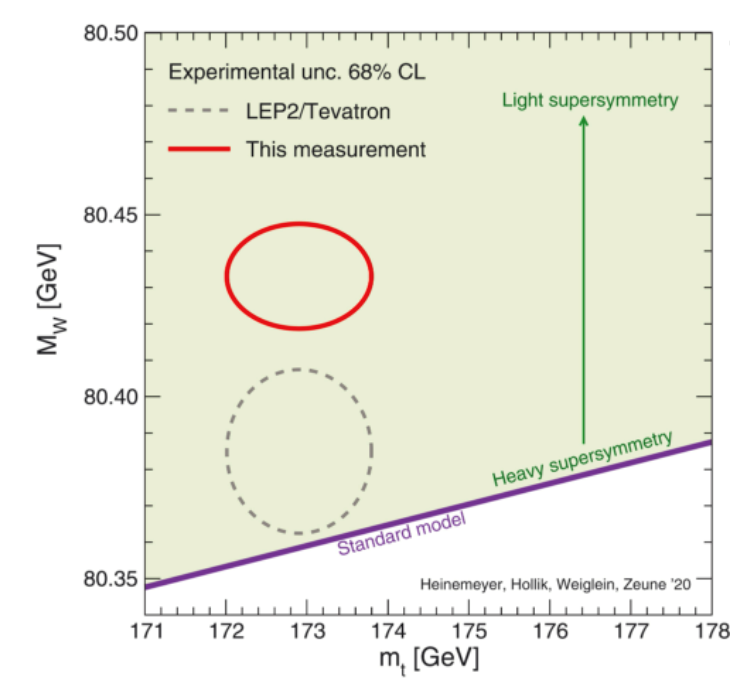
The units of the measurements are MeV/c2 and the latest number is 80,443.5 ± 9.4 MeV/c2 while calculations based on the standard model give 80,357± 4 [inputs]± 4[theory] MeV/c2. The difference is small but apparently significant, though I’m not sufficiently expert to understand all the details of the statistical analysis.
If true, this result has implications for the Standard Model because although this model has free parameters which have to be measured rather than obtained from theory, the model does imply relationships between these parameters. The reason this applies to particle masses is that these are affected to a greater or lesser extent by interactions with all the fields present in the theory. The first thing you learn when you study particle physics is that it’s not primarily about particles, it’s about fields. The mass of the W-boson is significantly affected by the mass of the top quark and the Higgs boson both of which have been measured to some level of accuracy, but the new W measurement doesn’t seem fit with these known values.
Anyway, here is the discrepancy with the top quark mass
So it’s definitely interesting, though it clearly needs further analysis: there could be uncorrected systematics in the measurement, for example. Also, as far as I know, some of the other masses feeding into this calculation may turn out to be wrong.
Incidentally, a student asked me yesterday why there’s no corresponding measurement for the Z-boson. The answer I gave (which I think is correct) is that the mass of the Z is already known much better than the W because it, being neutral, can decay into an electron-positron pair, both of which are easy to measure, but the W, being charged, has to decay into a charged lepton and a neutrino (or antineutrino) combination and the latter is much harder to deal with experimentally.
P.S. For some comments by a physicist who knows much more about this stuff than I do, see here.
Well, there we are. After an excruciating (and unexplained) delay the 2013 Nobel Prize for Physics has gone to François Englert and Peter Higgs. You can find the full press release here; the first section of text reads:
François Englert and Peter W. Higgs are jointly awarded the Nobel Prize in Physics 2013 for the theory of how particles acquire mass. In 1964, they proposed the theory independently of each other (Englert together with his now deceased colleague Robert Brout). In 2012, their ideas were confirmed by the discovery of a so called Higgs particle at the CERN laboratory outside Geneva in Switzerland. The awarded theory is a central part of the Standard Model of particle hysics that describes how the world is constructed. According to the Standard Model, everything, from flowers and people to stars and planets, consists of just a few building blocks: matter particles. These particles are governed by forces mediated by force particles that make sure everything works as it should. The entire Standard Model also rests on the existence of a special kind of particle: the Higgs particle. This particle originates from an invisible field that fills up all space. Even when the universe seems empty this field is there. Without it, we would not exist, because it is from contact with the field that particles acquire mass. The theory proposed by Englert and Higgs describes this process.
Anyway, congratulations to the two Laureates. I did get a bit excited when the rumour started that the winner this year would be someone born in Newcastle upon Tyne whose first name is Peter, but I guess I’ll have to wait until next year..
Oh, and François Englert is the first ever Belgian winner of the Nobel Prize for Physics!
I have to head off to London for a Parliamentary Reception organized by the Science & Technology Facilities Council, so I’ll have to leave it there but please feel free to add reactions to the announcement via the Comments Box.
I’m back in circulation just in time for tomorrow’s announcement of the 2013 Nobel Prize for Physics. The smart money is going on an award for the discovery of the Higgs Boson, but to whom should it be awarded. Today’s Grauniad summarizes the difficulties thus:
The committee can contrive the wording of the prize to narrow the number downwards and this is likely to happen. The prize could go to François Englert, who published the idea first, and Peter Higgs, who was second, but crucially was first to flag up the new particle. But that would rebuff the trio of Gerald Guralnik, Carl Richard Hagen and Tom Kibble, who developed the theory separately and published just a month after Higgs. The possibility has already caused acrimony among the scientists. Guralnik and Hagen, two US researchers, believe European physicists have conspired to erase their contribution from history.
This doesn’t seem to me to be entirely accurate, though. As far as I understand it, Higgs was the only one of the names above to mention a massive scalar particle, There is, I believe, therefore a strong case that the Nobel Prize should be awarded to Peter Higgs outright. Or if not to him, to some other person called Peter who was born in the North East…
However, I am used to being in a minority of one so there will undoubtedly be many others who feel differently. Time for a poll! This one is different from my usual ones, in that you are allowed to vote more than once. Please use up to three votes: if you think Peter Higgs should win it outright vote three times for him. If you think it should be a three way split then vote for three different people, etc.
I should say that I don’t think the Nobel Committee for Physics is allowed to make an award to an institution such as CERN, but I’ve left that option in to see whether folks think that tradition should change..
After my little dabble in particle physics yesterdays I thought I’d reblog this from a proper particle physicist – it’s a long and rather technical post about the Higgs-like Boson recently discovered at the LHC. Enjoy.
We are in the process of ascertaining the properties of the Higgs-like particle discovered by CMS and ATLAS last July 4th. It must be a boson because it decays to pairs of bosons. Since it decays to a pair of massless photons, it cannot be spin-1. The relative rates of decays to WW and ZZ on the one hand, and γγ on the other, are close to what is expected for spin-0 boson and not what is expected for a spin-2 graviton. John Ellis, Veronica Sanz and Tevong You wrote a nice paper about this earlier this week (arXiv:1211.3068, 13-Nov).
So let’s assume that the new particle X(126) is a Higgs boson (and I will use the symbol “H” for it). If it is the standard model Higgs boson, then its CP eigenvalue must be +1. If it is a member of a two-Higgs-doublet model, then its CP…
The announcement this morning of the 2012 Nobel Prize for Medicine or Physiology reminded me that tomorrow will see the announcement of the 2012 Nobel Prize for Physics. This is due to happen tomorrow morning at 11.45 CET (which I think is 10.45 BST) or thereabouts. It would be unseemly to speculate on the outcome, of course, so that’s what I’ll do.
Although the discovery of a scalar particle at the Large Hadron Collider that may well be the Higgs boson happened only recently, and is yet to be definitively proven to be the Higgs, the smart money has to be on an award relating to that, presumably to Peter Higgs. However, given that the award can go to up to three individuals, who else might earn a share? Gerald Guralnik, Tom Kibble and Carl Richard Hagen came up with the same idea about the same time as Higgs, but all four of them can’t win according to the rules. Answers to that little conundrum on a postcard…
But of course the Prize might go to something else altogether. An interesting bet would be Alain Aspect for his important work on experimental studies of quantum entanglement. Also with an outside chance is Sir Michael Berry for his brilliant work on the Geometric Phase.
That’s by no means an exhaustive list of runners and riders, but I have to get back to business now. I’d be interested to have further nominations via the comments box and will of course be getting an early night ahead of the expected phone call from Stockholm tomorrow morning…
Not long ago a colleague ran into my office all of a flutter and asked me about this new discovery called the “Wang particle” that had been in the media. I’m the one around here who’s supposed to know about particle astrophysics stuff, so I was quite embarrassed that I’d never heard of the Wang particle, although I’ll be delighted if it becomes famous as the name has a great deal of comedy potential.
Anyway, I vowed to find out a little bit about it and finally got around this lunchtime to doing so. It turns out that the story was sparked by press release from the British Science Association which, out of the goodness of my heart, I reproduce below (link added by me).
A new particle, similar to the Higgs Boson, could provide a clue to one of the greatest mysteries of the Universe.
Dr Charles Wang from the University of Aberdeen believes that a new scalar particle is behind the intense supernova explosions that occur when a star implodes. He presented his work to the British Science Association on Tuesday.
Supernova explosions are the most powerful forces in the universe, second only to the Big Bang.
Once frequent, the energy produced in these explosions is responsible for combining particles to produce all the recognisable elements on earth, providing all the known building blocks of life on earth.
There are still many gaps in our understanding of physics and one of the major blanks is how the implosion of a star subsequently produces an intense explosion.
It is known that as elements are created at the centre of a star, a huge amount of energy is released. However, it is believed that the conversion of known elements would never produce enough energy to result in an explosion.
Dr Wang’s theory states that “a scalar particle – one of the most elementary types of particles in the universe and similar to the Higgs Boson – is at work within these stars and responsible for the additional energy which causes the explosion to take place.”
The scalar particle would effectively enable the high transfer of energy during a supernova, allowing shockwaves from the implosion of a star to become re-energised and cause an explosion.
A new collaboration between Dr Wang and CERN could provide the equipment to make this theory a reality and demonstrate the existence of the ‘Wang particle’ – or as Dr Wang himself refers to it the ‘scalar gravitational particle’. It is hoped that using the ISOLDE facility at CERN it may be possible assimilate a nuclear reaction that would determine the process of a starburst.
If demonstrated, the existence of the ‘Wang particle’, like the Higgs Boson, would hold major implications for physics, shedding new light on the theory of everything and affecting our understanding of how different physical phenomena interact.
There’s no link to an academic paper with it, which is a bit disappointing, but an older piece in the CERN Courier does provide a reference to the paper, which is
C H-T Wang et al. 2011 Parametric instability induced scalar gravitational waves from a model pulsating neutron star, Phys. Letts. B 705 148
If you’re prepared to shake hands with the Devil that is Elsevier you can find the paper here.
I have to confess that this is a new one on me. I haven’t gone through the paper in detail yet but, at a quick skim, it seems to be based on a variation of the Brans-Dicke scalar-tensor theory of gravity. It’s probably an interesting paper, and I look forward to reading it in detail on a long flight I’m about to take, but I am a bit mystified as to why it created such a stir in the media. Looks more a result of hype than real significance to me. It certainly isn’t the “new Higgs boson” anyway. Nor is it likely to be relevant in explaining Climate Change. Or am I missing something? Perhaps hot air generated by press releases is responsible for global warming?
Anyone out there an expert on Wang’s work? Care to comment?
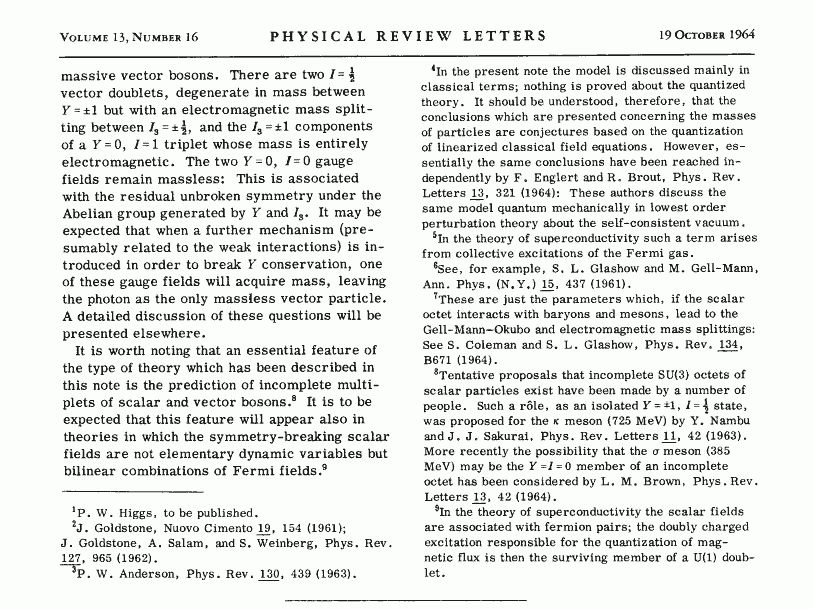
In the light of all this Malarkey about the (claimed) discovery of the Higgs Boson at the Large Hadron Collider, I thought you might be interested to see the original paper by Higgs (1964) in its entirety. As you can see, it’s surprisingly small. The paper, I mean, not the boson…
Although it’s a little late I thought I’d just put up a brief post to draw your attention to the news that a couple of technical papers have appeared on the arXiv giving updated details of the recent discovery at the Large Hadron of a new scalar particle that could be the Higgs boson. I don’t think it’s yet absolutely proven that this is what the new particle is, which is why I’ve called it the “LHC boson” in the title.
The ATLAS paper reports the detection of a Higgs-like particle with a 5.9 sigma confidence level, up from the 5.0 sigma reported on July 4. Here’s the abstract:
A search for the Standard Model Higgs boson in proton-proton collisions with the ATLAS detector at the LHC is presented. The datasets used correspond to integrated luminosities of approximately 4.8 fb^-1 collected at sqrt(s) = 7 TeV in 2011 and 5.8 fb^-1 at sqrt(s) = 8 TeV in 2012. Individual searches in the channels H->ZZ^(*)->llll, H->gamma gamma and H->WW->e nu mu nu in the 8 TeV data are combined with previously published results of searches for H->ZZ^(*), WW^(*), bbbar and tau^+tau^- in the 7 TeV data and results from improved analyses of the H->ZZ^(*)->llll and H->gamma gamma channels in the 7 TeV data. Clear evidence for the production of a neutral boson with a measured mass of 126.0 +/- 0.4(stat) +/- 0.4(sys) GeV is presented. This observation, which has a significance of 5.9 standard deviations, corresponding to a background fluctuation probability of 1.7×10^-9, is compatible with the production and decay of the Standard Model Higgs boson.
The paper from CMS reinforces the discovery of a Higgs-like particle with a mass of 125 GeV at a 5-sigma level of confidence:
Results are presented from searches for the standard model Higgs boson in proton-proton collisions at sqrt(s)=7 and 8 TeV in the CMS experiment at the LHC, using data samples corresponding to integrated luminosities of up to 5.1 inverse femtobarns at 7 TeV and 5.3 inverse femtobarns at 8 TeV. The search is performed in five decay modes: gamma gamma, ZZ, WW, tau tau, and b b-bar. An excess of events is observed above the expected background, a local significance of 5.0 standard deviations, at a mass near 125 GeV, signalling the production of a new particle. The expected significance for a standard model Higgs boson of that mass is 5.8 standard deviations. The excess is most significant in the two decay modes with the best mass resolution, gamma gamma and ZZ; a fit to these signals gives a mass of 125.3 +/- 0.4 (stat.) +/- 0.5 (syst.) GeV. The decay to two photons indicates that the new particle is a boson with spin different from one.
I’ll refrain from commenting on the use of frequentist language in both these papers, but instead just comment that these extremely important papers are available for free on the arXiv. Open access, we call it.
PS. There’s an interesting blog post related to these papers, about citations in particle physics here.
The views presented here are personal and not necessarily those of my employer (or anyone else for that matter).
Feel free to comment on any of the posts on this blog but comments may be moderated; anonymous comments and any considered by me to be vexatious and/or abusive and/or defamatory will not be accepted. I do not necessarily endorse, support, sanction, encourage, verify or agree with the opinions or statements of any information or other content in the comments on this site and do not in any way guarantee their accuracy or reliability.




 In the Dark