A very busy day back in Sussex meant that I had no time for a post until I finished lecturing at 6pm, so there’s just time for a bit of music before I head home. I thought I’d put up another track by Humphrey Lyttelton, from the same concert at the Royal Festival Hall in July 1951 sponsored by the National Federation of Jazz Organizations (NFJO) from which I posted The Dormouse some time ago. This is an excellent performance of a blues called It makes my love come down, which Humph probably transcribed from the classic original recording by the greatest female blues singer of all time, Bessie Smith. Again it shows the Lyttelton band’s front line in fine fettle, especially when they come together for the last couple of choruses.
Just spent an extremely enjoyable Saturday morning on the Sussex University campus for one of our Applicant Visit Days; there’ll be several more of these occasions over the next few months and I only hope we have such glorious weather for the others!
I thought I’d celebrate the fact that it all went well by posting a bit of old-fashioned good-time jazz. It’s getting on for seven years since the death of the great Humphrey Lyttelton, who was not only a fine trumpeter and bandleader but also blessed with wickedly dry sense of humour. During the late 1940s and early 1950s Humph’s band had a terrific front line consisting of Wally Fawkes on clarinet and the superb Keith Christie on trombone, led by himself on trumpet. Apparently when they did late-night gigs, Keith Christie had a habit of occasional dozing off while someone else was soloing. Not unreasonably, this behaviour reminded Humph of the Dormouse at the Mad Hatter’s Tea Party in Alice’s Adventures in Wonderland, so he decided to write a tune with that name in honour of Keith Christie. I have the studio recording of The Dormouse, which was released on Parlophone as a 78rpm single, and it’s such a blast that I love it to bits, but this is a live performance which I just came across a few days ago. It comes from a famous concert at the Royal Festival Hall in July 1951 sponsored by the National Federation of Jazz Organizations (NFJO) which featured a number of bands as well as Humph’s.
Anyway, it’s a delicious helping of New Orleans jazz served with a generous side order of English eccentricity, guaranteed to bring a smile to the most crabbed of faces. The trombone introduction and fills by Keith Christie, in whose honour the tune was written, are typically full of humour, but the improvised ensemble playing is absolutely terrific, especially from about 1.55 onwards. Humph’s band of this time didn’t have the greatest rhythm section – Humph himself joked that they often sounded like they were wearing diving boots – but the front line was world class.
ps. It definitely should be “The Dormouse” not “The Doormouse”…
pps. Unless my ears deceive me I think this number is announced by Kenneth Horne…
I thought I’d wind things down for the weekend by posting a little bit of British jazz history. It’s perhaps not very well known that the great Sidney Bechet came to England in 1949 and did a concert and a recording session with Humphrey Lyttelton’s band while he was here. What’s also not very well known is how controversial this was, as in the immediate post-war years the Musician’s Union had persuaded the UK government to ban American artists from performing over here. Humph was having none of it, thank goodness, and here we have the legacy. Here is the unmistakeable Sidney Bechet on soprano sax, playing a traditional blues called I told you once, I told you twice with Humph on trumpet, Wally Fawkes on clarinet and, stealing the show, the absolutely superb Keith Christie on trombone. The only problem is that the youtube version cuts out a bit early…
After the concert they played together, Bechet summoned Humph in order to deliver a kind of end-of-term report on the band in which he pointed out little criticisms of their playing and so on. Bechet was a forceful character and often a harsh critic but when he got to Keith Christie he expressed nothing but unqualified admiration. There’s not much higher praise than that in the world of jazz.
So, it’s October again. What happened to September? Anyway, looking back through my archive this morning I discovered that exactly five years ago today I posted a tribute to the legendary Humphrey Lyttelton. I still miss Humph greatly so thought I’d indulge myself by posting the piece again with a few small updates. Well, they say a Bad Penny always comes back….
–0–
I knew I could’t blog for long without writing something about a great hero of mine, the inimitable Humphrey Lyttelton, better known to his many fans as “Humph”. He died earlier this year (on April 25 2008, at the age of 86) of complications following a heart operation. News of his death came as a massive shock to me, as it had never really occured to me that one day he would be no more. Tributes to him in the media were unsurprisingly glowing in their admiration.
In later years, Humph was best known as the chairman of the long-running radio comedy show I’m Sorry I Haven’t a Clue, subtitled “The Antidote to Panel Games” in which his gravelly but perfectly elocuted voice, schoolmasterish manner and impeccable comic timing proved the perfect foil to the antics of Barry Cryer, Tim Brooke-Taylor, Graeme Garden and many other contributors. I hope I get the chance to say a bit more about this programme in due course, as I treasure my collection of recordings of shows that still make me laugh at the umpteenth listening.
But Humph had many other strings to his bow. He was a talented cartoonist and a gifted writer, and also hosted the BBC Radio programme “The Best of Jazz” on Radio 2 for forty years, counting the great John Peel among his legions of listeners. I owe a special debt to Humph for this programme as I listened to it religiously every monday night at 9pm during my teenage years. He would open the show with “This his Humphrey Lyttelton here, with the best part of an hour of jazz between now and five to ten”. His theme tune then was Wanderlust, recorded by a subset of Duke Ellington’s orchestra with the great saxophonist Coleman Hawkins appearing as a guest and contributing a truly magnificent tenor solo near the end of the piece.
Through Humph I discovered most of the music I still listen to on a daily basis, jazz from the classic era of Louis Armstrong and Jelly Roll Morton, through the swing era of Duke Ellington, Benny Goodman and Count Basie, the postwar bebop period of Charlie Parker, Dizzy Gillespie and Thelonious Monk, Miles Davis and John Coltrane, then modernists like Ornette Coleman, Sam Rivers, Archie Shepp and onto the avant-garde of the time. Humph loved all kinds of jazz, and he communicated his encyclopedic knowledge a style flavoured by a dry sense of humour. I never met him in person, but I would have loved the chance to thank him for helping nurture in me a passion for all that wonderful music.
Humph was also a fine Jazz trumpeter and bandleader in his own right. When my father was at school in the 1950s, the Lyttelton band was the leading “traditional Jazz” band in Britain. Humph had played with many of the greats, including Louis Armstrong and Sidney Bechet, and won their admiration for his trumpet-playing.
My dad had become a Lyttelton fan at School and it was this that persuaded him to take up playing the drums. He joined the RAF for his national service, and he had the opportunity to play with various bands then and later on when he went back into civvy street. He was a life long admirer of Humph and eventually got to play with him at the Corner House in Newcastle but not until the 1990s. He told me it was one of the proudest moments of his life, although he had been so nervous he didn’t really play very well. Here’s a photograph of this occasion:
In the late 1940s Humph’s band had started to record a series of 78rpm records for the Parlophone label, starting with a lovely version of “Maple Leaf Rag” and stretching to over a hundred titles. Among these tracks was one record that actually made it into the Top 20 of the British pop charts in 1956, admittedly at Number 19, but nevertheless that’s no mean feat for a Jazz record. I should point out that this was long before my birth, but I remember hearing the track many times around the house when I was young.
The Bad Penny Blues was written by Humphrey Lyttelton and the hit recording features a quartet drawn from his band which, by the mid-1950s, had gravitated to a more mainstream jazz style, away from the “traddy” sound favoured by most contemporary jazz outfits. Indeed, he had incurred the wrath of many conservative fans by daring to include a saxophonist, the brilliant but eccentric Bruce Turner, in his outfit. Bad Penny Blues, though, featured only Humph on trumpet, Johhny Parker on piano, Stan Greig on drums and Jim Bray on bass. It was only recorded as an afterthought because it went down well at live gigs at Humph’s Jazz Club the HL Club (which later became the 100 Club, at 100 Oxford Street.)
But the real key to the success of this record was a young man by the name of Joe Meek. Starting out as a sound engineer at the Parlophone studios, Meek had quickly established an excellent reputation and in this case he was asked to take over the whole production of the record. According to Humph, they were slightly concerned at what he was doing with the microphones before they made the take but after it was done they all went home and left Meek to do some tinkering with the sound before cutting the disk. In those days, recording techniques were relatively crude and there generally wasn’t much in the way of post production, especially in jazz.
When he heard the final record, Humph was shocked. For one thing, Meek had close-miked all the instruments, including the drums – something which wasn’t generally done with jazz records for fear of (a) drowning out the rest of the band and (b) exposing the clumsiness of the drummer, the latter being a particularly problem. As Humph said, his band always sounded like the rhythm section was wearing diving boots. For this reason the drums were usually recorded with a distant mike and generally hidden in the ensemble playing. But in this case it worked out very well. Stan Greig used brushes on this track and his playing served beautifully both to propel and to punctuate the performances of the other musicians.
But it wasn’t the drums that so disturbed Humph. Meek had also fiddled with the double bass and with the left hand boogie-woogie figures of Johnny Parker’s piano, fattening them out and changing the balance to bring them right up in the final mix. He also compressed the overall sound so that the bass lines seem to press in on both the piano’s right hand and the growling muted trumpet lead, tying them closer to Greig’s insistent drum patterns and creating an unusually dense sound. The result is an intense, driving feel, with a dark undertone that is quite unlike any other jazz record of its period and redolent with the atmosphere of a smoky jazz club. I love it, especially the moment when Humph’s trumpet takes over from the piano solo. With a timely kick from the drums and against the backdrop of those bluesy thumping bass lines the band finds another gear and they build up a fine head of steam before riffing their way into the fade.
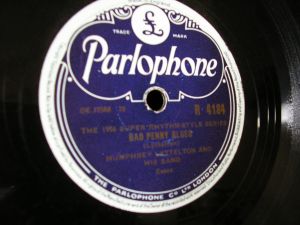
Here is the original 78rpm single:
Humph didn’t like the way the record had been put together, but it was an instant hit. He later joked that he hated it all the way to the bank.
Joe Meek went on to produce several classic pop records, generating many ideas that were later used by Phil Spector, but ultimately he became a tragic figure. Such commercial success as he achieved didn’t really last and he sank into debt, depression and paranoia. A gay man in an era in which homosexuality was still illegal, he became a victim of blackmail and was questioned by the police for alleged encounters with rent boys. He committed suicide in 1967 at the age of 37.
The Bad Penny Blues went on to be the “inspiration” behind Paul Macartney’s Lady Madonna,a Beatles track which has a lot of the same notes in it and also borrows the same overall feel. I can’t put it more subtly than that. George Martin, who produced the Beatles’ track, was actually in charge of the Parlophone studio at the time Bad Penny Blues was recorded…
And Humph went on to live another 52 years, bringing music and laughter to millions.
To end with, here’s a link to a later version of the tune recorded by a more recent manifestation of Humph’s band, probably in the 1980s. Note the way his technique involved the use of his eyebrows! I may be wrong, but I think the pianist on this performance is Mick Pyne and the bass is played by Dave Green. I can’t really make out the drummer.
It’s a cold and dreary Sunday and I’m definitely in need of a pick-me-up, so I thought I’d share this you. It was recorded live in 1981 by the Carla Bley Band and can be found on a superb album called, appropriately enough, Carla Bley Live! When this record came out I was an avid listener to Humphrey Lyttelton’s radio show The Best of Jazz and he chose this magnificent track featuring the trombonist Gary Valente as a taster for the album. It became one of the all-time favourites on his show and he played it a number of times over the years. It’s also one of the most-played tracks on my iPod, as I find it very uplifting on long and wearisome train journeys.
The trombone is usually described as a brass instrument, but Gary Valente makes his sound more like it’s made of wrought iron; Humph described the sound as as “like that of a wounded bison”. Anyway, ignore the rather dull pictures of churches used in the video, and just listen to one of the most overwhelming performances in all of Jazz; the immensity of Valente’s trombone sound is at times almost terrifying. And if you’re one of those people who dislikes Jazz that’s stylistically dated later than about 1945, give this a hearing because it’s absolutely drenched in the Blues and Gospel traditions. I’ll even let you call it awesome…
P.S. No, I haven’t gone religious, but this track disproves the old theory that the devil has the best music…
I saw that someone posted this on Youtube, so couldn’t resist putting it on here. For a long time in the 70s and 80s this was used by Humphrey Lyttelton as the theme tune for his BBC Radio programme The Best of Jazz so it’s full of nostalgia for me as I used to listen to it every Monday night when I was school. Although quite a traditionalist in terms of his own music, Humph played all kinds of Jazz on his programme and in so doing introduced me to a great deal of music that I still love, thirty odd years later. The only problem with using this as his theme tune was that I never got to hear the whole thing all the way through, until I finally got around to buying the LP (which I still have).
This track, Wanderlust, is taken from the album Duke Ellington meets Coleman Hawkins and it features star performers from the Ellington Band of the early sixties, with the great Coleman Hawkins sitting in on tenor saxophone. It’s a fairly basic blues composition, of the type often played at jam sessions like this; Ellington himself doesn’t play a solo, but provides wonderful piano accompaniment throughout. The rest of the rhythm section comprises Aaron Bell (bass) and Sam Woodyard (drums). Soloists in order are: Johnny Hodges (alto sax), typically relaxed; Ray Nance on trumpet; Harry Carney (baritone sax); Lawrence Brown (trombone); and finally a longer contribution by the star of the show, Coleman Hawkins, whose climactic solo is superbly constructed around the simple blues chords, taking it into another dimension entirely, before an ensemble chorus after which Sam Woodyward whips it up in sixths and takes them home. A great record by a bunch of great musicians that manages to be simultaneously very typically Duke Ellington and very typically Coleman Hawkins.
After a very long day I’m too tired this evening to post anything too demanding, so I thought I’d put up a bit of old jazz. In fact this is the Humphrey Lyttelton Band vintage 1954, recorded live at the Conway Hall. This record was a bit of a novelty at the time because it was one of those new fangled Long Playing discs (LPs). Anyway, the tune Memphis Shake is introduced by Humph as “from way back” and I in fact posted the original version some time ago. The band clearly enjoyed playing that night “way back” in 1954.
There’s no actual video but if you notice you get a good look at the album cover, which features cartoons drawn by Humph himself. That gives me the opportunity to remind everyone that as well as being a fine trumpeter and bandleader, as well as radio presenter with a dry sense of humour and impeccable comic timing, he was also an extremely talented cartoonist and caricaturist. Here is another example – I think his cartoon of himself is really excellent!
It’s a grey gloomy and rainy August lunchtime here in Wales and so I thought I’d just try to brighten things up a little by posting this video of a lovely set by the quintet led in the early 60s by the great Dizzy Gillespie, clearly enjoying himself on the BBC TV program Jazz 625. This was the band that also featured the brilliant James Moody on saxophones and flute. As you can hear, they played music that was strongly flavoured by Dizzy’s lifelong interest in Cuban jazz. The programme was introduced by the late great Humphrey Lyttelton and it’s in several bits which you will have to click through if you want to see them all. I hope you at least go as far as Part 3, where there’s a big laugh waiting for you…
I’m not going to make excuses. This is a piece of pure nostalgia.
We had this old record in the house when I was a little kid. It was quite an innovation at the time. Most of the jazz records my dad had collected were on 10″ shellac discs to be played at 78rpm. This was a very limited format in that you could never get more than about 3 minutes on each side. They were also extremely fragile. Most of the ones we used to have ended up broken into pieces.
But when Humphrey Lyttelton’s band did a concert in 1954 at the then very new Royal Festival Hall in London, the Parlophone label decided to release four tracks on a vinyl EP (extended play). This allowed them to get a longer playing time but also meant that the actual discs survived a bit longer than 78s used to.
I was born in 1963, about nine years after the record was released but I distinctly remember as a kid sitting in our house in Benwell with this record playing on our little gramophone. I never seemed to be able to shout “Onions” on the right beat in the little two-bar interval left for the purpose. But, then again, neither did many in the audience.
Humph himself (who died a year ago) does the announcement in that instantly recognizeable voice of his. The whole band plays wonderfully too, but I’d like to single out the clarinet of Wally Fawkes for special mention. In case you didn’t know, Wally Fawkes is actually a pseudonym for the award-winning cartoonist Trog. Anyway, on this track he gives an object lesson in how to build a solo: starting off in the smoky lower register then gradually building up steam until just after 2 minutes in he steps on the gas, switches to the upper register and wails like a banshee. He never plays anything very complicated and I must have heard that moment hundreds of times over the years but it still gives me a buzz!
I noticed this morning that I’ve passed a bit of a milestone on here. I’ve actually reached my 100th post. That probably means I’ve been spending way too much time blogging but, undaunted, here I go again.
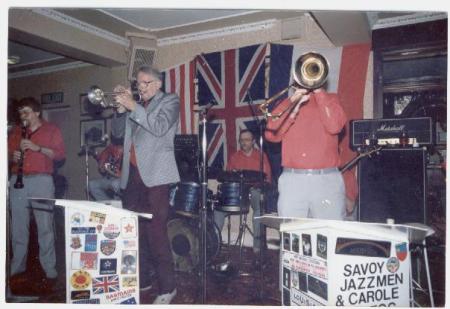
Ages ago (or it seems like ages ago) I posted an item about Humphrey Lyttelton and during the course of it I mentioned that my Dad had played the drums with Humph some years ago. I did mention in that post that I would put up a picture as soon as I found it, which I have now done. Here it is, taken probably somewhere around 1990.
I’m not entirely sure of the venue. I always thought this session took place in the Corner House in Newcastle but on closer inspection it doesn’t really look like it in this photograph so I wouldn’t bet on my memory being right. It’s not a great photograph, but that’s definitely my Dad (Alan Coles) on the drums. I don’t know the other personnel, but you do get a proper impression of how tall Humph was (he’s on trumpet, of course) .
Humph of course had his own band but many jazz venues (including the Corner House) preferred to invite soloists only to come and play with the house band. The main reason I think was that it was cheaper that way. And of course the local musicians loved it because they got to play with their heros. My Dad idolized Humphrey Lyttelton but when he finally got to play with him he was extremely nervous and didn’t particularly enjoy the evening.
Semi-professional bands like the Savoy Band shown here couldn’t afford fancy band uniforms or outfits so for some reason they all seem to settle on cheap red nylon shirts, as shown in the picture. I don’t know why because they’re not at all pleasant to wear if you’re going to be sweaty. But these shirts reminded me of a story that I’ve bored people with over many years. When I was little (in the 70s) there was a similar band in Newcastle called the Phoenix Jazz Band. They also wore horrible red nylon shirts for gigs, except for their young bass player (a guy called Gordon) who refused to do so. This uppity young student teacher turned up for gigs in a black-and-yellow hooped jersey so he looked rather like a bumble-bee or a wasp. The rest of the band called him, rather sarcastically, Sting. He soon went on to other things but the name stuck.
My dad always claimed that Sting had played the double bass in our garage – when I lived in Benwell village. I don’t remember having seen him though, and I might well have been having my leg pulled. Actually it wasn’t a garage anyway, more of a big wooden shed where he kept his drums and lots of other junk.
Anyway, I don’t know if I’ve mentioned this but I did for a while have dreams of becoming a Jazz musician myself. I wanted to be a saxophonist but my Dad persuaded me that I should learn to play the clarinet first and it would be easy then to switch to sax. I don’t think it was very good advice because they’re quite different instruments to play, but I rather think he had pushed the clarinet because he wanted me to play traditional Jazz rather than modern stuff.
I found that I had quite a good ear for music and a pretty good sense of rhythm so I mastered the rudiments fairly quickly but never got much further than that. I even got as far as sitting in with some bands, but never became a full-time member of one.
Sitting in with one of these traditional Jazz bands is a very informal business. Usually the repertoire consists of standard tunes that everyone knows and there are no real arrangements as such. The trumpet usually plays the lead for a chorus or two, with impromptu clarinet and trombone alongside, then there’s a sequence of solos (usually a couple of choruses for each player, unless you really get into it and the leader shouts “take another!”), and then you play out to the end. Other than that you make it up as you go along.
But there is one notable exception to this, a number called High Society. This probably began as a Mardi Gras parade tune but later on came to be played as an up-tempo flag-waver. Almost every Jazz band, however, plays it the same way. It starts with a sort-of call to arms with drum rolls and a few phrases on the horns a bit like a fanfare before moving into tempo and it has quite a few scored passages that are played straight (i.e. without improvisation). When it breaks eventually into the solos there is an unwritten rule that the clarinet soloist plays a standard set-piece solo obbligato, at least for one chorus, after which it’s back to the more normal improvised solo.
I don’t know how this became such a strong tradition but you can check it out yourself. There are dozens of versions of High Society played by different Jazz bands and the clarinettist will always play the same basic notes. There’s a classic recording by Jelly Roll Morton on which there are two clarinettists (Albert Nicholas and Sidney Bechet) who both play the original licks, one after the other.
The story I heard was that this solo (as well as possibly the tune itself) was written by a man called Alphonse Picou who was born in 1878 and played with the first real Jazz band in New Orleans, which was led by the legendary figure of Buddy Bolden, the first great jazz trumpeter. Bolden died in 1931 but no recordings by him have ever come to light because he stopped playing before 1910 and spent most of the rest of his life in mental institutions. It is said that Buddy Bolden’s band did make a cylinder recording, but this grail-like object has never been found.
High Society is such a well known tune and is such fun to play that it is very often part of after-hours Jam sessions at clubs like the Corner House where I did once actually play the Alphonse Picou solo from memory (or at least some sort of approximation to it), having heard it so many times on different records.
Last weekend, when I was playing around on Youtube, I chanced upon a bit of film of New Orleans Jam Session from 1958. It was looking back down a very long tunnel into ancient history but you could have knocked me down with a feather when I saw, sitting down next to the piano at the left, the great man himself, Alphonse Picou. I never thought there would be a film of him, thinking that he was, like Buddy Bolden, an almost mythical figure. I later found elsewhere, a clip from the same session of him playing his own famous solo! However, he was 80 years old and very frail at the time and he doesn’t actually play it that well so I’ll spare his posthumous blushes (he died in 1961) by picking a rather better number from the same session.
The tune I’ve picked to put on here is called Mamie’s Blues. They play it with that lovely lazily lilting beat that’s so typical of authentic New Orleans Jazz but is actually so difficult to get right. And if it wasn’t enough to see Alphonse Picou, there are several other legendary names too: Paul Barbarin (drums), George Lewis (clarinet) and Jim Robinson (trombone) amonst others. The session happened 50 years ago at which point these were all very old men and they’re all long gone now.This clip, to me, is every bit as important a piece of history as, say, an original score by Mozart.
They may all look like they’ve seen better days, but they certainly still knew how to play!
The views presented here are personal and not necessarily those of my employer (or anyone else for that matter).
Feel free to comment on any of the posts on this blog but comments may be moderated; anonymous comments and any considered by me to be vexatious and/or abusive and/or defamatory will not be accepted. I do not necessarily endorse, support, sanction, encourage, verify or agree with the opinions or statements of any information or other content in the comments on this site and do not in any way guarantee their accuracy or reliability.



 In the Dark