Archive for Ian Harrison

How big were the biggest galaxies in the early Universe?

Posted in Biographical, Cardiff, The Universe and Stuff with tags , , , , , , , on August 23, 2022 by telescoper

Once upon a time (over a decade ago when I was still in Cardiff), I wrote a paper with PhD student Ian Harrison on the biggest (most massive) galaxy clusters. I even wrote a blog post about it. It was based on an interesting branch of statistical theory called extreme value statistics which I posted about in general terms here.

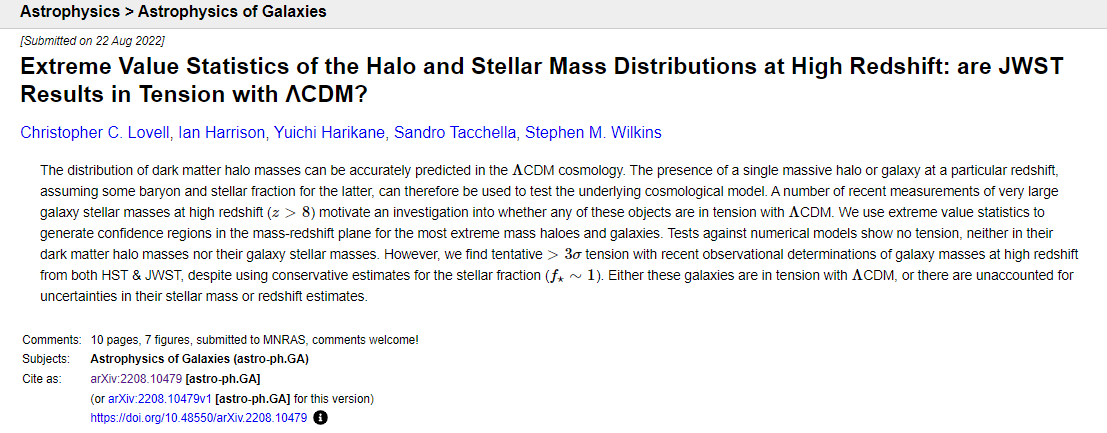
Well now the recent spate of observations of high-redshift galaxies by the James Webb Space Telescope has inspired Chris Lovell (who was a student at Cardiff back in the day then moved to Sussex to do his PhD and is now at the University of Hertfordshire) and Ian Harrison (who is back in Cardiff as a postdoc after a spell in the Midlands), and others at Cambridge and Sussex, to apply the extreme value statistics idea not to clusters but to galaxies. Here is the abstract:
The basic idea of galaxy formation in the standard ΛCDM cosmological model is that galaxies form in dark matter haloes that grow hierarchically so that the typical size of galaxies increases with time. The most massive haloes at high redshift should therefore be less massive than the most massive haloes at low redshift, as neatly illustrated by this figure, which shows the theoretical halo mass function (solid lines) and the predicted distribution of the most massive halo (dashed lines) at a number of redshifts, for a fixed volume of 100 Mpc3.
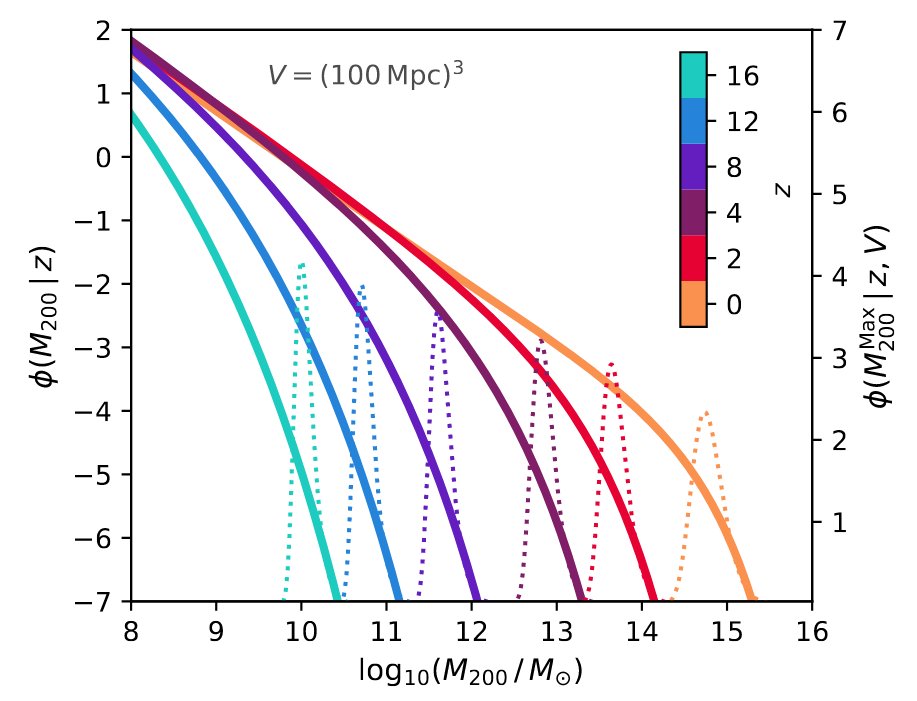
The colour-coding is with redshift as per the legend, with light blue the highest (z=16).

Of course we don’t observe the halo mass directly and the connection between this mass and the luminosity of a galaxy sitting in it is likely to be complicated because the formation of the stars that produce the light is a rather messy process; the ratio of mass to light is consequently hard to predict. Moreover we don’t even have overwhelmingly convincing measurements of the redshifts yet. A brief summary of the conclusions of this paper, however, is that is some of the big early galaxies recently observed by JWST seem to be a big too big for comfort if we take their observed properties at face value. A lot more observational work will be needed, however, before we can draw definite conclusions about whether the standard model is consistent with these new observations.
New Publication at the Open Journal of Astrophysics!

Posted in OJAp Papers, Open Access, The Universe and Stuff with tags , , , , , , on June 25, 2020 by telescoper

Proving further the point that the The Open Journal of Astrophysics is definitely fully open we have published yet another paper. This one was actually published yesterday, which means that we had two in two days..

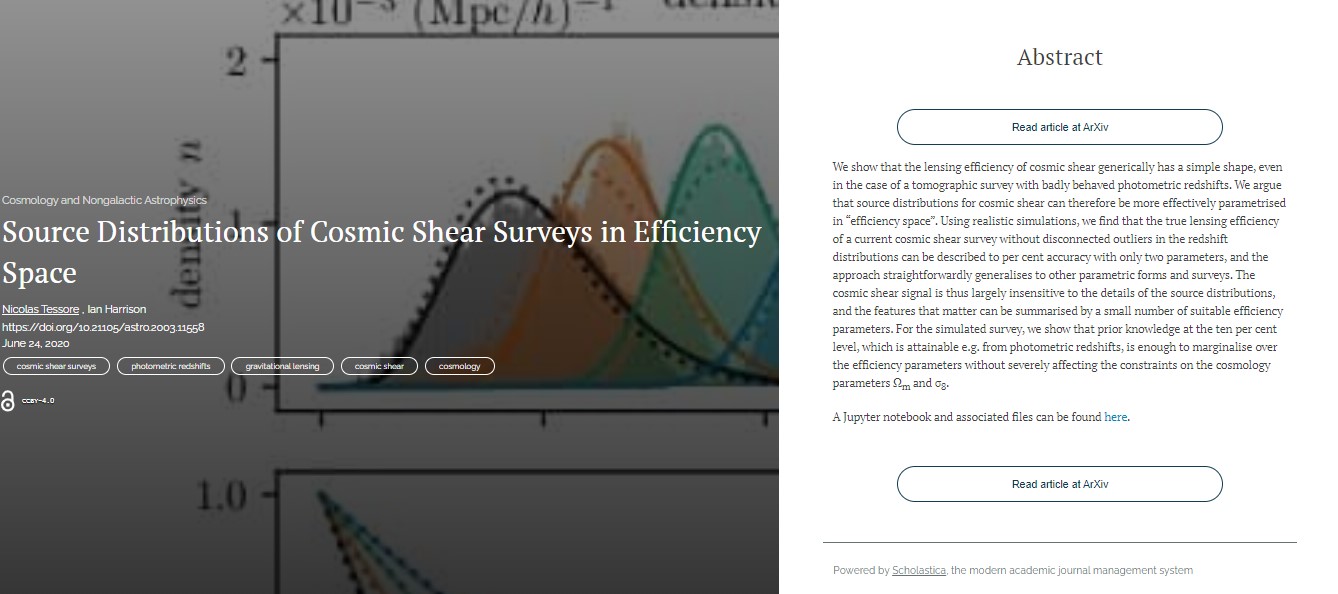
This one is in the Cosmology and Nongalactic Astrophysics section and is entitled Source Distributions of Cosmic Shear Surveys in Efficiency Space. The authors are Nicolas Tessore and Ian Harrison, both from the University of Manchester. The paper is concerned with the extraction of cosmological information from cosmic shear surveys.

Here is a screen grab of the overlay:

You can find the arXiv version of the paper here.

Three Minutes of Cosmology

Posted in The Universe and Stuff with tags , , on October 29, 2014 by telescoper

Not much time today to do anything except help one of my former PhD students become a Youtube sensation by sharing this video of Ian Harrison. Ian did his doctorate with me in Cardiff but now works in the Midlands, at the University of Manchester. Here he is talking about part of his PhD work for just three minutes without repetition, hesitation, deviation, or repetition:


Article of the Day!

Posted in The Universe and Stuff with tags , , , , , , on July 31, 2013 by telescoper

Back in the office today, the heatwave having given way to grey drizzle and cool breezes (at least for the time being). I’ve got stacks of paperwork to catch up on, but fortunately I’ve got time to post a quick congratulatory message to Ian Harrison, who is author of today’s NASA ADS Article of the Day! Ian is a PhD student in the School of Physics & Astronomy at Cardiff University and was supervised by me until I abandoned ship to come here to Sussex earlier this year; he’s got a postdoctoral research position lined up in the Midlands (Manchester) when he finishes his thesis. The other author, Shaun Hotchkiss, is coming to Sussex as a postdoctoral researcher in October.

Anyway, the paper is a nice one, called A consistent approach to falsifying ΛCDM with rare galaxy clusters. Here’s the abstract:

We consider methods with which to answer the question “is any observed galaxy cluster too unusual for ΛCDM?” After emphasising that many previous attempts to answer this question will overestimate the confidence level at which ΛCDM can be ruled out, we outline a consistent approach to these rare clusters, which allows the question to be answered. We define three statistical measures, each of which are sensitive to changes in cluster populations arising from different modifications to the cosmological model. We also use these properties to define the “equivalent mass at redshift zero” for a cluster — the mass of an equally unusual cluster today. This quantity is independent of the observational survey in which the cluster was found, which makes it an ideal proxy for ranking the relative unusualness of clusters detected by different surveys. These methods are then used on a comprehensive sample of observed galaxy clusters and we confirm that all are less than 2σ deviations from the ΛCDM expectation. Whereas we have only applied our method to galaxy clusters, it is applicable to any isolated, collapsed, halo. As motivation for future surveys, we also calculate where in the mass redshift plane the rarest halo is most likely to be found, giving information as to which objects might be the most fruitful in the search for new physics.

In case you’re wondering, the rather Popperian nature of the title is not the reason why I’m not among the authors. I’m just not the sort of supervisor who feels he should always be an author of papers done by his research students even when they had the idea and did all the work themselves. From what I’ve heard talking to others, we’re a dying breed!