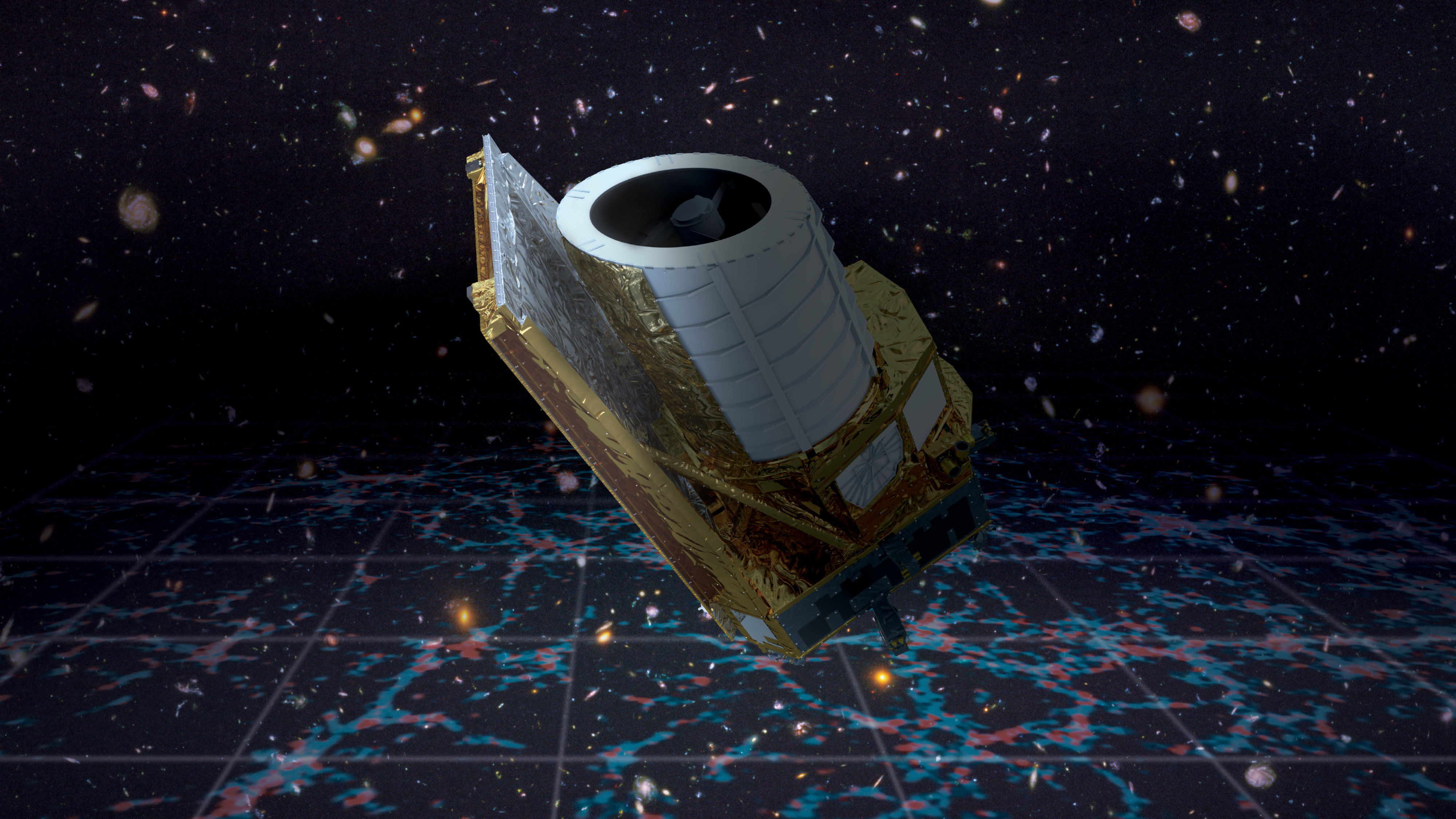
I’m travelling back to Barcelona today, later than planned because I’ve had a heavy cold that I struggled to shake off and didn’t want to infect fellow passengers on the flight. While I’m in transit I thought I’d share some updates about the European Space Agency’s Euclid mission.
The first thing to share is a piece by Knud Jahnke with news about Euclid’s issue with ice in the optical system. The latest intervention has led to an improvement, but since it is a closed system ice will probably form again – though perhaps not in the same place – and further procedures will probably be necessary in future. In the meantime, though, the survey resumes.
Now for some short videos -three, to be precise – about the Early Release Observations mentioned here. I posted another one in this series here. I think the titles are self-explanatory:
And if that isn’t enough, for those of you who like simulations here is another video about the Euclid Flagship simulation described in this paper.
I thought it would be appropriate to add a little update about the European Space Agency’s Euclid mission. I’ll keep it brief here because you can read the full story on the official website here.
You may have seen in the news that the Euclid telescope has been having an issue with ice forming on surfaces in its optical systems, especially the VIS instrument. This is a common problem with telescopes in space, but the extent of it is not something that can be predicted very accurately in advance so a detailed strategy for dealing with it had to be developed on the go.
The layers of ice that form are very thin – just tens of nanometres thick – but that is enough to blur the images and also reduce the throughput of the instruments. Given that the objects we want Euclid to see are faint, and we need very sharp images then this is an issue that must be dealt with.
Soon after launch, the telescope was heated up for a while in order to evaporate as much ice as possible, but it was not known how quickly the ice would return and to what parts of the optical system. After months in the cold of space the instrument scientists now understand the behaviour of the pesky ice a lot better, and have devised a strategy for dealing with it.
The approach is fairly simple in principle: heat the affected instruments up every now and again, and then let them cool down again so they operate; repeat as necessary as ice forms again. This involves an interruption in observations, it is known to work pretty well, but exactly how frequently this de-icing cycle should be implemented and what parts of the optical system require this treatment are questions that need to be answered in practical experimentation. The hope is that after a number of operations of this kind, the amount of ice returning each time will gradually reduce. I am not an expert in these things but I gather from colleagues that the signs are encouraging.
The views presented here are personal and not necessarily those of my employer (or anyone else for that matter).
Feel free to comment on any of the posts on this blog but comments may be moderated; anonymous comments and any considered by me to be vexatious and/or abusive and/or defamatory will not be accepted. I do not necessarily endorse, support, sanction, encourage, verify or agree with the opinions or statements of any information or other content in the comments on this site and do not in any way guarantee their accuracy or reliability.

 In the Dark