Archive for Integrated Sachs-Wolfe Effect

A Plug for Some Research…

Posted in The Universe and Stuff with tags , , , , on May 12, 2014 by telescoper

Very busy today so I just thought I’d give a bit of publicity to a paper that’s just been accepted for publication. I’m actually one of the authors, but the other guys (Dipak Munshi of Sussex, Bin Hu of Leiden, Alessandro Renzi of Rome, and Alan Heavens of South Kensington Technical Imperial College) did all the work! I’m posting it mainly to remind myself that there is a world outside of administration. If it weren’t for my inestimable (STFC-funded) postdoc, Dipak Munshi, I don’t know where my research would be!

Here is the abstract:

We use the optimised skew-spectrum as well as the skew-spectra associated with the Minkowski Functionals (MFs) to test the possibility of using the cross-correlation of the Integrated Sachs-Wolfe effect (ISW) and lensing of the cosmic microwave background (CMB) radiation to detect deviations in the theory of gravity away from General Relativity (GR). We find that the although both statistics can put constraints on modified gravity, the optimised skew-spectra are especially sensitive to the parameter B0   that denotes the the Compton wavelength of the scalaron at the present epoch. We investigate three modified gravity theories, namely: the Post-Parametrised Friedmanian (PPF) formalism; the Hu-Sawicki (HS) model; and the Bertschinger-Zukin (BZ) formalism. Employing a likelihood analysis for an experimental setup similar to ESA’s Planck mission, we find that, assuming GR to be the correct model, we expect the constraints from the first two skew-spectra, S(0)   and S(1), to be the same: B0 <0.45  at 95  confidence level (CL), and B0 <0.67  at 99  CL in the BZ model. The third skew-spectrum does not give any meaningful constraint. We find that the optimal skew-spectrum provides much more powerful constraint, giving B0 <0.071  at 95  CL and B0 <0.15  at 99  CL, which is essentially identical to what can be achieved using the full bispectrum.

It’s part of a long sequence of papers emanating from work done by Dipak (with various combinations of co-authors, including myself) which have been aimed at optimising the use of statistical techniques for detecting and quantifying possible departures from the standard model of cosmology using various kinds of data; in this case the paper is entitled Probing Modified Gravity Theories with ISW and CMB Lensing; `ISW means the Integrated Sachs-Wolfe Effect and CMB is the cosmic microwave background. This kind of work doesn’t have the glamour of some cosmological research – I don’t think we’ll be writing a press release when it gets published! – but it is the kind of preparatory analysis that is essential if cosmologists are to make the most of present and forthcoming observational data, which is why we keep plugging away…

Lessening Anomalies

Posted in Cosmic Anomalies, The Universe and Stuff with tags , , , , , on September 15, 2009 by telescoper

An interesting paper caught my eye on today’s ArXiv and I thought I’d post something here because it relates to an ongoing theme on this blog about the possibility that there might be anomalies in the observed pattern of temperature fluctuations in the cosmic microwave background (CMB). See my other posts here, here, here, here and here for related discussions.

One of the authors of the new paper, John Peacock, is an occasional commenter on this blog. He was also the Chief Inquisitor at my PhD (or rather DPhil) examination, which took place 21 years ago. The four-and-a-half hours of grilling I went through that afternoon reduced me to a gibbering wreck but the examiners obviously felt sorry for me and let me pass anyway. I’m not one to hold a grudge so I’ll resist the temptation to be churlish towards my erstwhile tormentor.

The most recent paper is about the possible  contribution of  the integrated Sachs-Wolfe (ISW) effect to these anomalies. The ISW mechanism generates temperature variations in the CMB because photons travel along a line of sight through a time-varying gravitational potential between the last-scattering surface and the observer. The integrated effect is zero if the potential does not evolve because the energy shift falling into a well exactly balances that involved in climbing out of one. If in transit the well gets a bit deeper, however, there is a net contribution.

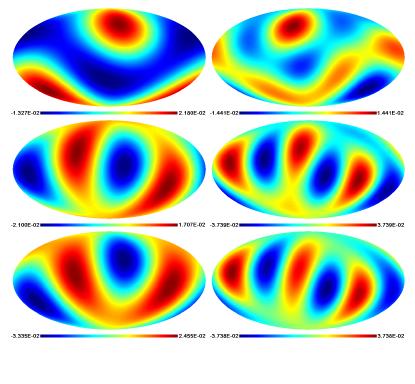
The specific thing about the ISW effect that makes it measurable is that the temperature variations it induces should correlate with the pattern of structure in the galaxy distribution, as it is these that generate the potential fluctuations through which CMB photons travel. Francis & Peacock try to assess the ISW contribution using data from the 2MASS all-sky survey of galaxies. This in itself contains important cosmological clues but in the context of this particular question it is a nuisance, like any other foreground contamination, so they subtract it off the maps obtained from the Wilkinson Microwave Anisotropy Probe (WMAP) in an attempt to get a cleaner map of the primordial CMB sky.

The results are shown in the picture below which presents  the lowest order spherical harmonic modes, the quadrupole (left) and octopole (right) for the  ISW component (top) , WMAP data (middle) and at the bottom we have the cleaned CMB sky (i.e. the middle minus the top). The ISW subtraction doesn’t make a huge difference to the visual appearance of the CMB maps but it is enough to substantially reduce to the statistical significance of at least some of the reported anomalies I mentioned above. This reinforces how careful we have to be in analysing the data before jumping to cosmological conclusions.

peacock

There should also be a further contribution from fluctuations beyond the depth of the 2MASS survey (about 0.3 in redshift).  The actual ISW effect could therefore  be significantly larger than this estimate.