Archive for ireland

The First Landing on the Irish

Posted in History with tags , , , , , , on September 7, 2019 by telescoper

While at the Irish National Astronomy Meeting last week I picked up a free copy of the magazine Astronomy Ireland. I chuckled when I saw this little item about the stamps issued in Ireland to commemorate the 50th Anniversary of the Apollo 11 first landing on the Moon:

If you can’t read the text it refers to a spelling error in the Irish language version of the caption on the Neil Armstrong stamp at the top image: instead of the Irish word for Moon (Gealach) the text contains the word for Irish (Gaelach). The caption thus translates as the 50th Anniversary of the First Landing on the Irish

ERC Starting (and Finishing) Grants

Posted in Politics, Science Politics with tags , , , , on September 3, 2019 by telescoper

Just time for a quick note to announce that the European Research Council has announced the winners of the latest round of `Starting Grants’ (which are intended to further the research plans of early career researchers). Full details are here. Congratulations to all the winners, and especially  Erminia Calabrese in the School of Physics & Astronomy at Cardiff University!

In all, 408 applicants were selected for funding, hosted in 24 different countries. The split by nationality and discipline is as follows:

I’ll make two comments on the numbers.

First, the United Kingdom is host to a total of 64 awards. It is however very unclear what will happen in the case of a `No Deal’ Brexit in which the British Government refuses to honour its existing financial commitments. Hopefully even in this case these grants will go ahead in some form (perhaps funded directly by the UK).

Second, note that there is only one award for Ireland and nothing in either Physical Sciences or Life Sciences. This is very disappointing, but is probably a fair reflection of the Irish governments ongoing failure to invest in basic science.

It’s not that the Irish aren’t good at research. Here is another graphic that shows that 7 Irish researchers were actually awarded grants under this scheme, but none of them chose to hold their awards in Ireland:


That tells you something about the environment for early career researchers in this country.

The imminent departure of the United Kingdom from the European Union makes its future participation in such schemes unlikely. Brexit could be a great opportunity for the research community in Ireland, if only the Irish Government would seize it, but it would first need to recognize the benefits of increasing investment in research. Sadly I don’t think it will.


Brexit and the British Border in Ireland

Posted in Politics with tags , , , , on August 31, 2019 by telescoper

The events of the past week have given me even more reason than usual to rant about Brexit, and the damage it is causing even to those who voted for it. So let me take as the subject for this one the absolute claptrap that brexiters are talking about the so-called `Backstop’ which is part of the Withdrawal Agreement (WA) negotiated between the United Kingdom and the European Union but voted down three times by the House of Commons. This part of the agreement is designed to allow the free flow of goods and people across the British* Border in Ireland by keeping the United Kingdom in the Customs Union and some parts of the Single Market if no free trade agreement is negotiated between the UK and EU that comes up with alternative ways of achieving this during the transition period allowed for in the WA (which extends at least until December 2020, but could in principle be extended further).

*Note: I consider the term `Irish Border’ to be misleading, so I use the more accurate `British Border in Ireland’.

The first thing to say – and this is blindingly obvious if you have actually read the WA – is that the backstop does not come into play at all if an alternative solution to the Border issue can be found. The fact that leading Brexiters are so exercised by the backstop therefore betrays their belief that no such alternative arrangements exist or can be put in place in the foreseeable future. If such arrangements existed the Brexiters would not be in the slightest bit bothered by the Backstop as it would be irrelevant. The fact that they are opposed to the backstop is an obvious signal that they know there is no technological or other solution consistent with the position into which the UK Government has trapped itself.

So why the constant demand from the ERG et al for the backstop to be removed? And why all the lying about its purpose?

To answer that I think you have to consider the true motivation of the Leave campaign. The purpose of Brexit was not just about the UK leaving the European Union. That was merely intended to be a step along the path to destroying the EU and so destabilizing Europe. The original theory was that Brexit would lead to a parade of other EU nations wanting to leave. That didn’t happen. Indeed the solidarity of the EU in the face of the attacks on it has been quite remarkable.

So now it is Plan B, which is based on the premise that the Achilles Heel of the EU is Ireland. By creating economic and political chaos – and possibly a return to violence, sparked by Britain’s intentional violation of the Good Friday Agreement – in Ireland they will force the EU to offer the UK favourable terms on access to the Single Market. To do so, however, would open the floodgates to other governments who might want to reap the benefits of EU membership without the responsibility that goes with it (as Britain does).

And even if this doesn’t work, Leave supporters will still have to find someone to blame when the cake-and-eat-it Brexit they promised – the `easiest trade deal in history’, `no downside only a considerable upside’, `because we hold all the cards’ Brexit – will never actually materialize. The alternative would be for the whole gang of them to admit they were lying (which we know they were). No prizes for guessing who the scapegoat will be…

The strategy of setting up Ireland as a target for economic aggression may well cause a great deal of pain in the short-term, but I hope and believe that it won’t succeed. For one thing, I don’t think the Irish economy is as vulnerable as the UK government thinks. for another, it may quickly lead to a United Ireland. That, at any rate, is far more likely than Ireland becoming a British colony again, which is what some Brexiters want.

More importantly, however, although Ireland and Britain differ substantially in size, the former will a great advantage over the latter in the world after Brexit: Ireland will still have friends, and Britain won’t.

The Myths of UK-Ireland Trade

Posted in Finance, Politics with tags , , , , on August 20, 2019 by telescoper

It is clear now that the UK Government’s strategy on Brexit is one of economic aggression towards Ireland.  Senior Brexiters seem to think that threatening to put up barriers to trade with the Republic will frighten it and the European Union into abandoning the rules of the single market and customs union.

As well as being morally repellent this strategy is also extremely stupid, as is based on a complete misconception of the state of trade between these two countries. For example, one prominent Leave campaigner and former Minister of State recently claimed that 90% of Ireland’s trade is with the UK. That may have been the case in the 1950s but it is certainly not the case now.

In fact, according to the latest figures, only about 11% of Ireland’s exports in goods go to the UK and this figure is falling rapidly. The largest export destination for Ireland within the EU is actually not the UK, but Belgium (11.65%) with Germany just behind on 8.56%. Overall the EU accounts for about 49% of Ireland’s exports; the largest other contribution is the United States on about 29%.

Contrary to popular myth, Ireland’s exports are not dominated by agriculture and food. By far the largest contribution is from chemicals and pharmaceutical products many of which go to Antwerp for onward distribution and/or further processing. This accounts for the large trade figure with Belgium.

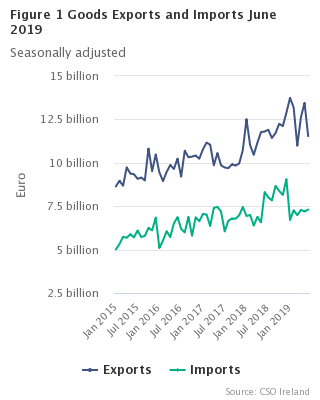
Another fact worth mentioning is that while Ireland overall has a healthy trade surplus overall (it exports more than it imports; see above Figure), its trade balance with the United Kingdom is actually negative (i.e. the UK exports more to Ireland than it imports). In 2018, UK exports to Ireland were worth £38.3 billion; imports from Ireland were £21.9 billion, resulting in a trade surplus of £16.4 billion with Ireland. Ireland accounted for 6.0% of UK exports and 3.3% of all UK imports. Ireland was the UK’s 5th largest export market and the 9th largest source of imports. The UK has recorded a trade surplus with Ireland every year between 1999 and 2018.

Brexiters have frequently used the argument that, since the UK has a negative trade balance with the EU, the EU needs the UK more than the UK needs the EU. It’s a wrong argument, of course, but it’s interesting that the Brexiters don’t apply it to Ireland.

There’s no question that the `No Deal’ Brexit which I’ve regarded as inevitable from the outset will disrupt the Irish economy, or at least parts of it, and in the short term, but I agree with the Irish Times analysis from some time ago and a more recent article from the FT that it will cause far greater damage to the UK.

In the longer term, when the UK is out of the European Union I’m sure its trade surplus with Ireland will quickly disappear as Ireland finds alternative (and more trustworthy) trading partners. Irish businesses are already eliminating British companies out of their supply chains and it seems likely that if and when the hard Brexit arrives, Irish customers will be increasingly disinclined to buy British products.

The UK seems to be hoping that some sort of deal with Trump’s America will help it out of the economic hole it has dug for itself, but remember that the UK currently has a trade surplus with the USA. The Americans will be keen to eliminate that during any future trade negotiations.

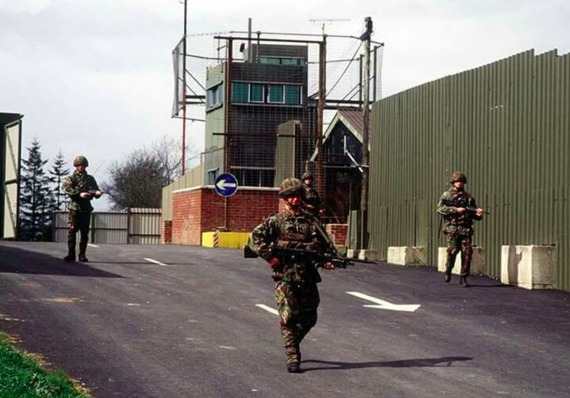
The really important thing however is not the overall effect on the economy but on the problems it will cause for communities either side of the British border in Ireland. The recently-leaked documents from Operation Yellowhammer make it clear that the UK government `expects a return to a hard border in Ireland’. The implication of this is stark: the UK government is planning to renege on its obligations under the Good Friday Agreement, which is an international treaty.

If it goes ahead and does that, then it may be that the economic effects of leaving the single market and customs union are small potatoes compared to the price that will pay for becoming a rogue state. I can’t see the United States, with its approximately 40 million citizens of Irish descent, being keen to support a British government that is so obviously seeking to bully Ireland especially, as seems sadly likely, British actions spark a return to violence in the North.

The Coles of Arms

Posted in Biographical, History with tags , , , , , , , , on August 8, 2019 by telescoper

Sparked by an exchange on Twitter last week with another person (who has the same surname as me) on the subject of heraldry, I did a little bit of googling about and found a little snippet I found quite intriguing. Although the name Coles is found all over England and Wales, with strong concentrations in the South West of England and in Northamptonshire, according to this source the name is of Anglo Saxon origin and is first recorded in Yorkshire as the family name of George Coles, which was dated 1555, in the “Register of the Freemen of the City of York”, during the reign of Queen Mary 1. The same source also points out that a branch of the Coles family subsequently moved to Ireland, though it gives no details (unless you pay for them).

I subsequently found that in Burkes General Armory (which details all the Coats of Arms registered in the UK and Ireland) the first entry under the surname Coles is indeed in Ireland, where it was confirmed in 1647. That date is during the Irish Confederate Wars, a couple of years before Oliver Cromwell arrived in Ireland with his army. One might surmise that this particular branch of the Coles lineage was somehow caught up in these hostilities, probably on the English side.

Anyway the description of the corresponding Coat of Arms, in typically cryptic heraldic language is:

Gu. on a chev. betw. two lions’ heads erased or, ten ogresses. Crest — A snake wreathed about a marble pillar ppr. garnished or.

The first part refers to the escutcheon (shield): Gu is short for Gules, a tincture (red), and it describes the main colour of the field of the escutcheon; chev is for chevron (an inverted v-shape), one of the Honorable Ordinaries (basic designs for the escutcheon). This and the two lions’ heads are described as `or’ (andother tincture, meaning gold-coloured); erased means `without the body’; an ogress is a special case of a roundel (filled circle) in which the circle is black (the word `pellet’ is also used).

The Crest is self-explanatory other than that `ppr’ is short for `proper’ which means, roughly speaking, `natural-coloured’. I’m not of the significance of the snake and the marble pillar.

Here is a mock-up of the whole thing:

There are several other entries for the name Coles in Burkes General Armory and I’m certainly not claiming that I have the right to use this Coat of Arms but I am intrigued by the Irish connection with the name Coles and will see what more I can find out about it.

The Wonderful Barn

Posted in History, Maynooth with tags , , on July 26, 2019 by telescoper

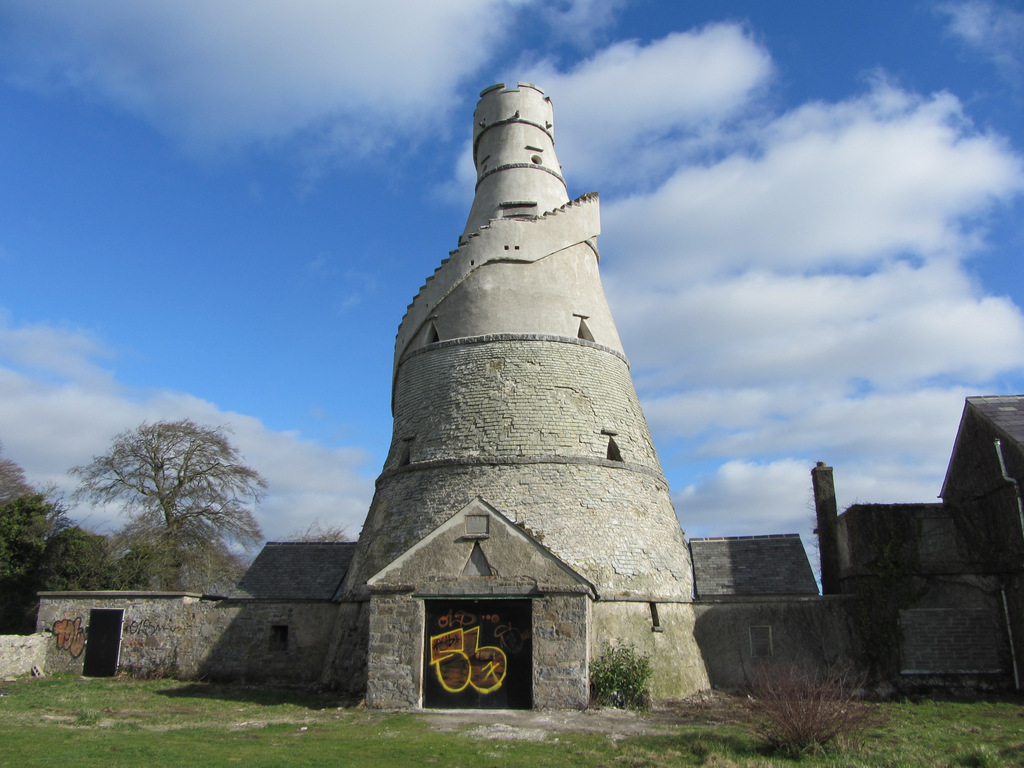
Despite the fact that it’s only a few miles away from Maynooth (in Leixlip) I had never heard of this extraordinary building until yesterday. The Wonderful Barn (for that is its name) is known to have been built in 1743 but nobody actually knows what its purpose was. Probably the best theory is that it was designed to be used as a granary, as it was built immediately after a severe famine (in possible anticipation of others in the future), but alternative possibilities to have been suggested are a tower from which people could shoot game birds, a folly (it was built by the Conolly family, owners of Castletown House and is on the Estate which has another famous folly), and simply as a means of providing work for poor people in a time of great hardship. Anyway, it’s a weird building, built from bricks but faced with what looks like recycled stone rubble.

Here’s a short video that includes some drone footage of the Wonderful Barn that gives you an idea of its corkscrew-shaped construction.

The Senior Academic Leadership Initiative

Posted in Education, Maynooth, Politics with tags , , , , , on June 27, 2019 by telescoper

I’ve been so busy over the last week or so that I forgot to mention that on Friday (21st June) the Minister of State for Higher Education Mary Mitchell O’Connor announced a new scheme to improve the gender balance in senior academic roles in Irish universities.

While women make up more than half of university lecturers here in Ireland, just 24% are professors, and the new scheme plans to tackle that under-representation at senior levels by creating up to 45 academic leadership positions specifically for women over the next three years.

The Senior Academic Leadership Initiative (SALI) is funded by the Department of Education and Skills and managed by the Higher Education Authority. More details of the scheme can be found here and the call for applications can be found here.

In summary: new and additional senior academic leadership posts will be funded in areas where

  • there is clear evidence of significant gender under-representation
  • where this appointment will have significant impact within the HEI and the relevant faculty/department/functional unit
  • where they would be a proportionate and effective means to achieve accelerated and sustainable change within an institution

Predictably there has been a bit of a backlash to this announcement from some quarters, but I think it’s an excellent idea and it has my full support. Note further that Legal advice from the Attorney General has confirmed that this policy approach is consistent with EU and national employment and equality law.

I hope a significant number of these positions go to outstanding female academics in STEM disciplines, where the under-representation is indeed significant – and hope we can also attract some here to Maynooth! We don’t have any female academics in the Department of Theoretical Physics….

It’s important, however, to bear in mind that this scheme addresses only one of the issues relating to gender discrimination in Irish higher education and there are many others, especially in STEM disciplines (such as recruitment of early-career level) which will require separate actions.


Institutes, Acronyms and the Letter H

Posted in Education, Maynooth with tags , , , , , on June 25, 2019 by telescoper

Here’s a rambling and inconsequential post emanating from a coffee-room discussion yesterday.

The latest round of guff about University Rankings, in which Massachusetts Institute of Technology (MIT) came top and Irish universities didn’t  prompted a strange letter to the Irish Times about the status of the Irish Institutes of Technology some of which have merged, or are planning to merge, to form Technological Universities.

Among the list of Irish Institutes of Technology, I found that sadly there isn’t an MIT in Ireland (Mullingar would be a good place for it!) but there are, for example:

Cork Institute of Technology (CIT)

Waterford Institute of Technology (WIT)

Limerick Institute of Technology (LIT)

Athlone Institute of Technology (AIT)

and so on, as well as..

Institute of Technology Tralee….(:-)

I wondered whether there might be some other potentially unfortunate acronyms  to be had, I hoped for example for a South Howth Institute of Technology but sadly there isn’t one; nor is there a Sligo Higher Institute of Technology. There’s no Galway Institute of Technology either.

In the course of that exercise in silliness I discovered how few towns and villages there are in Ireland whose names begin with the letter H. Moreover all of those listed on the Wikipedia page are in the Sacs-Bhéarla (English language) rather than genuinely Irish names.

I’m sure Irish speakers will correct me on this, but I guess this lack of Irish proper names beginning with H may be connected with the use of h in denoting lenition. When used in this way the `h’ always appears after the consonant being modified and so never forms the initial letter. There are plenty of words in Irish beginning with H, though, so this is either a red herring or something specific to place names.

Comments and corrections are welcome through the box below!


UPDATE: I’m reliably informed (via Twitter) that all words in modern Irish beginning with H are borrowings from other languages, and the h was only introduced into Irish words for the reason mentioned above,

Winners and Losers

Posted in Biographical, Crosswords, Politics with tags , , on May 30, 2019 by telescoper

Hopefully the hecticity of the last week or so will now begin to die down and I can get on with the rest of my examination marking, which I hope to complete today.

Now to a couple of updates.

Yesterday I took delivery of the above book. Regular readers of this blog will probably not recall that I won the Financial Times Crosssword competition way back in February. The prize never arrived so I contacted them to ask what had happened. It must have got lost in the post, but they kindly sent a replacement which arrived promptly. The book is not a dictionary, but is about the story of the creation of one – the Oxford English Dictionary to be precise. I look forward to reading it!

The other matter to be updated concerns the Irish Elections to the European Parliament. The counting of these proved to be a slow process but watching the regular updates on the web as votes were transferred is actually rather fascinating. It’s surprisingly difficult to predict where second choice votes of eliminated candidates will end up. The Green Party seems rather `transfer-friendly’, for example, whereas Sinn Féin is not.

In my own constituency of Midlands-North-West it took thirteen rounds of counting to pick the four MEPs: one for Sinn Féin, two for Fine Gael and one strange but probably harmless Independent. The turnout was about 50%. I think Fianna Fáil made a tactical error by fielding two candidates: neither had enough first-preference votes to make the cut.

I was worried that the dreadful Peter Casey might sneak in in fourth place but he fell well short of the required transfers, though he still got a worryingly large number of votes. The Irish Media are making the same mistake pandering to him as they have done in the UK with Nigel Farage: he gets far more airtime than the other candidates despite being obviously unfit for office.

Elswhere, Dublin elected MEPs from the Green Party (1), Fine Gael (1) and Fianna Fáil (1) and one Independent standing under the banner of `Independents for Change’ (I4C). The incumbent Sinn Féin candidate Lynn Boylan lost her seat. The 4th candidate here will only take a seat in the European Parliament if and when the United Kingdom leaves the EU.

As I write there’s a recount going on in Ireland South, but it looks like the winners will be Fine Gael (2), Fianna Fáil (1), I4C (1) and the fifth (who will only take up a seat after Brexit) will probably be from the Green Party. It looks like incumbent Sinn Féin MEP Liadh Ní Riada (and unsuccessful candidate for the Presidency) will lose her seat, but the count is very close: only a few hundred votes are in it, hence the recount. UPDATE: in fact there will be a full recount of the whole ballot, which could take weeks.

Overall it’s clear that the losers are Sinn Féin, who lost two MEPs (and also about half their councillors in the local elections). After appearing to improve their vote share in recent years this is a definite reverse for them. The party that gained the most is the Green Party, with (probably) two MEPs and a strong showing in Midlands-North-West. I wonder if they can keep this momentum going for a General Election?

Interestingly, unlike the rest of the `United’ Kingdom Northern Ireland uses the Single Transferable Vote system for European Elections too. There Sinn Féin came top of first preferences and won one seat, with another for the Alliance and one for the DUP. That’s two-to-one in favour of `Remain’.

Voting Matters in Ireland

Posted in Politics with tags , , , , on May 21, 2019 by telescoper

Arriving back in civilization last night I discovered that my polling card for Friday’s voting has arrived at last along with instructions on the Referendum to be held alongside the Local Council Elections and the European Parliament Elections, all held on 24th May.

I’m looking forward to casting my ballot. It is a new experience for me to vote here in Ireland. Both elections are held under Proportional Representation (Single Transferable Vote) which seems to me a very sensible system. One ranks the candidates in order of preference with votes progressively reallocated as the lowest-ranked candidates are eliminated. You can rank all the candidates or just some. In the system employed here one ranks the candidates in order of preference with votes progressively reallocated in various rounds until one ends up with the top n candidates to fill the n available seats. Surplus votes from the top candidates as well as those of eliminated candidates are reallocated to lower-preference candidates in this process.

The Local Elections involve filling 40 seats on Kildare County Council, with five councillors representing Maynooth. The nine candidates are listed here, in case you’re interested.

For the European Parliament Elections things are a bit more complicated. For the purposes of the EU elections Ireland is divided into three constituencies: Dublin, Ireland South and Midlands North West. I am in the latter, which elects four MEPs. There are 17 candidates for this constituency, listed here.

As a relative newcomer to Ireland I first sorted the candidates into three groups: (i) those that I would be happy to see elected, (ii) those that I don’t really like but could tolerate, and (iii) those that I wouldn’t like to see representing me under any circumstances. There are plenty in the latter category. There seems to be a law in Ireland that there has to be at least one deranged simpleton on every ballot paper, and there are several in this election. I will choose my lower-preference votes to ensure that none of these dickheads, especially racist gobshite Peter Casey, benefit from my vote in any way.

Although the STV system seems very sensible to me, it does lead to a rather lengthy counting process – especially if everyone does what I plan to do, i.e. rank all the candidates instead of just their favourites.