Archive for ireland

Before Phase Three..

Posted in Biographical, Covid-19, Maynooth with tags , , on June 28, 2020 by telescoper

Tomorrow (on Monday 29th June) Ireland will enter Phase Three of its (accelerated) Roadmap for Reopening after the Covid-19 restrictions.

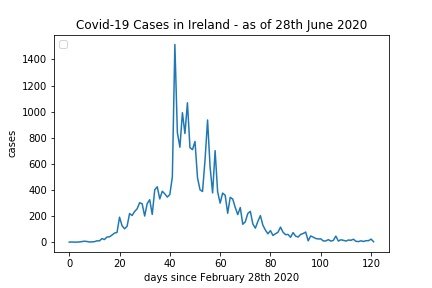
The Coronavirus situation here remains relatively stable, with new cases steady at a low level:

This is not the case for the rest of the world, however. Yesterday two grim milestones were passed: 10,000,000 confirmed cases of Covid-19 worldwide and 500,000 deaths:

Much of the recent numerical growth of the pandemic is associated with North and South America. Brazil is particularly badly affected as are some of the United States. I don’t need to comment on the quality of the political leadership involved.

I am very nervous about the situation in the United Kingdom too, where I feel the reopening is being rushed. Poor leadership is partly responsible for the continuing high levels of infection there too.

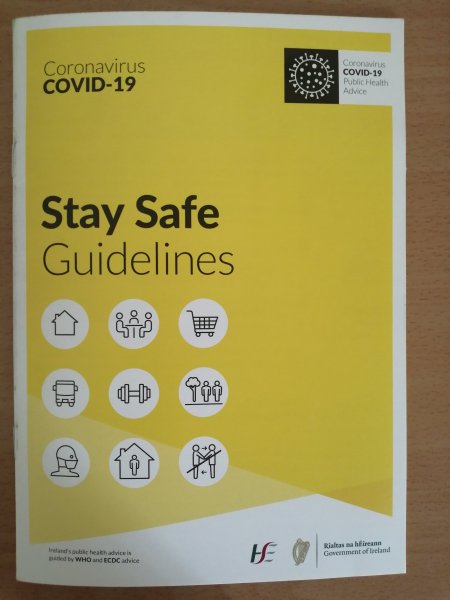
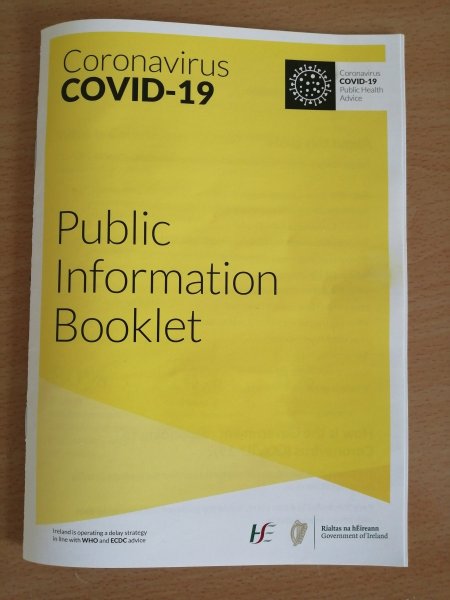
Anyway, back to Phase Three in Ireland. Yesterday I bought a copy of the Irish Times and found this booklet inside:

The emphasis is on the fact that despite the low levels in Ireland Covid-19 has not gone away and we all have to be prepared to take special precautions for the foreseeable future. I would be amazed if there wasn’t another flare-up here at some point, actually, it’s just a question of when. And those optimistic about the delivery of a vaccine in the near future, I’ll remind you that there isn’t yet a vaccine for any form of Coronavirus let alone the novel form responsible for Covid-19 (SARS-CoV-2).

Anyway, on Friday I attended a virtual Question and Answer session with the President of Maynooth University, Professor Philip Nolan, about the plans for reopening campus over the Summer and into the new academic year. It is clear that lots will have to be done before staff can return fully and even then it won’t be anything like “normal”.

Incidentally the issue of face masks came up and there was some discussion about their effectiveness. Not being a medical expert I don’t really know about that, but I think one of the important things about masks in a work environment is that their visibility means that they work as a signal to remind people to be aware of Covid-19. I have discarded my home-made face masks and bought a box of proper ones and I intend to wear them whenever I am in a work setting in which anyone else is present.

On Friday evening I finally received (relatively) detailed instructions on how the return to work process will work. The Department of Theoretical Physics at Maynooth University is still basically in Phase 1 while the university working group has been assembling this guidance. It will probably be several more weeks before we can get people back to work because there are many things still to be done: including the installation of hand sanitizers, one-way systems, screens, and new signage.

Another thing that came up during the President’s Q&A was the question of vacations for staff. Fortunately I had muted both my audio and video feeds for this as I laughed out loud. What with organising the return to work, overseeing repeat exams, recruiting a sabbatical replacement, planning teaching for next year, rewriting my own lectures for the “new normal”, etc etc, and (hopefully) moving into a new house, I can’t see any prospect of any summer holiday this year at all!

Meanwhile, in Ireland…

Posted in Covid-19, Education, Politics with tags , , , , , , , on June 17, 2020 by telescoper

It seems an eternity since we had the 2020 general election in Ireland on February 8th because of the intervention of the Covid-19 outbreak, but it’s still been over four months. Now however it seems we might have a new government fairly soon, as a deal has been agreed to form a coalition between Fine Gael, Fianna Fáil and the Green Party; between them these parties have 84 seats (not counting the Ceann Comhairle), enough to create a majority in the Dáil Éireann. It’s not quite done and dusted, though, as the Green Party has to ballot its membership and a two-thirds majority is needed to endorse the agreement. We should know next week.

In case you think this delay means that Ireland has been in political crisis since February, it hasn’t really. The constitution makes it clear that if a new government can’t be formed the old one continues until one can (or until another election can be held). Leo Varadkar has continued as Taioseach in the mean time. His popularity has increased in this period, at least partly because as a trained medical person, he is perceived to have handled the Covid-19 crisis rather well. It seems that incumbents have generally received the backing of the public when they have coped reasonably with the pandemic. Whether that continues in Ireland remains to be seen. When the truth comes out about how many patients were transferred from hospitals into nursing homes where they were left to die perhaps opinions will change.

It has taken over four months for the the parties to agree a `draft programme for government’ which you can find here. That document is 139 pages long but largely devoid of concrete commitments and indeed devoid of anything other than vague discussions, platitudes, and `reviews’. At a quick reading I’d say the Greens have been far more effective at getting their agenda into it than Fianna Fáil, perhaps because the latter don’t really have an agenda other than wanting to be in power. The Green initiatives are in my opinion the strongest parts of the programme, but the rest seems to me to be just “more of the same”.

I’d say that the one redeeming factor is the document is the emphasis on stimulus rather than austerity as a way out of the current crisis but of course that may turn out not to be what actually happens.

From the point of view of Ireland’s universities and research community there is little to rejoice. On page 114 you can find this:

Higher and Further Education have been greatly affected by the COVID-19 crisis and we will support the sector through these challenges to ensure that educational opportunities remain and are made more accessible to everyone, particularly the most vulnerable in our society. In addition, we will continue to support our research community to tackle the social and scientific problems posed by COVID-19 now and into the future.

We are committed to addressing the funding challenges in third-level education. We want a Higher and Further Education sector that sees education as a holistic and life-long pursuit. We will continue to build strong connections with other education sectors and wider society, while recognising our global and environmental responsibilities. It is vital we invest in our Higher and Further Education sectors so we can continue to tackle inequality based on race, gender, and socio-economic background. We recognise the potential for our Higher and Further Education institutions to be exemplars regionally, nationally and internationally.

At a time of great economic uncertainty, when so many people fear for their future employment, we will ensure that Higher Education plays a vital role in our recovery. We will equip students with the skills necessary to secure employment, while preparing for the opportunities and challenges posed by a changing economy, the move to a low-carbon future and disruptive technologies, as well as offering retraining and reskilling opportunities to help people into employment.

Warm words at the start and then a worryingly blinkered emphasis on universities simply as providers of skills training. We do that of course, but we do so much more that Irish governments seem not to recognize.

Later on we get a commitment to

Develop a long-term sustainable funding model for Higher Level education in collaboration with the sector and informed by recent and ongoing research and analysis.

Sigh. There’s been an OECD Report (2004), the Hunt Report (2011), the Cassells Report (2016), etc. How many times will this issue be kicked into the long grass?

The Fianna Fáil `pledge’ to introduce a Minister for Higher Education and Research has, needless to say, fallen by the wayside in the negotiations.

The plan for the new Government is that the plan is as the leader of the largest party in the coalition, Fianna Fáil, Micheál Martin will take over as Taoiseach for two years, after which Leo Varadkar will return. This is being referred to as a `Rotating Taoiseach’, which is a pretty apt given that the programme has more spin than substance.

Straight from Ireland

Posted in mathematics with tags on June 15, 2020 by telescoper

I came across this the other day. I think it’s fun because it’s a bit counterintuitive and it has generated quite a lot of discussion so I thought I would share it here. Two things are worth amplifying:

  1. By “in a straight line” I assume it means “along a great circle“.
  2. As it states in the small print on the diagram all lines originate at the geographical centre of Ireland which apparently lies at a place called Carnagh East, close to the border between County Roscommon and County Westmeath.

The main bone of contention is why the USA looks so small, in the matter of which I direct you to this reddit thread. The answer is clear when you look at what a great circle from Ireland to the USA looks like: most great circles from Ireland to the Eastern seaboard pass over Canada:

Time for Phase 2 in Ireland

Posted in Covid-19, Maynooth with tags , , on June 7, 2020 by telescoper

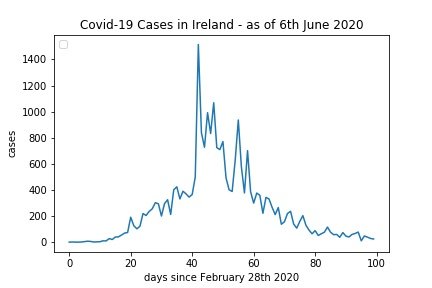
Tomorrow (June 8th) sees the start of Phase 2 of Ireland’s Roadmap for Reopening. You can see that, as of yesterday, the number of confirmed cases per day is small and stable after three weeks of Phase 1, which has justified proceeding to Phase 2.

Incidentally, since the Covid-19 outbreak took hold in Ireland there have been daily press briefings by the Department of Health. Yesterday’s was the last of these: from now on the updates will be twice a week, on Mondays and Thursdays. Data will still be released every day but there won’t be a press conference every time. I’ve been following these every day for three months so this will be quite a change to the routine!

Moving to Phase 2 means that most shops will be able to reopen (subject to social distancing measures being in place), people will be able to travel much further (anywhere within your own county and 20 km into another) and there will be a limited return to work (subject to the completion of various protocols, risk assessments, etc).

For us at Maynooth University there won’t be a sudden change. Staff who can will continue to work from home (which is basically everyone in the Department of Theoretical Physics) but labs will gradually reopen for research when the necessary arrangements are in place. Other than that Phase 2 will be very similar to Phase 1.

On Friday, however, the Taioseach announced that the Roadmap would be accelerated so that Phase 4, starting 20th July will, if all goes well, be the last, though measures will be in place for some time after that.

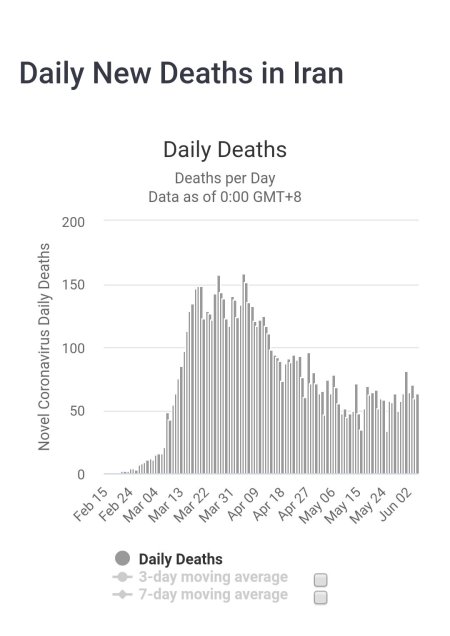
That’s good news of course but it’s all dependent on there being no second wave. As a cautionary tale, take a look at the numbers for Covid-19 Iran:

Iran has been experiencing a second wave of new cases for some time now, and this looks set to produce more cases than the first, but this has only recently resulted in an increase in daily mortality figures:

Note the lowest number of new cases per day in Iran was just under 1000. That’s far fewer than the United Kingdom, which has chosen to undo its restrictions far more rapidly in Ireland. The number of confirmed new cases in Ireland reported yesterday was just 24; in the United Kingdom the figure was 1557. In my opinion there is a strong possibility that the UK will follow a similar trajectory to Iran…

The War of Independence

Posted in History with tags , , on June 3, 2020 by telescoper

There is an excellent magazine supplement with today’s Irish Times looking back at the Irish War of Independence, which was raging a century ago. There’s a lot to digest in the magazine and it will take me a while to read all the articles in it.

The War of Independence began in earnest at the start of 1920 but the cycle of violence ramped up rapidly with the arrival of the infamous Blank and Tans in March and, later on, the equally infamous Auxiliaries. It was the latter who burned the city of Cork to the ground in October 1920, the aftermath of which event which provides the cover picture to the supplement.

The War of Independence ended in summer 1921 with a ceasefire and subsequently the Treaty that led to Partition and a Civil War.

The centenary commemorations of the Easter Rising of 1916 and the War of Independence in Ireland have generally taken the form of the heroic narrative of a liberation struggle, but the Civil War is a matter that many still find painful to confront. It will be interesting to see what the mood of the country will be like when that centenary arrives.

Mayday!

Posted in Biographical, Covid-19, Maynooth with tags , , on May 1, 2020 by telescoper

Today, 1st May, Beltane (Bealtaine in Irish) is an old Celtic festival that marks the mid-point between the Spring Equinox and the Summer Solstice. It’s one of the so-called Cross-Quarter Days that lie exactly halfway between the equinoxes and solstices. These ancient festivals have been moved so that they take place earlier in the modern calendar than the astronomical events that represent their origin: the halfway point between the Spring Equinox and Summer Solstice is actually next week…

Anyway, let me offer a hearty ‘Lá Bealtaine sona daoibh‘!

Today is also the day that the Irish Government decides whether to extend the restrictions arising from the Covid-19 outbreak due to end on May 5th (May 4th is a Bank Holiday). All the signs are that they will and indeed that they should.

We are told that the decision will be based on five measures.

The ‘criteria’ being quoted are:

  1. the progress of the disease;
  2. healthcare capacity & resilience;
  3. testing & contact tracing capacity;
  4. ability to shield & care for at-risk groups;
  5. the risk of secondary morbidity & mortality due to the restrictions themselves.

These aren’t really criteria of course as they don’t set a standard by which performance will be measured. My own amateurish attempts to keep track of the data show that while new cases are falling slowly (the value of the R-number is in the range 0.5-0.8) the rate of deaths remains roughly constant:

If you look at the world data on Covid-19 you will see that it’s a global phenomenon that the timescale for the spread to decrease is much longer than that for the initial increase. That means that loosening control too early will simply precipitate another rapid spread which in turn will require another lengthy lockdown.

The rate of hospital and ICU admissions is not falling significantly either. This may be because over the past weeks an increasing number of infections have occurred in care homes among elderly patients who are much more vulnerable to serious illness than the general population.

I can’t see any evidence from this that would support an argument for starting to end the lockdown anytime soon, and that’s before considering the other points. Testing, for example, is definitely not yet up to speed.

When it first started I told my colleagues that it wouldn’t start to unwind until June and I’m sticking with that.

It’s worrying though that there are signs that some individuals are taking it upon themselves to relax the restrictions. There is definitely more traffic (both vehicular and pedestrian) than there was a few weeks ago here in Maynooth. The question arises that if the lockdown is extended will it just become less effective as more people flout it? I think if it is going to be extended the Gardaí will have to get much tougher.

Although I’m very worried by the prospect of things dragging on I do at least get the impression that the Irish Government is doing its best not only to deal with Covid-19 but also to be honest about the situation, to the extent of owning up to its failures. The situation is very different on the other side of the Irish Sea, where the daily UK Government briefings are transparent only in their abject dishonesty.

UPDATE: to nobody’s great surprise the current restrictions will stay in place until 18th May, after which there will be a phased relaxation. For more details see here.

Covid-19: the next steps

Posted in Biographical, Covid-19, Education, Maynooth with tags , on April 16, 2020 by telescoper

The Irish Government’s information booklet about Covid-19

Although we are currently in what is meant to be the Easter holiday the new normal continues in the form of a plethora video conferences and email exchanges punctuated by the occasional bit of rest and relaxation. We’ve even got a virtual seminar tomorrow and a virtual Open Day on Saturday 25th April to add to the fun.

One of the things making life stressful for academics these days is uncertainty about the future. Will the current lockdown actually end on May 5th? Will our plans for remote examinations work out OK? Will the Leaving Certificate actually go ahead this summer? When will the next academic year begin?

None of these issues is on the same scale as those confronting health workers and others on the front line fighting this pandemic, but that doesn’t mean they aren’t causing anxiety.

My own view is that we need to concentrate as far as possible on the next step and not get carried away by the ifs and buts about what comes after. There are too many imponderables on the horizon, so just focus on what you can control. We have three more weeks teaching here at Maynooth before the end of the Semester so let’s do that as well as we can. After that there is the exam period so let’s try to get through that with as few glitches as possible. We’ll just have to cross other bridges when we come to them.

For myself, I am sceptical that there will be any reduction of the current restrictions on May 5th and if there is, it will be slight at first. As the Taoiseach Leo Varadkar said today relaxation of the lockdown will take places gradually over a number of months. As a physicist I see the change being rather like an adiabatic process, carried out in quasi-static fashion in a series of reversible steps…

The Oldest Tree in Ireland

Posted in Biographical, History, Maynooth with tags , , , , , , on April 15, 2020 by telescoper

Regular readers of this blog – both of them – will know that I’ve developed a habit during the current lockdown of talking walks around the South Campus of Maynooth University in order to get a bit of exercise.

I’ve noticed a bit of a side effect of strolling around the environs of the old College, though, which is that I always return home sneezing. I’ve never really been susceptible to hay-fever before, but I reckon this is a reaction to tree pollen. It’s the right season for that, and there are many trees about.

Last night I was idly googling around in an attempt to identify the types of tree I would encounter on my wanderings and during the course of that I accidentally came across something fascinating.

This Yew tree stands near the main entrance to Maynooth University campus.

It’s not a particularly tall specimen and I’ve walked past it hundreds of times without paying attention to it. It is however generally believed to be the oldest tree in the Republic of Ireland (there is one tree, another Yew, possibly older, in County Fermanagh.) The tree in Maynooth germinated (or was planted) around the year 1267 ± 50, which makes it around 753 ± 50 years old.

The timing is interesting because it means that the tree is roughly the same age as Maynooth Castle and the old church. In this picture you can see the Yew tree on the left, with the church on the right and the remains of the Castle in the background:

Here’s a better picture of the Castle from another direction. Only a few bits of wall, the gatehouse and solar tower remain. The Castle was damaged and subsequently surrendered after a siege in 1535 (see below) then reoccupied only to be largely dismantled in 1647, whereafter it fell into ruin.

The tree is often called the “Silken Thomas Tree” after Thomas Fitzgerald, the 10th Earl of Kildare, who led a rebellion against the English authorities during the time of Henry VIII. He acquired the nickname “Silken Thomas” because of the ribbons of silk worn by his supporters. Needless to say, the rebellion failed and his family castle was destroyed. Thomas surrendered, throwing himself on the mercy of the King. That went exactly as well as you might have expected: Thomas was executed, along with several members of his family, in 1537.

The tree, of course, pre-dates Silken Thomas by three centuries, but legend has it that he played a lute under the boughs of the tree the night before he surrendered to King Henry VIII.

All that is quite interesting but doesn’t answer the question of which trees make me sneeze…

Testing Times

Posted in Biographical, Covid-19 with tags , , on April 12, 2020 by telescoper

Today is April 12th which means, astonishingly, that it’s just one month since Ireland went into the first stage of its current lockdown. I say “astonishingly” because it seems much longer ago than that!

I know I’m not the only person who is finding it difficult these days to keep track of the passage of time. The lack of a regular routine seems to be the reason. The solution, I imagine, is to try to impose a timetable on yourself rather than have it imposed upon you by someone else. I’ve only been partially successful in that, probably because I lack the necessary self-discipline. Still, somewhat to my surprise, I am not having any significant problems sleeping.

Anyway talking about testing times, I wanted to make a quick comment on the Covid-19 situation in Ireland. I’ve been keeping track of the statistics on my page here, which I shall continue to update as things develop. The latest plot is as follows.

The last two points in the orange curve show a bit of a spike. That is because they include the results from a batch of about 6000 swabs sent for testing to Germany. These should be apportioned to earlier dates but lacking the information needed to do this in a sensible way I’ve just plotted them when the results were received (Friday and Saturday). This also means that the slight inflection in the blue curve is not real, but it doesn’t change the general picture significantly.

This is a manifestation of a major difficulty that the authorities in Ireland are facing, which is the capacity to do coronavirus testing in sufficient numbers and sufficiently rapidly to enable contact tracing in real time which is needed to further control the spread of this disease. At present only around two thousand tests per day are being done, which is inadequate.

Although the recent upward blip is an artefact, the fact remains that there is no evidence that the number of new cases is reducing sufficiently quickly for the relaxation of the rules to be considered feasible. There is a real danger that if the number of new cases does not stop falling soon, the number of patients needing intensive care will exceed the resources available.

Anyway, I reckon things will stay as they are until June at the earliest, so we’ll just have to get used to it!

Lockdown Prolonged, Leaving Certificate Postponed

Posted in Education, Politics with tags , , , on April 10, 2020 by telescoper

I’ve just listened to the latest update on the Covid-19 situation in Ireland. One entirely predictable announcement made this afternoon was that the current restrictions on movement will continue until Tuesday May 5th at the earliest. Monday May 4th is a Bank Holiday in Ireland.

I would personally be surprised if the measures now in place were eased before June, actually, but it seems sensible to wait and see if the situation improves before making a decision on further extensions.

(Incidentally, I am keeping track of the Covid-19 numbers in Ireland on a page here.)

Another announcement made today is likely to be more controversial: that this year’s School Leaving Certificate examinations, due to start on June 3rd, will postponed until “late July or early August”.

Among many other things, this will cause those of us involved in University teaching quite a few problems to solve. A lot of thinking caps will be getting dusted off right now!

On the normal cycle, Leaving Certificate results are available in mid-August and successful students begin their University courses in mid-September.

Assuming that there is a delay of two months in sitting the exams and no time can be made up in the marking and moderation process, we’re looking at students not being able to start their courses until mid-November, just a few weeks before the normal end of the First Semester. I have heard suggestions that new students could start in October but these have not included any explanation of how to speed up the process enough to make this possible.

It seems possible to me that, because starting in November would create more problems than it would solve, new students might actually have to defer entry until January, which means in turn that their Second Semester would have to take place during the period June-August. That, in turn, will require staff to abandon any plans for summer research activity and, for some science disciplines, will involve labs being kept open when they are usually closed for upgrades.

Presumably the proposal will be that returning students will follow the usual academic year timetable, but there’s a problem there too if students have to repeat modules from the 1st year which are to be taught on a different calendar.

I’m sure that none of these problems are insoluble but I’m equally sure that the powers that be haven’t really thought about them. Ireland’s current Government does not give the impression of being that interested in universities or the staff who work in them. In recent weeks lecturers have worked exceptionally hard to switch to online teaching and assessment only to have these efforts conspicuously ignored in a recent statement by the Minister for Higher Education Mary Mitchell O’connor. No doubt the Government will again just take it for granted that we’ll sort things out on their behalf.