Archive for ireland

The Strategic Academic Leadership Initiative Begins

Posted in Education, Maynooth with tags , , , , , on January 3, 2020 by telescoper

I was caught on the hop this morning by the formal announcement that twenty new professorships for women have been created in Ireland. I hadn’t expected this announcement to come so quickly since the idea was only floated in November 2018. There is a piece in the Irish Times about today’s announcement here.

I blogged about this scheme here when it was announced, a little over a year ago. The appointments are to be in areas where there is “clear evidence” of significant under-representation of women, such as physics, computer science and engineering.

I’m delighted that two of these new positions will be at Maynooth University, one in Computer Science and one in Physical Geography (in the area of Climate Science). These areas were selected as being of particularly high strategic priority.

The 20 new Chairs represent the first tranche of positions out of 45 planned under the Strategic Academic Leadership Initiative. I understand there will be two further rounds. I do hope that we might get a position in physics at Maynooth in a subsequent round. I note however that there will be a Professorship in Theoretical Physics at Dublin Institute for Advanced Studies. I’ll be sure to pass on the advertisement here when it appears.

Reactions to this scheme among people I know have been very varied, so it seems a good topic on which to have a simplistically binary poll:

For the record, I should state that although I had reservations when about this scheme when it was first announced, largely due to lack of detail about how it was to be implemented, I am now very enthusiastic about it and hope it is successful in its aims.

I will however also repeat that this initiative should not distract attention away from the need for Irish higher education institutions to have much better promotion procedures; see, e.g. here. There are plenty of female academics at lecturer level in Irish universities, but they seem to face serious difficulties getting promoted to Professorships.

Change in Northern Ireland

Posted in History, Politics with tags , , on December 17, 2019 by telescoper

One of the potentially most significant outcomes of the 2019 General Election, but one barely mentioned in the English media, was what happened in Northern Ireland. For the first time ever, a majority of the MPs elected in the six counties were nationalist. The Social Democratic and Labour Party (SDLP) gained two seats to add to the seven of Sinn Féin (including a significant gain in Belfast North) while the Democratic Unionist Party (DUP) lost two to finish with eight. The remaining seat went to the Alliance, originally a moderate unionist party but now basically a liberal centrist (and anti-Brexit) party.

Here’s how the electoral map of Northern Ireland changed:

Sinn Féin seats are dark green, DUP orange, SDLP light green and Alliance yellow.

In terms of the popular vote, the DUP+UUP got 42.3% whereas SDLP+ Sinn Féin got 37.7. Both SF and DUP lost vote share compared to 2017 (by 6.7% and 5.4% respectively) at the expense of the Alliance (up 8.8%) and SDLP (up 3.1%).

Incremental differences, perhaps, but significant nonetheless – especially as Brexit hasn’t yet happened. After Brexit there will be a border in the Irish Sea, which will bring the end of partition one step closer. The probability of seeing a United Ireland in my lifetime has definitely increased.

It was no surprise to see the hashtag `#UnityPlan’ trending on Twitter immediately after the election. Irish unification will only happen if there is a public vote and a majority on both sides of the border agree. For that vote to be fair it is vital that there is a definite plan on how to proceed in the event that the vote is in favour, so the public know what they are voting for. The Irish should not make the mistake that Britain did over Brexit.

For many unionists religion was the primary reason for wanting to remain in the United Kingdom at the time of partition in 1921: Protestants felt that their identity would be threatened if they were made to join the Catholic South. Maybe they were right to feel nervous, as the original constitution of the Irish Free State enshrined “the special position of the Holy Catholic Apostolic and Roman Church”.  But the section including that phrase was deltd from the Constitution way back in 1973 and the Roman Church has far less influence in the Republic than it did. Ireland is now an open and progressive country, so I hope those fears have receded.

Just to confuse matters even further I should mention that my Grandfather, the one born in Belfast, to whom I owe my Irish citizenship,  was a protestant republican…

Those in the North who wish to keep their British passports should be able to do so in a United Ireland, just as those of us who were born in Britain but now live in Ireland can keep ours. I’ll be keeping mine, at least until it expires…

P.S. It is worth mentioning (primarily for British friends) that there are three counties in Ireland that belong to the province of Ulster but are not part of Northern Ireland as it was formed after partition: these are Monaghan, Cavan and Donegal. The northernmost point of Donegal, Malin Head, is actually the northernmost point on the island of Ireland.

The Necessity for De-Anglicising Irish Universities

Posted in Education, History with tags , , , , on November 17, 2019 by telescoper

Way back in 1892 Douglas Ross Hyde (who later became the First President of Ireland) delivered a famous speech to the Irish National Literary Society in Dublin on the subject of The Necessity for De-Anglicising Ireland. You can find the text of the speech here, and it’s well worth reading because much of what Hyde says is still relevant to the state of independent Ireland. It’s by no means a xenophobic anti-English rant, by the way, if that’s what you are tempted to infer it is based on the title.

I was struck by a theme which comes up repeatedly in Hyde’s speech. Here, for example:

It has always been very curious to me how Irish sentiment sticks in this half-way house –how it continues to apparently hate the English, and at the same time continues to imitate them; how it continues to clamour for recognition as a distinct nationality, and at the same time throws away with both hands what would make it so.

Having moved to Ireland to take up a position in an Irish university relatively recently I have been particularly struck by the tendency of those in charge of higher education in Ireland to copy slavishly the actions of the English government. I say `English’ specifically because higher education is devolved within the UK and there are different policies in Wales, Scotland and Northern Ireland. While it is true that we haven’t got a REF or a TEF yet or ridiculously high tuition fees, but that is probably just because of inertia. I wouldn’t be at all surprised if any or all of these were introduced before too long.

(As things stand students at Irish universities do not have to pay tuition fees as such but they do have to pay a `student contribution’ of up to €3000, which is a fee in all but name. There is more state help for disadvantaged students in Ireland than in England too. In most respects the situation here is similar to the regime that held in England prior to 2012, when £9000 year fees were brought in following the Browne Review. The question is whether England will cut university fees before Ireland gets round to increasing them. )

The current Irish government – which is of neoliberal hue – is presiding over a worsening situation in Irish universities, with funding for Irish undergraduate students failing to keep up with increasing numbers. It is hard to resist the feeling that starving the system of state funding is a precursor to increasing student fees to levels seen in England. At the moment English universities have the highest tuition fees in Europe. After Brexit it will be Ireland that takes that dubious honour within the EU.

The situation is even worse at postgraduate level, about which there seems to have been no thought whatsoever at government levels. In contrast to most European countries there is very little state funding for Masters courses in Ireland, so those wanting to do postgraduate degrees generally have to fund their own fees (over €6K per annum in physics) and living expenses. When final-year undergraduate students ask for advice about doing a Masters one is morally obliged to point out to them that they can do a high-quality course in, e.g., Germany or The Netherlands essentially for free, and that’s what many very able students do. Some might return, and bring their skills and knowledge back to Ireland but many won’t. The landscape of higher-education in Ireland does not encourage them to come back.

So what’s the answer to these woes? Well, it won’t solve everything, but a good start would be to stop looking at England for a way to run higher education and look instead at continental models. In this respect Brexit could prove to be an excellent opportunity for Ireland to reinvent itself as a fully European country. Over the years, largely driven by its membership of the European Union, Ireland has steadily reduced its economic dependency on trade with the United Kingdom and increased its connections with mainland Europe. Brexit will probably accelerate that trend.

I think that Ireland now needs to re-examine other sectors and stop the slavish copying of the idiotic policies of English politicians. It could do worse than to start with higher education.

The Case for Irish Membership of CERN

Posted in Politics, The Universe and Stuff with tags , , , , on November 16, 2019 by telescoper

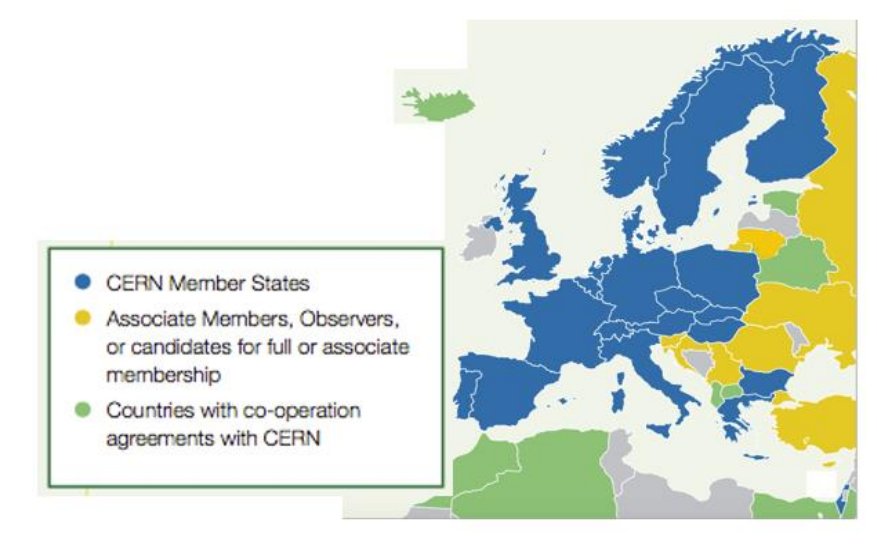
In the news here in Ireland this week is a new report from a Committee of the Houses of the Oireachtas making the case for Ireland to join CERN. You can download the report here (PDF) and you’ll find this rather striking graphic therein:

You will see that there are only three European countries that don’t have any form of membership or other agreement with CERN: Latvia, Bosnia-Herzegovina and Ireland. The fact that almost everyone else is in is not in itself necessarily a good argument for Ireland to join, but it does make one wonder why so many other countries have found it to join or have an agreement with CERN while Ireland has not.

As the document explains, if the Irish government  were to decide to take Ireland into CERN then  it would first have to become an Associate Member, which would cost around €1.2 million per year. That’s small potatoes really, and  the financial returns to Irish industry and universities are likely to far exceed that, so the report strongly recommends this step be taken. This Associate member stage would last up to 5 years, and then to acquire full membership a joining fee of around €15.6 million would have to be paid, which is obviously a much greater commitment but in my view still worthwhile.

While I strongly support the idea of Ireland joining CERN I do have a couple of concerns.

One is that I’m very sad that the actual science done at CERN is downplayed in the Oireachtas report. Most of it is about return to industry, training opportunities, etc. These are important, of course, but it must not be forgotten that big science projects like those carried out at CERN are above all else science projects. The quest for knowledge does have collateral benefits, but it a worthy activity in its own right and we shouldn’t lose sight of that.

My other (related) concern is that joining CERN is one thing, but in order to reap the scientific reward the government has to invest in the resources needed to exploit the access to facilities membership would provide. Without a related increase in research grant funding for basic science the opportunity to raise the level of scientific activity in Ireland would be lost.

Ireland recently joined the European Southern Observatory (ESO), a decision which gave Irish astronomers access to some amazing telescopes. However, there is no sign at all of Irish funding agencies responding to this opportunity by increasing funding for academic time, postdocs and graduate students needed to do the actual science.

Although astronomy is clearly much more interesting than particle physics (😉) in one respect the case of ESO is very like the case of CERN – the facilities do not themselves do the science. We need people to do that.

Irish Regional Accents – Niall Tóibín

Posted in Maynooth, Television with tags , , on November 14, 2019 by telescoper

I heard yesterday that renowned actor and comedian Niall Tóibín passed away yesterday at the age of 89. I knew him best from his role as the priest Frank MacAnally in Ballykissangel which I watched occasionally in the 1990s. This morning I heard a tribute to him on the radio and discovered that he was a bit of an expert on Irish regional accents, so I thought I’d share a clip here.

Living and working in Maynooth, which is not far from Dublin, the accents I hear most frequently are those of the Greater Dublin area. I say “accents” rather than “accent” because, as the clip demonstrates, there is quite a wide variety even in this region. At Maynooth we do have students from as far afield as the North of County Donegal and the South of County Cork (where Niall Tóibín came from). I’m better at identifying accents from the North than the South, and can at least tell the difference between Belfast and elsewhere in Ulster, but other than that although I can spot different accents I’m hopeless at identifying where they come from.

One final thing. Niall Tóibín mentions in this clip that the Cork accent sounds a bit like a Welsh accent. This is not the first time I’ve heard someone say that but I have to admit I can’t hear any resemblance myself!

Not Really Irish?

Posted in Biographical, Politics with tags , , , on October 23, 2019 by telescoper

I’m taking a quick break for coffee and remembered an article I saw in the Irish Times at the weekend about British immigrants in Ireland. Being one such myself I find a lot of it rings true. You can read the article here (I don’t think it’s behind a paywall). I think it’s well worth a look.

I found quite a few things in it resonate quite strongly with my experiences since I arrived here a couple of years ago. Top of these was the realization of just how ignorant I was about Irish history, thanks to the almost total neglect of this topic in British schools. Lack of education inevitably leads to lack of understanding and more often than not leads to prejudice and one finds a lot of that in the attitude of British people, even senior figures (many of them “educated” at Oxford) who are supposed to know better.

Another point I recognize is how many people ask me to explain Brexit, as if being British means that I should be able to do that. I don’t understand the madness that has descended on Britain but I feel it in my bones that the United Kingdom is headed for very dark times indeed.

I was also struck by the “Not Really Irish” tag, which I think about rather a lot. It’s not really just a question of whether or not you have Irish citizenship or an Irish passport, it’s about the extent to which you belong. I spent over fifty years living in England and Wales so I’m missing a huge amount of cultural background. I won’t ever be able to catch up so I don’t suppose I’ll ever feel `really Irish’. Of course people speak English here but I’m very conscious that I have a funny accent. I suppose that means I’ll always feel like a stranger in Ireland. If there is predominant attitude towards the British over here, however, in my experience it is one of sympathy rather than hostility. And the general friendliness of the locals means that this isn’t a bad place at all to be a stranger.

One final comment: it was mentioned in the Irish Times piece that there are a lot of British TV programmes on Irish television. I do not regard that as a positive at all! In fact I stopped watching UK television long before leaving the UK and have not started again since I moved here.

I wonder how different it feels to be an Irish person living in Britain right now? That might make for an interesting complementary article for a future edition of the Irish Times?

On Zero-Hours Contracts

Posted in Maynooth, Politics with tags , , , , on October 20, 2019 by telescoper

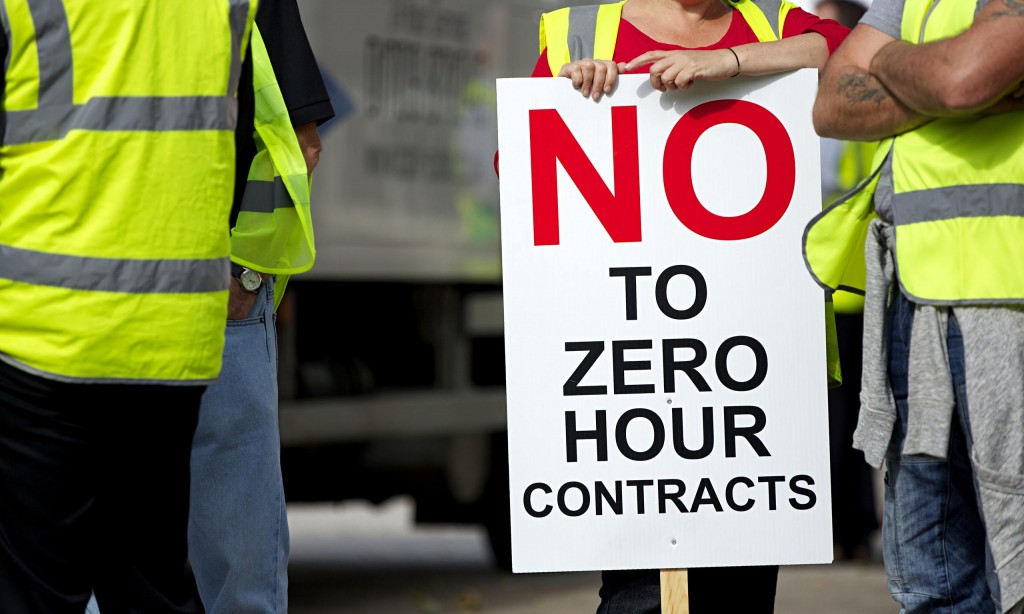
In a week dominated by stupid things being said by stupid British politicians, one of the stupidest of all was the claim by Labour MP Caroline Flint that the European Union is to blame for the rise of zero-hours contracts. Caroline Flint is a Brexit supporter, of course, so she will not be interested in facts, but it is a fact that the European Union recently adopted a directive that protects workers’ rights and, in most cases, rules out zero-hours contracts. It’s up to the national governments to implement EU directives, something that the United Kingdom has yet to do and obviously will not do if and when Brexit happens and all employment protections go on the bonfire. As a Labour MP you would think Caroline Flint would care about this, but apparently not. She’s content to recite lies she hopes will curry favour with her leave-voting constituents and perpetuate her own political career at their expense.

Meanwhile, here in Ireland, the Oireachtas recently passed legislation making zero-hours contracts unlawful in Ireland `in most circumstances’. There’s a nice summary of the effects of the new law here.

I probably don’t need to spell it out but I rather think that the existence of this law and Ireland’s membership of the European Union comprehensively refutes Caroline Flint’s claim. Zero-hours are on the rise in the UK because of it’s own Government, not because of the European Union. I can think of dozens of other things that the EU gets the blame for that are actually the fault of the idiots in Westminster. Perhaps after Brexit British politicians will no longer be able to use the EU as a scapegoat for things they themselves mess up, though something makes me think they will continue to try and that the gullible public may actually believe them.

Anyway, the legal changes around zero-hours contracts in Ireland have had a significant impact in higher education, where many people – often (but not always) graduate students – are employed on casual part-time arrangements to run small group teaching sessions (i.e tutorials), demonstrate in laboratories, mark coursework and so on. The contracts on which such people have been employed have hitherto often been of the zero-hours type that is now unlawful.

As a response to this change in the law, here in Maynooth we have changed the contracts we issue to casual teaching staff, introducing clearer terms and conditions of employment as well as giving clearer indications of hours to be worked. In particular there is now a new category of employment designed for graduate students who are doing teaching, with terms and conditions that reflect their special status. All this required quite an effort at the start of teaching term this year to adapt to the new arrangements in time for the first teaching sessions. I only started as Head of Department on 1st September, and teaching started on 23rd, so this all caused quite a few headaches for me personally as I tried to get to grips with the new system. Fortunately, in the end, the transition actually went relatively smoothly and we have now settled into a steady state.

Of course it wasn’t the existence of graduate student teachers that precipitated the change in the law in Ireland. There are far worse offenders than universities in the use of exploitative employment contracts. Nevertheless but I am glad that the change has happened. Meanwhile, in the United Kingdom, according to UCU figures, around 46% of universities use staff on zero-hours contracts to deliver teaching.

A Strange Day

Posted in Politics, Rugby with tags , , , , on October 19, 2019 by telescoper

Being in Maynooth getting some work done this afternoon, I wasn’t in London for today’s People’s Vote March, which seems to have been a big one. So big, in fact, that even the BBC felt compelled to mention it. Well done to everyone who took part!

Inside the House of Commons, Members of Parliament voted for an Amendment, the upshot of which is that the Government is now required to seek an extension of the October 31st deadline for leaving the European Union to allow Boris Johnson’s so-called `deal’ with the European Union and the associated legislation to be properly scrutinized.

The `deal’ finalized with the EU last week is a remarkable achievement, in that it is even stupider than the already extremely stupid deal negotiated by Theresa May. The one good thing about it is that it is a big step on the road to a United Ireland, which I personally hope I live long enough to enjoy. Loyalists – especially the Democratic Unionist Party – don’t see things the same way of course. The latter party’s public humiliation by Johnson in was a huge gamble that backfired spectacularly on him ,as their ten votes in favour of the Letwin Amendment led to the Government’s defeat, which lost by 322 to 308.

And then there’s Scotland which, like Northern Ireland, voted to remain in the European Union in the referendum that seemed to take place decades ago. While special customs arrangements to facilitate frictionless trade have been proposed for NI, there’s nothing at all in the Withdrawal Agreement for Scotland. In fact Scotland isn’t mentioned once in the text. Faced with such contemptuous treatment from Westminster, the likelihood of Scottish independence must now be greater than at any point in recent memory.

Anyway, Johnson is presumably now back at home in Downing Street with his crayons,writing a letter to the European Union asking for an extension as the law requires him. Or will he? Will he instead do what he usually does and try to bluster his way out of trouble? Will he end up going to prison for contempt of court? Or perhaps he’ll just go and die quietly in a ditch somewhere?

UPDATE: In an astonishing act of petulance, the UK Prime Minister sent not just one but three letters. The first – an unsigned photocopy of the letter contained in the Benn Act. It’s a wonder he didn’t wipe his bottom on it for further effect. The second letter was a covering note from the UK Ambassador to the EU explaining what the first letter was for, and the third was a rambling and incoherent missive from Bozo himself trying to explain in poor grammar why he didn’t think it was a good idea to grant an extension. If Johnson had been planning to make himself like a complete imbecile he could hardly have done a better job. Meanwhile Donald Tusk did exactly the right thing and took the first letter as a request for an extension. Johnson’s pathetic bluster had no effect on the EU, but in any case that was all for Tory party consumption anyway. Stupidity goes down very well with the Conservative Party these days.

P.S. For diary purposes I’ll note that today in the Rugby World Cup quarter-finals, England beat Australia 40-16 while New Zealand beat Ireland 46-14. That means my accumulator bet is still on…

P.P.S.  Wales beat France by the narrowest of margins (an elbow) and South Africa beat hosts Japan in the other two quarter-finals, bringing my quad bet home in style.  Who will win the competition overall? I’ll go for New Zealand, but I’m not going to bet on it. Always quit while you’re ahead.


The Calm Before Lorenzo

Posted in Maynooth, The Universe and Stuff with tags , , on October 3, 2019 by telescoper

It was calm and rather mild this morning as I walked into work, although the news on the radio this morning was filled with news about the rapidly approaching Storm Lorenzo. Lorenzo is a huge storm and was only downgraded from hurricane to tropical storm when it was about 500km from the Irish coast so it could be even more serious than Storm Ophelia, which caused chaos a couple of years ago.

This is how the storm looked in the early hours of this morning:

And this is the projection for later today. The prevailing wind right now is westerly, but this will veer to south-westerly as the storm moves along its (roughly) north-easterly path:

Here is an infra-red image taken this morning showing the outer belts of cloud already over Ireland.

Quite a few events have been called off in anticipation of the arrival of Storm Lorenzo this evening, with heavy rain and gale force winds forecast across the country. There are signs, however, that the low pressure region at the heart of the storm is filling more rapidly than expected, so it might not be as severe as feared, although there remains a significant risk of localized flooding and wind damage, especially in the West. I plan to sit it out at home this evening with a glass or two of wine for company…

University Rankings Again

Posted in Education, Maynooth with tags , , , , , on September 18, 2019 by telescoper

Last week saw the publication of the Times Higher World University Rankings which have once again predictably generated a great deal of sound and fury while signifying nothing very important. I can’t be bothered to repeat my previous criticisms of these league tables (though I will point you to a very good rant here) but I will make a couple of comments on the reaction to them here in Ireland.

First let me mention (for what it’s worth) that Maynooth University has risen from the band covering 351st-400th place to that covering 301st to 350th place. That means that Maynooth went up by anything from 1 place to 99 places. That’s two consecutive years of rises for NUIM.

(I’ll add without further comment that I arrived here two years ago…)

The Irish Media have not paid much attention to this (or to the improvement in standing of NUI Galway) but have instead been preoccupied with the fact that the College of the Holy and Undivided Trinity of Queen Elizabeth near Dublin, known as Trinity College Dublin for short, has fallen by 44 places to 164th place; see, for example, here. Now there’s no question in my mind that Irish universities need an injection of income – especially in science subjects – in order to improve standards of education and research, but I don’t really understand the obsession with Trinity College. It’s a fine institution, of course, but sometimes it’s almost as if the press think that’s the only University in Ireland…

In response to its declining fortunes Trinity College has claimed that Ireland needs a `Rankings Strategy’. No it doesn’t. It needs something far more radical – a higher education strategy. The current government  doesn’t have one

Anyway, given the rate of Maynooth’s rise and Trinity’s fall it is a straightforward undoubtedly scientifically valid extrapolation to predict that in two or three years time, Maynooth will have overtaken Trinity in the World Rankings anyway!

(No, I’m not going to take any bets on that.)

Turning away from the exercise in numerological flummery that is the Times Higher League Tables, let me pass on some numbers that are actually meaningful. The week before term with not everyone yet registered, the number of students taking Mathematical Physics in the first year at Maynooth has increased by 31% since last year and the number on our fast-track Theoretical Physics and Mathematics (TP&M) programme has increased threefold. These increases are very pleasing. Although lectures proper don’t start until next week, I did an introductory session with the TP&M students this morning. It was very nice to be able to welcome them to Maynooth for what I hope will be an enjoyable time at Ireland’s soon-to-be top University!