Archive for Irish National Opera

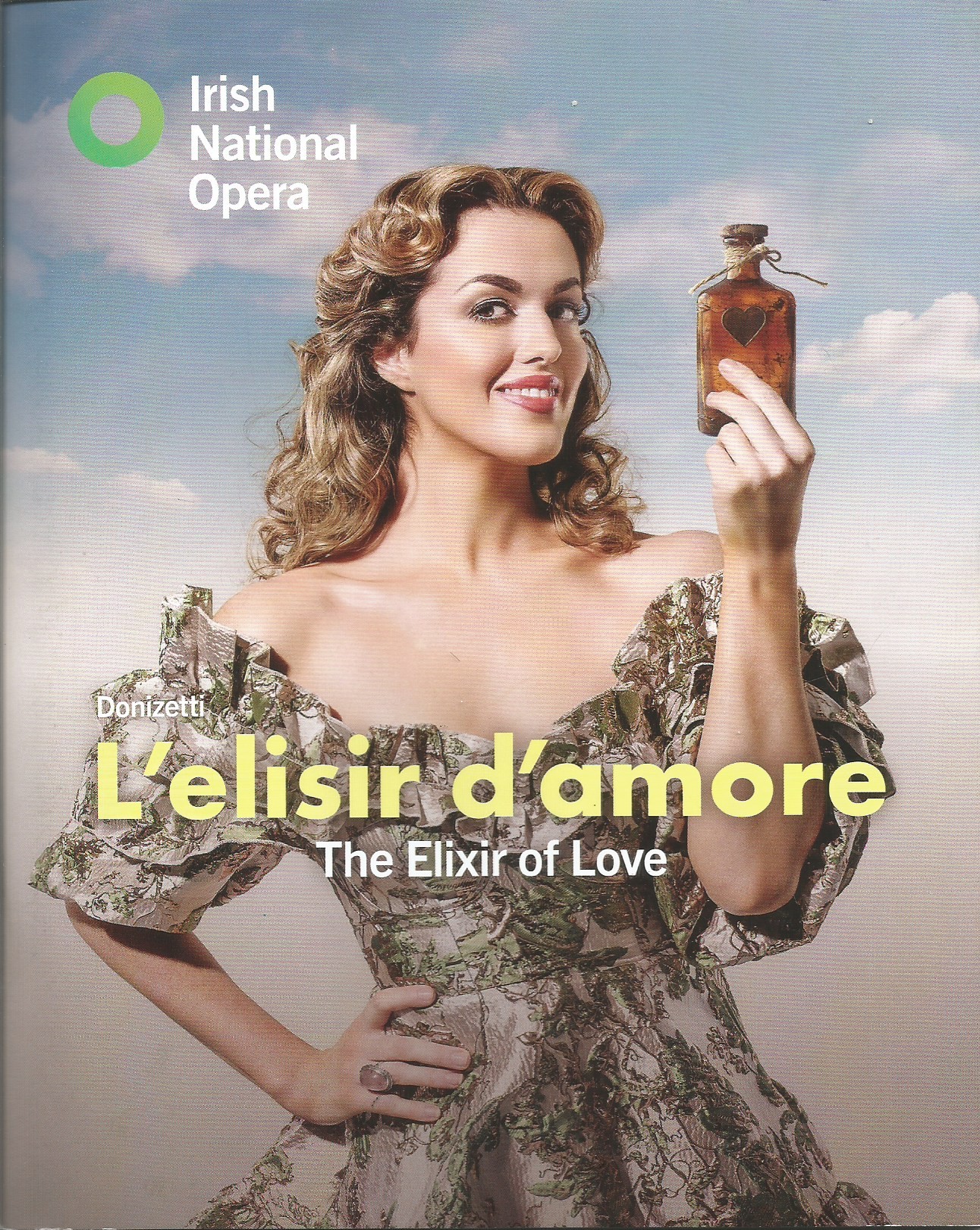
L’elisir d’amore at the National Opera House

Posted in Opera with tags , , , , , , , , on June 5, 2025 by telescoper

My trip to Wexford was to mark a special occasion by paying my first ever visit to the National Opera House to see a performance of Donizetti’s comic opera L’elisir d’amore by Irish National Opera. It was well worth the trip, as it was a wonderfully entertaining production with lovely singing and lots of laugh-out-loud moments. In short, it was a blast.

Billed as a melodramma giocoso, but more usually called an opera buffa, this was the first Donizetti opera to be performed in Ireland, in 1838; its world premiere was in 1832 in Milan and it has been in the operatic repertoire ever since. The show-stopping Una furtiva lagrima in Act II is one of the most recorded tenor arias, the first recording of which dates back to 1904 (by Enrico Caruso).

In case you’re not aware of the opera, it tells the story of a lowly peasant (Nemorino, tenor) who is in love with the wealthy Adina (soprano), who does not return his love – understandably not just because he’s poor but because he’s a bit of a drip. In despair Nemorino turns to the fake doctor Dulcamara (bass-baritone) “famous throughout the Universe and certain other places” who has arrived in town to peddle potions and quack remedies, no doubt made from snake oil. Nemorino asks him for a philtre that will make Adina fall for him. Dulcamara has sold all his potions, but fills an empty medicine bottle with wine and tells him it’s the love potion he needs. After drinking it, Nemorino feels more confident, but Adina still isn’t interested. Worse, Adina has agreed to marry to soldier Belcore. That’s Act I.

In Act II, desperate to stop the marriage, Nemorino wants to buy some more of the love potion but he has no money so he agrees to join the army for which he is entitled to a joining fee. He spends the money on more wine and gets completely wasted, so much so that he misses the news that a rich uncle has died and left him a large inheritance. When the women of the town find out that he is now rich, they all start showing an interest in Nemorino, which he assumes is because of the love-potion. At this point Adina decides she really does love Nemorino, buys out his contract with the army, and calls off the wedding with Belcore. The soldier shrugs off his loss. Dulcamara convinces himself that he really has magical powers…

Summarizing the plot doesn’t really do justice to the opera, however, as there are numerous musical interludes, with dancing, and slapstick comedy. Donizetti’s music is wonderful, and keeps the pace going. It’s basically a theatrical farce set to music, with the score keeping everything moving at the speed that is essential to make such a thing work. Erina Tashima conducted the Orchestra of Irish National Opera with great verve.

This production is set in a comical Wild West of America, with a relatively simple set but wonderful very witty costumes. Nemorino (Duke Kim) was dressed like Woody from Toy Story, for example. We also had appearances from Calamity Jane, Laurely & Hardy (who do their “Way Out West” dance), Abraham Lincoln and even the couple from Grant Wood’s painting American Gothic. Adina (Claudia Boyle) has no fewer than five costume changes, each one into a frock more glamorous than the previous. Dulcamara was the wonderful John Molloy and there is great comedy between him and his diminutive sidekick Truffaldino (a non-singing part played by Ian O’Reilly). Belcore’s troops are kitted out like the US Cavalry, and their dancing and messing about delivers laugh after laugh. There are also sundry “peasants”, i.e. cowboys and women of the town adding to the hilarity. I give 10/10 to the members of the chorus, their Director Richard McGrath and choreographer Paula O’Reilly.

All the principles were great too. Claudia Boyle sang beautifully, but also conveyed the comic aspects of her role. Duke Kim was perfectly cast as the boyish Nemorino; he has a light and agile tenor voice, which he used to bring the house down with the big number Una Furtiva Lagrima in Act II. Belcore was baritone Gianluca Margheri (whom I saw perform in Maynooth a couple of years ago). His physique matches the muscular quality of his voice, and he wasn’t shy in showing it off by taking off his shirt onstage! John Molloy’s singing was as impeccable as his comic timing in the role of Dulcamara. I think he got the most laughs, in a production that produced many.

This triumphant production plays L’elisir d’amore for laughs and wins by a knockout. Sadly there’s only one performance left in this run, in Cork on Saturday 7th June. Do go if you can!

INO The Flying Dutchman

Posted in Opera with tags , , , , on March 23, 2025 by telescoper

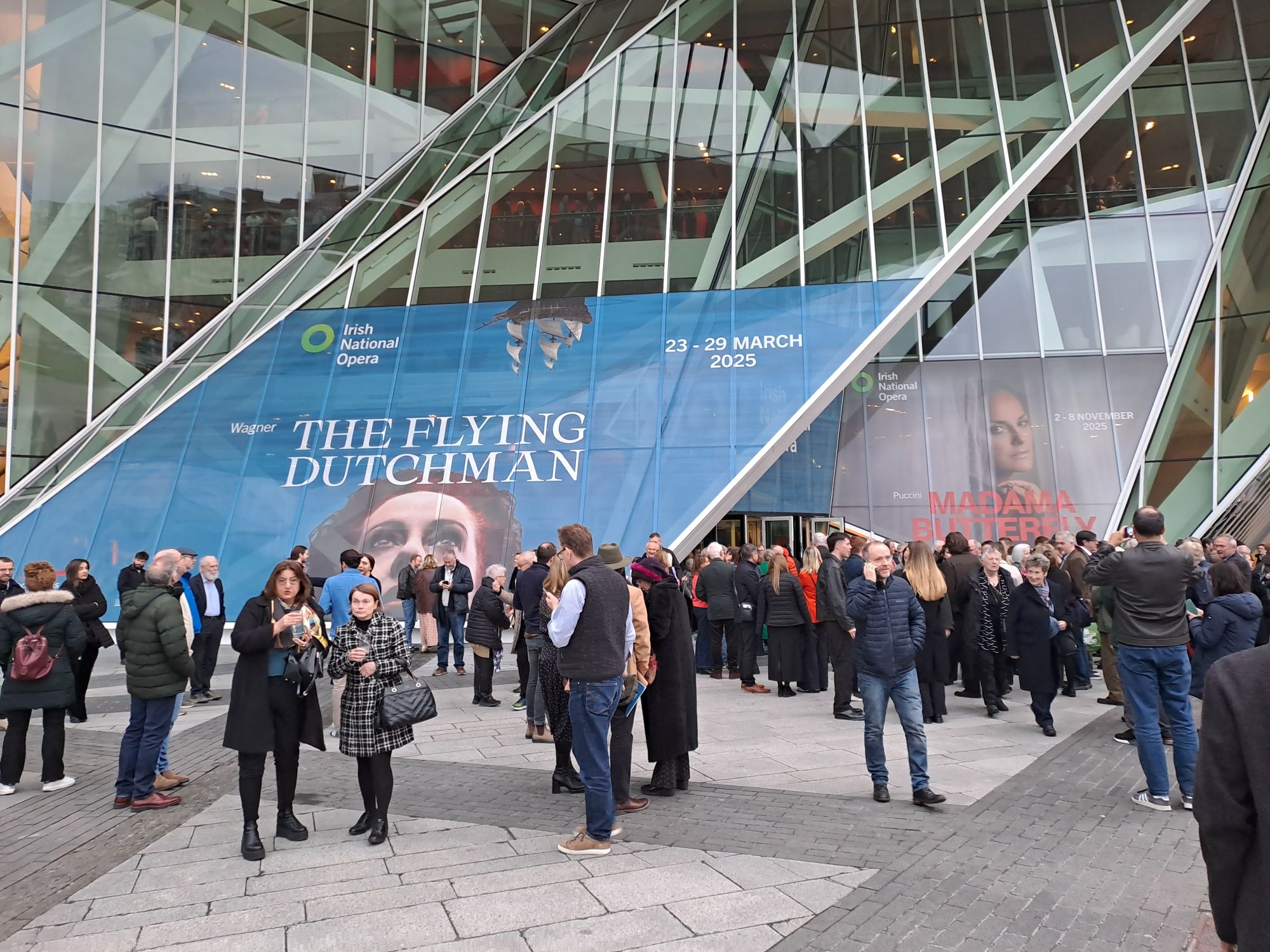
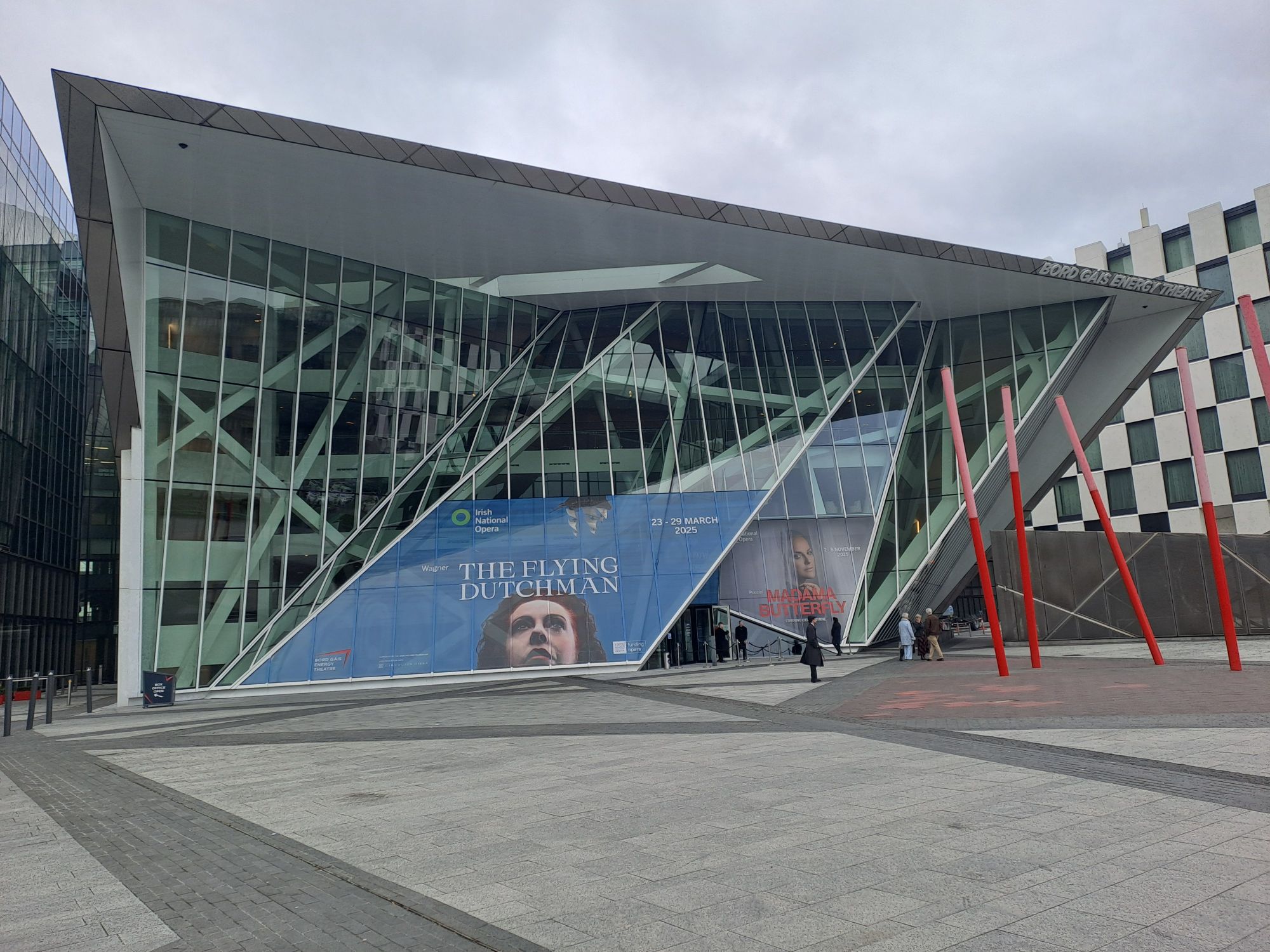
And so it came to pass that this afternoon I took the bus into Dublin to catch the first performance of Irish National Opera’s new production of Richard Wagner‘s The Flying Dutchman (or Der fliegende Holländer to give its proper title) at the romantically named Bord Gáis (Gas Board) Energy Theatre. It wasn’t exactly the first night, as the performance started at 5pm, but it did have a first night feel to it, with a smattering of media types in the full house.

The event took a bizarre twist at the interval, which was after Act 1. I’d only just collected my glass of wine when the fire alarm went off and we were told to leave the building. Amusingly, some of the cast joined us outside too, in costume. It was a false alarm, but the precautionary exodus extended the interval by about 15 minutes or so. When we were making our way back in, I overheard a nearby wit say “Never mind: worse things happen at sea”. Given the plot of the opera, that seemed a very apt comment.

The Flying Dutchman is an early composition by Wagner, first performed in 1843 when Wagner was only 30 years old. It’s much more of a conventional opera than his later music dramas. At least to my ears there are passages that sound a lot like Verdi, especially those featuring the chorus. It’s also quite short: it’s often performed without an interval, but even with one (and a fire alarm to boot) it’s only about three hours. On the other hand, there are some manifestations of things to come, especially the frequent use of a leitmotif whenever the eponymous Dutchman appears or is mentioned.

The story is set somewhere on the coast of Norway. This production has an intriguing preamble while the famous overture is playing. While the menfolk are away at sea, the women of a coastal village are going about their business. Among them is a little girl in a striking red coat. Shades of Schindler’s List, I thought. The little girl turns out to be “Little Senta”, a representation of the innocence of Senta, the leading female character.

The opera proper begings on a ship captained by a man called Daland which has been driven off course by a storm and is sheltering at anchor. While the crew are taking some rest, another ship appears beside and The Dutchman climbs onto Daland’s ship to have a look around. He meets Daland, explains that he is exiled from Holland, is fed up with travelling the seas all alone. He showers Daland with gifts and asks if he can marry Daland’s daughter, Senta. Daland is very keen to have a rich son-in-law and speedily gives his consent.

Meanwhile, back onshore, we’re in Act II. Senta is revealed to be obsessed with a portrait of the Flying Dutchman, a man cursed to wander the oceans until he finds a woman prepared to be completely faithful to him. She has known about this legendary figure since she was a child and wants to be the person who saves him from his fate. One person not happy about this is Erik, an impoverished hunter who himself wants to marry Senta. Eventually Daland’s and the Dutchman’s ships come home. Senta is overwhelmed to meet the Dutchman in person and consents to marry him.

Act III begins with a big party at which the sailor’s on Daland’s ship get drunk and try to get the crew of the Dutchman’s ship to reveal themselves, initially to no avail because they are ghosts. When they do appear it’s not a pretty sight. Erik comes back and tries to convince Senta to stay with him instead of mmarrying the Dutchman. The Dutchman overhears them and interprets their discussion as a betrayal in progress. He tells Senta to forget the whole thing and jumps on board his ship which descends into the sea. Heartbroken, Senta throws herself into the water after him, and drowns.

In the closing stages, Senta has changed is wearing a striking red coat just like Little Senta wore at the beginning. When Senta dies, Little Senta’s lifeless body appears suspended from a rope in the middle of the stage, symbolising her sacrifice and shattered dreams.

In a very strong cast, James Cresswell (bass) was an outstanding Daland, but others were fine too: Gavan Ring (tenor) was The Steersman, Jordan Shanahan (baritone) The Dutchman, Carolyn Dobbin (mezzo) Mary, Giselle Allen (soprano) Senta, Toby Spence (tenor) Erik and the non-singing part of Little Senta was engagingly played by Caroline Wheeler. The Orchestra and Chorus of Irish National Opera were also in fine form.

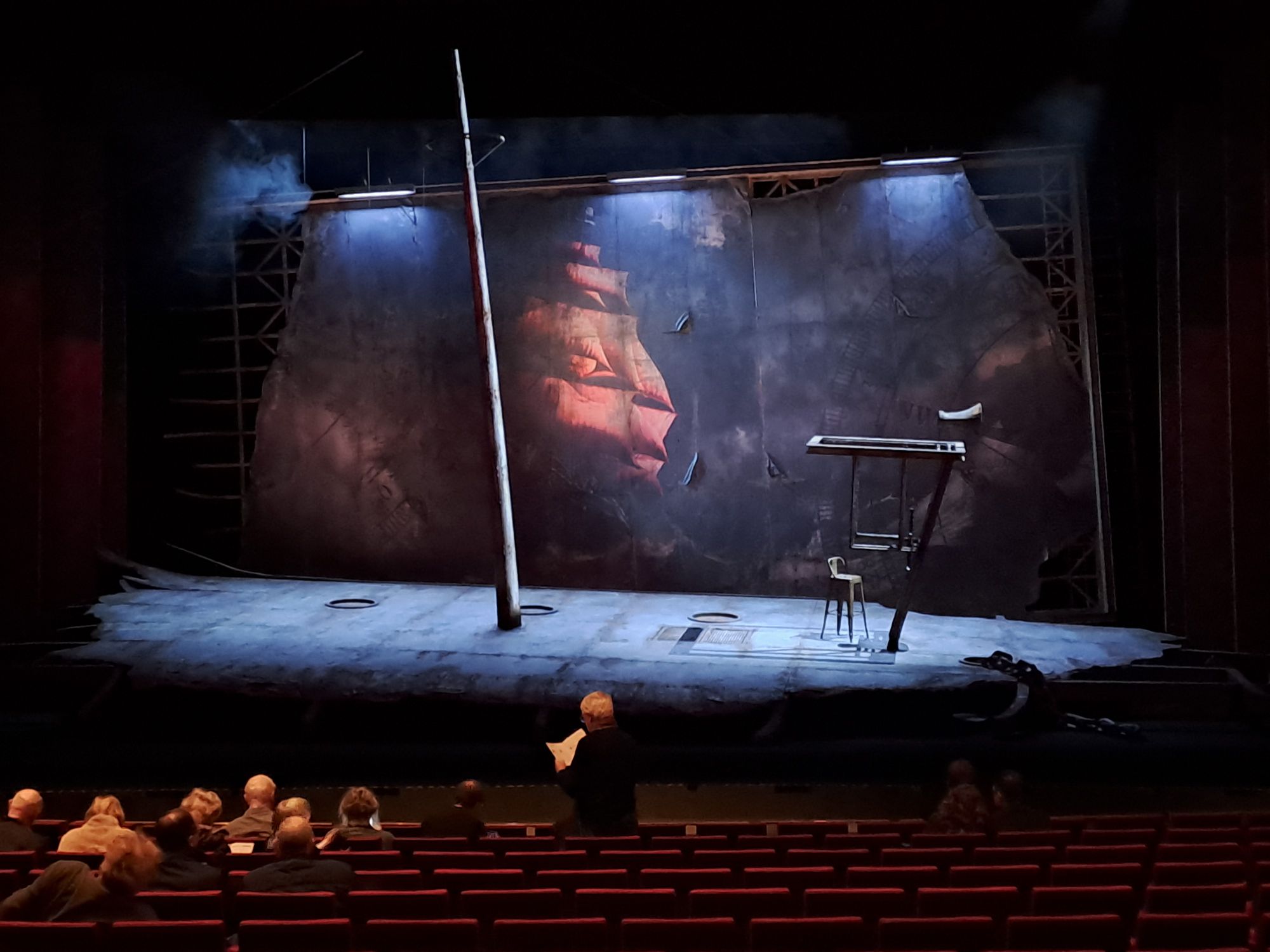
The set design by Francis O’Connor was relatively simple but highly effective: the only significant change after Act I (see picture above) was the wheelhouse to the right was removed and a lighthouse placed further towards the rear, from which Senta took her plunge at the end. There was some dramatic use of animated back-projections too.

This is the first time I’ve seen this opera. I was very impressed with the performance, both musically and dramatically. If anyone is thinking of trying their first taste of Wagner then they could do much worse than this production, but they’ll have to hurry – there are just three more performances in Dublin (Tuesday 25th, Thursday 27th and Saturday 29th March).

P.S. I usually go by train into Dublin for concerts and other performances, but there are two buses that go all the way from Maynooth to the Grand Canal Quay, which is where the Bord Gáis Energy Theatre is located so I thought I’d try them out. I took a C4 in and a C3 home, both journeys being pleasantly uneventful.

Tosca at the Bord Gáis

Posted in Opera with tags , , , , , , on July 15, 2022 by telescoper

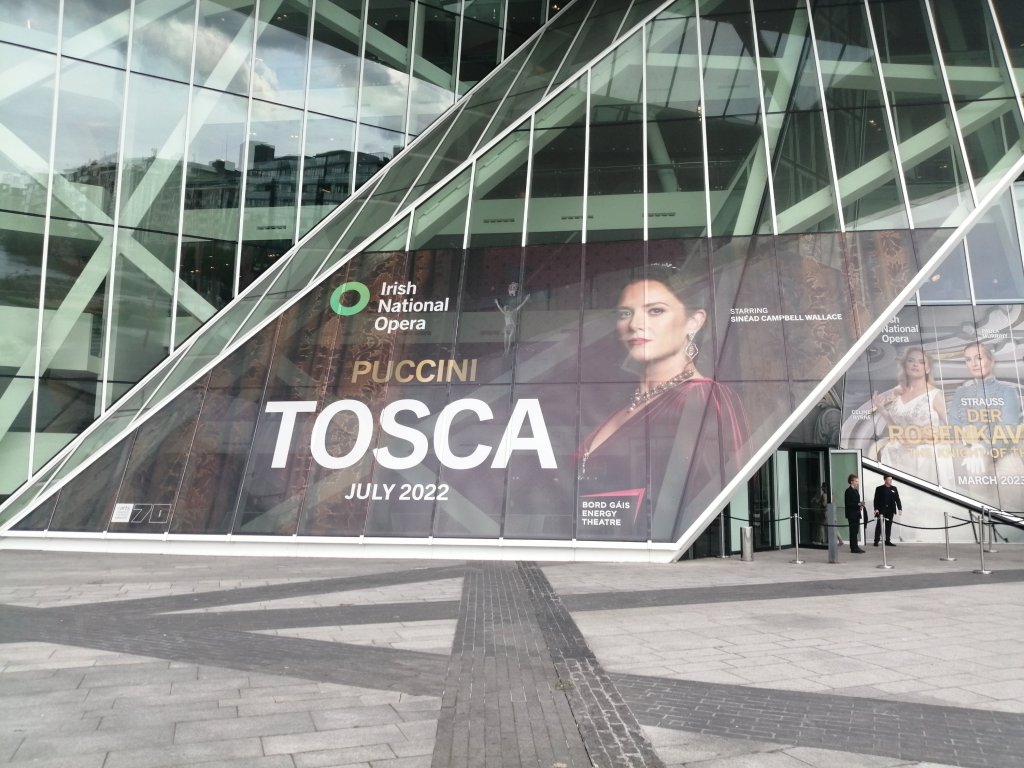
Last night found me for the very first time at Dublin’s splendid Bord Gáis Energy Theatre, for a performance of Tosca by Irish National Opera, a tale of jealousy and murder set to gorgeous music by Giacomo Puccini.

Bord Gáis means “Gas Board”, by the way, but a rose by any other name would smell as sweet.

It’s been a while since I last went to an Opera and it was a last-minute decision to attend this one, but I heard good things about the opening night on Monday and managed to get a ticket. I’m very glad I did as there was much to enjoy, with some quite original variations on a very familiar story.

Tosca is an opera in three acts (which means two intervals wine breaks…). It’s a melodrama, and is set in Rome in 1800. Each Act takes place in a very specific location within the Eternal City. Act I is set in the Church of  Sant’Andrea della Valle, Act II in the Palazzo Farnese, and the final denouement of Act III takes place among the battlements at the top of the Castel Sant’ Angelo overlooking the Tiber.

Most productions of Tosca I have seen stick rigorously to a specific sense of time and place. In this one, directed by Michael Gieleta, the locations are suggested rather than reproduced directly and the costumes and interior design are generally 20th Century, with some sly references. The villainous Spoletta, for example, a police agent, is clearly dressed as a Jesuit. The shepherd boy in Act III appears as an angel, complete with wings, whose ghostly presence leads the prisoners on to their impending execution.

There is also some very ingenious staging, with a rotating set showing the torture scene in Act II while Scarpia and Tosca do their thing. The revolving structure also provides a very interesting alternative view of the end of Act III. I won’t say any more for fear of spoiling it for others…

Floria Tosca (Sinéad Campbell-Wallace, soprano) is a celebrated opera singer who is in love with an artist (and political radical) by the name of Mario Cavaradossi (Dimitri Pittas, tenor), who helps to hide an escaped political prisoner Cesare Angelotti (John Molloy, bass) while working on a painting in Act I. The odious Baron Scarpia (Tómas Tómasson, bass-baritone), Chief of Police, comes looking for the convict and decides to catch (in different ways) both Tosca and Cavaradossi: he lusts after the former and hates the latter.

In Act II, we find Scarpia at home eating dinner for one while Cavaradossi is being tortured in order to find out the location of the escapee. Tosca turns up to plead for his life, but she hasn’t bargained with the true depths of Scarpia’s depravity. He wants to have his way with her, and to put pressure on he lets her listen to the sound of her lover being tortured. She finally consents, in return for Scarpia’s promise to let Cavaradossi go and grant free passage to the two of them. This he seems to do, but while she is waiting for him to write the letter of conduct she sees a knife. Instead of letting Scarpia defile her, she grabs it and stabs him to death. Act III begins with Cavaradossi facing execution, sure he is about to die. Tosca is convinced that this is just a charade and that Scarpia ordered them to pretend to shoot Cavaradossi so he wouldn’t look like he was being merciful, which would be out of character. The firing squad fire and Cavaradossi falls. But it was no fake. He is dead. Tosca is distraught and bewildered. Shouts offstage reveal that the police have found Scarpia’s body and that Tosca must have murdered him. To avoid capture she hurls herself from the battlements. Her last words are “O Scarpia, avanti a Dio!” – “I’ll meet you before God, Scarpia”, though in this production we don’t actually see her jump…

The opera wasn’t particularly well received when it was first performed in 1900, being famously described by one critic as “a shabby little shocker”, but it has become a firm favourite with audiences around the world and is now acknowledged as a masterpiece of music drama. So how did Puccini manage to transform a penny-dreadful plot into a great work of art? I don’t think it’s hard to see why it works so well.

First and foremost, there’s the music, which  is wonderful throughout, but it is always plays an essential part in keeping everything moving. Of course there are the great arias: Vissi d’arte, Vissi d’amore sung by Tosca in Act II and E Lucevan le Stelle from Act III, sung by Cavaradossi; but even apart from those tremendous set-pieces, Puccini uses the music to draw out the psychology of the characters and underline the drama.

Although not usually associated with the use of leitmotifs, Puccini deploys them throughout: Scarpia’s arrival is announced with a suitably menacing theme that recurs whenever he is present or even just referred to.  This theme is actually the first thing we hear as the Opera starts. It also plays Scarpia out at the end of Act 1 when he sings his magnificently chilling Va Tosca over a setting of the Te Deum. Time does stand still for Tosca’s great Act II aria, the dramatic fulcrum of the Opera, but that just emphasises the pace of the rest of the piece. This is a work with no spare flesh or padding anywhere, and a perfect interplay between music and action. The moment when Tosca sees the knife with which she will kill Scarpia is signalled by the orchestra. And after Scarpia dies with Tosca preparing to make her getaway we hear, slower and deep down among the strings, Scarpia’s motif yet again. Even in death we feel he is still present…

Each of the three principal roles could have been very one-dimensional: Cavaradossi the good guy.; Scarpia the bad guy; Tosca the love interest. But all the characters have real credibility and depth. Cavaradossi is brave and generous, but he succumbs to despair before his death. No superhero this, just a man. Scarpia is a nasty piece of work all right, but at times he seems vulnerable; he is trapped by the same system he exploits. And then there’s the glamorous and loving, but not entirely likeable, Tosca who haughty and jealous, and at times spiteful. It is a truly shocking moment when she kills Scarpia. There’s no attempt to sanitise the violence of his death. It’s all so real. I guess that’s why this type of opera is called Verismo!

As for this production, I thought the principals were excellent: Dimitri Pittas seemed to be straining a bit in Act I but recovered and sang beautifully in Act III. Scarpia was suitably villainous and got a few pantomime boos at the end. A special mention must be made of the young shepherd (Joe Dwyer, treble) who was outstanding in a very difficult part for a young singer. Music director was Nil Venditti who bounced across the stage at the end to take the applause from a very appreciative audience.

There are still two performances of this production, on Saturday 16th and Sunday 17th.

The Magic Flute at the Gaiety Theatre

Posted in Opera with tags , , , , on May 25, 2019 by telescoper

Last night went for the first time to the Gaiety Theatre in Dublin for a performance of Mozart’s The Magic Flute by Irish National Opera in conjunction with the Irish Chamber Orchestra. It was my first INO performance and my first visit to the Gaiety Theatre (although I’m sure it won’t be the last of either of those). I’ve actually lost count of the number of times I’ve seen the Magic Flute but I hope this won’t be the last either!

The Gaiety Theatre is quite compact, which engenders a more intimate atmosphere than is often experienced at the Opera. The music being provided by a small-ish chamber orchestra also suited the venue, but more importantly gave a fresh and sprightly feeling to Mozart’s wonderful score. You would think it would be hard to make Mozart sound stodgy, but some orchestras seem to manage it. Not last night though.

The scenery is rather simple, as is needed for touring Opera playing in relatively small venues. The stage directions of the Magic Flute are in any case so outlandish that it’s virtually impossible to enact them precisely according to instructions.

For example, what is the set designer supposed to do with this?

The scene is transformed into two large mountains; one with a thundering waterfall, the other belching out fire; each mountain has an open grid, through which fire and water may be seen; where the fire burns the horizon is coloured brightly red, and where the water is there lies a black fog.

This production takes the sensible approach of leaving a lot to the imagination of the audience though that does mean, for example, that there is no dragon…

The costumes are a different matter. The hero Tamino begins in the drab clothes of a working man of the 19th century, as do the three ladies that he encounters early on in Act I. The enigmatic Sarastro and his followers are however dressed as the gentry of a similar period, and are accompanied by a chorus of domestic servants. As Tamino works his way into the Brotherhood he becomes progressively gentrified in manner and in clothing. A central idea of the Opera is that of enlightenment values prevailing over superstition, but under the surface oppression remains, both in the form imposed by property-owners on the working poor, but also in the misogynistic behaviour of Sarastro and others, and the racist stereotyping of the villainous and lustful `Moor’, Monastatos. This production is sung in the original German, and there were gasps from the audience when they saw some of the surtitles in English. Although Magic Flute is on one level a hugely enjoyable comic fantasy, it also holds up a mirror to attitudes of Mozart’s time – and what you see in it is not pleasant, especially when you realize that many of these are still with us.

Importantly, however, this undercurrent does not detract from the basic silliness which I believe is the real key to this Opera. It’s fundamentally daft, but it succeeds because it’s daft in exactly the same way that real life is.

In last night’s performance the two fine leads were Anna Devin was Pamina (soprano) and Nick Pritchard Tamino (tenor). The excellent Gavan Ring provided suitable comic relief and a fine baritone voice to boot. Kim Sheehan (soprano) as the Queen of the Night doesn’t have the biggest voice I’ve ever heard, but she sang her extraordinarily difficult coloratura arias (one of them including a top `F’) with great accuracy and agility and brought a considerable pathos to her role instead of making it the pantomime villain you sometimes find. Sarastro was Lukas Jakobski (bass), memorable not only for his superb singing way down in the register, but for his commanding physical presence. Well over 2 metres tall, he towered over the rest of the cast. I think he’s the scariest Sarastro I’ve ever seen!

And finally I should congratulate the three boys: Nicholas O’Neill, Seán Hughes and Oran Murphy. These roles are extremely demanding for young voices and the three who performed last night deserved their ovation at the end.

The last performances in this run are today (Saturday 25th May, matinée and evening) so this review is too late to make anyone decide to go and see it but last night’s was recorded for RTÉ Lyric Fm and will be broadcast at a future date.